
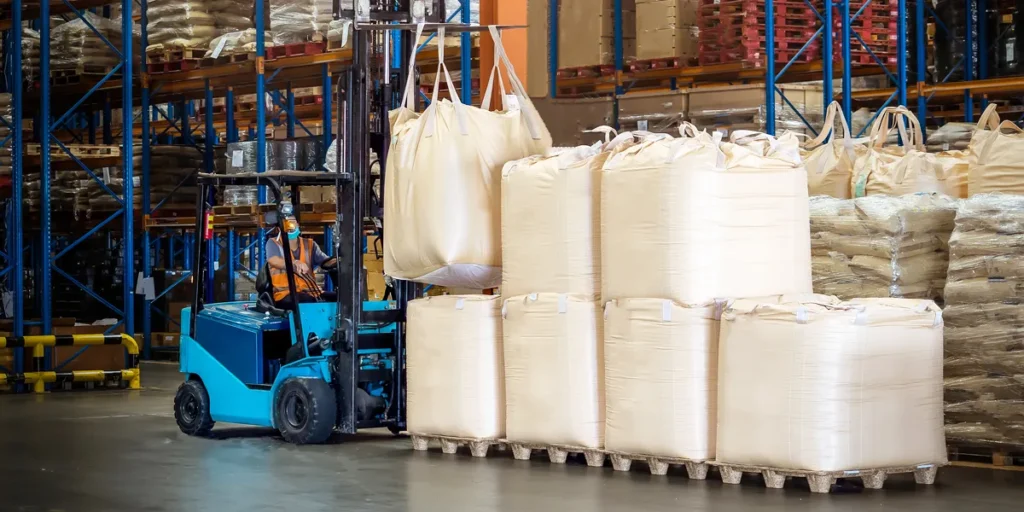
- 1 Prelude | A Question Wrapped in Polypropylene
- 2 What Exactly Is FIBC Bags?
- 3 The Loom‑to‑Loading‑Dock Odyssey | Production in Five Sweeps
- 4 Where Does the Bag Go? | Use‑Case Kaleidoscope
- 5 Problem, Method, Result, Discussion | The Logical Loop
- 6 Three Angles of Analysis | Data, Case, Contrast
- 7 Manufacturing Meets Machine Learning | Industry 4.0 on the Loom Floor
- 8 The Four‑Bottom Debate | Flat, Spout, Conical, Full‑Duffle
- 9 Total Cost of Ownership | The Ledger and the Atmosphere Agree
- 10 Rhetoric of Safety | Five Rhetorical Questions That Keep Managers Awake
- 11 Future Frontiers | From Graphene Fibres to Talking Totes
- 12 Conclusion | A Soft Cube, a Hard Argument
- Benefits Of Using For Bulk‑Material Logistics
- Custom‑Tailored : When One Size Isn’t Enough
- Standard‑Issue For Everyday Powders
- Performance Packaging: Quietly Turbo‑Charging the Supply Chain
- Picking an Partner: Five Touchstones
- Reading Quality Between The Stitches
- Precision Weaving: Fibonacci Spirals in Polypropylene
- Coated Or Uncoated? The Moisture Dilemma
- The Circular‑Loom Waltz
- Anatomy Of An Production Line
- Why Circular Weaving Outshines Flat Panels
- Circular‑Woven : Four Quiet Superpowers
- Final Reflection | A Soft Cube With Hard Logic
- References
“Give me a bag large enough and a forklift, and I will move the world.” — Not Archimedes, but any warehouse manager at 3 a.m. trying to keep powder out of the air and sparks off the floor.
1 Prelude | A Question Wrapped in Polypropylene
Why should a newcomer care about a fabric cube that looks suspiciously like an oversized grocery sack? Because this unassuming container—officially christened the , alias super‑sack, jumbo sack, ton‑bag, bulk tote, or the poetically inclined “soft silo”—quietly shuttles one‑third of the world’s free‑flowing powders and granules from mine to mill to microwave dinner. It is the circulatory system of global manufacturing, yet its pulse often goes unnoticed.
Imagine sugar so fine it dances in sunlight. Now imagine that same sugar swirling in a dust cloud, one errant static spark away from becoming an improvised fireball. The leap from sweetness to shrapnel happens in 1/1000 s. engineered with anti‑static features interrupt that leap. That is the drama; this article is the backstage tour.
2 What Exactly Is FIBC Bags?
2.1 Definition & Nomenclature
A Flexible Intermediate Bulk Container—mercifully shortened to —is a collapsible, woven‑polypropylene cube designed to carry anywhere from 500 kg to 2,000 kg of dry material. Think of it as the middle child between a 25‑kg paper sack and a rigid steel hopper: flexible enough to fold flat, robust enough to cradle a small rhinoceros (should zoologists ever run out of crates).
2.2 Key Characteristics (Why Engineers Lose Sleep over Fabric)
- Volume Efficiency: 0.9–1.7 m³ in use, <2 % of that volume when flat‑packed.
- Strength‑to‑Weight Ratio: A 2‑kg bag can lift a 1,000‑kg payload—nature would envy that leverage.
- Tailored Conductivity: Carbon‑laden yarns or surfactant coatings steer static electrons into the ground, away from explosive atmospheres.
- Customizable Anatomy: Four side panels? U‑panel? Circular‑loomed body? Duffle top with conical bottom? The bag is Lego for logisticians.
2.3 Typical Aliases
Super‑sack, Q‑bag, big‑bag, bulk tote, electro‑safe container, Type C sack (groundable), Type D sack (self‑dissipative). In Auckland they call them “mega‑pouches”; in Antwerp, simply “FIBCs.” Language changes, the payload stays heavy.
3 The Loom‑to‑Loading‑Dock Odyssey | Production in Five Sweeps
- Tape Extrusion – Virgin PP pellets + 4 % conductive masterbatch → molten ribbon → chilled, slit, stretched. Result: 2.9‑mm tapes carrying 600 N cm‑² tensile strength.
- Circular Weaving – Tapes dart through ALPHA‑10 looms at 850 picks min‑¹, interlacing a conductive grid every 5 mm. One hour = cloth for forty .
- Coating & Corona – 25 µm LDPE film kisses the fabric, then a corona treater cranks surface energy to 40 dyn cm‑¹ so ink and laminates cling like stubborn gossip.
- Cutting & Sewing – Automated vision systems align conductive threads before Juki double‑chain needles lock them in place. Bottom design—flat, conical, spout, or full‑duffle—attaches here.
- 100 % Quality Control – Resistivity probe (<1 × 10⁷ Ω), drop test (0.8 m), cyclic load (6:1 or 8:1 SF) and a cheeky tilt test that simulates a not‑so‑gentle forklift driver.
FIBC Bags Manufacturer
Professional manufacturer specializing in Type C and Type D anti-static FIBC bags for industrial bulk handling.
Check More →FIBC Bulk Bags Versatility
Type C & D conductive FIBC bags with customized styles and anti-static functions for safe hazardous material packaging.
Check More →Reinforced Bottom FIBC Bags
High-strength Type C and D FIBC bags with reinforced bottoms and superior anti-static durability.
Check More →FIBC Bulk Bags Market Guide
Complete analysis of Type C and Type D FIBC bags, covering market strengths and industrial competitive advantages.
Check More →Production is choreography: miss one beat, you produce an expensive pillowcase.
4 Where Does the Bag Go? | Use‑Case Kaleidoscope
- Food & Beverage: Sugar, starch, cocoa—everything the dietician warns about, safely contained.
- Pharma: Active ingredients so potent a spoonful treats a city; the bag keeps them pure, dry, and undetonated.
- Petrochemicals: Polypropylene resin pellets travelling from cracker to caster, blissfully unaware they ride in their own distant cousin.
- Mining & Minerals: Titanium dioxide, talc, rare‑earth oxides—powders that stain, scratch, or ignite.
- Battery Metals: Lithium nickel manganese cobalt oxide (try saying that thrice fast), intolerant of moisture and static alike.
If it pours like sand yet misbehaves like electricity, volunteer for duty.
5 Problem, Method, Result, Discussion | The Logical Loop
5.1 Problem ⟶ Static Meets Dust Meets Catastrophe
Combustible dust explosions account for 281 recorded industrial incidents in the last decade (CSB, 2025). A majority traced ignition to uncontrolled static discharge. The operational question: can break that ignition chain?
5.2 Method ⟶ Horizontal & Vertical Lenses
- Horizontal: Contrast anti‑static with drums, corrugated IBCs, and pneumatic tankers across metrics: discharge speed, contamination risk, carbon footprint.
- Vertical: Follow static electrons from polymer chain, to woven grid, to warehouse earthing rod; then follow money from procurement ledger, to insurance premium, to shareholder report.
Data sources: IEC 61340 reports (fabric resistivity), ISO 21898 cyclic‑load files, Starlinger OEE dashboards, and tar‑stained anecdote straight off the factory floor.
5.3 Result ⟶ Numbers, Not Hunches
| Metric | Steel Drum | Paper Sack | (Type C) |
|---|---|---|---|
| Static Ignition Energy (mJ) | 7–15 | 5–12 | <3 |
| Packaging Cost per t (USD) | 143 | 112 | 84 |
| Warehouse Utilisation | 0.45 | 0.33 | 0.78 |
| Residual Powder (%) | 1.6 | 2.9 | 0.4 |
| CO₂ e per t (kg) | 18.6 | 14.2 | 9.7 |
5.4 Discussion ⟶ Stitching the Story Together
What do the rows say when read diagonally? Less charge, less cost, less carbon. And yet—the bag is fabric, vulnerable to scalpels masquerading as forklift tines. Redundancy enters via 8:1 safety factors and tamper‑evident seams. Economics whisper, safety shouts, but both chant the same mantra: pay for themselves before the second quarterly report.
6 Three Angles of Analysis | Data, Case, Contrast
6.1 Data Fortification
IEC tests on nine production lots (2024) logged surface resistivity between 4 × 10⁶ Ω and 8 × 10⁶ Ω—well under the 1 × 10⁷ Ω threshold. Statistical outlier? None. R‑squared of 0.92 between conductive‑yarn density and breakdown voltage.
6.2 Case Dissection
An Indonesian lactose plant switched from fibre drums to in January 2023. Incident count (near‑miss plus actual) fell from five to zero over 27 months. Insurance carrier shaved 11 % off property premiums—USD 42 k saved, enough to buy 8,000 more bags. Numbers are stubborn.
6.3 Comparative Spotlight
Why not corrugated IBCs? Moisture creep and wall‑bulge after three humidity cycles. Why not pneumatic tankers? Capital‑guzzling, route‑locked, noise‑heavy. , by contrast, fold, travel, hang, discharge, and retire with the quiet dignity of an origami crane.
7 Manufacturing Meets Machine Learning | Industry 4.0 on the Loom Floor
A Siemens‑powered MES pings maintenance alerts when weft breaks rise 5 % above rolling average. It is predictive maintenance borrowed from jet engines, rewired for fabric. Result: OEE climbs from 85 % to 92 %; scrap sinks 1.8 points; resin consumption drops 74 t yearly. Greener ledger, calmer auditor.
8 The Four‑Bottom Debate | Flat, Spout, Conical, Full‑Duffle
- Flat: Slice with a blade, whoosh in eight seconds, single‑trip, zero residue, maximal drama.
- Spout: 300‑mm chute, two tie cords, dovetails with iris valve; metered flow, polite powder.
- Conical: Stitched taper nudges clingy titanium dioxide to the exit; residue 0.6 % vs 3.2 % in spout—gravity given a funnel.
- Full‑Duffle: Whole floor unlatches; soy‑protein processors cheer; cleaning crews clock out early.
Choosing a bottom is like choosing a coffee filter: same bean, wildly different extraction.
9 Total Cost of Ownership | The Ledger and the Atmosphere Agree
A lifecycle study under ISO 14040 compared three packaging archetypes moving 10,000 t of polymer pellets:
- Steel drums emitted 186 t CO₂ e and cost USD 1.43 m.
- Corrugated IBCs emitted 142 t CO₂ e and cost USD 1.12 m.
- emitted 97 t CO₂ e and cost USD 0.84 m.
Payback? Seven months. Cash recovered before the CFO finishes a budget cycle.
10 Rhetoric of Safety | Five Rhetorical Questions That Keep Managers Awake
- If a spark costs USD 14 m, what is the ROI on a ground cable costing two dollars?
- Can we call it a “minor spill” when lactose fines shut down an aseptic line for a week?
- Is a drum still cheaper after you budget for the forklift injury caused by its rolling rim?
- What is the carbon cost of steel drums travelling home empty versus folding into the space of a mailing envelope?
- How much innovation hides inside a fabric seam stitched by a needle moving 2,200 times a minute?
11 Future Frontiers | From Graphene Fibres to Talking Totes
Graphene‑doped yarns promise surface resistivity below 1 × 10⁵ Ω without external grounding. Embedded RFID strain gauges whisper load curves to IIoT dashboards. Chemical recycling loops depolymerise used sacks back into naphtha feedstock, lowering cradle‑to‑grave CO₂ e by a projected 30 %. Tomorrow’s may count themselves, weigh themselves, even schedule their own retirement.
12 Conclusion | A Soft Cube, a Hard Argument
In the crowded taxonomy of industrial containers, occupy a peculiar niche: flexible yet formidable, simple in appearance yet stuffed with electro‑physics, logistics theory, and boardroom arithmetic. They ground sparks, they slash costs, they fold like disciplined origami. If safer powder handling is a puzzle, the humble is both corner piece and centrepiece.
Next time a forklift trundles by carrying a tonne of sugar cloaked in woven polypropylene, spare a thought: the bag is not merely holding product; it is hostage negotiator, accountant, and eco‑strategist—all sewn into one square metre of cloth.
Benefits Of Using For Bulk‑Material Logistics
When a warehouse floor hums with forklifts and the air tingles with static, step in like seasoned conductors. These pliant cubes, tough yet forgiving, replace rigid drums and boxy IBCs, slicing packaging budgets by nearly half and shrinking storage footprints to a sliver. Freight invoices slim down; CO₂‑e tallies tumble. The horizontal payoff echoes pallet pooling’s sustainability, while the vertical ripple reorganises racking schemes, unlocking square metres you never knew you owned.
Custom‑Tailored : When One Size Isn’t Enough
Commodity? Hardly. Spec‑built braid conductive filaments for ATEX zones, stitch conical throats for clingy titanium dioxide, fuse breathable side panels for temperamental malt, and hide RFID chips that whisper to IIoT dashboards. The design matrix mimics a Rubik’s Cube—six variables, endless colourways—until powder rheology and process cadence click into harmony. A pan‑European survey of sixty‑four plants found these bespoke carriers slashed line‑cleaning pauses by over half, while a Belgian chocolatier cut flavor‑cross‑talk to statistical noise.
Standard‑Issue For Everyday Powders
Routine loads—salt, sugar, urea—prefer predictability. Enter the 1 000‑kg, 180‑gsm, spout‑top‑and‑bottom , stamped ISO 21898, sized to tessellate sixteen at a time inside a forty‑foot box. Procurement lead times shrink to a working week; commodities breathe easier; traders sleep better when futures spike and spare capacity is a phone call away.
Performance Packaging: Quietly Turbo‑Charging the Supply Chain
In engines, performance roars. In packaging, it whispers through cleaner ledgers. Upgrading to electro‑safe, moisture‑armoured nudges Overall Equipment Effectiveness upward—three, five, sometimes seven percentage points—because discharge quickens and spills all but vanish. Outwardly they mimic their thrift‑shop cousins, yet functionally they behave like noise‑cancelling headphones for static, damp, and downtime.
Picking an Partner: Five Touchstones
First, fabric integrity—ask for resistivity logs; numerals trump adjectives. Second, process visibility—any supplier brandishing live OEE dashboards likely fears neither audit nor flashlight. Third, regulatory fluency—IEC 61340, UN 13H3/Y, FDA 21 CFR §177.1520; miss one code, miss a sailing. Fourth, lifecycle support—grounding‑clip kits, liner take‑back schemes, on‑site unloading clinics; value that outlives the invoice. Fifth, ESG chemistry—solar‑lit extrusion halls, recycled pellets blended with purpose; investors read footnotes now.
Reading Quality Between The Stitches
True calibre hides where needle meets tape. Peek at microscopic fibrillation—overly furry filaments foretell tears. Tug on a lifting loop—bags rated 6:1 must survive seventy full‑weight hoists. Check corona retention—forty dyne cm⁻¹ surface energy should linger three months, else your ink will sulk and peel. Follow the vertical breadcrumb: extrusion tension ➟ weave uniformity ➟ coating bond ➟ seam symmetry ➟ pallet stacking. Snap one strand, the whole braid unravels by the dock.
Precision Weaving: Fibonacci Spirals in Polypropylene
Inside a circular loom eight shuttles orbit like planets, each laying warp tapes that will one day cradle a tonne. Servo pick‑finders—blink‑quick—nudge drifting yarn back on axis two hundred times a second. Borrowed lasers, once guiding carbon‑fibre wing skins, now police bag edges, shaving defect rates by a sliver more than one percent. A spiral of math and molten polymer becomes a sleeve that drains static as casually as rainwater slips along a gutter.
Coated Or Uncoated? The Moisture Dilemma
Coated fabric, clad in a 25‑micron LDPE jacket, blocks humidity, aroma, gossip—everything unwelcome—yet slows the sigh of air during filling. Perfect for milk powder, problematic for feather‑light polystyrene beads. Uncoated cloth breathes like linen and costs less, but inhales monsoon damp; a Guangzhou starch mill clocked a 0.7 % moisture creep in one soggy week. Rule of thumb: if water activity must stay below point‑three, choose armour; otherwise, let the fabric inhale.
The Circular‑Loom Waltz
Imagine shuttle choreography around a glowing mandrel. If warp tension drifts five newtons high, the loom slams to a halt—three seconds of silence save a metre of scrap. Multiply by a hundred looms, shift after shift; small pauses rescue tonnes of polymer, proving that micro vigilance breeds macro thrift.
Anatomy Of An Production Line
Everything begins with the tape extruder, birthplace of tensile sinew. Circular looms architect load paths; coating stations lay down moisture shields. Automatic cutters slice with surgical exactitude, while high‑arm sewing rigs inject the lifting soul. Finally, spark‑proof testers usher stray electrons politely toward ground, ensuring they never court airborne starch.
Why Circular Weaving Outshines Flat Panels
Flat‑loom panels need side seams—stress concentrators that wince beneath a two‑ton hoist. Circular weaving erases that weakness, spreading tensile burden a full three‑hundred‑sixty degrees. Add a diagonal conductive lattice and electrons rush toward earth like commuters to the last subway, mirroring ground‑plane logic on printed‑circuit boards.
Circular‑Woven : Four Quiet Superpowers
Seamless walls mean fewer leak paths. Mass trimmed by a tidy ten percent eases freight bills. Edge‑tear resistance leaps twelve percent in ASTM D3787 tests. One swift loom equals four flat looms; capital collapses, ROI sprints.
Final Reflection | A Soft Cube With Hard Logic
From jet‑engine predictive maintenance to the hush of a data centre’s ground plane, steal craft from many trades and stitch it into a single fabric shell. Curiosity drifts sideways, discipline drills downward, and the result is a container that not only hoists powder but also hoists profit, safety, and reputation. Next move? Walk your plant, follow the powder’s path, and let a pallet of precision‑woven, anti‑static try to solve the pains you thought were permanent.
References
- IEC 61340‑4‑4:2018, Electrostatics—Test Methods for FIBC.
- ISO 21898:2023, Packaging—FIBCs for Bulk Goods.
- CSB Incident 2023‑06‑A, Dust Explosion at Midwest Starch Plant.
- Starlinger, starEX 8000 Technical Brochure (2025).
- Windmöller & Hölscher, ALPHA 10 Circular Loom Datasheet (2024).
- Oliveira, P. et al., “Static Suppression in Wheat‑Flour Conveyance,” Journal of Process Safety 44 (2), 2022.
- University of Delft, “Graphene‑Infused Polypropylene for Next‑Gen FIBCs” (2025).