
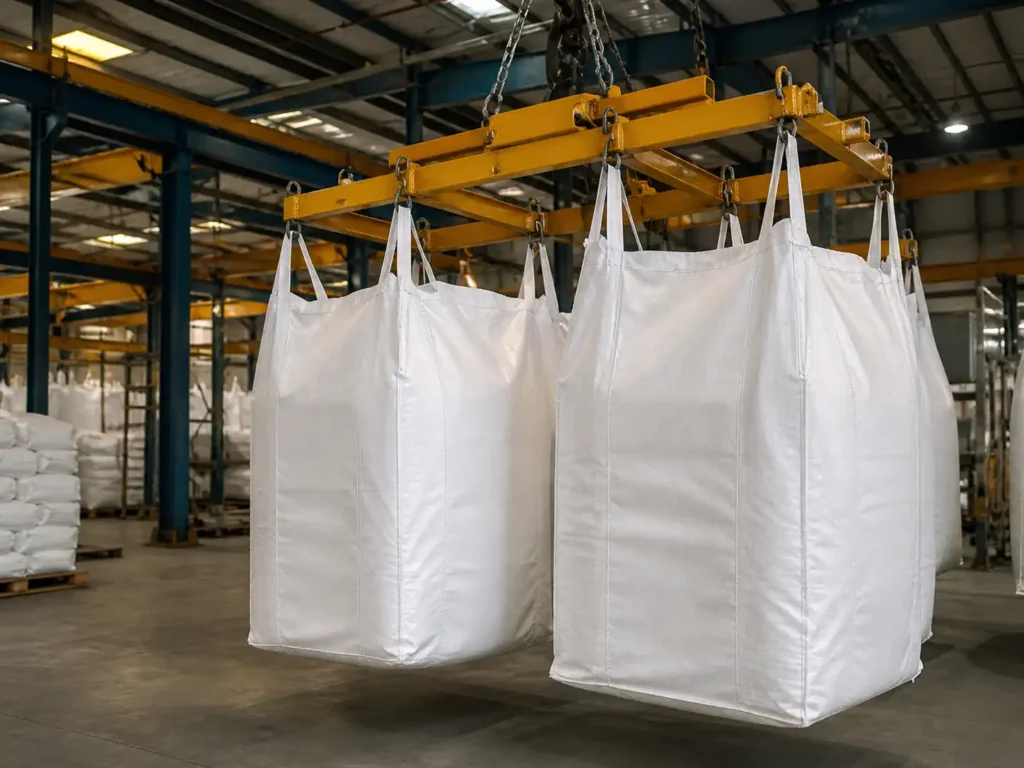
What Heavy Duty PP Woven Bags Really Are
Heavy Duty PP Woven Bags are not “just sacks.” They are load-bearing industrial packs built from woven polypropylene tapes, designed to move dense, abrasive, dusty, or moisture-sensitive goods through filling, stacking, shipping, unloading, and storage with less failure and more control. VIDEPAK’s own guide frames them in exactly this way: bags that must carry more, leak less, and last longer on filling lines, on forklifts, and on the road. The same source also highlights the real reasons buyers choose this structure—high tear resistance, stable tensile behavior, liner and coating flexibility, print-ready surfaces, and controllable friction for better pallet stability.
In practical terms, Heavy Duty PP Woven Bags sit at the meeting point of light weight and mechanical strength. That balance is the core value of woven polypropylene : the bag does not need to be heavy to be strong, and it does not need to be rigid to be dependable. VIDEPAK’s technical pages describe PP Woven Bags as sacks made by weaving drawn polypropylene tapes into fabric, creating a package that is light but mechanically robust, while other VIDEPAK technical pages place common fabric windows around 80–120 gsm for 5–25 kg programs and 100–160 gsm for 20–50 kg programs, often with 600–1100 denier tapes and around 10–14 ppi, depending on the target product and process.
They are also widely used because they work across industries. VIDEPAK’s heavy-duty guide points to agriculture, minerals, chemicals, and building materials as core use fields; its product pages expand that picture to grains, flour, sugar, seeds, fertilizer, feed, polymer pellets, and mineral powders. In short, where product weight is real, where dust is annoying, where handling is rough, and where failure costs money, PP industrial bags and PP industrial sacks become a rational choice, not a decorative one. Strong but simple. Flexible but serious. Cheap to move, costly to ignore.
Why this format keeps winning in industry
The reason is both technical and economic. The woven structure gives high strength for its own weight; the polypropylene base resists many handling stresses; coatings, liners, and laminations can be added only where needed; and the package can be tuned for open-mouth filling, valve filling, sewn closure, heat sealing, or bulk handling. VIDEPAK’s site presents this family as a broad industrial solution platform rather than a single SKU, and that is the right way to read it: one material system, many performance routes.
The Main Types of Heavy Duty PP Woven Bags
The core workhorse for 2 kg to 100 kg filling programs. Strong, efficient, printable, and highly customizable.
A laminated upgrade of woven PP, adding a film skin for sharper print, better surface finish, and stronger moisture control.
Large-format **PP industrial bags** for roughly 500 kg to 2,000 kg bulk loads, including Type A, B, C, and D variants.
VIDEPAK’s public product structure divides the heavy-duty family almost exactly along these lines: PP Woven Bags, laminated BOPP Woven Bags, and FIBC Jumbo Bags, all built on a woven polypropylene foundation but tuned for different fill weights, logistics patterns, and risk levels. The small-to-medium bag family serves 2 kg to 100 kg retail and industrial packing; the large-format FIBC Jumbo Bags step into ton-grade handling for dry flowable solids. This is not a random product list. It is a ladder of scale. One material, three routes, many end uses.
How to read the range
A simple rule helps. If the buyer needs the cleanest cost structure and solid mechanical performance in normal industrial packaging, choose PP Woven Bags. If the buyer also needs stronger shelf appearance, better print quality, and a more protected outer surface, move to BOPP Woven Bags. If the buyer is shipping dry bulk in hundreds or thousands of kilograms, move to FIBC Jumbo Bags and choose the electrostatic safety type according to the environment. That logic follows both VIDEPAK’s own product architecture and the standard functional split seen across its technical pages.
PP Woven Bags From 2 KG to 100 KG
PP Woven Bags are the first and most important layer of the heavy-duty family. They are made by extruding virgin polypropylene into tapes, drawing those tapes for strength, and weaving them into fabric that can then be converted into bags in open-mouth, sewn, valve, or other industrial styles. VIDEPAK’s own pages describe them as industrial and retail sacks engineered from woven polypropylene tapes, and its PP Woven Bags page explicitly promotes 17 years of production experience, large-scale manufacturing, and custom options in printing, size, thickness, and bottom pattern.
From a parameter point of view, the product is flexible but not vague. VIDEPAK technical pages place common woven-fabric windows at roughly 80–120 gsm for lighter 5–25 kg programs and 100–160 gsm for 20–50 kg programs, with typical tape denier around 600–1100 or even 600–1200 depending on product density, breathability, and anti-sift targets. Another VIDEPAK application page notes engineered warp strengths above 900 N and weft strengths above 600 N in feed-focused designs, while broader technical content mentions woven PP substrates commonly around 60–120 g/m² with grab tensile values in the 600–1200 N/5 cm range. These are not universal fixed numbers for every bag, but they show the engineering space in which PP industrial sacks are tuned.
What makes PP Woven Bags so useful
The answer is balance. PP Woven Bags give real mechanical strength without the mass of rigid packaging. They can be breathable for crops, tighter for powders, coated for moisture control, or liner-equipped for carry-over protection. They can be plain and cost-focused, or branded and export-ready. They can be simple. They can be smart. And because the woven substrate itself is the load-bearing body, buyers can tune the outer features without losing the core value of the package.
For the 2 kg to 100 kg range, the most common commercial windows are usually 5 kg, 10 kg, 20 kg, 25 kg, 40 kg, 50 kg, and selected higher industrial fills, but the real choice should be driven by the product’s bulk density, dust level, particle shape, moisture sensitivity, and the user’s filling line. A low-density grain product and a compact mineral powder may both weigh 25 kg, yet they demand very different width, height, weave density, mouth treatment, and seam structure. That is why PP industrial bags should be specified by application, not only by nominal weight.
Typical construction logic for PP Woven Bags
| Element | Common industrial logic | What it changes |
|---|---|---|
| Fabric weight | Lighter for smaller fills, heavier for denser or rougher goods | Strength, stiffness, puncture tolerance |
| Denier and weave density | Raised for higher tensile and lower sift; relaxed for breathability | Dust control, seam bite, flexibility |
| Coating or liner | Added when moisture or fine-powder control matters | Barrier performance, cleanliness |
| Mouth and bottom style | Sewn, valve, sealed, or easy-open depending on line | Filling speed, leakage, user convenience |
The parameter logic in this table is synthesized from VIDEPAK’s own PP technical pages, including its general woven-bag guides and sewn open-mouth guidance.
Best-fit applications
In the 2 kg to 100 kg space, PP Woven Bags are strongest where buyers care about strength, shipping efficiency, and packaging economy more than “premium shelf beauty.” Agriculture, feed, fertilizer, flour, sugar, resin pellets, powders, and construction inputs all fit this pattern. Here the bag is expected to perform before it is expected to impress. Yet even here, good printing, anti-slip treatment, coatings, and color coding can be added when brand visibility or warehouse handling needs rise. Function first. Then finish.
BOPP Woven Bags From 2 KG to 100 KG
If PP Woven Bags are the workhorse, BOPP Woven Bags are the workhorse in a clean jacket. A BOPP Woven Bag is built by laminating a reverse-printed BOPP film—biaxially oriented polypropylene—to a woven polypropylene substrate. VIDEPAK describes these bags as high-strength, graphics-ready sacks in which the woven PP layer carries the load while the BOPP film protects the yarns, improves moisture resistance, and creates a scuff-resistant, high-definition print surface.
This structure changes much more than appearance. According to VIDEPAK’s BOPP technical pages, common specification windows include woven fabric around 65–100 g/m² for 10–25 kg food applications, BOPP film around 18–25 μm in many programs, and multi-color print performance commonly around 6–10 colors, often 7–9 colors, via gravure or HD flexo. Other VIDEPAK pages expand the film range toward 15–35 μm depending on style and barrier targets, and show how anti-slip finishes, matte or gloss effects, windows, and micro-perforation choices can be added for specific line behavior and retail goals.
How BOPP Woven Bags compare with PP Woven Bags
The most useful way to compare them is not to ask which one is “better.” Ask which one is better for the job. Plain PP Woven Bags are usually simpler, lower in conversion complexity, and often more cost-efficient for pure industrial movement. BOPP Woven Bags add a laminated film face, which means stronger print impact, better outer-surface cleanliness, and often better resistance to moisture ingress and abrasion at the face of the bag. That is why BOPP Woven Bags often win in pet food, rice, flour, seeds, premium feed, and export consumer-visible industrial products, while plain PP industrial sacks still dominate where cost, breathability, and rugged simplicity matter most.
| Factor | PP Woven Bags | BOPP Woven Bags |
|---|---|---|
| Structure | Woven PP fabric as the main body | Woven PP body + laminated BOPP film skin |
| Print quality | Good for industrial labeling and basic branding | Sharper, richer, more photographic graphics |
| Surface protection | Depends on coating or liner choices | Film face adds scuff and moisture support |
| Best-use image | Pure industrial efficiency | Industrial strength plus premium presentation |
| Typical fit | Feed, fertilizer, resin, powders, grains | Rice, flour, pet food, seeds, branded export goods |
This comparison is synthesized from VIDEPAK’s BOPP vs. PP comparison pages and its separate PP and BOPP technical articles.
Where BOPP becomes the smarter choice
Choose BOPP Woven Bags when the bag must do two jobs at once: protect the product and sell the product. The woven body still provides the strength; the film face elevates the message. That contrast is the value. Plain structure versus refined surface. Hidden force versus visible finish. For many export-oriented products, that is exactly what modern packaging needs.
FIBC Jumbo Bags and the Type A to Type D System
FIBC Jumbo Bags are the large-format branch of the same woven-polypropylene family, built for roughly 500 kg to 2,000 kg dry bulk loads. VIDEPAK’s official FIBC pages call them ton-grade PP fabric bags for storing and transporting dry, flowable materials, while its engineering pages describe them as large-capacity containers made primarily from woven polypropylene, often also called bulk bags, jumbo bags, big bags, ton bags, or form-stable Q-bags when shape control matters. ISO 21898:2024, meanwhile, defines the international standard framework for FIBCs intended for non-dangerous solid materials, covering materials, construction, design requirements, type tests, and marking requirements.
In real buying work, FIBC Jumbo Bags are not specified only by size. They are specified by safe working load, safety factor, top style, bottom style, liner need, shape stability, and—when relevant—electrostatic behavior. VIDEPAK’s FIBC engineering content repeatedly points buyers toward open top, duffle top, or filling-spout top choices, and flat bottom or discharge-spout bottom choices, while also stressing that baffle structures improve cubic shape and stacking. The bag is large, yes—but the decisions inside it are precise.
Type A FIBC Jumbo Bags
Type A FIBC Jumbo Bags are plain woven polypropylene bulk bags with no static protection. VIDEPAK describes them as suitable for non-flammable materials in non-hazardous environments. They are the cost-effective answer for inert products such as sand, aggregates, and similar goods, but they should not be used where flammable vapors, gases, or dust-cloud ignition risks are present. Cheap is useful; unsafe is expensive.
Type B FIBC Jumbo Bags
Type B FIBC Jumbo Bags are still non-conductive bags, but they use fabric engineered with low breakdown voltage. FIBCA states that a Type B bag is constructed from insulating fabric with a breakdown voltage of less than 6 kV, reducing the risk of energetic sparks and propagating brush discharges. VIDEPAK’s Type A /Type B/ type C/Type D content aligns with this logic, noting that Type B offers more protection than Type A but does not provide true static dissipation. In practical terms, Type B is a limited safety upgrade, not a universal answer.
Type C FIBC Jumbo Bags
Type C FIBC Jumbo Bags incorporate conductive or interwoven groundable elements and must be grounded during use. Both FIBCA and VIDEPAK stress this point clearly: the conductive grid works only when operators connect the bag to ground during filling and discharge. That makes Type Cthe right choice for flammable powders and hazardous environments when disciplined grounding procedures are in place. It is a strong technical solution, but it depends on strong operating behavior too.
Type D FIBC Jumbo Bags
Type D FIBC Jumbo Bags use static-dissipative fabric that prevents dangerous discharges without external grounding when the bag is clean and used correctly. VIDEPAK and FIBCA both position Type D as the advanced option for hazardous conditions where grounding is difficult or where operational simplicity matters, but both also note that surface contamination can reduce antistatic performance. In other words, Type D removes the grounding cable, not the need for discipline.
| FIBC type | Static behavior | Typical safe use | Critical caution |
|---|---|---|---|
| Type A | No static protection | Non-flammable products in safe areas | Never for explosive atmospheres |
| Type B | Low breakdown voltage, no true dissipation | Selected dry powder uses with controlled risk | Not a substitute for Type C or D |
| Type C | Conductive and groundable | Hazardous powders and flammable atmospheres | Must be grounded during use |
| Type D | Static dissipative without grounding | Hazardous zones where grounding is impractical | Keep the bag surface clean |
The Type A–D table aligns with VIDEPAK’s own FIBC guidance, FIBCA’s static-protective guidance, and ISO/IEC-linked references cited by official standards bodies.
Why Choose VIDEPAK
VIDEPAK presents itself as a specialist in Heavy Duty PP Woven Bags, PP Woven Bags, BOPP Woven Bags, and FIBC Jumbo Bags, with a company history dating to 2008, more than 500 employees, and exports to over 70 countries. Its official product and about pages describe a broad industrial-bag platform built on virgin raw materials and large conversion capacity, which supports the basic story your buyers need to hear: long experience, full-range product capability, and scale that can support serious industrial programs.
Experience that matters in production, not only in sales talk
For product messaging, the strongest safe wording is “17+ years of production experience in PP Woven Bags since 2008.” VIDEPAK’s dedicated PP Woven Bags page uses the “17 Years Production Experience” line, while the corporate history on the official site places the business foundation in 2008. That combination gives a practical and credible positioning: an experienced manufacturer that has spent well over a decade refining PP industrial bags, PP industrial sacks, and related woven packaging systems.
German W&H equipment as a process advantage
VIDEPAK’s official pages also state that its facilities use equipment from W&H and that the manufacturing platform includes over 100 circular looms, 16 extrusion lines, and more than 30 lamination and printing machines. For buyers, this matters because heavy-duty packaging quality is built on process stability: tape quality, weaving consistency, lamination control, print registration, seam repeatability. Machines do not replace management, but weak machines make stable quality much harder. Good equipment does not solve every problem; it does remove many avoidable ones.
Standards-led production
VIDEPAK’s FIBC materials state that production follows mainstream international standards including ASTM, ISO, EN, and JIS, while ISO 21898:2024 sets the formal framework for FIBC materials, construction, design, testing, and marking. ASTM itself describes its role as a globally recognized standards organization, and official ASTM listings show relevant test-method families such as D5034 for breaking strength and elongation of textile fabrics, D1683 for sewn seam failure, and D5276 for drop testing of loaded bags and sacks. That combination matters because buyers of Heavy Duty PP Woven Bags do not only buy a bag—they buy evidence that the bag was made and tested within a recognized technical discipline.
Capacity note for marketing use
Public VIDEPAK pages consistently show a large production platform, but they do not present one single perfectly consistent public number for annual output across every product family. For example, the PP Woven Bags page highlights 300 million pcs capacity, the homepage highlights 800 million pcs annually, and different FIBC-related pages cite different million-scale outputs for FIBC Jumbo Bags. Because of that, the safest external wording is to emphasize “large-scale manufacturing capacity” unless you have internally confirmed the exact current figure for each product line. If your campaign must use the phrase “30 Million pcs Ton Bags,” that number should be checked against the current official source before publication. For a market team, clarity is power; for a buyer, consistency is trust.
VIDEPAK combines 17+ years of woven-bag production experience, German W&H equipment, a large multi-line manufacturing platform, and a standards-based production system aligned with ASTM and EN/ISO thinking to deliver dependable Heavy Duty PP Woven Bags, BOPP Woven Bags, and FIBC Jumbo Bags.
Closing Perspective
The real strength of VIDEPAK’s portfolio is not that it sells many bag names. It is that the portfolio makes technical sense. PP Woven Bags answer the need for efficient, durable 2 kg to 100 kg industrial packaging. BOPP Woven Bags build on that base and add a stronger print face, better presentation, and more surface protection. FIBC Jumbo Bags extend the same woven-polypropylene logic into the 500 kg to 2,000 kg bulk world, where structure, safety type, and handling compatibility matter as much as raw load capacity. This is one family, not three unrelated products. One root, many branches. One material logic, many commercial answers.
For buyers, that means a more coherent sourcing conversation. For brand owners, it means a clearer packaging ladder. For VIDEPAK, it means the company can speak with one industrial voice across Heavy Duty PP Woven Bags, PP industrial bags, PP industrial sacks, BOPP Woven Bags, and FIBC Jumbo Bags—not as buzzwords, but as engineered packaging solutions built on woven polypropylene, process control, and standards-led production. That is the right story. Strong in structure, simple in language, and credible in the market.
PP Woven Bags Specifications
Complete specifications for heavy-duty polypropylene woven packaging bags.
Check More →Sewn Open Mouth PP Bags
Heavy-duty sewn open mouth PP woven bags for industrial bulk packaging.
Check More →SOM PP Fabric Bags Excellence
High-strength PP fabric bags with heavy-duty performance and durability.
Check More →Heavy Duty PP Bags Manufacturer
Professional manufacturer of heavy-duty sewn open mouth PP woven bags.
Check More →References
ISO 21898. Packaging—Flexible Intermediate Bulk Containers (FIBCs)—Performance requirements and tests.
IEC 61340‑4‑4. Electrostatics—Standard test methods for specific applications—Part 4‑4: Electrostatic classification of flexible intermediate bulk containers.
ASTM D5034. Standard Test Method for Breaking Strength and Elongation of Textile Fabrics (Grab Test).
ASTM D6775. Standard Test Method for Breaking Strength and Elongation of Textile Webbing, Tape, and Braided Material.
21 CFR 177.1520. Olefin polymers for food contact applications (U.S. FDA).
Regulation (EU) No 10/2011. Plastic materials and articles intended to come into contact with food.
BRCGS Packaging Materials—Global Standard for Packaging Materials (latest issue).
Association of Plastic Recyclers (APR). Design® Guide for PE Film & Flexible Packaging (contextual reading for liners and recyclability).