
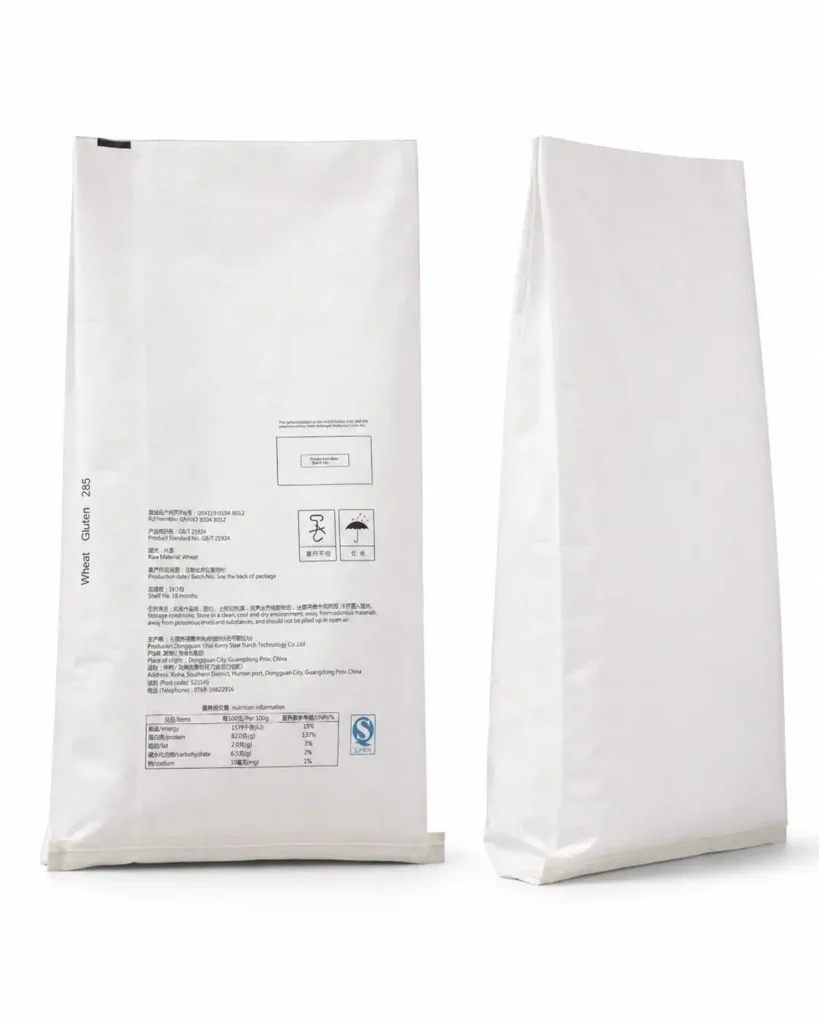
VIDEPAK Open Mouth Bags: A Practical Guide to Kraft Paper, PP Woven and Co-extruded Polyethylene Packaging
Industrial packaging has a simple job to do, but the conditions around that job are rarely simple. A sack may need to fill quickly, carry 25 or 50 kilograms, resist puncture during handling, stay stable on a pallet, protect a moisture-sensitive product, display clear branding, and finally open without creating unnecessary waste. That is why VIDEPAK develops Open Mouth Bags as a configurable packaging platform rather than as one fixed bag.
The basic idea behind Open Mouth Bags is easy to understand: the bag reaches the packing line with the bottom already formed or closed while the top remains fully open for filling. After the target weight is reached, the customer closes the mouth by sewing, heat sealing, pinch sealing, or another method selected for the material structure and filling system. This geometry works with many dry products and can support manual, semi-automatic and automated packing operations. ISO packaging vocabulary also recognizes open-mouth construction within the broader terminology used for industrial sacks.
The central packaging question is not simply, “Which bag is strongest?”
The better question is: which structure provides the right combination of filling speed, mechanical strength, moisture protection, sealing performance, pallet stability, appearance and cost? For one product the answer may be Open Mouth Kraft Paper Sacks. For another it may be Open Mouth PP Woven Sacks. For a third, the best solution may be Open Mouth Co-extruded Polyethylene Sacks.
Understanding the Logic Behind Open Mouth Bags
One opening concept, several material systems
The value of Open Mouth Bags comes from flexibility. A wide top opening can receive free-flowing grains, pellets, granules and many powders through gravity filling, auger dosing or other open-mouth bagging systems. Once filling is complete, the closure can be adapted to the product: sewing for straightforward dry goods, a heat-sealed PE liner when better moisture control is required, or a heat-sealed polyethylene body when a welded plastic closure is preferred. VIDEPAK’s product information describes sewing, liner heat sealing, easy-open options and other configurations across its open-mouth portfolio.
This creates an important distinction. The opening method describes how the sack is filled; the material structure describes how the sack performs. Open Mouth Kraft Paper Sacks use paper strength, stiffness and printable surfaces. Open Mouth PP Woven Sacks use woven polypropylene tapes to combine low packaging weight with strong resistance to handling loads. Open Mouth Co-extruded Polyethylene Sacks use continuous plastic film and heat-sealable structures to emphasize moisture protection, cleanliness and seal integrity. Different materials. The same practical filling idea.
Three routes to the same goal
Paper route: Choose Open Mouth Kraft Paper Sacks when stiffness, natural paper appearance, clear printing and multiwall construction are major priorities.
Woven route: Choose Open Mouth PP Woven Sacks when tear resistance, carrying strength, flexible surface options and demanding transport conditions are central.
Film route: Choose Open Mouth Co-extruded Polyethylene Sacks when moisture resistance, heat sealing, clean surfaces and engineered multi-layer film performance lead the specification.
The application categories above reflect VIDEPAK’s current product portfolio and its published open-mouth packaging guidance; the final construction should always be matched to the actual packed product, filling equipment, package weight and distribution route.
VIDEPAK Open Mouth Kraft Paper Sacks
Multiwall paper construction with a practical open top
Open Mouth Kraft Paper Sacks combine the familiar appearance of kraft paper with industrial sack construction. VIDEPAK’s current kraft paper range covers heavy-duty packaging from approximately 2 kg to 60 kg and includes brown or white paper, multiwall structures, PE-coated options, PE inner liners, paper-woven composites and higher-barrier constructions where required. Its published product range includes open-top formats as well as several bottom and closure configurations.
For many Open Mouth Kraft Paper Sacks, strength is created through multiple paper plies rather than through one very heavy sheet. VIDEPAK lists multiwall configurations using multiple kraft paper layers, with the number and type of plies adjusted according to load, stiffness, tear resistance, filling conditions and barrier needs. This layered approach allows the outer ply to support printing and appearance while inner plies contribute strength or accommodate a PE liner when additional moisture or sifting protection is needed.
The choice between brown and white kraft paper also serves more than an aesthetic purpose. Natural brown kraft communicates a direct, industrial or agricultural appearance, while white kraft gives printed graphics and product information a brighter background. For brand-focused products, that difference can matter. The package is a container, but it is also a communication surface.
Sewn, satchel and pinch-bottom possibilities
The term Open Mouth Kraft Paper Sacks covers more than one final geometry. VIDEPAK’s range includes Sewn Open Mouth constructions, where the full top remains open for filling and is stitched afterward; Pinch Bottom Open Mouth constructions, which support a controlled post-fill sealing process; and Satchel Bottom Open Mouth formats designed around a more stable bottom shape. Side gussets, block-style bottoms, paper-tape sewing, sealing tape and PE liners can be selected according to the project.
This versatility makes Open Mouth Kraft Paper Sacks particularly useful when customers want a paper-led package but do not want to accept one universal closure method. A free-flowing granular product may work well with a straightforward sewn mouth. A finer or humidity-sensitive powder may justify an inner PE liner. A retail-facing product may put more emphasis on clean shape and printed panels. One family can therefore move from simple to sophisticated without losing its basic open-mouth filling logic.
Where Open Mouth Kraft Paper Sacks create value
They offer an effective balance when the buyer wants paper appearance, a broad printable area, good bag stiffness and several possible barrier levels. Yet paper must be specified honestly: if the logistics route involves severe humidity or the product requires a strong vapor barrier, the solution may need a PE liner, a coated ply or a different material family altogether.
Use paper because paper fits the job—not simply because paper looks familiar.
The ranges and configurations shown for Open Mouth Kraft Paper Sacks are based on VIDEPAK’s current kraft sack product information and should be treated as design starting points rather than universal values.
VIDEPAK Open Mouth PP Woven Sacks
Woven strength for demanding transport
Open Mouth PP Woven Sacks are made from polypropylene tapes that are formed and interwoven into a fabric. The woven structure is the core of their mechanical performance. VIDEPAK’s current PP woven product range lists nominal capacities from 5 kg to 50 kg, grammage options around 80–150 GSM for the broader PP woven range, and customizable dimensions that extend across a wide set of industrial applications. The range can include flat or gusseted sides, sewn bottoms, reinforced seams, block-bottom constructions, anti-slip surfaces and liners.
This is where Open Mouth PP Woven Sacks differ visibly from paper sacks and PE film sacks. Instead of relying on paper fibers or a continuous film wall, the main load-bearing body is a woven textile-like structure. That architecture is especially useful when sacks must survive repeated lifting, conveyor movement, palletizing, road transport and rough industrial handling.
VIDEPAK’s published open-mouth engineering guidance describes woven sack designs using fabric mesh, fabric weight, tape size, sewing pattern and optional lamination as coordinated variables. Typical open-mouth woven projects may use meshes around 9 × 9 to 12 × 12, while the suitable fabric weight depends on filled weight, product shape, drop exposure and puncture risk. These figures are not a substitute for application testing; they demonstrate why Open Mouth PP Woven Sacks should be engineered as a system rather than purchased only by nominal dimensions.
From breathable fabric to laminated retail packaging
A key advantage of Open Mouth PP Woven Sacks is the ability to change surface and barrier behavior without changing the basic filling format. An unlaminated woven sack can provide more natural air movement through the fabric. A coated or laminated structure can increase protection from external moisture and create a smoother printing surface. A separate PE inner liner can provide another layer of protection against moisture or fine-product leakage. VIDEPAK lists BOPP-laminated woven structures, paper-laminated woven structures and PP woven bags with PE liners within its current manufacturing range.
The open mouth then remains simple: fill first, close second. Standard sewing is widely suited to dry grains, seeds, feed and industrial granules. When the packed material demands tighter moisture control, a PE inner liner can be heat sealed before or together with closing the outer woven sack. The woven body carries the mechanical load; the liner addresses the barrier. Strength outside, protection inside. Each layer has a job.
For branding-heavy agricultural, pet food, seed or retail-oriented products, lamination can turn Open Mouth PP Woven Sacks into a much more visual package. The underlying fabric provides carrying strength, while the laminated surface supports detailed artwork and protects print from ordinary scuffing and handling. VIDEPAK’s engineering guidance lists BOPP film, anti-slip treatment, gussets, micro-perforation and liners among the design variables that can be selected for open-mouth woven constructions.
Think of Open Mouth PP Woven Sacks as a platform, not a single recipe.
Need breathability? Start with an unlaminated woven structure. Need stronger moisture control? Add coating or a PE liner. Need premium graphics? Add a printable laminated surface. Need better pallet behavior? Consider gussets and anti-slip treatment. The best specification adds what is necessary—and avoids paying for what is not.
Typical applications
Open Mouth PP Woven Sacks are well suited to many products that are dry, granular, pelletized or moderately powdery: rice and grains, animal feed, seeds, fertilizers, salts, plastic pellets, minerals and selected construction materials are common examples in VIDEPAK’s published application guidance. For very fine powders, however, the buyer should examine air release, dust generation, seam leakage and liner design carefully rather than assuming that the same woven specification will suit every product.
VIDEPAK Open Mouth Co-extruded Polyethylene Sacks
Continuous film engineered layer by layer
Open Mouth Co-extruded Polyethylene Sacks take a different engineering route. Instead of paper plies or a woven fabric, the sack body is made from polyethylene film. In co-extrusion, multiple polymer layers are formed together so that different layers can contribute different properties to the final film. VIDEPAK states that its polyethylene manufacturing capability extends to multi-layer co-extruded structures of up to nine layers for heavy-duty PE packaging.
Why use several layers? Because one layer does not have to solve every problem. Depending on the formulation, outer layers can be selected for handling and surface behavior, internal layers can support strength or toughness, and a sealing layer can be optimized for closure. The practical result is that Open Mouth Co-extruded Polyethylene Sacks can be designed around a target combination of film strength, puncture resistance, sealing response, surface friction and moisture protection rather than relying only on greater total thickness.
VIDEPAK’s current PE product information lists widths of approximately 35–65 cm, thicknesses around 0.10–0.25 mm, customizable length and printing of up to 10 colors for the broader heavy-duty polyethylene range. It also describes heavy-duty applications at 5 kg and above and reports annual PE bag output above 500 million pieces. These figures show the manufacturing window available, but each Open Mouth Co-extruded Polyethylene Sacks project should still be defined around the product density, target fill weight, sealing machine and distribution test requirements.
Why the open mouth works especially well with heat sealing
With Open Mouth Co-extruded Polyethylene Sacks, the packer fills through the complete open top and then seals the film across the mouth. The continuous PE body is naturally suited to welded closure, which can be attractive for products where moisture protection, cleanliness or control of fine material leakage is important. VIDEPAK describes its standard polyethylene open-mouth bags as being supplied with one end closed and the opposite end fully open for filling, after which the mouth can be heat sealed or otherwise closed according to the chosen structure and line.
The apparently simple heat-sealed seam deserves careful engineering. Sealing temperature, pressure, dwell time, film thickness and surface condition must work together. Too little energy can leave a weak seal; too much can deform or damage the film. For this reason, seal validation should be linked to the customer’s actual packing equipment rather than judged only from an empty-bag sample.
ASTM F88/F88M provides a recognized method for measuring the strength of seals in flexible barrier materials, while ASTM D5276 covers free-fall drop testing of loaded containers, including bags and sacks. These methods illustrate two different but complementary questions: does the seal itself have adequate strength, and does the filled package survive realistic handling impacts?
Where Open Mouth Co-extruded Polyethylene Sacks stand out
A continuous PE film wall plus a controlled heat-sealed mouth can create a clean, practical package for dry chemicals, polymer resin, food ingredients, fertilizer and other products that benefit from moisture resistance and controlled sealing. The goal is not “more plastic.” The goal is the right film structure, at the right thickness, with the right seal.
Choosing Between the Three Open Mouth Bags Systems
Start with the failure mode, not the material name
The fastest way to choose among Open Mouth Kraft Paper Sacks, Open Mouth PP Woven Sacks and Open Mouth Co-extruded Polyethylene Sacks is to identify what would make the package fail. Is the main danger tearing? Moisture? Dust leakage? Poor sealing? Pallet movement? Weak graphics? Slow filling? Once the dominant risks are ranked, the material decision becomes far more logical.
The matrix is a selection guide rather than a ranking. VIDEPAK’s published ranges show that all three families can be customized through liners, coatings, gussets, different closures and other features, so overlaps are normal. A paper sack can gain a plastic liner; a woven sack can gain lamination; a PE sack can gain perforation. The correct answer is therefore application-specific.
Paper gives form. Woven PP gives toughness. Co-extruded PE gives continuous-film protection. Good packaging design does not ask which material wins in theory; it asks which material solves the customer’s real problem in practice.
From Product Data to a Reliable Open Mouth Bags Specification
A practical development flow
A strong specification begins before material selection. VIDEPAK first needs to understand what is going into the package and what happens to the package afterward. Bulk density affects volume. Particle shape affects puncture risk. Fine powder affects dust and sifting. Humidity sensitivity affects the barrier. The filling machine affects mouth geometry. Pallet height affects surface friction. Transport distance affects drop and vibration exposure. Each answer changes the bag.
Product Data
Weight • Bulk density • Particle size • Moisture sensitivity
↓
Filling System
Manual • Semi-automatic • Automatic • Filling speed • Air release
↓
Material Route
Open Mouth Kraft Paper Sacks • Open Mouth PP Woven Sacks • Open Mouth Co-extruded Polyethylene Sacks
↓
Functional Design
Gusset • Liner • Lamination • Anti-slip • Venting • Printing • Closure
↓
Validation
Dimensions • Seam / seal performance • Filled drop test • Filling trial • Pallet test
↓
Approved Production Specification
Testing the complete package, not just the raw material
Testing matters because material data alone cannot predict every filled-package failure. A strong fabric can still fail at a poor seam. A strong film can still fail through an incorrect heat seal. A strong paper body can still suffer when bottom construction does not match the filled weight. ASTM D5276 specifically covers free-fall drop testing of loaded bags and sacks, making filled-package testing a useful part of qualification for demanding transport routes.
For heat-sealed liners and Open Mouth Co-extruded Polyethylene Sacks, seal strength is another important measurement. ASTM F88/F88M measures the force required to separate a seal in flexible barrier materials and identifies the failure mode, giving packaging teams a structured way to compare seal performance instead of relying only on visual inspection.
Food-contact projects require another layer of specification discipline. For products destined for the European Union, plastic layers intended for food contact fall within the scope of Regulation (EU) No 10/2011, including multi-layer plastic structures and plastic layers used in multi-material systems. Buyers should therefore communicate the destination market and contact conditions before material approval so that the relevant declarations and testing requirements can be defined for the specific package.
Specification rule:
Do not approve Open Mouth Bags only because the empty sample “feels strong.” Approve the material, dimensions, bottom, mouth, closure and filled-package performance together. The package travels as one system, so it should be qualified as one system.
Building the Right Open Mouth Bags with VIDEPAK
Customization should begin with the customer’s packing line
VIDEPAK manufactures PP woven bags, kraft paper sacks and heavy-duty polyethylene packaging as major parts of its industrial bag portfolio, which allows the discussion around Open Mouth Bags to begin with the application rather than forcing every project into one material family. Its current product pages describe broad customization of size, structure, side gussets, bottom design, liners, coating or lamination, surface treatment, printing and closure method.
That matters because two customers filling the same 25 kg product may still need different bags. One may transport the product for only a few kilometers and prefer economical Open Mouth Kraft Paper Sacks. Another may export through humid ports and choose lined Open Mouth PP Woven Sacks. A third may require a welded plastic package and move toward Open Mouth Co-extruded Polyethylene Sacks. The product name is the same. The supply chain is not.
Information that makes a quotation more accurate
For a new project, a useful RFQ should state the packed material, net weight, bulk density if known, preferred bag dimensions, filling equipment, filling temperature, required closure, pallet pattern, storage conditions, transport route, printing artwork, food-contact or other compliance needs, and any previous package failure that the new specification is expected to solve. These details turn a request for “a strong bag” into measurable packaging requirements.
VIDEPAK’s published product information also provides reference samples and custom mock-up samples as part of its project-development approach, allowing material, dimensions and printing details to be reviewed before mass production.
The VIDEPAK approach to Open Mouth Bags is simple:
Choose the material by function. Choose the structure by risk. Choose the closure by the filling line. Validate the complete package under the conditions that matter.
Whether the result is Open Mouth Kraft Paper Sacks for a strong paper-led presentation, Open Mouth PP Woven Sacks for demanding mechanical handling, or Open Mouth Co-extruded Polyethylene Sacks for controlled film protection and heat sealing, the objective remains the same: easier filling, reliable transport, practical storage and packaging performance that remains consistent from the packing line to the final user.
Open Mouth Bags succeed because they do not make industrial packaging more complicated than it needs to be. The mouth is open when the product needs to enter. The closure is created when the product is in place. Everything between those two moments—paper plies, woven tapes, co-extruded PE layers, liners, gussets, seams, surface treatment and printing—can then be engineered around the customer’s real operating conditions. That is the practical value of VIDEPAK Open Mouth Bags: one clear packaging principle, multiple material solutions, and a specification built around the job it must perform.
- VIDEPAK Open Mouth Bags: A Practical Guide to Kraft Paper, PP Woven and Co-extruded Polyethylene Packaging
- Understanding the Logic Behind Open Mouth Bags
- VIDEPAK Open Mouth Kraft Paper Sacks
- VIDEPAK Open Mouth PP Woven Sacks
- VIDEPAK Open Mouth Co-extruded Polyethylene Sacks
- Choosing Between the Three Open Mouth Bags Systems
- From Product Data to a Reliable Open Mouth Bags Specification
- Building the Right Open Mouth Bags with VIDEPAK
- What is Open Mouth Bags?
- Why Open Mouth Bags Succeed Across Industries
- A Systems Approach: From Requirement to Open Mouth Bags Specification
- Manufacturing and Quality: From Resin to Open Mouth Bags on the Pallet
- Application Pathways: Where Open Mouth Bags Deliver Results
- Specification Summary Tables
- Barrier and Liner Selection: Data, Trade‑offs, and Use Cases
- Closures and Mechanics: Sewing, Sealing, and Easy‑Open
- Branding and Aesthetics: Making Open Mouth Bags Speak on the Shelf
- Logistics, Safety, and Pallet Architecture
- Compliance and Documentation: Passing Audits Without Drama
- Sustainability and Material Strategy
- Buyer Questions, Engineer Answers
- Appendix — Example Specification Sheet (50 kg Refined Sugar, Export)
- Introduction — Problem Context and Objectives
- What Are Open Mouth Bags and Where Do They Fit?
- Method — From Requirements to a Working Specification
- Product Behavior — Flow, Dust, and Geometry
- Barrier Needs — Moisture and Oxygen Strategy
- Closure Engineering — Sewing, Sealing, Pinch, and Easy‑Open
- Pallet Stability — Friction, Form, and Environment
- Compliance and Food Safety — Documentation as a Design Input
- Branding and Retail Presence — Surface as a Sales Tool
- Sustainability — Material Stewardship Without Performance Loss
- Result — An Actionable Specification Template
- Discussion — Trade‑Offs, Trends, and Risk Control
- Sub‑Problem 1 — Flow Modeling and Venting
- Sub‑Problem 2 — Barrier Economics
- Sub‑Problem 3 — Closure Reliability
- Sub‑Problem 4 — Pallet Architecture
- Integrated Solution — Recombining the Decisions
- Use‑Case Snapshots — Evidence Over Assumptions
- References
What is Open Mouth Bags?
If a package could be both a workhorse and a billboard, Open Mouth Bags would be it. In essence, these are woven‑polyolefin sacks closed at the bottom and left fully open at the top for straightforward filling and post‑fill closure. Some buyers encounter them under alternate names such as Sewn‑Open‑Mouth (SOM) bags, Flat‑Bottom Sewn Bags, BOPP‑Laminated Woven Sacks, or PP Woven Sacks—different labels for the same core geometry and production logic.
PP Woven Fabric Bags Analysis
Complete analysis of open mouth PP woven fabric bags for industrial packaging applications.
Check More →PE Open Mouth Bags
Durable polyethylene open mouth bags with reliable sealing and loading performance.
Check More →Heavy-Duty Woven Bags Guide
Professional guide covering heavy-duty open mouth woven bags for bulk material packaging.
Check More →BOPP Laminated PP Bags Analysis
Detailed analysis of BOPP laminated open mouth PP woven bags with premium surface finish.
Check More →Features of Open Mouth Bags. Strength without bulk. A generous top aperture that cooperates with gravity feed, screw augers, and belt weighers. Closures that scale from quick sewing to hermetic liner heat‑seals. Options for vivid rotogravure/flexographic artwork on BOPP lamination. Treatments for UV stability, anti‑slip, micro‑perforation, and more. In short: resilient on the road, credible on the shelf, adaptable on the line.
Production process. Resin to tape; tape to fabric; fabric to finished bag. Polypropylene (and sometimes blends) are extruded into flat tapes and stretched for tensile performance. These tapes are woven—on circular or flat looms—into fabric with typical meshes of 9×9 to 12×12 and GSM ranging from 60 to 120 for small sacks. Afterward, the fabric may be corona‑treated and laminated (BOPP or PP coating) to accept high‑fidelity printing and moisture protection. Conversion follows: cutting, gusseting, bottom folding and stitching, top hemming, optional easy‑open tape, liner insertion (LDPE/LLDPE/HDPE or foil composites), and QC. The final closure happens after filling: liner heat‑seal, outer stitch, or a glue/pinch top depending on the spec.
What are they used for? The canvas is broad: rice, grains, flour, sugar, salt, animal feed and pet food, seeds, fertilizers, plastic resins and pellets, minerals, construction mixes, produce requiring ventilation. Where the product must move swiftly into the bag, where the closure must flex with the application, where the outside must tell the brand story—Open Mouth Bags earn their place. For additional background and examples, see Open Mouth Bags.
Why Open Mouth Bags Succeed Across Industries
Consider the buyer’s paradox: a package must be strong but light; economical yet premium; breathable during fill yet tight in storage. Open Mouth Bags solve this balance with a deceptively simple form. The full‑width mouth welcomes fast infeed and awkward particle sizes; the woven matrix handles rough handling; the closure strategy (stitch, heat‑seal, or glue) tunes barrier and budget. Are there alternatives? Yes. Are they always better? Rarely. Valve bags excel on very fine powders at high line speeds; paper multi‑wall brings a familiar touch and adhesive pinch tops. Yet on cost‑to‑performance, graphics durability, and moisture resilience—particularly in humid or monsoon climates—Open Mouth Bags repeatedly outperform.
A buyer may ask: But will they stack? Will they scuff? Will they keep moisture out? Stackability comes from gussets and anti‑slip textures; scuff resistance from laminations; moisture control from liners and controlled seals. The design variables are many, but they are coherent—each choice has a measurable effect, and each effect can be validated under test.
A Systems Approach: From Requirement to Open Mouth Bags Specification
Decision quality improves when the problem is segmented. Below, each sub‑problem is framed as Question → Diagnosis → Options → Outcome, and enriched with comparative notes and data points.
1) Product Rheology and Flow Behavior
Question. How will particle size distribution, shape, and moisture content influence fill rate, dust emission, and final bag geometry?
Diagnosis. Free‑flowing granules (resins, rice) slip easily through a full‑width mouth. Cohesive, fine powders (flour) trap air and generate dust. The first class wants speed; the second demands venting and post‑fill deaeration.
Options.
- Standard SOM build with BOPP lamination for retail‑grade graphics; add micro‑perforations when trapped air slows fill or causes “pillow” bags.
- PE inner liners (40–60 µm LDPE/LLDPE) to gain heat‑sealability and moisture control; for stiffer fills, swap to HDPE for lower WVTR but allow for reduced conformability.
Outcome. Faster fills, fewer leaks at the stitch, and better pallet geometry from a squarer, settled bag. Parallel lesson: when the powder is ultra‑fine, a valve bag can beat surge‑dust; otherwise, Open Mouth Bags plus a smart liner spec meets performance at a lower materials cost.
2) Barrier Strategy: Moisture and Oxygen
Question. Is your product hygroscopic, oxidation‑sensitive, or both?
Diagnosis. Water vapor triggers clumping in sugars and salts; oxygen accelerates rancidity in high‑fat pet foods and bio‑actives. Ambient conditions—38 °C and 90% RH in tropical ports—stress poor specs mercilessly.
Options.
- Tier A: Unlaminated PP Open Mouth Bags with PE liner; heat‑seal liner, stitch outer.
- Tier B: BOPP‑laminated exterior for print and splash resistance + PE liner for sealability; optional micro‑perfs for fill venting.
- Tier C: Aluminum‑foil composite liners when near‑zero OTR/WVTR is non‑negotiable.
Outcome. The chosen tier should mirror shelf‑life economics: not the thickest film, the right film. Why over‑engineer a commodity resin when the failure mode is handling, not moisture? Why skimp on barrier when a single rancidity complaint costs more than the foil increment? The calculus is commercial as much as chemical.
3) Closure Design and Seal Integrity
Question. Which top closure yields the desired balance of line speed, appearance, and leak tightness?
Diagnosis. Stitching is fast and robust but not hermetic. Heat‑sealing a liner stops vapor ingress; glue/pinch tops offer a clean, paper‑like aesthetic. Easy‑open tapes add consumer convenience but demand precise sewing.
Options.
- Liner heat‑seal (10–15 mm seal width) + outer chain stitch for a hygienic, tight system.
- Pinch‑top variants for premium retail if equipment and coatings allow.
- Easy‑open systems for feed and pet food where end‑users prefer tool‑free access.
Outcome. Closures that pass seal pull tests (ASTM F88), survive drop cycles (ASTM D5276), and maintain edge integrity after long‑haul vibration. A simple rule of thumb: if you can hand flex the closed mouth and hear air escaping, upgrade the liner seal or the stitch pattern.
4) Pallet Stability and Environmental Robustness
Question. Will stacks survive hot containers, uneven docks, and humid warehouses?
Diagnosis. Smooth laminates slide; unlaminated fabric grips but scuffs. UV exposure erodes polymer chains over time.
Options.
- Anti‑slip coatings/embossed textures to raise static and dynamic COF.
- M‑gussets to square the bag, raising layer‑to‑layer friction and improving cube.
- UV stabilization (200–1600 h) for outdoor storage.
- Ventilated weaves or micro‑perforated laminates for produce and baked goods.
Outcome. Tighter stacks, taller pallets, and fewer topple incidents. It’s the quiet ROI: crashes avoided, claims not filed, schedule not disrupted.
5) Regulatory Confidence and Hygiene Programs
Question. Can the packaging pass a food‑safety audit in your destination market?
Diagnosis. Without documentation—resin DoCs, ink/adhesive statements, migration tests—access can stall.
Options.
- Materials compliant with FDA 21 CFR 177.1520, EU 10/2011 (under EC 1935/2004), and GB 4806 as applicable.
- Manufacturing sites certified to FSSC 22000 (Category I) or BRCGS Packaging; traceability embedded in bales and bag rolls.
Outcome. Shorter onboarding with multinational buyers; fewer retests; better leverage in tenders where compliance is scored.
6) Brand Expression and Surface Engineering
Question. Will the bag sell the product as effectively as it protects it?
Diagnosis. In modern trade, shelf presence is performance. Smudged inks or scarred graphics drag conversion even if the product inside is perfect.
Options.
- BOPP lamination (15–25 µm) for matte, gloss, or hybrid effects; 8–10 color rotogravure or high‑end flexo.
- Clear windows, metallized inks, and registered varnishes to add tactile and visual cues.
Outcome. Packages that arrive intact and persuasive—bags that “speak” across the aisle. In categories like pet food or seeds, the difference is measurable at POS.
7) End‑of‑Life and Material Stewardship
Question. Can the bag do its job and still fit a credible recycling narrative?
Diagnosis. Mixed materials complicate recycling streams; excessive GSM adds cost without obvious gain.
Options.
- Keep to polyolefins: PP fabric with PP/PE liners and coatings.
- Explore monomaterial PP solutions where feasible, and responsibly trial PCR/PIR content in tapes if allowed by regulations and risk profiles.
Outcome. A spec that aligns with internal sustainability goals without jeopardizing protection.
Manufacturing and Quality: From Resin to Open Mouth Bags on the Pallet
A production line for Open Mouth Bags is a choreography of physics and quality gates. Extruders define tape tensile properties; loom tension controls weave uniformity; lamination sets adhesion; converters control dimensional tolerances; printers guard register and color; sewing heads guarantee seam strength. Any weak link surfaces downstream as broken stitches, delamination, or scuffed art.
Process map (condensed).
- Tape extrusion & stretching: MFI of the base resin, chill‑roll temperatures, and draw ratios are tuned to hit tensile targets without brittleness.
- Weaving: Mesh (e.g., 10×10) and denier (600–1000D) are chosen by load and puncture risk.
- Surface prep & lamination: Corona treat to ~38–42 dynes; laminate BOPP 15–25 µm or PP coatings 12–50 µm; manage nip temps and pressures to avoid curl.
- Printing: Color management and scuff testing (e.g., Taber) ensure shelf‑ready faces.
- Conversion: Heat‑cutting to seal edges; gusset formation; bottom fold/stitched geometry; top hem and optional easy‑open.
- Liner insertion: Inline or offline, loose or sewn‑in; thicknesses typically 25–80 µm for PE, ~90 µm equivalent for foil composites.
- QC & packing: Dimensional checks, seam pulls, seal tests, and drop tests; then baled with traceable lot codes.
Quality metrics that matter. GSM and mesh must be consistent; print adhesion must resist scuff cycles; liner seal windows must be validated on the customer’s sealer; drop tests should simulate worst‑case temperatures. Numbers tell the story: stitch density (e.g., 10–12 SPI), seal width (≥10 mm), COF targets (static ≥0.45 on anti‑slip faces).
Application Pathways: Where Open Mouth Bags Deliver Results
Food staples. Rice, flour, sugar, salt—each a deceptively simple commodity with unforgiving failure modes. Hygroscopic pickup? Choose BOPP‑laminated Open Mouth Bags with LDPE/LLDPE liners; heat‑seal the liner, stitch the outer. Dusting at fill on flour? Add micro‑perfs and allow post‑fill settlement before sealing.
Feed and pet nutrition. Animal feed and pet food benefit from billboard‑quality prints and barriers that slow oxidation. A BOPP‑laminated exterior plus a PE liner gives a durable face and a controlled seal. For high‑fat kibbles in tropical climates, consider foil composite liners.
Agrochemicals and fertilizers. Fertilizers and minerals punish poor seams. Double‑stitch bottoms, anti‑slip coatings, and UV‑stabilized fabric keep stacks upright in sun‑exposed yards.
Plastics and industrials. Resins and plastic pellets cannot leak, ever. A liner heat‑seal + outer stitch stops pellet escape, while BOPP protects graphics against abrasion in bulk handling.
Ventilated goods. Produce or baked goods require breathability. Ventilated weaves or micro‑perforated laminates allow vapor exchange, limiting condensation and mold.
A skeptic might ask: Isn’t one bag like another? Not when a mill‑stop at the port, a humid monsoon, or a robot palletizer exposes the weak link. Open Mouth Bags are not a single product; they are a configurable platform.
Specification Summary Tables
Table 1 — Typical Specification Ranges for Open Mouth Bags
| Parameter | Typical Range | Practical Notes |
|---|---|---|
| Fabric weight (GSM) | 60–120 | Higher GSM → higher tensile & puncture resistance; match to 25–50 kg loads |
| Mesh (warp × weft) | 9×9 to 12×12 | Coarser meshes for heavy bulk; tighter for finer powders |
| Tape denier (D) | 400–1400 | Higher denier → stronger tapes; balance against sewability |
| Bag size (W × L) | 30–80 cm × 50–110 cm | 25 kg: ~45–55 × 70–90 cm; 50 kg: ~50–60 × 80–100 cm |
| Gusset width | 5–12 cm | Improves cube and pallet stability |
| Lamination | BOPP 15–25 µm / PP coating 12–50 µm | Choose BOPP for print; PP coating for matte industrial finish |
| Liner (PE) | 25–80 µm | LDPE/LLDPE for sealability; HDPE for lower MVTR |
| Liner (foil composite) | 70–120 µm equivalent | For near‑zero OTR/WVTR; use when justified by shelf‑life data |
| UV stabilization | 200–1600 h | Outdoor storage/transport |
| Printing | Flexo/rotogravure up to 8–10 colors | Matte/gloss effects, clear windows |
| Top closure | Sewn; liner heat‑seal; easy‑open tape | Combine heat‑sealed liner + outer stitch for hygiene |
| Bottom closure | Single/double fold; single/double stitch | Double stitch for dense powders/high drop heights |
Table 2 — Barrier & Closure Selection by Application
| Application | Recommended Scheme | Why it Works |
|---|---|---|
| Rice/Grains (25–50 kg) | Unlaminated Open Mouth Bags + PE liner 30–50 µm; or BOPP‑lam + PE liner | Moisture protection; retail‑grade graphics when needed |
| Flour/Sugar | BOPP‑lam + PE liner 40–60 µm; micro‑perfs optional | Controls dust; maintains stack geometry; protects label |
| Animal Feed/Pet Food | BOPP‑lam + PE liner; anti‑slip; optional micro‑perfs | Barrier + billboard effect; safer pallets |
| Fertilizer/Minerals | Open Mouth Bags (laminated or unlaminated) + anti‑slip + UV 200–1600 h | Survives sun and rough handling |
| Resins/Pellets | Open Mouth Bags + liner heat‑seal + outer stitch | Prevents pellet leakage; clean unloading |
| Hygroscopic/High‑value powders | Open Mouth Bags + foil composite liner | Near‑zero OTR/WVTR for shelf‑life critical goods |
| Produce/Baked goods | Ventilated weave or micro‑perforated Open Mouth Bags | Breathability avoids condensation/mold |
Table 3 — QA & Validation Methods to Specify
| Performance Aspect | Typical Method | Purpose |
|---|---|---|
| Heat‑seal strength (liner) | ASTM F88 | Validate sealer window and seal integrity |
| Dart impact (film) | ASTM D1709 | Confirm film toughness against puncture |
| Elmendorf tear (film) | ASTM D1922 | Compare tear propagation resistance |
| Drop test (filled bag) | ASTM D5276 | Ensure pallets survive realistic handling |
| WVTR/OTR (films/liners) | Standard WVTR/OTR tests | Select barrier structures by data |
Barrier and Liner Selection: Data, Trade‑offs, and Use Cases
Some decisions are only clear when quantified. Moisture ingress can be modeled using film WVTR and the bag’s surface area; oxygen transmission follows similar logic.
Polyolefin liners. LDPE liners at 40–60 µm offer a broad seal window and friendly handling on vertical formers; HDPE reduces WVTR but may be noisy and less conformable. LLDPE blends can widen the seal window and enhance puncture resistance. Choose based on the dominant failure mode: moisture pickup vs. seal burn‑through vs. stack shape.
Foil composites. When potency, flavor, or oxidation kinetics demand near‑zero permeation, foil becomes economical. The extra microns, the sealed edges, the stricter QC—they all cost less than a nationwide recall.
Micro‑perforations and venting. Perforation count and pattern influence fill rate and bag settlement. Too few perfs and you trap air; too many and you risk dust and barrier loss. The craft lies in finding the minimal pattern that restores flow without undoing the barrier.
Model scenario. A 50 kg refined sugar line in a coastal climate: BOPP‑laminated Open Mouth Bags with a 50 µm LDPE liner, micro‑perfs limited to the print margins, liner heat‑seal width 12 mm, outer top chain stitch, double‑stitch bottom. Results: reduced caking, better barcode legibility after scuff cycles, and stacks stable at 7 layers.
Closures and Mechanics: Sewing, Sealing, and Easy‑Open
Sewn closures. Single or double fold with chain stitch remains the industrial default. Stitch density of 10–12 SPI and high‑tenacity thread mitigate seam rips. Combine with pre‑sealed liners for hygiene.
Heat‑sealed liners. The real moisture barrier lives here. Specify jaw temperature ranges, dwell, and pressure; verify peel vs. shear failure modes. Remember: a neat outer stitch cannot rescue a weak inner seal.
Pinch/glue tops. Where appearance is paramount and equipment allows, pinch tops produce crisp, paper‑like seams while retaining PP strength.
Easy‑open features. A small cost for a big user‑experience gain—particularly in pet food and feed. They demand consistency; mis‑aligned tapes frustrate users and attract complaints.
Testing cadence. Seal pulls every run change; drop tests at worst‑case temperature; line logs that capture settings and deviations. If the bag fails, the data tells you why.
Branding and Aesthetics: Making Open Mouth Bags Speak on the Shelf
Packaging is silent salesmanship. Open Mouth Bags with BOPP lamination enable high‑resolution imagery, matte‑gloss contrast, and even transparent windows to showcase the product. Retailers notice when art survives transit; consumers notice when a bag opens cleanly and re‑closes reasonably. Subtle details—registered varnishes, metallic accents, tactile emboss—signal quality before the product is tasted, poured, or planted.
The paradox returns: industry wants ruggedness; marketing wants beauty. Laminated Open Mouth Bags—when correctly specified—deliver both.
Logistics, Safety, and Pallet Architecture
Anti‑slip faces keep layers aligned; M‑gussets create squarer profiles that pack tighter; corner boards and correct stretch‑wrap tension prevent load creep. UV stabilizers protect when pallets dwell outdoors. Define your pallet pattern, layer count, and drop height in the spec—make it part of the bag design, not an afterthought.
A rhetorical question worth asking at every pre‑production meeting: What single change would most reduce damage in our lane—an extra stitch row, a higher COF face, or one more millimeter of liner? The answer is usually cheaper than the last damage claim.
Compliance and Documentation: Passing Audits Without Drama
Compliance is not a burden; it is a passport. For food contact, ensure resin and film declarations cite FDA 21 CFR 177.1520, EU 10/2011 (within EC 1935/2004), and relevant GB 4806 standards. For hygiene, ask for valid FSSC 22000 (Category I) or BRCGS Packaging certificates. Keep migration and odor test reports on file. Embed traceability via bale labels, fabric roll IDs, and bag lot codes. When everyone is prepared, audits feel like confirmations rather than investigations.
Sustainability and Material Strategy
Reduction before substitution; monomaterial before multi‑layer; performance before rhetoric. Open Mouth Bags are already aligned with common recycling streams because they are polyolefin‑based. To improve further, keep laminations PP‑based where possible, and rationalize GSM and liner thickness by observed field performance rather than intuition. The greenest gram is the gram you never specified.
Buyer Questions, Engineer Answers
Do I need lamination if I already use a PE liner? When graphics and scuff resistance matter—or when ambient humidity is high—lamination earns its keep. If the bag lives in an industrial chain with minimal branding needs, an unlaminated fabric plus liner is efficient.
How do I minimize trapped air in powder fills? Micro‑perforations, longer settling time before liner sealing, and tuned fill spouts. If you can hear “pillow” bags easing air hours later, increase perf density modestly and validate barrier loss is acceptable.
Can these bags be recycled? Yes, in polyolefin streams; avoid incompatible laminations.
What UV rating is sensible? Indoor logistics: often none. Outdoor storage in hot zones: 800–1600 h.
What’s a dependable default for 50 kg sugar? BOPP‑lam Open Mouth Bags, 80–100 GSM fabric, 10×10–12×12 mesh, LDPE 50 µm liner, double‑stitch bottom, liner heat‑seal + outer stitch, anti‑slip face, 8‑color print.
Appendix — Example Specification Sheet (50 kg Refined Sugar, Export)
Bag Type: Open Mouth Bags (PP woven), BOPP‑laminated, with Heat‑Sealed PE Liner
Nominal Size: 52 cm (W) × 90 cm (L) with 8 cm M‑Gussets
Target Net Content: 50 kg
Construction
- Fabric: PP woven, 90 GSM, mesh 10×10, denier 800D (±10%).
- Lamination: BOPP 20 µm matte/gloss hybrid; face COF after anti‑slip ≥ 0.45.
- Liner: LDPE 50 µm, MFI 2–4 g/10 min (190 °C/2.16 kg), slip 300–600 ppm.
- Top: Hemmed; easy‑open tape; liner heat‑seal (two‑bar seal, 10–12 mm width) + outer chain stitch.
- Bottom: Double fold, double stitch, 12 SPI with high‑tenacity PP thread.
- Additives: UV stabilization 800 h; anti‑slip face; optional micro‑perf (≤ 30 holes/100 cm²).
Performance Targets
- Drop Test (ASTM D5276): 50 kg fill, 1.2 m, three drops (flat, bottom, top) without rupture/leakage.
- Seal Strength (ASTM F88): Liner heat‑seal ≥ 12 N/15 mm; peel‑mode failure preferred.
- Tear (ASTM D1922): Film MD/TD ≥ 200/250 g after lamination.
- Dart Impact (ASTM D1709): ≥ 200 g on laminate film.
- COF: Face‑to‑face static ≥ 0.45; dynamic ≥ 0.40.
- WVTR (Composite): Verify < product‑specific limit at 38 °C/90% RH dwell.
Compliance Pack
- Materials: FDA 21 CFR 177.1520 (PP/PE), EU 10/2011, GB 4806; inks/adhesives suitable for intended contact (indirect).
- Hygiene: Valid FSSC 22000 or BRCGS Packaging certificates.
- Traceability: Lot coding on fabric/laminate and box/bale; 2‑hour in‑process QC.
Artwork
- 8‑color rotogravure; matte background with gloss product window; barcode ANSI ≥ B; scuff test: 200 cycles Taber CS‑10, 500 g, legible.
Palletization
- Pattern: 5 × 7 interlocked; 35 bags/layer; 7 layers; total 245 bags; stretch‑wrap with corner boards; no overhang.
Notes
- Allow 24 h dwell before liner seal if powder aeration is high; maintain freeboarding ≤ 15 mm after settling.
Introduction — Problem Context and Objectives
Open Mouth Bags are the silent workhorses of bulk packaging: tough enough for ports and plants, clean enough for food lines, and expressive enough for retail aisles. In this copy, we translate a manufacturing‑and‑operations mindset into buyer action: when, why, and how to specify Open Mouth Bags so they protect the product, move efficiently, and sell persuasively. For quick orientation and category examples, see Open Mouth Bags.
What Are Open Mouth Bags and Where Do They Fit?
At their core, Open Mouth Bags are woven polyolefin sacks closed at the bottom and left fully open at the top for straightforward filling and post‑fill closure. This geometry favors gravity feed and auger systems, accommodates a broad particle‑size spectrum, and supports multiple closure styles. Horizontally, they compete with valve bags (great for ultrafine powders at very high speeds) and multi‑wall paper sacks (familiar feel, weaker humidity performance). Vertically, they scale from 5–50 kg retail/industrial formats up to heavier custom builds, marrying strength, printability, and line friendliness.
Method — From Requirements to a Working Specification
We adopt a systems method that decomposes the buying problem into linked decisions: product behavior → barrier needs → closure → pallet stability → compliance → branding → sustainability → cost. Each decision is framed as question, diagnosis, options, and expected outcomes, then recombined into a coherent spec.
Product Behavior — Flow, Dust, and Geometry
Question. How will particle shape, size distribution, and moisture interact with filling equipment? Diagnosis. Free‑flowing granules (rice, resin pellets) want speed; cohesive powders (flour) trap air and dust. Options. Standard Open Mouth Bags with optional micro‑perforations to vent air during fill; LDPE/LLDPE liners (40–60 μm) for heat‑sealability; HDPE liners when moisture is dominant but conformability can be sacrificed. Outcome. Cleaner fills, fewer leaks at the stitch, and squarer bags that stack safely.
Barrier Needs — Moisture and Oxygen Strategy
Question. How sensitive is the product to water vapor and oxygen? Diagnosis. Sugars and salts cake with moisture; high‑fat kibbles oxidize with O₂. Options. Tier A: unlaminated Open Mouth Bags + PE liner for basic moisture control. Tier B: BOPP‑laminated exterior + PE liner for retail durability and balanced barrier. Tier C: foil‑composite liners for near‑zero OTR/WVTR in tropical lanes or long shelf‑life SKUs. Outcome. Shelf‑life targets met without overspecifying film thickness or cost.
Closure Engineering — Sewing, Sealing, Pinch, and Easy‑Open
Question. Which top closure balances line speed, appearance, and tightness? Diagnosis. Stitching is robust and economical; inner‑liner heat‑seals deliver the real vapor/odor barrier; pinch‑top gives a crisp retail seam when equipment permits. Options. Heat‑seal the liner at 10–15 mm width, then chain‑stitch the outer; specify easy‑open tapes for pet food and feed; consider pinch/glue top for premium aesthetics. Outcome. Mouths that pass seal‑strength pulls, survive drop cycles, and open cleanly for end‑users.
Pallet Stability — Friction, Form, and Environment
Question. Will the load remain intact through docks, yards, and containers? Diagnosis. Smooth laminates can slide; unlaminated faces scuff; UV degrades polymer chains in sun exposure. Options. Anti‑slip coatings or surface textures to elevate COF; M‑gussets to square the bag; UV stabilization (200–1600 h) for outdoor dwell; micro‑perforation or ventilated weave for produce and baked goods. Outcome. Taller stacks, fewer topple incidents, and less rework.
Compliance and Food Safety — Documentation as a Design Input
Question. Can the supplier prove food‑contact safety and hygienic manufacture? Diagnosis. Without declarations, migration data, and hygiene certificates, audits stall. Options. Films and resins aligned to FDA 21 CFR 177.1520, EU 10/2011 within EC 1935/2004, and GB 4806 where applicable; manufacturing sites certified to FSSC 22000 (Category I) or BRCGS Packaging. Outcome. Faster onboarding with multinationals and smoother, evidence‑based approvals.
Branding and Retail Presence — Surface as a Sales Tool
Question. Can a rugged bag also act as a billboard? Diagnosis. In high‑traffic retail, scuff‑resistant art and clear product cues drive conversion. Options. BOPP lamination (15–25 μm) with matte/gloss or hybrid finishes, 8–10 color rotogravure or high‑end flexo, clear windows for product visibility, registered varnishes for tactile cues, and easy‑open features for user delight. Outcome. Open Mouth Bags that arrive intact and sell on sight.
Sustainability — Material Stewardship Without Performance Loss
Question. How to reduce footprint while preserving protection? Diagnosis. Mixed materials complicate recycling; over‑thick GSM inflates cost and waste. Options. Keep components in the polyolefin family (PP fabric with PP/PE liners and coatings); rationalize GSM and liner microns using drop‑test and dwell data; where regulations allow, trial PCR/PIR content in tapes and layers. Outcome. Credible recyclability narratives with no compromise on safety.
Result — An Actionable Specification Template
For common 25–50 kg food and agro SKUs: PP woven fabric at 80–100 GSM, mesh 10×10–12×12, liner LDPE 50 μm (or HDPE where moisture dominates), BOPP lamination at 20 μm for premium graphics, M‑gussets, anti‑slip face, UV 800–1600 h if outdoors, liner heat‑seal (≥10 mm) plus outer chain stitch, double‑stitch bottom for dense powders, barcode readability validated after scuff tests, and pallet pattern documented (e.g., 5×7 interlocked, seven layers).
Discussion — Trade‑Offs, Trends, and Risk Control
Horizontally, compare Open Mouth Bags with valve and paper: valve formats control dust at very high line speeds but often need extra sealing to be truly airtight; paper offers tactile familiarity yet falters in humidity. Vertically, tune the bag by application: retail pet food prioritizes billboard graphics and oxidation control; fertilizers demand UV stability and anti‑slip; resins require leak‑proof liner seals. Trends to watch include monomaterial PP laminations for end‑of‑life simplification, wider seal‑window LLDPE blends that support faster lines, and anti‑slip textures that raise COF without sticky feel.
Sub‑Problem 1 — Flow Modeling and Venting
Set a target fill time and a maximum “pillow effect.” If bags remain over‑aerated, increment perforation density in small steps while measuring dust release and barrier loss. For powders with entrained air, allow a short dwell before liner sealing—five minutes of patience can save months of shelf‑life.
Sub‑Problem 2 — Barrier Economics
Quantify moisture pickup at expected port dwell (e.g., 38 °C/90% RH). If a 50 μm LDPE liner meets the caking threshold, avoid jumping to foil. Conversely, if rancidity complaints outweigh lamination cost by an order of magnitude, adopt foil composites and define sealer parameters rigorously.
Sub‑Problem 3 — Closure Reliability
Adopt a QC rhythm: seal pulls at start‑up and after changeovers, stitch density checks per hour, drop tests at worst‑case temperatures, and line logs for parameters. A neat outer stitch cannot rescue a weak inner seal; the barrier lives in the liner.
Sub‑Problem 4 — Pallet Architecture
Design the pallet with the bag, not after it: specify layer count, interlock pattern, corner boards, wrap tension, and acceptable overhang (preferably none). Ask the team a simple question: if one parameter changed, which would cut damage most—COF, gusset width, or seal width?
Integrated Solution — Recombining the Decisions
When recombined, the above choices form a closed loop: product behavior dictates barrier; barrier defines closure; closure and face treatments dictate stacking; compliance and branding set the external constraints; sustainability and cost prune excess. The output is a specification for Open Mouth Bags that is right‑sized, auditable, and repeatable across suppliers.
Use‑Case Snapshots — Evidence Over Assumptions
Refined sugar in coastal export: BOPP‑laminated Open Mouth Bags + 50 μm LDPE liner, micro‑perfs at print margins, liner heat‑seal 12 mm, outer chain stitch → fewer caking complaints and stable seven‑layer pallets. Resin pellets for automotive suppliers: unlaminated Open Mouth Bags + HDPE liner, liner heat‑seal + outer stitch, double‑stitch bottom → zero pellet leakage in drop tests. Pet food in tropical retail: laminated Open Mouth Bags + LDPE/LLDPE liner, easy‑open tape, anti‑slip face → cleaner shelves, better consumer experience.
References
FDA 21 CFR 177.1520 (olefin polymers) for food‑contact plastics; Regulation (EU) No. 10/2011 within EC 1935/2004 for plastic food‑contact materials; GB 4806 series (e.g., GB 4806.7, GB 4806.1) for China market compliance; ASTM F88 (heat‑seal strength), ASTM D5276 (drop test), ASTM D1709 (dart impact), ASTM D1922 (Elmendorf tear) for validation methods; general industry data on BOPP lamination thickness (15–25 μm) and polyolefin liner selections (LDPE/LLDPE/HDPE) as used in Open Mouth Bags for food, agro, and industrial applications.