
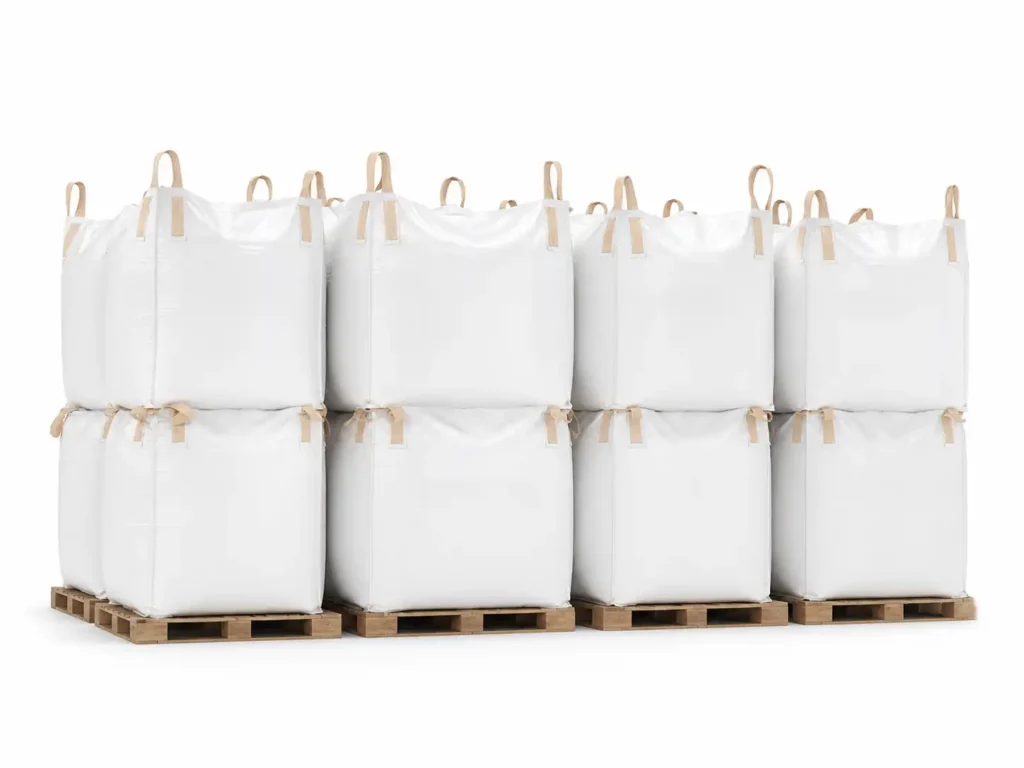
VIDEPAK FIBC Jumbo Bags: A Practical Product Guide to Type B, Type C, Spout Top, Open TOP and Duffle Top Bulk Packaging
Moving hundreds or thousands of kilograms of dry bulk material is not simply a question of finding a bigger bag. It is a question of controlling weight, flow, dust, static electricity, lifting, filling, discharge and storage as one complete packaging system. This is where VIDEPAK fibc jumbo bags are designed to work: as flexible industrial containers that can be matched to the material inside the bag and to the equipment around it.
Flexible Intermediate Bulk Containers are widely used for powders, granules and other bulk solids because their woven polypropylene construction combines high load capacity with a relatively low package weight. Current ISO 21898:2024 covers material, construction, design, type-test and marking requirements for FIBCs used for non-dangerous solid materials, while IEC 61340-4-4 addresses electrostatic classification when static ignition risk must be considered. VIDEPAK offers customizable fibc jumbo bags with different top openings, bottoms, body constructions, lifting systems and electrostatic designs.
Key idea: the right VIDEPAK fibc jumbo bags specification starts with the process, not with the bag. A customer should first ask: What are we filling? How does it flow? Is dust generated? Is the atmosphere flammable? How will the bag be filled, lifted, stored and emptied? Those answers determine whether the practical solution is Type B or Type C, and whether the filling interface should be Spout Top, Open TOP or Duffle Top.
The Engineering Profile of VIDEPAK FIBC Jumbo Bags
VIDEPAK fibc jumbo bags are part of a heavy-duty woven packaging system in which the bag body, lifting loops, seams, filling opening, discharge system and optional liner work together. VIDEPAK publicly lists four main body constructions—U-panel, circular, four-panel and baffled designs—together with four-loop, tunnel-lift, corner-loop and cross-corner lifting configurations. Top choices include Open TOP, Duffle Top, filling-spout systems and flap arrangements; bottom choices include flat, duffle and discharge-spout designs.
This modular approach matters because the same nominal one-ton package can behave very differently depending on what is inside it. Free-flowing polymer pellets can pour through a relatively compact inlet and outlet. Fine mineral powder may need a tighter filling connection, sift-resistant sewing and a liner. Coarse recycling material may require a large opening instead. A combustible powder may make the electrostatic classification more important than almost any other feature.
That is why VIDEPAK approaches fibc jumbo bags as configurable industrial packaging rather than one fixed catalog item. The specification can be adjusted around bulk density, target fill weight, filling-head size, discharge equipment, forklift access, required barrier performance and electrostatic risk. VIDEPAK’s published FIBC information places common Safe Working Loads around 500–2,000 kg, while specialized designs can extend beyond the mainstream range. Common industry safety-factor configurations include 5:1 for single-trip duty and 6:1 for controlled reusable applications, but the final rating must belong to the tested design actually supplied rather than being assumed from fabric weight alone.
The numbers above are useful starting points, not automatic purchase specifications. A 1,000 kg bag for dense mineral powder does not necessarily need the same dimensions, fabric system or outlet as a 1,000 kg bag for light flakes. In the same way, choosing between Type B and Type C cannot be separated from the process environment. Engineering means matching all the parts; good packaging means making those parts work together.
Static-Safety Choice: Type B versus Type C
Electrostatic charge can be generated when powder or granules move through a filling chute, rub against the inner surface of a container or flow out during discharge. The risk is not determined by the material name alone. It depends on the ignition sensitivity of the contents, the possibility of combustible dust, the presence of flammable gas or vapor, the liner system, conductive objects nearby and the way the filling and unloading station is controlled.
IEC 61340-4-4 classifies FIBCs by construction, intended operation and electrostatic performance. Under the IEC definitions, Type B and Type C are fundamentally different approaches: Type B is designed to prevent sparks and propagating brush discharges but is not normally earthed, while Type C uses conductive material or interconnected conductive threads and is designed to remain connected to earth during filling and emptying.
Type B: Low-Breakdown-Voltage Protection Without a Grounding Network
VIDEPAK Type B fibc jumbo bags are designed for applications where a standard non-static-control bag is not sufficient, but where a conductive groundable container is not the required solution. The important distinction is simple: Type B does not work by carrying accumulated charge through a conductive grid to earth. Its electrostatic performance is based on controlling the types of discharge that can occur from the bag material. IEC explicitly distinguishes Type B from conductive FIBCs and notes that it is not normally connected to earth.
In practical manufacturing, low electrical breakdown voltage is associated with controlling propagating brush discharge. Industry specifications commonly reference a breakdown voltage below 6 kV for Type B fabric. Depending on the final construction, this may influence coating, lamination, liner selection and other components because electrostatic classification belongs to the complete tested FIBC design, not simply to the name printed on the label. VIDEPAK’s published technical material likewise describes Type B as a non-conductive polypropylene design with lower breakdown voltage than a basic non-static-control bag.
What Type B does well: it adds an electrostatic safety function without requiring the operating routine of grounding a conductive bag.
What Type B does not do: it does not provide the same grounded charge-dissipation pathway as Type C. Therefore, a buyer should never replace a Type C requirement with Type B merely because both products are described as electrostatic FIBCs.
For procurement teams, the commercial advantage of Type B is not that it is “better” than Type C; it is that it answers a different risk profile. In a suitable application, VIDEPAK Type B fibc jumbo bags can combine familiar woven-PP handling with an electrostatic design intended to suppress specific energetic discharge modes. In an unsuitable application, that same bag may not provide the protection the process requires. The decision must follow the hazard assessment.
The top design can then be selected separately. A Type B bag for a powder line may use a Spout Top to connect closely to filling equipment. A coarser product may work with Duffle Top. An operation prioritizing very broad loading access may consider Open TOP, provided that dust, contamination and electrostatic considerations are compatible with that open interface. Electrostatic class answers one question; top geometry answers another.
Type C: Conductive FIBC Jumbo Bags Designed for Grounding
VIDEPAK Type C fibc jumbo bags take a more direct approach to static charge: conductive elements are built into the FIBC structure so charge can move through the interconnected network toward the designated grounding point. IEC defines Type C as conductive fabric or plastic sheet, or material interwoven with conductive threads or filaments, designed to prevent incendiary sparks, brush discharges and propagating brush discharges when the FIBC is correctly connected to earth.
The grounding step is essential. A Type C FIBC is designed to be connected to earth before filling or emptying begins and to remain connected throughout those operations. The 2018 edition of IEC 61340-4-4 states that the maximum resistance-to-ground limit for Type C was revised to 100 MΩ, or 1 × 10⁸ Ω. This requirement shows why the conductive yarn network, loop construction where applicable, seams, bonding points and final electrical testing all matter.
Safety-critical point: specifying Type C is only half of the solution. The operating system must also provide a reliable ground connection. A conductive FIBC without correct grounding should never be treated as if its intended electrostatic protection were automatically active.
For customers handling combustible powders or operating where static ignition risk is a major concern, Type C can become part of a broader electrostatic control strategy that also includes grounded process equipment, trained operators, compatible liners, controlled transfer equipment and documented procedures. IEC itself places FIBC classification within a larger framework covering labeling, liners, testing, qualification and safe use, rather than treating bag type as a stand-alone safety statement.
A useful way to remember the difference is through contrast: Type B controls specific discharge behavior without a conductive earth network; Type C creates a conductive pathway that depends on grounding. One is not a cheaper copy of the other. One is not a premium version of the other. They are different tools for different electrostatic conditions.
The Filling Interface: Spout Top versus Open TOP versus Duffle Top
After electrostatic class comes a very practical question: how will material enter the bag? VIDEPAK offers multiple top geometries because a loader bucket, a broad gravity chute, a screw feeder and an enclosed powder-filling machine create very different operating conditions. The difference between Spout Top, Open TOP and Duffle Top is therefore much more than appearance. It affects filling speed, dust release, operator access, contamination protection, closure method and compatibility with machinery. VIDEPAK’s published product range identifies these top configurations as core customization options for its fibc jumbo bags.
Spout Top: Controlled Filling for Powders, Pellets and Automated Equipment
A Spout Top places a cylindrical filling tube into the top panel of the FIBC. Instead of leaving the entire bag mouth exposed, the filling tube is connected or positioned around the customer’s filling chute. Material enters through a defined path; after filling, the tube can be tied or otherwise closed according to the design. VIDEPAK describes Spout Top as a preferred interface when customers need controlled machine filling, reduced open exposure and better compatibility with powder-handling systems.
For fine products, this difference can be significant. A broad uncontrolled opening gives displaced air and fines many routes to escape. A correctly sized Spout Top creates a much closer connection to the filler, which can support cleaner transfer when used together with suitable dust extraction, coated fabric, liners and sift-resistant seams. It is especially attractive for powders, cementitious products, food ingredients, chemical powders, plastic pellets and other materials where filling repeatability matters.
However, the phrase Spout Top does not define one universal diameter. The inlet must fit the customer’s actual filling chute. A tube that is too small can restrict flow; a tube that is too large can weaken the quality of the connection and allow more dust to escape. Length also matters because operators need enough material to position, clamp and close the tube without allowing excess fabric to interfere with the product stream.
VIDEPAK specification rule for Spout Top: provide the filling-chute outside diameter, desired spout diameter and length, expected filling rate, product particle size, dust level, liner requirement and closure method. A well-designed Spout Top should fit the process; the process should not have to fight the bag.
A Spout Top can be combined with either Type B or Type C when the electrostatic and mechanical design is properly engineered and tested. This illustrates one of the most important principles behind VIDEPAK fibc jumbo bags: top style and electrostatic classification are independent specification layers that must eventually become one compatible final design.
Open TOP and Duffle Top: Maximum Access versus Access Plus Closure
Open TOP is the simplest filling configuration. The upper body is left fully accessible without a dedicated filling tube, allowing material to be deposited directly into the bag. It works especially well for bulky, coarse or irregular materials and for sites using loaders, buckets, conveyors or wide chutes. VIDEPAK describes Open TOP as a fast, economical option when sealed filling and tight dust control are not priorities.
Open TOP is about freedom of access.
It gives the filling operation the widest practical target area, which is useful for coarse aggregates, recycling streams, stones, large granules and other products that would be awkward to force through a narrow tube. The trade-off is equally direct: the product remains more exposed during and after filling unless another cover system is added.
For a clean indoor line handling low-dust, non-sensitive product, the simplicity of Open TOP can be exactly what the customer needs. There are fewer top components, alignment is easy and loading can be fast. But when the material is dusty, moisture-sensitive or contamination-sensitive, the same openness can become a disadvantage. In other words, what makes Open TOP simple is also what limits it.
Duffle Top sits between the very open geometry of Open TOP and the controlled cylindrical interface of Spout Top. A large tubular skirt is sewn around the top opening. During filling, the skirt can provide broad access; after filling, operators gather and tie it closed. VIDEPAK identifies this arrangement as useful for grains, feed, granules and similar products that need a generous opening but also benefit from closure after filling.
Duffle Top is about flexibility.
It offers much of the filling freedom associated with Open TOP, but the skirt can be gathered after filling. Compared with Spout Top, Duffle Top tolerates larger or less precisely aligned feed openings. Compared with Open TOP, Duffle Top gives the operator a practical way to close the package.
The decision can therefore be expressed as a simple three-part contrast: choose Open TOP when maximum opening and simplicity matter most; choose Duffle Top when broad access and post-fill closure must coexist; choose Spout Top when machine connection, controlled entry and dust management matter most. None is automatically superior. Each is superior in the right process.
From Specification to Production: Building the Complete VIDEPAK FIBC Jumbo Bags System
A successful FIBC project is rarely solved by selecting only Type B, Type C, Spout Top, Open TOP or Duffle Top. These choices are the beginning. The final VIDEPAK fibc jumbo bags design must connect the top, body, bottom, loops, fabric, liner and safety requirements into one manufacturing specification.
Start with the body. Circular construction uses tubular woven fabric and reduces vertical seam count, which can be attractive where simplicity and sift control matter. U-panel construction uses a large U-shaped section plus side panels and offers a useful balance between shape and seam count. Four-panel construction creates a more box-like body and can support good pallet presentation. Baffled FIBCs add internal panels that resist outward bulging, helping the package retain a more cubic shape during filling and storage. VIDEPAK offers these construction families as configurable options rather than forcing every material into one geometry.
Then consider the bottom. A flat bottom is simple and economical where the bag is emptied by tipping, cutting or another one-time method. A discharge spout creates a defined outlet for more controlled flow into a hopper or process vessel. A conical discharge arrangement can assist products that tend to remain in corners or bridge above a standard outlet. A full-opening bottom releases material rapidly and may suit coarse or difficult-flowing loads, but it provides less metering control. VIDEPAK’s public product information lists flat, discharge-spout and duffle-style bottoms among its principal FIBC options.
Next come the lifting loops. Four standard loops remain common because they work with widely used forklift and lifting arrangements. Cross-corner loops can improve fork access because the loops tend to stand in a more accessible position. Tunnel or sleeve-style lifting can make sense where forklift handling dominates the operation. Whatever loop style is chosen, it is part of the load path; therefore loop material, sewing geometry, reinforcement and rated load cannot be treated as decorative options.
A complete specification should answer all of these questions:
- What is the product, bulk density and target fill weight?
- Does the process require Type B or Type C electrostatic performance?
- Is Spout Top, Open TOP or Duffle Top best for the filling equipment?
- Should discharge be controlled through a spout or released rapidly through a larger opening?
- Is a PE liner, coating or sift-resistant seam system required?
- How will the loaded fibc jumbo bags be lifted, palletized, stacked, shipped and stored?
- What tests, labels, standards and documentation must apply to the final design?
Liners deserve particular attention in both Type B and Type C projects. A liner can improve cleanliness, reduce fine-particle leakage and add barrier performance, but it can also change electrostatic behavior. IEC 61340-4-4 therefore includes specific classification and performance requirements for FIBC inner liners rather than treating them as an unrelated accessory. The correct liner must be selected as part of the electrostatic system.
The same system thinking applies to dust. A Spout Top can narrow the filling interface, but top geometry alone cannot turn woven polypropylene into a hermetic package. Fine powders may also require coated fabric, a PE liner, suitable seams and controlled venting. By contrast, Open TOP may be entirely adequate for clean coarse materials where dust and contamination are minor concerns. Duffle Top offers a useful middle position when the customer needs broad filling access and a tieable closure.
The selection process can be visualized as a simple flow rather than a long list of isolated options:
VIDEPAK’s manufacturing and quality-control approach begins with polypropylene raw materials and continues through tape extrusion, weaving, coating where required, cutting, sewing, liner integration, dimensional checks and performance verification. The company states that it uses virgin raw material for its industrial bag programs and applies incoming material checks, fabric and seam inspection, dimensional audits and electrostatic verification where relevant. Its FIBC product pages also describe customization of top pattern, bottom pattern, construction and lifting design.
For non-dangerous-goods FIBCs, ISO 21898:2024 provides the current international framework for materials, construction, design, type testing and marking. For electrostatic applications, IEC 61340-4-4 covers classification, liners, test methods, design requirements, labeling, qualification and safe use. These standards underline an important purchasing principle: a reliable FIBC specification is not just “1,000 kg, white PP.” It should define how the bag is expected to perform.
From a purchasing perspective, the strongest advantage of customized VIDEPAK fibc jumbo bags is the ability to combine these choices instead of accepting them in isolation. A customer can specify a Type B design with Spout Top for one process, while another application may require Type C with conductive construction, a Spout Top, a liner and a controlled discharge outlet. A coarse mineral operation may require neither of those combinations and may instead favor Open TOP. Grain or feed packaging may find Duffle Top more practical.
The VIDEPAK approach in one sentence:
Choose the electrostatic behavior first, the filling interface second, the discharge and handling architecture third, then validate the complete package as one engineered system. That is how Type B, Type C, Spout Top, Open TOP and Duffle Top become useful product choices instead of isolated catalog terms.
For buyers evaluating fibc jumbo bags, the final question should therefore not be, “Which bag is the most advanced?” It should be, “Which design fits our product and our plant?” Type B offers one approach to electrostatic discharge control; Type C offers a conductive, groundable approach. Spout Top favors controlled machine filling; Open TOP favors unrestricted loading; Duffle Top balances a wide opening with a practical closure. Add the right body construction, bottom, lifting loops, fabric, liner and verified load rating, and the result is no longer just a large woven sack. It is a purpose-built bulk handling package.
VIDEPAK develops fibc jumbo bags around that complete-package idea: strong where the load travels, controlled where the product flows, practical where operators interact with the bag, and configurable where one industry differs from another. For industrial minerals, chemicals, agriculture, food ingredients, polymers, construction materials and other dry bulk products, the objective remains the same—fill efficiently, lift safely, transport reliably and discharge predictably.
Anti-Static FIBC Bags For Food Industry
Professional guide for anti-static FIBC jumbo bags applications and safety standards in food packaging industry.
Check More →Anti-Bulge FIBC Jumbo Bags
High-performance anti-bulge FIBC bags with improved weight capacity and sustainable packaging solutions.
Check More →FIBC Jumbo Bags Solutions
Customized FIBC jumbo bag solutions for industrial bulk storage, transportation and packaging needs.
Check More →Type A/B/C/D FIBC Jumbo Bags
Complete introduction of Type A, B, C, D FIBC jumbo bags with specifications and application scenarios.
Check More →The global performance framework most frequently referenced for non-dangerous goods is ISO 21898, which specifies requirements for materials, construction/design, type testing, and marking, and also gives guidance on selection and safe use. Inside that same framework, two terms carry most of the operational meaning:
- Safe Working Load (SWL): the maximum load the FIBC may carry in service (as certified).
- Safety Factor (SF): defined through testing as the integer quotient between the final cyclic top-lift test load and the SWL (rounded down). In other words: the ratio is not marketing; it is rooted in a standard test method.
So when buyers ask, “Is it a 5:1 or 6:1 bag?” what they are really asking is: How much verified margin exists between a rated working load and a standardized test load under cyclic lifting?
Capacity-wise, many mainstream industrial descriptions place common FIBC working ranges around 500–2,000 kg, with heavier-duty designs and special configurations extending higher. A practical example from a one- and two-loop product brochure explicitly states a load range between 500 and 3000 kg for that design family, underscoring that “typical” and “possible” are not the same word.
- VIDEPAK FIBC Jumbo Bags: A Practical Product Guide to Type B, Type C, Spout Top, Open TOP and Duffle Top Bulk Packaging
- The Engineering Profile of VIDEPAK FIBC Jumbo Bags
- Static-Safety Choice: Type B versus Type C
- The Filling Interface: Spout Top versus Open TOP versus Duffle Top
- From Specification to Production: Building the Complete VIDEPAK FIBC Jumbo Bags System
- Construction Options: Top, Bottom, Body Construction, and Lift Loops
- Open TOP Jumbo Bags
- Duffle Top Jumbo Bags
- Spout Top Jumbo Bags
- Flap Top Jumbo Bags
- Flat Bottom
- Discharge Spout Bottom
- Conical Discharge Spout Bottom
- Duffle Bottom
- Body construction: U-panel, 4-panel, tubular/circular, baffled
- Lift loop options: 4 loops, tunnel loops, cross-corner, corner seam, stevedore straps
- Construction decision table: a practical menu view
- Weaving and Material Engineering: How FIBC Fabrics Differ from Standard PP Woven Bags
- Tape geometry and Denier: thickness is a design choice, not a guess
- Weaving method and fabric form: circular woven and beyond
- Conversion and sewing: where the FIBC becomes a structural system
- Static protective weaving: conductive threads, continuity, and the hidden grid
- Comparison table: standard PP woven sacks vs FIBC Jumbo Bags
- Practical specification table: ranges buyers commonly request
Comparison table: Type A–D and UN-certified FIBCs
| Category | Core purpose | What the bag is made to prevent | Grounding required | When it is typically appropriate | Primary caution |
| Type A | Standard bulk handling | No static protection measures | No | Non-flammable products; minimal static ignition risk in environment | Not appropriate where flammable solvents/gases or combustible atmospheres are present |
| Type B | Reduce propagating brush discharge ignition risk | Sparks and propagating brush discharges (via low breakdown voltage design) | Typically no | Certain combustible powder contexts without surrounding flammable vapors/solvents, subject to risk assessment | Not “charge-dissipating”; leakage constraints if uncoated; still sensitive to environment assumptions |
| Type C | Controlled dissipation pathway | Incendiary sparks/brush/PBD when grounded | Yes (during fill/discharge) | Combustible powders and higher-risk environments where grounding can be reliably implemented | Grounding failures can defeat the protection; treat grounding as a verified control |
| Type D | Static protective without grounding | Incendiary sparks/brush/PBD without earth connection | No | Operations where grounding is difficult or error-prone, within stated conditions | Cleanliness/contamination limits; must not be treated as universally compatible |
| UN certified (e.g., 13H1–13H4) | Dangerous goods transport compliance | Passing UN-based design type test + marking + QA regime | Depends on Type A–D if static class also specified | Regulated dangerous goods shipments (packing groups/approvals apply) | Must match exact approval, marking, stacking load, and maximum gross mass requirements |
Construction Options: Top, Bottom, Body Construction, and Lift Loops
If Types A–D answer “static behavior,” construction options answer a broader question: How will this bag behave in your process, with your equipment, with your material? A bag can be electrostatically correct yet operationally wrong—too dusty on fill, too slow on discharge, too unstable on a pallet, too awkward for forklifts, too vulnerable to moisture ingress. Construction is where the bag becomes site-specific.
To keep decisions practical, it helps to think in four modules: top, bottom, body construction, and lift loop architecture.

Open TOP Jumbo Bags
An open top (sometimes called full open top) has no closure mechanism; material is deposited directly and remains exposed after filling. It is generally economical and fast to load, but it sacrifices environmental protection and dust control.
Duffle Top Jumbo Bags
A duffle top provides a full-open access experience during filling while still allowing closure for transport/storage through a skirt-like extension that can be tied off. Industry descriptions emphasize that duffle tops allow full open access to the bag body, and the key distinction versus spout systems is that spouts constrain the opening for more controlled filling.
Spout Top Jumbo Bags
A fill spout (spout top) is designed for controlled, lower-dust filling and equipment compatibility. It is essentially a cylindrical inlet sewn onto the top panel, often tied off after filling. In terminology guidance, a fill spout is explicitly described as an inlet used for filling and designed to fit the customer’s filling chute—this is a detail that matters because “spout” is not one size, and mismatch creates dust, spillage, and stress on seams.
Flap Top Jumbo Bags
A flap top adds a protective cover over the top opening, improving protection against contamination and the elements, and is sometimes paired with closure features (ties, drawstrings, zippers depending on design). Some constructions also combine spouts with additional flaps for extra coverage over a sealed spout.
What is the hidden theme across these top choices? It is not “looks.” It is dust control, contamination risk, fill speed, and equipment interface—four forces pulling in different directions.
Flat Bottom
A plain bottom (flat bottom, no spout) is simple and stable, but often requires cutting to discharge. That makes it economical yet typically single-use in discharge-centric operations.
Discharge Spout Bottom
A discharge spout allows controlled emptying and supports reuse because the bag body is not damaged during discharge. Discharge spout dimensions are frequently customizable; one supplier guide notes typical spout sizing examples (e.g., diameter and length ranges) while emphasizing adjustability to process needs.
Conical Discharge Spout Bottom
A conical discharge spout (or conical bottom discharge concept) is used to improve complete emptying, reducing product hang-up in corners and decreasing the need for shaking or manual persuasion—particularly valuable for powders that bridge or cling.
Duffle Bottom
A duffle bottom / full open bottom is chosen when very fast, full discharge is needed, often in applications where dust control is managed by other means or where the discharge area is engineered for containment.
More advanced closures (iris/star closures, flaps, “pajama” outer covers) exist to tune dust control and flow regulation; bottom-discharge option menus from multiple suppliers show how common these engineered closures are in modern bulk handling.
Body construction: U-panel, 4-panel, tubular/circular, baffled
Body construction is where geometry and stacking performance are decided.
- Tubular/Circular bodies are produced from tubular woven fabric, resulting in fewer side seams. This can benefit sift control and reduce seam-related leakage paths, yet circular bags may bulge more when filled unless designed with loop geometry and/or internal features.
- U-panel designs use panel geometry to improve shape and stability compared to simple tubular profiles, commonly used for heavier or denser products where shape control matters.
- 4-panel designs can offer strong shape retention and stacking efficiency by constructing a more “box-like” profile, often preferred when pallet footprint and warehouse cube utilization are priorities.
- Baffled (Q-bag) constructions add internal baffles to hold a squarer shape when filled, reducing bulging and improving palletization and container loading efficiency.
Even a one- and two-loop product brochure illustrates how construction options are often bundled in real offerings: coated/uncoated choices, liner options, and defined top/bottom constructions.
Lift loop options: 4 loops, tunnel loops, cross-corner, corner seam, stevedore straps
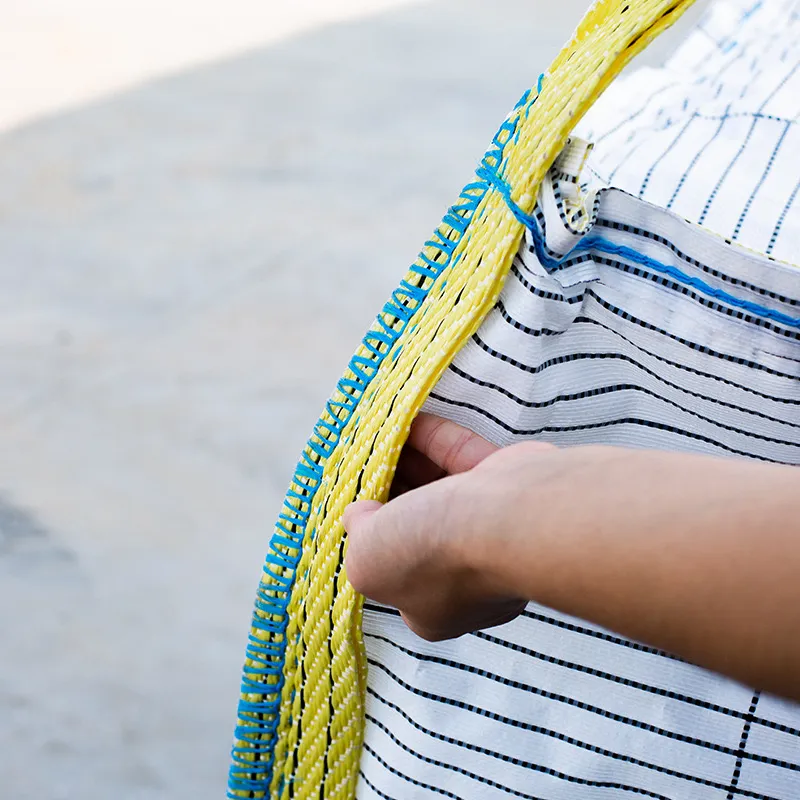
Lift loops are not decoration; they are the load path.
- Standard 4 lift loops (corner seam / loop-over-loop style) are widely used and cost-effective.
- Cross-corner loops keep loops more upright, improving forklift tine access and speed—useful in high-throughput operations, especially for tubular bags where loops might otherwise collapse inward.
- Tunnel (sleeve) loops are practical when forklifts are the exclusive handling method, allowing forks to slide through sleeves formed from body fabric.
- Stevedore straps bridge loops to enable single-point lifting configurations in some dock/container handling contexts.
Every one of these choices answers a different operational “why.” Why faster forklift engagement? Why single-point lifting? Why reduce loop collapse? Why reduce handling time? The loops are where safety, labor efficiency, and equipment compatibility converge.
Construction decision table: a practical menu view
| Module | Option family | What it optimizes | What it can compromise | Good fit when… |
| Top | Open top | Fast filling; low cost | Exposure to elements; limited dust control | Product is non-sensitive, site is controlled, speed matters more than sealing |
| Top | Duffle top | Full access fill + ability to close | Dust control weaker than spout; relies on proper tie-off | Irregular or bulky materials; mixed filling methods; need re-closure |
| Top | Fill spout | Controlled filling; better dust control; equipment interface | Slower manual fill; requires correct spout sizing | Fine powders; automated fill heads; dust-sensitive processes |
| Top | Flap / spout-with-flap | Extra contamination protection | Additional material and handling steps | Outdoor storage; contamination-sensitive products |
| Bottom | Plain / flat bottom | Stability; simplicity; low cost | Often cut-to-discharge; reuse limited | Discharge is rare or speed discharge is acceptable via cutting |
| Bottom | Discharge spout | Controlled discharge; reuse | More components; must manage closure and cleanliness | Regular discharge operations; process control required |
| Contruction | Tubular/circular | Fewer seams; cost efficiency | Bulging unless engineered | Cost-sensitive; certain sift control needs; compatible loop choice |
| Contruction | 4-panel / U-panel | Better shape; stacking | More sewing complexity | Warehouse cube and pallet stability matter |
| Contruction | Baffled | Cube retention; pallet and container efficiency | Higher cost; design complexity | Maximizing container loading; reduced bulge needed |
| Loops | Cross-corner / tunnel / stevedore | Handling speed; equipment match | Wrong choice can slow operations or raise misuse risk | Forklift-only sites (tunnel), high throughput (cross-corner), single-point handling (stevedore) |
Top style distinctions and practical behaviors are described by bulk bag guidance sources. Bottom discharge option sets and typical behaviors are widely outlined in discharge-type guides. Body construction families are commonly listed in FIBC design catalogs. Lift loop categories and use-cases are documented in loop guides.
Weaving and Material Engineering: How FIBC Fabrics Differ from Standard PP Woven Bags
Here is a useful truth—and also a useful provocation: FIBCs and “regular PP woven bags” share the same family tree. Both are typically built from polypropylene resin processed into flat tapes, woven in warp/weft directions, then converted into packaging. So why do they behave so differently in real use?
Because scale changes everything. A 25–50 kg sack and a 1,000 kg bulk bag do not differ by a factor of two; they differ by an order of magnitude. Load paths, seam stress, cyclic lifting fatigue, handling dynamics, and failure consequences all escalate. And so the engineering escalates too.
Tape geometry and Denier: thickness is a design choice, not a guess
In woven PP packaging, denier is a foundational measure: the weight of yarn in grams per 9,000 meters. Higher denier generally means thicker/heavier yarn (or tape), which can translate into higher strength potential—assuming polymer quality, draw ratio, and weave integrity are controlled.
A typical woven bag and fabric specification example (for conventional woven bags/fabrics in the 25–100 kg class) shows tape widths ranging roughly 1.7 to 5 mm (standard cited as 2.5 mm) and denier ranges about 650–2100 D (standard cited as 800 D), with mesh ranges up to 14×14 per inch. That same document explicitly lists bag capacities in the tens-of-kilograms range, which is an important context: these parameters are common for sacks and woven fabrics, not necessarily for 1–2 ton FIBCs.
FIBC fabrics, by contrast, often push toward heavier fabric weights and higher-duty constructions. Supplier specifications for conductive FIBC products commonly list 140–220 GSM fabric as a standard band, and SWL bands from hundreds of kilograms up to multi-ton designs, reflecting the heavier-duty intent.
If you want a more mechanical way to connect these numbers, industry conversions used in woven PP practice often relate GSM, tape width, and denier through simplified formulas (used as practical planning tools in weaving operations). The message is not that one formula rules all; the message is that denier, width, mesh, and GSM are coupled variables—change one, and the fabric’s behavior changes.
Weaving method and fabric form: circular woven and beyond
FIBC manufacturing descriptions commonly outline a sequence: extrusion of PP tapes, weaving on large circular looms into circular woven polypropylene fabric, then lamination/coating as needed, cutting, sewing, and final testing. The same general method exists for many PP sacks, but FIBCs typically employ a heavier-duty optimization of that method: higher fabric weights, reinforcement strategies, and seam specifications engineered around lifting and cyclic stress.
Equipment suppliers also reflect this shared manufacturing base: tape extrusion systems are described as producing tapes used for woven bags and for FIBC fabrics—same core technology, different end-duty requirements.
Conversion and sewing: where the FIBC becomes a structural system
A regular PP woven sack is usually loaded from the top and supported by the ground or stacking; it is not typically lifted by sewn-in loops. An FIBC is. Therefore, seams and loop attachments are engineered as structural elements. Standards and association guidance emphasize that markings should include SWL and safety factor, and that the bag type and certification/traceability elements are part of responsible use.
This is also where FIBCs diverge sharply from many sacks: testing regime. ISO 21898 defines safety factor through cyclic top lift testing relative to SWL, embedding fatigue-like stress into the definition. If you think that is overkill, ask a different question: Would you rather discover weakness in a test bay—or during a 1,000 kg lift over a worker’s foot? The rhetorical answer is the real answer.
Static protective weaving: conductive threads, continuity, and the hidden grid
When FIBCs are Type C, the fabric is interwoven with conductive threads/filaments or constructed from conductive materials, and the design intent is to provide a controlled discharge path—but only if grounded. That means the weave and seam continuity matter in a different way: it is not only tensile strength; it is electrical continuity and verified grounding pathways.
When FIBCs are Type D, the design intent is static protection without grounding, which again shifts material engineering from “how strong is the tape?” to “how does the fabric prevent incendive discharges under stated conditions?”
Comparison table: standard PP woven sacks vs FIBC Jumbo Bags
| Dimension | Standard PP woven sacks (typical) | FIBC Jumbo Bags (typical) |
| Typical load class | Tens of kilograms to ~100 kg class commonly referenced for woven sacks/fabrics | Hundreds of kilograms to ~2,000 kg commonly cited; higher-capacity designs exist |
| Core material path | PP resin → extruded tapes → woven fabric → sack conversion | PP resin → extruded tapes → heavy-duty woven fabric → cut/sew into load-bearing container |
| Tape width & denier | Common spec ranges cited for woven bags/fabrics include ~1.7–5 mm width and ~650–2100 denier (example spec includes “standard” values) | Often engineered toward heavier tapes/fabrics; denier/width/mesh tuned to SWL+SF and application; conductive/static protective elements may be added for Types C/D |
| Fabric weight (GSM) | Varies widely with sacks; woven fabric specs for conventional woven can cover lower GSM bands | Common FIBC product specs frequently cite heavier bands such as ~140–220 GSM for many industrial builds |
| Structural features | Bottom stitch/valve, top hem, sometimes lamination; rarely lifted by sewn-in loops | Lift loops are structural; reinforcement/tramlines, seam specs, and tested safety factors are central |
| Testing and performance language | Often focuses on tensile/tear and stacking for packaged goods | SWL and SF are prominent; safety factor tied to cyclic top-lift tests per ISO 21898; static class per IEC when relevant |
| Electrostatic classification | Usually not classified as A–D for static hazard use | Often explicitly classified as Type A/B/C/D under IEC test methods in static-hazard contexts |
Denier definition and woven-FIBC terminology are described in FIBC terminology/glossary material. Example woven bag tape specification ranges are provided in an industry manufacturer profile. FIBC manufacturing process descriptions and the role of denier/GSM and stress tests are commonly described in FIBC manufacturing guides. ISO 21898 definitions connect safety factor to cyclic top-lift testing. IEC classification defines Type C and Type D fabric intents.
Practical specification table: ranges buyers commonly request
| Specification item | Typical range seen in industry references | What drives the right choice |
| SWL (rated) | ~500–2,000 kg commonly cited; designs up to ~3,000 kg exist | Bulk density, handling method, stacking, regulatory requirements |
| Safety factor | Commonly 5:1 (single trip) and 6:1 (reusable duty); higher factors exist | Use pattern (single vs multiple uses), risk tolerance, customer policy |
| Fabric weight (GSM) | Often ~140–220 GSM for many industrial FIBC builds (examples) | SWL+SF, puncture/tear needs, reuse intent, drop/jerk conditions |
| Body construction | Tubular/circular, U-panel, 4-panel, baffled | Shape retention, stacking, sift control, cost |
| Top openings | Open top, duffle top, spout top, flap systems | Fill method (manual vs automated), dust control, contamination sensitivity |
| Bottom discharge | Plain bottom, discharge spout, conical discharge, full-open styles, iris-like controls | Discharge equipment, dust control, reuse intent, complete emptying requirement |
| Marking | SWL, SF, production info; UN marking fields when dangerous goods | Auditability, compliance, traceability expectations |
Widely cited SWL bands and general “what is a bulk bag” definitions support the 500–2,000 kg mainstream range. Higher-end design examples and multi-loop brochures show extension to 3,000 kg. Fabric GSM bands are demonstrated in common industrial product specifications. ISO and association sources define SWL/SF and marking expectations. Top and bottom option families are documented in bulk bag design guides.