
What Are Custom Printed Woven Bags: Advancements from Traditional Designs to Modern Innovations?
Custom Printed Woven Bags: Advancements from Traditional Designs to Modern Innovations are polypropylene (PP) packaging sacks that merge a high‑tenacity woven backbone with advanced print workflows to deliver rugged handling, fast line performance, and brand‑ready surfaces in one package. In busy plants you may hear other names—PP woven sacks, BOPP‑laminated woven bags, AD‑star/valve woven bags, block‑bottom woven bags, or sewn open‑mouth woven bags—but the core architecture is consistent: oriented PP tapes are drawn and woven into a durable fabric; that fabric is engineered with a PP extrusion coat or a reverse‑printed BOPP laminate to control dust and unlock crisp graphics; and the closure—open‑mouth sewn, heat‑sealed block bottom, or pasted valve—synchronizes with existing fillers.
Why elevate a “bag” to a system? Because the construction supply chain, the food aisle, and the feed mill all demand the same impossible combination: fill fast, seal clean, stack square, carry data, survive weather, look good. Custom Printed Woven Bags: Advancements from Traditional Designs to Modern Innovations exist precisely for this tension—bridging operations and merchandising, safety and speed, strength and storytelling. Read horizontally and you’ll see polymer physics meeting print science and warehouse ergonomics; read vertically and you’ll trace a ladder from resin → tape → fabric → coating/lamination → seam/valve → pallet behavior → route KPIs.
As a quick reference for brand and packaging teams, see also this anchor explainer built around Custom Printed Woven Bags: Advancements from Traditional Designs to Modern Innovations: Custom Printed Woven Bags: Advancements from Traditional Designs to Modern Innovations.
What Are the Features of Custom Printed Woven Bags: Advancements from Traditional Designs to Modern Innovations?
Strength without bulk, stamina without stiffness. Drawn PP tapes (≈700D–1200D) interlace into a fabric that resists tear, puncture, and creep while keeping grammage lean (≈60–110 g/m² for 10–50 kg formats). The physics is simple and elegant: more orientation in the polymer chains yields higher tensile strength per gram, so you move product—not packaging. In the real world that means fewer split corners, fewer rewraps, fewer sighs on the dock.
Print that persuades and performs. Reverse‑printed BOPP films (≈15–25 μm) enable photo‑true imagery—livestock portraits that actually look alive, mortar colors that match the sample board—while high‑line flexography on coated fabric delivers bold hazard icons and machine‑readable IDs. Gloss zones for shelf theatre; matte windows for scanners. On Custom Printed Woven Bags: Advancements from Traditional Designs to Modern Innovations, design is more than decoration: it’s a control panel for people and machines.
Dust and moisture logic, tuned like a recipe. PP extrusion coating (≈18–30 g/m²) closes interstices to reduce sifting; optional liners (LDPE/LLDPE ≈30–90 μm) manage humidity or oil migration. Heat‑welded block bottoms remove needle holes altogether for powders that prefer to stay home; valve sleeves and dust flaps tame the plume at the spout. The horizontal view compares barrier stacks across industries (food, feed, cement), while the vertical view maps barrier choice → seal window → reject rate → housekeeping hours.
Stacking stability, designed not hoped for. Patterned anti‑slip lacquers target a static COF ≥0.4; block‑bottom geometry lowers the center of gravity; tight weave and low creep keep pallets square throughout the route. A quiet trailer is not luck—it’s specification.
Data you can trust under dust and glare. Big 1D/2D codes print flat and scan first‑time; redundant lot/batch IDs on front panel and gusset survive scuffs, rain, and rewraps. As the shop‑floor saying goes: “If it won’t scan, it didn’t happen.” Custom Printed Woven Bags: Advancements from Traditional Designs to Modern Innovations make the audit trail visible.
Sustainability pathways grounded in reality. Mono‑material PP builds (fabric + PP film) align with #5 PP recovery where collection exists; “paper‑look” can be emulated with matte BOPP where fiber recovery isn’t practical. Using lighter fabrics at equal strength trims upstream resin tonnage—a vertical win from pellet to pallet.
Rhetorically, put it this way: not heavier, but tougher; not louder, but clearer; not costlier, but smarter. That’s the promise embedded in Custom Printed Woven Bags: Advancements from Traditional Designs to Modern Innovations.
What Is the Production Process of Custom Printed Woven Bags: Advancements from Traditional Designs to Modern Innovations?
Pellet discipline (chemistry meets throughput). Virgin PP with a stable melt‑flow index (≈2–4 g/10 min at 230 °C/2.16 kg) is compounded with UV/process stabilizers. Clean pellets widen the processing window: fewer tape breaks, cleaner films, and tighter register downstream—proof that quality upstream pays rent downstream.
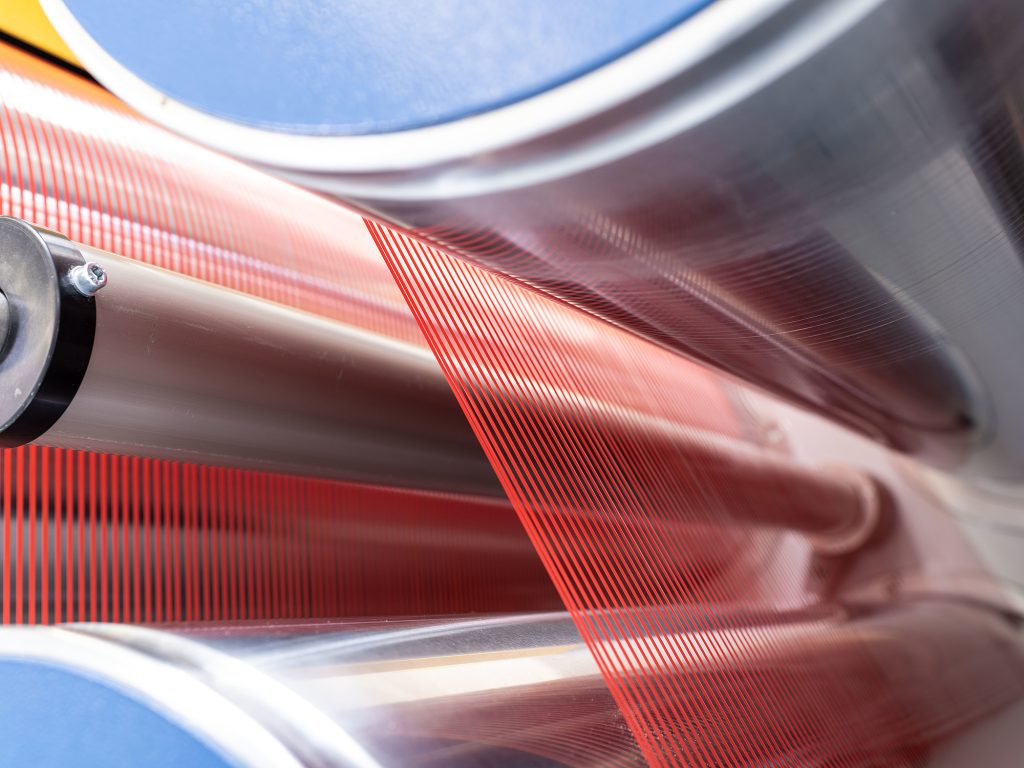
Tape extrusion & orientation (make the muscle). PP is extruded as a thin sheet, slit to tapes, and drawn ≈5–7× to align polymer chains. Narrow denier distribution produces consistent tape widths—the bedrock for even fabric GSM and predictable seam bite. Horizontal logic links polymer orientation to tear energy; vertical logic links draw ratio → fabric evenness → seam performance → drop test outcomes.
Weaving on circular/flat looms (build the grid). Tapes interlace at ≈10×10–12×12 picks per inch for mainstream 20–50 kg builds; heavy‑duty programs tighten toward ≈12×12–14×14. Flatness and clean selvedges govern lamination quality and the squareness of finished bags. VidePak’s loom fleet ensures tension holds steady across shifts, so Custom Printed Woven Bags: Advancements from Traditional Designs to Modern Innovations remain calm all the way to packing.
Surface engineering (close the window, open the stage).
- PP extrusion coating (≈18–30 g/m²) seals the fabric window for anti‑sifter performance and establishes a generous heat‑seal range.
- BOPP lamination (≈15–25 μm, reverse‑printed) adds photo‑true graphics and abrasion resistance while preserving woven toughness. Matte/gloss pairs help both cameras and eyes.
Printing & artwork control (signals that steer). Coated fabrics run high‑line flexography (up to 6 colors) for rugged icons and data carriers; BOPP laminates support rotogravure (often 8–10 colors) for small type and halftones. Register is held so quiet zones around 1D/2D codes remain matte and unvarnished. The goal: “scan on first pass” as a measurable KPI.
Conversion & closures (geometry equals behavior). Tubing and cutting define length; bottom formation completes the body:
- Heat‑welded block bottom for sift‑proof stability and shelf‑friendly cubics.
- Pasted valve (AD‑style) for high‑speed dosing and auto‑closing flaps.
- Sewn open‑mouth (chain stitch with filler cord) for mixed‑mode operations and rugged lanes.
Quality gates (boringly predictable beats exciting). Grammage by roll; raveled‑strip tensile and seam strength by lot; COF before/after anti‑slip; drop tests (≈1.2 m multi‑cycle for 25–50 kg packs); barcode/QR legibility under dust and LED glare; UV aging where outdoor staging is likely. Only calm inputs yield calm pallets—especially for Custom Printed Woven Bags: Advancements from Traditional Designs to Modern Innovations in export lanes.
To explore core fabric choices that underpin Custom Printed Woven Bags: Advancements from Traditional Designs to Modern Innovations, see: Custom Printed Woven Bags: Advancements from Traditional Designs to Modern Innovations.
What Is the Application of Custom Printed Woven Bags: Advancements from Traditional Designs to Modern Innovations?
Staple foods & dry ingredients. Rice, flour, sugar, pulses, starches—materials that punish weak seams and reward sift‑proof closures. Block‑bottom with liners keeps moisture steady; large barcodes and high‑contrast nutrition panels keep receiving honest. Cross‑industry link: food labeling demands legibility standards that also improve industrial traceability.
Feeds & agri‑inputs. Poultry, cattle, and aquafeeds plus fertilizers and seeds need abrasion resistance and clean dosing. Custom Printed Woven Bags: Advancements from Traditional Designs to Modern Innovations stand upright in tall stacks, take forklift scrapes in stride, and present stage cues (starter/grower/finisher) that reduce pick errors.
Chemicals & minerals. Resins, masterbatches, salts, gypsum, mineral fillers—tight weaves and tuned coatings make docks less dusty. Vertically, that reduces housekeeping hours; horizontally, it aligns EHS goals with line efficiency.
Construction materials. Dry mortar, cement, silica sands—valve‑type block‑bottom formats accelerate fills and lock in cubics. Anti‑slip bands and low‑creep fabric keep pallets composed over long, bumpy routes.
Retail & e‑commerce. Reusable woven shoppers and mailers marry matte/gloss effects with rugged handles and machine‑readable IDs. The bag is both billboard and barcode; both story and spec.
Across all of these, the refrain repeats: product physics → bag spec → machine settings → pallet map → route performance. Break one link and the song falls apart; specify Custom Printed Woven Bags: Advancements from Traditional Designs to Modern Innovations correctly and the whole choir stays in tune.
VidePak at a Glance — Capacity Behind Custom Printed Woven Bags: Advancements from Traditional Designs to Modern Innovations
Founded in 2008, VidePak’s core leadership brings over 30 years of on‑the‑floor packaging experience. Today, 568 colleagues operate a global‑grade equipment bench—more than 100 circular looms, 16 extrusion lines, and 30+ lamination/printing machines—from industry leaders such as Germany’s W&H and Austria’s Starlinger. We work exclusively with virgin raw materials, support high‑coverage multi‑color artwork, and serve the United States, Europe, Brazil, South America, Southeast Asia, Japan, South Korea, Central Asia, the MENA Region, East Africa, and South Africa. Annual sales are near USD 80 million. The practical outcome for Custom Printed Woven Bags: Advancements from Traditional Designs to Modern Innovations: reliable schedules, disciplined color, and specification fidelity from pilot to program.
**Technical Parameters — Custom Printed Woven Bags: Advancements from Traditional Designs to Modern Innovations
The bands below consolidate realistic, orderable specifications that appear across reputable converters and sourcing platforms. Treat them as a tuned starting brief; we adjust to product rheology, climate, and handling method.
| Parameter | Typical Options / Ranges for Custom Printed Woven Bags: Advancements from Traditional Designs to Modern Innovations |
|---|---|
| Net Capacity | 10 kg, 15 kg, 20 kg, 25 kg, 40 kg, 50 kg |
| Typical Bag Size (L × W × Bottom/Gusset) | 50 × 32 × 12 cm (20 kg); 55 × 35 × 12 cm (25 kg); 60 × 40 × 14 cm (40 kg); 70 × 47 × 15 cm (50 kg) |
| Fabric GSM (uncoated) | ≈60–110 g/m² (heavier toward 50 kg or abrasive fills) |
| Weave Density | ≈10×10 to 12×12 picks per inch (up to ≈14×14 heavy‑duty) |
| Tape Denier | ≈700D–1200D (fine‑yarn options ≈500–800D for tighter weaves) |
| Coating Weight | PP extrusion ≈18–30 g/m² (anti‑sifter, heat‑sealable) |
| Lamination Film | BOPP ≈15–25 μm (reverse‑printed; matte/gloss) |
| Printing Routes | Flexography up to 6 colors (coated fabric); Rotogravure up to 8–10 colors (BOPP) |
| Liner Options | LDPE/LLDPE 30–90 μm; inserted or liner‑through‑valve |
| Anti‑Slip (COF) | Target static COF ≥0.4 via patterned lacquer bands |
| Venting | Micro‑perforations on non‑seal panels where de‑aeration is required |
| Drop Test (guide) | Typical pass ≈1.2 m, multi‑cycle (specify by SKU and lane) |
| UV Stabilization | Optional packages ≈150–200 kLy for outdoor staging |
Figures are indicative, not idealized; they mirror what buyers of Custom Printed Woven Bags: Advancements from Traditional Designs to Modern Innovations routinely order for food, feed, chemical, and construction programs.
Printing & Artwork Guidance for Custom Printed Woven Bags: Advancements from Traditional Designs to Modern Innovations
- Reserve matte quiet zones around 1D/2D codes; scanners prefer calm backgrounds to glossy glare.
- Use large pictograms (species, safety, handling) for instant recognition at distance; language changes, icons travel.
- Align register to cut length so lot/batch IDs don’t lose their heads at the guillotine; duplicate critical IDs on a gusset for redundancy.
- Zone anti‑slip away from codes; keep gloss where retail needs sparkle and matte where operators need a read.
These micro‑decisions sound small; they move mountains—of inventory, of confidence, of time saved.
How to Specify Custom Printed Woven Bags: Advancements from Traditional Designs to Modern Innovations
Begin with four blunt questions. What’s the product’s bulk density and particle size? How moisture‑ or oil‑sensitive is it over storage time? What’s the harshest handling event—fast valve fill, tall stack, long export? What must the label survive—dust, rain, LED glare? With those answers in hand, we’ll set GSM, weave, denier, coating/lamination route, closure style, liner gauge, and anti‑slip plan. Then we’ll validate on your line—seal temperature, dwell, pressure; drop and vibration—so Custom Printed Woven Bags: Advancements from Traditional Designs to Modern Innovations behave on day 90 exactly as they did on day one.
If you’d like a quick pathway from conversation to trial, brief us on product rheology, target pack weights, and lane profiles; we’ll return a tuned spec, a pallet map, and a short run plan built around **Custom Printed Woven Bags: Advancements from Traditional Designs to Modern Innovation
- What Are Custom Printed Woven Bags: Advancements from Traditional Designs to Modern Innovations?
- What Are the Features of Custom Printed Woven Bags: Advancements from Traditional Designs to Modern Innovations?
- What Is the Production Process of Custom Printed Woven Bags: Advancements from Traditional Designs to Modern Innovations?
- What Is the Application of Custom Printed Woven Bags: Advancements from Traditional Designs to Modern Innovations?
- VidePak at a Glance — Capacity Behind Custom Printed Woven Bags: Advancements from Traditional Designs to Modern Innovations
- **Technical Parameters — Custom Printed Woven Bags: Advancements from Traditional Designs to Modern Innovations
- Printing & Artwork Guidance for Custom Printed Woven Bags: Advancements from Traditional Designs to Modern Innovations
- How to Specify Custom Printed Woven Bags: Advancements from Traditional Designs to Modern Innovations
Custom printed woven bags have transformed packaging across industries, offering robust, versatile, and customizable solutions. This evolution has been driven by the need to package products such as flour, sugar, spices, and food additives in ways that ensure durability, compliance, and branding efficiency. These bags stand out for their superior performance, enabled by advanced materials and manufacturing techniques.
Tailored Applications Across Food Ingredients
1. Flour and Powdered Ingredients
Flour requires leak-proof packaging to prevent spillage and contamination. Woven bags with food-grade PE liners ensure product safety while maintaining structural integrity under heavy loads. The addition of lamination offers moisture resistance, crucial for storage in humid conditions. Block-bottom designs enhance stacking efficiency, providing stable transport.
2. Sugar and Granular Materials
Granular materials like sugar demand moisture-resistant packaging to prevent clumping. Smooth inner linings reduce friction, ensuring seamless filling and discharge during processing. Laminated woven bags with UV-resistant coatings are ideal for protecting the sugar from environmental factors during extended outdoor storage.
3. Spices and Additives
Spices and food additives require airtight, durable packaging to retain flavor and aroma. High-resolution, multi-color printing on these bags facilitates detailed product information and branding. Laminated layers and UV-resistant coatings protect the product from light and moisture degradation, essential for maintaining quality during long-term storage.
| Ingredient | Key Requirements | Features Provided |
|---|---|---|
| Flour | Leak-proof, moisture resistance | Food-grade liner, lamination, block bottom |
| Sugar | Anti-clumping, UV protection | Smooth lining, laminated outer layer |
| Spices & Additives | Airtight, branding efficiency | Multi-layer lamination, high-resolution printing |
Innovations in Custom Printed Woven Bags
1. Advanced Printing Technology
State-of-the-art flexographic printing allows multi-color, high-resolution designs, ensuring branding visibility and compliance with labeling standards. This printing method uses durable inks that remain vibrant under extreme conditions, enhancing the professional appearance of the product.
2. Block Bottom and Valve Designs
Block-bottom designs provide a stable base, optimizing storage and stacking. Valve closures enable efficient filling and sealing, especially for automated systems. These features not only streamline logistics but also minimize spillage and material waste during handling.
3. Material Advancements
Woven bags now incorporate laminated films and UV-resistant coatings, significantly enhancing durability. These advancements reduce the risk of wear and tear, making the bags ideal for bulk transport and long-term storage.
Choosing the Right Packaging Parameters
Selecting the appropriate woven bag specifications depends on the product’s requirements and storage conditions.
| Parameter | Specification |
|---|---|
| Thickness | 80–120 GSM for heavier loads or outdoor use |
| Lamination | Ensures moisture resistance, crucial for powdered or granular products |
| Inner Liner | Food-grade PE liner for added hygiene and protection |
| Size | Customizable dimensions, typically 25–50 kg |
| UV Coating | Essential for products stored outdoors for prolonged periods |
Sustainability and Global Standards
Sustainability is a growing focus in woven bag manufacturing. Recyclable materials and compliance with regulations such as ISO and FDA are critical for market competitiveness. Companies like VidePak prioritize eco-friendly solutions without compromising on quality or performance. Additionally, the compatibility of woven bags with automated systems enhances operational efficiency and reduces manual intervention.
FAQs About Custom Printed Woven Bags
1. Are woven bags safe for food packaging?
Yes, food-grade liners and compliance with international standards ensure safety and hygiene.
2. How can I protect products during outdoor storage?
Use laminated bags with UV-resistant coatings to guard against sunlight and moisture.
3. Can I customize bag size and printing?
Absolutely. Woven bags are highly customizable in size, color, and printing to suit branding and logistical needs.
4. What is the load capacity of these bags?
Woven bags typically handle 5 to 50 kg, depending on the weave density and thickness.
Conclusion
Custom printed woven bags represent a sophisticated blend of durability, functionality, and aesthetic appeal. They cater to diverse requirements in food packaging, ensuring safety, compliance, and branding. Innovations in materials, printing, and design have elevated these bags to meet modern logistical challenges while aligning with sustainability goals.
Learn more about custom printed woven bags and explore innovative packaging solutions to transform your product’s packaging approach.