
What is Woven Fabric Bags?
Woven Fabric Bags—also called woven PP fabric bags, polypropylene woven fabric sacks, or simply PP woven bags—are engineered containers built by interlacing oriented polypropylene (PP) tapes into a robust fabric, then finishing that fabric to suit the job: left uncoated when breathability matters, extrusion‑coated when dust and humidity must be tamed, or laminated (e.g., BOPP film or kraft composite) when abrasion resistance and premium print are non‑negotiable. In everyday terms, the fabric bears the load, the finish steers the environment, and the closure seals the deal. Are Woven Fabric Bags meant for retail polish or industrial grit? For both—because modern packaging must sell on the shelf, survive on the route, and stack in the warehouse without drama.
Viewed through a wider technical lens, Woven Fabric Bags stand where three disciplines meet. Polymer science influences tape draw ratio, crystallinity, and surface energy—factors that decide tensile modulus, sealability, and ink anchorage. Textile mechanics governs mesh density, tape denier, and creep behavior under pallet compression. Conversion precision shapes hem geometry, stitch architecture, valve design, and registration control. Compare laterally with neighboring formats and the trade‑offs become obvious: multi‑wall paper offers a warm aesthetic yet wilts in humidity; mono‑film PE FFS tubes fly on high‑speed lines but can creep in tall stacks; rigid bins defy abuse but punish freight and storage budgets. Woven Fabric Bags reconcile these tensions—delivering pallet‑grade stability and clean machinability inside a recyclable PP monomaterial platform. For a fuller category view, see Woven Fabric Bags.
What is the features of Woven Fabric Bags?
Features matter only when they neutralize real failure modes: powder sifting at stitch lines, pallets leaning in summer heat, labels scuffing on conveyors, moisture sneaking in during a monsoon. The architecture of Woven Fabric Bags is therefore a playbook of countermeasures, not a brochure of buzzwords.
Laminated PP Woven Bags
High-standard woven fabric bags with strict quality control to maintain stable performance and consistency.
Check More →Polypropylene Woven Bags
Premium PP woven fabric bags manufactured with standardized processes for reliable quality output.
Check More →PP Woven Fabric Bags Analysis
In-depth analysis of woven fabric bag materials, craftsmanship and overall quality consistency standards.
Check More →BOPP Laminated PP Woven Bags
Composite woven fabric bags with systematic quality management for long-term stable specifications.
Check More →Strength‑to‑weight efficiency that compounds value. Drawn PP tapes (typically 700D–1000D) woven to meshes such as 8×8–14×14 translate low resin mass into high tensile and tear performance. Orthogonal load paths resist tear run‑on from corner impacts and restrain creep under prolonged compression—so towers stay square, not sway.
Barrier tuning without sacrificing runability. Uncoated fabrics breathe—useful for hot fills or products that off‑gas. PE/PP extrusion coats (≈ 18–30 g/m²) moderate humidity and dust while providing a clean print base; BOPP films (18–25 µm) or kraft laminations shield artwork and add scuff resistance. Loose or tubular PE liners (20–40 µm) confine hygroscopic goods (sugar, salts, fertilizers) and curb odor transfer. Moisture out, flowability in.
Closures matched to the filler, not the other way around. Sewn open‑mouth (single/double fold; chain or lock stitch) supports manual to semi‑auto lines and rough routes. Valve formats (gravity/air/impeller) deliver speed with dust discipline in pneumatic zones. Pinch‑top designs provide stitch‑free hermeticity and retail‑clean edges. Mouth geometry, stitch density, and thread selection (PP/HDPE) are tuned to particle size, fat content, and target drop energy.
Stacking safety by design, not by luck. Anti‑slip emboss or spray targets COF ≈ 0.45–0.70, helping columns stay square with less wrap. Block‑bottom and gusseted bodies improve cube and shelf‑standing behavior, which in turn lowers side‑loads on closures—because a seal that isn’t stressed is a seal that doesn’t fail.
Graphics, traceability, and compliance that travel well. High‑linecount CI flexo up to 6 colors on coated fabrics or gravure under BOPP prints crisp logos, nutrition panels, hazard icons, microtext, and QR/2D codes. Color ΔE is controlled lot‑to‑lot so your brand hue on pallet one matches pallet one‑hundred‑one.
Sustainability levers that actually move. As monomaterial PP systems, Woven Fabric Bags can align with established recycling streams where available. Downgauging via fine‑filament tapes reduces resin per unit. Print‑under‑film extends bag re‑use in non‑critical cycles. For non‑food programs, controlled rPP content can be engineered while safeguarding mechanical targets. Reduce, retain, reuse—without retreating on performance.
What is the production process of Woven Fabric Bags?
Turning a drawing into dependable pallets is choreography; each upstream decision echoes downstream as line speed, seal integrity, and stack behavior. The steps below highlight where capability today becomes stability tomorrow.
1) PP tape extrusion & drawing. Virgin PP is extruded into a thin film, slit into narrow tapes, and hot‑drawn to align polymer chains. Draw ratio governs tensile strength and elongation; controlled quench and anneal lock tape width and crystallinity. Anti‑fibrillation additives minimize yarn “hairiness,” which otherwise invites wicking paths and fuzzy print edges.
2) Weaving on circular/flat looms. Over 100 circular looms interlace warp and weft to target meshes—e.g., 8×8–14×14—at sack fabric weights ≈ 60–120 g/m². Balanced loom tension limits skew, delivering flat webs that convert cleanly and print in register. In heavier shells (e.g., FIBC components), GSM rises (often 140–240 g/m²) and meshes tighten for tensile headroom.
3) Coating & lamination. A PE/PP melt curtain (≈ 18–30 g/m²) bonds to the fabric for humidity moderation and dust control. Where photo‑quality branding or extra abrasion resistance is needed, reverse‑printed BOPP (18–25 µm) or kraft is laminated under monitored adhesion windows—too cool starves bonds; too hot relaxes fabric or mutes film gloss.
4) Printing. Corona‑treated surfaces accept high‑linecount CI flexo or gravure. Registration is stabilized by tension‑controlled paths; ΔE targets keep brand color true; barcodes, PLUs, and micro‑icons are verified to remain machine‑readable after conversion. Compliance isn’t an afterthought—it’s designed in at plate and anilox.
5) Conversion & closures. Fabric is cut; gussets and block‑bottoms are formed; bottoms are sewn or folded; valve sleeves are inserted; pinch‑top mouths are prepared for heat activation at the filler. Anti‑slip textures and EZ‑open tear strings can be integrated without disturbing seam geometry. Stitch architecture (chain/lock), seam allowances, and mouth folds are matched to product granularity and target drop energy.
6) Quality assurance. Routine tests verify fabric tensile/tear, seam strength, COF, lamination peel, dimensions, and filled‑bag drop/stack performance. Where dust control or weatherability are critical, sift tests (using representative powders <75 µm) and spray/drip exposure cycles are executed. Repeatability—held in documented process windows—turns drawings into dependable pallets.
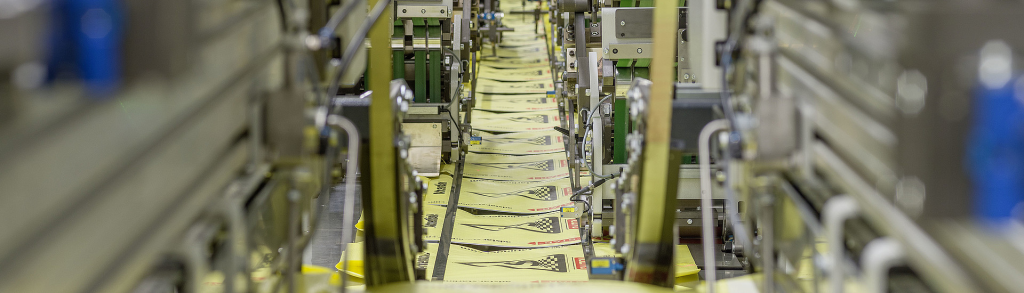
VidePak executes this sequence on industry‑top platforms from W&H (Germany) and Starlinger (Austria)—a capacity base of 16 extrusion lines, 100+ circular looms, and 30+ lamination/printing machines—so adhesion, registration, and seam integrity sit inside measured, repeatable windows.
What is the application of Woven Fabric Bags?
Because Woven Fabric Bags combine mechanical grit with configurable faces, they perform across sectors where packaging must sell, shield, and stack—often in the same shift and the same store.
Fertilizers & agro‑inputs. Urea, NPK blends, MAP/DAP, SOP/MOP, seeds, micronutrients: liners reduce caking; UV‑stabilized builds endure yard exposure; valve options keep fillers fast and dust‑disciplined. When climates swing and depots sweat, barrier stacks are dialed for regional humidity.
Cement & construction blends. Dry mortar, tile adhesives, gypsum: abrasion‑tolerant faces with anti‑slip backs hold pallets square from silo to site. Block‑bottom formats stand upright for clean warehouse picks; pinch‑top variants guard against dust when the worksite is windy.
Grains, flour & food staples. Rice, flour, sugar, starches: micro‑perfs (where specified) vent hot fills; reverse‑printed films keep nutrition panels legible; low‑odor inks respect organoleptics. The result is tidy aisles and predictable stock rotation.
Animal nutrition. Pet food and livestock/poultry feeds marry photo‑grade branding with puncture‑tolerant woven cores. Optional liners temper oil migration and aroma in high‑fat rations; matte‑over‑gloss effects create tactile shelf cues that customers notice and remember.
Minerals, salts & chemicals. Salt, calcium carbonate, TiO₂, silica: laminated faces curb scuff; sift‑proof seam options protect conveyors and air quality. In coastal logistics, coating grammage is tuned to resist humidity ingress during marine legs.
Recycling & municipal services. Open‑top, color‑coded builds streamline sorting; block‑bottom formats stand neatly in totes and resist roll‑off on conveyors. Icons remain readable because ink sits protected under film, not exposed to abrasion.
Across the US, Europe, Brazil & South America, Southeast Asia, Japan, Korea, Central Asia, the MENA Region, East & South Africa, VidePak tunes the controllable levers—mesh/GSM for tear paths, coating weight for humidity, UV package for sunlight, COF for stacking—to match your route and climate.
Typical Parameters for Woven Fabric Bags
The ranges below reflect widely available, real‑world specifications; VidePak supports application‑specific customization.
| Parameter | Typical Range / Option | Notes (for Woven Fabric Bags) |
|---|---|---|
| Fabric mesh | 8×8 – 14×14 | Strength/printability balance |
| Fabric weight (GSM) | 60 – 120 g/m² (sacks); 140 – 240 g/m² (heavier shells) | Selected by fill weight & drop targets |
| Tape denier | 700D – 1000D | Correlates with tensile & puncture resistance |
| Coating weight | 18 – 30 g/m² (PE/PP) | Dust & humidity moderation; print base |
| Lamination film | BOPP 18 – 25 µm or kraft composite | Photo‑quality face; scuff resistance |
| Bag width | 350 – 650 mm | Common bodies for 10 – 50 kg SKUs |
| Bag length | 500 – 1,100 mm | Tuned to bulk density & filler setup |
| Mouth/closure | Sewn OM / Valve / Pinch‑top | Choose speed vs. hermeticity vs. dust control |
| Bottom style | Sewn flat / Block‑bottom / Valve | Standing fill vs. conveyor handling |
| Liner options | PE 20 – 40 µm (loose/tubular) | Moisture & aroma control for hygroscopic goods |
| COF (stacking) | ≈ 0.45 – 0.70 | Anti‑slip emboss/spray to target window |
| UV stability | 200 – 400 h | Package tuned to outdoor exposure |
| Printing | Flexo up to 6 colors; Gravure 8–10 with BOPP | Registration‑controlled branding |
| Load capacity | 5 – 50 kg | Depends on GSM, seams, and safety factor |
Why VidePak
Founded in 2008, VidePak’s core team brings 30+ years of woven‑packaging experience and a workforce of 568. We manufacture Woven Fabric Bags alongside BOPP woven, valve, and kraft‑paper composite ranges using 100% new raw materials to stabilize mechanical properties and color outcomes. Our platform—W&H printers/converters and Starlinger tape & loom lines—spans 16 extrusion lines, 100+ circular looms, and 30+ lamination/printing machines. With annual sales around USD 80 million and a shipping footprint that covers the US, Europe, Brazil & South America, Southeast Asia, Japan, Korea, Central Asia, the MENA Region, East & South Africa, we turn specifications into pallets that behave exactly as drawings promise.
Ready to validate a spec, reduce dust, or raise pallet stability? Share your dimensions, fill weights, line speeds, climate profile, and storage conditions—we’ll engineer Woven Fabric Bags to match or outperform your reference pack and provide the data to prove it.
- What is Woven Fabric Bags?
- What is the features of Woven Fabric Bags?
- What is the production process of Woven Fabric Bags?
- What is the application of Woven Fabric Bags?
- Typical Parameters for Woven Fabric Bags
- Why VidePak
Woven fabric bags are indispensable in agricultural packaging due to their superior durability, moisture resistance, and customizability, making them an ideal solution for products like flour, rice, and grains. VidePak’s rigorous quality control, advanced manufacturing techniques, and sustainability-focused innovations ensure that every bag meets the highest standards of performance and reliability.
Introduction
Agricultural packaging demands solutions that can withstand the rigors of storage, transportation, and marketing while preserving product quality. Woven fabric bags have become a preferred choice, offering a unique combination of strength, adaptability, and eco-friendliness. VidePak, a leader in the woven bag industry, delivers state-of-the-art solutions tailored to diverse agricultural needs, ensuring both functionality and brand enhancement.
The Role of Woven Fabric Bags in Agricultural Packaging
Woven fabric bags provide an efficient and reliable solution for packaging agricultural goods. Their multi-functional design caters to a wide range of needs, from protecting sensitive products to promoting brand visibility.
Key Benefits of Woven Fabric Bags
- Durability: High tensile strength materials prevent tears and ruptures, even under heavy loads.
- Moisture Resistance: Laminated layers shield products like rice and flour from humidity.
- Customization: Sizes, thickness, and branding can be tailored to meet specific client requirements.
Material Selection and Functional Design
Selecting the right materials is crucial for ensuring optimal bag performance. VidePak offers various options designed to meet specific packaging requirements.
Material Options
- Polypropylene (PP): Lightweight yet durable, ideal for large-scale agricultural use.
- Laminated PP: Provides an added layer of protection against moisture and contamination.
- Inner Liners: Optional polyethylene liners enhance airtight sealing for products requiring extra care.
Product Parameters
| Feature | Options | Advantages |
|---|---|---|
| Thickness | 60–120 GSM | Balances durability and weight efficiency |
| Bag Size | Customizable (e.g., 25 kg, 50 kg) | Suitable for various agricultural goods |
| Lamination | Optional | Shields contents from moisture and dust |
| Inner Liner | Optional | Improves protection for sensitive products |
Quality Control: A Foundation of Excellence
VidePak ensures every woven fabric bag meets rigorous quality standards, combining international certifications with in-house testing protocols.
Key Quality Control Metrics
- Tensile Strength Testing: Ensures bags can handle heavy loads without tearing.
- Seam Inspection: Verifies the integrity of stitching or sealing to prevent leaks.
- Lamination Check: Confirms uniformity and adhesion for moisture resistance.
Testing Standards
VidePak adheres to ISO 21898 and other relevant standards for packaging materials, conducting regular tests to ensure compliance. Random batch testing further minimizes defects and maintains high product consistency.
Custom Printing: Merging Functionality with Branding
Woven fabric bags do more than protect; they serve as a mobile advertising platform. VidePak offers advanced printing technologies to enhance brand visibility.
Printing Technologies
- Flexographic Printing: Ideal for high-volume production with clear, bold prints.
- Rotogravure Printing: Delivers high-definition images, perfect for premium branding.
Example: A rice exporter in Southeast Asia increased brand recall by 30% after switching to high-definition rotogravure printing on VidePak’s woven bags.
Sustainability and Innovation
VidePak incorporates the latest industry trends to meet evolving market demands for sustainability and technological integration.
Sustainability Initiatives
- Recyclable Materials: Bags are made from polypropylene, a fully recyclable material.
- Energy-Efficient Production: VidePak’s facilities utilize solar-powered machinery, reducing carbon emissions by 30%.
- Eco-Friendly Packaging: Optional biodegradable liners cater to environmentally conscious customers.
Learn more about VidePak’s commitment to sustainable packaging solutions.
Smart Packaging Integration
The future of woven fabric bags lies in incorporating smart features such as QR codes and RFID tags. These technologies enhance supply chain traceability, ensuring transparency and efficiency.
Case Study: A grain supplier in Europe adopted RFID-enabled woven bags, reducing inventory errors by 40% and improving customer satisfaction.
Logistical and Storage Advantages
Woven fabric bags streamline logistics and storage with their lightweight, stackable design and reusability.
- Efficient Storage: Stackable design minimizes warehouse space.
- Durability in Transit: Reinforced seams and sturdy materials protect contents during shipping.
- Cost Efficiency: Reusability reduces packaging costs over time.
FAQs
Q: How can I choose the right woven bag for my product?
A: Consider factors like product weight, moisture sensitivity, and storage conditions. For instance, laminated bags are better for moisture-prone environments.
Q: Can the bags be customized for branding?
A: Yes, VidePak offers multi-color printing and custom designs to align with your branding needs.
Q: What thickness is ideal for heavy agricultural products like rice?
A: A thickness of 100–120 GSM ensures durability and prevents tears during transportation.
Q: Are VidePak’s bags eco-friendly?
A: Absolutely. They are made from recyclable materials and can include biodegradable liners upon request.
Conclusion
Woven fabric bags are an essential component of agricultural packaging, offering unparalleled durability, functionality, and branding opportunities. VidePak’s expertise in material selection, quality control, and sustainability ensures that clients receive reliable and innovative packaging solutions tailored to their needs. Whether for rice, flour, or other agricultural products, VidePak’s woven fabric bags combine superior performance with eco-conscious design, setting a new standard for the industry.
For more information on advanced woven bag solutions, visit VidePak’s innovative packaging services.