
Polyethylene (PE) and polypropylene (PP) are two closely related polyolefin polymers with many similarities, but also important differences in structure, properties, and applications. Both are made from petroleum- or gas-derived monomers (ethylene vs. propylene), but even the single extra –CH₃ group in propylene profoundly changes PP’s characteristics. Which material is “better” depends entirely on the application: each has its strengths. Below we compare PE and PP in terms of production, materials and properties, and uses, with special emphasis on heavy-duty industrial bags (multi-layer PE film bags vs. BOPP-laminated PP woven bags).
Production Processes and Raw Materials
Both polyethylene and polypropylene start as simple gas monomers cracked from hydrocarbons. Polyethylene is formed by polymerizing ethylene (C₂H₄). LDPE (low-density PE) is typically made by a high-pressure free-radical process, producing a branched, flexible polymer. HDPE (high-density PE) and LLDPE (linear LDPE) use catalysts at lower pressure to make mostly linear chains, yielding a denser, tougher polymer. Polypropylene is polymerized from propylene (C₃H₆), usually via Ziegler–Natta or metallocene catalysts. Commercial PP is often isotactic (ordered –CH₂–CH(CH₃)– units), giving it high crystallinity and a higher melting point.
In simple terms, the raw materials differ by one carbon and two hydrogens, and their polymerization methods differ (radical vs. catalytic). PE’s linear or lightly branched chains contrast with PP’s methyl-substituted chains. Both plastics are recyclable thermoplastics. All production routes involve extrusion or molding equipment. (As a trivia aside, the Beatles even wrote a song “Polythene Pam” in praise of polyethylene!) In practice, ethylene usually comes from steam cracking of ethane or naphtha, and propylene is often a by-product of petroleum refining. Both are then polymerized into pellets or blown into films.
Material Properties and Performance
Structural and Physical Differences
Even though PE and PP are chemically similar (long carbon–hydrogen backbones), the extra –CH₃ side-group in PP makes a big difference. PE chains are simply –CH₂–CH₂– links, while PP chains are –CH₂–CH(CH₃)–. Polypropylene’s methyl side-groups prevent the chains from packing quite as closely, yet cause PP to crystallize differently. The result: PP typically has lower density (~0.90–0.92 g/cm³) than HDPE (~0.94–0.97 g/cm³) and LDPE (~0.91–0.93 g/cm³). In other words, PP is somewhat lighter by volume. More importantly, PP’s structure gives it higher stiffness and melting point, whereas PE tends to be more flexible and impact-resistant.
A useful analogy: imagine molecular chains as beads on a string. Polyethylene is like a uniform string of identical beads (–CH₂– units), whereas polypropylene adds a little extra bead (–CH₃) on every other link. That extra “bead” makes the PP chain stiffer and harder to melt. Indeed, PP can withstand higher temperatures – it melts around 160 °C, while HDPE melts ~130–137 °C and LDPE ~105–115 °C. This explains why PP is chosen for hot-fill containers or dishwasher-safe parts, whereas PE is favored for cold conditions (PE stays tough even down to –80 °C, whereas PP becomes brittle near 0 °C).
Mechanical and Thermal Properties
Polypropylene is generally stronger and stiffer: PP has a higher tensile modulus and strength than equivalent PE. For example, a drawn PP fiber or film may reach 30–40 MPa tensile strength, while LDPE film is often under 12 MPa. Xometry notes that PP is “more rigid and has a higher melting point than polyethylene”, which is why PP is used in ropes, automotive parts, and any application needing rigidity. Polyethylene grades (especially LLDPE/LDPE) are much more ductile and tough. A thin LDPE bag can stretch and absorb impact like a rubber band, while a PP film will tend to spring back or even crack under extreme bend. In practice, this means PE films flex and stretch, whereas PP films and fabrics hold their shape.
Impact resistance shows the opposite trend: PE (especially LDPE/LLDPE) is better at absorbing shocks and resisting tears at low temperature, whereas PP is more prone to notch cracking in the cold. This is why LDPE stretch-wrap and garbage bags can absorb rough handling, and HDPE crates are tough, while PP might fracture if frozen.
Chemical and Environmental Resistance
Both PE and PP are chemically inert to many substances, but PP has a slight edge against solvents and high heat. Polypropylene resists organic solvents (ketones, gasoline, etc.) better than PE. Neither polymer dissolves in water or acids. Polyethylene is a bit more UV-sensitive (it yellows and cracks under sun unless stabilized) and is more flammable (ignition ~343 °C) compared to PP (ignition ~360 °C). In heat, however, PP holds up far beyond PE. Both are FDA-approved for food contact, but only PP can safely endure hot-fill or steam sterilization without softening.
Electrically, PE is a better insulator but tends to build static charge, while PP dissipates charge a bit better. In any case, both polymers do not corrode like metals when in contact with acids or bases. They do require additives for UV/oxidation resistance in outdoor use.
Property Comparison Summary
Table 1 highlights key differences:
| Property | Polyethylene (PE) | Polypropylene (PP) |
|---|---|---|
| Density | HDPE ~0.94–0.97; LDPE/LLDPE ~0.91–0.93 g/cm³ | ~0.90–0.92 g/cm³ |
| Melting Point | HDPE: 130–137 °C; LDPE: 105–115 °C | ~160 °C |
| Stiffness | Relatively low (floppy film); improves with density | Higher (stiffer sheets/fabrics) |
| Tensile Strength | HDPE ~20–30 MPa; LDPE ~8–12 MPa | ~30–40 MPa (often higher than similar PE) |
| Impact Resistance | Very high (especially LDPE/LLDPE, even below 0 °C) | Moderate (brittle near freezing) |
| Chemical Resistance | Good to acids/bases; moderate to solvents | Very good to solvents and acids |
| Heat Resistance | Good to ~80–100 °C (above that softens) | Good to ~120–140 °C (melts ~160 °C) |
| UV Stability | Low (needs stabilizers) | Better (still needs additives) |
| Flammability | More flammable (ignite ~343 °C) | Less flammable (ignite ~360 °C) |
| Weld/Seal | Heat-seals very well (films, bags) | Heat-seals (often needs higher temp or adhesives) |
| Recyclability | Recyclable (PE #4 for LDPE, #2 for HDPE) | Recyclable (PP #5) |
| Cost | Generally inexpensive; feedstock-dependent | Comparable (often slightly cheaper than PE) |
Table 1: Key property differences between common polyethylene and polypropylene grades (data from polymer references).
Common Applications of PE and PP
Because of these properties, PE and PP often appear in different roles. Polyethylene is ubiquitous in films and soft packaging: grocery/shopping bags (LDPE), stretch film (LLDPE), food wraps, bottles and containers (HDPE), pipes, cable insulation, and plastic lumber. Its flexibility and ease of sealing make it ideal for thin films. Polypropylene finds use in rigid products and fabrics: dishwasher-safe containers, automotive trim, piping, battery cases, fibers (ropes, carpets), and colored films (BOPP snack wrappers). For example, LDPE is used for stretch wrap and trash bags, while PP is used for microwavable meal trays and strong woven sacks. PP’s higher melting point and stiffness also make it suitable for rope and tapes (carpet fiber, twine).
In packaging, both plastics can overlap: both make bottle caps, bags, and box liners. But their differences guide the choice. For instance, HDPE excels in chemical drums, whereas PP is chosen for industrial fibers. Xometry notes that PP “can withstand higher temperatures” and is “more rigid” than PE, which is why PP is used in applications like ropes and rigid containers. In contrast, PE’s flexibility and clarity make it first choice for cling film and squeezable bottles.
Industrial Packaging Bags: PE vs. PP
For 5 kg+ industrial bags (bulk sacks for foods, feed, cement, chemicals, etc.), two formats dominate:
- Multi-layer Co-Extruded Polyethylene Bags: These are heavy-duty plastic bags made from a blown-film extrusion of multiple PE layers. Different polyethylene resins are co-extruded together to create a layered film. For example, one layer might be soft LDPE for sealing, a middle layer of HDPE for strength, and an outer LLDPE or EVA blend for toughness. The co-extruded film can be blown into a tube or sheet and then sealed into bags. Because all layers are polyethylenes, the bag is a single material (fully recyclable) but with engineered properties.
- This multi-layer PE bag excels in puncture and tear resistance. VIDEPAK emphasizes that their multi-layer valve bags “exhibit remarkable tear and puncture resistance” and long shelf-life. In practice, a coex PE bag can resist sharp edges and abrasion (from sand or rocks), and its heat seals make it leak-proof and moisture-resistant. Heavy-duty PE bags are made with high-performance resin via an “advanced multi-layer co-extrusion” process, yielding bags with uniform thickness and very high durability. These bags often include a fill valve or are form-fill-seal (FFS) tubes, allowing bulk powders (cement, chemicals, flour, fertilizer) to be filled with minimal spillage. They can incorporate venting, anti-slip embossing, and multi-color printing. Advantages: Strong polyethylene film, seamless welds, customizable barrier layers (for moisture or gas), excellent puncture resistance, smooth surface for printing, and fully recyclable (single polymer). Typical Uses: Cement, chemicals, minerals, grains, and any application where a heavy-duty plastic bag with a tight seal is needed.
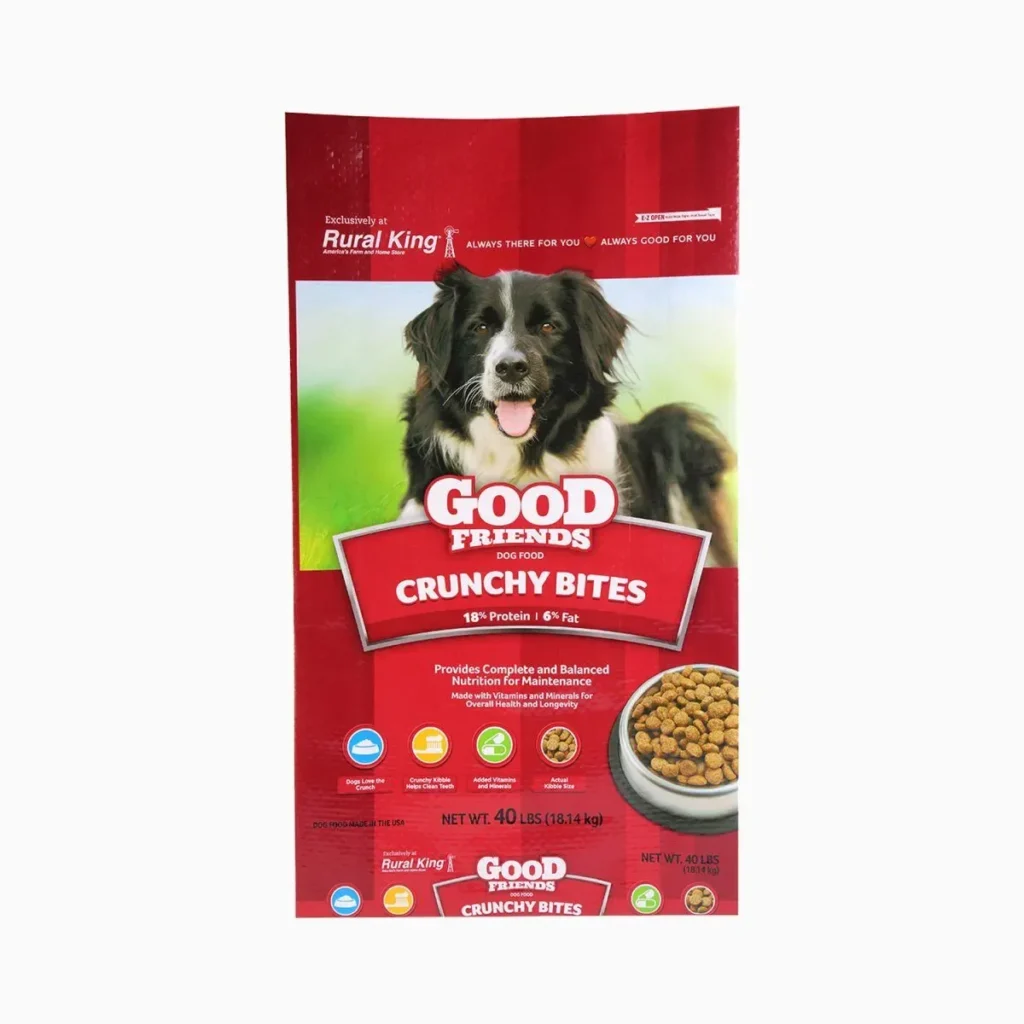
- BOPP-Laminated Polypropylene Woven Bags: These start with a woven fabric made from PP tapes, which on its own is extremely strong. The woven PP (often 15–30 g/m² tapes) gives the bag its base tensile and tear strength. A BOPP (biaxially-oriented PP) film is then laminated onto one or both faces of the fabric. BOPP film is a stretched PP film that is strong, clear, and has excellent printing properties. The lamination bonds the film to the fabric, creating a composite bag. The result is a rigid, printable, and heavy-duty bag. HomPak describes BOPP-PP woven bags as meeting “high-stiffness” requirements, with excellent puncture resistance and moisture resistance. The laminated film provides a bright, smooth surface for high-resolution graphics and brand logos. These bags typically have sewn or hemmed edges (often taped over) and can carry very heavy loads (commonly 25–50 kg, depending on fabric strength). These bags are “tough as nails” and ideal for bulk packaging because they handle rough treatment while showcasing colorful prints.Advantages: Extremely high tensile strength (via woven PP fabric), outstanding print quality (vibrant, multi-color on BOPP), good moisture barrier (BOPP film is water-resistant), rigid shape, and recyclable (all PP). Typical Uses: Animal and pet foods, grains, rice, salt, sugar, fertilizers, seeds, chemicals – anywhere a tough branded bag is needed.
Comparison: Multi-layer Co-Extruded PE Bags vs. BOPP PP Woven Bags
| Feature | Multi-layer Co Extruded PE Bags | BOPP-Laminated PP Woven Bags |
|---|---|---|
| Base Material | Polyethylene film (3–5 coextruded layers of HDPE/LDPE/LLDPE/EVA) | Polypropylene fabric + PP film (BOPP) laminate |
| Construction | Blown or cast film, heat-sealed into bags | Woven PP tape, laminated with PP film, sewn seams |
| Strength | Very high tear and puncture resistance (film form) | Very high tensile (woven strength) and stiffness |
| Puncture Resistance | Excellent (engineered multi-layer toughness) | Good (woven fabric resists sharp edges) |
| Barrier | Very good moisture/air barrier; can include specialty layers | Good moisture barrier (BOPP); limited gas barrier |
| Sealing | Heat-sealed edges (monolayer film) | Sewn/taped edges (tape covers stitches) |
| Print Quality | Good (flexo printing on film, typically 1–3 colors) | Excellent (up to 10-color gravure on smooth film) |
| Stiffness (Empty bag) | Flexible (bag walls collapse when empty) | Rigid (bags stand up on conveyor) |
| Recyclability | Recyclable as PE film (single-material bag) | Recyclable as PP (single-material bag) |
| Typical Weights | 20–50 kg bag capacities (film strength dependent) | 25–50+ kg bag capacities (woven strength) |
| Common Uses | Powders, chemicals, minerals, cement, FFS valve bags | Grains, feed, seeds, fertilizer, pet food, sand |
The table shows that multi-layer PE bags and laminated PP bags both serve heavy packaging needs but in complementary ways. PE film bags emphasize sealed, tear-resistant film performance; PP woven bags emphasize raw strength and print quality. The choice depends on the product and filling process.
Choosing the Right Bag Material
With these differences in mind, how does a user decide between multi-layer PE or BOPP-PP woven bags? The answer depends on multiple factors:
- Contents & Load: For fine powders (cement, chemicals), a leak-proof PE valve bag may be ideal. For coarse, sharp, or very heavy loads (rock salts, agricultural seeds), the tensile strength of a PP woven bag is advantageous.
- Moisture/Gas Barrier: If you need hermetic sealing (e.g. to keep moisture or oxygen out), multi-layer PE can be engineered with barrier layers. If you mainly need to shed external moisture, a BOPP-coated PP bag offers good water resistance.
- Filling Equipment: Valve-filling machines and FFS lines work seamlessly with PE tubular and valve bags. High-speed bagging lines with sewing heads are designed for open-mouth PP woven sacks.
- Printing and Branding: PP woven bags with BOPP lamination support high-resolution, multi-color printing that can carry marketing graphics (up to 10 colors). PE film bags can be printed but typically use fewer colors and may look less vibrant.
- Environmental Conditions: PP woven bags handle high heat and UV a bit better; PE bags handle cold and impact better. For example, if bags might freeze in transit, PE is safer; if bags sit in a hot warehouse, PP might last longer.
- Recyclability & Sustainability: Both are single-polymer and recyclable in the polyolefin streams. Some buyers favor one based on local recycling capabilities or recycled content policies, but both rank similarly in “green” terms (both FDA/food-approved).
- Cost: PP resin is often slightly cheaper per kg, and woven bags are lighter per volume. However, PE bag liners or extra thickness may be needed for some heavy loads, potentially offsetting cost differences.
In practice, manufacturers weigh all these. As one industry saying goes, the choice isn’t about “winner” vs. “loser” but “right tool for the job.” For instance, a fertilizer producer might use thick laminated PP sacks for retail branding, but use multi-layer PE valve bags for bulk shipments of powder. A cement plant might switch from multi-wall paper sacks to coex PE bags to cut dust, while a pet food company stays with printed PP sacks for shelf appeal.
In summary: Polyethylene and polypropylene each offer a distinct profile: PE film bags give excellent flexibility, seal integrity, and impact resistance, whereas PP woven bags give exceptional stiffness, strength, and printing quality. By matching the polymer’s properties to the product and process requirements – as shown in the tables and discussion above – a user can select the optimal heavy bag material for any given application.