
What are Block BOPP Bags?
Block BOPP Bags are BOPP‑laminated, woven‑polypropylene (PP) sacks engineered with a square, brick‑like base that lets the pack stand upright like a box and stack like a pro on pallets. In daily use you’ll also hear block‑bottom BOPP woven bags, BOPP block‑bottom valve bags, square‑bottom PP woven sacks, or 5‑panel BOPP woven bags—different labels for the same design intent: a tough woven PP body clad in vivid, printable BOPP film, converted into a stable, boxy silhouette that behaves as container, billboard, and silent merchandiser. Are these merely bags? Or are they shape, structure, and story in one? For brands chasing premium presence and dependable handling, Block BOPP Bags answer with a confident, square‑shouldered yes. For a broader context on construction and finishing options, see Block BOPP Bags.
Laminated BOPP Woven Bags
Versatile BOPP laminated packaging bags with diverse styles and aesthetic design options.
Check More →Printed BOPP Woven Bags
Custom printed BOPP bags with rich aesthetic choices for differentiated packaging solutions.
Check More →Custom Printing BOPP Bags
Stylish BOPP packaging bags with personalized aesthetics and multi-scene application value.
Check More →BOPP Laminated PP Bags Analysis
In-depth introduction of block BOPP bags and multi-type aesthetic packaging solutions.
Check More →Horizontally, the concept sits at the intersection of polymer science, surface engineering, and retail merchandising; vertically, its logic ladders from resin selection → tape orientation → weave architecture → lamination finish → print control → bottom forming → pallet behavior. Each tier constrains—and enables—the next, so a small change in denier, laminate thickness, crease geometry, or stitching recipe can ripple into big gains in shelf stability and transit performance. That’s why converters and brand owners treat Block BOPP Bags as a platform to be tuned rather than a SKU to be purchased.
What are the Features of Bl
ock BOPP Bags?
Shelf‑stable, pallet‑efficient geometry. The block bottom creates a self‑standing pack that resists bellying, side‑bow, and face collapse. Aisles look tidier, pallet cubes are predictable, and end‑caps retain their crisp facings. A bag that looks like a box—without the cost, weight, or curbside complexity of a box.
High‑impact printing across 4–5 panels. Rotogravure or tight‑tolerance flexo lays down up to 8–10 colors with continuous wraparound artwork. Go high‑gloss for vibrancy, choose matte for a refined paper‑touch look, or combine matte‑and‑gloss for contrast. Add spot tactile varnish for grip cues or use metallized BOPP for shimmering accents. Prefer truth in packaging? Integrate a transparent window so the product itself shares the stage.
Strength without bulk. Woven PP fabric—often in the ~70–160 g/m² band for retail builds—delivers tear and burst resistance for 5–25 kg fills. Reinforced constructions with heavier fabric or double‑fold bottoms push higher. The BOPP skin adds scuff resistance and print protection without a penalty in tare weight. In short: lighter on resin, not lighter on duty.
Valve or open‑mouth versatility. Block BOPP Bags ship in open‑mouth versions (heat‑cut or hemmed) for conventional filling as well as valve formats (internal or external patch valve) for faster, cleaner fills on automated lines. EZ‑open tear tapes, carry handles, and reclose features support consumer convenience—seconds saved per pack add up to hours per shift.
Barrier and breathability—tuned, not guessed. Clear or white BOPP films (typically ~18–30 µm) and/or PP coatings moderate moisture vapor transmission; micro‑perforation supports respiration for grains and seeds; anti‑slip finishes stabilize stacks during transport. Engineering detail turns into commercial dividend when bags arrive unscuffed, stacks stay true, and products keep spec.
Regulatory and sustainability alignment. Mono‑material PP constructions (BOPP‑on‑PP) simplify conformity documentation and improve recyclability perception where infrastructure exists. Food‑contact builds specify virgin PP with appropriate declarations; inks and adhesives are screened against restricted‑substance lists. Sustainability here is not a slogan but a set of upstream choices: downgauged fabrics, mono‑material laminations, and reuse where supply chains allow.
Process stability at scale. Tight weave density, controlled coat‑weights, precise creasing and bottom forming, and reliable registration are maintained on high‑end conversion lines. Variability down; predictability up. Your artwork prints true, your seams pull strong, your pallets travel well.
Read horizontally, these attributes blend materials engineering, surface science, and retail psychology. Read vertically, they cascade into a clear cause‑and‑effect chain: adjust denier → alter seam pull; tweak film thickness → change scuff and gloss; refine crease/bottom geometry → stabilize stand‑up performance. In other words: design with intent, and Block BOPP Bags will repay the favor in‑market.
What is the Production Process of Block BOPP Bags?
Resin & additive selection. Food‑grade SKUs specify virgin PP with Declarations of Compliance; industrial SKUs may incorporate recycled PP where standards permit. Pigments and masterbatches are vetted against restricted‑substance lists. Where a window is desired, clarifying packages reduce haze; where outdoor storage is expected, UV stabilizers extend fabric life.
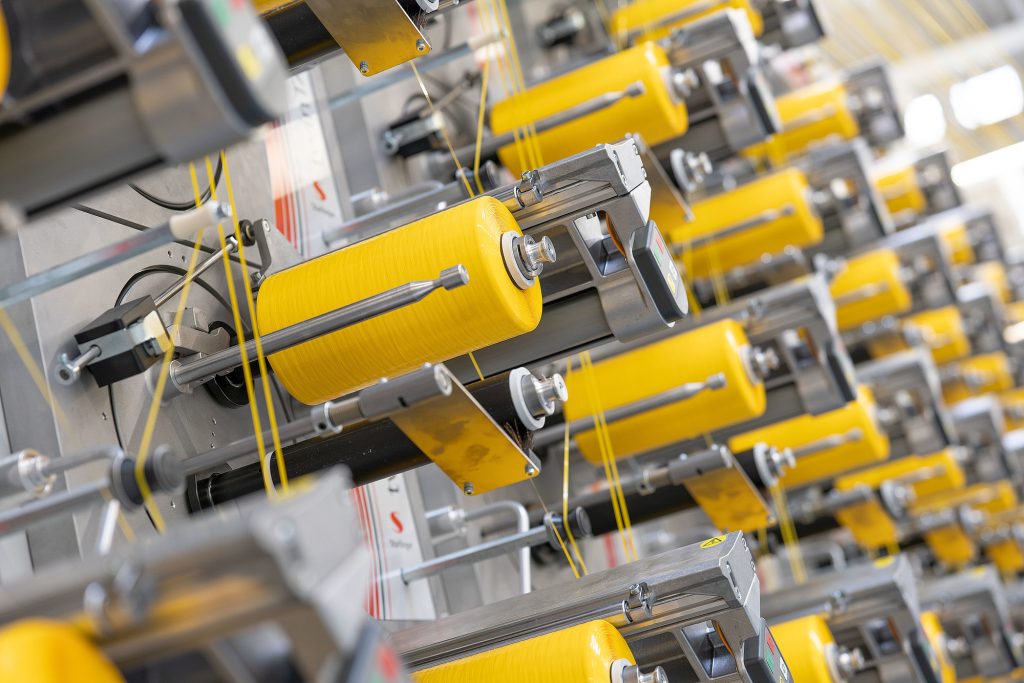
Extrusion & tape stretching. PP resin is melted, cast into film, slit into tapes, and drawn to orient polymer chains. Orientation boosts tensile strength and modulus without proportional weight gain—why Block BOPP Bags can be durable without being heavy. The microstructure is invisible to the shopper but evident in drop tests and seam pulls.
Weaving. Circular or flat looms interlace warp and weft to a target mesh (e.g., 10×10 to 14×14). Denser meshes yield smoother print faces and more uniform lamination; looser meshes trade some smoothness for pliability and breathability. The weave is the skeleton; get it right and everything that follows has a better chance of going right, too.
Lamination (BOPP) or PP coating. BOPP film (typ. ~18–30 µm) is laminated onto the woven fabric to create a printable, scuff‑resistant face. Finish options include high‑gloss, matte, registered matte‑gloss, metallized effects, and clear windows. Where a simpler build suffices, PP coating delivers moisture moderation with a lighter process footprint.
High‑resolution printing. Rotogravure cylinders or high‑line‑count flexo plates deliver consistent color density, crisp microtext, and barcode fidelity. Reverse printing behind BOPP shelters artwork from rub; spot effects fine‑tune the brand’s tactile signature. Printing is not decoration alone—it is persuasion and compliance wrapped together.
Cutting, creasing, gusseting, and bottom forming. Tubes are cut to length, side gussets are set, precision creases define the block bottom, and the base is formed—either sewn or hot‑melt pinch closed as the application dictates. For valve builds, patch type and orifice diameter are matched to filling line pressures and product rheology.
Conversion finishing & QC. EZ‑open tapes, anti‑slip coatings, and handle die‑cuts are integrated before palletization. Dimensional checks, seam pull tests, rub/abrasion tests, and drop tests validate performance. Pallet patterns are optimized to resist stack creep and fork‑shock. Traceability (roll IDs, lot codes) ties every shipment to its process history.
From an operations vantage, extrusion and weaving prefer steady cadence, while printing and conversion flex to artwork rotations and lot sizes—a push–pull hybrid that rewards clever scheduling. In export corridors where deadlines move but vessels don’t, orchestration matters as much as resin grade.
What is the Application of Block BOPP Bags?
Pet food & specialty feed. The block bottom creates a self‑standing retail pack; the BOPP face carries photo‑quality imagery; optional windows reveal kibble geometry or grain length. EZ‑open features reduce frustration at home, which is another way of saying they increase perceived quality.
Seeds, grains & rice. Micro‑perforation supports respiration; square‑bottom geometry improves pallet stability; high‑resolution print communicates varietals, origin, and agronomic claims. When accuracy is audited at the shelf, a window tells the truth quickly.
Fertilizers & soil amendments. Valve versions speed fills while reducing dust; anti‑slip exteriors tame aggressive pallet moves; scuff‑resistant faces keep hazard pictograms legible after long hauls. Safety signage that survives the journey is not optional—it’s essential.
Construction materials (tile adhesives, dry mixes). The brick‑like profile stacks securely and survives abrasive yards. Reinforced seams and robust pinch or sewn bottoms withstand drop tests and forklift bumps.
Resins & additives. Clear windows (where appropriate) help operators confirm pellet color or grade without opening packs. Stable stacks and clean barcodes ease warehousing and inventory audits. What’s faster than cutting a bag open? Not cutting it open at all.
Across these sectors the mandate repeats: stand straight, print beautifully, travel safely. Within plants the integration is practical: straightforward changeovers, consistent register, predictable pallet behavior. Block BOPP Bags make the shelf look better and the warehouse run smoother—and that’s a commercial outcome you can measure.
Key Technical Parameters (Typical Ranges)
| Parameter | Typical Range / Options |
|---|---|
| Product | Block BOPP Bags (BOPP‑laminated PP woven; block/square bottom; open‑mouth or valve) |
| Capacity window | Retail 5–25 kg common; reinforced builds up to ~40–50 kg depending on spec |
| Fabric basis weight | ~70–160 g/m² for retail builds; up to ~200 g/m² for heavy‑duty |
| Mesh density | 10×10 to 14×14 (warp × weft) typical for block‑bottom formats |
| BOPP film | ~18–30 µm; gloss, matte, registered matte‑gloss, metallized, or windowed |
| Printing | Up to 8–10 colors (rotogravure/flexo); reverse print recommended under BOPP |
| Structure | 4‑ or 5‑panel wrap; side‑gusseted tube; back seam or lap seam as required |
| Top options | Heat‑cut or hemmed open‑mouth; patch valve (internal/external); EZ‑open tear tape |
| Bottom options | Sewn block bottom or hot‑melt pinch bottom; reinforced fold options |
| Liner | Optional PE liner (loose or tubular) for powders/moisture barrier |
| Add‑ons | Anti‑slip finish, micro‑perforation, UV stabilizer, handle die‑cut, tactile varnish |
Why VidePak: Founded in 2008, VidePak’s core team brings 30+ years of field experience. With 568 employees and global coverage (US, Europe, Brazil, South America, Southeast Asia, Japan, Korea, Central Asia, MENA, East & South Africa), we run top‑tier equipment from Germany’s W&H and Austria’s Starlinger to keep weave density, coat‑weights, registration, and bottom forming on spec. Using all‑new raw materials and offering full customization with multi‑color printing, our capacity—over 100 circular looms, 16 extrusion lines, and 30+ lamination/printing machines—supports consistent quality and reliable lead times for Block BOPP Bags, contributing to annual sales around USD 80 million.
- What are Block BOPP Bags?
- What are the Features of Bl
- What is the Production Process of Block BOPP Bags?
- What is the Application of Block BOPP Bags?
In the fast-evolving world of packaging, Block BOPP bags have emerged as a versatile and highly functional solution across various industries. Whether you’re packaging food, chemicals, or agricultural products, these bags provide a reliable, durable, and customizable option. The beauty of Block BOPP bags lies not only in their physical functionality but also in their ability to be tailored for different aesthetic requirements, making them a top choice for businesses looking to enhance their brand appeal while maintaining efficiency and sustainability.
What Are Block BOPP Bags?
Block BOPP bags are woven polypropylene bags that have been laminated with BOPP (Biaxially Oriented Polypropylene) film. The “block” term refers to the way these bags are designed— with a square or rectangular bottom that allows for stable stacking, making them an ideal choice for bulk packaging. The combination of woven polypropylene with BOPP film offers a high level of strength and barrier properties, providing both durability and protection for a wide range of products.
Features and Advantages of Block BOPP Bags
Block BOPP bags come with a host of features that make them highly desirable for different applications. These include:
| Feature | Benefit |
|---|---|
| Durability | High resistance to tearing and puncturing, ensuring secure packaging. |
| Customizability | Available in various sizes, colors, and printing options to match branding. |
| Moisture and Dust Resistance | BOPP film provides an effective barrier to moisture, dust, and UV rays. |
| Eco-friendly | Recyclable and often made from sustainable materials. |
| Cost-effective | Offers a low-cost solution without compromising quality. |
| Efficient for Bulk Packaging | Square bottom design ensures efficient stacking and easy transport. |
These bags are designed to meet the needs of industries requiring robust, secure packaging that also allows for creative and customized design.
Types of Products Best Suited for Block BOPP Bags
Block BOPP bags are used in a variety of sectors, each benefiting from the unique properties of the material. Below are some common applications:
- Agricultural Products
Block BOPP bags are widely used in packaging seeds, grains, fertilizers, and animal feed. Their durable structure helps prevent damage during transport and storage, while their resistance to moisture ensures the integrity of agricultural products. - Food Packaging
For the food industry, Block BOPP bags provide a high-quality packaging solution that preserves the freshness of products like flour, sugar, rice, and snacks. The moisture resistance of the BOPP film is crucial in keeping food products safe from environmental factors. - Chemical and Industrial Packaging
The durability and strength of these bags make them an ideal solution for packaging chemicals, powders, and other industrial materials that require robust protection against external elements. - Retail and Consumer Goods
Block BOPP bags are also used for packaging consumer goods like pet food, detergents, and other retail items. Their ability to be printed with intricate designs allows brands to create visually appealing packaging that stands out on shelves.
Aesthetic Customization Options
One of the standout features of Block BOPP bags is their potential for customization. The BOPP lamination provides a smooth surface that is perfect for high-quality printing, which is essential for companies looking to incorporate their brand identity into their packaging. Here are some key aesthetic options:
- Multi-color Printing
BOPP bags can be printed in vibrant, multi-color designs, offering a dynamic canvas for logos, product information, and brand messaging. The lamination allows for crisp, clear graphics that won’t fade or smudge easily. - Transparent and Semi-transparent Designs
For products that benefit from visibility, Block BOPP bags can be manufactured with transparent or semi-transparent windows. This allows consumers to view the contents, which is particularly useful for products like rice, pasta, or pet food. - Matte or Glossy Finishes
Depending on the desired look, Block BOPP bags can have either a matte or glossy finish. A glossy finish enhances color vibrancy, while a matte finish offers a more subdued, elegant look. - Custom Shapes and Sizes
Block BOPP bags can be produced in various shapes and sizes to accommodate specific product requirements. Whether you need a larger bag for bulk items or a smaller one for retail, these bags can be tailored to fit.
Benefits of Using Block BOPP Bags
1. Sustainability
As environmental concerns continue to grow, many businesses are turning to more sustainable packaging solutions. Block BOPP bags are fully recyclable, making them an eco-friendly option. Many manufacturers now offer production processes that adhere to strict environmental standards, reducing the carbon footprint associated with packaging.
2. Durability and Protection
The woven polypropylene structure offers superior strength compared to traditional packaging materials. These bags are resistant to punctures, tears, and abrasions, providing long-lasting protection for the contents. The BOPP film adds an extra layer of protection, guarding against UV rays, moisture, and dust.
3. Cost Efficiency
Despite their high-quality design, Block BOPP bags are a cost-effective solution for packaging. The materials used are relatively inexpensive, and the manufacturing process is streamlined to ensure efficiency. This makes them a popular choice for businesses looking to reduce packaging costs without compromising on quality.
4. Branding and Marketing
The aesthetic flexibility of Block BOPP bags is a key selling point for businesses looking to differentiate their products. The ability to print custom designs, logos, and messages allows companies to create packaging that resonates with their target audience and enhances brand recognition.
Trends in Block BOPP Bags
As the packaging industry continues to evolve, several trends are shaping the future of Block BOPP bags:
- Shift Toward Eco-friendly Materials
There is a growing demand for environmentally friendly packaging options. Companies are increasingly opting for BOPP bags made from recycled polypropylene or materials that can be fully recycled. - Smart Packaging
Technological advancements are also making their way into the packaging industry. QR codes and NFC (near-field communication) technology are being integrated into the design of Block BOPP bags, allowing consumers to access additional product information or promotional content by scanning the packaging. - Increased Focus on Customization
With the rise of e-commerce and direct-to-consumer brands, there is a greater emphasis on personalized packaging. Custom prints, sizes, and shapes allow businesses to offer unique packaging solutions that cater to specific consumer needs.
Frequently Asked Questions (FAQs)
1. What is the difference between Block BOPP bags and regular woven polypropylene bags?
Block BOPP bags have a laminated BOPP film that enhances their strength, moisture resistance, and aesthetic appeal, while regular woven polypropylene bags do not have this additional layer. The block design also allows for more efficient stacking.
2. Are Block BOPP bags recyclable?
Yes, Block BOPP bags are recyclable. The materials used in the bags, such as polypropylene and BOPP film, can be processed and reused, making them an eco-friendly packaging choice.
3. Can Block BOPP bags be used for food packaging?
Yes, Block BOPP bags are commonly used in food packaging. The BOPP film provides an effective barrier against moisture and contaminants, keeping food products safe during storage and transport.
4. How customizable are Block BOPP bags?
Block BOPP bags can be fully customized in terms of size, color, printing, and even the addition of transparent windows. This makes them ideal for branding and marketing purposes.
5. What industries typically use Block BOPP bags?
Block BOPP bags are used across various industries, including agriculture, food, chemicals, retail, and industrial packaging. Their versatility and durability make them suitable for a wide range of products.
Conclusion
Block BOPP bags have quickly become one of the most versatile and customizable packaging solutions in the market. Their durability, combined with aesthetic flexibility, makes them an ideal choice for a wide range of industries looking to balance functionality with brand appeal. As the demand for sustainable packaging solutions grows, Block BOPP bags offer both eco-friendliness and cost-efficiency, making them a smart investment for businesses worldwide. For more insights on sustainable packaging solutions, check out the role of block bottom bags in modern packaging or explore the benefits of BOPP laminated woven bags.