
What Are Paper Valve Woven Bags?
Paper Valve Woven Bags are composite industrial sacks that combine a printable kraft‑paper exterior with a polypropylene (PP) woven fabric core and an engineered valve sleeve that closes itself after filling. Across regions, the same solution appears under neighboring names—paper/PP composite valve sacks, pasted‑valve woven paper bags, paper‑laminated PP valve bags, form‑stable valve sacks—different labels converging on the same goal: fill quickly, seal cleanly, stack squarely, and still look like a brand asset when pallets leave the dock. For readers seeking a product landing page, our primer on Paper Valve Woven Bags outlines how valve geometries interface with automated fillers.
Why this format now? Because the packaging brief has changed. Modern fillers thrive on cycle time; retail programs hinge on legibility and color fidelity; sustainability teams ask for durable packs that minimize breakage and rewraps. Paper Valve Woven Bags sit at that intersection.
From a materials‑science standpoint, the woven PP layer behaves like a biaxial textile: warp and weft share tensile loads; oriented polymer chains resist tearing; the lattice provides grip on pallets and decks. The kraft face, by contrast, adds panel stiffness and takes high‑contrast inks for regulatory panels and barcodes. The valve sleeve—paper, PP, or PE—acts as a one‑way gate that meters air out and product in. When these three elements are co‑engineered, the result is a hybrid that outperforms paper sacks in wet strength and mono‑film bags in clamp tolerance. Horizontally, compare media across functions (print body, moisture barrier, handling grip); vertically, trace cause to effect (resin → tape denier → weave density → lamination → valve geometry → pallet stability). The logic ladder makes Paper Valve Woven Bags less of a wrapper and more of a process component.
From VidePak’s side, we’ve built, audited, and scaled programs around Paper Valve Woven Bags since 2008. Our core team brings 30+ years of field experience; 568 colleagues operate Germany’s W&H and Austria’s Starlinger platforms—100+ circular looms, 16 extrusion lines, and 30+ lamination/printing machines—so every reorder behaves like the approved golden sample from filler to depot.
Kraft Paper Valve Woven Bags
Eco-friendly paper valve woven bags, providing sustainable packaging solutions for multiple industries in China.
Check More →Sustainable Paper Valve Bag Types
Various types of paper valve woven bags, promoting the upgrading and development of green sustainable packaging.
Check More →Paper Valve Bags Green Comparison
Compare paper valve woven bags with plastic alternatives, highlighting advantages in sustainable packaging.
Check More →Eco Paper Woven Valve Bags
Professional producer of kraft paper woven valve bags, leading the trend of sustainable packaging in China.
Check More →What Are the Features of Paper Valve Woven Bags?
Strength without excess weight. The PP woven lattice carries tensile and tear loads along warp and weft while the kraft face contributes panel stiffness. The combination is paradox and advantage: light yet tough, pliant in the former yet rigid on the pallet. Paper Valve Woven Bags endure clamp cycles, fork rub, and stack compression without the over‑gauge penalties that inflate freight or carbon budgets.
A valve that closes itself—cleanly and consistently. The pasted valve sleeve is sized to the filler spout so operators don’t fight the mouth. With hot‑melt or ultrasonic self‑sealing and tuned overlap angles, the valve collapses after fill, limiting dust egress. Micro‑perforations around the sleeve vent fill air so panels don’t “pillow,” a small design choice that yields a visible improvement in pallet squareness.
Moisture and dust discipline by design. Between paper and fabric, a thin LDPE/PP coating (≈18–30 g/m², ≈20–35 μm) forms a continuous barrier and a heat‑seal interface. Optional PE inliners—clear for inspection or black for opacity/UV—provide a second wall against humidity and fines. The horizontal comparison is instructive: paper sacks print beautifully yet falter in drizzle; mono‑film bags seal neatly yet skate on pallets. Paper Valve Woven Bags split the difference—grip like a textile, seal like a film, present like a paper panel.
Graphics that sell and survive. Kraft faces accept sharp, high‑contrast flexographic prints for hazard icons, dosage charts, and QR/GS1 codes. For photo‑grade branding, a reverse‑printed BOPP laminate (15–25 μm, matte/gloss/pearl) protects inks under film. Either route, Paper Valve Woven Bags keep panels legible after conveyors, clamps, and cross‑dock handling—because a SKU that can’t be scanned might as well be invisible.
Friction where it matters. Woven textures inherently raise pallet friction. Where epoxy floors or steel forks demand more, we specify anti‑slip stripes or matte varnish zones. The effect is measurable—calmer stacks, fewer rewraps, safer aisles—and managerial: fewer interventions, tighter audits.
Sustainability with engineering honesty. Increase paper share for tactile appeal; trim PP grammage by optimizing tape denier and weave. Where downstream streams allow, mono‑material variants (PP‑forward with printable film; or paper‑forward with designed‑in separability) simplify end‑of‑life. Durability also prevents rebagging and reduces stretch‑wrap usage—less waste created, less waste managed.
Documentation that travels. When programs go food‑adjacent, polymer elements can align with GB 4806.7, FDA 21 CFR 177.1520, and EU 10/2011. Print rub (ASTM D5264/TAPPI T 830), drop (ASTM D5276), compression (ASTM D642), and water‑vapor transmission (ASTM E96/ISO 15106) convert claims into numbers that procurement and QA can file, query, and defend.
VidePak repeatability. Spectrophotometric color control and SPC on critical dimensions keep Paper Valve Woven Bags consistent across lots and seasons. Plate/cylinder libraries prevent artwork drift; virgin resins protect sealing windows and mechanicals through the year.
What Is the Production Process of Paper Valve Woven Bags?
Extrusion & drawing—where strength begins. Virgin PP pellets melt, extrude as a film, slit into tapes, then draw to orient polymer chains. Draw ratio fixes tape denier; denier governs puncture resistance and seam integrity. Too little draw invites stretch and stress whitening; too much risks brittleness. The sweet spot makes tapes that weld cleanly, resist fibrillation, and carry load without needless mass—precisely what Paper Valve Woven Bags need.
Weaving—forming the biaxial backbone. Tapes interlace on circular looms to create tubular fabric. Weave density (often 10×10–14×14 tapes/inch) balances flexibility and print lay‑down against fines containment and seam efficiency. This is the “textile grip” that keeps pallets tidy and forklifts honest.
Surface engineering—coating, lamination, inlining. An LDPE/PP interlayer closes inter‑yarn pores and creates a heat‑seal interface for pasted bottoms and valve zones. Where retail‑grade visuals matter, reverse‑printed BOPP (15–25 μm) laminates to the kraft face or directly to the fabric, locking ink under film. For corridors with humidity swings, clear or black PE inliners (40–80 μm) add a second wall; black variants also block light for photosensitive grades.
Valve construction & pasting—speed at the spout. Sleeve geometry—length, overlap, opening angle—matches the filler so the mouth opens reliably, vents air, and self‑closes with hot‑melt or ultrasound. Vent patches and micro‑perfs are tuned to dust profile and bulk density to accelerate cycles without leaking fines. In practice, better valve fit raises OEE because operators stop “coaxing” bags under the spout.
Conversion—creating square, stack‑ready bodies. The laminate is gusseted, cut to length, and pasted to form the block‑style bottom. Reinforced corners protect against clamp pressure; anti‑slip varnish is applied where floor friction is a known risk. Registration control keeps panels aligned so scanners read first time, every time.
Quality control—turning claims into proof. Inline gauges track tube width, gusset depth, squareness, and pasting symmetry. Off‑line labs run WVTR, compression, drop, and rub tests; bond‑peel confirms lamination strength. Each Paper Valve Woven Bags SKU ships with traceable COAs, making audits faster and tenders defensible.
Capacity that scales without drift. VidePak’s bench—100+ circular looms, 16 extrusion lines, 30+ lamination/printing machines—absorbs seasonal surges and multi‑SKU campaigns while holding tolerances through SPC. Equipment pedigree (W&H, Starlinger) provides stability; disciplined process control keeps it.
What Is the Application of Paper Valve Woven Bags?
Cement & dry‑mix mortar. High bulk density and abrasive flow punish weak sacks. Paper Valve Woven Bags pair woven toughness with paper stiffness for stackable, scuff‑resistant pallets. The self‑closing valve cuts stitch dust and improves housekeeping around fillers—cleaner bays, clearer audits.
Industrial minerals & pigments. Calcium carbonate, kaolin, barite, iron oxide—powders that abrade films and expose seam weaknesses. Laminated Paper Valve Woven Bags with tighter mesh and black inliners keep fines inside and labels legible on long export routes. Matte BOPP faces reduce glare for faster barcode scans in high‑bay lighting.
Fertilizers & agrochemicals (solids). Hygroscopic blends need humidity discipline. Interlayer coatings and optional PE inliners curb caking, while woven texture and anti‑slip stripes keep pallets steady in automated racking. Paper Valve Woven Bags make depots calmer and load plans more predictable.
Food ingredients (dry). Where documentation matters, polymer elements and clean‑room builds support migration and cleanliness files. Vent strategy keeps pack shape while preventing over‑pressurization during high‑rate fills—flat panels, proud logos, easy audits.
Additives & masterbatches. Valve sleeves sized to spouts reduce dust plumes; reverse‑printed BOPP protects multi‑color graphics through conveyor transfers, clamp cycles, and stacked storage. For light‑sensitive grades, black liners add opacity without sacrificing workflow.
Global routes, local realities. Monsoon humidity in Southeast Asia, desert UV in MENA, high‑bay automation in Europe—the routes differ but the physics is the same. VidePak tunes Paper Valve Woven Bags by corridor and climate: coating weight → WVTR target; UV package → storage plan; anti‑slip strategy → pallet angle tolerance. Problem → parameter → proof.
Table — Representative Parameters for Paper Valve Woven Bags
| Parameter (for Paper Valve Woven Bags) | Typical Range / Option | Notes |
|---|---|---|
| Capacity | 10–50 kg (25 kg / 50 lb common) | Select by bulk density, pallet plan, and stack height |
| Kraft paper basis weight | 70–100 g/m² per ply | One or two plies depending on stiffness/print body |
| Woven PP fabric weight | 60–110 g/m² | Higher GSM for abrasive minerals or clamp handling |
| Tape denier (PP) | 700D–1200D | Denser tapes → higher puncture & seam strength |
| Weave density (mesh) | 10×10–14×14 tapes/inch | Tighter mesh contains fines & smooths print zones |
| Interlayer coating (LDPE/PP) | 18–30 g/m² (≈20–35 μm) | Barrier + heat‑seal interface between paper and fabric |
| Valve sleeve options | Paper / PP / PE; hot‑melt or ultrasonic | Sized to filler spout; self‑sealing reduces dust |
| Air management | Micro‑perfs / vent patches | Releases fill air while controlling fines |
| Optional PE inliner | Clear or black, 40–80 μm | Moisture + light defense; black improves opacity/privacy |
| Printing | 1–6 colors (kraft flexo); up to 8 with BOPP laminate | Spectro‑controlled color; barcode/QR zones designed‑in |
| Bottom style | Pasted valve / block bottom | Chosen by filler technology and stack geometry |
| Anti‑slip features | Printed stripes / matte varnish | Raises pallet friction on smooth floors |
| UV stabilization (polymer elements) | 200–300 h class | For sun‑exposed depots and outdoor staging |
| Verification & tests | ASTM E96, D642, D5276, D5264 / TAPPI T 830 | WVTR, compression, drop, rub; bond‑peel for lamination strength |
Ranges reflect windows commonly published on Made‑in‑China, Alibaba.com, and peer technical datasheets; final targets are proven by line trials and route testing. VidePak supplies Paper Valve Woven Bags to the US, Europe, Brazil/South America, Southeast Asia, Japan, Korea, Central Asia, the MENA Region, East Africa, and South Africa—supporting annual sales of about USD 80M.
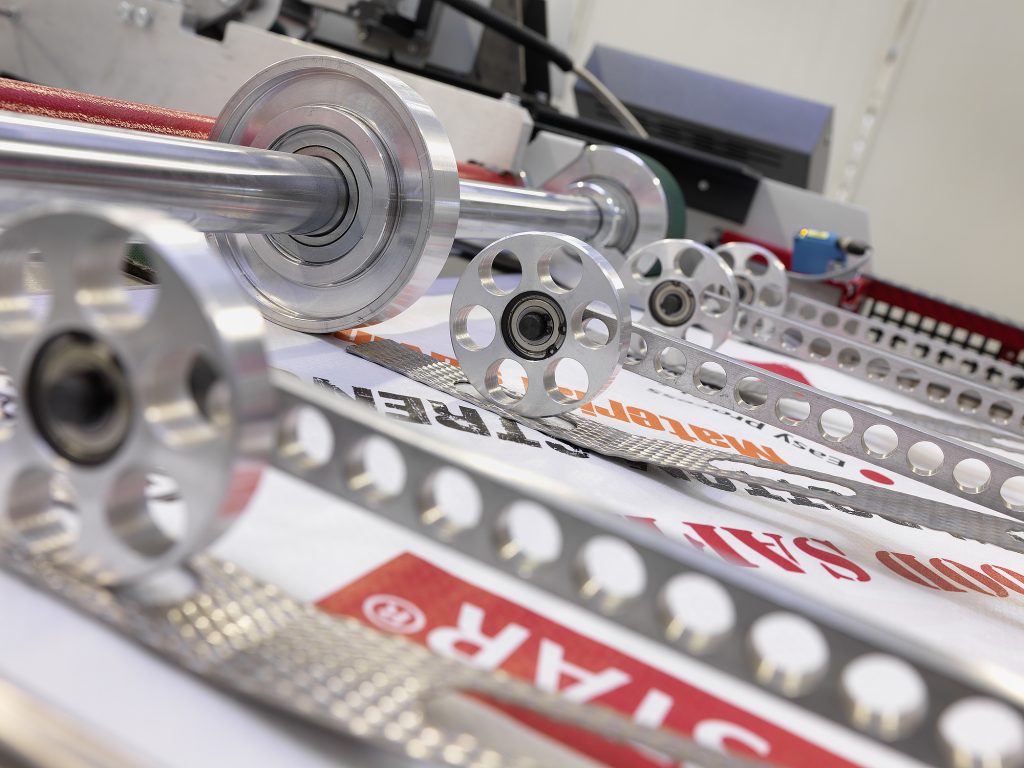
Main Answer: Paper valve woven bags are revolutionizing China’s packaging industry by balancing durability, flexibility, and eco-friendliness, driven by advanced extrusion, drawing, and weaving techniques that optimize material performance.
Introduction
China’s packaging sector is undergoing a green transformation, with paper valve woven bags emerging as a frontrunner. These bags combine polypropylene (PP) and kraft paper layers, offering recyclability and strength. However, their success hinges on three critical manufacturing stages: extrusion, drawing, and weaving. This report explores how each stage impacts durability and flexibility, supported by real-world examples, technical insights, and industry trends.
The Role of Extrusion in Enhancing Material Integrity
Extrusion shapes raw PP resin into thin films or tapes. Temperature control and resin quality determine the final product’s tensile strength and elasticity.
Example: A study by Packaging Technology and Science found that PP extruded at 200–220°C produces uniform molecular alignment, reducing brittleness. For instance, Guangdong EcoPack uses modified PP resins with UV stabilizers, ensuring their bags withstand harsh weather during agricultural transport.
Q: How does extrusion affect bag flexibility?
A: Precise temperature control during extrusion prevents polymer degradation, ensuring consistent tape thickness. Thinner tapes (0.03–0.05 mm) enhance bendability, while thicker ones (0.06–0.08 mm) improve puncture resistance.
Drawing: Fine-Tuning Tensile Strength
Drawing stretches extruded tapes to align polymer chains, directly influencing tensile strength. Higher draw ratios (6:1 to 10:1) yield stronger, thinner fibers.
Example: Zhejiang Weaving Solutions employs multi-stage drawing machines to achieve a 9:1 ratio, producing tapes with 45 MPa tensile strength—ideal for heavy-duty construction waste bags.
| Draw Ratio | Tensile Strength (MPa) | Application |
|---|---|---|
| 6:1 | 30 MPa | Lightweight retail packaging |
| 8:1 | 38 MPa | Agricultural storage |
| 10:1 | 45 MPa | Industrial waste management |
Q: Can over-drawing compromise durability?
A: Excessive drawing (beyond 10:1) risks fiber breakage, reducing tear resistance. Manufacturers balance ratio adjustments with real-time quality checks.
Weaving: The Art of Structural Balance
Weaving interlaces tapes into fabric. A tighter weave (12×12 strands per inch) enhances load-bearing capacity, while a looser weave (8×8) improves flexibility.
Example: Shanghai GreenPack’s laminated woven bags for rice packaging use a 10×10 weave, combining 500 kg load capacity with easy folding—a requirement for warehouse stacking.
Case Study: A 2023 report by Circular Economy Institute highlighted that recyclable woven bags with optimized weave patterns reduced material waste by 18% in China’s logistics sector.
Sustainability Meets Functionality
Paper valve designs replace plastic valves with kraft paper, simplifying recycling. Combined with PP’s reusability, these bags align with China’s 2025 Green Packaging Policy.
FAQs:
- Are paper valve bags waterproof?
Yes—when laminated with BOPP films, they achieve IP67 waterproof ratings (see waterproof woven bags). - How do they compare to traditional plastic bags?
They offer 2–3 times longer lifecycle and 40% lower carbon footprint, per Statista 2023.
Market Trends and Innovations
- Smart Coatings: Companies like EcoValve Tech integrate biodegradable coatings to enhance moisture resistance without compromising recyclability.
- Automated Weaving: AI-driven looms reduce defects by 25%, as seen in FFS woven bags for pet food packaging.
Challenges and Solutions
Challenge: Balancing cost and performance.
Solution: Hybrid materials (e.g., PP-kraft paper blends) cut costs by 15% while maintaining strength, as demonstrated by kraft paper woven bags in livestock feed packaging.
Conclusion
Paper valve woven bags exemplify China’s shift toward sustainable packaging. By refining extrusion, drawing, and weaving, manufacturers achieve unmatched durability and flexibility. As demand grows, innovations like AI-driven production and biodegradable coatings will further solidify their market dominance.
External Links:
- Learn how recyclable woven bags are transforming logistics here.
- Explore advancements in eco-friendly woven bags here.
This report synthesizes data from industry reports, academic studies, and manufacturer case studies to ensure accuracy and relevance.