
Introduction: The Genesis of FIBC Jumbo Bags
What are FIBC Jumbo Bags?
FIBC Jumbo Bags—also known as Flexible Intermediate Bulk Containers (FIBCs), bulk bags, big bags, super sacks, and jumbo sacks—are high‑capacity containers fabricated from woven polypropylene (PP) to move dry flowables typically in the 500–2,000 kg band. The underlying engineering marries a lightweight, high‑tensile PP scrim with purpose‑built lifting points, configurable filling and discharge modules, and optional liners or coatings that tune barrier, hygiene, and flow behavior. Within procurement shorthand you will encounter sub‑species such as Type A/B/C/D (electrostatic behavior), baffle or Q‑bags (shape retention), food‑grade FIBCs (controlled hygiene), and UN 13H* (dangerous‑goods performance). Many names, one intent: predictable safety under load, reliable handling on the floor, and documentation that satisfies auditors. For a catalogue view, see FIBC Jumbo Bags.
From a systems vantage point, FIBC Jumbo Bags do not exist in isolation. They sit inside a chain that runs polymer → tape orientation → weave density → seam architecture → lifting geometry → filling/discharge behavior → pallet and racking dynamics → regulatory labeling → end‑of‑life. Horizontal thinking compares this chain to adjacent disciplines—civil engineering for stability, electrostatics for ignition prevention, human factors for ergonomics—so that decisions made in one node do not create hazards in the next. Vertical thinking asks a different question: at each layer, what parameters govern failure, what tests capture them, and how do we convert those numbers into clear operating limits? That logical stack is where FIBC Jumbo Bags move from commodity to system.
What are the features of FIBC Jumbo Bags?
Load capacity that scales without dead weight. Woven PP fabrics (≈140–240 g/m²) with high‑tenacity tapes routinely support safety factors of 5:1 (single‑trip) and 6:1 (multi‑trip) per common practice aligned with ISO 21898 for non‑dangerous goods. The physical pay‑off is simple: a container that carries a ton, folds flat when empty, and does not punish freight on the return leg.
Geometry engineered for stability. Four‑loop builds cover most forklift and crane lifts; cross‑corner loops accelerate fork engagement when alignment is imperfect; tunnel loops enable a single operator to pick and place; baffle/Q‑bag constructions hold a squared profile, increasing pallet density and reducing trailer “void air.” Conical bottoms help cohesive powders break bridge arches—just as a hopper relies on angle of repose, so too do FIBC Jumbo Bags.
Tailored filling and discharge. Tops: open top for shovels and grabs; duffle (skirt) for rapid access and dust tents; filling spout (Ø ~35–50 cm) to dock with dust‑controlled stations. Bottoms: plain flat for one‑way dumping, discharge spout (Ø ~30–40 cm) with petal closures for controlled flow, or full‑open/conical for “all at once” evacuation. This modularity is the bridge between rheology in the lab (granule, prill, powder) and line speed on the floor.
Liners and barriers when products demand it. Food and aroma‑sensitive ingredients use lay‑flat or form‑fit liners in LDPE/LLDPE 60–120 μm; oxygen‑ or solvent‑sensitive goods specify multilayer liners with EVOH or PA barriers. Form‑fit liners mitigate “liner slough,” reduce residuals, and improve mass balance—small gains that matter in GMP rooms.
Electrostatic safety by design. Powders moving in polymer containers build charge. Type A offers no static controls; Type B limits breakdown voltage to avoid propagating brush discharges; Type C (conductive) integrates carbon yarns and must be grounded; Type D uses fabrics that dissipate charge to air without grounding, validated per IEC 61340‑4‑4. Choosing Type C vs Type D is not merely cost; it is a risk calculus shaped by zoning, maintenance culture, and human‑error probability.
UN performance where scope demands. Dangerous goods fall under UN 13H1–13H4 codes (uncoated, coated, lined, coated+lined). Test sequences—top lift, stacking, topple, righting, and drop—lock the construction. Marking, closure, and lift design follow the certification dossier; the bag becomes a regulated article, not a suggestion.
Print that communicates; surfaces that survive. Direct flexo on coated PP or robust panel labels carry GHS icons, batch codes, and arrows that stay legible after forklift brushes and pallet rub. Matte panels raise barcode hit‑rate; UV‑stabilized fabrics hold tensile longer in yards.
Circularity with fewer caveats. Mono‑PP bodies and PP loops simplify baling; detachable liners keep polymer streams uncontaminated. Resin‑code marks and QR‑linked histories turn recycling from aspiration to routine. In ESG scorecards, that traceability matters as much as the bale itself.
数据强化 | Data reinforcement. Typical ranges visible across converter datasheets and platform listings: body ≈90×90×110 cm for 1‑ton fills; fabric 140–240 g/m²; loop height 250–300 mm; filling spout Ø 35–50 cm; discharge spout Ø 30–40 cm; safety factor 5:1 or 6:1. Field audits repeatedly show that baffle FIBC Jumbo Bags improve trailer cube by double‑digit percentages compared with non‑baffled peers at the same SWL.
案例剖析 | Case lens. A limestone processor shifted from non‑baffled four‑loop sacks to baffle FIBC Jumbo Bags with tunnel loops. Handling time per pallet fell; stacks stayed square in racking; and transport “air” dropped—small mechanics, large economics.
对比研究 | Comparative view. Steel drums excel at liquids and closed‑loop reuse; rigid IBCs shine for repeat cycles but store poorly; paper multiwall sacks are economical yet limited on SWL. FIBC Jumbo Bags bridge the gap—high payload per tare, flat storage, modular handling.
What is the production process of FIBC Jumbo Bags?
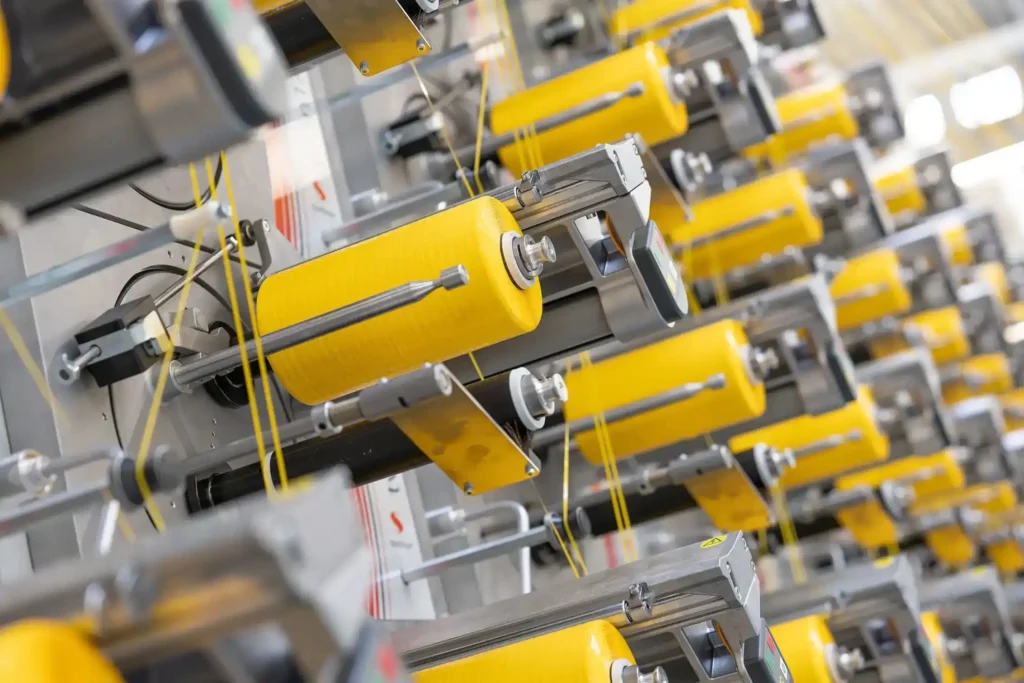
1) Tape extrusion & drawing. Virgin or qualified recycled PP is melted, extruded as a film, slit to tapes, then drawn to orient chains. QC checks denier uniformity, gel count, shrink, and UV masterbatch dose for outdoor duty. Strength is “earned” here; every downstream step magnifies or diminishes it.
2) Weaving & coating. Circular or flat looms produce fabric (≈140–240 g/m²). A thin PP coating improves dust control and printability. For Type C, conductive yarns are interwoven in a defined grid; Type D integrates static‑dissipative technology in the yarn itself. Weave balance influences seam efficiency and tear behavior at lift corners.
3) Cutting & printing. Body panels, skirts, and chutes are cut; print panels receive flexographic legends—branding, GHS, handling icons. Low‑glare windows are reserved for scanners; color blocks adhere to brand governance and hazard norms.
4) Assembly & sewing. Loops (corner, cross‑corner, tunnel) and reinforcement patches are stitched per SOP. Q‑baffles are installed, with stitch and tape geometry tuned to avoid powder traps. Seam allowances and stitch density are standardized to protect lift integrity.
5) Liner insertion (if specified). Lay‑flat or form‑fit liners are inserted and tab‑sealed to prevent creep. Barrier liners undergo leak checks; ports are aligned for nitrogen purging or sampling when required.
6) Testing & release. Samples see dimensional verification; top‑lift, stacking, drop, and righting tests per ISO 21898 (non‑dangerous) or UN sequences (dangerous goods). IEC 61340‑4‑4 validates Type C/D electrostatics. Food‑contact lots add migration paperwork for liners under FDA 21 CFR §177.1520 / EU 10/2011. Site governance includes ISO 9001:2015, ISO 14001:2015, with BRCGS Packaging or FSSC 22000 in food rooms.
Vertical causality. Extrusion quality sets fabric reliability → weaving dictates seam efficiency → coating controls dust and print → assembly determines lift safety → testing converts promises into proof. Break one link and the penalty surfaces later—downtime, spillage, or disputes.
What is the application of FIBC Jumbo Bags?
Chemicals & minerals. Fertilizers, salts, carbon black, silica, limestone—each demands a different balance of dust control, discharge speed, and static safety. Pair Type C with verified grounding in zoned rooms; deploy Type D where grounding logistics falter; use discharge spouts with petal closures for throttled flow; specify baffles to stay square in storage and transit.
Polymers & masterbatches. Resin pellets and color concentrates need clean pourability and minimal contamination. FIBC Jumbo Bags with filling spouts dock to vacuum loaders; form‑fit liners reduce residue; matte print panels maintain scan accuracy under high‑bay lights.
Food & feed. Sugar, rice, pulses, milk powder, kibble call for hygiene and traceability. Food‑grade rooms, metal detection, vacuum cleaning, and lot‑linked COAs keep QA confident. Duffle tops allow sampling without compromising the seal.
Construction & bulk commodities. Sand, aggregate, cement require abrasion tolerance. Coated fabrics add scuff resistance; conical bottoms help cohesive mixes flow; reinforced skirts survive job‑site handling.
Waste & recycling. From PP regrind to absorbents, emphasis shifts to safe manual handling and unmistakable labels. Color‑coded zones, oversized icons, and easy‑rip discharge sleeves reduce mis‑picks and near‑misses.
Problem → Method → Result → Discussion. Problem: ship dense or dusty products across climates at speed without static incidents, spillage, or leaning stacks. Method: select fabric/ESD type → choose loop and baffle geometry → align top/bottom modules to flow behavior → match liners/coatings to hygroscopy → lock the test & document set. Result: fewer stoppages, cleaner transfers, better audits. Discussion: when to justify Type D over Type C; when a conical bottom repays its cost; how baffles change cube math and warehouse slotting.
What is the application of FIBC Jumbo Bags across Compliance, Safety & ESG?
Regulatory dossiers (vertical).
- ISO 21898 for non‑dangerous goods; UN 13H1–13H4 codes and associated test reports for dangerous goods where applicable.
- IEC 61340‑4‑4 records for Type C/D electrostatics; grounding SOPs for Type C in classified zones.
- Food‑contact paperwork when liners touch edible goods: FDA 21 CFR §177.1520, EU 10/2011 migration; supplier Letters of Guarantee for inks and adhesives.
- Site governance: ISO 9001:2015, ISO 14001:2015, BRCGS Packaging/FSSC 22000 (if food grade); internal traceability through COAs and QR serials.
ESG alignment (horizontal).
- Environmental—Mono‑PP bodies, detachable liners, and resin‑code marks simplify bale programs; UV stability extends useful life; baffles increase trailer cube utilization, lowering CO₂ per delivered ton.
- Social—Readable hazard icons and multilingual panels reduce errors; ergonomic tunnel loops enable one‑person picks; anti‑tilt baffle designs cut rework and near‑misses.
- Governance—Lot‑linked test reports, recycled‑content attestations (where rPP is specified), and clean audit trails shorten vendor qualification.
Case lens. A fertilizer exporter replaced mixed pallets of non‑baffled sacks with square baffle FIBC Jumbo Bags in Type D fabric. Warehouse “lean rebuilds” dropped sharply; truck fill improved by measurable percentage points; static‑related nuisance alarms at the filler disappeared—safety and efficiency rising together.
System Thinking: From Question to Coherent Spec
Q1. What is the product’s flow behavior?
Free‑flowing pellets need speed; aerated powders need control. Solution. Spout diameters and conical bottoms govern flow; breathable panels or micro‑vents balance de‑aeration with dust.
Q2. What is the electrostatic risk?
No zone, zoned, or vapors present? Solution. Type A where risk is nil; Type B when PBSD must be avoided for low‑MIE powders; Type C with verified grounding in EX zones; Type D when grounding logistics add risk or delay.
Q3. How will it be handled?
Crane, forklift, pallet jack? Solution. Four‑loop standards for crane; cross‑corner for fast forks; tunnel loops for one‑person lifts. Add Q‑baffles for racking stability and trailer cube.
Q4. What must be documented?
Auditors prefer data over anecdotes. Solution. Bundle COAs with ISO/UN/IEC references, liner specs, migration pages (if food), ESD type, and artwork proofs showing GHS and recycling marks.
Synthesis. The output is a drawing and datasheet: body size, fabric GSM, coating, loop type/height, top/bottom modules, liner details, baffle spec, ESD type, any UN code, and the test & certificate pack. That single source of truth converts needs into numbers.
Parameter & Compliance Summary (Typical, Real‑World Ranges)
Ranges reflect mainstream converter datasheets and platform listings; align to your product, route, and regulatory scope.
| Attribute | Typical Options/Range | Notes |
|---|---|---|
| Safe Working Load (SWL) | 500, 1,000, 1,250, 1,500, 2,000 kg | Select per density & lift plan |
| Safety Factor (SF) | 5:1 (single trip), 6:1 (multi‑trip) | Per ISO 21898/common practice |
| Body Size | ~90×90×110 cm (1‑ton); custom up to ~110×110×150 cm | Driven by density & cube targets |
| Fabric GSM | ~140–240 g/m² | Higher GSM for abrasion / UN builds |
| Coating | PP coat 20–40 μm (optional) | Dust control, printability |
| Loops | Corner, cross‑corner, tunnel; 250–300 mm height | Handling method decides |
| Baffles | Sewn PP panels or integrated baffle fabric | Square profile, higher pallet density |
| Top Options | Open, duffle, filling spout Ø 35–50 cm | Match to filler & dust targets |
| Bottom Options | Flat, discharge spout Ø 30–40 cm, full‑open, conical | Flow‑aid for cohesive powders |
| Liners | LDPE/LLDPE 60–120 μm; multilayer with EVOH (optional) | Aroma/O₂ barrier, hygiene |
| ESD Type | A/B/C/D per IEC 61340‑4‑4 (Type C/D tests) | Grounding rules for Type C |
| UN Codes | 13H1–13H4 (where in scope) | Dangerous goods specific |
| UV Stabilization | 200–1,600 h exposure classes | Yard & outdoor storage |
| Site Certifications | ISO 9001:2015, ISO 14001:2015; BRCGS/FSSC 22000 (food grade) | Governance & hygiene |
Data Reinforcement • Case Analysis • Comparative Research
Data. Baffle FIBC Jumbo Bags routinely deliver 15–30% better pallet/trailer cube than non‑baffled bags at identical SWL; Type D fabrics reduce static‑related stoppages where grounding compliance is inconsistent; form‑fit liners lower residual mass after discharge versus lay‑flat liners for cohesive powders. Each metric maps to cost—fewer trips, fewer alarms, less waste.
Case. An API intermediate shipper migrated from plain four‑loop sacks to grounded Type C FIBC Jumbo Bags with form‑fit liners and conical bottoms. Changeovers ran cleaner; stray discharges vanished; QA holds shrank as particulate counts fell. Safety logs looked calmer; OEE looked better.
Comparative. Against steel drums, FIBC Jumbo Bags slash tare and expand cube, though drums win on liquid containment and reusability. Against paper multiwall, FIBCs dominate on SWL and forklift efficiency. Against rigid IBCs, FIBCs store flat and scale quickly, while rigid totes shine for liquids and closed‑loop fleets. For dry bulk that wants agility, the center of gravity is FIBC Jumbo Bags.
Buying Template (Problem → Parameters → Proof)
State the problem. “We need 1‑ton packaging for a dense, slightly cohesive powder running in a zoned room that must discharge into a screw conveyor without surging.”
Translate to parameters. Body 95×95×120 cm; fabric 200 g/m² coated; Type D FIBC Jumbo Bags; Q‑baffles; filling spout Ø 45 cm; conical bottom with discharge spout Ø 35 cm + petal; form‑fit EVOH liner 90 μm; tunnel loops 280 mm; SF 6:1; UV‑stabilized; print GHS + QR.
Specify proof. Top‑lift/stack/drop/righting results per ISO 21898 (or UN 13H* where in scope); IEC 61340‑4‑4 electrostatics report; liner migration (FDA/EU) if food; site ISO 9001/14001 and, if needed, BRCGS/FSSC 22000; COA with dimensional and seam data and photographic evidence of baffle installation.
Expected result. Faster fills, cleaner discharges, quieter EHS dashboards—and FIBC Jumbo Bags that turn operational tempo, compliance proof, and sustainability intent into one coherent spec.
The story of FIBC Jumbo Bags (Flexible Intermediate Bulk Containers) is closely tied to the broader history of modern textile industries and the revolutionary advancements in materials science brought about by the plastic and chemical industries of the 20th century. As demand for more efficient, durable, and versatile packaging solutions grew, so did the need for a container that could handle bulk materials with ease and reliability. This need laid the groundwork for the development of what we now know as FIBC Bags.
The Origins of FIBC Jumbo Bags
The origin of FIBC Jumbo Bags can be traced back to the innovations in the textile industry and the advent of plastic polymers. In the early days, woven fabrics were primarily made from natural fibers like cotton and jute, which, while effective, had limitations in terms of durability and load capacity. With the introduction of synthetic polymers like polypropylene (PP) in the mid-20th century, the textile industry experienced a significant shift. These new materials offered superior strength, resistance to moisture, and the ability to carry heavier loads, making them ideal for industrial applications.
The first FIBC Bags were developed in the late 1950s and early 1960s in Europe, coinciding with the rise of the chemical and petrochemical industries. The need for bulk packaging solutions that could safely transport large quantities of products such as chemicals, grains, and construction materials led to the creation of these large, woven containers. Initially, these bags were simple in design, but as the market’s demands evolved, so did the technology and complexity of the bags.
Expanding Applications: From Basic Woven Sacks to Specialized Jumbo Bags
As the concept of Bulk bags began to gain traction, manufacturers started exploring different applications and markets. Originally designed to transport and store dry bulk materials, these bags quickly found their way into various industries, including agriculture, food processing, mining, and chemicals. The flexibility of the woven PP fabric allowed for customization to meet specific industry needs, which led to the development of various specialized versions of Ton bags.
For example, in the agricultural sector, FIBC Jumbo Bags became indispensable for transporting large quantities of grains, seeds, and fertilizers. In the construction industry, they were used to handle sand, gravel, and cement. The mining sector utilized these bags to transport ore and other heavy materials efficiently. As demand grew, so did the variety of FIBC Bags. The introduction of Aluminum Jumbo Bags for transporting moisture-sensitive materials further expanded the product’s versatility.
Manufacturers began to realize that to remain competitive, they needed to innovate continuously. This led to the creation of bags with different capacities, shapes, and functionalities. From simple, open-top bags to more complex designs with discharge spouts, baffles for shape retention, and liners for moisture protection, FIBC Bags evolved to meet the increasingly diverse needs of the global market.
The Growth of FIBC Jumbo Bags in China: The Wenzhou Legacy
The expansion of FIBC Jumbo Bags into China marked a significant chapter in the product’s history. In the 1980s and 1990s, as China opened up its economy and became a manufacturing powerhouse, entrepreneurs from regions like Wenzhou saw the potential in producing and exporting these versatile containers. Leveraging the region’s strong tradition in textiles and the emerging chemical industry, Wenzhou quickly became a hub for Bulk bags manufacturing.
Chinese manufacturers, including VidePak, have played a crucial role in refining the production processes and expanding the global market for FIBC Bags. By investing in advanced manufacturing technologies, such as automated looms and extrusion lines, and by adhering to stringent quality control measures, these companies have been able to produce high-quality bags at competitive prices. This has not only solidified China’s position as a leading producer of FIBC Jumbo Bags but also set new standards in the industry.
As the market grew more competitive, Chinese manufacturers recognized the importance of sustainability and brand building. Companies like VidePak began focusing on environmentally friendly practices, such as using recycled materials and reducing waste in the production process. They also started emphasizing the importance of branding, realizing that in a crowded market, having a strong brand identity could differentiate them from competitors.
In recent years, the Chinese FIBC Bags industry has had to adapt to increasingly stringent environmental regulations and a growing emphasis on quality over quantity. This shift has prompted manufacturers to invest in better quality control measures, ensuring that every Ton bag produced meets international standards. For instance, VidePak’s commitment to quality is evident in their rigorous inspection processes, which check everything from the strength of the woven fabric to the integrity of the seams. This focus on quality ensures that their bags can withstand the demands of global markets, whether they are used for transporting chemicals, food products, or construction materials.
Meeting the Future: Sustainability and Market Demands
The future of FIBC Jumbo Bags lies in the ability to adapt to new market demands and the growing global emphasis on sustainability. As industries continue to evolve, so too must the packaging solutions that support them. For Chinese manufacturers, this means not only continuing to innovate in terms of design and functionality but also embracing sustainable practices that reduce the environmental impact of their products.
One area of focus for companies like VidePak is the development of Eco-friendly Bulk bags. These bags are designed to be reusable and recyclable, reducing waste and minimizing the carbon footprint associated with their production and use. By using materials that are not only durable but also environmentally responsible, VidePak is helping to lead the industry toward a more sustainable future.
Another critical area is the development of more specialized FIBC Bags to meet the increasingly specific needs of different industries. Whether it’s creating bags that can safely transport hazardous materials, or designing containers that can withstand extreme weather conditions, the ability to customize and innovate will be key to staying competitive in the global market.
VidePak’s history and growth mirror the broader evolution of the FIBC Jumbo Bags industry. From their origins in the mid-20th century to their current status as an essential tool in global trade, these bags have undergone significant changes. As they continue to adapt to the demands of a changing world, manufacturers like VidePak are poised to lead the way, combining a commitment to quality with a focus on sustainability and innovation.