
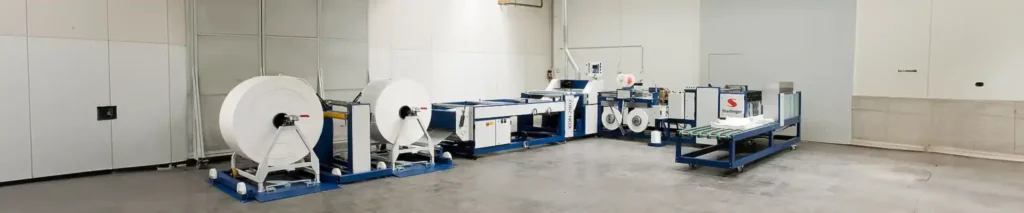
What is FFS Roll Woven Bags?
FFS Roll Woven Bags designate a roll‑fed packaging web tailored for high‑throughput form‑fill‑seal operations where the product is heavy, abrasive, or moisture‑sensitive. In supplier literature you may see adjacent labels—FFS tubular woven rolls, PE‑coated PP woven FFS webs, laminated raffia FFS rolls. Different names, same intent: a woven polypropylene (PP) fabric supplies the mechanical backbone, and a heat‑sealable polyolefin surface (often PE extrusion coating or a BOPP/PE laminate) supplies continuous sealing performance. Structure plus sealability; drop integrity plus line efficiency. That duality is why FFS Roll Woven Bags sit at the crossroads of textile engineering and film converting.
Treat the web as a system, not a sheet. The system comprises the materials (PP tapes, coatings/laminates, slip and antiblock packages, ink/varnish chemistry), the structure (mesh, denier, GSM, friction profile, seam geometry), the process (tape extrusion → circular‑loom weaving → coating/lamination → treatment/printing → slitting and winding → FFS conversion), and the assurance layer (mechanical tests, seal validation, barrier checks, regulatory compliance). Adjust one dial and others move: raise mesh to smooth print and mass creeps; thicken PE to widen the seal window and fold behavior stiffens; tune COF to stop pallet creep and you may need to re‑optimize former drag. Is that a burden—or a design freedom? For performance buyers, it is the latter, because FFS Roll Woven Bags reward holistic tuning.
Evidence, vignette, comparison. Uncoated fabrics commonly fall near ~60–110 GSM; PE coatings run ~20–40 μm; laminated totals sit around ~110–180 GSM for 20–50 kg fills. Meshes of 9×9–12×12 with deniers ~700–1200 are mainstream. A cement brand that transitioned from pre‑made sacks to roll‑fed FFS Roll Woven Bags reduced manual touches, boosted packs‑per‑hour, and cut corner‑tear rework at pallet edges. Versus paper multiwall, the woven/PE stack resists edge scuff and wet floors; versus monolayer PE film, the woven core improves drop resistance and stack geometry. For a single reference touchpoint aligned to heavy‑duty roll formats, see FFS Roll Woven Bags.
What is the features of FFS Roll Woven Bags?
Mechanical strength with modest mass. Oriented PP tapes arrest tear propagation; the woven lattice spreads impact loads; stitched seams are replaced by thermal bonds that act as structural members. This is why FFS Roll Woven Bags hold geometry in four‑way wraps and tolerate ~1.2–1.5 m drop regimes typical of 25–50 kg materials.
Heat‑sealable efficiency. A PE coating or a BOPP/PE laminate delivers a generous, repeatable heat‑seal window for continuous jaws. Reverse‑printed BOPP protects ink under film, keeping artwork intact against conveyor rub. Seals are not an afterthought—they are engineered load paths.
Controlled friction, controlled flow. Outer‑face COF for pallet friction, inner‑face COF for former glide. Anti‑slip emboss or matte varnish on the outside helps stacks climb without sliding; low‑slip internals keep the web stable through shoulders and tubes. Small numbers matter here: a shift from 0.40 to 0.50 outer COF can be the difference between a leaning pallet and a square one.
Dust‑tolerant surfaces. Matte/embossed finishes and scuff‑resistant ink systems preserve legibility. Why print barcodes that disappear at the first conveyor? FFS Roll Woven Bags pair abrasion‑aware varnishes with durable substrates so marks survive the lane.
Lane‑specific barrier. Hygroscopic powders demand moisture management. Coating microns can be tuned—or an inner liner inserted—to meet target WVTR bands while preserving machinability. The choice is not binary; it is parametric.
Horizontal and vertical reasoning. Horizontally, weigh FFS Roll Woven Bags against paper multiwall FFS or monolayer PE tubular film. Paper prints warmly yet loses form on wet floors; PE seals cleanly yet can dent drop performance; woven/PE hybrids reconcile both worlds. Vertically, trace the cascade: +10 μm PE widens the seal window → lowers jaw rejects → raises OEE; the same +10 μm raises fold stiffness → former settings shift → guide clearances adjust. One knob, many consequences; many consequences, one outcome.
Numbers, case, head‑to‑head. Typical flat roll widths cluster near ~450–900 mm; gussets of ~80–200 mm are formed on the line; printing supports 1–8 colors via flexo or gravure. A dry‑mortar producer cut pallet creep by pairing anti‑slip outer emboss with a low‑COF interior—fast fill, steady stack, calmer warehouse.
What is the production process of FFS Roll Woven Bags?
Step 1 — Tape extrusion & drawing. PP is extruded into a film, slit to tapes, and drawn to align polymer chains. Draw ratio sets tensile and elongation, parameters that echo through weaving and sealing.
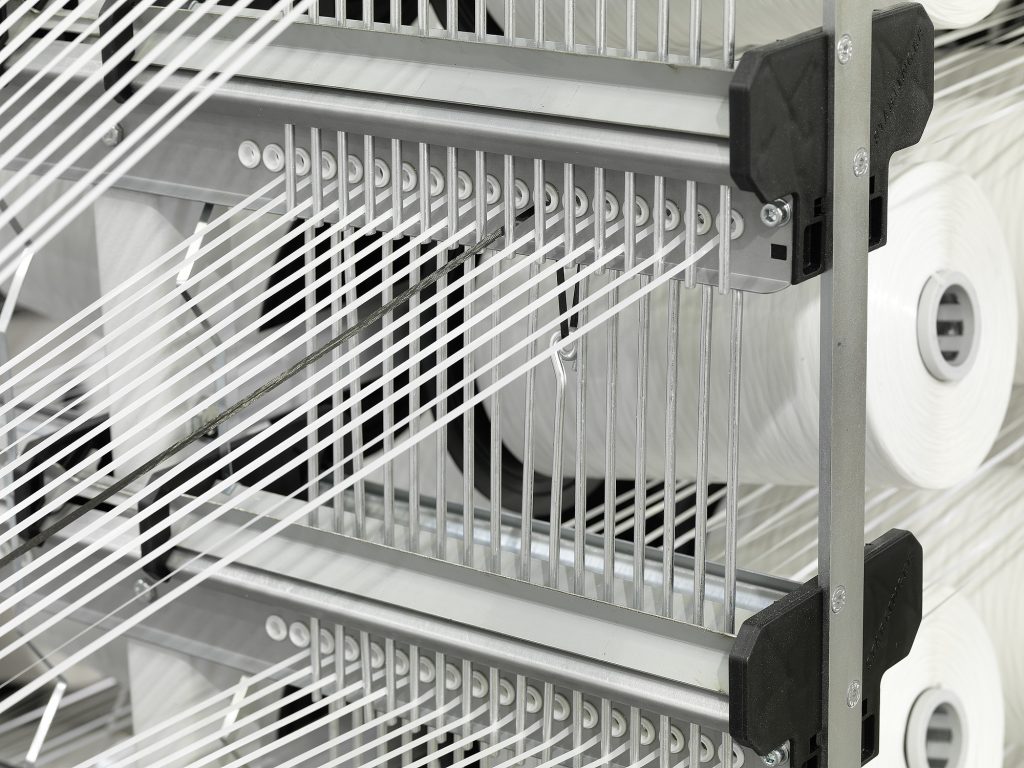
Step 2 — Circular‑loom weaving. Warp and weft tapes interlace to the target mesh and width. Loom tension, pick count, and denier determine dimensional stability, base GSM, and print smoothness.
Step 3 — Coating/lamination. A PE extrusion coating (~20–40 μm) or a BOPP/PE laminate bonds to the fabric. This station governs peel strength, layflat, curl, and barrier. Micro‑perforation can be added for air‑entraining powders to prevent ballooning at high filler speeds.
Step 4 — Surface treatment & printing. Corona treatment and primer condition the surface; flexographic or gravure presses lay down brand art, compliance grids, and machine marks. Reverse print under BOPP shields ink from scuff.
Step 5 — Slitting & winding. The web is slit to defined widths and wound with controlled tension and edge profile. Wind quality—core concentricity, roll hardness—directly affects FFS run stability.
Step 6 — FFS conversion. On the user’s line, the web forms into a tube, fills, and seals. Fin seals, cross seals, header reinforcements, and date codes are applied in motion. Stitching gives way to heat‑seals; knives are calibrated to avoid film nicks.
Step 7 — QC & compliance. Thickness/GSM audits; tensile/tear per ASTM D882/D1004; dart impact ASTM D1709; coefficient of friction ASTM D1894; drop testing ASTM D5276; seal strength/peel ASTM F88/F88M. Food‑adjacent salts or additives trigger plastics assessments under 21 CFR 177.1520 (USA), EU No 10/2011 (EU), GB 4806.7 (China), with woven mechanics aligned to GB/T 8946. Management systems often include ISO 9001:2015 and, where appropriate, ISO 22000:2018.
Process mapping, two lenses. Horizontally, this looks like a textile mill coupled to a film‑lamination and print plant. Vertically, it behaves like a tolerance cascade: miss draw temperature → lamination curl rises; under‑tension warp → print registration drifts; mis‑set winding tension → FFS web wander increases. Stability is not accidental; it is engineered.
Verification, case, comparison. Vendors routinely publish peel windows at sealing temperatures, COF targets for pallets and formers, and drop performance at 1.2–1.5 m for 25–50 kg sacks. A gypsum packer eliminated corner blowouts by stepping denier from ~900 to ~1100 and lengthening the cross‑seal fold—small edits, outsized gains.
What is the application of FFS Roll Woven Bags?
FFS Roll Woven Bags serve cement, mortar, gypsum, sand, lime, fly ash, mineral salts, and similar bulk solids. Selection pivots on three axes: bulk density, lane humidity, and target line speed. Retail‑friendly 20–25 kg formats tend to run ~500–700 mm flat widths with formed gussets; industrial 40–50 kg fills lean toward ~650–900 mm. If humidity looms, increase PE microns or specify an inner liner; if dust is rampant, add micro‑perfs to keep filler counts accurate and bags from ballooning.
Metrics, vignette, contrast. Print systems handle up to 6–8 colors alongside QR/EAN/lot coding. A sand supplier broadened the seal window by +10 μm PE and specified low‑slip interior/high‑grip exterior films—formers stopped binding, pallets stacked cleaner. Against paper multiwall, FFS Roll Woven Bags keep their stance on wet decks; against monolayer PE, they fall slower and straighter in drop tests.
What is the application of FFS Roll Woven Bags (Extended)?
Cement & blended cements. High‑denier fabrics paired with anti‑slip exteriors hold geometry through rough yards; matte finishes reduce glare for scanner accuracy.
Gypsum & dry mortar. Reverse‑printed BOPP + PE lamination protects fine graphics and compliance grids from rub‑off; gusset geometry keeps faces flat on shelf.
Salts & de‑icers. Where incidental food‑contact frameworks apply, mono‑polyolefin stacks align with plastics regulations while keeping rugged drop performance.
Aggregates & minerals. For coarse abrasives, specify higher denier and double‑fold cross seals; balance outer COF for stack friction with inner COF for former glide.
Data points, case, comparison. Exposure‑class UV packages extend outdoor endurance; total GSM is tuned to stack height and drop regime. A fly‑ash program improved seal integrity by adopting pre‑heated jaws to match thicker coatings—uniform seals, fewer rejects.
Compliance & Certification Map (for buyers and auditors)
United States. 21 CFR 177.1520 (olefin polymers) for PP/PE components; film and seal testing via ASTM D882, D1004, D1709, D1894, D5276 and ASTM F88/F88M.
European Union. Framework (EC) 1935/2004 and Plastics Regulation (EU) No 10/2011; barrier/OTR/WVTR checks per ISO 15106 series where relevant; printing inks aligned to supplier declarations.
China. GB 4806.7 (plastics in contact with food) where applicable; woven sack mechanics under GB/T 8946.
Quality systems. ISO 9001:2015 for QMS; ISO 22000:2018 where food‑adjacent minerals or salts are processed. Third‑party labs (SGS/TÜV/Intertek) typically execute validations. Documentation is not bureaucracy; it is insurance—invoices don’t hold pallets together, certificates and test reports do.
Quick Spec Table — FFS Roll Woven Bags (Representative Ranges)
| Attribute | Representative Range / Options | Engineering Notes |
|---|---|---|
| Roll form | Tubular or single‑sheet roll | Tubular enables quickest FFS setup |
| Roll width (flat) | ~450–900 mm | Choose by target fill (20–50 kg) and former geometry |
| Gusset (formed on FFS) | ~80–200 mm | Wider gusset → flatter faces, better pallet stability |
| Core ID / Roll OD | 76 mm (3 in) / up to ~1,000–1,200 mm | Standard cores; check max OD against former clearance |
| Typical roll length | ~200–800 m | Set by web thickness and handling limits |
| PP fabric GSM | ~60–110 GSM | Sets tensile/tear baseline |
| Mesh & denier | 9×9–12×12; ~700–1200 denier | Higher denier for abrasive products |
| Coating/laminate | PE ~20–40 μm; BOPP/PE options | Drives seal window and WVTR tuning |
| Total laminated GSM | ~110–180 GSM | Balance drop integrity and line speed |
| COF (outer/inner) | Outer 0.35–0.55 / Inner 0.18–0.30 | Anti‑slip outside, low friction inside |
| Printing | 1–8 colors flexo/gravure | Reverse print under BOPP for rub resistance |
| Dart impact (ASTM D1709) | ≥ 200–400 g typical | Tune to handling severity |
| Tensile (ASTM D882) | Application‑specific | Correlates with denier and GSM |
| Drop test (ASTM D5276) | 1.2–1.5 m @ 25–50 kg | Validate per product and pallet height |
| Seal strength (ASTM F88/F88M) | Target per line | Match jaw temp/dwell to coating microns |
Values reflect widely published supplier ranges; validate against product density, humidity cycles, and transport simulations before freezing a BOM.
System synthesis — an integrated FFS brief you can issue today
Objective. Run a 25–40 kg cement and mortar program with high OEE, low re‑bagging, and square pallets.
Material & structure. Specify FFS Roll Woven Bags with ~100 GSM PP fabric (mesh ~11×11, denier ~1,000) and ~30 μm PE coating; target total ~150–170 GSM. Set exterior COF at 0.45 ± 0.05; interior at 0.22 ± 0.04.
Barrier & print. Deploy reverse‑printed BOPP under PE when premium branding is needed; otherwise matte PE with anti‑slip emboss. Keep WVTR targets consistent with climate and dwell.
FFS setup. Fin seal plus cross seal; jaw temperature and dwell matched to coating microns; micro‑perfs where fills are dusty. Add an easy‑open notch if retail‑adjacent.
Assurance. Require supplier reports per ASTM D882/D1004/D1709/D1894/D5276 and F88/F88M, plus compliance to 21 CFR 177.1520, EU 10/2011, GB 4806.7, and GB/T 8946 as applicable.
Outcome. Seals that hold. Pallets that sit straight. Graphics that survive. A roll web that keeps machines singing. That, in practical terms, is what FFS Roll Woven Bags deliver in the unforgiving world of building‑materials logistics.
- What is FFS Roll Woven Bags?
- What is the features of FFS Roll Woven Bags?
- What is the production process of FFS Roll Woven Bags?
- What is the application of FFS Roll Woven Bags?
- What is the application of FFS Roll Woven Bags (Extended)?
- Compliance & Certification Map (for buyers and auditors)
- Quick Spec Table — FFS Roll Woven Bags (Representative Ranges)
- System synthesis — an integrated FFS brief you can issue today
In the construction and building materials industry, packaging plays a crucial role in ensuring the safe transportation and storage of materials. One of the most innovative solutions to meet these packaging demands is the FFS Roll Woven Bag. These bags, commonly made from polypropylene (PP) or other woven materials, offer numerous benefits in terms of strength, flexibility, and cost-efficiency. In this article, we will explore the advantages of FFS Roll Woven Bags in the building materials industry, providing readers with a comprehensive understanding of their capabilities and potential applications.
What Are FFS Roll Woven Bags?
Form Fill Seal (FFS) Roll Woven Bags are a type of packaging that utilizes a roll of woven fabric that is pre-formed, filled with material, and sealed using a specialized machine. These bags are primarily used in bulk packaging, offering a highly efficient method of packing construction and building materials such as sand, gravel, cement, and aggregates.
The FFS technology ensures that bags are produced continuously, making them a highly automated and cost-effective solution for large-scale packaging operations. This process also allows for enhanced precision in bag size and seal quality, which is essential for ensuring the safe handling of materials in harsh environments.
Key Benefits of FFS Roll Woven Bags in the Building Materials Industry
FFS Roll Woven Bags are increasingly being favored in the building materials sector for their numerous advantages. Here are the key benefits that make these bags an optimal solution:
- Durability and Strength
- FFS Roll Woven Bags are made from high-strength woven fabric, typically PP, which is known for its toughness. These bags can withstand the rough handling and heavy loads typically associated with transporting building materials.
- The strength of these bags also ensures that they do not tear or rupture during storage or transit, providing enhanced protection for the contents.
- Cost Efficiency
- The FFS process allows for high-speed manufacturing of bags, which reduces the overall production cost. This makes them a highly cost-effective option for large-volume packaging.
- The use of polypropylene, which is an affordable yet durable material, further contributes to keeping costs low without compromising on quality.
- Customization
- One of the key advantages of FFS Roll Woven Bags is their ability to be customized. These bags can be produced in various sizes and strengths to meet specific requirements of different construction materials.
- Moreover, FFS bags can be printed with custom branding, which can be an essential marketing tool for construction companies looking to establish their identity in the market.
- Moisture Resistance
- In the construction industry, moisture resistance is a critical factor, especially when packaging materials like cement and aggregates. FFS Roll Woven Bags are designed to protect contents from moisture and environmental elements, ensuring that materials remain intact and usable during transportation and storage.
- Environmental Benefits
- Polypropylene is a recyclable material, which makes FFS Roll Woven Bags an environmentally friendly option for packaging in the building materials industry. Additionally, these bags can be reused multiple times, further reducing their environmental footprint.
Applications of FFS Roll Woven Bags in the Building Materials Sector
FFS Roll Woven Bags are versatile and can be used in a wide range of applications within the building materials sector. Some of the most common uses include:
| Application | Description |
|---|---|
| Cement Packaging | FFS Roll Woven Bags are commonly used for packaging cement, offering superior strength and moisture resistance. |
| Aggregate Packaging | For materials like sand, gravel, and crushed stone, these bags provide a cost-effective and durable solution. |
| Mortar and Plaster | These bags ensure that powdered products like mortar and plaster are securely contained and protected from moisture. |
| Construction Waste Disposal | FFS bags are also used for packaging construction waste, providing a safe, durable option for waste management. |
FFS Roll Woven Bags Specifications
When selecting FFS Roll Woven Bags for building materials, it’s important to consider specific product parameters to ensure the bags meet the necessary performance standards. Here are some of the critical specifications to look out for:
| Specification | Details |
|---|---|
| Material | Polypropylene (PP) or other woven materials |
| Bag Type | Tubular or flat woven, depending on the application |
| Strength | Varies based on the application; commonly up to 100kg load capacity |
| Thickness | Typically ranges from 90gsm to 200gsm depending on the weight of contents |
| Customization Options | Custom sizes, color printing, valve types, and reinforcement options |
| Moisture Resistance | Enhanced through laminated options or coatings |
Frequently Asked Questions (FAQs)
- What are the advantages of using FFS Roll Woven Bags over traditional sacks?
- FFS Roll Woven Bags provide superior strength, moisture resistance, and cost efficiency compared to traditional sacks. The automated manufacturing process allows for more consistent quality, which reduces the likelihood of defects or leaks.
- Are FFS Roll Woven Bags suitable for hazardous materials?
- Yes, these bags can be designed to handle hazardous materials by providing enhanced strength and protective coatings. However, it is essential to consult with the manufacturer to ensure that the bags meet specific industry standards for hazardous materials.
- Can FFS Roll Woven Bags be reused?
- Yes, these bags can be reused multiple times, especially in bulk packaging applications. Polypropylene is durable and can withstand multiple uses without losing its strength.
- What is the typical production lead time for FFS Roll Woven Bags?
- The lead time for production can vary depending on order size and customization requirements. However, FFS Roll Woven Bags typically have a faster production turnaround compared to other types of woven packaging due to the automation of the manufacturing process.
- Are FFS Roll Woven Bags eco-friendly?
- Yes, polypropylene is a recyclable material, making FFS Roll Woven Bags an environmentally friendly packaging solution. Additionally, these bags can be reused, reducing waste.
The Future of FFS Roll Woven Bags in the Construction Industry
The demand for FFS Roll Woven Bags in the building materials sector continues to grow as companies seek more efficient and sustainable packaging solutions. As the construction industry embraces sustainability and eco-friendly practices, FFS bags offer a solution that aligns with these goals.
Furthermore, innovations in materials and manufacturing processes, such as the integration of advanced technology for producing high-strength fabrics, are expected to enhance the performance and reliability of FFS Roll Woven Bags in the future.
For companies like VidePak, the continual improvement of packaging solutions through the use of Form Fill Seal technology and fine yarn technology is shaping the future of packaging in the construction industry. Learn more about advancements in FFS roll bags here.
By focusing on key parameters such as strength, moisture resistance, and environmental sustainability, FFS Roll Woven Bags are well-positioned to remain the preferred packaging solution for the construction industry for years to come.
If you’re looking to enhance your packaging strategy, optimize your building material packaging needs with FFS roll bags and unlock the potential for increased efficiency and reduced costs.
This article should provide you with a clear understanding of how FFS Roll Woven Bags serve as optimal solutions in the building materials industry. From their durability and cost-efficiency to their environmentally friendly attributes, these bags continue to shape the future of packaging in construction.