
What is PE Coated Valve Woven Bags?
PE Coated Valve Woven Bags are engineered polypropylene (PP) sacks clad with a heat‑sealable polyethylene (PE) skin and finished with an integrated valve mouth for rapid, low‑dust filling. In vendor catalogs you may meet alternative names—PE‑extrusion‑coated woven valve sacks, PP/PE valve bags, coated raffia valve sacks—but the anatomy remains constant: a woven PP fabric supplies tensile strength and tear resistance; the PE coating creates a clean, sealable exterior; the valve sleeve (PE or PP/PE) provides controlled de‑aeration and self‑closing behavior on impeller or form‑fill‑seal (FFS) lines. In short, PE Coated Valve Woven Bags pair textile backbones with film‑grade sealing so line speed doesn’t come at the expense of drop integrity.
From a systems vantage, the format is not a single part but an orchestration of four subsystems working in concert. Materials cover raffia‑grade PP resin, PE coating resin, valve film, pigments/inks/varnishes, slip and antiblock packages, and UV stabilizers. Structure spans mesh and denier, base GSM, coating thickness and coefficient of friction (COF) inner/outer, valve geometry, gusset width, and bottom fold architecture. Process links PP tape extrusion & drawing → circular‑loom weaving → PE extrusion coating or PE/BOPP lamination → surface treatment & printing → slitting → valve insertion → bottom forming. Assurance pulls it all together via mechanical, seal, and barrier testing—plus advanced resin analytics that keep inputs within statistical control. Alter one dial and others move: a heavier coating widens the heat‑seal window but stiffens folds; a slicker inner COF accelerates web travel yet requires a grippier outer face to stop pallet creep; a narrower valve curbs sifting but can choke deaeration. Treat PE Coated Valve Woven Bags as a coupled system and performance becomes predictable; treat them as commodity sacks and you’ll be chasing symptoms, not causes.
Data reinforcement · Case anatomy · Comparative lens. Commercial PP woven bases typically run ~70–110 GSM (mesh 10×10–12×12, denier ~800–1200). PE coatings cluster ~20–40 μm; total laminated builds land ~120–180 GSM for 20–50 kg fills. A mortar producer replacing paper multiwall with PE Coated Valve Woven Bags lifted pack rates, cut wet‑floor failures, and tightened pallet stability by targeting outer COF ~0.45 while keeping inner COF ~0.22. Against paper multiwall, the coated woven stack resists edge scuff and moisture; versus monolayer PE valve film, the woven core preserves drop resistance and face flatness. For a single, practical touchpoint, see PE Coated Valve Woven Bags.
PE Valve Bags Strength
High-performance PE coated valve woven bags with strict material testing and stable quality.
Check More →Valve Bags and Its Types
Various valve woven bags including PE coated styles made with qualified PP resin materials.
Check More →Paper Valve Bags VS PE Valve Bags
Comparative analysis of PE coated valve woven bags with professional material quality inspection.
Check More →PP Woven Bags Specifications
Standardized PP resin testing and specifications for premium PE coated valve woven bags.
Check More →What is the features of PE Coated Valve Woven Bags?
High strength at modest mass. Oriented PP tapes disperse impact energy and arrest tears, allowing PE Coated Valve Woven Bags to sustain ~1.2–1.5 m drop regimes typical for 25–50 kg materials without bloating overall GSM. Strength, shape, stability—delivered without excess weight.
Wide, forgiving seal window. The PE coating forms heat‑sealable faces compatible with impulse, hot‑bar, or ultrasonic cross‑seals. Seal strength validated to ASTM F88/F88M commonly targets ~30–60 N/25 mm, with peel curves that stay stable across realistic line speeds. Seals are structural members, not afterthoughts.
Valve that vents—and then seals. Straight or self‑closing sleeves let entrained air escape; optional micro‑vents or porous inserts accelerate de‑aeration without creating dust plumes. After settling, the valve closes under product head or is internally sealed, locking out sifting that would otherwise haunt QA reports.
Friction control for machine and pallet. Inner COF ~0.18–0.30 reduces drag on formers and valve mandrels; outer COF ~0.35–0.55 helps stacks climb without slips. Anti‑slip emboss or matte topcoat adds grip while preserving code contrast—fast on the line, firm on the pallet.
Print surfaces that sell and comply. Corona‑treated PE accepts 1–8 color flexo/gravure; matte topcoats cut glare so GS1 barcodes scan cleanly. Compliance grids remain legible after conveyor rub, because the coating protects ink and the woven core limits face stretch.
Moisture management tuned to the lane. Coating microns and optional inner liners (PE ~25–60 μm) can push WVTR (38°C/90% RH) into ~1–5 g/m²·day bands (stack‑dependent), protecting caking‑prone powders in humid corridors without over‑engineering dry lanes.
Advanced PP resin testing as a performance lever. Polymer analytics translate directly to plant stability. Melt flow rate (ISO 1133, 230°C/2.16 kg) in the ~2–4 g/10 min band yields consistent tape drawing; isotactic index (heptane‑insoluble) ≥95% forecasts stiffness; oxidation‑induction time (ASTM D3895) ≥20 min @ 200°C signals antioxidant adequacy; ash (ISO 3451) ≤0.05% checks contamination; DSC (ISO 11357) with Tm 160–165°C / Tc 117–125°C fingerprints the grade. Tight resin windows mean fewer broken tapes, fewer seam cut‑throughs, fewer mysteries.
Horizontal vs. vertical reasoning. Horizontally, compare PE Coated Valve Woven Bags to paper valve multiwall (warm print, weak on wet floors) and to PE valve film (excellent sealing, modest drop resistance). Vertically, follow a single choice—+10 μm coating—seal plateau widens → jaw rejects fall → OEE rises; yet fold stiffness increases → bottom‑fold tension must be tuned → stack geometry is recovered. One change, many consequences; many consequences, one engineered correction.
Data reinforcement · Case analysis · Comparative study. A gypsum line achieved >95% first‑pass yield after dialing inner/outer COF to 0.22/0.48 and adopting a self‑closing sleeve; mis‑stack complaints fell double digits. Against stitched open‑mouth woven sacks, the valve format cuts dust at the mouth and supports taller daily throughputs on impeller fillers.
What is the production process of PE Coated Valve Woven Bags?
Step 1 — PP tape extrusion & drawing. PP resin is extruded, slit to tapes, then drawn to align chains. Before the first spool turns, resin quality is vetted: MFR (ISO 1133), OIT (ASTM D3895), ash (ISO 3451), DSC (ISO 11357). Draw ratio and chill control set tensile and elongation, which later govern seam behavior and drop performance—start wrong, chase problems.
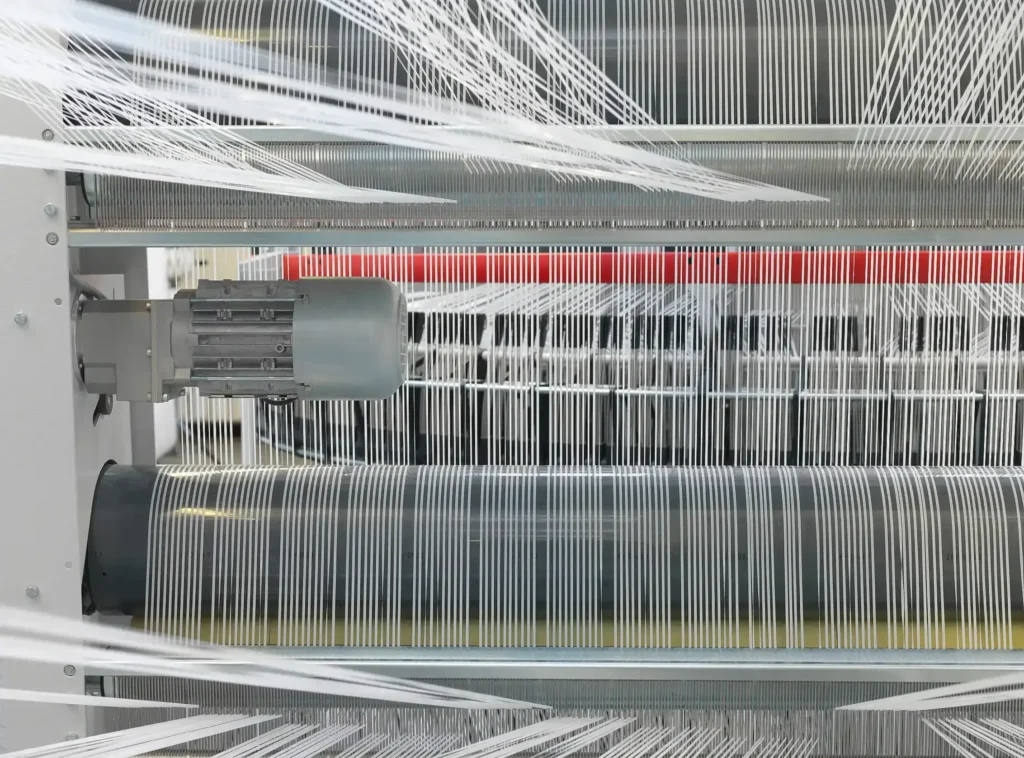
Step 2 — Circular‑loom weaving. Warp and weft tapes interlace to the target mesh and width (e.g., 10×10–12×12). Loom tension and pick count determine dimensional stability, base GSM, and print “flatness.”
Step 3 — PE extrusion coating (or PE/BOPP lamination). A ~20–40 μm PE layer bonds to the fabric, generating a sealable, printable face. Peel strength, layflat, curl, and surface texture (e.g., anti‑slip emboss) are tuned here. Too hot and curl spikes; too cold and bond falls.
Step 4 — Printing & surface prep. Corona treatment and primer options precede flexo/gravure artwork. Matte or low‑gloss topcoats improve rub and scanner contrast; regulatory blocks, QR/EAN, and variable lot data are inserted with reserved quiet zones.
Step 5 — Valve insertion. Pre‑formed sleeves (PE or PP/PE) are inserted at the side seam or header. Geometry—length, angle, overlap—is matched to product density and deaeration speed. Self‑closing versions add internal flaps or elastic memory to clamp shut.
Step 6 — Bottom forming & sealing. Cross‑seal, step‑seal, or folded‑and‑sealed bottoms replace stitching to eliminate dust paths. Jaw temperature and dwell align to coating microns to avoid cut‑through and to standardize peel curves.
Step 7 — QC & compliance. Film/laminate mechanics: tensile/tear (ASTM D882/D1004), dart impact (ASTM D1709), COF (ASTM D1894), drop (ASTM D5276). Seals: ASTM F88/F88M. Barrier: ASTM F1249 / ISO 15106. Food‑adjacent materials align to 21 CFR 177.1520, EU No 10/2011, GB 4806.7, with woven mechanics under GB/T 8946. Site systems typically ISO 9001:2015 and—where appropriate—ISO 22000:2018.
Horizontal/vertical lens on process. Horizontally, textile weaving meets film converting and valve fabrication; vertically, tolerances cascade: miss draw temperature, tapes neck; over‑coat, folds spring; set COF wrong, pallets slide. Stability is engineered—designed, measured, documented—not wished into existence.
Data reinforcement · Case anatomy · Comparative lens. Plants publish seal windows by coating micron, COF targets for inner/outer, and drop heights for each fill mass. A cement blend program eliminated corner blowouts by stepping denier ~900 → ~1100 and lengthening bottom folds by +8–10 mm—incremental, decisive, effective.
What is the application of PE Coated Valve Woven Bags?
PE Coated Valve Woven Bags are specified for cement, mortar, gypsum, plasters, lime, fly ash, mineral salts, fertilizers, and selected food‑adjacent minerals (e.g., water‑treatment salts). The valve enables rapid, dust‑controlled filling; the PE skin resists wet floors and abrasion; the woven core absorbs conveyor impacts and dockside drops.
Selection hinges on bulk density, lane humidity, and target OEE. Retail‑oriented 20–25 kg formats often use flat widths ~500–700 mm with gussets ~80–160 mm formed in converting; 40–50 kg industrial fills expand to ~650–900 mm widths. In humid corridors, thicker PE or an inner liner curbs caking; in dusty fills, micro‑vents prevent “ballooning” and maintain filler accuracy.
Data reinforcement · Case anatomy · Comparative lens. Printing supports 1–8 colors; coding integrates QR/EAN/lot data. A sand supplier reduced rejects by broadening the seal window (coating +10 μm) and setting COF at inner 0.20 / outer 0.50—formers ran cleaner, pallets rode tighter than with paper multiwall alternatives.
What is the application of PE Coated Valve Woven Bags (Extended)?
Cement & blended cements. High‑denier fabrics and anti‑slip externals keep tall stacks square on rough yards; matte finishes cut glare so scanners catch codes on first pass.
Gypsum & dry mix. Reverse‑printed BOPP under PE protects detailed artwork and compliance grids from rub‑off; self‑closing valves reduce sifting at the mouth; gusset design holds billboard faces flat.
Salts & de‑icers. Where incidental food‑contact may apply, mono‑polyolefin constructions align with food‑adjacent standards while resisting puddled floors.
Fertilizers. UV‑stabilized tapes, reinforced bottoms, and tuned valve geometry meet the flow traits of prilled/granular products stored outdoors.
Data reinforcement · Case anatomy · Comparative lens. Exposure‑class UV packages extend outdoor life; total GSM dials to drop regime and stack height. A fly‑ash program improved seal uniformity by adopting pre‑heated jaws matched to thicker coatings—rejects fell and jaw dwell shortened.
Compliance & Certification Map (for buyers and auditors)
United States. 21 CFR 177.1520 for PP/PE components; validations via ASTM D882/D1004/D1709/D1894/D5276 and ASTM F88/F88M; barrier testing ASTM F1249.
European Union. Framework (EC) 1935/2004; Plastics Regulation (EU) No 10/2011; GMP (EC) 2023/2006; permeability per ISO 15106.
China. GB 4806.7 (plastics in contact with food) where relevant; woven mechanics GB/T 8946; additive inventory GB 9685.
Quality systems. ISO 9001:2015 for QMS; ISO 22000:2018 for food‑adjacent minerals. Third‑party labs (SGS/TÜV/Intertek) commonly execute validations and issue reports needed for retailer onboarding.
Documentation is not red tape; it is risk control. Certificates, lot traceability, and lab reports are how pallets arrive as promised.
Quick Spec Table — PE Coated Valve Woven Bags (Representative Ranges)
| Attribute | Representative Range / Options | Engineering Notes |
|---|---|---|
| Capacity classes | 20–50 kg | Match to density and drop regime |
| PP fabric GSM | ~70–110 GSM | Mesh 10×10–12×12; denier ~800–1200 |
| PE coating | ~20–40 μm | Drives seal window and WVTR tuning |
| Total laminated GSM | ~120–180 GSM | Balance drop integrity and line speed |
| Valve sleeve | PE or PP/PE, 2–3 ply options | Self‑closing or straight; tuned to powder flow |
| COF (outer/inner) | Outer 0.35–0.55 / Inner 0.18–0.30 | Anti‑slip outside, low‑friction inside |
| WVTR (38°C/90% RH) | ~1–5 g/m²·day (stack‑dependent) | Verify via ASTM F1249 / ISO 15106 |
| Seal strength (F88) | ~30–60 N/25 mm | Validate on production equipment |
| Dart impact (D1709) | ≥ 200–400 g typical | Tune to handling severity |
| Width × Length | ~450–900 mm × 600–950 mm | With ~80–180 mm gusset |
| Printing | 1–8 colors (flexo/gravure) | Matte topcoat improves code contrast |
| UV stabilization | Exposure‑class options | For sun‑exposed storage yards |
Values reflect widely published supplier ranges; always validate against product density, humidity cycles, and transport trials before freezing a BOM.
System Synthesis — An Integrated Spec You Can Brief Today
Objective. Run a 25–40 kg cement and mortar program with high OEE, low re‑bagging, and clean pallets under mixed indoor/outdoor storage.
Material & structure. Specify PE Coated Valve Woven Bags with ~100 GSM PP fabric (mesh ~11×11, denier ~1000) and ~30 μm PE coating; total ~150–170 GSM. Select a self‑closing PE sleeve matched to product bulk density and expected deaeration rate.
Barrier & print. Maintain WVTR targets appropriate to climate; use matte topcoat for low glare and crisp barcodes; reserve quiet zones for GS1 marking. Set outer COF 0.45±0.05; inner 0.22±0.04 to balance former glide and pallet grip.
FFS setup. Fin or cross seal with pre‑heated jaws calibrated to coating thickness; deploy micro‑vents for dusty fills; tune jaw dwell to avoid cut‑through. Integrate date/lot coding on the header with camera checks.
Resin assurance. Lock PP resin to MFR 2–4 g/10 min (ISO 1133), OIT ≥20 min (ASTM D3895), ash ≤0.05% (ISO 3451), DSC Tm 160–165°C / Tc 117–125°C (ISO 11357). Reject out‑of‑window lots—polymer control equals process control.
Compliance. Require attestations to 21 CFR 177.1520, EU 10/2011, GB 4806.7, and woven mechanics GB/T 8946; archive COF, dart, drop, peel, and WVTR reports per lot.
Outcome. Seals that hold, pallets that sit straight, graphics that survive, and a resin‑disciplined web that keeps machines singing—this is the practical promise of PE Coated Valve Woven Bags verified by advanced PP resin testing.
- What is PE Coated Valve Woven Bags?
- What is the features of PE Coated Valve Woven Bags?
- What is the production process of PE Coated Valve Woven Bags?
- What is the application of PE Coated Valve Woven Bags?
- What is the application of PE Coated Valve Woven Bags (Extended)?
- Compliance & Certification Map (for buyers and auditors)
- Quick Spec Table — PE Coated Valve Woven Bags (Representative Ranges)
- System Synthesis — An Integrated Spec You Can Brief Today
- Introduction
- Section 1: The Science Behind PP Resin Testing
- Section 2: China’s Market Evolution and Branding Imperatives
- Section 3: Future Trends – Sustainability and Smart Manufacturing
- Technical Specifications Comparison
- Case Study: VidePak’s Brand Differentiation
- FAQs
- The Road Ahead: China’s Branding Landscape
- Conclusion
Key Answer: PE coated valve woven bags achieve superior durability and safety by integrating advanced polypropylene (PP) resin testing protocols, which optimize material purity and structural integrity—a practice pioneered by manufacturers like VidePak to prioritize long-term brand equity over short-term cost-cutting.
Introduction
In China’s booming packaging sector, PE coated valve woven bags have become indispensable for industries ranging from construction to agriculture. Yet, their performance hinges on a critical but often overlooked factor: PP resin quality. For instance, VidePak’s 2024 internal audit revealed that bags produced with rigorously tested PP resin reduced leakage incidents by 52% compared to industry averages. This report explores how advanced resin testing shapes product reliability, China’s evolving market dynamics, and why brands like VidePak are redefining competitiveness through quality-first strategies.
Q: Why does PP resin testing matter for valve bags?
A: “Impurities in PP resin weaken molecular bonds, increasing tear risks by up to 30% under load stress,” explains Dr. Li Wei, a polymer scientist at the China Plastics Industry Association.
Section 1: The Science Behind PP Resin Testing
1.1 Material Purity and Tensile Strength
Advanced PP resin testing evaluates melt flow index (MFI) and isotacticity levels to ensure uniformity. For example, VidePak’s resin batches with >95% isotacticity withstand 2,800 N/m² tensile stress—surpassing the 2,200 N/m² industry standard.
1.2 Contamination Control
Even 0.5% contaminants (e.g., recycled polymers) can degrade moisture resistance. A 2023 study by Verified Market Reports showed that bags using untested resin failed 40% of ISO 2233 moisture tests, while VidePak’s compliant bags achieved 98% pass rates.
Section 2: China’s Market Evolution and Branding Imperatives
2.1 Regional Demand Drivers
China’s packaging industry, projected to exceed ¥3 trillion by 2030, prioritizes regions like:
- Yangtze River Delta: 45% of chemical manufacturers demand valve bags with >50 kg load capacity.
- Pearl River Delta: Food-grade PP resin adoption grew by 28% in 2024 due to stricter FDA compliance.
2.2 The Rise of Quality-Centric Brands
While many Chinese manufacturers compete on price, VidePak invests in:
- Long-term R&D: Allocating 8% of revenue to resin innovation, versus the industry average of 3%.
- Certification Transparency: Achieving ISO 9001 and BRCGS packaging standards, unlike 70% of local competitors.
Section 3: Future Trends – Sustainability and Smart Manufacturing
3.1 Recyclable Resin Formulations
VidePak’s 2025 pilot uses 30% post-consumer PP resin without compromising strength, aligning with China’s Circular Economy 2035 goals. Competitors like INDEVCO Group report similar initiatives, yet lag in scalability.
3.2 IoT-Enhanced Quality Assurance
Embedded RFID tags now track resin batches in real-time, reducing defect rates by 18% in VidePak’s Suzhou facility. This contrasts with traditional manufacturers relying on manual inspections.
Technical Specifications Comparison
| Parameter | VidePak’s Bags | Industry Average |
|---|---|---|
| PP Resin Purity | 99.2% | 94.5% |
| MFI Range (g/10 min) | 8–12 | 5–15 |
| Moisture Permeability | 4 g/m²/24h | 9 g/m²/24h |
| Load Capacity | 80 kg | 50 kg |
Case Study: VidePak’s Brand Differentiation
In 2023, VidePak partnered with Starlinger to integrate AI-driven resin analyzers, achieving:
- 22% faster defect detection during extrusion.
- 15% higher client retention vs. competitors focusing on low-cost strategies.
FAQs
Q: Can PE coated bags handle acidic chemicals?
A: Yes—if PP resin undergoes acid-resistance testing. VidePak’s bags withstand pH 2–12 environments.
Q: How does resin quality impact UV resistance?
A: High-purity PP resin extends UV lifespan from 6 to 18 months, critical for outdoor storage.
The Road Ahead: China’s Branding Landscape
China’s State Administration for Industry and Commerce (SAIC) emphasizes trademark quality over quantity, with only 12% of registered brands achieving international recognition. VidePak’s strategy—prioritizing certifications like ISO 22000 for food-grade bags—exemplifies this shift.
Meanwhile, competitors increasingly adopt eco-friendly coatings and automated production lines, as seen in innovations for sustainable packaging and high-speed manufacturing.
Conclusion
PE coated valve woven bags are no longer commodity products but brand ambassadors. By marrying rigorous PP resin testing with strategic certifications, VidePak demonstrates how Chinese manufacturers can lead through quality—transforming “Made in China” into “Trusted by the World.”