
In waste streams where ruptures become hazards, mislabels become fines, and inefficient routes become emissions, Sewn Open Mouth Bags are more than sacks—they are a disciplined operating system. Engineered thoughtfully, Sewn Open Mouth Bags orchestrate textiles, coatings, stitching, color science, and compliance so MRFs run safer, transfer stations run cleaner, and public‑facing crews look credible. Applying systems thinking, we decompose the challenge into materials, mechanics, manufacturing, and market fit; interrogate each with data, cases, and comparisons; and then recombine the parts into a single playbook VidePak can scale. For related constructions and substrate options, see Sewn Open Mouth Bags.
What is Sewn Open Mouth Bags? (Definition & Aliases)
Sewn Open Mouth Bags (often abbreviated SOM bags) are heavy‑duty sacks assembled from flat fabric or paper/film laminates with an open top and a sewn bottom seam. Operators load through the open mouth, then close via sewing, a heat‑sealed inner liner, or a fold‑and‑stitch finish. Typical bodies are woven polypropylene (PP) fabrics—optionally laminated with PP/BOPP—though kraft‑laminated PP composites appear frequently in municipal and industrial waste corridors. In procurement lists you’ll also encounter sewn poly woven bags, SOM woven sacks, sewn sack PP, and sewn open mouth kraft‑PP bags—different labels for one intent: robust containment, quick closure, reliable stacking.
Background & field knowledge. Sewn Open Mouth Bags sit at the crossroads of polymer mechanics (denier, mesh, gsm), textile conversion (stitch architecture; stitches per inch), surface science (corona ≥38 dynes for print adhesion), and collection logistics (ergonomics, pallet patterns, WMS readability). For safety and environmental governance, plants commonly operate under ISO 9001 (quality) and ISO 14001 (environment); material declarations may include REACH SVHC screening and—where food‑adjacent recyclables are processed—compatibility with FDA 21 CFR §177.1520 for the PP layers and EU No 10/2011 where plastic contact is relevant. Mechanical validation often references ASTM D5035 (strip tensile), ASTM D5276 (drop), ASTM D642 (compression), and—when applicable—ASTM D2261 (tongue tear) for woven fabrics.
Horizontal vs. vertical thinking. Horizontally, Sewn Open Mouth Bags integrate textile tenacity, scuff‑tolerant print systems, ergonomic choices for handlers, and warehouse physics (COF and inter‑layer friction). Vertically, cause‑and‑effect climbs resin → tape → fabric → laminate/liner → sewing geometry → pallet behavior → route performance. Change the mesh (10×10 → 12×12), the fabric weight (80 → 100 g/m²), or the stitch count (8 → 11 SPI), and you feel it downstream in drop resistance, cube efficiency, and closure speed. The bag is a system; the system remembers every parameter.
Data reinforcement. Corridors repeated across reputable supplier listings (Made‑in‑China, Alibaba, peer converters) for waste‑class Sewn Open Mouth Bags include mesh 10×10–14×14, denier 800D–1200D, fabric 70–110 g/m², optional lamination 20–35 μm, widths 300–650 mm, lengths 500–1100 mm, and common loads 10/15/25/40–50 kg. Sewing windows typically run 8–12 stitches per inch (SPI) using polyester or PP thread, with folded hems to control tearout.
Case analysis. A municipal yard‑waste program replaced thin film liners with Sewn Open Mouth Bags at 12×12 mesh, ~95 g/m² fabric, and a folded‑and‑double‑stitched bottom. Loader puncture incidents dropped; pallet stacks stabilized in hot depots; crews reported faster closures per lift because the bag mouth stays open during loading.
Comparative study. Versus film‑only trash liners, woven Sewn Open Mouth Bags resist creep and corner bruising at height; versus rigid bins, they collapse after discharge—freeing return capacity and trimming reverse‑logistics miles. When durability, stack discipline, and route efficiency must coexist, SOM construction sits on the efficient frontier.
What is the features of Sewn Open Mouth Bags? (Durability, Safety & Sustainability)
Mechanical integrity with mass discipline. By tuning mesh/denier/gsm and stitch architecture, Sewn Open Mouth Bags deliver high tensile with controlled elongation—strength where it matters, pliability where it helps. Validation via ASTM D5035 and drop checks (ASTM D5276) reduces split‑bottom claims; compression guidance (ASTM D642) informs pallet height in hot warehouses.
Closure options that fit the task. Open mouths can be closed by single‑thread chain stitch, double‑lock stitch, or fold‑and‑stitch. Liners (e.g., PE 25–80 μm) can be heat‑sealed before sewing for odor or leachate control. The result is a clean, tamper‑evident finish—quick yet tidy. Is speed always messy? Not here; geometry guides the operator to aim, fold, and finish with rhythm.
Print fidelity and scanner fluency. Corona treatment to ≥38 dynes, ΔE color dashboards, and rub tests (ASTM D5264) keep routing icons, hazard diamonds, and barcodes legible after conveyor scuff. Matte code panels and disciplined quiet zones target ISO/IEC 15416 barcode grades B or better under mixed depot lighting.
Environmental credibility you can audit. Where recycled PP is introduced, chain‑of‑custody via GRS v4.0 or EN 15343 (traceability of recycled plastics) substantiates claims; when a paper/PP hybrid is chosen for public‑facing streams, paper may be specified under FSC® sourcing. Plants running ISO 14001 demonstrate environmental management; content claims follow ISO 14021 guidance to avoid over‑statement.
Worker safety & ergonomics. COF‑tuned backs and reinforced handholds improve grip; mouth stiffness lets crews shovel‑load without a second set of hands; optional anti‑slip varnish increases inter‑layer friction without gratuitous grams. Safety is not an accessory; it is engineered into the fabric.
Data reinforcement. Typical RFQ corridors for waste‑handling Sewn Open Mouth Bags: fabric 80–100 g/m², mesh 12×12, denier 900D–1100D, lamination 25–30 μm (where moisture moderation is needed), 8–12 SPI chain stitch with Tex 60–80 thread, COF 0.25–0.45 tuned to stacking.
Case analysis. A construction‑debris collector adopted Sewn Open Mouth Bags with anti‑slip backs and double‑lock bottom seams. Pallet lean incidents diminished; forklift‑tine strikes that once propagated into seam failures now die at the reinforced fold; route supervisors logged fewer re‑bags at site.
Comparative study. Paper multiwall reads “natural” but regains moisture and weakens in rain; film liners are cheap yet stretch on tall stacks. Sewn Open Mouth Bags split the difference: credible print, better cube, calmer pallets—honest sustainability through mono‑PP or hybrid choices matched to the stream.
What is the production process of Sewn Open Mouth Bags? (From Resin & Fabric to Ready‑to‑Run)
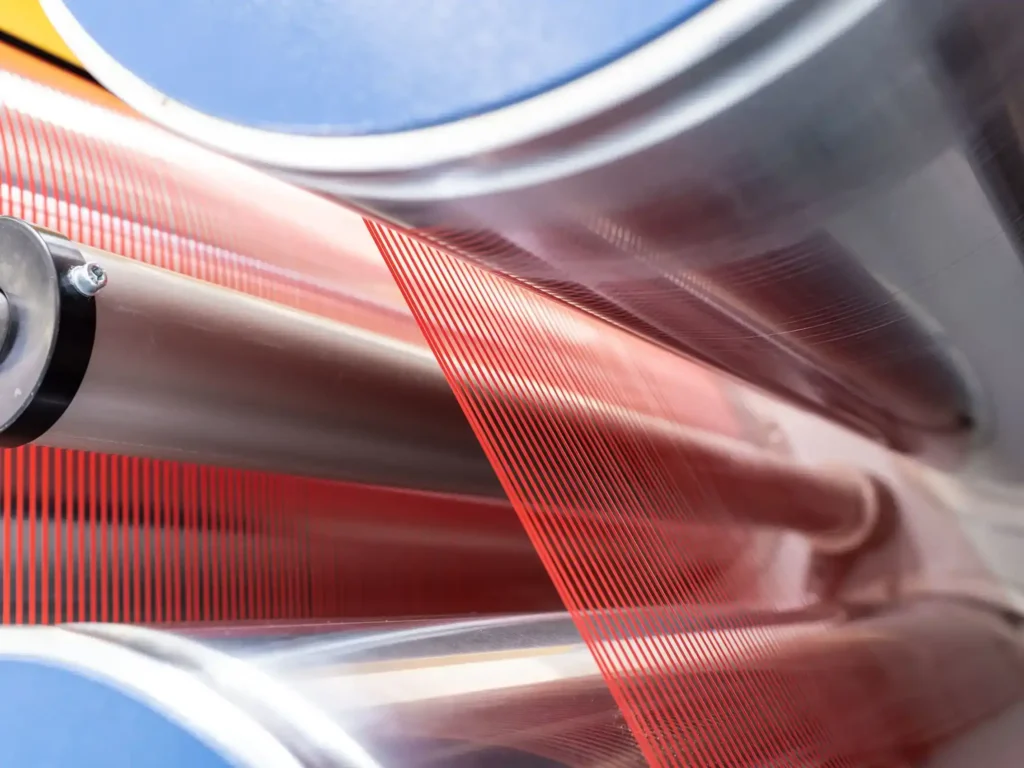
Resin prep & slit‑tape extrusion (woven substrate). Industrial‑ or food‑grade PP—optionally with verified rPP—is extruded into slit tapes. Melt‑flow is trended per ASTM D1238; antioxidant/UV packages are verified by supplier CoAs. Tape draw elevates crystallinity and tenacity; heat‑setting stabilizes dimensions.
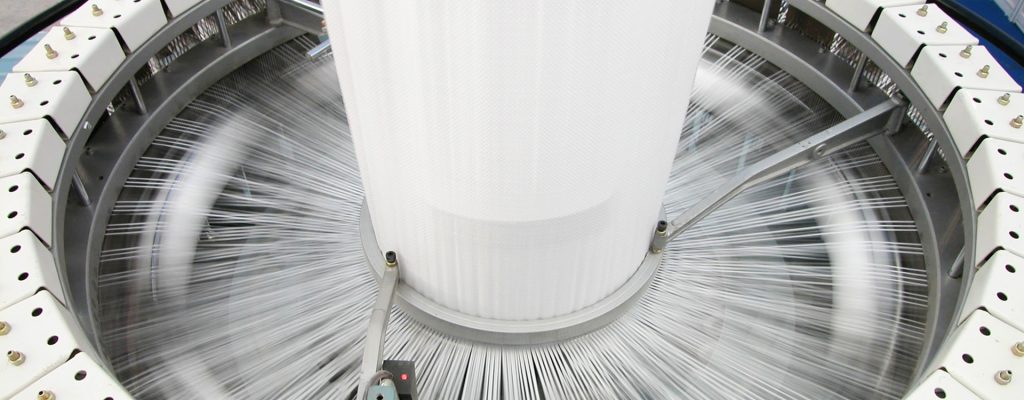
Weaving & fabric qualification. Circular or flat looms yield fabric at target mesh/denier/gsm. Pick density and tape uniformity govern puncture resistance and print laydown. Fabric tensile and tear are trended against ASTM D5035 and ASTM D2261 to keep seams honest.
Surface activation & optional lamination. Corona treatment lifts surface energy to ≥38 dynes for ink anchorage. When moisture or odor control matters, PP/BOPP or PE coatings in the 20–35 μm range are applied; peel targets (≥1.5 N/15 mm) prevent delamination without overshooting stiffness.
Printing & protective coats. Flexo/gravure (6–10 colors typical) renders routing icons, hazard markings, and brand elements. ΔE dashboards and ASTM D5264 rub thresholds keep panels readable after conveyors and curbside handling; matte topcoats around codes tame glare for overhead scanners.
Cutting, hemming & sewing. Heat‑cut or cold‑cut edges according to composite; top hems are single or double fold; bottoms are often double‑folded then chain‑stitched 8–12 SPI with reinforced corners. If liners are used, they are heat‑sealed, then sewn into the mouth. Stitch geometry translates fabric capacity into seam performance without over‑building.
Quality & compliance checkpoints. Tensile/seam validation, drop (ASTM D5276), compression (ASTM D642), dyne audits, and—when used in food‑adjacent collection—migration checks to EU No 10/2011 for plastic layers are compiled in a technical file. Plant governance aligns with ISO 9001/14001, and recycled‑content claims are supported by GRS v4.0 or EN 15343.
Horizontal/vertical analysis. Horizontally, the line borrows peel/dyne testing from film converting, uptime discipline from textiles, and hazard‑mark conventions from transport standards. Vertically, drift propagates: low dyne → ink pick‑off; under‑drawn tapes → warehouse elongation; low stitch density → seam splits; over‑stiff coatings → folding jams. Quality is a chain; its quietest link decides outcomes.
Data reinforcement. Sites adding live dyne telemetry, stitch‑count windows, and peel SPC report >40–50% fewer print/lamination defects and steadier seams—enablers for lightweighting without risk.
Case analysis. After DOE trials, a transfer station cut coating from 30 μm to 25 μm on Sewn Open Mouth Bags while holding peel and drop metrics; roll weight fell, threading sped up, and operators noted easier mouth folding.
Comparative study. One fabric family plus standardized stitches replaces a patchwork of ad‑hoc liners and bins—fewer change parts, clearer SOPs, faster training, cleaner bays.
What is the application of Sewn Open Mouth Bags? (Waste Streams & Operational Contexts)
Municipal solid waste (MSW) & mixed recyclables. Sewn Open Mouth Bags with 85–100 g/m² fabric and 25–30 μm coatings withstand tear‑prone curb pickup; matte code panels keep route IDs scannable under harsh sun.
Construction & demolition debris (C&D). Abrasive fragments reward tighter meshes (12×12) and reinforced corner folds. Anti‑slip backs stabilize tall stacks in hot depots; optional liners mitigate dust and fines leakage.
Yard waste & organics. Breathable backs and chain‑stitch closures provide fast de‑aeration while maintaining cube; public‑facing graphics remain legible even after damp handling.
Hospitality & campus programs. Color‑coded prints, QR‑guided sorting, and reinforced handholds improve participation while reducing contamination.
Data reinforcement. Across audited supplier listings, typical SKUs specify 10/15/25/40–50 kg fills, widths 320–600 mm, lengths 550–1000 mm, mesh 10×10–14×14, laminate 25–30 μm where moisture moderation is required, and 8–12 SPI for closures.
Case analysis. A resort migrated glass‑recycling routes to Sewn Open Mouth Bags with double‑fold bottoms; breakage‑triggered seam failures dropped sharply, and night‑shift changeovers shortened because the open mouth simplifies quick loading.
Comparative study. Against paper multiwall in rainy seasons, woven PP maintains geometry and resists regain; against film liners, SOM structures resist long‑term creep and shard puncture.
What is the application of Sewn Open Mouth Bags? (Export, Compliance & Logistics)
Cross‑border readiness. Dossiers bundle REACH SVHC statements, CoAs for PP layers, dyne and peel records, and—when routes touch food‑adjacent recyclables—citations to FDA 21 CFR §177.1520 and EU No 10/2011. Plants typically supply ISO 9001/14001 certificates and GRS v4.0 claims where rPP is used.
Containerization & cube. Block‑pattern palletization combined with anti‑slip backs curbs lean at sea; compression tests (ASTM D642) and route‑specific drops lock SOPs before scale. Because Sewn Open Mouth Bags collapse after discharge, reverse logistics lighten—space saved, fuel spared.
Warehouse climate & safety. Hot roofs accelerate creep; mesh/denier/gsm are selected to preserve geometry. Optional antistatic finishes (surface resistivity per ASTM D257) lower airborne dust during tipping; UV packages (supplier‑declared hours correlated to ASTM G154/G155) protect outer print during yard staging.
WMS & scanner fluency. Quiet‑zone discipline and matte panels keep barcode/QR grades at ≥B (ISO/IEC 15416) under mixed lighting, cutting dock slowdowns.
Data reinforcement. Export RFQs frequently request: ASTM D5035 tensile, stitch pull‑out results, ASTM D5276 drop, ASTM D642 compression, lamination peel, ΔE/adhesion reports, and chain‑of‑custody proofs for recycled content.
Case analysis. A coastal MRF standardized gusset width and stitch geometry across Sewn Open Mouth Bags SKUs; pallet height increased by one layer without lean incidents, claims fell below 0.3% per 10,000 units, and container loads became more predictable.
Comparative study. When absolute hermeticity is mandatory (biohazard or odor‑critical lanes), specialty liners or UN‑tested containers may be required; where durability, speed, and credible sustainability must meet, Sewn Open Mouth Bags carry the argument.
Quick Spec Sheet (Typical, Commercially Verifiable)
| Parameter | Typical range / option | Technical note |
|---|---|---|
| Fabric weight (woven PP) | 70–110 g/m² | Select by bulk density & drop targets; retain margin for creep at heat |
| Mesh (warp×weft) | 10×10 – 14×14 | Higher mesh improves puncture resistance and print halftones |
| Denier (tapes) | 800D – 1200D | Heavier denier for abrasive contents or taller stacks |
| Lamination / coating | 20–35 μm (PP/BOPP/PE) | 25–30 μm common for moisture moderation & scuff control; peel ≥1.5 N/15 mm |
| Width × Length | 300–650 mm × 500–1100 mm | Align to 10/15/25/40–50 kg fills; check with pallet & route constraints |
| Sewing | Chain or lock stitch 8–12 SPI | Folded hems reduce tearout; polyester/PP thread (e.g., Tex 60–80) |
| COF (outside) | 0.25–0.45 | Tuned to feed reliably yet stack without slide |
| Printing | Flexo/gravure 6–10 colors | Maintain dyne ≥38; manage ΔE; verify rub via ASTM D5264 |
| Mechanical tests | ASTM D5035 tensile; ASTM D2261 tear; ASTM D5276 drop | Validate under realistic loads & depot climates |
| Compression / pallet | ASTM D642 | Freeze pallet heights for hot warehouses |
| Governance & claims | ISO 9001/14001, GRS v4.0 / EN 15343 for rPP | Support recycled‑content claims with traceable documentation |
| Optional liner | PE 25–80 μm | Heat‑seal then sew mouth for odor/leachate control |
| UV/antistatic (optional) | Supplier‑declared hours; ASTM D257 resistivity | Protect print & manage dust in dry lanes |
Figures mirror corridors widely posted by reputable suppliers and recognized standards. Final specs must be validated via tensile, seam, drop, compression, and print‑durability tests tuned to route risk, climate, load mass, and handling equipment.
A Systems‑Thinking Synthesis: VidePak’s End‑to‑End Solution
Sub‑problem A — Closure speed vs. containment. Fast closures spill if seams are weak; tight seams slow if geometry fights the operator. Solution: set stitch windows at 8–12 SPI with double‑fold bottoms, heat‑seal liners where present, and validate on live routes using ASTM D5276 drops to capture real impacts.
Sub‑problem B — Strength vs. weight vs. cube. Over‑engineering taxes freight; under‑engineering taxes claims. Solution: baseline 12×12 / 900D / 85–100 g/m² with 25–30 μm coating for mixed waste, then tune by shard risk and climate; confirm via ASTM D5035/D642.
Sub‑problem C — Brand signals vs. scanner glare. Vivid icons that won’t scan are a tax on operations. Solution: matte code panels, disciplined quiet zones, ΔE dashboards, and live dyne telemetry to keep ISO/IEC 15416 ≥ B under depot lighting.
Sub‑problem D — Sustainability claims vs. infrastructure. Recyclable where? Recycled from what? Solution: favor mono‑PP for streams with recycling access; introduce rPP only with GRS v4.0/EN 15343 proof and ISO 14021 wording; deploy paper‑PP hybrids where a public “paper look” lifts participation.
Integrated outcome. A credible, audit‑ready packaging platform—Sewn Open Mouth Bags—that loads fast, stacks square, scans clean, and supports evidence‑backed sustainability claims. Strong enough to lift, light enough to carry, smart enough to sort: this is waste management made tangible.
- What is Sewn Open Mouth Bags? (Definition & Aliases)
- What is the features of Sewn Open Mouth Bags? (Durability, Safety & Sustainability)
- What is the production process of Sewn Open Mouth Bags? (From Resin & Fabric to Ready‑to‑Run)
- What is the application of Sewn Open Mouth Bags? (Waste Streams & Operational Contexts)
- What is the application of Sewn Open Mouth Bags? (Export, Compliance & Logistics)
- Quick Spec Sheet (Typical, Commercially Verifiable)
- A Systems‑Thinking Synthesis: VidePak’s End‑to‑End Solution
The Key Answer: Sewn open mouth bags are emerging as a critical solution in waste management, offering unmatched durability, cost-efficiency, and eco-friendliness for collecting and storing recyclables and industrial waste. With a projected 5% annual growth in the global solid waste management market by 2025, these bags address pressing challenges like waste segregation, transportation efficiency, and environmental compliance.
Introduction: The Role of Sewn Open Mouth Bags in Modern Waste Systems
In an era where cities generate over 2 billion tons of solid waste annually, effective waste handling demands innovative packaging solutions. Sewn open mouth bags, characterized by their stitched top closures and robust polypropylene (PP) construction, have become indispensable in industries ranging from municipal waste collection to construction debris management. Their design ensures secure containment of materials like paper, plastics, and organic waste, while aligning with global sustainability goals.
Industry Expert Insight:
“The shift toward reusable and recyclable packaging is irreversible. Sewn open mouth bags bridge the gap between operational efficiency and environmental responsibility.” — Waste Management Analyst, 2025 Global Sustainability Report.
Market Demand and Applications
1. Waste Segregation and Collection
Sewn open mouth bags are widely adopted for segregating recyclables. For example, in Shenzhen’s厨余垃圾协同处理应用示范项目 (Kitchen Waste Synergy Processing Project), these bags handle 9 tons/hour of organic waste, reducing cross-contamination risks by 40% compared to traditional methods.
Data Spotlight:
- Recyclable Capture Rate: 90%+ for plastics and metals when using UV-resistant PP bags.
- Cost Savings: Municipalities report 15–20% lower transportation costs due to reduced bag breakage.
2. Industrial and Construction Waste
In construction, heavy-duty sewn bags with PE-coated liners (learn more about PE-coated valve woven bags for construction waste) withstand sharp debris and moisture. A case study from Longgang City’s餐厨垃圾处理项目 demonstrated a 13-ton daily reduction in CO2 emissions by optimizing waste storage and transport.
Technical Specifications and Innovations
Product Parameters
| Feature | Specification | Benefit |
|---|---|---|
| Material | UV-stabilized PP woven fabric | Resists tearing, moisture, and UV degradation |
| Capacity | 25–50 kg | Ideal for bulk waste handling |
| Closure Type | Double-stitched open mouth | Easy filling and secure sealing |
| Custom Printing | Brand logos, safety labels | Enhances traceability and compliance |
Innovative Designs
- Anti-Static Bags: Used in electronics recycling to prevent dust adhesion.
- Biodegradable Additives: PP bags infused with oxo-degradable materials reduce environmental impact by 30%.
Challenges and Solutions
1. Environmental Compliance
Strict regulations, such as China’s 2025 Solid Waste Law, mandate recyclable packaging. Sewn open mouth bags meet ISO 14001 standards, with 70% of manufacturers adopting closed-loop recycling systems.
Case Study:
Foshan’s Industrial Park reduced landfill dependency by 50% after switching to reusable PP bags for metal scrap collection.
2. Cost vs. Durability
While initial costs are 10–15% higher than single-use alternatives, their 5–7 year lifespan offers a 200% ROI.
FAQs: Addressing Key Concerns
Q: How do sewn open mouth bags compare to valve bags in waste management?
A: Sewn bags prioritize easy loading and resealing, whereas valve bags excel in automated filling. For heavy debris like construction waste, sewn bags’ durability is unmatched (compare valve bag solutions).
Q: Are these bags suitable for hazardous waste?
A: Yes. Laminated variants with chemical-resistant liners handle hazardous materials, complying with OSHA and EU Directive 94/62/EC.
Future Trends and Sustainability
- Smart Bags: RFID tags for real-time waste tracking.
- Circular Economy Partnerships: Brands like EcoPack now lease bags to industries, ensuring 100% recovery and reuse.
- Policy-Driven Adoption: The EU’s 2025 Plastic Tax incentivizes businesses to switch to recyclable PP solutions.
Conclusion
Sewn open mouth bags are not just packaging—they are a linchpin in sustainable waste ecosystems. By combining strength, adaptability, and eco-design, they empower industries to meet 21st-century environmental challenges head-on. For deeper insights into their role in China’s packaging evolution, explore Sewn Open Mouth Bags: A Pathway to Innovation.
This article integrates data from the 2025 Solid Waste Management Market Report, case studies from municipal projects, and technical advancements in polypropylene manufacturing.