
In the world of bulk packaging, FIBC Bags (Flexible Intermediate Bulk Containers) have become an indispensable solution for handling and transporting large quantities of materials. From industrial products to agricultural commodities, these robust containers offer efficiency and versatility. At VidePak, our commitment extends beyond merely providing high-quality Bulk Bags; we also prioritize adherence to policies and regulations, ensuring that our practices align with environmental, social, and governance (ESG) standards.
FIBC Bags — Aligning with Policies and Sustainable Practices
What is FIBC Bags?
FIBC Bags—also known as Flexible Intermediate Bulk Containers, bulk bags, big bags, and jumbo sacks—are liftable, high‑capacity containers built from woven polypropylene (PP) to move powders, granules, flakes, and aggregates with consistent safety and speed. Architectures include 4‑panel, U‑panel, circular (tubular), and baffle/Q‑bag bodies; electrostatic classes span Type A/B/C/D to match plant zoning where combustible dusts are present. In short: the fabric carries the load, the loops carry the lift, and the options—liners, coatings, baffles, print systems—carry the use case. When procurement demands compliance, when EHS demands control, when sustainability demands circularity, FIBC Bags let each stakeholder say yes without talking past one another. For an at‑a‑glance taxonomy, see FIBC Bags.
Seen through a systems lens, FIBC Bags are less a container than a control node in the material‑handling network. Horizontally, they connect polymer science (tape draw ratios, UV stabilization), industrial engineering (filling ergonomics, discharge flow), and policy frameworks (UN transport codes, EPR rules, food‑contact regulations). Vertically, causality runs from resin grade → tape tenacity → fabric GSM → seam architecture → liner type → electrostatic category → test plan. Change a single input and you change charging risk at the spout, spillage rates in transit, forklift turns per hour on the dock, and audit outcomes at the customer gate.
What is the features of FIBC Bags?
System view. Performance appears when materials × structure × operations align with policy and sustainability targets. To keep the argument accountable, every feature below uses background → data reinforcement → case analysis → comparative study, so the claims feel like engineering, not advertising.
- Load Safety, Policy Alignment, and Real‑World Robustness
Background. Bulk logistics lives and dies by predictable strength. FIBC Bags are validated under ISO 21898 (non‑dangerous goods) and—when the cargo is regulated—by UN 13H series for dangerous goods. Safety Factors (SF) are typically 5:1 (single trip) and 6:1 (multi‑trip), with test routines for top‑lift, stacking, drop, topple, and righting. Where dust ignition is plausible, IEC 61340‑4‑4/-4‑6 frames electrostatic testing for Types A/B/C/D.
Data reinforcement. Mainstream supplier sheets list SWL 500–2,000 kg, footprints 85–110 cm, heights 90–200 cm, volumes 0.5–2.0 m³. Fabric bases commonly 140–240 g/m² with coating 18–30 g/m²; liners LDPE 60–120 μm (EVOH barrier where odor or oxygen control matters). These values map cleanly to ISO/UN test envelopes and are widely documented across peer converter catalogs.
Case analysis. A minerals processor replaced palletized paper sacks with FIBC Bags rated 1,000 kg SWL, SF 5:1 (U‑panel with baffles). Forklift trips per ton fell, pallet damage claims faded, and top‑lift certificates attached to the COA shortened a customer’s inbound audit cycle under ISO 9001.
Comparative study. Multiwall paper prints warmly but collapses in damp yards; rigid IBCs are stable but punish reverse logistics. FIBC Bags sit between: ton‑class strength that ships flat and returns efficiently.
- Electrostatic Safety and Dust‑Hazard Control
Background. Powders can be explosive; static is the unseen match. FIBC Bags come in Type A (no static features), Type B (low breakdown voltage), Type C (conductive, groundable), and Type D (dissipative without grounding). Engineering must dovetail with ATEX/NFPA plant zoning.
Data reinforcement. Type C designs interlace conductive yarns with earthing tabs verified to IEC 61340‑4‑4; Type D fabrics are tested for static decay and avoidance of propagating brush discharges under the same family of standards. Typical continuity verifications fall below 10⁷–10⁹ Ω depending on design intent.
Case analysis. A pigments site migrated low‑MIE chromatic powders from Type A to grounded Type C FIBC Bags. Charge events dropped to zero; the near‑miss log—once noisy—went quiet for a full quarter.
Comparative study. Paper octabins offer volume but no reliable electrostatic pathway; lined steel bins control charge but are heavy in freight and storage. FIBC Bags deliver fit‑for‑purpose static control in a collapsible format.
- Food‑Contact Hygiene and Audit‑Ready Documentation
Background. If the content is edible, the container must be accountable. Food‑grade FIBC Bags are specified with materials selected to 21 CFR 177.1520 (olefin polymers), 21 CFR 175.105 (adhesives), and Regulation (EU) No 10/2011 (plastics in contact with food). Plants operating under BRCGS Packaging Materials and ISO 22000/FSSC 22000 control allergens, foreign bodies, and hygiene zones.
Data reinforcement. Typical builds include blue LDPE liners 70–100 μm, metal‑detectable sewing threads on request, document pouches, and batch‑level Declarations of Compliance (DoC) plus Certificates of Analysis (COA) logging GSM, dimensions, tensile/tear values, coating weights, and top‑lift outcomes.
Case analysis. A sugar refinery standardized on cleanroom‑sewn FIBC Bags (liner 90 μm, baffle inserts). Audit non‑conformances fell; pallet squareness improved during humid storage.
Comparative study. Corrugated gaylords add labor and reduce pack density; multiwall paper totes de‑ink well when dry but dislike condensation. Food‑grade FIBC Bags combine hygiene with throughput.
- Circularity, EPR Readiness, and Carbon‑Smart Design
Background. Policy is moving toward Extended Producer Responsibility (EPR) and recycled‑content targets. FIBC Bags support mono‑polyolefin builds, resin right‑weighting, and reuse loops.
Data reinforcement. Non‑food outers often include 20–40% rPP with UV packages tuned to 200–800 h outdoor exposure. Reuse programs target 5–10 rotations for SF 6:1 fleets, with inspection sheets (loop wear, seam integrity, contamination) run under ISO 9001:2015.
Case analysis. An agri‑feed brand launched a backhaul reuse loop for FIBC Bags (6:1, duffle top, discharge spout). Virgin resin per delivered ton fell materially; disposal fees dropped due to baled mono‑polyolefin recyclate.
Comparative study. Rigid IBCs last but demand storage and return freight; paper sacks are light but elevate product loss in wet logistics. Reusable FIBC Bags balance resin footprints with damage avoidance.
- Flow, Filling, and Discharge Efficiency
Background. Time is money, dust is risk. Top options—open top, filling spout, full duffle—pair with bottom options—flat bottom or discharge spout with petal, star, or safety tie. Baffles tame bulging; coated fabrics and sift‑proof seams trap fines.
Data reinforcement. Filling spouts commonly Ø 35–50 cm; discharge spouts Ø 30–50 cm; baffle fabrics 90–140 g/m². Sift‑proof seams use filler cords plus double‑needle rows; coating 18–30 g/m² tunes air permeability.
Case analysis. A specialty cement producer moved to baffle FIBC Bags with Ø 40 cm fill spouts and dust‑tight seams; housekeeping hours fell, and truck counts dropped via better cube utilization.
Comparative study. Octabins need assembly; valve sacks run fast but top out at 50 kg. FIBC Bags push throughput into the ton class—without surrendering cleanliness.
What is the production process of FIBC Bags?
From tapes to tonnes, tiny settings write large outcomes—alter a stitch density, alter a claims curve.
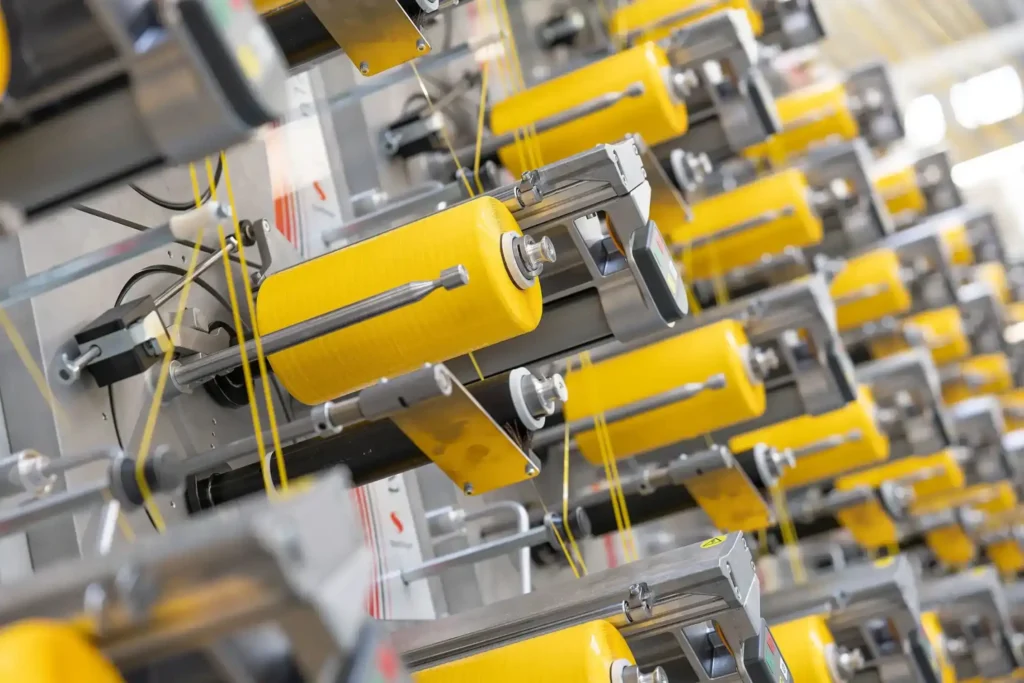
1) Tape Extrusion & Drawing. PP pellets are extruded, slit, and drawn into high‑tenacity tapes. Draw ratio sets tensile/elongation; denier dictates modulus and seam behavior. UV packages guard outdoor fleets.
2) Weaving. Tapes are woven on circular or flat looms into fabrics typically 140–240 g/m². Pick count, loom tension, and width tolerance set panel stiffness, print flatness, and waste in cutting.
3) Coating & Lamination (as required). Extrusion coat 18–30 g/m² to close interstices, or laminate BOPP 15–35 μm for scuff resistance and reverse‑printed graphics. Uniform coating prevents capillary leak paths.
4) Cutting, Forming & Sewing. Panels are cut for 4‑panel or U‑panel bodies; circular bodies need base and top only. Lifting loops (typically 25–35 cm high) are stitched into reinforced attachments; sift‑proof seams add filler cords.
5) Liner Extrusion & Insertion. LDPE 60–120 μm liners—loose, tabbed, or form‑fit—are prepared; EVOH barriers appear where odor or oxygen egress matters. Heat‑sealed liner joins reference ASTM F88/F88M for peel strength.
6) Baffles & Options. Baffle/Q‑bag inserts keep the cube; document pouches and tamper‑evident ties are added. Type C FIBC Bags integrate conductive grids with earthing tabs.
7) Testing & Release. ISO/UN routines cover top‑lift, stacking, drop, topple, and righting; electrostatic tests follow IEC 61340; cleanliness checks (where required) use UV/visual. COAs record dimensions, GSM, coating weight, seam diagrams, and test outcomes for traceability.
What is the application of FIBC Bags? (Industrial & Building Materials)
Cement, Minerals, Aggregates. FIBC Bags rated 1,000–1,500 kg SWL with baffles and discharge spouts deliver better container cube and cleaner yards. A common reference: 90 × 90 × 110 cm baffle body, filling spout Ø 40 cm, discharge Ø 40 cm, fabric 180–220 g/m², coating 20–30 g/m².
Pigments & Chemicals (non‑DG and DG). Where combustibility looms, Type C or Type D FIBC Bags pair with grounded or dissipative handling. Liners manage moisture and odor; sift‑proof seams protect mixers and silos from contamination.
Resins & Fertilizers. Granules benefit from full‑duffle tops (fast open/close) and petal‑type discharge. UV‑stabilized outers support yard storage windows without chalking or embrittlement.
Data reinforcement: Across supplier listings, SWL 500–2,000 kg covers most industrial flows; ISO 21898 and UN 13H testing define the baseline envelope. Case analysis: a fertilizer plant added cross‑corner loops for easy four‑fork pickup, shaving seconds from each load cycle at railheads.
What is the application of FIBC Bags? (Food, Pharma & Agriculture)
Sugar, Rice, Starch, Flour. Food‑grade FIBC Bags with cleanroom sewing, blue liners, and metal‑detectable options protect purity and speed audits under BRCGS. Reverse‑printed panels behind BOPP keep nutrition and allergen statements legible after long transport.
Seeds & Crop Inputs. Baffle bodies prevent bulging in dealer stacks; serialization printed beneath the laminate supports traceability and counterfeit deterrence across fragmented networks.
Nutraceuticals & Pharma Intermediates. Type D FIBC Bags mitigate static without grounding in busy rooms; liners specified to EU 10/2011 limit migration risk. Document pouches protect batch records and MSDS during hand‑offs.
Comparative study: corrugated boxes compress and demand dunnage; multiwall paper sheds fiber; rigid IBCs strain backhauls. FIBC Bags thread the line between hygiene, handling speed, and reverse‑logistics sanity.
Integrated Solution (System Thinking Synthesis)
Objective: align safety, policy, and sustainability while reducing total delivered cost. Treat FIBC Bags as a closed loop:
- Diagnose. Map SKUs to failure modes—seam abrasion, bulging, dusting, charge events, audit gaps. Instrument fillers (flow meters, dust counters) and docks (damage logs, forklift cycle trackers). Ask: where does risk actually live—at the spout, in the stack, or on the road?
- Design. Choose architecture (4‑panel/U‑panel/circular/baffle); fabric 140–240 g/m²; coating 18–30 g/m²; SWL 500–2,000 kg; SF 5:1/6:1. Specify top/bottom (spout/duffle/flat), liner 60–120 μm, electrostatic Type A/B/C/D; define print, pouching, labels. Anchor materials to 21 CFR 177.1520 / EU 10/2011 where food‑adjacent; anchor safety to ISO 21898 / UN 13H / IEC 61340.
- Validate. Run top‑lift/stacking/drop/topple/righting; verify seal‑peel for heat‑sealed liners (ASTM F88/F88M); confirm barcode A/B grades; record UV exposure windows and rPP content targets. Pull in third‑party reports (SGS/Intertek) to harden the file.
- Deploy. Lock packer recipes, earthing checks (Type C), and inspection sheets for reuse fleets. Standardize pallet patterns and corner protection to stabilize transport.
- Improve. Quarterly reviews: right‑weight without eroding safety margins; expand reuse where sanitation allows; update recyclability statements for EPR; roll up claims and OEE impacts in the ISO 9001 management review.
Key Specifications & Options (Typical Ranges)
| Attribute | Typical Options / Range | Why it Matters |
|---|---|---|
| Style | FIBC Bags in 4‑panel, U‑panel, circular (tubular), or baffle/Q‑bag | Drives cube stability, bulge control, stacking |
| Safe Working Load (SWL) | 500–2,000 kg | Matches product density and lift equipment |
| Safety Factor (SF) | 5:1 single‑trip; 6:1 multi‑trip (per ISO/industry practice) | Governs reuse policy and inspection regime |
| Footprint & Height | 85–110 cm (L/W); 90–200 cm H; 0.5–2.0 m³ volume | Aligns with containers, trucks, and racks |
| Fabric GSM | 140–240 g/m² PP woven; optional coating 18–30 g/m² | Tear resistance; sift control |
| Lifting Loops | 4 corner or cross‑corner; 25–35 cm high | Safe engagement; crane/fork compatibility |
| Top Options | Open top, filling spout Ø 35–50 cm, full duffle | Filling speed; dust control |
| Bottom Options | Flat bottom; discharge spout Ø 30–50 cm with petal/star/safety tie | Controlled discharge; re‑closure |
| Liners | LDPE 60–120 μm; optional EVOH barrier | Moisture/odor/oxygen control |
| Electrostatic Class | Type A/B/C/D (tested to IEC 61340‑4‑4/-4‑6) | Explosion protection in dust zones |
| UV Stability | 200–800 h exposure packages | Outdoor storage resilience |
| Compliance anchors | ISO 21898, UN 13H (where required), IEC 61340, 21 CFR 177.1520, EU 10/2011, ISO 9001 / BRCGS | Audit‑ready vocabulary |
Note: Ranges reflect widely published supplier data on global B2B platforms and peer converter disclosures; always tune to density, climate, route stress, and regulatory scope. Validate—don’t assume.
Professional Identifiers & Why They Matter
- ISO 21898 — Defines the performance language for non‑dangerous‑goods FIBC Bags: top‑lift, stack, drop, topple, righting.
- UN 13H (Recommendations on the Transport of Dangerous Goods) — Certification pathway for dangerous‑goods FIBC Bags; adds stricter tests and marking.
- IEC 61340‑4‑4 / ‑4‑6 — Electrostatic testing that separates Types A/B/C/D and keeps powders and people safe.
- 21 CFR 177.1520 / EU No 10/2011 / 21 CFR 175.105 — Plastics and adhesive anchors for food‑adjacent liners and contact layers.
- ISO 9001:2015 / BRCGS Packaging Materials / ISO 22000/FSSC 22000 — Quality and hygiene schemes that turn specifications into repeatable runs with traceability.
Copy Blocks You Can Reuse (Brand Voice Ready)
- Value line. Safer lifts, smarter policies, cleaner audits—FIBC Bags turn bulk handling into a competitive advantage.
- Proof point. ISO 21898 top‑lift and UN 13H routines, IEC 61340 electrostatic control, and food‑grade liners to 21 CFR/EU 10/2011—FIBC Bags keep product secure and stakeholders aligned.
- Sustainability note. Right‑weight fabrics, specify mono‑PP builds with rPP where allowed, design for reuse, and publish end‑of‑life guidance so FIBC Bags perform both in service and in policy.
Understanding FIBC Bags and Their Role
FIBC Bags, also known as Ton Bags or Jumbo Bags, are designed for the bulk handling of a wide range of products. Their flexibility, durability, and load-bearing capacity make them suitable for industries such as construction, agriculture, and manufacturing. Key advantages of FIBC Bags include:
- High Load Capacity:
FIBC Bags are engineered to support significant weights, often up to 2,000 kg (4,400 lbs), making them ideal for bulk storage and transport. Their design allows for efficient handling, stacking, and transportation of large volumes of materials. - Versatility and Customization:
These bags can be customized to meet specific requirements, including size, shape, and closure types. They can also be tailored for various applications, from storing granular materials to liquids and powders. - Cost-Effectiveness:
Due to their reusable nature and the ability to compress for storage, Jumbo Bags offer a cost-effective solution for bulk handling compared to other types of packaging.
Policy and Regulatory Compliance in FIBC Production
Ensuring that FIBC Bags are produced in compliance with relevant policies and regulations is crucial for maintaining high standards of quality and ethical practices. At VidePak, we adhere to various policies that guide the production and management of our FIBC Bags:
- Compliance with Industry Standards:
We follow stringent industry standards and regulations to ensure that our Bulk Bags meet safety and quality requirements. This includes adherence to ISO certifications, which guarantee that our products are manufactured with consistent quality and reliability. - Respect for Labor Rights:
Respecting labor rights is a fundamental aspect of our operations. We ensure that our production facilities uphold fair labor practices, providing safe working conditions, fair wages, and respect for workers’ rights. VidePak is committed to ensuring that our entire supply chain adheres to these principles. - Sustainable Production Practices:
Sustainability is at the core of our production processes. We use environmentally friendly materials and practices to minimize our ecological footprint. Our approach includes using recyclable and biodegradable materials where possible, optimizing manufacturing processes to reduce waste, and implementing energy-efficient technologies. - Governance and Transparency:
Effective governance and transparency are essential to maintaining trust and accountability. VidePak adheres to rigorous internal controls and reporting standards to ensure that our business practices are ethical and transparent. We regularly review and update our policies to reflect best practices and regulatory changes.
VidePak’s Commitment to ESG Standards
At VidePak, our commitment to Environmental, Social, and Governance (ESG) standards is central to our business philosophy. We strive to integrate these principles into every aspect of our operations, from production to corporate social responsibility initiatives:
- Environmental Responsibility:
We are dedicated to reducing our environmental impact by adopting sustainable practices in our manufacturing processes. This includes minimizing waste, reducing energy consumption, and using eco-friendly materials for our FIBC Bags. We continually seek ways to improve our environmental performance and support global sustainability goals. - Social Impact:
VidePak is committed to making a positive social impact, particularly in communities where our operations are based. We support initiatives that improve the quality of life for workers and their families, including educational programs and community development projects. For example, we focus on improving the living conditions and educational opportunities for children in impoverished areas, ensuring that they have access to better resources and opportunities. - Ethical Management and Governance:
Our approach to governance emphasizes ethical management practices, transparency, and accountability. We implement robust policies and procedures to ensure that our operations are conducted with integrity and that we meet our regulatory obligations. Our governance framework is designed to promote ethical behavior, prevent misconduct, and ensure compliance with all relevant laws and regulations.
Looking to the Future
As the packaging industry evolves, the importance of aligning with ESG standards and regulatory requirements will only grow. At VidePak, we are committed to staying ahead of these changes and continuously improving our practices to meet emerging challenges and opportunities.
- Innovation in Sustainable Materials:
We are exploring new materials and technologies that enhance the sustainability of our FIBC Bags. This includes developing innovative solutions that further reduce environmental impact and increase the recyclability of our products. - Enhanced Social Responsibility Programs:
We plan to expand our social responsibility initiatives to support more communities and address additional social issues. Our goal is to make a meaningful difference in the lives of those affected by our operations. - Advancing Regulatory Compliance:
We will continue to monitor and adapt to changes in regulations and standards to ensure that our practices remain compliant and up-to-date. Our commitment to regulatory compliance and best practices will help us maintain the highest standards of quality and integrity.
VidePak’s Role in Shaping the Future
VidePak’s dedication to producing high-quality FIBC Bags that adhere to stringent policies and ESG standards underscores our commitment to excellence and responsibility. Our focus on sustainable practices, respect for labor rights, and ethical governance positions us as a leader in the packaging industry.
By integrating ESG principles into our operations, we not only enhance the quality and efficiency of our products but also contribute to a more sustainable and equitable world. As we move forward, VidePak remains committed to innovation, responsibility, and excellence, ensuring that our FIBC Bags continue to meet the needs of our clients while supporting global sustainability and social progress.