
What are Heavy Duty Woven Bags? (a.k.a. heavy‑duty PP/HDPE woven sacks)
Heavy Duty Woven Bags sit at the crossroads of materials science, logistics engineering, and brand communication. Built from oriented polypropylene (PP) or HDPE tapes woven into a stable fabric and then converted into sacks, they are engineered for demanding 10–50 kg applications—and, with the right bill of materials, beyond. In practice they answer a stubborn dilemma: films show but don’t carry; rigid bulk solutions carry but don’t pack densely. Heavy Duty Woven Bags do both—providing visibility options, robust mechanical performance, and efficient cube utilization on pallets.
From a domain perspective, packaging scientists treat these sacks as tape‑fabric composites whose performance can be tuned by denier, mesh density, and fabric GSM. Operations teams see them as unit‑load stabilizers that must survive clamp‑truck pressure, conveyor abrasion, and stack compression. Marketing views the face panel as a print surface that—especially when paired with BOPP lamination—can hold crisp graphics and scannable barcodes. Horizontally, the concept borrows load‑path logic from geotextiles, optical discipline from film packaging, and traceability rigor from food‑contact regulation. Vertically, the logic climbs resin → tape → weave → surface → conversion → testing; each layer constrains and empowers the next. What looks like “just a sack” is, in fact, a stack of interlocking systems.
Data grounds the promise. Typical market ranges for Heavy Duty Woven Bags show fabric around 80–140 g/m², meshes near 9×9 to 14×14, and tape deniers between ~800D and 1500D for 25–50 kg fills. Widths commonly span ~40–100 cm; a 25 kg format often lives around 40×60 cm, while 50 kg sits near 50×80 cm. Those numbers are not window dressing; they are levers: alter GSM and you alter drop energy tolerance; shift mesh and you change print smoothness; adjust denier and you rebalance puncture resistance versus mass.
Case evidence illustrates the mechanism. A rice processor replacing plain white sacks with printed, laminated Heavy Duty Woven Bags accelerated SKU verification at the line (graphic cues on the face), reduced rework from mis‑picks, and held pallet heights constant. Comparative logic adds color: against paper multiwall, the woven option keeps its strength in humid warehouses and shrugs off corner impacts; against mono‑material PE film, it offers better pallet friction and more confident clamp‑truck handling—while still enabling a premium look when clear lamination is used.
What are the features of Heavy Duty Woven Bags?
Feature sets matter because they control real risks. Heavy Duty Woven Bags deliver high strength‑to‑weight efficiency: oriented PP tapes provide tensile, tear, and abrasion resistance at moderate GSM, which means lighter packaging carrying a heavier product safely. Seam integrity anchors the base: single or double‑fold bottoms, single or double stitching, and precisely set stitch pitches distribute impact forces; hemmed or heat‑cut mouths govern fray control and mouth stiffness. Moisture strategies range from breathable fabric to PE coating to clear BOPP lamination, with optional PE liners for hygroscopic goods. For branding, flexographic or gravure printing on a clear laminate yields sharp color, dense blacks, and barcodes that scan under harsh warehouse lighting. Handling aids—anti‑slip coatings, UV stabilizers, antistatic packages, M‑gussets, even valves or handles—customize behavior for specific fillers, conveyors, and pallet patterns.
Horizontal thinking ties those features across disciplines. Materials engineering explains how tape modulus, orientation, and crystallinity translate into tear resistance; operations safety shows how anti‑slip surfaces reduce pallet shear on turns; commercial design frames why a smoother print plane improves price‑perception at shelf. Vertical thinking traces how a dial upstream propagates downstream: increase mesh and the surface profile smooths; smoother surfaces keep halftones tidy; tidier halftones reduce misreads; fewer misreads trim picking errors. The chain is technical, the payoff operational, the benefit economic.
Empirical clues support this framing. Heavy‑duty listings frequently cite GSM 90–120 for many 50 kg rice or fertilizer SKUs, meshes around 10×10–12×12, and BOPP lamination thickness in the 15–25 µm corridor. Where drop heights or abrasive fills grow harsh—minerals, aggregates—fabric GSM and denier are stepped up. In one fertilizer program, an anti‑slip coating paired with hemmed mouths reduced pallet slippage and cut fiber dust, producing cleaner stores and fewer damage claims. And in comparative trials, laminated Heavy Duty Woven Bags resisted face scuffing better than plain woven and outperformed paper after contact with damp floors.
What is the production process of Heavy Duty Woven Bags?
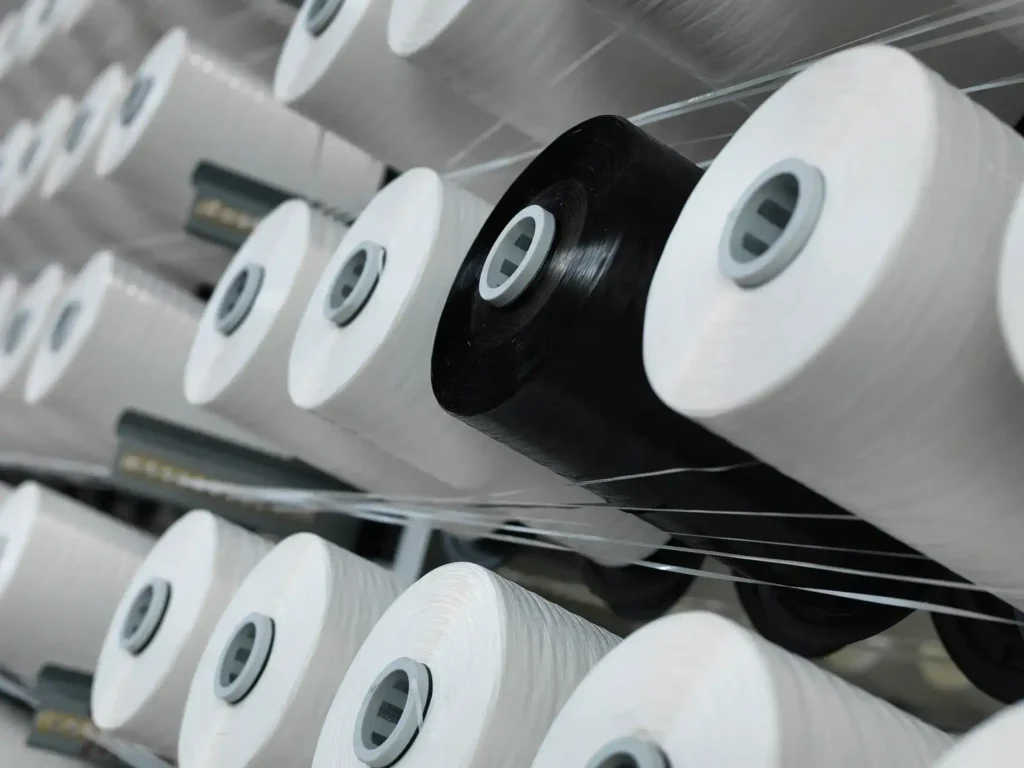
The manufacturing arc unfolds in five stages, each with its own physics and economics. Stage one: tape extrusion on advanced lines such as Starlinger starEX. Polymer is melted and cast, slit into narrow tapes, and then stretched/annealed to align chains and lock in strength. Modern lines integrate non‑nuclear thickness measurement, multi‑godet orientation control, and high‑cleanliness filtration that accommodates controlled rPP or mineral filler without peppering the film with gels. What is the outcome? Tape uniformity—modulus, width, and crystallinity within tight bands—so the weave behaves predictably.
Stage two: weaving on RX/FX circular looms under controlled warp tension. Weft‑end sensors and warp‑break detection keep defects from propagating, while width tolerance is maintained at pace. Stable tension protects the tapes, reduces hairiness, and sets the stage for better lamination. If extrusion tunes the instrument, weaving keeps time.
Stage three: coating, lamination, and printing. PE coating tightens porosity and helps with moisture control. Clear BOPP lamination smooths the woven profile, creating a high‑gloss, print‑ready face that elevates brand marks and barcode legibility. Flexo or gravure systems deposit inks with adhesion tailored to surface energy; registration accuracy depends on width stability achieved upstream. Is lamination just about shine? No—it is signal clarity, abrasion resistance, and scuff management packaged as optics.
Stage four: conversion. Cutting, hemming or heat‑cutting the mouth; folding and stitching the bottom (single or double); inserting a PE liner where needed; adding M‑gussets, valves, or carry features. Inline inspection and roll tracking cement traceability so a finished pallet can be tied back to resin lots, extrusion lines, and loom clusters. If it can be traced, it can be trusted.
Stage five: QA and compliance. Mechanical tests for tensile, tear, and seam strength; drop tests aligned to handling realities; migration tests where food contact is claimed; a documentation stack—DoC, resin data sheets, additive lists, line IDs—that stands up under audit. Quality systems such as ISO 9001 provide the governance layer so the story can be retold with evidence.
The comparative lens clarifies the machinery’s role. eQo‑class extrusion tolerates recycled content more gracefully than legacy lines while preserving clarity; tighter tape distributions yield flatter laminates, which, in turn, lift print outcomes. Converters that replaced older looms with RX‑class machines often saw bobbin‑end defects fall and width dispersion tighten—scrap dropped, registration improved, rework shrank. The physics is invisible on shelf, yet its results are not: fewer cosmetic defects, more consistent brand presence, steadier margins.
What is the application of Heavy Duty Woven Bags?
Applications gather where identity confirmation meets bulk movement. In staple foods—rice, flour, sugar, pulses—packers need faces that sell and bodies that stack. Heavy Duty Woven Bags enable both. In agriculture and feed, UV‑stabilized fabric and anti‑slip surfaces protect outdoor storage and forklift turns; liners capture fines and guard against moisture. In construction and minerals, puncture resistance and bottom strength dominate; the right denier and seam design dissipate impact energy. In chemicals and resin pellets, dimensional stability pairs with barcode fidelity so inventory counts do not drift.
Behavior changes with geometry. The familiar 25 kg (≈40×60 cm) and 50 kg (≈50×80 cm) footprints are not arbitrary—they coordinate with filler spouts, pallet patterns, and clamp‑truck jaws. Adjust width and you may synchronize better with a particular filling line; adjust bottom folds and you may absorb drops unique to a given warehouse. Specification is strategy written in numbers.
Horizontally, Heavy Duty Woven Bags compete with paper multiwall, PE film sacks, and—in the next size tier—FIBCs. Vertically, each sector imposes a different ladder of constraints: food anchors to migration and organoleptic performance; agriculture emphasizes UV endurance and pallet friction; minerals push seam efficiency at drop; chemicals sometimes demand antistatic behavior. One platform, many staircases—each climbed with a tuned bill of materials.
What is the application of Heavy Duty Woven Bags? (sector‑specific deployment)
Food‑contact and retail place the sack under the lights—literally. Declarations under EU 10/2011 and FDA 21 CFR §177.1520 clarify admissible materials and usage conditions; clear BOPP faces carry color‑rich graphics without surrendering to abrasion. Yard storage and exposure in agriculture reward UV‑stabilized fabric; anti‑slip keeps pallets together when forklifts yaw. High‑abrasion and heavy‑drop scenarios—cement, sand, salts—benefit from higher GSM and denier, with double‑fold/double‑stitch bottoms spreading loads; liners prevent fines from wicking through interstices. For ESD‑sensitive powders, antistatic packages and liners tame charge build‑up relative to plain PE while preserving woven strength.
A cross‑disciplinary lens shows the trade‑space: raise GSM and you may relax denier; add lamination and you gain print quality but carry more mass; insert a liner and you strengthen barrier yet must recalibrate seam specifications. The “best” configuration is not universal; it is the one that matches a line’s rhythm, a warehouse’s choreography, and a market’s rulebook.
Compliance & testing (numbers that open markets)
Compliance is engineering meeting law with a handshake. For Heavy Duty Woven Bags, the portfolio usually includes: EU Regulation 10/2011 for plastics in food contact with migration testing and a maintainable Declaration of Compliance; FDA 21 CFR §177.1520 covering PP articles with conditions of use tied to temperature and contact duration; GB/T 8946‑2013 defining general technical requirements for plastic woven sacks—dimensions, seam strength, marking, inspection rules; and a QMS backbone under ISO 9001:2015 that preserves lot‑to‑line traceability. Third‑party labs such as Intertek or SGS supply migration, organoleptics, tensile, and seam results that convert claims into evidence. Bureaucratic? No—permission to sell is built from these numbers.
Key Parameters & Options (market‑referenced)
| Parameter | Typical Range / Option | Field Rationale | Notes |
|---|---|---|---|
| Fabric GSM | ~80–140 g/m² for many 25–50 kg SKUs | Balances drop energy and mass | Lamination adds mass; abrasive goods → higher GSM |
| Mesh density | ~9×9 – 14×14 | Denser mesh smooths surface and boosts puncture resistance | Choose by artwork ambition and product abrasiveness |
| Tape denier | ~800D – 1500D | Higher denier tolerates clamp‑truck and impact stress | Denier and GSM interact; verify on line |
| Width | ~40–100 cm | Aligns with 25–50 kg formats and pallet schematics | 25 kg ≈ 40×60 cm; 50 kg ≈ 50×80 cm |
| Top finish | Heat‑cut / hemmed | Mouth integrity and dust control | Hemming reduces fray; heat‑cut accelerates throughput |
| Bottom seam | Single/double fold; single/double stitch | Distributes impact loads on drops | Double‑fold/double‑stitch for heavier drops |
| Surface | Plain / PE‑coated / BOPP‑laminated | Moisture control, printability, abrasion | Clear BOPP gives gloss and graphics fidelity |
| Liner | Optional PE inner liner | Moisture/fines control for hygroscopic goods | Increases barrier; affects seam specs |
| Additives | Anti‑slip / UV / antistatic | Safer handling and outdoor endurance | Tune to yard storage, powder behavior |
Integrated solution (synthesis for VidePak buyers)
The objective is stable stacks, persuasive faces, compliant materials, and predictable cost. The method is disciplined engineering tied to brand intent. Start with a tuned recipe—virgin PP or controlled rPP with UV and anti‑slip as needed. Run it on advanced Starlinger tape lines with online thickness control; translate it on RX/FX looms with warp and weft protections; choose a surface architecture—plain fabric, PE‑coated, or clear BOPP lamination—aligned to moisture and merchandising aims; convert with hemmed mouths and double‑fold bottoms where impacts threaten; and close the loop with EU/US food‑contact dossiers and GB/T 8946 conformance backed by ISO 9001 traceability. That is not a slogan; it is a repeatable bill of materials you can audit. For a concise category view aligned to this construction, explore Heavy Duty Woven Bags—an intentional anchor to the family where these specifications live.
Messaging blocks you can reuse (VidePak)
Clarity of purpose without excess mass: Heavy Duty Woven Bags carry the load while keeping packaging weight disciplined. Proof‑ready graphics that persuade: a clear BOPP face converts woven strength into a premium canvas for saturated color and sharp codes. Engineered on advanced lines: from tape to weave, process control trims variation so the brand looks Friday‑fresh every Monday. Ready for regulated markets: when specified and verified, the construction aligns with EU 10/2011, FDA 21 CFR §177.1520, and GB/T 8946—numbers that do not decorate brochures but open doors.
Heavy Duty Woven Bags, also known as Ton Woven Bags, Jumbo Bags, Bulk Bags, and FIBC Bags, are essential in industries where strength, durability, and reliability are crucial. These bags are designed to handle large quantities of materials, from construction aggregates to agricultural products, making them indispensable in various sectors. With the advancements in manufacturing technology, the production of Heavy Duty Woven Bags has seen significant improvements, particularly with the integration of Starlinger’s high-efficiency equipment. VidePak’s commitment to using this state-of-the-art technology highlights the company’s dedication to quality and productivity.
The Importance of Heavy Duty Woven Bags
Heavy Duty Woven Bags are designed to withstand rigorous handling and transportation conditions. Their primary applications include:
- Construction: Used for packaging and transporting materials such as sand, gravel, and cement. These bags are built to endure heavy loads and harsh conditions on construction sites.
- Agriculture: Ideal for packaging bulk quantities of agricultural products like fertilizers, seeds, and grains. The robustness of these bags ensures the safe and efficient handling of these materials.
- Industrial: Essential for the storage and transportation of chemicals, powders, and other bulk materials. The strength and durability of Heavy Duty Woven Bags make them suitable for various industrial applications.
- Logistics: Facilitates the movement of large quantities of goods, simplifying bulk handling and reducing the need for multiple smaller packages.
Technological Advancements in Production
The production of Heavy Duty Woven Bags has evolved significantly with the introduction of advanced machinery and automation. Traditionally, the manufacturing process for these bags involved several manual steps, which could limit production efficiency and consistency. However, with the advent of modern technology, the industry has experienced remarkable improvements.
VidePak has embraced these advancements by utilizing the full suite of equipment from Starlinger, a global leader in packaging machinery. Starlinger’s technology is renowned for its high automation levels and efficiency, which have transformed the production of Heavy Duty Woven Bags.
Advantages of Starlinger Equipment
- High Automation: Starlinger’s machinery is designed with advanced automation features that minimize manual intervention. This automation not only speeds up the production process but also ensures a high level of precision and consistency in the finished product.
- Production Speed: With the ability to produce over 200 bags per minute, Starlinger’s equipment significantly boosts production efficiency. This high speed allows VidePak to meet growing demand while maintaining quality standards.
- Multi-Machine Integration: The ability of Starlinger’s equipment to operate multiple machines in a coordinated manner enhances overall production efficiency. This integration streamlines the manufacturing process, reduces downtime, and improves output consistency.
- Quality Control: The advanced quality control mechanisms integrated into Starlinger’s equipment ensure that each Heavy Duty Woven Bag meets stringent specifications. These mechanisms monitor various parameters, including bag strength, seam integrity, and material consistency, ensuring that every product adheres to the highest standards.
VidePak’s Commitment to Excellence
VidePak’s investment in Starlinger’s advanced technology reflects its commitment to delivering top-quality Heavy Duty Woven Bags. With over 20 years of industry experience, VidePak has established itself as a leader in the woven bag sector, known for its focus on quality, innovation, and customer satisfaction.
The company’s use of cutting-edge machinery is a testament to its dedication to staying at the forefront of the industry. By leveraging high-speed, automated equipment, VidePak can efficiently produce Ton Woven Bags, Jumbo Bags, and other heavy-duty solutions that meet the diverse needs of its customers.
In addition to technological advancements, VidePak maintains rigorous quality control processes to ensure that every bag meets specific performance criteria. This attention to detail is crucial in maintaining the company’s reputation for delivering reliable and durable products.
The Future of Heavy Duty Woven Bags
The future of Heavy Duty Woven Bags is likely to be shaped by several key trends and developments:
- Material Innovations: Advances in materials technology may lead to the creation of even stronger and more resilient woven bags. Innovations in polymers and fibers could enhance the durability and load-bearing capacity of these bags.
- Sustainability: As environmental concerns continue to grow, there is increasing pressure on the packaging industry to adopt sustainable practices. The use of recycled materials and the development of eco-friendly packaging solutions are expected to become more prominent.
- Continued Automation: The trend towards greater automation in manufacturing will likely continue, with new technologies further improving production efficiency and product quality.
- Customization: The demand for customized solutions tailored to specific industry needs is expected to rise. Heavy Duty Woven Bags that can be adapted to different applications and requirements will become more common.
In conclusion, Heavy Duty Woven Bags play a crucial role in various industries, offering strength, durability, and efficiency. The integration of advanced technology, such as Starlinger’s high-speed and automated equipment, has revolutionized the production process, allowing companies like VidePak to deliver superior products. As the industry continues to evolve, innovations in materials, sustainability, and automation will drive future developments, ensuring that Heavy Duty Woven Bags remain a key component in the packaging sector.