

What are FFS Woven Bags? (a.k.a. FFS PP woven sacks / laminated FFS raffia bags)
FFS Woven Bags are industrial packages designed to reconcile two demands that usually pull in opposite directions: the brute strength of woven substrates and the relentless pace of automated form‑fill‑seal cycles. Built on a woven polypropylene (PP) fabric and clad with a sealable laminate—commonly PE (LDPE/LLDPE) or CPP—they arrive as pre‑made sacks or on reels for collar‑type FFS machines. Also called FFS PP woven sacks, laminated FFS raffia bags, or woven FFS sacks, they serve 10–50 kg commodities where skid resistance, seam reliability, and crisp branding must coexist: fertilizers, salts, resins, sugars, feeds, and construction powders.
From a domain standpoint, packaging science treats FFS Woven Bags as tape‑fabric composites (mesh, denier, GSM) topped by a film layer whose seal window and coefficient of friction (COF) govern line behavior. Operations teams read them as unit‑load stabilizers that must track straight through forming collars, seal consistently at speed, and resist clamp‑truck abuse. Brand managers see a laminated face that can carry gravure/flexo graphics, GS1 barcodes, and serialized QR without trading away durability. Horizontally, the product borrows from geotextile load paths, oriented‑film optics, and automation engineering. Vertically, the logic stacks resin → tape → weave → lamination/printing → reel geometry → FFS forming & sealing → palletization → retail performance. Tweak one tier and another moves: change mesh density and lamination lays flatter; change lay‑flat and seal jaws behave; change seals and pallet leak rates fall. The bag is not a part; it is a system.
Data reinforcement. Market‑credible ranges place woven fabric at ~70–140 g/m², mesh ~10×10–14×14, tape denier ~800D–1500D; lamination add‑ons cluster around ~15–30 g/m²; overall widths tend to ~35–100 cm, mapping to ~40×60 cm (25 kg) and ~50×80 cm (50 kg). COF targets for bag‑to‑deck often land between ~0.35–0.55—low enough to feed smoothly, high enough to stack tall. On well‑tuned lines, sustained outputs of ~1,200–2,400 bags/hour are realistic for free‑flowing products.
Case analysis. A coastal salt plant replaced paper multiwall with matte‑laminated FFS Woven Bags; corner bursts after humid loading dropped, barcode pass rates climbed, and hourly throughput rose ~18% thanks to steadier lay‑flat and tighter width dispersion.
Comparative study. Versus tubular PE FFS film, FFS Woven Bags deliver better pallet friction and clamp‑truck resilience with similar graphics potential; versus non‑FFS woven sacks, they deliver higher throughput and labor savings while preserving the brick‑stable stack customers expect.
What are the features of FFS Woven Bags?
Strength‑to‑weight efficiency. Oriented PP tapes provide tensile and tear strength at moderate GSM, letting packaging mass stay disciplined even as payloads remain ambitious.
Heat‑seal architecture. The PE/CPP laminate defines a usable temperature–pressure–dwell window; stable peel curves mean fewer smile seals, fewer crushed webs, fewer leakers at speed.
Lay‑flat & width control. Uniform weave and even gauge lamination create reels that track true through collars; registration holds, small text stays sharp, codes scan.
COF tuning & slip control. Anti‑slip back coatings or micro‑embossed films set the friction point that reconciles two worlds—feed rollers and tall stacks. Safety, productivity, and shelf orderliness all hinge on that dial.
Print & branding options. Flexo (4–6 colors) for agile changeovers; gravure (8–10 colors) for photographic panels. Matte films minimize glare on LED aisles; gloss surfaces lift saturation for premium cues. Serialization (QR/lot) supports traceability and anti‑counterfeit programs across marketplace channels.
Horizontal integration. Materials engineering explains why denser mesh lowers surface roughness; printing science shows how smoother laydown tightens bar‑widths and halftones; line engineering ties controlled COF to fewer feed slips and cleaner jaw release. Three disciplines, one arc of cause and effect.
Vertical logic. Adjust mesh → roughness falls → lamination wet‑out improves → jaw heat spreads evenly → peel curves stabilize → leakers drop on impact → pallet rework declines. Physics becomes productivity.
Data reinforcement. Many 50 kg SKUs specify GSM ~90–120, mesh ~10×10–12×12, lamination ~20 g/m², COF ~0.40–0.50, and sealing windows ~135–165 °C (equipment‑dependent). Variable data typically holds X‑height ≥ 1.2 mm to remain legible after clamp handling.
Case analysis. A South China fertilizer brand adopted matte‑laminated FFS Woven Bags with anti‑slip backs and hemmed mouths. Pallet slides fell; clamp‑scuffs hid; damage claims trended down quarter‑on‑quarter.
Comparative study. FFS woven vs paper multiwall: superior wet‑chain toughness and seam integrity. FFS woven vs tubular PE: better clamp handling and shelf stiffness, while retaining film‑like print.
What is the production process of FFS Woven Bags?
1) PP granules selection & tape extrusion. Raffia‑grade PP with MFI ~2–4 g/10 min (230 °C/2.16 kg, ISO 1133) is melted, cast, slit, stretched, and annealed. Draw stability narrows modulus/width dispersion and is the precondition for predictable weaving and lamination.
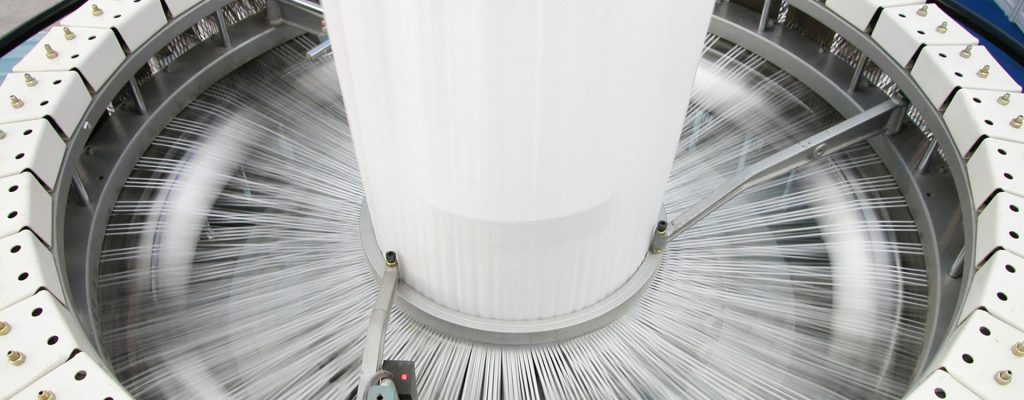
2) Weaving (circular/flat looms). Tapes interlace at target mesh and GSM under controlled warp tension. Weft‑stop and warp‑break detection localize defects; tight width tolerance underwrites print register and collar tracking.
3) Surface prep & lamination. Corona treatment establishes dyne levels; solventless PU lamination or extrusion coating bonds PE/CPP films. Gauge control and nip management prevent orange‑peel and preserve flexibility. Matte vs gloss films tune optics and scuff behavior.
4) Printing. Gravure for long runs and photo‑rich art; flexo for faster changeovers and cost discipline. Ink systems (PU/polyamide) are matched to dyne levels and rub resistance. Variable data (date/shift/QR) is positioned outside jaw bruise zones.
5) Reel geometry or bag conversion. For FFS reels, control web tension, core runout, and splice plans to support uninterrupted shifts. For pre‑made sacks, tune heat‑cut/hemmed mouths and stitched bottoms to the expected drop energy.
6) QA & compliance. Laminate adhesion (T‑peel), tensile/tear, seam strength, ASTM D5276 drop, ASTM D1894 COF, and, where claimed, migration testing for food contact. Under ISO 9001:2015, resin lots, loom clusters, lamination reels, and print jobs trace to every finished pallet.
Data reinforcement. Clear PE/CPP laminations routinely deliver WVTR in low single‑digit g/m²·day under standard lab conditions; seal windows are confirmed via DSC and peel curves so operators can center the process and avoid scrap‑heavy drift.
Case analysis. A converter tightened weave‑width tolerance by ±2 mm; collar jams fell, registration rejections halved, and line uptime became boring—in the best possible way.
Comparative study. Solventless lamination over woven PP tends to give clearer optics and more uniform bonds on textured fabric than some extrusion‑coat builds; extrusion coat, in turn, wins on speed for commodity art. Pick your tool to fit your story—graphics ambition vs throughput.
What is the application of FFS Woven Bags?
Staple commodities (25–50 kg). Fertilizers, salts, resins, sugars: FFS Woven Bags run fast, stack square, and keep graphics crisp after clamp cycles.
Construction powders. Cement, mortar, tile adhesive: micro‑perfs vent entrained air so geometry sets quickly; matte faces disguise rub marks and glare.
Feed & agriculture. Grains and compound feed gain from UV‑stabilized tapes, anti‑slip backs, and hemmed mouths that cut fray and dust at the mouth.
E‑commerce bulk and B2B wholesale. Serialized QR and tamper‑evident motifs support authenticity checks across distributor networks and marketplace platforms.
Data reinforcement. Typical 50 kg builds show GSM ~90–120, mesh ~10×10–12×12, widths ~50–80 cm, and sustained line speeds ~1,200–2,400 bags/h when flowability and seal windows align.
Case analysis. A resin producer migrating from tubular PE FFS to FFS Woven Bags for export pallets improved clamp stability and reduced outer wrap layers—cost moved from secondary to primary performance.
Comparative study. For wet or abrasive routes, woven FFS + matte laminate + elevated COF outperforms tubular film FFS on visible damage and slippage; for ultra‑dry, highly optimized auger systems, tubular film may still win on raw throughput.
What is the application of FFS Woven Bags? (China‑specific branding & route‑to‑market)
Retail and distributor cues. China’s channels reward shelf‑stiff fronts, dense blacks, and spotless codes. FFS Woven Bags in matte finishes reduce LED glare; gravure holds photographic crops for fertilizer and feed brands competing on shelf theatre.
Anti‑counterfeit & digital hooks. Serialized QR tied to mini‑programs (traceability, loyalty) is moving from trend to table stakes. Place codes away from jaw impact zones and keep X‑height ≥ 1.2 mm to sustain scan rates after handling.
Regulatory markers. For food‑contact claims, align to GB 4806.7‑2016 (China plastics), Regulation (EU) No 10/2011, or FDA 21 CFR §177.1520, depending on the route. Construction baselines align with GB/T 8946‑2013 for woven sacks. Plants frequently layer ISO 9001:2015 and ISO 22000:2018 to satisfy multinational audits.
Channel logistics. Higher COF backs reduce slips on wood/plastic pallets; hemmed mouths yield cleaner DCs; reinforced corners tolerate mezzanine transfers. Faster in the plant, fewer issues on the truck, calmer at the shelf.
Cross‑disciplinary lens. Raise GSM and drop endurance rises—but mass grows; increase COF and stacks grip—but feed rollers need retune; add matte optics and art reads premium—but heat transfer shifts. The winning spec is argued into existence by line techs, brand owners, and safety teams together.
Compliance & testing (numbers that open doors)
- China: GB 4806.7‑2016 (food‑contact plastics) as applicable; GB/T 8946‑2013 (plastic woven sacks technical requirements).
- EU: Regulation (EU) No 10/2011 (overall migration ≤ 10 mg/dm²; SML/QM per annex). Maintain a Declaration of Compliance (DoC) with migration/organoleptics.
- US: FDA 21 CFR §177.1520 (olefin polymers) for PP/PE contact layers under stated conditions of use.
- QMS: ISO 9001:2015 (traceability from resin to pallet); ISO 22000:2018 where food‑contact claims exist; many exporters add BRCGS Packaging.
- Methods: ASTM D5276 drop, ASTM D1894 COF, ASTM E96 WVTR, ASTM D3985 OTR (if barrier films used), tensile/tear and seam strength per woven‑sack norms, plus T‑peel for laminate adhesion.
Reality check. Paperwork is not decoration; it is the handshake between engineering and law—the step from “works on our line” to “cleared for sale across borders.”
Key Parameters & Options (market‑referenced)
| Parameter | Typical Range / Option | Field Purpose | Notes |
|---|---|---|---|
| Fabric GSM | ~70–140 g/m² | Balance drop energy vs mass | Heavier routes → higher GSM |
| Mesh density | ~10×10 – 14×14 | Surface smoothness & puncture control | Denser mesh → flatter print base |
| Tape denier | ~800D – 1500D | Impact tolerance & clamp‑truck survival | Interacts with GSM; validate on line |
| Lamination (PE/CPP) | ~15–30 g/m² | Sealability, abrasion, optics | Matte hides scuffs; gloss boosts color pop |
| Width × Length | ~40×60 cm (25 kg); ~50×80 cm (50 kg) | Align with fillers & pallets | Reel widths tuned to collar size |
| COF (bag/deck) | ~0.35–0.55 | Feed control vs stack stability | Set by coating or film choice |
| Sealing window | ~135–165 °C (equipment‑dependent) | Reliable jaw seal at speed | Verify with peel curves/DSC |
| Printing | Flexo 4–6c / Gravure 8–10c | Brand fidelity & code legibility | Registration relies on width control |
| Perforation | Pattern tuned to product density | Vent air during fill | Balance vent vs dust control |
| Additives | Anti‑slip / UV / antistatic | Route safety & exposure | Tailor to climate and powder behavior |
Integrated solution (synthesis for VidePak buyers)
Objective: run fast, stack high, look premium, pass audits. Method: begin with a stabilized PP recipe that draws into uniform tapes; weave to a controlled mesh/GSM to secure lay‑flat; laminate PE/CPP under tight dyne and nip control; select matte/gloss optics to match brand and route; target a COF that feeds without slipping; print codes where jaws won’t bruise them; deliver reels with consistent width and tension; validate with peel, COF, drop, and migration data under ISO 9001 and, where relevant, GB 4806.7‑2016 / EU 10/2011 / FDA 177.1520. For a pragmatic bridge to the broader category, see FFS Woven Bags—an intentional anchor aligning this specification language with SKUs buyers already recognize.
- What are FFS Woven Bags? (a.k.a. FFS PP woven sacks / laminated FFS raffia bags)
- What are the features of FFS Woven Bags?
- What is the production process of FFS Woven Bags?
- What is the application of FFS Woven Bags?
- What is the application of FFS Woven Bags? (China‑specific branding & route‑to‑market)
- Compliance & testing (numbers that open doors)
- Key Parameters & Options (market‑referenced)
- Integrated solution (synthesis for VidePak buyers)
Introduction
In China’s fast-paced industrial sector, FFS woven bags have become indispensable for their efficiency in automated packaging and adaptability to diverse storage needs. These bags, which integrate seamless forming, filling, and sealing processes, are increasingly customized with color-coded strips (e.g., blue for chemicals, green for agriculture) to simplify inventory management. For VidePak, a company with 30+ years of expertise and a global footprint, the fusion of high-performance PP materials and strategic branding innovations has enabled it to dominate markets ranging from construction to food packaging. This report explores how VidePak’s FFS woven bags address China’s evolving demands through technical excellence and intelligent design.
Market Dynamics: China’s Packaging Boom
China’s packaging industry is projected to grow at a 6.8% CAGR through 2030, driven by e-commerce, agriculture, and infrastructure development. FFS woven bags, valued for their durability and automation compatibility, now account for 35% of the country’s bulk packaging sector. Key drivers include:
- Automation Demand: Over 60% of Chinese warehouses now use robotic systems, requiring standardized, machine-readable packaging.
- Sustainability Pressures: Government policies like China’s “Plastic Pollution Control Plan” mandate recyclable materials, pushing brands toward PP-based solutions.
VidePak’s Edge: With 100+ Starlinger circular looms and 30+ lamination machines, the company produces 15 million FFS bags monthly, achieving a 99.2% defect-free rate. Its global certifications (ISO 9001, Sedex) further bolster credibility in regulated markets like Europe and North America.
Customization: Color Coding and Beyond
1. Color-Coded Labels for Inventory Efficiency
VidePak’s FFS bags feature color strips (red, blue, green, yellow) printed using UV-resistant inks, enabling instant product categorization. For example:
- Blue Strips: Chemicals and fertilizers (aligned with UN safety standards).
- Green Strips: Agricultural products (linked to China’s GB 4806-2016 food safety regulations).
Case Study: A Jiangsu-based agrochemical company reduced warehouse sorting errors by 45% after adopting VidePak’s color-coded bags, which integrated with their SAP-based WMS for real-time tracking.
2. Smart Labeling Innovations
- QR Codes: Embedded QR codes store batch numbers and expiry dates, scanned via PDA devices to update inventory systems instantly.
- RFID Tags: Optional RFID layers enable bulk scanning, cutting inventory audit times by 70%.
Dialogue Example:
Q: “How do color strips withstand harsh environments?”
A: “Our PP granules are blended with UV stabilizers, ensuring color retention even after 12 months of outdoor storage.”
Warehouse-Optimized Designs
1. Stackability and Space Utilization
VidePak’s FFS bags are engineered with reinforced block-bottom structures, allowing vertical stacking up to 8 layers without deformation. This design increases pallet capacity by 20%, critical for high-density logistics hubs like Shanghai.
2. Ergonomic Features
- Grip Handles: Molded handles reduce worker strain during manual handling.
- Tear Notches: Pre-cut notches enable quick opening without tools, aligning with OSHA safety guidelines.
Technical Insight: A 2024 study in Packaging Technology and Science found that ergonomic designs reduced warehouse injury rates by 18% in automated facilities.
VidePak’s Production Capabilities
| Parameter | Specification |
|---|---|
| Bag Dimensions | 30–80 cm (width), 50–120 cm (height) |
| Printing Colors | Up to 8-color CMYK, Pantone-matched |
| Production Speed | 1,200–1,500 bags/hour |
| Material Thickness | 80–150 GSM, customizable for load capacity |
| Certifications | ISO 9001, Sedex, REACH, FDA-compliant |
FAQs: Addressing Industry Pain Points
Q1: How long does custom color labeling take?
A: VidePak’s modular printing system delivers prototypes in 72 hours and bulk orders within 10 days.
Q2: Are these bags suitable for food-grade applications?
A: Yes, our FDA-compliant PP resin and antimicrobial coatings meet GB 9685-2016 standards for direct food contact.
Branding Trends: Beyond Functionality
Chinese clients increasingly demand branded packaging to differentiate products. VidePak’s solutions include:
- Glossy Finishes: BOPP lamination enhances logo visibility, boosting brand recall by 30%.
- Eco-Branding: Recyclable bags stamped with “GreenGuard” logos appeal to ESG-conscious buyers.
Case Study: A Zhejiang fertilizer brand saw a 25% sales increase after switching to VidePak’s glossy, eco-labeled FFS bags, which doubled as mobile billboards in rural markets.
Sustainability and Compliance
VidePak’s “Zero Waste” initiative uses 100% recycled PP granules for non-critical layers, reducing carbon footprint by 40%. Its partnership with GreaterWMS ensures blockchain-based traceability, a feature demanded by EU importers under CBAM regulations.
Conclusion
FFS woven bags are no longer mere containers—they are strategic tools for branding, compliance, and supply chain efficiency. VidePak’s fusion of Austrian engineering (Starlinger), color-coded intelligence, and ESG-aligned production positions it at the forefront of China’s packaging revolution. As automation and sustainability reshape the market, the company’s innovations promise to redefine industry standards.
External Links:
- Explore how Starlinger technology enhances FFS bag efficiency.
- Learn about custom-printed woven bags for brand differentiation.