
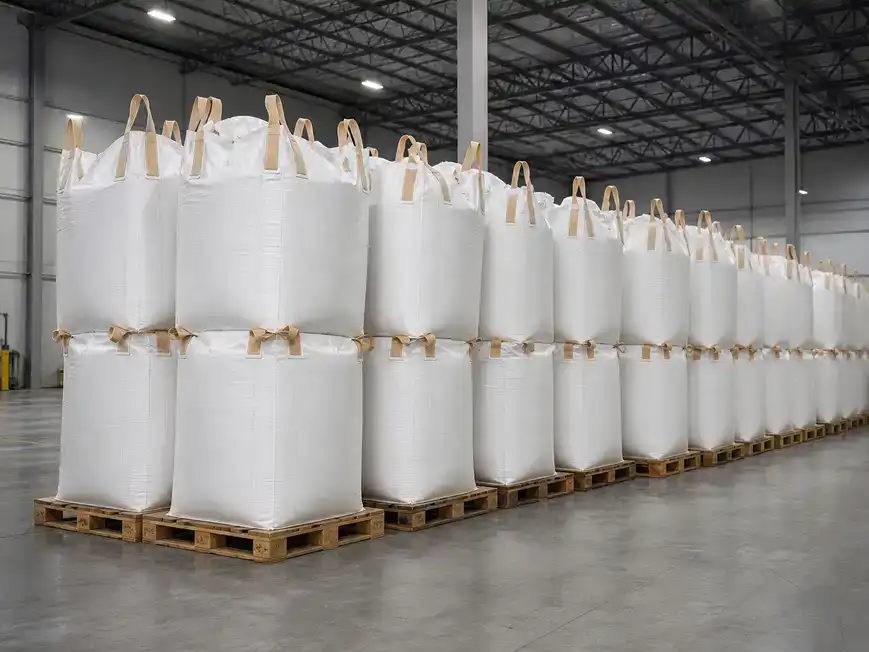
Introduction to FIBC Bulk Bags
FIBC Bulk Bags are large-capacity containers woven from high-strength polypropylene tape yarn. Also called flexible intermediate bulk containers (FIBCs), jumbo bags, or big bags, they serve as modular shipping cubes for powders, granulates, pellets and other dry bulk materials. Unlike ordinary sacks, an FIBC sits on a pallet and holds its shape when filled. A typical bag measures roughly 90×90 cm at the base by 110–120 cm tall for a 1-ton size, holding about 0.8–1.5 m³ of product. The PP woven fabric body (commonly 160–240 g/m²) provides excellent tensile strength with minimal weight, so an empty bag may weigh only 3–8 kg. Built-in fill and discharge openings, spouts, and reinforced lifting loops (4 corner loops or a continuous sleeve) make handling easy. When filled, these bulk bags stack neatly in a warehouse, enabling forklift or crane movement like modular cubes.
Customization is a hallmark of FIBCs. Tops can be plain, open (no closure), or fitted with various spouts and duffle flaps. Bottoms may be solid or include a discharge spout for controlled emptying. Many bags incorporate sift-proof seams and filler cords to contain dust during filling. Optional inner liners (loose, tab-sewn or form-fitted films) create a barrier for hygroscopic or food-grade products. Modern bulk bags combine these features with data tags or barcodes printed on the fabric for easy tracking. In essence, each FIBC is a highly engineered PP woven fabric bag tuned to its intended load and handling method.
Material and Construction
Woven Polypropylene Fabric: The backbone of every FIBC is woven PP tape. Raffia-grade polypropylene (density ~0.90 g/cm³) is extruded into wide sheets, slit into narrow tapes, and drawn (heat-stretched) to align polymer chains. This process yields high-tenacity yarn. Weavers then interlace these tapes on circular or flat looms, targeting a fabric weight usually in the 160–240 g/m² range. A one-ton bag uses roughly that GSM in its walls. Because PP is light, the bag itself remains lightweight. Yet the resulting fabric can withstand dozens of tons of force (e.g. a 1000 kg design SWL bag is often tested to 5:1 or 6:1 safety factors) before breaking.
Coatings & Surface Treatment: To contain fine powders and block moisture, panels may be coated with a thin PE/PP layer (~20–30 g/m²). The coating fills the tiny gaps between tapes, making the fabric essentially sift-proof. Coated surfaces are also corona-treated (raised to ~38–42 dynes) before printing to ensure inks and adhesives anchor firmly. Most bulk bags have large, flat panels for labels or logos. Matte-coated panels minimize glare under warehouse lights and maintain barcode contrast, enabling high-speed scanning and automated identification.
Loops: Heavy-duty PP or polyester webbing (typically 70–100 mm wide) is cut and folded into lift loops. These loops are sewn to the bag’s corners (called corner loops) or sides using reinforced stitch patterns. The stitching disperses the load into the fabric while avoiding knife-edge stress. Common loop arrangements include four separate corner loops, cross-corner loops, or one continuous tubular sleeve. All fabric edges are hot-cut or heat-sealed upon cutting to prevent fraying. Critical seams are double-stitched (chain or lock stitch) with high-tensile thread. Some designs add extra patch reinforcements at the bag’s corners or base to extend wear life. Together, this construction meets rigorous standards (ISO 21898 and UN 13H tests) for lifting, stacking and drop resistance.
Liners & Spouts: For sensitive or dusty loads, an inner liner is often used. Liners come in loose bags, welded to tabs, or shaped to the bag interior (form-fit). They are typically LDPE or multi-layer films (e.g. PE/EVOH/PE) of about 60–100 μm thickness. Liners protect against moisture, retain volatile aromas, and help keep powders flowing during discharge. Fill spouts (usually Ø35–50 cm) on top and discharge spouts on the bottom are heat- or radio-frequency sealed to the liner and fabric, preventing fray. The result is a fully integrated system that fills, transports and empties cleanly.
Types of FIBC Bulk Bags
FIBC bulk bags come in four basic constructions, each affecting the bag’s shape and performance:
| Types | Construction & Material | Capacity | Typical Uses | Pros | Cons |
|---|---|---|---|---|---|
| U-Panel | Three-panel design: one U-shaped panel (back/front) plus two side panels of PP woven fabric (160–240 g/m²) | 500–2000 kg | Dry bulk (e.g. grains, cement, sand, salt) | Lower cost; simple manufacturing | Sidewalls bulge outward; less rigid cube |
| 4-Panel | Four separate panels (front, back, two sides) sewn together; PP woven fabric (160–240 g/m²) | 500–2000 kg | Chemicals, minerals, food ingredients | Symmetrical shape; balanced load distribution | More seams; moderate cost increase |
| Circular (Tubular) | Single tubular weave of PP tape (cut and seamed down one side) | 500–1500 kg | Pellets, powders, lightweight solids | Cheapest option; minimal seams | Greatest bulging; least box-like |
| Baffled | Any above type with internal fabric baffles at each corner (PP baffle fabric ~90–120 g/m²) | 500–2000 kg | Fine powders, bulk solids needing shape control | Keeps near-cubic shape; higher stacking efficiency | Complex to sew; higher cost |
In summary, U-panel and 4-panel bags use heavier fabric and provide good support, while circular bags are simpler but allow more side bulge. Adding corner baffles makes all bag types act like a rigid box, improving container cube utilization at the expense of cost. Choose the style based on your product’s flow characteristics and value (e.g. fine powders often justify baffled bags).
Guide to FIBC Bulk Bags: Types A, B, C, and D
FIBC Bulk Bags (often called Jumbo Bags or Ton Bags) are the heavy-duty polypropylene containers at the heart of modern bulk handling. While they share common strengths—lightweight strength, stackable cubic shape, and custom fit—their internal fabric static classification varies dramatically. In fact, bulk bags are categorized by IEC into four safety types (Type A, Type B, Type C, Type D) depending on how they handle electrostatic charge. Choosing the right type can mean the difference between smooth, safe transport and a hazardous spark. In this guide, we dive deep into Type A FIBC Bulk Bags, Type B FIBC Bulk Bags, Type C FIBC Bulk Bags, and Type D FIBC Bulk Bags. We’ll compare their materials, safety features, ideal uses, and pitfalls—in vivid detail, with colorful callouts and tables, to help you pick the perfect bag for your needs.Whether you’re moving food-grade powders or flammable chemicals, understanding these bag types is critical. We start with a quick comparison table and then explore each type in depth.
| Bag Type | Material & Feature | Static Protection | Grounding Required | Typical Use | Key Limitation |
|---|---|---|---|---|---|
| Type A FIBC Bulk Bags | Plain polypropylene (non-conductive) | None (no antistatic) | No | Non-flammable, inert powders | Not for flammable materials or combustible dusts |
| Type B FIBC Bulk Bags | PP fabric with controlled breakdown voltage | Moderate (limits brush discharges) | No | Dry powders with high ignition energy | Unsuitable for fine dusts or high-risk flammables |
| Type C FIBC Bulk Bags | PP with conductive yarns woven in grid | High (groundable conductive) | Yes (mandatory) | Flammable powders, combustible dust (with grounding) | Unsafe if not properly grounded or if ground fails |
| Type D FIBC Bulk Bags | Antistatic/static-dissipative PP fabric (quasi-conductive) | Very High (dissipates without grounding) | No | Flammable powders, combustible dust (no grounding needed) | Not for bags contaminated by conductive materials (water, grease) |
Type A (Regular) FIBC Bulk Bags
Type A FIBC Bulk Bags are the baseline flexible bulk container. They’re made from ordinary woven polypropylene with no conductive additives—in other words, they have no inherent static protection. As the simplest and most economical option, Type A bags are ideal when handling non-flammable, inert materials. For example, cement, sand, or bulk food ingredients that pose no ignition risk can be safely transported in Type A bags.
For many general-use applications, Type A FIBC Bulk Bags are perfectly adequate and cost-effective. They give you the strength and capacity of a Jumbo Bag without the added expense of antistatic materials. Just remember: when packing anything that even might burn, upgrade to a higher type.
Type B Anti-Static FIBC Bulk Bags
Type B FIBC Bulk Bags step up safety by adding fabric additives that control static breakdown voltage. These bags are still made of polypropylene, but the material and weave allow a controlled breakdown of charge (to prevent brush discharges). However, they still do not dissipate static to ground on their own. In practice, Type B bags are like a halfway point: they limit sparks but cannot neutralize charge entirely.
Limitations: Not for very high-risk dust. Avoid Type B if your material or environment has a low MIE (e.g. <5–10 mJ) or if flammable vapors are present. For example, flour dust with low ignition energy or any environment with explosive gases would exceed Type B’s safety margin . The rule of thumb: do not use Type B bags in dusty areas where an ignition energy >3 mJ would cause a problem (as per customer guidance). They are also ill-suited if humidity cannot be maintained (>50% RH) to help dissipate charge.
In summary, Type B FIBC Bulk Bags are a middle-ground solution: they limit static discharges, providing more safety than Type A, but they still rely on environmental controls. For most industrial powder handling without serious flammability, a Type B bag can be a cost-effective choice. However, if any serious hazard exists, safer types should be used.
Type C (Conductive) FIBC Bulk Bags
Type C Bulk Bags are conductive heavyweights. Made of polypropylene but interwoven with conductive threads (usually stainless steel or carbon fibers) in a grid pattern, these bags can drain static charges to ground. The network of conductive yarns must be fully interconnected and grounded during filling and emptying to work. If used properly, Type C bags offer robust protection for truly flammable cargo.
Best For: Flammable powders and dusts (for example, combustible chemicals, flour, or metal powders) in environments where grounding infrastructure exists. Ideal when the material itself can ignite easily, but the facility can reliably implement grounding protocols. Type C is common in chemical and pharmaceutical industries.
Safe Uses for Type C Bags: Transporting and storing flammable powders. Type C is approved when either flammable vapors, gases, or combustible dusts are present, as long as strict grounding is followed. For example, bagging plastic resins in a solvent-rich environment or filling bags in explosive dust zones. These bags are common in hazardous areas (ATEX zones or NFPA Class I divisions) under proper protocols.
When not to use Type C Bags: Whenever there is no reliable ground connection (e.g. mobile operations without fixed grounding, or if a grounding tab is damaged). If your process cannot guarantee <10^7 Ω continuity to ground, skip Type C. Also avoid if the conductive grid could short (for instance, if a conductive liner is used, or if anything brushes off the threads). In short, Type C = safe if grounded, extremely dangerous if not.
Type D (Static-Dissipative) FIBC Bulk Bags
Type D FIBC Bulk Bags represent the high-tech end of static control. Their fabric is inherently static-dissipative, achieved by special antistatic or conductive yarns woven throughout. These quasi-conductive bulk bags safely bleed off charges into the air rather than needing a ground clip. In practice, Type D bags form a no-ground-needed solution to the static problem.
Safe Uses for Type D Bags: Use them whenever you’re carrying combustible powders, even in environments with flammable vapors or gases. They are ideal for fast-paced or mobile handling – where clipping on a ground isn’t feasible. If the worst case happens (someone forgets a ground), Type D will still keep sparks at bay. In other words, Type D covers scenarios that require extreme caution, from chemical plants to grain elevators.
When not to use Type D Bags: Avoid using them if the bag surface could be contaminated by conductive liquids, oils, or wet dusts. If the fabric picks up grease or moisture, its static-dissipative pathways can short-circuit. In that case, the bag’s performance can resemble a plain Type A. Also, don’t substitute Type D in place of Type C if the type C bag’s conductive grid is the actual requirement; each standard has its purpose.
Key Features & Advantages
Engineered Strength: Every FIBC has a published Safe Working Load (SWL) and Safety Factor (SF). For example, a 1000 kg SWL bag is usually tested to 5:1 (single-trip) or 6:1 (multi-trip) in ISO 21898 top-lift, cyclic, and stacking tests. Fabric GSM, seam designs, and loop construction are all calculated to meet these targets. This guarantees that the bag can be handled confidently without guesswork.
Efficient Filling & Emptying: The top of an FIBC can be plain or fitted with a filling spout (Ø35–50 cm) and closures (flap, duffle, or spout lid). This allows operators to fill bags rapidly from hoppers or valves. Bottoms can be flat, have a star closure, or include a discharge spout (often Ø35–50 cm) for controlled emptying. Sift-proof filler cords sewn into seams prevent powder leakage during fill. These features make loading/ unloading faster and cleaner.
Safe Lifting: Four sturdy loops or a tubed sling distribute the bag’s weight to a forklift or crane. The standard loop size (~70–100 mm wide webbing) and stitched anchor pattern ensure one-person handling is ergonomic yet secure. Options include cross-corner loops (for easier tine entry) or tunnel sleeves (for spreader bars). The combination of bag geometry and loop design minimizes the risk of tip or snag.
Static and Hygiene Protection: FIBCs can be ordered in IEC 61340 Types A, Type B, Type C, or Type D for electrostatic control. Type C (conductive grid with grounding) and Type D (dissipative without ground) are used for flammable or combustible products, while A/B suffice for non-explosive loads. For food or pharmaceuticals, manufacturers use food-contact-rated materials and liners compliant with EU 10/2011 and FDA 21CFR177.1520. This means they can transport edible goods without contamination, and multilayer liners (PE/EVOH/PE) can be added to protect against oxygen, moisture or VOC loss.
High Storage Efficiency: The near-cubic shape of a filled FIBC packs goods tightly, reducing air gaps. Compared to cylindrical IBCs or barrels, these bags yield more payload per pallet and stack higher. In a warehouse, a well-designed FIBC system can cut total forklift moves and shrinkwrap usage: one case study saw a company halve its forklift touches by switching from 25-kg sacks to baffled bulk bags.
Woven PP fabric and reinforced stitching give these bags exceptional load-bearing ability. Each bag is engineered with strict safety factors so it lifts tons of material reliably.
Lightweight yet durable, FIBC bulk bags cut handling and freight costs. One 1-ton bag replaces dozens of smaller sacks and reduces shipping weight, improving logistics economy.
Every aspect can be tailored: fabrics, coatings, top/bottom styles, spouts, loops, colors and printing. This ensures the right bag design and branding for your specific needs.
Static-safe (Type C/D) fabrics and grounded loops protect against sparks. Food-grade liners and FDA/EU-compliant materials keep edible products pure. Leak-proof seams and spouts ensure containment.
Mono-polymer construction (PP body and loops) means easy recycling. These reusable bags have a long service life, and some manufacturers offer rPP options, cutting plastic waste.
The cube shape and stacking capability save floor space and trailer volume. When empty, FIBCs collapse flat, slashing return freight costs versus rigid containers.
Production Process
The manufacture of an FIBC follows precise stages:
- Resin Extrusion: Raffia-grade PP granules (typical MFI ~2–4) are melted and extruded into wide sheets. These sheets are slit and stretched into tapes, orienting the polymer chains to maximize strength.
- Fabric Weaving: The PP tapes are woven into fabric panels on flat or tubular looms at the target GSM (often 160–240 g/m² for one-ton bags). Loom stop-motions detect flaws, and precise tension controls keep the weave uniform.
- Coating & Surface Prep: For dust/moisture protection, panels may be coated (20–30 g/m² of PE/PP). Some panels get corona treatment to improve ink adhesion for printing.
- Loop Preparation: High-tenacity PP webbing is woven and cut into loop straps (70–100 mm wide). Loop style (corner or tubular) is chosen by design. Reinforcing plates or cross stitches are added in loop bases for load distribution.
- Bag Cutting & Assembly: The woven fabric is cut to shape. Rotary screen or flexographic presses apply graphics to panels. Hot-knife blades seal all cut edges to prevent fraying. Sewing machines stitch the main body seams using double or triple-needle patterns for strength. If baffles are used, lighter fabric (90–120 g/m²) is sewn into each corner to form flow corridors.
- Liner Integration: Liners are made from film (LDPE or multilayer) and cut to fit. They are attached by sewn tabs or adhesive points, or designed as one-piece inserts. Fill and discharge spouts are heat-sealed to the liner and bag fabric to lock the seal.
- Final Sewing & Reinforcement: Webbing loops are sewn onto the corners or sides. Corner patches or lifting pads are added if needed. The entire bag undergoes a final check to ensure stitch integrity, correct loop placement, and the absence of defects.
- Quality & Performance Testing: Sample bags are put through ISO 21898 top-lift, cyclic-lift, stacking, and drop tests. Dangerous-goods bags get UN 6.5 drop testing (markings 13H1–13H4 depending on coating/liner). Bags meant for food contact receive a Declaration of Compliance based on EU/FDA migration tests. Loop pull-out forces and bag elongation are recorded. Only when all criteria are met is the bag labeled with its SWL, SF and certifications.
Applications and Industries
- Food & Agriculture: Bulk bags move staple ingredients like sugar, flour, rice, and seed grains. Food-grade liners and PE coatings keep products dry and hygienic. Cubic packaging means more kilos per pallet. These bags streamline high-speed filling and inventory, yielding cleaner conveyors and warehouses.
- Chemicals & Minerals: Powders such as pigments, salts, cement, and plastics additives are ideal for FIBCs. Coated fabric and tight seams prevent fugitive dust, while antistatic features (Type B/ type C/ type D) manage ignition risks with flammable powders. Mineral processors value how FIBCs collapse for return shipments versus bulky metal drums.
- Polymers & Resins: Plastic pellets and masterbatch are often shipped in circular FIBCs. Baffle styles or heavier fabric help retain shape when load flow is unpredictable. Corner loops and top spouts simplify filling from silos, and bulk packaging cuts per-ton cost for manufacturers.
- Feed & Bulk Commodities: Compound feed, fertilizer, and grain in agriculture benefit from UV-stabilized PP fabrics for sun exposure. Specialized designs with tunnel loops allow a forklift crossbar to pick up multiple bags at once from overhead bins or wagons.
Efficiency Comparison: In practical terms, one 1-ton FIBC replaces roughly forty 25‑kg sacks in throughput. This cuts handling labor and dust dramatically. Compared to rigid Intermediate Bulk Containers (FIBCs), FIBCs deliver higher payload per cubic meter and shrink back to flat for return trips. In one case, switching to baffled FIBCs halved terminal dust issues and material waste, while increasing container fill factor. Such gains make FIBC bulk bags a strategic choice in modern supply chains.
Purchasing Considerations & Certifications
When selecting an FIBC, start by defining your requirements: the load weight and volume, product flow characteristics, handling equipment and environment. Confirm the bag’s Safe Working Load (SWL) and Safety Factor suit single- or multi-trip use. Decide on fill/empty methods: will you fill with hoppers (choose top spouts) or manually (open top)? Do you need outlet spouts for controlled discharge? Match loop style to your lift machinery (corner vs. spreader-bar loops). Assess safety needs: flammable or conductive products require Type C/D fabric and ground tabs; powders may need venting or filtration rings to relieve air pressure. Consider shelf-life: does your operation require UV protection or a moisture barrier? Finally, think about labeling and color-coding for inventory management, and whether washable or reusable options will save cost.
- Load & Volume: Ensure the bag’s rated capacity and dimensions match your tonnage and volume (typical 1-ton bag ≈0.9×0.9×1.1 m).
- Material Flow: Free-flowing grains may use standard bags; sticky or powdery products might need liners or special coatings to prevent clogging.
- Fill/Discharge Design: Choose open top, spouted, or duffle top based on your filling setup. Select spouted or open-bottom closures for discharge to suit your unloading process.
- Safety & Static: If handling flammables, pick the correct IEC type C with grounding grid, or Type D dissipative) and request grounding tabs. For everyday powders, Type B or Type A may suffice.
- Environment: For outdoor storage, ask for UV-stabilized fabric. For moisture-sensitive products, specify water-tight coatings or laminated liners.
- Reuse & Lifespan: Decide single-trip vs. multiple-trip bags. Multi-trip bags often have heavier fabric or reinforced loops. Ask about repairability or refurbishment.
Here’s a simplified flowchart (for illustration) of selecting the right FIBC:
Sustainability & Efficiency
FIBC Bulk Bags also support sustainability goals. They use mono-polymer construction (typically 100% polypropylene in body and loops), which simplifies recycling. Many manufacturers now offer versions with recycled PP content for non-food layers. Because the entire bag is PP, it can be reclaimed and processed at end-of-life as plastic waste. Their high strength-to-weight ratio means less plastic per ton of cargo compared to rigid containers. Critically, FIBCs are often reusable: a well-handled bag can go through dozens of cycles, reducing total bag count. At journey’s end, empty FIBCs fold flat – unlike drums or IBCs – dramatically saving backhaul volume. From a logistic perspective, one pallet of stacked bulk bags can transport many tons of material, cutting trips and emissions. In short, FIBC Bulk Bags combine cost and transport efficiency with a design that fits circular-economy practices.
Summary: Engineered FIBC bulk bags are a proven solution for modern bulk handling. Their woven PP construction, high load ratings, and adaptable design deliver reliability, safety and efficiency. By carefully matching bag type, features and certifications to your product, you can optimize storage, transport, and overall cost of goods movement. Whether for grains or grains of chemistry, these versatile polypropylene containers streamline your supply chain.