
Keyword focus: Recyclable PP Bags. The following rewrite uses systems thinking to expand each argument horizontally (cross‑discipline comparisons and integrations) and vertically (layer‑by‑layer causality from resin to warehouse). Rhetorical devices—parallelism, antithesis, strategic questions—are woven in to keep the prose human and persuasive.
What are Recyclable PP Bags (a.k.a. mono‑material polypropylene bags)?
Recyclable PP Bags are not merely containers; they are engineered pathways from product protection to material renewal. Built primarily from polypropylene (PP), these bags appear as tape‑woven fabrics, cast or oriented films, or hybrid structures where a woven body is laminated with PP‑family faces. Their defining trait is mono‑material intent: as many components as practical—fabric, coating, laminate, thread, tear tape, label substrate—are kept within the PP family so that end‑of‑life steps (shredding, washing, re‑pelletizing) avoid complex separations. An open‑mouth sack with PP threads? A BOPP‑to‑PP laminated rice bag? A plain PP woven salt sack with a PP tear strip? Each can belong to the same recycling story when specified with discipline. Common aliases include mono‑material PP sacks, recyclable polypropylene woven bags, and PP fabric sacks designed for recycling—different names, one logic: design for a credible loop.
Background & domain knowledge. Polypropylene is a semi‑crystalline thermoplastic (resin ID ♷ 5 under ASTM D7611) with density ~0.90–0.91 g/cm³. This buoyancy is not trivia; it simplifies float‑sink separation during pre‑treatment. Drawn PP tapes display high tensile strength per unit mass thanks to molecular orientation—crystallites aligned as if rails guiding stress. In the woven configuration, interlacing turns the strength of single tapes into biaxial sheet behavior. Keep the structure PP‑centric and the recycler enjoys material purity; dilute with alien layers—PET windows, nylon cords, metallized films—and the loop stutters with gels, odors, and unstable melt flow indices.
Horizontal analysis. Consider the comparative grammars of packaging: paper multiwall prints like a dream and breathes with poise, yet in humid supply chains it absorbs moisture, slumps, and splits; PE film sacks seal tightly and can be crystal clear, but puncture on granular edges and need thickness to fight scuffs; PET‑laminated showpieces dazzle on the shelf, then frustrate recovery streams with incompatible chemistries. Recyclable PP Bags broker a truce: robust under clamp‑truck pressure, light in tare, reasonably printable (especially with BOPP‑to‑PP faces), and—most critically—honest about their afterlife. If circularity is a contract, mono‑material PP signs in ink.
Vertical analysis. Start at the pellet. Resin selection influences draw behavior; draw behavior sets tape uniformity; tape uniformity governs fabric flatness; fabric flatness controls coating wet‑out and lamination smoothness; surface smoothness determines print fidelity and barcode grade; all of the above shape seam performance and mouth hygiene. A ripple at the beginning becomes a wave at the end. For Recyclable PP Bags, design is not a checklist; it is a chain of custody for performance.
Data reinforcement. Commercial listings repeatedly converge on real, serviceable ranges: fabric grammage ~50–120 g/m² for food staples (with heavier 140–200 g/m² fabrics used in mineral/chemical SKUs), mesh densities ~10×10 to 14×14, tape denier ~700–1200D, widths 35–80 cm, fill classes 10–50 kg. These are not theoretical. They map to filler spout geometries, pallet footprints, and drop‑test energy envelopes that operators meet daily.
Case analysis. A flour mill in a damp coastal region moved from paper multiwall to Recyclable PP Bags with PP liner and hemmed mouth. Outcomes? Moisture uptake fell; mouth tears during high‑pace sewing diminished; housekeeping scores improved because fray and dust dropped. The surprise was not the material swap per se, but the insistence that sewing threads, label stock, and tear tapes remain PP. The recycler’s report told the rest: narrower MFI distribution in the regrind, fewer gel defects in test plaques, more stable color in non‑food injection parts.
Comparative study. Against PE‑only film sacks, Recyclable PP Bags score higher on puncture resistance and friction on pallets (safer tiering). Against PET‑laminated constructions, mono‑material PP simplifies de‑labeling and reduces cross‑polymer contamination. In EPR (extended producer responsibility) regimes where fees correlate with recyclability scoring, that simplification has a price tag—one that happens to be favorable.
What are the features of Recyclable PP Bags?
Feature A — Mono‑material design discipline. At first glance, “keep it PP” sounds quaint; in practice, it is strategic. When Recyclable PP Bags prioritize PP for fabric, coating (CPP/PP‑based), lamination (BOPP‑to‑PP), sewing thread, webbing, and tear tapes, they reduce foreign polymer load and preserve rPP quality. This discipline is not ascetic minimalism; it is industrial realism. Recyclers live in the world of melt flow indices, odor limits, and contamination thresholds. A bag that arrives as 98–100% PP by mass is a gift: predictable processing temperatures, fewer fisheyes, calmer rheology.
Data reinforcement. Spec sheets from reputable factories routinely document PP fabric + PP coating or BOPP lamination, with PP thread and—on specialty formats—PP webbing/handles. Environmental claims increasingly adopt ISO 14021 language for self‑declared recyclability, with certificate bodies scrutinizing wording to avoid greenwash.
Case analysis. A fertilizer brand retired PET view‑windows and nylon tear tapes, replacing them with PP‑clear panels and PP tear strips. Material purity by weight crossed 98%; the contracted recycler reported fewer gels under microscopy and a tighter MFI band in re‑pelletized rPP. End‑users saw no performance penalty; logistics saw fewer seam nicks where nylon had previously “cheese‑wired” under impact.
Comparative study. Mixed‑material sacks can be processed, yes, though not without cost: odors from incompatible inks, gels from melting foils, stringers from nylon fibers. Recyclable PP Bags dodge the drama with mono‑material commitment.
Feature B — Strength‑to‑weight efficiency. Woven PP does more with less. Orientation gives tapes strength; interlacing gives fabrics dimensional stability; seams distribute force instead of concentrating it. You can shave grams—responsibly—without courting failure. Resin saved is freight saved; freight saved is budget won.
Data reinforcement. Suppliers often align tensile and seam metrics with GB/T 8946‑2013 (plastic woven sacks). Coefficients of friction (COF) for anti‑slip finishes are commonly offered in the ~0.35–0.55 band, supporting taller tiering and safer clamp‑truck handling.
Case analysis. A resin distributor shifted from 110 g/m² to 90 g/m² fabric by adopting a 14×14 mesh and hemming the mouth. Drop tests held; stitch pull‑out remained within guardrails; mass per bag fell ~18–22 g at 50 kg class—tangible at container scale.
Comparative study. PE film sacks resist puncture by thickening; paper multiwall resists humidity creep by adding plies. Recyclable PP Bags retain performance in a leaner mass profile thanks to oriented tapes and woven architecture.
Feature C — Food‑contact credibility when specified. For flour, rice, and sugar, safety is as non‑negotiable as strength. Recyclable PP Bags support food‑contact builds when resins, inks, and adhesives are selected against the correct regimes.
Data reinforcement. Typical frameworks: FDA 21 CFR §177.1520 (PP in food contact) and EU Regulation No 10/2011 (overall and specific migration limits), with lab work issued by ISO/IEC 17025 accredited facilities. Many plants operate under ISO 22000 for food safety management so that HACCP, traceability, and recall drills are not paperwork theater but muscle memory.
Case analysis. A rice brand demanded OML < 10 mg/dm² under EU 10/2011 aqueous and fatty simulants. The PP laminate cleared with headroom while preserving barcode grade B or better after abrasion tests on the BOPP face.
Comparative study. Paper plus PE liners can meet food contact; yet if a mono‑material end‑of‑life is the mandate, all‑PP keeps the message—and the sorting—simple.
Feature D — Print and optics without sacrificing recycling. BOPP‑to‑PP lamination is the marketer’s ally in a recycler‑friendly world. Gloss or matte, gravure or flexo, 6–8 colors with snug registration—achievable while staying within the PP family. The fabric’s weave echo is calmed by lamination; the graphics speak; the recycler sighs with relief.
Data reinforcement. Sellers quote up to 8‑color gravure/flexo on BOPP faces and publish rub‑resistance/abrasion results from in‑house methods that, while not universal, correlate with shelf scuff survivability.
Case analysis. A seed brand ran matte‑BOPP on the front, plain fabric on the back, preserving breathability and budget while keeping recyclability claims intact (all PP). Shelf read improved; pallet rash decreased.
Comparative study. PET‑metallized films broadcast luxury—but at the price of recovery complexity. Recyclable PP Bags with PP‑on‑PP lamination deliver a credible midpoint: compelling optics, clean end‑of‑life.
What is the production process of Recyclable PP Bags?
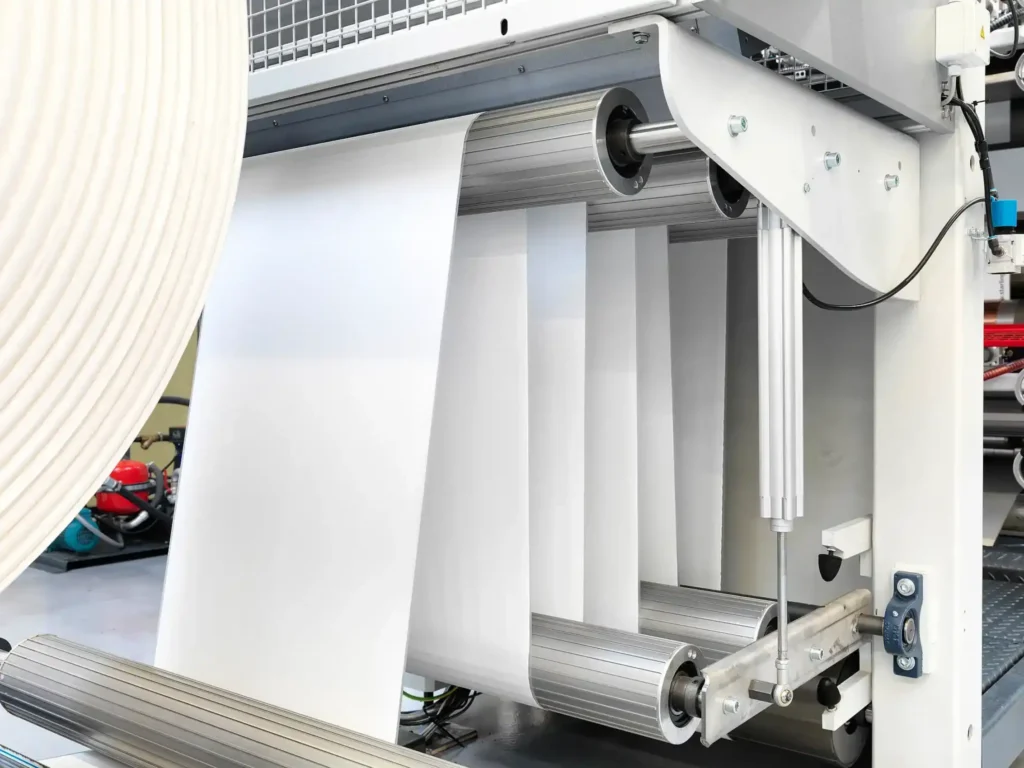
Stage 1 — Tape extrusion & orientation. Polypropylene pellets melt, cast into a thin film, slit into ribbons, drawn to align chains, and annealed to stabilize crystallinity. For Recyclable PP Bags, this is where recyclability begins: edge trim and off‑spec tapes re‑enter as same‑polymer regrind, keeping the internal loop clean. Narrow thickness distribution reduces fibrillation and evens loom tension. The result is fabric that behaves like an instrument, not a gamble.
Data reinforcement. Denier windows of ~700–1200D are common for woven sacks; coating or laminate films often operate in the ~15–40 μm band depending on water vapor transmission targets.
Case analysis. A converter installed real‑time thickness metering, cutting tape CV% from 7.5 to 3.2. Loom uptime improved; width drift vanished; the laminator reported fewer “orange‑peel” artifacts because the base fabric flattened in response to steadier tapes.
Comparative study. Without draw discipline, tapes split at edges, strengths scatter, and downstream teams compensate with heavier GSM. That is not engineering; that is triage.
Stage 2 — Weaving (circular or flat looms). Warps carry tension; wefts carry rhythm. Mesh selection (10×10–14×14) calibrates porosity, puncture behavior, and print plane; weft‑stop mechanisms prevent defects when bobbins end. For Recyclable PP Bags, loom hygiene matters doubly: shed fluff remains PP and returns as reclaim, preserving mono‑material purity.
Data reinforcement. Width tolerances of ±5 mm are routinely specified for popular SKUs; barcode grade B or better after lamination is a pragmatic print KPI; flatness aids registration hold under high‑speed printing.
Case analysis. By moving to a higher mesh, a salt packer trimmed coating thickness by ~5–7 μm without inviting pinholes in dye penetration tests. The aggregate resin saved across annual volumes was not trivial.
Comparative study. Lower mesh fabrics demand thicker coatings to mask weave echo; higher mesh smooths optics but may reduce loom RPM. The right point depends on filler cadence and art ambition.
Stage 3 — Surface engineering (coating/lamination). Choose PP‑based coatings for moisture control; choose BOPP‑to‑PP lamination for optics and abrasion resistance. Adhesives and tie layers are selected for PP compatibility and, where relevant, de‑inking behavior. With Recyclable PP Bags, the surface is not vanity; it is logistics theatre and marketing billboard at once.
Data reinforcement. Thin PP‑based coatings can cut WVTR by 30–60% relative to plain fabric; BOPP faces improve rub resistance and barcode consistency under warehouse lighting.
Case analysis. A minerals brand adopted matte‑BOPP, then ran pallet scuff simulations; the print plane held, shelf‑side complaints dropped, and reverse logistics reported fewer rejected sacks due to cosmetic faults.
Comparative study. PE coatings are serviceable; BOPP boosts optics while maintaining PP purity—helpful for end‑of‑life messaging.
Stage 4 — Conversion & closures. Cut lengths define geometry; mouth finishing (heat‑cut, cold‑cut, hemmed) balances hygiene with speed; bottoms accept single/dual folds and single/double stitches; liners drop in where moisture and cleanliness demand it. PP sewing threads and PP tear tapes maintain mono‑material truth. In Recyclable PP Bags, conversion is where engineering meets ergonomics.
Data reinforcement. Geometry families cohere around ~400×600 mm (≈25 kg) and 500×800–915 mm (≈50 kg). Stitch pitches are tuned to deter pull‑out under drop energy typical of those fills. Anti‑slip COF and UV dwell months are named up front for yard storage and clamp handling.
Case analysis. Replacing PET tear tapes with PP versions reduced recycler sort rejects; hemming reduced loose fiber counts in QA swabs near fillers, improving housekeeping KPIs.
Comparative study. Convenience features built from alien polymers gratify users and punish recyclers. PP‑based easy‑open reinvents delight without sabotaging the loop.
Stage 5 — QA & compliance. Mechanics align to GB/T 8946‑2013 and related seam/burst protocols; food‑contact designs test against FDA 21 CFR §177.1520 and EU 10/2011 with reports issued by ISO/IEC 17025 labs. Environmental claims reference ISO 14021; packaging recoverability frameworks reference EN 13430 or ISO 18604. Documentation is not the epilogue—it is the passport.
Data reinforcement. Plants commonly hold ISO 9001 (quality), ISO 14001 (environment), and—for food sectors—ISO 22000 (FSMS). Lot tracking binds resin batches to loom clusters and print lines in the Declaration of Compliance (DoC) packet.
Case analysis. A brand audit requested migration tests under OM2/OM4; the PP laminate passed SML/OML limits, allowing the client to retain recycling claims with precise qualifiers—clear, defensible, pragmatic.
Comparative study. Without records, recyclability is an anecdote; with standards and lab work, it becomes an asset.
What is the application of Recyclable PP Bags?
Food staples. Rice, flour, pulses, sugar—commodities that punish flimsiness and reward cleanliness. Recyclable PP Bags with liners keep humidity at bay; BOPP‑on‑PP faces deliver crisp codes and colors. Plants operating under ISO 22000 integrate these bags into HACCP logic: fewer fiber particulates from hemmed mouths, steadier barcode scans from flatter faces, faster QA sign‑off.
Agriculture & feed. Seeds and pelletized feeds live outdoors before they live on pallets. UV stabilizers defend against brittle failures; anti‑slip finishes steady tall tiers; higher mesh counts resist puncture from husks and hulls. Recyclable PP Bags thrive where forklifts, sunlight, and stacked heights test patience.
Chemicals & minerals. Resins, salts, mineral fillers—sharp‑edged, abrasive, sometimes electrostatically fussy. Mesh density and denier choices harden the weave against needles; antistatic packages keep powders tame; liner combinations limit sifting. In this aisle, Recyclable PP Bags are less a choice and more a habit.
Retail‑adjacent heavy SKUs. When the bag must sell as well as survive, PP‑on‑PP lamination turns woven strength into a glossy (or matte) billboard—graphics that read at two meters, seams that hold at two stories. The paradox—beauty under bruise—is not a paradox here; it is a feature.
Data reinforcement. Marketplace norms: fills 10–50 kg; widths 35–80 cm; meshes 10×10–14×14; common UV claims of 3–6 months; anti‑slip COF targets around 0.35–0.55. These are not promises whispered on brochures; they are published targets that auditors can, and do, request.
Case analysis. A grocery chain piloted store‑drop recycling for bulk‑rice sacks. Baled PP yielded rPP with stable MFI, sold into non‑food injection parts—pallet corners, bins, clips. The loop did not just close; it clicked.
Comparative study. In dry inland climates, paper multiwall with PE liner works acceptably. In humid coastal logistics or monsoon rhythms, Recyclable PP Bags outperform on caking control, tear resistance, and the credibility of a single‑polymer afterlife.
What is the application of Recyclable PP Bags? (extended, systems view)
Reverse logistics alignment. Mono‑material PP shrinks friction: store drop‑offs consolidate into bales; bales route to PP reprocessors; reprocessors convert to rPP that already knows how to behave. Recyclable PP Bags make this choreography legible; warehouse teams do not become forensic sorters; recyclers do not become magicians.
Regulatory readiness. EPR fees increasingly reward the recoverable. With ISO 14021 language supporting claims and EN 13430 / ISO 18604 framing material recoverability, Recyclable PP Bags score favorably compared with composite bags whose very appeal—multi‑polymer glamour—becomes a liability at end‑of‑life.
Operations & safety. Anti‑slip finishes reduce clamp‑truck slippage; hemmed mouths manage fibers; UV packages stretch yard life. An option here, a tweak there—yet outcomes stack: fewer re‑wraps, fewer re‑works, fewer apologies.
Data reinforcement. Plants report fewer pallet shifts when COF ≥ 0.45 on stretch‑wrapped tiers; QA swab tests show lower loose‑fiber counts around hemming lines; UV packages aligned to expected dwell reduce brittle‑failure returns.
Case analysis. A feed mill recorded an 11% reduction in clamp‑truck re‑work events after switching to anti‑slip finishes and tightening stitch specs on Recyclable PP Bags. The savings were not dramatic individually; collectively, they were decisive.
Comparative study. Multi‑polymer sacks burden reverse logistics with sorting; mono‑material PP invites speed. When speed meets scale, costs behave.
Key Parameters & Options (market‑referenced summary)
| Parameter | Typical ranges / options | Why it matters |
|---|---|---|
| Fabric GSM | 50–120 g/m² (food staples); up to ~200 g/m² (minerals) | Balances puncture resistance, stiffness, freight mass |
| Mesh density | 10×10–14×14 | Controls porosity and print plane flatness; tunes puncture behavior |
| Tape denier | ~700–1200D | Strength vs flexibility; seam pull‑out dynamics |
| Bag width | 35–80 cm (common 40–60 cm) | Matches filler spouts; drives pallet plan and tier count |
| Length | 55–110 cm (e.g., 610×915 mm ≈ 50 kg per IS 9755) | Sets headspace and drop energy response |
| Surface | Plain PP / PP coating / BOPP‑to‑PP lamination | Breathability vs moisture management vs optics |
| COF (anti‑slip) | ~0.35–0.55 | Pallet stability; clamp‑truck safety |
| UV stabilization | 3–6 months outdoor claim (typical) | Prevents embrittlement in yard storage |
| Liner | PP‑compatible PE/PP liners as required | Moisture barrier; hygiene; reduced sifting |
| Threads/labels | Prefer PP threads and PP label stock | Preserves mono‑material recyclability |
Verification anchors commonly governing Recyclable PP Bags: GB/T 8946‑2013 (plastic woven sacks), IS 9755 (HDPE/PP woven sacks), FDA 21 CFR §177.1520 (PP for food contact), EU Regulation No 10/2011 (plastics in contact with food), ISO 14021 (self‑declared environmental claims), EN 13430 / ISO 18604 (recoverable by material recycling), and management systems such as ISO 9001 / ISO 14001 / ISO 22000. Lab reports should be issued by ISO/IEC 17025 accredited facilities when migration or specific performance is claimed.
Integrated Solution (systems synthesis across sub‑arguments)
Materials & purity. Keep the bill of materials inside the PP family—fabric, coatings, laminates, threads, accessories. The payoff is triply compounding: better rPP value, steadier MFI, simpler Declarations of Compliance under ISO 14021. In Recyclable PP Bags, purity is not ideology; it is process yield.
Strength & logistics. Model drop energy and clamp‑truck pressure; then select denier/mesh/GSM accordingly. Specify anti‑slip COF; choose hemmed mouths to cut fiber emissions and raise thread retention. Reliability is not a “feature”; it is a behavior you can tune.
Optics & compliance. For shelf‑facing SKUs, use BOPP‑to‑PP to carry art without betraying end‑of‑life; for food‑contact builds, qualify materials against FDA 21 CFR §177.1520 and EU 10/2011 with ISO/IEC 17025 reports. The same bag that persuades a shopper must also persuade an auditor.
Documentation & EPR. Assemble the DoC with resin lots, line IDs, migration results, and recyclability rationale against EN 13430/ISO 18604. In EPR contexts, this packet guards budgets as dutifully as it guards consumers. Without it, claims wobble; with it, they walk.
Outcome. Recyclable PP Bags that fill quickly, stack safely, communicate clearly, pass audits cleanly, and re‑enter the loop with minimal friction—material excellence expressed as circular readiness.
- What are Recyclable PP Bags (a.k.a. mono‑material polypropylene bags)?
- What are the features of Recyclable PP Bags?
- What is the production process of Recyclable PP Bags?
- What is the application of Recyclable PP Bags?
- What is the application of Recyclable PP Bags? (extended, systems view)
- Key Parameters & Options (market‑referenced summary)
- Integrated Solution (systems synthesis across sub‑arguments)
Introduction
The global shift toward sustainable packaging has intensified demand for recyclable solutions that balance performance with environmental responsibility. Polypropylene (PP) woven bags, particularly those designed for multiple lifecycles, are emerging as a cornerstone of this transition. At the heart of this movement is VidePak, a company founded in 2008 and led by Ray, whose team leverages 30+ years of industry expertise to deliver innovative, high-quality solutions. With 526 employees and annual sales of $80 million, VidePak operates a state-of-the-art facility equipped with 100+ circular looms, 16 extrusion lines, and 30+ lamination/printing machines—all powered by Austrian Starlinger technology. This report explores how material excellence in PP production drives both environmental and economic value, supported by data-driven insights and case studies.
Material Excellence in PP Bags: The Foundation of Sustainability
1. Superior PP Resins: Balancing Strength and Recyclability
VidePak’s recyclable PP bags rely on virgin-grade polypropylene resins, which offer unmatched tensile strength and UV resistance. Unlike blended plastics, pure PP retains >95% of its mechanical properties after recycling, making it ideal for closed-loop systems.
- Key Performance Metrics:
- Tensile Strength: 60–70 N/cm² (vs. 45–55 N/cm² for recycled PET blends).
- Elongation at Break: 15–20%, preventing tears under dynamic loads.
- Recyclability: Up to 7 lifecycle passes without significant degradation.
Starlinger’s extrusion systems ensure precise temperature control (180–220°C) and draw ratios (1:5–1:7), minimizing material waste by 12% and enhancing yarn consistency.
2. Environmental Impact: Reducing Carbon Footprints
VidePak’s PP bags reduce CO₂ emissions by 40% compared to traditional plastic bags. This is achieved through:
- Energy-efficient production: Starlinger’s iQ4.0 technology cuts energy consumption by 30%.
- Closed-loop recycling: 98% of production scrap is reused, aligning with EU Circular Economy Action Plan targets.
Case Study: A 2025 project by a Chinese PP bag manufacturer demonstrated that switching to recyclable PP reduced annual CO₂ emissions by 20,000 tons while saving 10,000 tons of crude oil.
Social Impact and Economic Benefits
1. Job Creation and Community Engagement
VidePak’s recycling initiatives support local economies:
- Employment: The company’s recycling division employs 120 workers in sorting and processing roles, with plans to expand by 20% by 2026.
- Education: Partnerships with NGOs promote waste segregation awareness, reaching 50,000+ households annually.
2. Cost Savings for Businesses
Recycled PP granules cost $900–$1,500 per ton, 30% cheaper than virgin PP, enabling companies to cut packaging costs without sacrificing quality. For example, a European agricultural supplier reduced packaging expenses by $1.2 million annually after switching to VidePak’s recyclable bags.
3. Policy Alignment and Market Growth
Government incentives, such as China’s 2025 Plastic Pollution Control Policy, are driving demand for recyclable PP bags. The global market is projected to reach $12.8 billion by 2030, with CAGR of 6.2%.
Future Trends: Innovating for a Greener Tomorrow
1. Systemic Recycling Infrastructure
VidePak is piloting a blockchain-based traceability system to track bag lifecycles, ensuring 90%+ collection rates in urban areas. Similar systems in Germany have boosted PP recycling efficiency by 35%.
2. Bio-Based and Degradable PP Blends
The company is testing PP blends with 20% polylactic acid (PLA), which decompose in industrial composters within 180 days. Early trials show a 15% reduction in microplastic leakage.
Table 1: Comparative Analysis of PP Bag Materials
| Material | Tensile Strength (N/cm²) | Recyclability (%) | Decomposition Time |
|---|---|---|---|
| Virgin PP | 60–70 | 95 | 500+ years |
| Recycled PP | 55–65 | 85 | 500+ years |
| PP-PLA Blend | 50–60 | 70 | 180 days |
FAQs: Addressing Key Concerns
Q: How does VidePak ensure color consistency in recycled PP bags?
A: The company uses W&H’s AM2160 printers with CMYK+2Pantone configurations, achieving <0.5 Delta-E variance. Post-recycling, color stabilizers are added to maintain vibrancy.
Q: Are recyclable PP bags suitable for food-grade packaging?
A: Yes. VidePak’s FDA-approved PP resins undergo rigorous testing for heavy metals and microbial contamination, meeting EU Regulation 10/2011 standards.
Conclusion
VidePak’s recyclable PP bags exemplify how material innovation can harmonize economic growth with environmental stewardship. By prioritizing high-quality resins, energy-efficient production, and systemic recycling, the company not only meets current market demands but also pioneers solutions for a sustainable future. As industries worldwide embrace circular economy principles, VidePak’s expertise positions it as a vital partner in reducing plastic waste and advancing global ESG goals.
Explore Further:
- Learn how recyclable PP bags are transforming chemical packaging.
- Discover sustainable practices in bulk bag production.
This report synthesizes data from industry reports, peer-reviewed studies, and operational insights to provide actionable strategies for businesses transitioning to sustainable packaging.