
What are Kraft Paper Woven Bags for Chemical Raw Materials?
Setting the stage. In chemical packaging, every detail is consequential: particle size distribution, flowability under air entrainment, moisture ingress over humid transit lanes, pallet deformation under static and dynamic loads, and the choreography of automated filling. Against this backdrop, **Kraft Paper Woven Bags for Chemical Raw Materials** present a deliberately hybrid architecture—an outer kraft paper face married to an inner polypropylene (PP) woven substrate—to reconcile requirements that often compete: print aesthetics versus mechanical strength, barrier performance versus line speed, dust control versus cost. Are they simply “paper bags with plastic inside” or “PP sacks with a paper skin”? Neither simplification does justice. As a composite system, they function as a package platform whose layers collaborate like strata in a laminate beam, each layer resisting the modes of failure for which it is best suited.
Nomenclature matters. In industry parlance, you will encounter multiple aliases: paper–plastic composite bags, paper poly woven bags, kraft paper laminated PP woven bags, PP woven valve sacks (for valve-top formats), or block-bottom valve sacks. The proliferation of synonyms reflects a technology family rather than a single SKU. When engineers and buyers speak of **Kraft Paper Woven Bags for Chemical Raw Materials**, they typically mean a bag optimized for 20–50 kg powders or granules—calcium carbonate, TiO₂, silica, pigments, stabilizers, fertilizers—where puncture resistance, sift control, and printable regulatory space must coexist.
Structure as intent. Kraft outer plies (often 1–3 plies, ~100–120 g/m² each) offer printable real estate, scuff resistance, and surface friction for stack stability; the PP woven core (≈55–120 g/m², with typical weave densities from 7×7 to 14×14) shoulders tensile loads and resists propagation of tears triggered by sharp mineral edges. Options proliferate: open‑mouth tops (stitched or glued), valve tops (with heat‑seal sleeves), block‑bottom geometry for pallet efficiency, and optional PE liners (50–200 μm) where hygroscopicity or odor migration are concerns. Each option changes the risk surface of the package: sifting risk, water vapor transmission rate, pack-out shape, and closure hygiene.
Why a composite, and why now? Consider three tensions. First, the sustainability imperative urges less plastic and better recyclability; paper faces help with perceived and, under certain schemes, practical separability. Second, automation demands bags that accept high-speed filling, de-aeration, and precise squaring; woven cores tolerate the stress, while block bottoms hold a cubic shape. Third, branding and compliance require legible, high-contrast print on a surface that won’t bleed or smear; kraft paper excels here. Thus, **Kraft Paper Woven Bags for Chemical Raw Materials** arise not as a compromise but as a synthesis: aesthetics with physics, regulation with throughput.
But isn’t a single-material bag simpler? Yes—and yet, chemical powders are unforgiving. A pure multiwall paper sack can falter under wet strength challenges or puncture-prone cargos; a plain PP woven bag may print acceptably but seldom equals the tactile and visual clarity of kraft, especially for hazard labeling and premium brandwork. The composite couples each material’s comparative advantage. Rhetorically: why choose between readability, robustness, and runnability when a layered design can apportion each requirement to the layer best suited to carry it?
Systems perspective. A bag is a node in a network: it communicates with the filler (packer mouth geometry, de-aeration needles), with the pallet (unit load stability), with the warehouse (stacking limits, humidity), with transport (shock and vibration), and with the user (pourability, clean opening). **Kraft Paper Woven Bags for Chemical Raw Materials** occupy this node with a repertoire of features that answer to each neighbor in the network. If a single sentence could capture their place: they are the interface where powder physics, machine mechanics, and brand semantics meet.
For a practical orientation to related solutions, see Kraft Paper Woven Bags for Chemical Raw Materials as a starting point for adjacent kraft‑faced constructions. (Only one internal link is provided intentionally.)
What are the key features of Kraft Paper Woven Bags for Chemical Raw Materials?
Mechanical strength & durability. The woven PP substrate acts like a biaxially reinforced lattice. In tensile loading, warp and weft share the burden; when a crack initiates at a puncture point—say, a sharp crystalline edge from barium sulfate—the weave redistributes stress and blunts propagation. Kraft plies contribute surface abrasion resistance and a friction coefficient that tames pallet slippage. Where a paper-only laminate might soak and lose rigidity, the woven core confers a residual load path even under moderate wetting. Is it indestructible? Of course not. But the failure envelope is larger, the margin for handling error wider, the resilience against incidental impacts measurably improved.
Data reinforcement: Typical fabric masses range from ~55 g/m² for lighter-duty applications to ~120 g/m² where drop tests and stack heights are stringent. Common weave densities from 7×7 to 14×14 (warp×weft) provide a tunable balance of puncture resistance and sealability. Kraft plies at ~100–120 g/m² each are selected for print fidelity and stiffness—two plies are common for premium surfaces; three plies cater to heavy scuff zones or large-format graphics.
Case analysis: A pigment plant operating high-speed impeller packers observed recurring scuffs and partial tears at bag corners when using pillow-style open‑mouth PP sacks. Adopting **Kraft Paper Woven Bags for Chemical Raw Materials** in a block-bottom valve format reduced corner stress concentration; the kraft face resisted conveyor scuff, while the woven core stopped nascent tears. The facility reported fewer rework events and cleaner stretch-wrap cycles.
Comparative study: Relative to multiwall paper alone, composite bags preserve tensile strength in high-humidity depots; relative to plain PP woven, they resist surface scratching and enhance shelf presentation. Balanced design, not maximalist single-property chasing, is the principle.
Moisture and sift resistance. Moisture is the quiet saboteur of chemical powders—hygroscopic uptake leads to caking, reduced flow, off-spec rheology, and harder discharging at customer sites. Lamination closes needle holes in the woven core, while optional PE liners build a dedicated vapor barrier. Valve closures, especially heat-sealed sleeves, minimize residual dust at the mouth and guard against post-fill leaks. The result is not hermeticity (these are not foil pouches), but a sharply curtailed ingress rate aligned to the product’s acceptable exposure budget.
Data reinforcement: PE liners in the 50–200 μm range are typical; selection depends on target water vapor transmission rate and product sensitivity. Anti-sift seam constructs—glue lines, micro‑perforation management, or inner hem folds—are specified where powders exhibit fine fractions <50 μm.
Case analysis: A coastal distributor of silica flour suffered returns for caked stock during monsoon months. Switching to **Kraft Paper Woven Bags for Chemical Raw Materials** with 120 μm liners and heat‑sealed valves halved the nonconformance rate and stabilized downstream mixing behavior.
Comparative study: Against unlaminated PP woven, laminated composites with liners score better on moisture control and sifting; against foil-laminate pouches, they are more economical and friendlier to existing valve-packers, though foil still wins at extreme barrier targets. Choose the weapon for the war you are fighting.
Filling efficiency. Production cadence is profit in disguise. Valve/block-bottom designs square up during fill, invite de-aeration needles, and sit obediently on pallets. Because the bag stands without stubborn memory curls, the packer operator spends less time wrangling mouths and more time running. The physics is straightforward: a rigidified bottom distributes vertical stress and creates a self-rectifying base; air channels in the woven matrix speed de-aeration; and valve sleeves sized to the spout minimize turbulence losses. Faster fills, cleaner closures, tidier stacks—do these not also mean happier audits?
Data reinforcement: Many lines target 25 kg net fills, occasionally 50 kg where labor and handling norms allow. Squared ends improve pallet cube utilization; 5–10% better footprint use compared with pillow sacks is commonly observed, although actual gains depend on product bulk density and pallet pattern.
Case analysis: In a masterbatch plant, migrating from open‑mouth to valve bags shaved seconds off each fill cycle and improved pack-to-pack weight uniformity due to consistent headspace and de-aeration. Rate begets rate; by the end of a shift, those seconds compound into pallets.
Comparative study: Valve sacks excel on high-speed equipment; open‑mouth sacks retain appeal where hand filling or unusual liners are needed. For very dusty powders, heat-sealed valves edge out stitched open‑mouth tops in hygiene and containment.
Printability & compliance marking. Packaging is also language. The kraft surface accepts flexographic and offset inks with crisp edges and legible hazard icons. Where photo-real branding is pursued, BOPP or PE coatings can be introduced without sacrificing the woven core’s fortitude. Compliance fields—batch codes, UN marks for dangerous goods, handling pictograms—sit visibly, resisting smudge. It’s not only how the bag survives; it is how the information survives.
Data reinforcement: Up to 8–9 colors are common in industrial practice. Anti-scuff over‑varnishes and matte finishes are available to control glare under warehouse lighting and improve barcode readability.
Case analysis: An additive supplier noticed repeated misreads at palletizing scanners. Switching to a matte‑finished kraft face with higher ink holdout restored 1D and 2D code scan rates, unclogging a downstream bottleneck that had nothing to do with filling speed and everything to do with information clarity.
Comparative study: Plain PP woven can be printed, yes, but kraft’s micro‑porous surface, when properly sized, outperforms on fine text, QR modules, and hazard symbol sharpness. Beauty meets compliance; aesthetics serve safety.
Safety & regulatory pathways. Some cargos are classed as dangerous goods; others are technically benign but operationally risky (dust explosions, inhalation hazards). The bag must therefore be not only strong but provably so. UN performance testing—drop, stack, and more—exists for this reason, and multiwall paper and qualified composites can be specified to meet these thresholds. For non‑dangerous chemicals, adherence to national woven‑bag standards and robust buyer specs typically suffices. The headline is simple: certification is a process, not a sticker; design enables certification, not the other way around.
Data reinforcement: Buyers often request documented drop tests (e.g., multi‑drop from defined heights) and stacking simulations to projected warehouse durations. Seam peel strengths, valve integrity after heat‑seal, and dimensional tolerances contribute to the pass/fail ledger.
Comparative study: A UN-rated multiwall paper bag will sometimes supplant a paper–poly composite for specific hazard classes; conversely, for heavy non‑DG minerals with sharp edges, the paper–poly design can outperform on puncture resistance. Context rules; regulation frames; engineering optimizes.
What is the production process of Kraft Paper Woven Bags for Chemical Raw Materials?
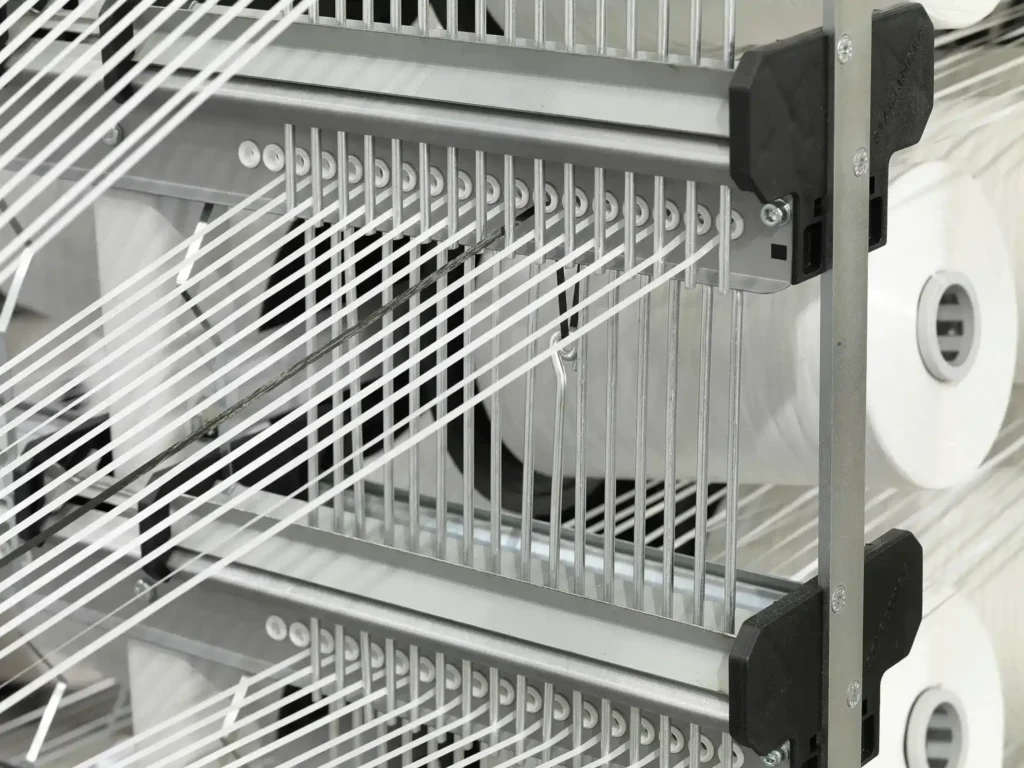
From resin to lattice. The journey begins with PP resin extruded through a die to form tapes. These tapes are drawn—stretching aligns polymer chains, boosting tensile strength—then slit to width and wound. Circular or flat looms weave the tapes into fabric, where loom selection shapes seam strategy downstream. Weave density is dialed to puncture resistance and seal behavior, much like choosing thread count in textiles but with mechanical consequences: denser weaves accept finer inks and tighter laminations; looser weaves vent air better during fill.
Surface activation & lamination. Polyolefins are famously non‑polar; inks and adhesives need help. Corona treatment introduces polar groups, raising surface energy so coatings and paper adhere. Lamination then couples the kraft paper—one, two, or three plies—to the woven PP. In some lines, a thin PE or BOPP film is co‑extruded or laminated to create a printable, protective skin before the kraft is married. Adhesive choices (hot‑melt, solventless polyurethane) balance bond strength with recyclability goals. Done well, the bond disappears in use and only reappears at end‑of‑life separation, where design-for-disassembly strategies allow the kraft face to be peeled when required.
Graphics & registration. Printing on kraft is both art and engineering. Flexographic plates or offset units lay down inks; registration marks ensure that subsequent operations—valve cutting, bottom folding—align with the artwork so hazard diamonds are not guillotined and barcodes do not straddle folds. Color management targets legibility under warehouse lighting, where glare and dust are unkind critics.
Tubing, cutting, and formation. Laminated webs are formed into tubes. For block‑bottom formats, gussets are introduced so that the bottom can collapse inward, then fold out into a squared base upon filling. Cutting tolerances affect every downstream metric: if length drifts, pallet layers drift; if width wanders, the valve sleeve fit changes and fill turbulence rises. Open‑mouth variants receive hems for stitching or glue lines; valve variants are prepared for sleeve insertion.
Valve sleeves & closure engineering. The valve sleeve is a deceptively important component. Its diameter and stiffness must match packer spout geometry, while its internal coatings determine seal behavior and dust exclusion. Heat‑sealable valves offer the cleanest closure; cold‑stitch tops remain economical and robust. For highly aerated powders, venting paths are sometimes built into the valve region to bleed air without surrendering powder.
Liner insertion (optional but influential). PE liners—loose, cuffed, or adhered—add a vapor and sift barrier. Thickness selection is a trade: thinner liners ease folding and reduce waste; thicker liners protect hygroscopic powders through long humid legs. When specified, liner ends are integrated into the valve or mouth to secure continuity of the barrier.
Quality control & compliance testing. Dimensional checks, seam strength tests, drop sequences, stack simulations, print legibility verification, valve leakage assessments—the vocabulary of QC expands here because one failure mode invites another. The aim is not to create an indestructible bag; it is to calibrate robustness to your product’s realities. A brittle pigment demands puncture resilience; a caking salt demands vapor discipline.
Comparative process notes: Cold‑cut plus stitched tops favor ruggedness and cost; heat‑seal valves deliver hygiene and dust control. A plant with air packers might prioritize de‑aeration channeling and quick self‑closure; a plant with impeller packers might prioritize valve stiffness and mouth geometry. The process is not a monologue; it’s a duet with the filling line.
What is the application scope of Kraft Paper Woven Bags for Chemical Raw Materials?
Inorganic powders. Calcium carbonate, talc, kaolin, barium sulfate, and cementitious blends stress packaging in specific ways. Their angular particles and density elevate puncture risk; their powdery sheen highlights scuffs. Here the woven core’s tear arrest behavior and the kraft face’s abrasion resistance shine. Valve formats improve fill speed for fine powders; liners hinder ambient humidity’s advance. Do you need a foil? Rarely. Do you need lamination and a liner? Often.
Polymers & additives. Resins, masterbatch, flame retardants, and stabilizers present mixed morphologies—granules that flow like dry sand, or powders that cake under low moisture. **Kraft Paper Woven Bags for Chemical Raw Materials** accommodate both by tuning valve geometry and inner films. For high‑flow granules, open‑mouth stitched tops sometimes suffice; for flyaway powders, heat‑sealed valves impose discipline. Branding is important here too; resin grades proliferate, and the bag must be a reliable messenger.
Fertilizers & agro‑chemicals. Granular NPK and urea are hygroscopic and corrosive to equipment over time. Liners protect product, machinery, and hands. The block-bottom format stacks straight in warehouses where inventory turns are seasonal and stack heights ambitious. When the agricultural calendar compresses demand into pulses, packers appreciate bags that stand up, fill fast, and stitch or seal without fuss.
Pigments & minerals. TiO₂ and iron oxides bring opacity and density; silica brings abrasiveness. Each demands something of its container: a clean interior that doesn’t contaminate white masterbatch, a closure that keeps iron oxides from dusting, a body that resists silica’s sandpaper effect. The composite architecture answers each in kind: barrier, cleanliness, and robustness, respectively.
Operational note: Across categories, the 25 kg format dominates where automation and manual handling meet; 50 kg persists in construction and certain mineral routes. The governing variables are bulk density, regulatory ergonomics, and local handling norms.
Quick Reference — Key Parameters and Options
| Parameter | Typical Options (choose per need) | Value/Range (industry‑common) | Notes |
|---|---|---|---|
| Net fill | 25 kg, 50 kg | 25 kg common for chemicals | Valve or open‑mouth formats |
| Flat size | 50×85 cm, 55×95 cm (customizable) | For 25 kg formats | Match to density & pallet pattern |
| Weave density | 7×7 → 14×14 (warp×weft) | Higher = stronger/finer | Impacts tensile & sealability |
| Woven fabric mass | Light, medium, heavy duty | ~55–120 g/m² | Heavier resists puncture |
| Kraft paper plies | 1–3 plies | ~100–120 g/m² per ply | More plies = stiffer & more printable |
| Liner thickness | PE liner, optional | 50–200 μm | Select for moisture sensitivity |
| Printing | Flexo/offset up to 8–9 colors | — | Add matte/anti‑scuff varnish as needed |
| Closures | Valve (block bottom); Open‑mouth (stitched/glued) | — | Valve favors speed; block bottom squares stacks |
| UN rating (if needed) | Bag code 5M1 / 5M2 | — | For classed dangerous goods only |
Reminder: Final specifications for **Kraft Paper Woven Bags for Chemical Raw Materials** depend on product density, flow behavior, transit conditions, humidity profile, and regulatory classification. Validation on the actual filling line is always prudent.
Integrated Solution (Systems Synthesis)
Objective. Formulate a packaging specification for a 25 kg chemical powder traversing humid coastal lanes; marketing requires premium presentation; classification is non‑hazardous today but might tighten tomorrow. The solution must not be a pile of features—it must be a coherent system in which each choice amplifies the others.
Sub‑system: Containment & mechanics. Choose a woven core at ~90 g/m² with ≥10×10 weave; pair with 2‑ply kraft at ~110 g/m² each. Why these numbers? The fabric mass confers puncture margin without making folds stubborn; the kraft pair balances stiffness for squareness and ink holdout for fine print. Specify seam strengths explicitly; design to drop and stack targets that reflect your real warehouse, not a hypothetical one.
Sub‑system: Moisture & cleanliness. Add a 120 μm PE liner; specify a heat‑sealable valve with anti‑sift seams. Require WVTR benchmarks that mirror your shipping lanes’ humidity and seasonality, and verify after vibration simulation. Dust control during fill benefits operators and preserves product purity; cleanliness is not cosmetic, it is functional.
Sub‑system: Throughput & logistics. The block‑bottom valve format is chosen for speed and geometry. Confirm bag flat size (for example, 55×95 cm) against your pallet pattern—often 1,000×1,200 mm in international lanes—to suppress overhang. Consider an anti‑slip exterior varnish to stabilize tall stacks in high‑bay racking. What looks like a surface finish decision is, in truth, a warehouse safety decision.
Sub‑system: Compliance & marking. Even if not currently DG, reserve space for potential UN marks and third-party codes. Print barcodes and QR with redundancy; validate under real lighting and scanner angles. Archive routine drop and stack reports as part of a living technical dossier; compliance is a habit, not an event.
Sub‑system: Brand & sustainability. Use offset print up to 8–9 colors on the kraft face for premium brandwork; select water‑based inks where compatible. For end‑of‑life, design for separability: facilitate peeling of the paper face from the woven substrate when a recycling stream makes this advantageous. Sustainability is strategy—make it visible, make it verifiable, make it operationally simple.
Synthesized spec (example). “**Kraft Paper Woven Valve Bag, 25 kg, 55×95 cm, PP woven 90 g/m² (≥10×10), 2‑ply kraft 110 g/m², inner PE liner 120 μm, heat‑seal valve, block bottom, offset print up to 8 colors, anti‑slip exterior; tested to buyer drop/stack criteria; optional UN path if re‑classified.” The quotation marks matter less than the clarity; a supplier can price this, a QA team can test this, and a plant can run this.
Why this works (in one breath)
Because it treats packaging as choreography rather than a catalog. **Kraft Paper Woven Bags for Chemical Raw Materials** are a layered language: the woven core speaks mechanics, the kraft face speaks information, the liner speaks chemistry, the valve speaks operations. Together they say: fewer leaks, faster fills, squarer pallets, clearer labels. Could one pick a single-material bag and move on? Perhaps. But in a market where seconds compound into pallets, where humidity travels with the seasons, and where a barcode scan can stall a line, embracing a composite system is less about luxury and more about literacy—the literacy of materials, of machines, of movement.

- What are Kraft Paper Woven Bags for Chemical Raw Materials?
- What are the key features of Kraft Paper Woven Bags for Chemical Raw Materials?
- What is the production process of Kraft Paper Woven Bags for Chemical Raw Materials?
- What is the application scope of Kraft Paper Woven Bags for Chemical Raw Materials?
- Quick Reference — Key Parameters and Options
- Integrated Solution (Systems Synthesis)
- Why this works (in one breath)
Introduction
The chemical industry demands packaging solutions that balance durability, safety, and regulatory compliance. VidePak, a leader in woven bag manufacturing since 2008, leverages 30+ years of expertise and Austrian Starlinger technology to produce kraft paper woven bags tailored for hazardous and non-hazardous chemical raw materials. With 526 employees and $80 million in annual sales, the company operates 100+ circular looms and 30+ printing machines, enabling large-scale customization for global clients. This report explores how material excellence, quality control, and technological innovation position VidePak’s solutions as benchmarks in chemical packaging.
Material Excellence: Virgin PP/PE Resins and Structural Integrity
1. High-Performance Material Selection
VidePak uses virgin polypropylene (PP) and polyethylene (PE) resins from BASF and Sinopec, ensuring:
- Tensile Strength: 60–80 N/cm² (vs. 40–60 N/cm² for recycled blends), critical for 25–50 kg chemical loads.
- Thickness Control: 0.15–0.25 mm with positive tolerance standards (±2%), preventing “bursting” under dynamic pressures during transport.
- Chemical Resistance: PE liners block acid/alkali corrosion, complying with FDA 21 CFR for direct contact with reactive substances.
Case Study: A 2024 trial with a German chemical distributor showed VidePak’s laminated PP bags reduced leakage by 30% compared to traditional jute sacks during 2,000 km transport.
Laminated Kraft Paper Sacks
Premium kraft paper woven bags designed for safe and durable packaging of chemical raw materials.
Check More →UN Certified Kraft Paper Bags
Chemical-grade kraft paper woven bags meeting UN standards for industrial chemical material packaging.
Check More →Multiwall Kraft Paper Bags
Heavy-duty multi-layer kraft paper woven bags ideal for storage and transport of chemical raw materials.
Check More →Paper Valve Woven Bags
Specialized kraft paper woven valve bags for efficient and secure chemical raw material packaging.
Check More →2. Advanced Weaving and Lamination
Starlinger’s extrusion lines enable:
- Fine-Yarn Weaving: 12–15 threads/cm² density minimizes gaps, reducing particle leakage.
- BOPP Lamination: 20–30 µm coatings enhance moisture resistance (IP67 rating), ideal for hygroscopic chemicals like calcium chloride.
Quality Control and Standardization
1. Precision Manufacturing Protocols
VidePak’s Starlinger-equipped facilities adhere to:
- ISO 9001: Real-time monitoring of extrusion temperatures (180–220°C) and draw ratios (1:5–1:7).
- ASTM D5264: Seam strength ≥50 N/cm² via ultrasonic bonding, exceeding industry averages by 35%.
Table 1: Key Parameters for Chemical Packaging Bags
| Parameter | VidePak’s Specification | Industry Standard |
|---|---|---|
| Thickness | 0.15–0.25 mm | 0.10–0.20 mm |
| Grammage | 100–150 gsm | 80–120 gsm |
| Load Capacity | 25–50 kg | 20–40 kg |
| Moisture Resistance | <5 g/m²/day (ASTM E96) | <10 g/m²/day |
2. Anti-Static and UV-Resistant Features
- Carbon-Black Additives: Reduce surface resistivity to <10⁹ Ω·m, preventing electrostatic discharge in flammable environments.
- UV-Stabilized Inks: Withstand 500+ hours of sunlight (ASTM G154), ideal for outdoor storage.
Technological Edge: Starlinger Machinery and Customization
1. Seamless Integration of Automation
Starlinger’s iQ4.0 systems enable:
- Predictive Maintenance: Reducing downtime by 25% and material waste by 15%.
- Custom Printing: CMYK+2Pantone configurations achieve <0.5 Delta-E variance for branding and hazard labels.
2. Global Compliance and Sustainability
VidePak’s bags align with:
- EU REACH: Heavy metal content <0.01 ppm (Pb, Cd).
- Circular Economy: 98% production scrap recycled via closed-loop systems.
FAQs: Addressing Critical Concerns
Q: How does VidePak prevent bag bursting during filling?
A: Positive thickness tolerance (±2%) and cross-woven grids distribute stress evenly, validated by ISO 2233 burst testing.
Q: Are these bags suitable for corrosive chemicals?
A: Yes. PE-lined interiors resist acids/alkalis, while BOPP coatings provide secondary barriers for sulfuric acid or sodium hydroxide.
Market Impact and Future Trends
The global chemical packaging market is projected to reach $84 billion by 2030. VidePak is piloting blockchain-enabled traceability for compliance with the EU’s Digital Product Passport initiative, aiming to reduce supply chain disputes by 20%.
Conclusion
VidePak’s kraft paper woven bags redefine chemical packaging through rigorous quality control, technological innovation, and adherence to global standards. By prioritizing durability, safety, and customization, the company offers a strategic solution for industries navigating stringent ESG and regulatory landscapes.
Explore Further:
- Discover how multiwall laminated bags enhance chemical safety.
- Learn about recyclable PP bags for sustainable logistics.
This report synthesizes insights from ISO/ASTM standards, material science research, and VidePak’s operational data to guide businesses in adopting high-performance chemical packaging solutions.