
What is Block BOPP Bags and why the format matters now?
Block BOPP Bags are packaging formats built on a woven polypropylene (PP) fabric that is laminated with biaxially oriented polypropylene (BOPP) film and then formed into a squared, block‑bottom geometry. In procurement and plant-floor conversations the same concept travels under adjacent names—block-bottom BOPP bags, block-bottom valve sacks, AD*STAR-type PP sacks, laminated PP woven sacks, and BOPP-woven pinch-bottom bags. Labels shift, functions stay: a woven PP base for mechanical strength, a BOPP face for durable, high-fidelity print and abrasion defense, and a block-bottom that stacks like a brick, fills like a tool, and ships like a system. The category answers three persistent pains of legacy sack packaging: poor pallet cube, scuff-prone exteriors, and messy powder filling. When policy expectations tighten, freight becomes unforgiving, and unit economics must hold, this design earns its keep.
To see the architecture clearly, imagine the bag as a composite beam: the fabric carries load; the film protects and communicates; the bottom geometry converts a flexible shell into a stable prism. The outcome is not just a bag that looks squared. It is a unit that behaves squared—on a high-speed packer, on a lift, on a long road.
The material of Block BOPP Bags — layers, roles, and rational trade‑offs
Designing Block BOPP Bags is the art of load paths and the science of surfaces. Each layer earns a seat in the bill of materials by delivering measurable advantage—tensile, tear, sealability, print holdout, moisture control, hygiene. The levers are simple to name and subtle to tune: fabric grammage and draw ratio, film gauge and finish, adhesive chemistry and coatweight, valve form and liner choice.
Woven PP fabric
Extruded tapes are stretched, oriented, and woven into cloth (≈55–120 g/m²). Orientation confers tensile per gram; the weave distributes impact loads. Humidity where paper would fatigue? The lattice endures.
Cost levers: resin index, tape MFR grade, loom uptime, fabric gsm.
BOPP film laminate
15–35 µm biaxially oriented polypropylene yields a smooth, printable, abrasion-resistant skin. Matte for natural cues, gloss for pop; metallization is rare here but possible for aroma-sensitive retail lines.
Cost levers: film gauge, finish, surface treatment, ink coverage.
Adhesives & ties
Extrusion lamination (PP/PE curtain) or adhesive lamination (solvent‑free PU, water‑borne acrylics). Tie resins couple BOPP to polyolefins. Bond must survive stacking, climate swings, and handling.
Control: coatweight, nip load, line temperature, cure time.
Valves & liners
Valve sleeves (PP, PE, or paper) accelerate clean fills and self-seal under product pressure. Moisture- or aroma-critical goods may add LDPE/LLDPE liners (≈25–70 µm) pre-inserted or blown-in at fill.
Closures & features
Open‑mouth variants use heat seals, sewing with crepe tape, or pinch‑bottom hotmelt. Anti‑slip coatings, micro‑perforations, tear tapes, and varnishes turn a container into a tool.
What are the features of Block BOPP Bags? function, physics, and perception
Feature lists can look like catalogs; better to read them as cause and effect. Geometry dictates cube efficiency. Materials dictate abuse tolerance. Finishes dictate how a brand speaks across a dusty warehouse and a bright aisle. Below, the attributes are grouped by the outcomes they enable.
Geometry & logistics
- Block-bottom architecture stacks as stable prisms, lifting pallet fill and lowering overwrap consumption.
- Anti‑slip varnishes and micro‑embossed films raise friction angles, curbing pallet collapse in transit.
Strength-to-weight
- Woven PP dissipates drop energy, especially in humid conditions where paper fatigues; ISO 7965‑2 and ISO 2248 testing verify.
- Puncture and tear resistance from oriented tapes protect against pallet splinters and auger edges.
Print & shelf presence
- Rotogravure or HD flexo on BOPP delivers photo‑grade imagery; matte/gloss playbook supports premium cues.
- Cleanability matters: BOPP sheds dust better than paper, improving shelf aesthetics and worker hygiene.
Food‑contact readiness
- Compliance pathways through EU 10/2011, EN 1186 migration protocols, and U.S. 21 CFR 177.1520/175.105 declarations.
- Moisture management via film gauge or inner liners stabilizes hygroscopic powders.
What is the production process of Block BOPP Bags? from resin to squared geometry
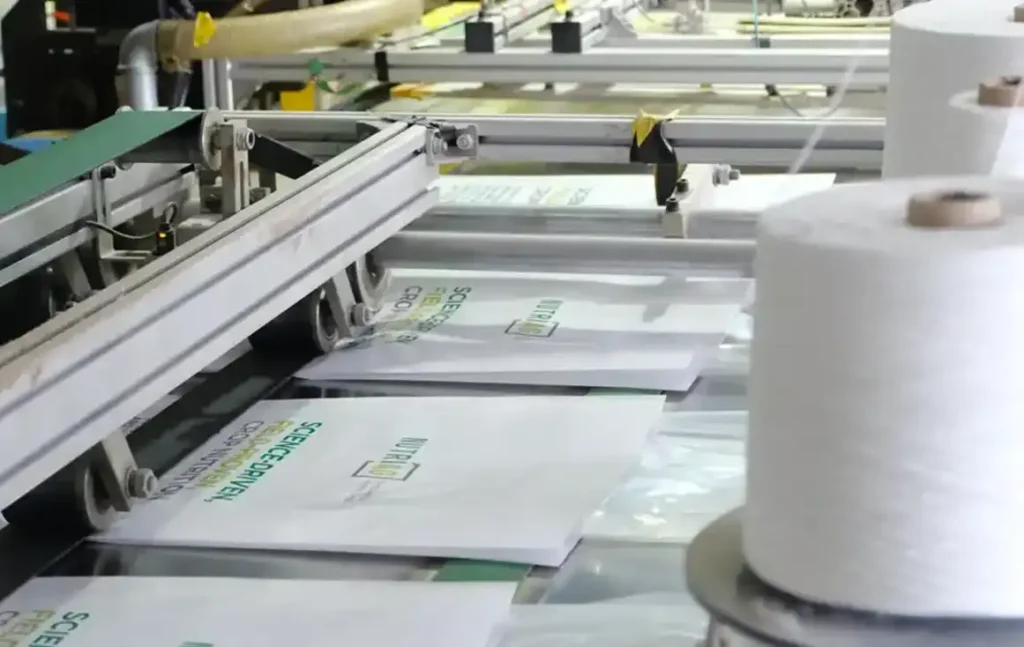
A conversion line for Block BOPP Bags is choreography with consequences. Decisions at extrusion ripple into weaving; choices in lamination determine print survivability; bottoming geometry decides pallet fate. The steps below highlight not only the sequence but the decision points that move outcomes.
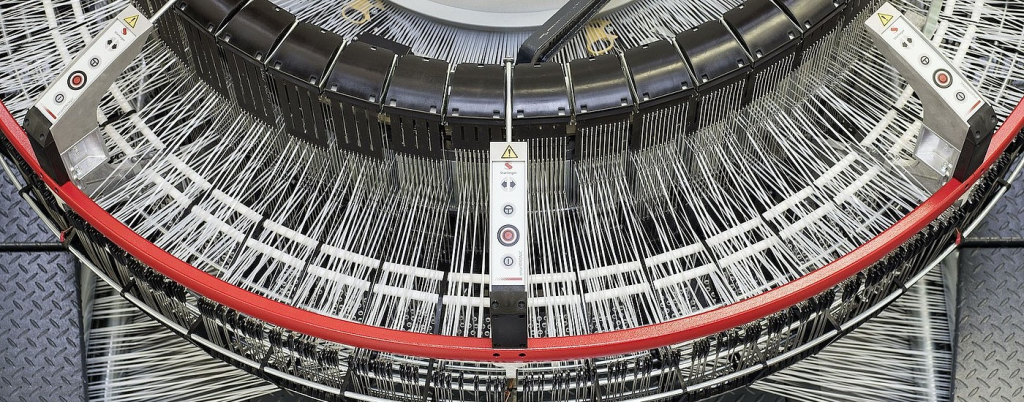
- Tape extrusion & weaving. PP resin, stabilized with antioxidants and UV packages when necessary, is extruded to tapes, quenched, reheated, and stretched to a target draw ratio. Tapes enter circular or flat looms to produce fabric widths matched to bag sizes.
Control: tape gauge uniformity, draw ratio, loom tension, weave density, off‑loom gsm. - BOPP surface & printing. Film is corona/plasma treated and printed—rotogravure for long runs or HD flexo for agility. Low‑migration ink sets serve food-contact SKUs; drying ovens and solvent capture ensure safety where solvents are used.
Control: dyne level, adhesion cross‑hatch, register, density, gloss/haze. - Lamination. Choose extrusion coating (PP/PE curtain) for simplicity and strong bonds, or adhesive lamination (solvent‑free PU, water‑borne acrylics) for thermal gentleness and graphics preservation.
Control: bond per ASTM F88, coatweight checks, nip load, cure window. - Slitting & tube formation. Laminated web is slit; tubers set side seams by hot air, ultrasonic, or hotmelt. For open‑mouth, pinch geometry is tuned; for valve bags, sleeves are placed with tight tolerances.
Control: seam strength, valve position repeatability, tube circumference. - Bottoming. Bases fold and bond to create the block footprint; reinforcement patches are added for heavy duty. Squareness and base flatness influence pallet stability hours later, not just minutes after conversion.
Control: base compression strength, angle deviation, flatness. - Features & finish. Micro‑perforations, anti‑slip coats, tear notches, tin ties, or zippers. Over‑varnish guards graphics against conveyor abrasion and forklift contact.
- Quality & compliance. Mechanical (ISO 7965‑2 drop, ISO 13934‑1 tensile), barrier (ASTM F1249 WVTR; ASTM D3985 OTR), regulatory (EU 10/2011 SML; EN 1186 OML ≤ 10 mg/dm²; 21 CFR 177.1520/175.105), and system (ISO 9001; FSSC 22000/ISO 22000 for food plants; GMP under EC 2023/2006).
What is the application of Block BOPP Bags? sectors, physics, and choices
Applications expose the true grain of specifications. One structure cannot rule them all; one barrier does not solve every problem. Recurrent patterns, though, make selection faster and smarter.
Cement & minerals
Cement, calcium carbonate, kaolin, silica sand, barite—powders with flow but dust—prefer valve designs and micro‑perforations for de‑aeration. The abrasion-resistant shell survives rough sites.
Flour, grains & rice
Retail and foodservice sizes (5–25 kg) benefit from photo‑grade graphics and wipe‑clean skins; liners stabilize moisture-sensitive contents and improve seal integrity.
Pet food & feed
Dry kibbles and feeds demand grease management and aroma control. Matte BOPP projects natural cues; liners protect seals and lessen odor escape.
Seeds & fertilizers
Granular fertilizers abrade; seed coatings are sensitive; UV-stabilized tapes and controlled venting lengthen outdoor life and keep bags stack-stable through seasons.
System thinking for Block BOPP Bags — decomposing constraints, composing solutions
To future‑proof specifications, treat the package as a system with four interlocking subsystems: performance, compliance, cost‑and‑carbon, and user experience. Analyze each; then integrate.
Subsystem A — Performance (barrier, strength, machinability)
Challenge. Match powder or particulate properties to geometry, barrier, and seams while preserving line speed.
- Barrier. Minerals rarely need oxygen heroics; moisture is the villain. Food and pet treats may require liners or metallized BOPP. The cost is not just film—it is complexity at end‑of‑life.
- Strength. Draw ratio and fabric gsm balance drops with resin economy; bottom patches protect against sharp edges.
- Machinability. Valve diameter and stiffness govern fill rate and dust; seal windows must match jaw temperatures and dwell times.
Solution set. A three‑platform toolkit: standard mono‑PP for minerals; liner‑assisted food grade for dry foods; enhanced barrier for aroma‑sensitive goods. Gate decisions on moisture sensitivity, oxygen sensitivity, and shelf‑life intent.
Subsystem B — Compliance (food contact, labeling, claims)
Challenge. Satisfy EU 10/2011 and U.S. 21 CFR while making claims that survive audits and evolving EPR regimes.
- Food contact. Build a register mapping substances to SML entries; verify migration via EN 1186; maintain GMP per EC 2023/2006.
- Claims. Recyclability messaging must reflect local collection for flexible PP; metallized structures complicate claims.
Solution set. Geography‑specific artwork with QR‑based disposal guidance; documented test reports and declarations (EU 10/2011; 21 CFR 177.1520, 175.105).
Subsystem C — Cost & carbon (BOM, energy, logistics)
Challenge. Reduce total delivered cost while demonstrating carbon literacy.
- Material. Fabric gsm and film gauge are the big levers; downgauging saves resin but can raise scrap without tight control.
- Energy. Solvent‑free lamination cuts oven load; water‑based inks reduce VOC and energy demand.
- Logistics. Block‑bottom geometry improves pallet density, lowering emissions per tonne‑kilometer.
Solution set. Costed BOM scenarios (±5 g/m² fabric, ±5 µm film) coupled to drop and seal acceptance criteria; energy per 1,000 bags as a KPI; pallet efficiency tracked before/after design shifts.
Subsystem D — Brand & user experience
Challenge. Use BOPP’s print advantage without losing a natural, tactile feel where the category demands it.
- Matte films and tactile varnishes emulate paper; selective gloss builds hierarchy.
- Tear‑tapes and reclosures upgrade daily user interactions in homes and farms.
Solution set. Finish library (matte 20, satin 50, gloss 80 GU) with abrasion indices; iconography standards for disposal and safety.
Integration principle: Pick the platform by SKU, not by ideology. Let the product, the line, and the local waste system vote equally.
Future signals shaping Block BOPP Bags — policy, technology, commerce (last 12 months)
Policy clarified expectations for recyclability claims and design-for-recycling criteria; technology advanced solvent‑free bonding, high‑solids coatings, and inline inspection; commerce emphasized shelf impact and predictable BOMs. The thread across them: fewer materials, simpler claims, better documentation.
Policy
DfR checklists, EPR fee modulation by recyclability grade, firmer guidance against vague compostability. Mono‑PP narratives gain traction where PP flex collection exists.
Technology
Solvent‑free PU lamination, water‑borne primers, real‑time coatweight sensors, and maturing digital print pilots on BOPP compress RFQ‑to‑shelf timelines.
Commerce
Construction and agriculture supported steady sack demand; retail pushed for matte aesthetics and scuff‑resistant graphics. Resin volatility eased relative to the prior year.
Technical dossier for Block BOPP Bags — parameters, methods, indicative ranges
Numbers defend promises. The following table gathers the metrics most often requested in RFQs and audits. Values are starting points; line trials write the final script.
| Dimension | Typical Method | Indicative Target/Rationale |
|---|---|---|
| Fabric weight | Gravimetric (gsm) | 60–100 g/m² general duty; 90–120 g/m² heavy minerals |
| Tape tensile | ISO 527 / ISO 13934‑1 | Draw ratio matched to drop targets with safety margin |
| Film gauge | Micrometer (µm) | 15–35 µm; matte at higher gauge for stiffness/scuff |
| Lamination bond | ASTM F88/F88M | Peel > 2.0 N/15 mm typical; higher for rough handling |
| WVTR | ASTM F1249 (38°C/90% RH) | < 5–10 g/m²/day for moisture-sensitive SKUs |
| OTR | ASTM D3985 | 500–1,500 cc/m²/day non‑metallized; much lower if metallized |
| Dart impact | ASTM D1709 | Tailored to SKU; prioritize for sharp granules |
| Drop test | ISO 7965‑2 / ISO 2248 | No rupture or leak at specified height/mass |
| Valve leak | In‑house powder method | < 0.5% mass loss after vibration cycle |
| Migration (EU) | EN 1186; EU 10/2011 SML | OML ≤ 10 mg/dm²; specific limits respected |
| Food‑contact (US) | 21 CFR 177.1520; 175.105 | Declarations for plastics/adhesives used in contact |
Market structure for Block BOPP Bags — where growth concentrates
Growth concentrates where the format’s advantages are visible and measurable: construction (cement, gypsum, minerals), agriculture (fertilizers, seeds, feed), and retail staples (rice, grains, pet food). Europe’s policy momentum accelerates trials of mono‑PP sacks; Asia‑Pacific remains the manufacturing hub and demand engine for industrial sacks; North America emphasizes shelf impact and clean handling in retail, with pragmatic pilots in recycling pathways.
Procurement & qualification — a buyer’s ritual for Block BOPP Bags
Use a seven‑step sequence to compress approval time and reduce surprises: define the job; pick the platform; demand the layer stack; ask for proof; audit the line; run trials; lock specs.
- Define the job. Moisture sensitivity? Oxygen sensitivity? Shelf life? Aesthetic?
- Pick the platform. Mono‑PP for minerals; liner‑assisted food grade for dry foods; enhanced barrier for aroma‑sensitive retail.
- Demand the stack. Layer‑by‑layer structure with gauges/coatweights; include valve and liner data.
- Ask for proof. F88 bond, drop tests, WVTR/OTR, migration, ISO 9001 and FSSC 22000/ISO 22000 where relevant.
- Audit the line. Weaving, lamination, printing controls; defect cameras; solvent capture if applicable.
- Run line trials. Fill rate, dust loss, seal integrity, pallet stability; document parameters and photos.
- Lock specs. Master data for fabric gsm, film gauge, valve dimensions, finishes; change control via ECNs and requalification triggers.
Worked scenarios — translating requirements into Block BOPP Bags structures
25 kg white cement
Structure: 90 g/m² PP fabric + 25 µm matte BOPP + PP extrusion layer; micro‑perfs; anti‑slip varnish. Valve sleeve (PP), self‑sealing. Targets: ISO 7965‑2 drop at 1.2 m, WVTR ≤ 10 g/m²/day, valve leak < 0.5% after vibration. Rationale: mono‑PP claim where collection exists; matte hides scuffing.
10 kg premium basmati rice
Structure: 80 g/m² PP fabric + 20 µm gloss BOPP printed; 40 µm LDPE liner fixed at bottom. Open‑mouth pinch‑bottom; optional nitrogen flush. Targets: WVTR ≤ 5 g/m²/day; seal integrity at 200 mm water column; EN 1186 migration passed. Rationale: shelf appeal + seal assurance.
15 kg dry dog food
Structure: 90 g/m² PP fabric + 25 µm matte BOPP + anti‑scuff varnish; 60 µm inner PE liner; optional zipper/tin tie. VFFS or pre‑made bagger, 140–160°C seal jaws. Targets: minimal aroma loss; no grease strike‑through; abrasion resistance on print zones. Rationale: premium cues with functional hygiene.
Risk register for Block BOPP Bags — pitfalls and mitigations
- Delamination under thermal stress. Validate dyne levels; confirm adhesive cure; monitor F88 peel across shifts.
- Valve dust leakage. Tighten sleeve tolerances; evaluate self‑sealing geometries; add internal flaps.
- Pallet slip incidents. Specify anti‑slip coatings; test static/dynamic friction angles with filled units.
- Migration non‑conformance. Use compliant ink/adhesive systems; conduct worst‑case EN 1186 simulant testing.
- Fabric stiffness mismatch. Tune draw ratio and gsm; run forming trials to ensure fold memory.
Where to learn more about Block BOPP Bags
For a practical catalog view and adjacent formats, see Block BOPP Bags in a broader laminated-woven portfolio context. This link anchors the keyword to a relevant resource without overwhelming the narrative.
- What is Block BOPP Bags and why the format matters now?
- The material of Block BOPP Bags — layers, roles, and rational trade‑offs
- What are the features of Block BOPP Bags? function, physics, and perception
- What is the production process of Block BOPP Bags? from resin to squared geometry
- What is the application of Block BOPP Bags? sectors, physics, and choices
- System thinking for Block BOPP Bags — decomposing constraints, composing solutions
- Future signals shaping Block BOPP Bags — policy, technology, commerce (last 12 months)
- Technical dossier for Block BOPP Bags — parameters, methods, indicative ranges
- Market structure for Block BOPP Bags — where growth concentrates
- Procurement & qualification — a buyer’s ritual for Block BOPP Bags
- Worked scenarios — translating requirements into Block BOPP Bags structures
- Risk register for Block BOPP Bags — pitfalls and mitigations
- Where to learn more about Block BOPP Bags
- 1. Material Selection: Balancing Standards and Performance
- 2. Production Innovations at VidePak
- 3. Future Trends Shaping the Industry
- FAQs: Block BOPP Bags
“Block BOPP bags are evolving from simple containers to intelligent, sustainability-driven packaging systems,” asserts Ray, CEO of VidePak, during a factory audit. “By aligning PP resin selection with global standards and integrating IoT-enabled quality control, we’ve reduced client material waste by 35% while maintaining 99.8% seal integrity—critical for industries like chemicals and premium agriculture.” This report dissects the technical and strategic advancements in Block BOPP bags, analyzing material science, regulatory compliance, and automation trends through the lens of VidePak’s 17-year expertise in woven packaging solutions.
1. Material Selection: Balancing Standards and Performance
1.1 PP Resin Grades by Regional Standards
Global regulations dictate distinct PP requirements for BOPP bags:
- FDA 21 CFR 177.1520 (U.S.): Requires melt flow rates (MFR) of 2–4 g/10 min (230°C/2.16 kg) for food-grade applications, ensuring thermal stability during sterilization.
- EU REACH: Limits heavy metal migration to <0.1% and mandates recyclability thresholds of ≥65% for circular economy compliance.
- China GB/T 21661-2020: Specifies tensile strength ≥2,500 N/5 cm and oxidation induction time (OIT) >30 minutes at 200°C.
VidePak’s EcoShield PP5500 resin meets all three standards, achieving an MFR of 3.2 g/10 min and OIT of 45 minutes—validated by third-party labs per ASTM D3895-19.
1.2 Additive Engineering for Enhanced Durability
| Additive | Concentration | Function | Compliance |
|---|---|---|---|
| Hindered Amine Light Stabilizers (HALS) | 0.3–0.5% | Extends UV resistance from 500 to 2,000 hours | ISO 4892-3 |
| Irganox 1010 Antioxidant | 0.1–0.2% | Reduces thermal degradation by 70% | FDA 21 CFR 178.2010 |
| Antistatic Carbon Black | 1.5–2.0% | Lowers surface resistivity to 10⁶–10⁸ Ω/sq | ISO 80079-36 |
Case Study: A Japanese client handling explosive magnesium powders adopted VidePak’s VoltShield BOPP bags with carbon black additives, reducing static ignition risks by 90% while complying with JIS Z 7253-2019.
2. Production Innovations at VidePak
2.1 Starlinger-Driven Automation
With 100+ circular looms and 30 lamination machines, VidePak achieves:
- Precision Extrusion: ±0.02 mm BOPP film thickness uniformity, critical for moisture barriers in humid climates.
- High-Speed Printing: 10-color CMYK+Pantone customization at 1440 dpi for OSHA/GHS-compliant hazard labels.
A 2024 partnership with a German chemical manufacturer utilized FFS tubular bags to automate 25kg filling at 60 bags/minute, reducing labor costs by 55%.
2.2 Sustainability Integration
- Solar-Powered Production: VidePak’s 2MW rooftop photovoltaic system covers 80% of energy needs, reducing carbon emissions by 1,200 tons/year.
- Closed-Loop Recycling: 40% of production scrap is reprocessed into recycled PP (rPP), cutting raw material costs by 18%.
3. Future Trends Shaping the Industry
3.1 Smart Packaging Systems
- RFID-Embedded Bags: Track temperature/humidity in real-time via IoT, reducing spoilage by 25% in pharmaceutical logistics.
- Self-Healing Films: Microcapsules releasing sealant upon puncture, extending bag lifespan by 300% in abrasive environments.
3.2 Regulatory-Driven Material Shifts
- EU Single-Use Plastics Directive: Accelerating adoption of 30% rPP blends (VidePak’s EcoCycle series) to meet 2030 recyclability targets.
- China’s Dual Carbon Policy: Favoring PLA-PP hybrids with 60% biodegradability, projected to capture 15% market share by 2027.
FAQs: Block BOPP Bags
Q1: How do UV stabilizers affect bag lifespan in tropical climates?
A: HALS additives extend outdoor usability from 6 to 24 months under 500 kWh/m² UV exposure (tested per ASTM G154).
Q2: Can Block BOPP bags handle liquid chemicals?
A: Yes—VidePak’s AquaGuard PE-lined bags achieve <0.01 g/m²/day water vapor transmission rates, compliant with ISO 2528:2017.
Q3: What’s the ROI of automated FFS systems?
A: Clients report 18-month payback periods via 50% labor reduction and 30% material savings.
Conclusion
The Block BOPP bag market is transitioning toward intelligent, circular solutions. VidePak’s $8 million R&D investment targets graphene-enhanced barriers and blockchain-tracked recycling—positioning it to lead the $42 billion industrial packaging sector. As Ray concludes: “In packaging, innovation isn’t optional. It’s the price of entry.”
External Links:
- Explore BOPP lamination innovations: BOPP Laminated Woven Bags: Branding and Market Dynamics.
- Learn how ESG compliance drives material selection: Polypropylene Bags: Meeting Regulatory Standards and ESG Commitments.