
What are Breathable Woven Bags? Meaning, aliases, boundaries
Breathable Woven Bags are textile‑engineered packaging articles made from interlaced polyolefin tapes—predominantly polypropylene—whose signature capability is controlled airflow through the bag wall. Instead of sealing moisture vapor, they admit measured convection and diffusion so that heat, humidity, and gases produced by living or hygroscopic goods do not accumulate. In trading language and procurement sheets, the same family appears as ventilated woven bags, aerated woven sacks, ventilated PP bags, mesh‑panel woven poly sacks, perforated woven sacks, and—at warehouse scale—ventilated flexible intermediate bulk containers. The essence is not merely “holes in fabric,” but a tuned permeability that preserves strength, prevents sifting, and supports the hygiene and regulatory context of the payload.
Look‑alike sacks are everywhere. Yet a sack that vents adequately for onions can be a liability for dusty premixes; a bag that passes food‑contact migration may still fail a stacking test; a fabric that breathes well may bale poorly at end‑of‑life. A precise definition turns loose features into testable specifications.
Where do Breathable Woven Bags outperform alternatives? Wherever payloads respire, expel moisture, or trap condensate—potatoes, onions, garlic, ginger, nuts in shell, coffee cherries; firewood and charcoal that continue to dry; animal feed pellets that sweat; hygroscopic industrial pellets or additives that need a trickle of air to stay stable. In such contexts, over‑sealing invites microbial growth, odor, and caking. Breathable architectures counter those risks while remaining printable, liftable, and compatible with modern recycling streams.
A useful way to frame the category is systemic: fabric architecture governs airflow; coatings and laminations are selected to avoid sealing pores; seam geometry decides whether the system strength equals fabric strength; unit‑load design dictates whether pallet cores remain cool and dry; traceability converts theoretical recyclability into real returns.
The materials of Breathable Woven Bags: polymers, additives, and architectures
At the polymer level, polypropylene (PP) anchors most specifications. Why? Low density (~0.90–0.91 g/cm³) yields excellent mass efficiency; orientation during tape drawing creates high modulus and tensile strength; moisture uptake is low; melting point (~160–165 °C) supports hot environments and heat‑cutting. Polyethylene (PE) shows up as liners or occasional tapes where softer hand‑feel or low‑temperature flexibility are prized, but mono‑PP designs simplify recycling and reduce stiffness loss at summer dock temperatures.
Core resins
PP‑H (homopolymer) provides stiffness and clean tape edges; it responds strongly to orientation for high tensile per gram. PP‑R (random copolymer) sacrifices a measure of modulus for improved low‑temperature impact—useful for cold‑room produce. Recycled PP may occupy non‑contact layers or non‑food SKUs; odor and UV stability must be curated.
Additive packages
HALS UV stabilizers for outdoor exposure; slip/anti‑block agents for machinability and pallet friction control; pigments for commodity identification; and where regulations permit, antimicrobial treatments on labels or threads. Avoid indiscriminate carbon black in regions that depend on NIR sorting.
Architectures
Open‑weave bodies for inherent porosity; mesh‑panel hybrids that concentrate airflow; micro‑perforated laminations for graphic faces; engineered vents in bulk FIBCs. The art lies in reaching the airflow target without sacrificing seam strength or allowing product sifting.
Composition maps to function. The woven body carries tensile loads; coatings temper moisture ingress and provide print anchors; seams translate fabric strength into system strength; handles and lift loops manage local stresses; liners, if any, protect against dust or odor yet must not cancel breathability. In mono‑material strategies, fabric, coats, threads, and label films remain polypropylene to keep the article in the PP recycling stream. Where a liner is unavoidable, make it removable: tethered but separable, obvious to operators, and clearly labeled.
Cost deserves an honest breakdown. Resin and weaving dominate (often 55–70%). Breathability features—perforation, mesh windows, quality control—add conversion cost. Yet value flows from avoided losses: fewer cartons collapse from condensation, less mold forms at the pallet core, pallets stack higher because surfaces stay dry, fewer claims arrive downstream. In fresh produce and kiln‑dried goods, these recovered values consistently surpass the marginal premium over dense, non‑breathing sacks.
Features of Breathable Woven Bags: performance, safety, and circularity
Performance never stands alone. Airflow, moisture management, mechanical strength, hygiene, electrostatic safety, and recyclability interact—and sometimes collide. Mature specifications reconcile trade‑offs, not by splitting the difference, but by designing mechanisms: micro‑perforation patterns that vent without compromising tear; seam allowances that translate fabric tensile to system strength; graphics that persuade shoppers yet keep pores open.
Airflow tuned to payload
Standardized air‑permeability tests translate into target windows: enough movement to remove metabolic heat in tubers and bulbs, not so much as to overdry or stir dust. Open weaves and vent windows couple with pallet “chimneys” to draw heat away from cores.
Moisture & condensation control
Patterns align with warehouse airflow so vapor exits, not condenses. Partial coatings, breathable faces, and reduced ink coverage preserve diffusion. The outcome is cleaner skin on produce and reduced carton degradation.
Strength at low mass
Oriented PP tapes achieve high tensile per gram; 90–110 gsm bodies comfortably carry 25–50 kg when seams are engineered to ≥80% efficiency. Bulk formats with vent strips maintain 5:1 or 6:1 safety factors over 500–1,500 kg loads.
Hygiene & food contact
Where crops touch plastic, components align to recognized food‑contact frameworks; ink systems with low migration, reverse‑printed laminations on graphic faces, and robust scuff resistance protect both produce and brand.
Electrostatic considerations
Small sacks seldom need electrostatic classes; ventilated FIBCs for combustible dusts may require Type C (groundable) or Type D (dissipative) designs. Modern conductive yarns and detachable grounding hardware keep the base polymer stream predominantly PP for recycling.
Designed for recycling
Mono‑PP bills of materials—fabric, coat, threads, label films—plus removable liners and clear marks keep value in PP bales. Post‑use bale density targets (≥250 kg/m³) matter for economics and acceptance at reprocessors.
How Breathable Woven Bags are produced: from pellets to ventilated carriers
Manufacturing follows the familiar woven‑PP pathway with process windows tuned so pores remain functional. The sequence matters; the parameters matter more.
- Compounding & tape extrusion: Pellets with UV and pigment are melted; a sheet is cast, slit, and drawn into tapes at 5–8×. The anneal schedule balances toughness with modulus. Oxygen control during melt lessens yellowing when recycled content is used.
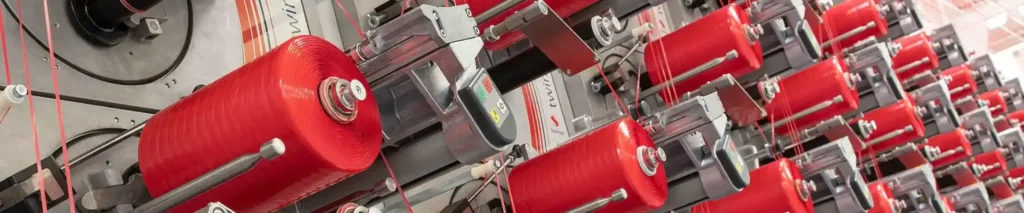
- Weaving: Circular or flat looms interlace tapes at lower pick density than dense sacks. Openness must meet airflow while resisting sifting; for mesh panels, leno weaves create large, stable apertures.
- Surface engineering: Where branding is required, designers deploy breathable faces (uncoated or micro‑perforated) and reserve coatings for structural or print‑critical zones. Over‑coating is the enemy of breathability.
- Perforation & vent windows: Laser or mechanical systems introduce micro‑holes in films; die‑cut slots accept mesh windows sewn or welded to bodies. Tear propagation testing guards against runaway rips.
- Conversion: Heat‑cutting reduces fray without sealing pores; bottoms are folded and double chain‑stitched. Valve sleeves for powders, open‑mouth for produce, and reinforced corners for reuse cycles complete the forms.
- Printing & serialization: Flexo on PP coats with low‑ash inks; reverse‑printed films on graphic faces. Inline lot codes and QR serialize units, enabling deposit/return and targeted recalls.
- Testing & release: Fabric and seam tensile, drop and stack testing, air permeability, UV aging, electrostatic classing where needed, and food‑contact migration where applicable. Bulk formats undergo lift cycles to verify safety factors.
Field failures cluster at seams, not fabrics. Stitch density, thread selection, seam geometry, and allowances must be specified as carefully as fabric gsm. Testing seams early is cheaper than rescuing product later.
Applications for Breathable Woven Bags: sectors, payloads, and unit‑load logic
Fresh produce loves airflow; pellets and powders tolerate it in measured amounts; bulk goods benefit when vented FIBCs cooperate with warehouse blowers. The following lenses sharpen the fit.
Fresh produce
Potatoes, onions, garlic, ginger, sweet potatoes, citrus. Airflow pulls off metabolic heat and reduces surface condensate; mesh windows protect skins from slime and mold.
Nuts & seeds
In‑shell nuts and seed potatoes avoid moisture pockets. Gentle drying continues during transit, improving storage outcomes.
Energy & building materials
Firewood and charcoal continue drying; kiln‑dried timber off‑gasses safely. Construction aggregates packaged in breathable versions shed residual moisture faster.
Animal nutrition
Pellets that exude moisture resist caking in micro‑perforated sacks. Valve sleeves allow high‑speed filling while pores temper humidity.
Industrial powders
Hygroscopic premixes, salts, and additives maintain flowability with moderate ventilation. Where dust is critical, tighten weaves and reduce perforation density.
Bulk programs
Ventilated FIBCs align vent strips to pallet channels and warehouse blowers for forced‑air cooling. Stack stability and safety factors remain paramount.
Thinking through Breathable Woven Bags: an outline, an argument, a chain of logic
The phrase contains a blueprint: breathable (property), woven (method), bags (function). Begin with property: what airflow does the payload need? Continue with method: how do fabric openness, mesh windows, and perforations achieve it? End with function: will the bag, once filled, palletized, trucked, and stored, still breathe where it counts—the pallet core?
Set explicit assumptions. The payload respires, emits moisture, or risks condensation. The supply chain spans changing temperatures that create cold walls and dew points. The buyer values both performance and circularity. If any of these assumptions fail, specifications shift: less openness for dusty products; higher recycled content for non‑food goods; stronger seams for reuse loops. The logic remains: match permeability to physiology or physics; keep the bill of materials simple; instrument the system so claims and returns are data‑driven.
Inline resource: For a broad gallery of woven polypropylene formats, see Breathable Woven Bags.
Systems view of Breathable Woven Bags: break down, analyze, recombine
Design becomes tractable when decomposed into subsystems with measurable outputs. Each subsystem admits levers, constraints, and metrics. Recombination then yields a program rather than a one‑off SKU.
Material purity
Mono‑PP fabric, coat, thread, label films; removable liners. Metric: mono‑PP mass fraction; recyclability grade; bale purity.
Recognizability
NIR‑detectable pigments; prominent material marks; QR with material ID. Metric: sort purity; recovery rate; mis‑sort frequency.
Use‑phase
Target permeability; seam efficiency ≥80%; UV class matched to geography. Metric: field failure PPM; drop/stack pass rates.
Safety
Electrostatic classing where needed; UN codes for hazardous solids; food‑contact migration for edible crops. Metric: incidents = 0.
Reverse logistics
Deposit and return; retailer take‑back; bale density ≥250 kg/m³; reprocessor partnerships. Metric: cost per returned kg; recovered %.
The integrated specification bundles these choices: permeability window and test method; mono‑PP bill of materials; seam standard and allowances; UV class; pallet airflow plan (chimneys, channel spacing, forced‑air setpoints); labeling and serialization; take‑back contract; KPI dashboard. Quarterly reviews turn field data into parameter updates.
Standards, certifications, and third‑party signals around Breathable Woven Bags
Safety and market access rely on recognized frameworks. Bulk ventilated carriers follow flexible container standards for lift and stack trials; electrostatic classifications guide combustible dust environments; food‑contact frameworks govern materials that touch edible crops; management system standards entrench quality and EHS discipline; design‑for‑recycling programs point toward mono‑material choices; textile air‑permeability tests help quantify breathable targets. Together they create a compliance lattice that reduces risk and speeds procurement.
Selected frameworks
- Flexible bulk container safety testing for lift, stack, topple, and drop trials (2024 updates widely referenced by industry).
- Electrostatic classification for A/B/C/D bulk bags guiding grounding and charge dissipation in dusty atmospheres.
- Food‑contact baselines for olefin polymers used near edible crops.
- Quality, environmental, and occupational health management systems for consistent production and EHS controls.
- Design‑for‑recycling programs in North America and Europe steering mono‑PP specifications and removable liners.
- Textile air‑permeability test methods (e.g., air passing through a defined area at fixed pressure differential) as proxies for breathable fabric performance.
Why they matter
Standards convert opinions into pass/fail results. Certifications structure audits. Third‑party test reports build trust with retailers and regulators. And because several frameworks now nudge packaging toward mono‑material designs, compliance increasingly aligns with circularity rather than competing with it.
Technical details for Breathable Woven Bags: colored tables & parameter ranges
| Parameter | Typical Range / Option | Rationale |
|---|---|---|
| Fabric basis weight (sacks) | 80–120 gsm | Tensile with low mass for produce; supports breathability |
| Picks per inch (woven body) | 28–36 | Sets openness and sifting resistance |
| Mesh panel width | 80–160 mm per side | Boosts convective flow through pallets |
| Perforation density (film faces) | 100–800 micro‑holes / 100 cm² | Balances airflow, tear risk, and dust control |
| Seam efficiency | ≥75–90% of fabric tensile | System strength depends on seams |
| UV stabilization | 200–800 h xenon‑arc equiv. | Outdoor storage and field durability |
| Printing method | Flexo or reverse‑printed BOPP | Graphics with restrained ink mass |
| Bale density (post‑use) | ≥250 kg/m³ | Reverse‑logistics efficiency and acceptance |
Ventilated FIBC parameters
| Parameter | Typical Range / Option | Why it matters |
|---|---|---|
| Safe working load (SWL) | 500–1,500 kg @ 5:1 or 6:1 | Defines safe handling capacity |
| Vent strip geometry | Longitudinal slits or mesh windows | Aligns with forced‑air channels |
| Body fabric | 160–230+ gsm | Structural integrity with vents |
| Electrostatic class | Type A/B/C/D (as environment dictates) | Safety in combustible atmospheres |
| Lift loops | 4‑loop or cross‑corner | Forklift & crane compatibility |
| Liner strategy | Removable PP or PE liner | Dust control without losing recyclability |
Indicative process windows
| Stage | Typical settings | Notes |
|---|---|---|
| Tape extrusion | 220–260 °C barrel, draw 5–8× | Balance tensile and toughness; control oxidation when using rPP |
| Weaving | 8–12 wefts/cm (sacks) | Calibrate openness for air targets |
| Coating/lamination | PP coat 12–25 g/m² (optional) | Avoid sealing breathable faces |
| Perforation | Mechanical or laser | Validate tear propagation limits |
| Seaming | Double chain‑stitch 2.5–3.5 stitches/cm | Seam geometry governs reliability |
Deep arguments about Breathable Woven Bags and what they imply
Breathability is a system property
A fabric can pass every lab test and still underperform if pallets suffocate airflow. Conversely, a moderate‑permeability sack can work brilliantly inside a unit load designed with chimney channels and corner vents. Therefore, specifications must include pallet layouts, channel spacers, and target pressure drops for warehouse blowers. Responsibility shifts from packaging alone to the triumvirate of packaging, operations, and facility engineering.
Mono‑material choices multiply value
Keeping the bill of materials within polypropylene—fabric, coats, threads, labels—and making liners removable raises bale value, reduces reprocessing losses, and stabilizes supply of usable recyclate. It also simplifies labels and consumer guidance in retail variants. Incentives should reward mono‑material compliance rather than only initial unit cost.
Seam engineering prevents most field failures
Fabric strength is abundant; seam design is where systems crack. Stitch density, thread selection, seam geometry, and allowances translate fabric tensile into usable capacity. Pilot drops, stack compression, and lift cycles cost little compared with ruined loads. Budget time and money early for seams.
Graphics must respect airflow and recycling
Heavy ink coverage can obstruct pores and load regrind with ash; thick laminates can strangle breathability. Reverse printing on thin, micro‑perforated films or confining graphics to select panels preserves both marketing and function.
UV stability is non‑negotiable
Sunlight degrades untreated PP. Under‑specifying HALS stabilizers in high‑UV geographies produces brittle failure and seam splits. Match UV packages to climate and expected exposure—field staging, open‑yard storage, or retail display.
Implementation checklist for Breathable Woven Bags: from RFQ to steady state
- Define payload and airflow target using a named test (e.g., air permeability at stated ΔP) and acceptance window.
- Lock a mono‑PP bill of materials; state liner removability; cap total ink mass and forbid incompatible labels.
- Engineer seams for ≥80% efficiency; specify stitch pattern, density, thread polymer, and allowances.
- Assign UV class by geography and storage profile; validate in xenon‑arc aging.
- Author pallet airflow guidance: chimney geometry, channel spacing, and blower setpoints for cool rooms.
- Validate lifting, stacking, drop, and—where relevant—electrostatic classes and food‑contact migration.
- Serialize units; contract take‑back with bale density targets; publish track‑and‑trace dashboards.
- Launch with KPIs: field failure PPM, recovery %, bale purity %, CO₂e per kg. Review quarterly; revise parameters.
Functional card — Common pitfalls: over‑laminating graphic faces; adding metal eyelets; using dark pigments invisible to NIR; neglecting seam allowances; forgetting that pallets, not just bags, must breathe.
Glossary to navigate Breathable Woven Bags
Air permeability — volumetric flow through fabric at defined pressure; used to target breathability. FIBC — the bulk format for woven carriers. HALS — stabilizers that protect PP from UV degradation. Micro‑perforation — tiny holes in films that vent without large apertures. Seam efficiency — seam tensile as a fraction of fabric tensile, a superior predictor of field performance.
Final integration of choices for Breathable Woven Bags
Breathable Woven Bags convert a material advantage—orientation‑strengthened polypropylene—into a system advantage—controlled airflow that preserves quality, safety, and value. When tuned permeability meets engineered seams; when food‑contact and electrostatic duties meet documented test results; when mono‑material design meets serialization and contracted take‑back; when pallet airflow is specified rather than assumed—the result is consistent quality, higher recovery, and a credible circular story.
Breathable woven bags are becoming a vital packaging solution across various industries, including agriculture, food processing, and construction, due to their unique combination of durability, breathability, and adaptability. These bags, primarily made from woven polypropylene (PP), offer a porous structure that allows air to pass through while maintaining the strength needed for heavy-duty use. In this article, we will explore the benefits of breathable woven bags, the history and origins of these products, their expanded applications, and their growth within the Chinese market. We will also consider how these bags are transforming industry standards amid global competition and sustainability trends.
The Functionality and Importance of Breathable Woven Bags
The primary advantage of breathable woven bags lies in their ability to allow air to circulate through the bag while protecting the contents from external damage. This breathability is crucial for products that are sensitive to moisture or require proper ventilation, such as grains, seeds, and other agricultural goods. Unlike regular woven bags that may trap moisture and lead to spoilage, breathable woven sacks prevent the buildup of condensation, helping to maintain the freshness and quality of the goods inside.
In addition to agriculture, industries such as building materials, chemicals, and food processing have also adopted breathable woven bags due to their versatility. They provide an excellent solution for products that need both structural support and protection from dampness. For example, in the construction industry, materials like cement, sand, and powdered chemicals can be stored in breathable woven sacks to ensure that moisture does not compromise their quality.
VidePak has made significant strides in the development of these breathable bags, offering a variety of customizable options that cater to different industrial needs. By utilizing advanced manufacturing techniques and equipment from Starlinger, VidePak ensures that its bags maintain the right balance between air permeability and strength. Many competitors in the market offer standard woven bags, but VidePak’s emphasis on breathability and customization gives it a competitive edge in niche markets that require specialized packaging solutions.
The Origins and Evolution of Woven Bags
The history of breathable woven bags is deeply rooted in the industrial revolution of the textile and plastics industries. Woven bags can trace their origins back to the modernization of the textile industry in the 19th century when innovations in fabric production enabled the large-scale manufacture of durable, flexible materials. However, the transformation of these textiles into what we now recognize as modern woven bags did not occur until the 20th century, when the advent of synthetic polymers revolutionized material science.
In the early 1900s, the discovery of plastic polymers such as polyethylene (PE) and polypropylene (PP) changed the packaging landscape forever. These materials were lighter, cheaper, and more versatile than traditional textiles or metal containers, leading to their widespread adoption in industries ranging from consumer goods to heavy manufacturing. Polypropylene, in particular, became a popular choice due to its exceptional tensile strength, resistance to chemicals, and ease of production.
By the mid-20th century, woven polypropylene bags began to emerge as a dominant packaging solution. They were initially used in agriculture to store grains, rice, and other dry goods. The woven structure of PP fibers provided the necessary durability to hold large quantities of materials, while the light weight and low cost made these bags highly attractive for industrial use. As the market for woven PP bags expanded, manufacturers began to explore ways to improve functionality, leading to the development of breathable woven bags.
These bags offered a critical innovation by incorporating pores or breathable designs into the fabric, allowing for better ventilation of products. This development was particularly useful for agricultural goods that required moisture control. Over time, as industries grew more specialized, the demand for different types of woven bags increased. Today, breathable woven bags come in a variety of designs, each tailored to the specific needs of the market.
Expansion of Applications and Market Diversification
As industries continued to evolve and diversify, the application range of breathable woven bags expanded. Initially confined to agriculture and food storage, these bags have found new uses in industries such as construction, chemicals, and even retail packaging. This expansion came as manufacturers adapted their products to meet the varying requirements of different markets.
In the agricultural sector, the use of breathable woven sacks for storing grains, seeds, and vegetables remains the most prominent. However, with increasing concerns over food safety and the need for long-term storage, breathable bags have been further refined to ensure that they can protect contents from spoilage caused by moisture, pests, and contamination. Some bags are now designed with additional UV resistance, protecting sensitive agricultural products from sun damage during storage or transport.
In the construction industry, breathable woven bags are used for storing materials such as cement, gravel, and powdered chemicals. These products require ventilation to prevent moisture from compromising their quality, especially in areas with high humidity. Additionally, chemicals such as fertilizers and pesticides are often stored in breathable woven bags, ensuring that the contents remain dry while being shielded from external contamination.
As industries and consumers continue to seek more sustainable packaging options, breathable woven bags have adapted to meet these demands. Companies like VidePak have led the way in creating eco-friendly, durable bags that can be reused and recycled. By offering customization options such as size, print designs, and lamination, VidePak caters to the specific needs of businesses, from large-scale agricultural operations to boutique organic food producers. This flexibility allows businesses to meet their packaging requirements while ensuring the integrity and freshness of their products.
Growth and Development in China
China’s role in the global manufacturing landscape has been instrumental in the development and growth of breathable woven bags. The rise of the woven bag industry in China can largely be attributed to the entrepreneurial spirit of the Wenzhou business community, which was among the first to recognize the potential of woven PP bags. In the early stages, Chinese manufacturers focused on producing high volumes of low-cost woven bags for export to international markets. However, as global competition intensified, Chinese manufacturers were forced to adapt, placing greater emphasis on quality, innovation, and sustainability.
Chinese companies, including VidePak, now operate in an environment where meeting global standards is crucial. With increasing concerns over environmental sustainability and the need to build brand reputation, manufacturers must focus on producing breathable woven bags that are both high-quality and eco-friendly. The move toward sustainable production processes, such as using fully recyclable materials and adopting energy-efficient manufacturing practices, has become a key factor in maintaining competitiveness in both domestic and international markets.
The expansion of the woven bag industry in China has also been driven by the need to cater to a rapidly diversifying market. As consumer preferences become more specialized, manufacturers are required to offer a wider range of products. This includes breathable woven bags designed for specific applications, such as moisture-sensitive agricultural products or chemical powders. Chinese manufacturers are increasingly investing in research and development to create innovative packaging solutions that meet the growing demand for more tailored, functional products.
Despite the challenges of an ever-changing market and growing environmental regulations, Chinese manufacturers have continued to lead in the production of woven bags. The ability to mass-produce high-quality breathable woven bags, while maintaining cost efficiency, has solidified China’s position as a global leader in this industry.
Final Thoughts
The development of breathable woven bags has transformed the packaging landscape across multiple industries, from agriculture to construction. Their origin in the textile and plastics revolutions of the 20th century, coupled with continued innovation in material science, has allowed these bags to evolve into an indispensable part of modern packaging. Chinese manufacturers, like VidePak, have played a critical role in refining these products, ensuring that they meet the demands of a global market increasingly focused on sustainability, durability, and versatility. As industries continue to seek high-performance, environmentally friendly packaging solutions, breathable woven bags are poised to remain a key player in the future of global packaging.