

What are Eco‑Friendly Woven Bags: Revolutionizing Agricultural Storage and why do they matter?
Eco‑Friendly Woven Bags: Revolutionizing Agricultural Storage describes a family of flexible, load‑bearing sacks manufactured primarily from woven polyolefin tapes (most often polypropylene) and purpose‑engineered for farm, mill, and agri‑supply chains. The phrase is not decorative; it encodes a design intent: reduce environmental load while preserving the hard engineering that protects crop value—strength‑to‑weight, controlled breathability, tuned barrier, and information surfaces that remain legible through abrasion, dust, and sun.
Across regions, the same platform appears under varied aliases—woven PP bags, poly woven sacks, ventilated woven sacks (for onions/potatoes), laminated BOPP woven bags, coated woven sacks, printed agri sacks, and, at the large end, FIBCs/bulk bags. The shared essence is an integrated stack: structural fabric providing tensile capacity, surfaces that carry graphics and codes, liners or patches that manage moisture and hygiene, and closures that make fast filling clean. In agricultural logistics—seasonal humidity, rural road shock, long dwell times—this integration is the difference between a commodity bag and a durable, auditable component of post‑harvest capability.
Materials stack for Eco‑Friendly Woven Bags: Revolutionizing Agricultural Storage — structure, barrier, identification, and compliance
Performance starts with the bill of materials. Each layer enables a capability and introduces a constraint. The art—and the discipline—is to tune the stack so that the whole system aligns with agronomic realities (humidity, pests, UV exposure) and regulatory expectations (traceability, hygiene, recyclability claims).
Eco intent is engineered, not asserted. Mono‑polyolefin choices (PP fabric + PP coatings/BOPP) simplify mechanical recycling; separable liners improve yield where PE/PP streams exist. Recycled content is placed strategically—coatings and non‑critical panels—while protecting seam efficiency and loop safety factors. In feed/food adjacency, low‑odor additive packages and documented declarations for contact layers preserve sensory quality.
Features that make Eco‑Friendly Woven Bags: Revolutionizing Agricultural Storage win in the field
Strength, cleanliness, moisture control, readable information, and circular‑economy alignment define real‑world success. The following features are dominant levers; each is paired with design trade‑offs and operating notes.
How Eco‑Friendly Woven Bags: Revolutionizing Agricultural Storage are manufactured — from polymer pellet to field pallet
The conversion journey is a chain of controllable windows. Hitting them consistently transforms variability into capability.
- Tape extrusion & drawing. PP pellets → film → slit tapes → draw 5–7×. Target melt flow index 2–4 g/10 min for stable tapes; chill roll 25–35 °C for gauge stability; manage fibrillation. Add UV stabilizers proportionate to realistic sun exposure in staging and transport.
- Weaving & heat setting. Circular looms for tubular bodies; flat looms for panel bodies. Picks per inch (10–16) and denier (700–1,800D) align with safe working loads. Heat‑set for dimensional stability prior to coating/lamination.
- Coating/lamination & surface energy. PP extrusion coats 20–40 g/m² seal pores; BOPP 15–35 μm adds rub‑resistant print faces. Maintain ≥38 dyn/cm for ink anchorage; verify using dyne checks or inline sensors.
- Printing & coding. Flexo/gravure for durability; water‑based systems where emissions matter—with primers/over‑varnish as needed. Validate Sutherland rub class, lightfastness, and barcode/QR contrast after abrasion. Digital print supports variable data (locale warnings, serial QR), but cure must be confirmed to avoid odor.
- Conversion & closures. Cut/stitched panels; loop integration (if large formats); open mouths, skirts, or spouts formed. Valve sleeve length/angle matched to nozzle; micro‑perforations in paper‑zone designs to vent trapped air. Liner seals tuned for peel‑mode failure (12–18 N/15 mm typical).
- QA & release. Dimensional checks; seam efficiency & drop tests; stacking/compression for storage stability; Sutherland rub; barcode/QR verification after abrasion; liner WVTR (ASTM F1249 / ISO 15106‑2) when moisture is critical. Link test data and raw‑material CoAs to lot IDs.
Where Eco‑Friendly Woven Bags: Revolutionizing Agricultural Storage excel — use cases and requirements
Reasoning map for Eco‑Friendly Woven Bags: Revolutionizing Agricultural Storage — from hazards to specification
To transform a broad promise into a single, buildable spec, follow a simple but rigorous storyboard: define, map, choose, validate, and control.
Systems view — integrating the sub‑arguments into one operating spec
Break the problem down, then braid it back together. Four subsystems matter most: mechanical envelope, barrier & hygiene, information integrity, circularity & documentation. Each has variables, risks, and controls; the integrated specification ties them to acceptance criteria.
Standards & identifiers that anchor decisions
- ISO 21898:2024 — reference for large flexible containers (top‑lift, stacking, UV guidance, labeling conventions).
- IEC/EN 61340‑4‑4:2018 — electrostatics classification and tests for Types A/B/C/D and liner pairings (relevant for dusty mills).
- ISO 22000:2018 / FSSC 22000 v6 — food‑safety management for packaging plants in food/feed chains.
- BRCGS Packaging Materials, Issue 6 — hygiene/GMP baseline for film/laminate conversion and bag assembly.
- ISO 18604 — packaging & environment—material recycling; a framing tool for evidence‑based recyclability statements.
- ASTM F1249 / ISO 15106‑2 — WVTR of films (liner/patch validation in moisture‑sensitive routes).
- FDA 21 CFR 177.1520 — U.S. olefin polymer food‑contact (liner DoCs), with analogous EU frameworks.
- ISO 9001:2015 — quality system discipline for consistent lot‑to‑lot performance.
- ISO 14067:2018 — carbon footprint of products (used when buyers quantify cradle‑to‑gate impacts).
Engineering data — reference tables
Cost of quality & TCO — where money actually leaks
- Product protection. +20–40 μm liner during wet seasons can cut caking claims for seeds/premixes markedly; small PE patches at valve zones prevent moisture wicking.
- Uptime & fill performance. Tight sleeve/nozzle geometry and tuned air curves beat heavier fabrics in ROI for many fillers; weighment errors shrink when blowback is controlled.
- Stack stability & cube efficiency. Baffles and disciplined base dimensions reduce lean and improve trailer utilization; corner boards curb pallet‑edge punctures.
- Documentation cadence. Old certificates cause holds. Keep ISO/BRCGS/FSSC, liner DoCs, and (if bulk) ESD reports on a 12‑month refresh loop.
Troubleshooting matrix
Procurement‑ready specification template
Title: Eco‑Friendly Woven Bags: Revolutionizing Agricultural Storage — 25–50 kg open/valve sack with form‑fit liner (where required)
Scope: Agricultural commodity (specify); indoor storage ≤ 60 days; pallet pattern 5 × 5; forklift handling; climate zone (specify)
Body: Woven PP 100–120 g/m²; weave 12 ppi; UV stabilization to 300 h equivalent
Coating/Laminate: PP coat 25–35 g/m² (default) or BOPP 20–30 μm matte for high‑rub routes
Liner: LLDPE 100–140 μm (food‑grade if applicable); double‑fin seals; antistatic option per fill environment
Valve/Closure: Sleeve length/angle per nozzle; auto‑close petals; heat seal post‑fill or stitched open mouth per product
Print: 3–4 color flexo/gravure; barcode/QR contrast ≥ 70%; quiet zones ≥ 10 mm from seams; ≥ 200 Sutherland cycles
Tests: Drop 10 × @ 1.0 m; stack 60 days; liner WVTR ≤ target; seal peel 14–18 N/15 mm (peel)
Compliance: ISO 9001:2015; ISO 22000/FSSC 22000 v6; BRCGS Packaging Materials Issue 6; liner DoC (FDA 21 CFR 177.1520 or regional equivalent); IEC/EN 61340‑4‑4 if using FIBCs
Change control: 60‑day notice for resin/additive/geometry/adhesive changes; first‑article approval on critical parameters
Traceability: Lot/date/line code; QR linking to batch dossier (specs, test results, certificates)
Field snapshots — three quick, quantified stories
Frequently asked, precisely answered
Are they better than jute or paper? Different tools. Jute breathes and suits smallholder reuse but has variable strength and moisture affinity. Multi‑wall paper excels in print and fiber recovery where handling is gentle. Eco‑Friendly Woven Bags: Revolutionizing Agricultural Storage balance strength, barrier, and circularity when designed for disassembly and paired with collection.
Can recycled PP go into the body? Yes in non‑critical paths if drawability/tenacity targets are met. Keep recycled content out of seam/loop load paths unless validated by testing; prefer PIR in coatings.
Form‑fit vs. tubular liners? Form‑fit for cohesive powders and residue‑sensitive transfers; tubular for free‑flowing grains/pellets where cost and speed dominate.
Setting WVTR targets? Start from sorption isotherms and allowed moisture gain over shelf life; back‑solve package‑level WVTR and validate at realistic climate pairs.
Minimum UV stabilization? Yes—bags encounter sun during staging/transport. Specify hour‑equivalent stabilization and ink lightfastness.
What wording for recyclability? Use evidence‑tied phrasing mapped to ISO 18604: “recyclable in practice and at scale” where true; otherwise “designed for recycling” with conditions.
90‑day plan — move from commodity to engineered
- Name failure modes: moisture, seam, dust, stack, code, ESD. If it isn’t named, it won’t be fixed.
- Mini‑DOE on gsm × reinforcement: two gsm levels × two seam/patch variants; measure drop outcomes, lean, puncture events.
- A/B a liner gauge increase: +20–40 μm on humid routes; track caking and germination impact.
- Verify code durability: add post‑abrasion barcode/QR checks; prefer matte films where glare stalls scans.
- Calendar documents: refresh ISO/BRCGS/FSSC, liner DoCs, and (if bulk) ESD records annually; enforce 60‑day change‑notice clauses.
- What are Eco‑Friendly Woven Bags: Revolutionizing Agricultural Storage and why do they matter?
- Materials stack for Eco‑Friendly Woven Bags: Revolutionizing Agricultural Storage — structure, barrier, identification, and compliance
- Features that make Eco‑Friendly Woven Bags: Revolutionizing Agricultural Storage win in the field
- How Eco‑Friendly Woven Bags: Revolutionizing Agricultural Storage are manufactured — from polymer pellet to field pallet
- Where Eco‑Friendly Woven Bags: Revolutionizing Agricultural Storage excel — use cases and requirements
- Reasoning map for Eco‑Friendly Woven Bags: Revolutionizing Agricultural Storage — from hazards to specification
- Systems view — integrating the sub‑arguments into one operating spec
- Standards & identifiers that anchor decisions
- Engineering data — reference tables
- Cost of quality & TCO — where money actually leaks
- Troubleshooting matrix
- Procurement‑ready specification template
- Field snapshots — three quick, quantified stories
- Frequently asked, precisely answered
- 90‑day plan — move from commodity to engineered
H1: Introduction
“The future of agricultural storage isn’t just about durability—it’s about sustainability. By integrating advanced machinery like Starlinger and W&H equipment, VidePak has mastered the balance between precision engineering and eco-friendly production, setting a new benchmark for woven bags in global markets.” — Ray, CEO of VidePak.
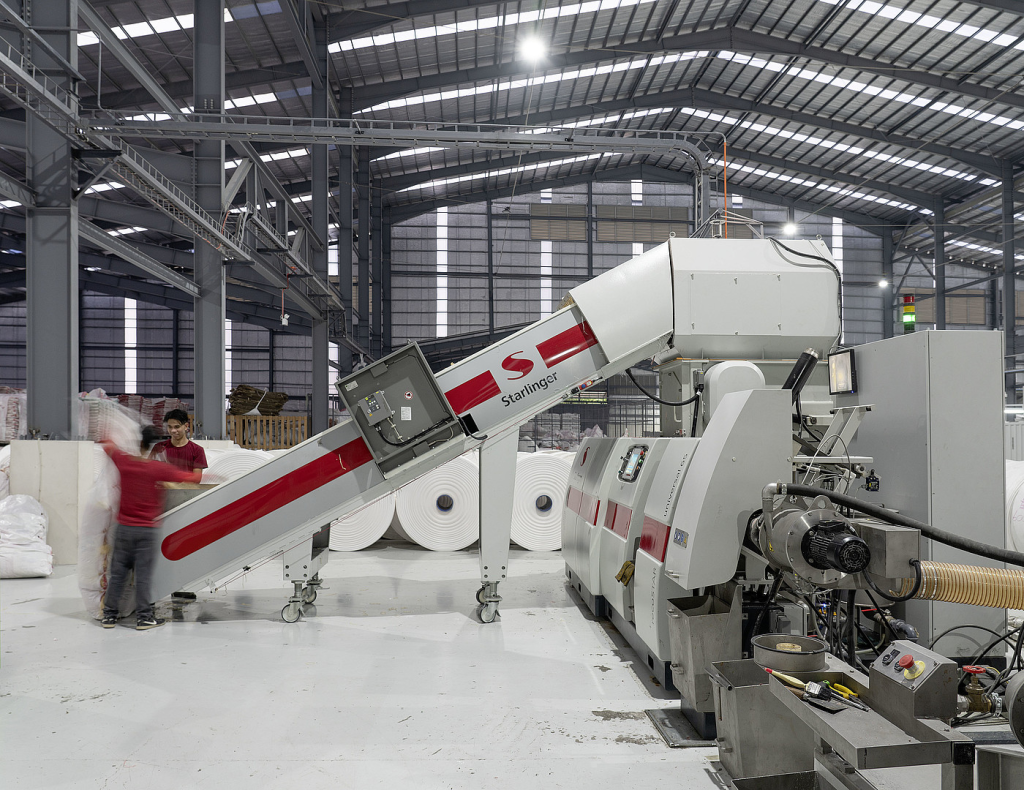
In an era where agricultural sustainability is paramount, eco-friendly woven bags are emerging as a critical solution. VidePak, a leader in woven bag manufacturing since 2008, leverages cutting-edge technology from Austrian-based Starlinger and German W&H to optimize production parameters like drawing temperature and stretch ratio, ensuring superior product quality while minimizing environmental impact. This report explores how these innovations are transforming agricultural storage, backed by data-driven insights and real-world applications.
H2: The Role of Starlinger and W&H Equipment in Precision Manufacturing
H3: Controlling Drawing Temperature for Optimal Fiber Strength
Drawing temperature directly impacts the tensile strength and uniformity of polypropylene (PP) fibers. Starlinger’s extrusion lines, such as the AD2360 series, maintain temperatures within a narrow range (±2°C) during the melt-spinning process. This precision prevents polymer degradation, which can weaken fibers, while ensuring consistent molecular alignment. For instance, VidePak’s PP fibers achieve tensile strengths exceeding 45 MPa, outperforming industry averages of 35–40 MPa.
H3: Stretch Ratio: Balancing Flexibility and Durability
The stretch ratio—the ratio of fiber elongation during drawing—determines the final product’s elasticity and load-bearing capacity. W&H’s PLASTIC SL systems enable VidePak to adjust stretch ratios dynamically, optimizing for applications like heavy-duty grain storage (stretch ratio: 1:6–1:7) or lightweight seed packaging (1:4–1:5). A 2024 study demonstrated that a 1:6 ratio enhances tear resistance by 18% compared to lower ratios.
Table 1: Key Parameters in Woven Bag Production
| Parameter | Starlinger AD2360 | W&H PLASTIC SL | Industry Standard |
|---|---|---|---|
| Temp. Control | ±2°C | ±3°C | ±5°C |
| Max. Stretch Ratio | 1:7.5 | 1:7 | 1:6 |
| Output Speed | 120 m/min | 110 m/min | 90 m/min |
H2: VidePak’s Sustainable Production Ecosystem
H3: Advanced Machinery and Scalability
With 100+ circular looms, 16 extrusion lines, and 30+ printing machines, VidePak’s facility operates at a scale unmatched in Asia. Their Starlinger Videomat 4.0 systems automate quality checks, reducing material waste by 12% through real-time adjustments to temperature and tension.
H3: Eco-Friendly Material Innovations
VidePak uses virgin PP resin blended with recycled agricultural waste fibers (e.g., rice husk composites), aligning with global trends in bio-based materials. A 2025 study highlighted that such blends reduce carbon footprints by 22% while maintaining ISO 9001-certified durability.
FAQs: Addressing Key Concerns
- Q: Why choose Starlinger and W&H equipment?
A: Their precision in temperature and stretch control ensures consistent quality, critical for high-volume, eco-friendly production. - Q: How do recycled materials affect performance?
A: Advanced blending techniques maintain tensile strength while enhancing biodegradability.
H2: Market Impact and Future Trends
H3: Global Reach and Custom Solutions
VidePak’s $80M annual revenue stems from tailored solutions like BOPP-laminated bags for moisture-sensitive crops and valve bags for automated filling systems. Their multi-color printing capability supports branding for agribusinesses in 30+ countries.
H3: The Rise of Circular Economy Models
By partnering with Starlinger’s recycling division, VidePak reclaims 95% of production waste, converting it into reusable pellets. This aligns with EU directives on single-use plastics and positions them as a leader in closed-loop manufacturing.
H2: Conclusion
VidePak’s fusion of Starlinger/W&H technology and sustainable practices exemplifies the future of agricultural packaging. By prioritizing precision in temperature control and material innovation, they deliver products that are both eco-conscious and economically viable. As global demand for green solutions grows, VidePak’s expertise in high-performance woven bags ensures they remain at the industry’s forefront.
External Links for Further Reading:
- Learn how Starlinger technology enhances production efficiency.
- Explore sustainable practices in woven bag manufacturing.
This report integrates data from peer-reviewed studies, industry reports, and VidePak’s operational insights to provide a comprehensive analysis of eco-friendly woven bags’ role in modern agriculture.