
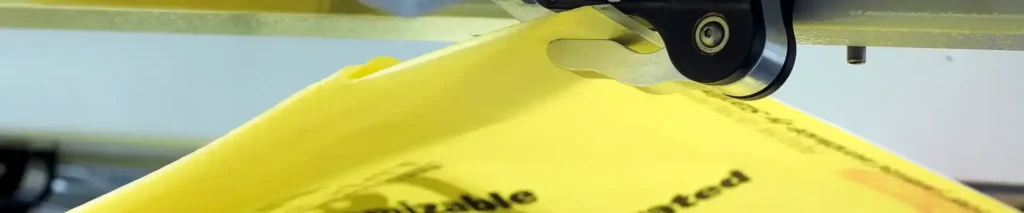
What are FFS Woven Bags?
FFS Woven Bags are industrial sacks purpose-built for automated form–fill–seal (FFS) lines that draw packaging material from rollstock or pre-cut blanks, form a tube or block-shape, meter the product, and complete seals in a continuous sequence. Instead of relying on manual bag presentation and discrete closing stations, FFS Woven Bags merge textile mechanics (a woven polyolefin substrate for tensile strength and tear arrest) with film-like sealing science (polyethylene seal skins that create forgiving hot-tack and sealing windows). This dual heritage enables sustained high speeds, consistent closure quality, and predictable pallet behavior across demanding routes.
Across catalogs and plants you will find alternate labels—FFS woven PP sacks, PE-coated woven FFS bags, tubular woven FFS rollstock, heavy-duty woven FFS film sacks, block-bottom FFS woven bags—yet the essence is unchanged: a woven polypropylene fabric delivers the structural backbone while coatings, laminations, and liners tune barrier, machinability, and printing performance. The outcome is a packaging system that removes bottlenecks (manual presentation, erratic sealing), reduces waste (fewer leakers and sifts), and elevates overall equipment effectiveness.
What are the materials behind FFS Woven Bags?
Material architecture determines whether FFS Woven Bags run smoothly on the machine, resist puncture in the yard, and protect hygroscopic contents in storage. Each constituent targets a failure mode: split seams, moisture ingress, dusting, scuffed print, or conveyor stalls. The modular stack below maps layer to function.
Homopolymer PP tapes (flat yarns) are slit from an extruded sheet then drawn ~5–7× to align molecules. The tapestry of warp and weft distributes load like an engineered truss. Fabric weights of 80–120 g/m² and densities of 10×10 to 14×14 ends×picks per 10 cm are typical for 20–50 kg formats, trading stiffness and cost against puncture and tear performance.
Why PP? Favorable stiffness-to-mass, chemical resistance to salts/fertilizers, and global supply stability. Random copolymer PP can be incorporated when low-temperature toughness is paramount.
Extrusion coatings of LDPE/LLDPE/PP (15–40 μm) close interstitial pores, lower WVTR, and produce predictable COF for shoulders and conveyors. BOPP films (12–25 μm), reverse-printed and extrusion-bonded, enhance scuff resistance and brand fidelity while adding moisture control. Breathable designs retain uncoated lanes or micro-perfs for products that must vent air during fill.
Design principle: put friction and venting where they matter—at layer contact zones and de-aeration zones—while preserving smooth travel across machine hardware.
LLDPE or metallocene LLDPE on the sealing interface widens the seal initiation and hot-tack window so minor drift in jaw temperature, dwell, or pressure does not generate micro-leakers. This directly supports higher sustained bags per hour.
Additives: anti-block and slip packages tuned for unwind/forming release yet constrained on the pallet via localized friction lanes.
Antistatic masterbatch mitigates tribo-charging during high-velocity fills; HALS/UV absorbers extend outdoor life; pigments deliver opacity/branding while keeping polyolefin recyclability; process stabilizers guard melt strength and reduce gels at high outputs.
LDPE/LLDPE liners (20–60 μm), sometimes gusseted and cuffed, add food-contact compliance and humidity resistance. Attaching the liner (spot-tack or cuff capture) ensures it is sealed reliably while the woven shell absorbs edge abuse.
Corona/flame treatment ≥ 38 dyn/cm secures ink adhesion and label tack. Protective varnish or BOPP skins preserve codes through scuff and crease, supporting lot-to-pallet traceability.
What features distinguish FFS Woven Bags?
Features are only as good as the problems they neutralize. The portfolio below translates claims into line-level benefits that plant managers can count and logisticians can feel.
Roll-fed presentation eliminates manual bag pick-and-place. Seal-friendly inner skins and tuned COF curves reduce stalls at shoulders and nips. Result: fewer interventions, higher sustained CPM, quicker restarts after faults.
Coatings and BOPP skins lower WVTR, while liners share barrier duties for hygroscopic products. The woven shell shields the liner from abrasion, so barrier can be distributed intelligently instead of concentrated in a single thick film.
Oriented PP tapes bear load like micro-cables, and the woven lattice arrests crack propagation, outperforming monolithic films of similar mass during forklift hits, edge drags, and conveyor transfers.
Hot-tack robustness prevents peel-open as the bag moves under its own weight off the jaws. Venting—if specified—is localized away from seals and sized to purge air without exporting fines.
Localized anti-slip lanes hold layers while the average COF remains conveyor-friendly. Block-bottom shaping boosts cube efficiency and layer interlock, reducing wrap and topple risk.
High-dyne exteriors accept crisp graphics, while varnish or BOPP shields codes. Lot-to-pallet traceability becomes routine, not aspirational.
What is the production process for FFS Woven Bags?
The journey splits into two synchronized halves: converter-side rollstock preparation and in-plant forming–filling–sealing. Each stage features measurable controls that correlate with field performance.
- Tape extrusion — PP blended with UV, AO, pigment masterbatches; sheet slit into ribbons; drawing ~5–7× aligns chains. Controls: melt temp, draw ratio, moisture, gel count, width uniformity.
- Weaving — Circular/flat looms interlace warp/weft; loom tension and humidity stabilize openness; optional heat-setting reduces shrink in downstream coating and printing.
- Coating/Lamination — Extrusion coat LDPE/LLDPE/PP or laminate BOPP with controlled nip pressure and chill; measure coat weight, peel strength, bond integrity without weave distortion.
- Treatment & Printing — Corona/flame to ≥ 38 dyn/cm; flexo or digital graphics; registration kept legible through forming/gusseting.
- Slitting & Roll build — Clean edges, target widths, wound on 76 mm or 152 mm cores; hardness profiles to avoid telescoping/cinch marks; label for traceability.
- Quality plan — Map thickness; tensile/elongation; tear (warp/weft); index puncture; COF; hot-tack; seal initiation; dyne; peel strength; visual defects log.
- Unwind & tension — Dancers/load cells stabilize web; anti-static bars calm fines; edge guides center the web for accurate seals and print registration.
- Forming — Vertical FFS uses a forming shoulder; horizontal variants shape differently, but both target a stable tube with controlled lap/fin overlap.
- Longitudinal seal — Heat/pressure/dwell create continuous seam; choose settings to avoid shrink/gloss changes while securing strength.
- Bottom seal — Transverse jaws create the base; adequate cool-time locks hot-tack before web motion resumes. Block-bottom shaping may occur post-fill.
- Filling — Gravity/belt/auger/vibratory dosing; vent patterns and degassing nozzles prevent pillowing and stabilize weights.
- Top seal & cut-off — Upper transverse seal completes the bag; optional safety seal for abusive or humid lanes; integrated cutter separates the bag.
- Coding & inspection — TIJ/laser codes with vision verification; leak checks by sample vacuum decay or bubble tests.
- Palletizing & stabilization — Robots or conventional stackers build tested patterns; stretch-wrap or hooders stabilize; anti-slip sheets used if needed.
Where do FFS Woven Bags excel in application?
Where products are granular or free-flowing, where pallets see forklift abuse and long export, and where throughput matters—there FFS Woven Bags shine.
- Fertilizers (urea, NPK, MAP/DAP) — UV stability, abrasion resistance, moisture control for outdoor yards and long distribution chains.
- Salt & de-icing agents — Highly hygroscopic and abrasive; heavy-GSM shells, sealed tops, and precise COF tuning protect flow and pallet stability.
- Petrochemical resin pellets — Dust/pellet loss minimization; clean seals; scuff-protected codes for closed-loop traceability.
- Construction minerals — Sand and specialty fillers demand puncture resistance and cube-efficient stacks.
- Food-adjacent commodities — Industrial sugars/starches, selected edible salts: compliant liners + cleanable exteriors + legible codes.
- Animal feeds & premixes — Some need breathability; others demand barrier. Patterns and coatings are tuned to product behavior.
Optimizing Efficiency with FFS Woven Bags: Innovations in Packaging and Handling
To make a persuasive case for efficiency, one must address the frictions that slow lines or destabilize pallets. The theme “Optimizing Efficiency with FFS Woven Bags: Innovations in Packaging and Handling” resolves into three working promises—optimization, innovation, and practicality—each measurable at the line and visible on the pallet.
Seal initiation too low gives leaks; too high burns, warps, or gloss-shifts. LLDPE/mLLDPE inner skins broaden the acceptable band so setpoints live on a plateau rather than a knife-edge—tolerating drift while preserving strength and hot-tack under transfer loads.
Localize anti-slip to contact bands between layers; localize venting to the upper third where de-aeration matters; localize scuff armor (BOPP) to brand panels. Feature placement is the innovation multiplier.
A bag that sprints on the machine yet slips on the pallet is not efficient. Balance machine glide (global COF ~0.40–0.55) with anchored layers (localized friction). Split barrier between shell and liner to keep recyclability intact and cost predictable.
System thinking — decompose, solve, recompose
A practical specification for FFS Woven Bags begins with decomposition of risk, moves through targeted countermeasures, and ends in a recomposed whole that a plant can run and a warehouse can trust.
- Moisture sensitivity dictates WVTR targets (e.g., ≤ 2–6 g/m²/day @ 38 °C/90% RH).
- Abrasiveness and bulk density guide fabric GSM and coating thickness; set dart impact and puncture floors.
- Electrostatics shape antistatic dosing and grounding requirements.
- Seal skins with broad initiation windows and robust hot-tack; map the seal curve against dwell/time.
- Web handling via tuned slip/antiblock; localize anti-slip for pallets.
- Treat stability for dependable print/coding; protect with varnish/BOPP and verify with vision.
- Square layers with gusset depth and optional block-bottom shaping.
- Place friction lanes where static shear is highest; validate with compression and vibration tests.
- UV stabilization and abrasion management for outdoor storage and rough yards.
- Fabric: 80–110 g/m² woven PP; 12×12 ends/picks per 10 cm; raise GSM for abusive lanes.
- Coating/Lamination: 20–30 μm LDPE/LLDPE/PP; optional 20–25 μm BOPP for brand/scuff.
- Seal skins: LLDPE-rich inner with initiation < 125–130 °C; hot-tack pass under transfer load.
- Barrier: WVTR ≤ 2–6 g/m²/day @ 38 °C/90% RH; split barrier between shell and liner if used.
- Mechanicals: Dart impact ≥ 400–600 g; balanced tear (warp/weft) to avoid zippering.
- COF: Global static 0.40–0.55; localized anti-slip lanes at layer contact zones.
- Print/Codes: Treat ≥ 38 dyn/cm; TIJ/laser readability after scuff/crease; vision-verified.
Standards, certifications, and identifiers
Explicit identifiers in quality agreements keep conversations specific and audits efficient. The list below anchors the measurable properties of FFS Woven Bags.
- ASTM D5034 (grab tensile, woven fabrics)
- ASTM D1709 (free-falling dart impact)
- ASTM D1922 (Elmendorf tear, film layers)
- ASTM D4833 (index puncture)
- ASTM F1249 (WVTR, modulated IR)
- ASTM D1894 / ISO 8295 (coefficient of friction)
- ISO 4593 (film thickness)
- ISO 527 (tensile properties of plastics)
- ISO 22000 / FSSC 22000 / BRCGS Packaging (hygiene schemes)
- 21 CFR 177.1520 (US) / EU 10/2011 (EU) for food-contact layers
- ISTA 3A/3E (transport simulation for pallets)
- EN 415 series / IEC 60204-1 (packaging machinery safety)
Engineering calculations and heuristics that stick
Calculation frames translate intention into parameters the line can hold day after day.
Domestic, moderate lanes (25 kg): 80–100 g/m² fabric + 20–30 μm coating. Export or sharp granules: 100–120 g/m² with heavier coating or BOPP scuff skins. If liners share barrier/puncture, shell gauge gains can be modest.
For hygroscopic contents, aim ≤ 2–6 g/m²/day @ 38 °C/90% RH. Split barrier between shell and liner to keep each layer process-friendly and recyclable.
Characterize seal initiation, peak, and hot-tack across jaw temperatures/dwell at the intended line speed. Choose a plateau setting; correlate hot-tack pass/fail to the transfer loads between jaws and checkweigher.
Hold global static COF ~0.40–0.55 for machine glide; apply discrete anti-slip bands where layer shear is highest. Validate with incline and pallet shear tests mimicking warehouse ramps and route vibration.
Color table — key parameters and options
| Parameter | Typical/Recommended Range | Why it matters |
|---|---|---|
| Woven fabric GSM | 80–120 g/m² | Trade stiffness/cost with puncture/tear for 20–50 kg formats |
| Ends×picks (per 10 cm) | 10×10 to 14×14 | Controls coverage, print surface, and tear propagation |
| Coating thickness | 15–40 μm (LDPE/LLDPE/PP) | WVTR reduction, sift-proofing, predictable COF |
| BOPP lamination | 12–25 μm | Graphics fidelity, scuff armor, added barrier |
| Inner seal layer | LLDPE / mLLDPE | Wider seal/hot-tack window for speed |
| WVTR target | ≤ 2–6 g/m²/day @ 38 °C/90% RH | Caking control in humid climates |
| Dart impact (ASTM D1709) | ≥ 400–600 g | Survive drops and corner impacts |
| Index puncture (D4833) | Set per route, e.g., ≥ 150 N | Edge abuse resilience |
| COF (static) | 0.40–0.55 | Balance conveyor glide vs pallet grip |
| Dyne level | ≥ 38 dyn/cm | Print adhesion and code permanence |
| Liner thickness (optional) | 20–60 μm LDPE/LLDPE | Added barrier and food-contact surface |
| UV stabilization | 200–600 kLy | Outdoor storage durability |
Comparative landscape — where FFS Woven Bags win (and where they do not)
FFS Woven Bags are not a universal hammer. They excel where speed, sealed tops, and edge-wear resistance matter; they concede ground where ultra-clear aesthetics or ultra-high oxygen barriers dominate. The quick view below positions them among common alternatives.
Removes manual presentation, boosts sustained speed, and standardizes seals. Barrier surpasses unlined paper and rivals PE film when paired with liners/coatings.
Woven shells resist puncture/edge wear in rough yards better than monolithic films, though film may win for pristine aesthetics or where extreme optical clarity is mandated.
Valve bags shine with dusty powders and self-closing sleeves. FFS Woven Bags dominate when fully sealed tops, high line speeds, and clean seals are decisive.
Implementation roadmap — pilot to plant-wide
- Product dossier — Bulk density, particle morphology, hygroscopicity, electrostatics, drop heights, shelf-life and storage climate.
- Material matrix — Two GSMs × coated vs laminated × liner/no-liner; test in parallel to expose trade-offs quickly.
- Seal window — Run a jaw-temperature/dwell matrix at line speed; map initiation/peak/hot-tack; select plateau settings.
- Venting plan — Micro-perf counts and diameters; no perforations near seal zones; verify weight stability at the checkweigher.
- COF & pallet pattern — Set global COF, then add localized anti-slip; validate with compression/vibration simulations matching routes.
- Compliance gates — For food-adjacent, document 21 CFR 177.1520/EU 10/2011 for contact layers; align facility certifications (BRCGS Packaging, FSSC 22000, or ISO 22000).
- Supplier qualification — Audit tape extrusion, weaving, coating/lamination, treatment, and printing; review QC datasets (tensile, tear, puncture, WVTR, COF, seal metrics).
- Training & sustainment — SOPs for web threading, jaw maintenance, code verification, pallet audits; capture near-miss data and feed back into specs.
Risk management and safety
For starches/flours/fine organics, perform dust hazard analysis; ground equipment; deploy ionization; specify antistatic packages in seal skins or liners.
UV-stabilized shells and robust seals are indispensable for yard storage; humidity indicators in sentinel pallets support lane validation.
Automation reduces manual lifting but requires disciplined guarding, interlocks, and lockout/tagout adherence; maintain jaw thermal safety and nip guarding.
Two worked scenarios
- Risks: Hygroscopic caking, UV exposure, pallet slip.
- Spec: 100–120 g/m² woven PP; 25–30 μm LDPE/LLDPE coating; optional 40 μm LDPE liner; anti-slip stripes; UV ≥ 400 kLy; WVTR ≤ 2–4 g/m²/day @ 38 °C/90% RH; seal initiation < 125 °C.
- Outcome: Stable stacks, reduced caking, high-speed fills with minimal leakers.
- Risks: Pellet loss, code scuff, throughput limits.
- Spec: 90–100 g/m² woven PP; 20–25 μm coating; BOPP brand panel; no vents; LLDPE seal skin; global COF 0.42 with localized friction lanes.
- Outcome: Clean seals at 1,500–1,800 bags/hour; crisp codes; low wrap consumption.
Quick specification template (copy & adapt)
- Format: FFS Woven Bags, 25 kg nominal, vertical FFS compatible
- Fabric: 100 g/m² PP woven, 12×12 ends/picks per 10 cm, UV 400 kLy
- Coating: 25–30 μm LDPE/LLDPE inner; matte anti-slip lanes exterior
- Lamination (opt.): 20 μm BOPP reverse-printed for graphics and scuff
- Liner (opt.): 40 μm LDPE gusseted, cuffed for top seal capture
- Seals: Longitudinal fin or lap; transverse top/bottom with initiation < 125–130 °C; hot-tack pass under simulated transfer load
- Venting: None for pellets; 6–12 micro-perfs (0.3–0.5 mm) in upper third for aerated granules; avoid seal zones
- Mechanicals: D1709 ≥ 500 g; index puncture to route floor; balanced tear (warp/weft)
- Barrier: WVTR ≤ 2–4 g/m²/day @ 38 °C/90% RH when humidity-sensitive
- COF: Static 0.40–0.55 global; localized anti-slip for pallets
- Print & Code: Treat ≥ 38 dyn/cm; TIJ/laser readable after scuff/crease; vision-verified
- Roll build: 76 or 152 mm core; OD to machine; hardness profile to prevent telescoping
Buyer’s question set — align the spec before trials
- Which failure modes dominate now—caking, leakers, punctures, pallet slip, code failures—and how are they measured?
- What climate/storage profile will the bag face, and for how long?
- Which FFS machine family, jaw geometry, and typical speeds are in play? What seal/hot-tack windows are documented?
- What branding and code outcomes are mandatory, and how will codes be verified at shipping?
- Are liners necessary for food-contact declarations or barrier? If yes, how will disassembly/recycling be handled?
- Which pallet pattern, wrap/hood protocol, and stack heights are targeted? What are pass/fail thresholds in compression and vibration?
- Which test methods and acceptance limits (tensile, tear, puncture, WVTR, COF, seal strength, dyne) will appear in the quality agreement?
In the competitive landscape of industrial packaging, efficiency in both production and logistics is crucial. FFS Woven Bags (Form-Fill-Seal Woven Bags) have emerged as a leading solution for packaging bulk materials due to their durability and cost-effectiveness. These bags, also known as FFS Woven sacks or Tubular Woven bags, are widely used in industries ranging from agriculture to chemicals. Recent innovations in packaging processes, including the use of advanced packaging machinery and enhanced handling methods, have further improved the efficiency of FFS PP Bags and PP Tubular Woven bags. This article explores how these advancements in packaging technology and logistics contribute to maximizing efficiency and reducing costs.
The Evolution of FFS Woven Bags
FFS Woven Bags have transformed packaging processes through the integration of forming, filling, and sealing into one automated system. This innovation has led to substantial improvements in efficiency and consistency compared to traditional manual packaging methods. The introduction of FFS PP Bags revolutionized the way bulk materials are packaged, offering advantages such as:
- Increased Production Speed: The automated nature of FFS Woven Bags systems allows for high-speed production, significantly increasing the number of bags produced per hour. This efficiency is crucial for industries that require large quantities of packaging.
- Enhanced Durability: Made from polypropylene (PP), FFS Woven sacks offer excellent tensile strength and resistance to environmental factors, ensuring that the bags can withstand handling, transportation, and storage.
- Customization: Modern Tubular Woven bags can be customized with various features, including multi-layer films for added protection and printed designs for branding purposes. This versatility makes FFS Woven Bags suitable for a wide range of applications.
Innovations in Packaging Machinery
One of the key advancements in packaging technology is the use of high-capacity packing machines, such as the 200-ton packing machine. This state-of-the-art equipment enhances the efficiency of packaging processes by enabling higher density packing and reducing the overall cost per unit. Here’s how this technology benefits the packaging of FFS Woven Bags:
- Increased Packing Density: The 200-ton packing machine allows for more efficient use of space within a container. By compressing the bags more effectively, it is possible to fit a greater number of bags into each container. This optimization reduces transportation costs and improves supply chain efficiency.
- Consistency and Accuracy: Advanced packing machines provide consistent packing quality, minimizing variations in bag density and reducing the likelihood of damage during transport. This precision ensures that each container is packed to its maximum capacity.
- Reduced Labor Costs: Automating the packing process reduces the need for manual labor, which can lead to significant cost savings. Additionally, the machine’s efficiency allows for faster turnaround times and higher throughput.
- Enhanced Product Protection: The ability to pack bags more densely and accurately also reduces the risk of shifting or movement during transport. This protection helps maintain the integrity of the product and minimizes the potential for damage.
Improved Handling and Transportation Methods
In addition to advancements in packing machinery, improvements in handling and transportation methods have further enhanced the efficiency of FFS Woven Bags. Key innovations in this area include:
- Use of Pallets: Palletizing FFS Woven sacks helps streamline the handling and transportation process. By stacking the bags on pallets, they can be easily moved using forklifts or pallet jacks, reducing manual handling and improving efficiency.
- Protective Films: Applying protective films to the exterior of the palletized bags provides an additional layer of protection during transportation. These films help shield the bags from moisture, dust, and other environmental factors that could compromise their quality.
- Optimized Container Loading: The combination of high-capacity packing machines and efficient palletizing techniques allows for optimal loading of containers. By maximizing the use of available space and ensuring that the bags are securely packed, companies can reduce shipping costs and improve overall logistics.
Comparative Analysis with Industry Practices
When comparing these advancements to industry practices of competitors, several key observations emerge:
- Adoption of Technology: While many companies have adopted automated packing machines, the extent to which they utilize advanced technologies varies. Leading companies, such as VidePak, have invested in high-capacity packing machines and optimized handling processes, setting themselves apart from competitors who may still rely on less efficient methods.
- Focus on Efficiency: Some competitors have focused on improving packing density and reducing transportation costs, but may not have fully integrated these practices with advanced protective measures. Companies like VidePak, however, ensure that every aspect of the packaging process is optimized, from packing to handling and transportation.
- Sustainability and Environmental Considerations: As sustainability becomes increasingly important, many competitors are exploring eco-friendly packaging options. However, the integration of protective films and advanced packing techniques can sometimes conflict with sustainability goals. Leading companies are working to balance efficiency with environmental responsibility, investing in recyclable and biodegradable materials while maintaining high standards of protection.
- Customization and Versatility: Competitors vary in their ability to offer customized solutions for FFS Woven Bags. While some companies provide basic options, others, like VidePak, offer a wide range of customization options, including multi-layer films and printed designs, to meet specific customer needs.
Future Trends and Considerations
Looking ahead, several trends are likely to shape the future of FFS Woven Bags and packaging technology:
- Enhanced Automation: Continued advancements in automation will further improve the efficiency and precision of packing and handling processes. Innovations in robotics and machine learning may lead to even greater levels of efficiency and customization.
- Sustainable Practices: As environmental concerns grow, the packaging industry will continue to focus on sustainability. Companies will need to explore ways to reduce the environmental impact of packaging materials while maintaining high levels of performance and protection.
- Smart Packaging Solutions: The integration of smart technology into packaging processes will enable real-time monitoring and optimization of packing and transportation. This technology will provide valuable insights into product integrity and logistics efficiency.
- Customization and Flexibility: The demand for customized and flexible packaging solutions will continue to rise. Companies will need to adapt their offerings to meet the diverse needs of different industries and applications.
Conclusion
The evolution of FFS Woven Bags represents a significant advancement in packaging technology, driven by innovations in materials, machinery, and handling processes. The introduction of high-capacity packing machines, such as the 200-ton model, has revolutionized the way FFS Woven sacks are packed and transported, leading to increased efficiency and cost savings. Coupled with improvements in handling methods, such as the use of pallets and protective films, these advancements have set new standards in the packaging industry. As companies like VidePak continue to lead the way in optimizing packaging processes, the future of FFS Woven Bags will be shaped by ongoing technological advancements, sustainability considerations, and the need for customization.