
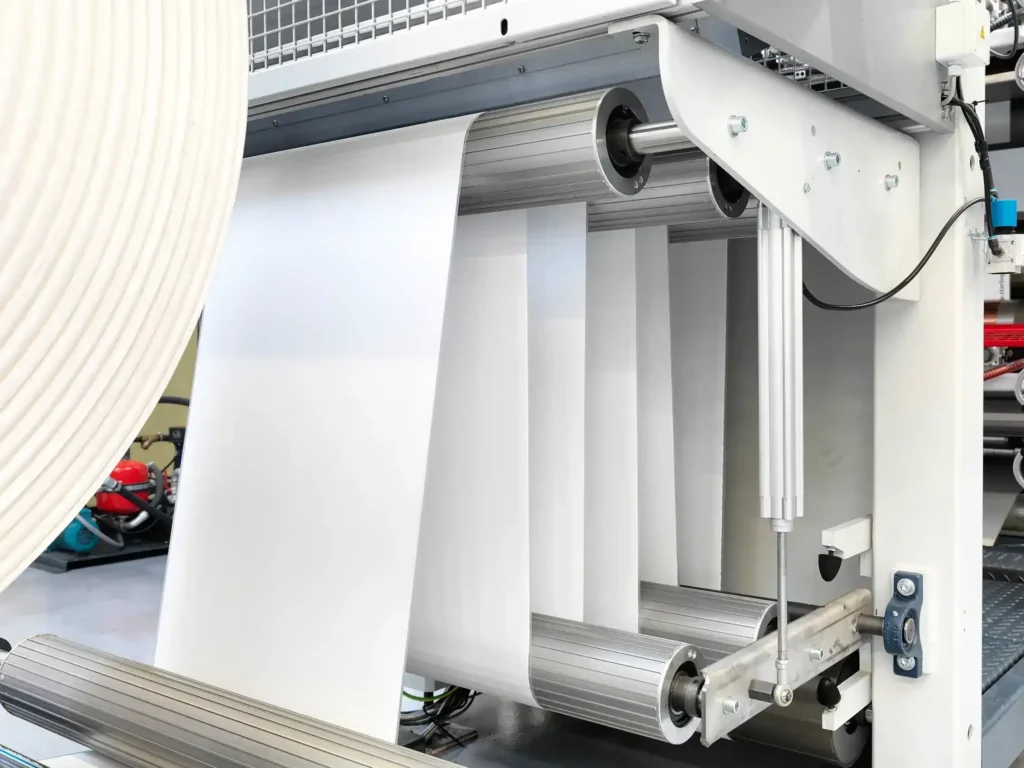
What are Poly‑BOPP Bags?
Poly‑BOPP Bags are high‑duty packaging structures that laminate a reverse‑printed biaxially oriented polypropylene (BOPP) film to a woven polypropylene (PP) fabric, and then form that composite into open‑mouth or valve‑style sacks ranging from 5 kg to 50 kg. Under different procurement dialects you will also meet aliases such as BOPP‑laminated PP woven sacks, PP woven bags with BOPP film, mono‑polyolefin woven sacks, and BOPP/PP composite chemical bags. The structural logic is intentionally simple: the BOPP web contributes image fidelity, abrasion resistance, and dimensional stability; the woven PP body supplies load‑bearing strength, tear tolerance, and resistance to pallet compression.
Why does this hybrid matter in chemical and raw‑material supply chains now? Because modern logistics impose conflicting requirements that once felt mutually exclusive: richly printed GHS/CLP panels yet scuff‑proof faces; low migration near food‑adjacent chemistries yet aggressive throughput on HFFS/VFFS equipment; credible end‑of‑life options yet robust moisture/dust control. Poly‑BOPP Bags reconcile these forces with a mono‑polyolefin stack (PP + BOPP + PP tie layers) that balances machinability, safety signaling, and compatibility with #5 PP recovery streams where infrastructure exists.
The Materials of Poly‑BOPP Bags — Resin Families, Additives, and Layer Roles
Designing Poly‑BOPP Bags is not “stack more layers and hope for the best.” It is disciplined minimalism: each layer must justify its presence by the property it delivers, the failure mode it prevents, and the cost it earns back in line speed or risk avoided. Four structural building blocks do nearly all the work—BOPP print web, PP tie‑layer/lamination, PP woven fabric, and the optional inner sealant or liner—while functional finishes (anti‑slip, varnishes, antistatic) refine safety and operability.
1) BOPP print web (outer film)
Function. The BOPP film is the visual and protective skin. Reverse printing hides inks under the film so graphics survive abrasion, forklift brushes, and ambient moisture. Because biaxial orientation elevates modulus and controls shrink, pictograms and batch codes remain flat and scannable over the inherent topography of a woven substrate. Registered matte/gloss or tactile varnish can segregate safety zones (GHS panels) from branding without adding foreign substrates.
Parameters. 20–35 μm thickness; clear or white/pearlescent variants depending on contrast needs; surface treatment via corona/plasma to ≥ 38 dynes for durable ink anchorage; optional anti‑fog windows for chilled warehouses; optional pearlescent bases to mask product show‑through when aesthetics matter.
Cost levers. Past resin tonnage, cost is dominated by plate/cylinder preparation, color count, flood coverage, and special varnishes. Tight register control curbs scrap on long chemical runs where millions of identical sacks are printed.
2) Tie layer and lamination
Function. Extrusion lamination lays a molten PP tie coat between BOPP and woven fabric. This bondline smooths the weave, fills inter‑yarn porosity that would otherwise vent dust, and locks the print web to the mechanical backbone. Coat‑weight uniformity tracks directly with bag‑level water‑vapor transmission (WVTR) and with the perceived surface “orange‑peel.”
Parameters. 15–30 μm tie coat per interface. Add HALS/UV stabilization for sunlit yards; include slip/antiblock to tune winding and line handling. If thermal budgets are constrained (sensitive inks; multi‑stage builds), solventless polyolefin‑compatible adhesives enter the stack and must be supported by migration documentation where food‑adjacent substances are involved.
3) Woven polypropylene fabric (structural backbone)
Function. Drawn PP tapes (~6–8×) woven on circular looms deliver the heavy lifting—tensile, tear, puncture tolerance, and dimensional stability under stacked loads. This is the piece that permits 25–50 kg bulk movement without film blowouts.
Parameters. Basis weight (GSM) of 70–120 g/m² for chemical and raw‑material formats; weave densities ~10×10 to 12×12 tapes per inch. Balanced MD/TD tensile suppresses “barrel” bulging and reduces corner bruises during drop testing.
Cost levers. Resin mass dominates COGS. Every 5 g/m² of down‑gauging ripples across millions of sacks—provided seam efficiency (≥70% of fabric tensile) and corner puncture resistance remain inside spec. Data‑led light‑weighting should fund better coat‑weight control and anti‑slip density, where it materially lowers pallet incidents.
4) Inner sealant or liner (optional)
Function. Many chemicals are hygroscopic (calcium chloride, specialty salts) or problematic dusters (titanium dioxide, carbon black). A co‑extruded PP‑based sealant or a detachable insert liner of PP/PE (20–60 μm) reduces bag‑level WVTR and captures fines. Cuff‑sealing beneath stitches interrupts edge‑wicking—the dominant ingress path in sewn constructions.
Choices. PP‑based sealants support mono‑material recovery in #5 streams and can still achieve low seal‑initiation temperatures with the right copolymer ratios. LDPE/LLDPE liners maximize toughness and speed; where recycling is strategic, confirm local MRF acceptance or use detachable liners called out in disassembly notes.
5) Functional coatings, anti‑slip textures, and inks
COF and stability. Silica‑filled anti‑slip micro‑stripes elevate inter‑bag friction (target kinetic COF 0.30–0.40), enabling taller pallets with fewer interleaves—critical in humid seasons when wet COF often collapses. Registered patterns concentrate friction where stack shear initiates.
Ink systems. Reverse‑printed low‑migration inks under BOPP protect hazard pictograms, barcodes, datamatrix codes, and batch identifiers from scuffing. Matte registers reduce glare so scanners perform reliably in dim or glossy conditions.
What are the Features of Poly‑BOPP Bags?
Features earn their keep only when they convert to measurable outcomes in plants, warehouses, and audits. The capabilities below map to specific mechanisms and indicators so that teams can specify, test, and improve Poly‑BOPP Bags coherently.
Mechanical robustness
Oriented tapes and balanced weaves distribute loads and resist puncture from angular crystals. Typical plant acceptance: ≥5 drops @ 1.2 m for 15–25 kg fills with no rupture, validated dry and damp. Block‑bottom options improve shelf stance and course‑to‑course stability.
Barrier and product protection
Bag‑level WVTR is driven as much by tie‑coat uniformity, pinhole suppression, and seam pathways as by film specs alone. Hygroscopic goods routinely target ≤2.5 g/m²·day @ 38 °C/90% RH through liner strategies and seam design that eliminates edge wicking.
Information integrity
Reverse printing keeps GHS/CLP icons legible after abrasion and condensation cycles. Spectrophotometric ΔE control for hazard red and process black, plus large x‑height fonts and matte scanner windows, stabilizes scan rates across lighting conditions.
Machinability
Coex low‑temperature sealants widen sealing windows and cut jaw temperatures, boosting throughput on VFFS/HFFS lines. Tuned COF (0.25–0.40) reduces jams and permits confident pallet heights without heavy slip‑sheet use.
What is the Production Process of Poly‑BOPP Bags?
- Resin selection & compounding. PP homopolymers for tapes; BOPP grades for print web; masterbatches for HALS/UV, antioxidants, pigments, slip/antiblock, and antistatic. Moisture control and melt filtration (e.g., 120–200 μm screens) prevent gels that seed seam weakness.
- BOPP orientation & reverse printing. Cast, then biaxially orient (~4–6× MD; ~7–9× TD). Treat surfaces to ≥38 dynes. Reverse print CMYK/spot with low‑migration systems; add registered matte/gloss so scanners read reliably.
- Tape extrusion & drawing. Extrude sheet; slit tapes; draw ~6–8× to build tenacity. Inline gauges track width/thickness/orientation; splits here become failures later.
- Weaving. Circular looms build tubular fabric at target GSM and pick density. Balanced MD/TD properties minimize barrel bulge and keep laminate flat for legible safety panels.
- Extrusion lamination. Apply PP tie coat (15–30 μm) to bond printed BOPP to fabric. Map coat weight (beta gauges or gravimetric) to WVTR uniformity and visual smoothness. Optionally print anti‑slip micro‑stripes.
- Liner integration (if specified). Insert PP/PE liners (20–60 μm) and cuff‑seal beneath stitches; or co‑laminate sealant film for hot‑air‑welded builds.
- Forming & seaming. Cut‑to‑length; bottom‑fold (single/double; block‑bottom); stitch (chain) or hot‑air weld; install valve sleeves for powder lines; reinforce corners for 25–50 kg SKUs.
- Quality controls & documentation. Fabric GSM, tape tenacity, lamination adhesion, COF (ASTM D1894), WVTR (ASTM F1249), film tensile (ASTM D882), dart impact (ASTM D1709), haze/gloss (ASTM D1003/D2457), liner seal strength (ASTM F88/F88M), and filled‑bag drop tests (≥5 @ 1.2 m). Link bag IDs to resin/film/ink/tie‑coat lots and coat‑weight maps; maintain DoCs for food‑adjacent SKUs.
What is the Application of Poly‑BOPP Bags?
- Base salts & mineral chemicals. Soda ash, sodium bicarbonate, calcium chloride, magnesium sulfate. Payoffs: stacking stability, caking control with liners, legible labeling in damp warehouses.
- Specialty additives & masterbatches. Polymer additives, flame‑retardant powders, color masterbatches. Payoffs: dust containment, scuff‑resistant identification panels, reliable data capture via protected barcodes.
- Pigments & fillers. Titanium dioxide, carbon black, calcium carbonate. Payoffs: puncture resistance against angular particles; antistatic packages for clean transfer.
- Agrochem raw materials (non‑hazardous). Micronutrients, soil amendments. Payoffs: UV‑stable graphics for yard exposure; valve options for high‑speed filling.
- Food‑adjacent industrial ingredients. Food‑grade salts and sugars. Payoffs: documented migration files; mono‑PP designs compatible with many #5 streams.
Systems Thinking for “Poly‑BOPP Bags: The Importance in Chemical Product and Raw Material Packaging”
To do justice to the title, the analysis must start with decomposition—separating interacting subsystems—and end with integration—rebuilding them into a coherent, testable specification. Below, each subsystem couples a practical question to an engineering mechanism and a plant‑floor practice. Together they form a self‑consistent playbook for Poly‑BOPP Bags.
Subsystem 1 — Materials × Mechanics
Question. How far can fabric down‑gauging go without compromising drop survival or pallet stance? Mechanism. Biaxial orientation in both BOPP and PP tapes multiplies modulus; failure often initiates at corners and folds, not in mid‑panel tensile. Practice. Pilot 5–10 g/m² reductions with instrumented drops and stack‑creep tests; reinvest grams saved into anti‑slip density and fold reinforcement; verify seam efficiency ≥70% and monitor corner bruise incidents per thousand cycles.
Subsystem 2 — Barrier × Seam
Question. Why do sacks with excellent film WVTR still cake in the field? Mechanism. Edge wicking at stitch lines and low coat‑weight zones dominate ingress in sewn sacks. Practice. Cuff‑seal liners under stitches; raise tie‑coat at fold radii; conduct bag‑level humidity tests (38 °C/90% RH) with seam‑proximal sensors; publish WVTR mapping heat‑plots.
Subsystem 3 — Hygiene × Throughput
Question. Can we widen sealing windows without risking peel failures? Mechanism. Coex low‑SIT sealants cut jaw temperature and shorten dwell; sustained dyne ensures ink/tie adhesion after storage. Practice. Build heat‑seal maps on the actual HFFS/VFFS packer; refresh corona/plasma after long dwell; audit peel mode per ASTM F88 to favor cohesive failure in the sealant rather than adhesive failure at interfaces.
Subsystem 4 — Information × Compliance
Question. How can hazard communication and traceability remain intact through rough distribution? Mechanism. Reverse printing under BOPP shelters graphics; matte windows curb glare; larger x‑height boosts read distance; serialization under film prevents label loss. Practice. Control ΔE for hazard colors; implement inline vision and 2D verification; test scan rates under daylight, LED, and low‑lux conditions.
Subsystem 5 — Sustainability × Reality
Question. Are recovery claims credible across markets? Mechanism. Mono‑PP stacks (BOPP + PP + PP ties) align with #5 PP, but acceptance varies by MRF and contamination profile. Practice. Publish mass per bag and mono‑material declarations; separate clean production scrap from post‑use contaminated returns; maintain disassembly notes where detachable liners are used; engage EPR reporting early.
Subsystem 6 — Cost × Risk
Question. Why does the cheapest unit price become the most expensive total cost? Mechanism. Under‑spec GSM, uneven coat weights, and marginal seams trigger transit failures, write‑offs, and chargebacks that dwarf per‑bag savings. Practice. Score SKUs on risk‑weighted TCO (materials, uptime, scrap, freight, returns, EPR fees); fund metrology before decorative features; track pallet incidents per million as a lead KPI.
Standards, Certifications, and Test Methods (2024–2025)
- Material & food‑adjacent logic. FDA 21 CFR §177.1520 (olefin polymers) and EU Regulation No. 10/2011 (OML 10 mg/dm²; SMLs case‑by‑case). GMP frameworks: 21 CFR §174.5 and EU 2023/2006. Declarations of Compliance should list simulants and exposure conditions.
- Management systems. ISO 9001:2015 (quality), ISO 14001:2015 (environment), ISO 45001:2018 (OH&S), and FSSC 22000 v6 where packaging sites also handle food‑sector work.
- Transport frameworks. UN Model Regulations for Dangerous Goods; modal rules ADR/IMDG/IATA. Many powder chemistries in Poly‑BOPP Bags are non‑UN performance; where UN performance is required, adjacent 5H4 woven plastics bags or tested overpacks may be specified.
- Test methods. ASTM D882 (film tensile), ASTM D1709 (dart impact), ASTM D1894 (COF), ASTM F1249 (WVTR), ASTM D3985 (OTR), ASTM D5035/D4632 (woven tensile), ASTM F88/F88M (seal strength), plus filled‑bag drop/stack protocols that emulate routes.
Engineering Tables — Parameters & Details
Design Playbook — Practical Choices & Trade‑offs
- Clarity vs. opacity. If contents must be visible, specify clear/white BOPP with matte scanner windows. If photo‑labile, use pearlescent bases or limited metallization—paired with candid recyclability notes.
- Seam strategy. Double‑fold chain stitch is robust yet porous. Add cuff‑sealed liners or examine hot‑air welded bottoms for dusty/hygroscopic chemistries; document peel mode per ASTM F88 to prefer cohesive failure.
- Anti‑slip tuning. Start at COF 0.30–0.35 for mixed pallets; verify wet COF; micro‑pattern stripes outperform spray‑on friction aids for cleanliness and consistency.
- UV package sizing. Map outdoor staging; size HALS/pigments to climate; over‑dosing wastes money, under‑dosing invites brittle fabric and faded print.
- Recyclability & simplicity. Favor mono‑PP stacks; avoid paper/foil labels; keep inks under BOPP; label #5 PP; publish mass per bag for EPR.
Field Failures — Diagnostics & Correctives
- Scuffed graphics. Surface print on coated fabric without film protection → migrate to reverse print beneath BOPP; raise varnish hardness; verify rub testing.
- Corner splits. Under‑spec GSM or weak bottom geometry → reinforce corners; adjust stitch density/thread spec; add localized coat weight at folds.
- Caking despite compliant film data. Edge wicking at stitches/pinholes → cuff‑seal liner; increase tie‑layer uniformity; run bag‑level humidity tests.
- Pallet slump in humid season. COF too low when wet → increase anti‑slip density; verify wet COF; add interleaves for extreme dwell.
- Barcode misreads. Glare/low contrast through windows → matte register on BOPP; revise artwork quiet zones; validate under warehouse lighting.
Worked Specifications — Editable Templates for Chemical Uses
Spec A — Food‑grade sodium bicarbonate, 25 kg
Structure. BOPP 25 μm (reverse print, matte scanner window) // PP tie 20 μm // Woven PP 95 g/m²; optional PP sealant 35 μm; block‑bottom.
Targets. WVTR ≤2.0 g/m²·day @ 38 °C/90% RH; drop ≥5× @ 1.2 m; seam efficiency ≥70%; COF 0.30–0.35.
Compliance. FDA 21 CFR §177.1520; EU 10/2011 DoC; site ISO 9001/14001/45001; FSSC 22000 v6 if co‑located with food packaging.
Spec B — Titanium dioxide, 25 kg
Structure. BOPP 30 μm (registered matte/gloss) // PP tie 22 μm // Woven PP 100 g/m²; anti‑slip stripes; valve top with cuff‑sealed liner 50 μm (LDPE/LLDPE).
Targets. Drop ≥5× @ 1.2 m; high dart impact at corners; wet COF ≥0.32; dust escape below IH threshold.
Notes. Validate corner protection in drop tests; add antistatic package in arid seasons.
Spec C — Calcium chloride pellets, 25 kg
Structure. BOPP 25 μm (white) // PP tie 20 μm // Woven PP 95 g/m²; co‑laminated PP sealant 40 μm; hot‑air welded bottom.
Targets. Minimized bag‑level WVTR; cohesive seal failure preferred; drop ≥5× @ 1.2 m.
Notes. Confirm heat‑seal curves; use moisture indicator dots beneath film for QA sampling.
Spec D — Color masterbatch, 20 kg
Structure. BOPP 25 μm (clear with reverse‑printed datamatrix panel) // PP tie 18 μm // Woven PP 85 g/m²; anti‑slip stripes.
Targets. ≥99.5% scan rate; drop ≥5× @ 1.2 m; COF 0.30–0.35.
Notes. Maintain ΔE thresholds for brand color; serialize to ERP with lot/batch logic.
Reasoned Outline from the Title to Practice
- Define the platform: Poly‑BOPP Bags = BOPP print (graphics + abrasion) + PP woven fabric (mechanics) + optional sealants/liners (moisture control) under a mono‑polyolefin logic.
- Derive features from structure: gloss/clarity from BOPP; tensile/tear & stack stability from woven PP; WVTR control from coat‑weight uniformity + liners; COF tuning for pallet stability.
- Map to chemical logistics: hygroscopic/dusty products demand seam and liner strategies; labels must withstand abrasion; scanners must read; pallets must hold in humidity.
- Anchor with standards: ASTM/ISO methods, FDA/EU material approvals when relevant, management systems, and transport frameworks.
- Integrate via systems thinking: Materials × Mechanics; Barrier × Seam; Hygiene × Throughput; Information × Compliance; Sustainability × Reality; Cost × Risk.
- Operationalize: spec templates, QC matrices, coat‑weight maps, failure diagnostics; publish mass/energy/scrap KPIs for EPR and for procurement scorecards.
- Decide with candor: down‑gauge only with data; invest in metrology before decoration; disclose end‑of‑life realities; separate clean scrap from contaminated returns.
In the global packaging industry, there is a growing demand for durable, reliable, and customizable solutions that can handle the storage and transportation of various products. For industries involved in chemicals and raw materials, such as fertilizers, plastic granules, activated carbon, carbon black, and disinfectants, ensuring the safety and integrity of their products during transit is critical. One of the most effective solutions for this need is Poly-BOPP Bags. These bags offer high strength, versatility, and protection, making them an essential packaging material for chemical products.
Poly-BOPP sacks (biaxially oriented polypropylene sacks) are a popular choice in this sector because they provide superior strength, durability, and resistance to environmental factors like moisture. With advancements in manufacturing processes, BOPP Woven Bags are now highly customizable and are available in both Waterproof Woven Bags and Leakproof Woven Bags, ensuring product safety and integrity.
Structure and Benefits of Poly-BOPP Bags
The primary structure of Poly-BOPP Bags is made up of woven polypropylene (PP), which is a highly durable thermoplastic polymer known for its strength and resistance to wear and tear. The additional BOPP lamination on these bags provides a smooth, printable surface that is not only visually appealing but also enhances the bag’s protective qualities. This laminated layer acts as a shield against moisture, dust, and chemicals, making Laminated Woven Bags ideal for handling sensitive materials such as chemical products and raw materials.
The robust design of BOPP Woven Bags makes them particularly suitable for packaging heavy or abrasive products, including fertilizers, plastic granules, carbon black, and activated carbon. These materials can be tough on packaging, causing lesser quality bags to break down or leak, potentially leading to contamination and product loss. However, Leakproof Woven Bags address this issue by minimizing the risk of leakage during storage and transport, thus offering an additional layer of security.
One of the key advantages of Waterproof Woven Bags is their ability to withstand adverse environmental conditions. Whether stored outdoors or exposed to moisture during transportation, these bags keep the contents dry and secure. This is crucial for chemical products like fertilizers, which can degrade when exposed to moisture, or activated carbon, which needs to maintain its integrity to ensure its effectiveness in filtration or purification processes.
Packaging Requirements for Chemicals and Raw Materials
Packaging for chemical products and raw materials must meet strict standards to ensure safety and product integrity. Chemicals like fertilizers, carbon black, and disinfectants can be hazardous if not properly contained, and improper packaging can lead to spillage, contamination, or damage to the surrounding environment. This is where Poly-BOPP Bags excel.
For instance, fertilizers are hygroscopic, meaning they absorb moisture from the air. This can reduce their effectiveness and cause them to clump together, making them difficult to spread evenly during application. By using Waterproof Woven Bags, companies can prevent moisture ingress, ensuring that the fertilizer remains in its optimal condition until it reaches the end-user.
Similarly, materials like plastic granules and activated carbon require packaging that prevents contamination and ensures that the product remains intact during transit. Laminated Woven Bags provide this level of protection by offering a smooth interior surface that minimizes friction, reduces product loss, and prevents any contamination from external sources.
Leakproof and Waterproof Features for Safety
Chemical products are often sensitive to moisture, air, and contamination. Leakproof Woven Bags are specially designed to prevent leaks, which is especially critical when transporting potentially hazardous chemicals like carbon black, which is used in manufacturing rubber, plastics, and dyes, or disinfectants, which are used in various cleaning and purification processes.
Carbon black, for example, is a fine powder that can easily escape from poorly sealed bags, leading to contamination of other products and potential safety hazards for workers handling the material. Leakproof Woven Bags ensure that even the finest particles are contained, preventing spills and maintaining a clean and safe work environment.
The waterproofing features of Poly-BOPP sacks are another essential element, particularly for chemicals like disinfectants that must remain uncontaminated to ensure their effectiveness. Waterproof Woven Bags protect against moisture exposure, which can dilute or otherwise compromise chemical products, rendering them ineffective.
Customization and Branding with BOPP Woven Bags
In addition to their practical benefits, Poly-BOPP Bags offer significant opportunities for customization and branding. The BOPP lamination provides a smooth surface that can be printed with high-quality, multicolor designs. This allows companies to display their branding, logos, product information, and safety instructions directly on the packaging, enhancing both functionality and aesthetics.
For businesses, this high level of customization is crucial in today’s competitive marketplace. Laminated Woven Bags not only serve a functional purpose but also act as a marketing tool, helping companies stand out and communicate critical information to their customers. From handling instructions to safety warnings, the ability to print directly on the bags helps improve communication while also reinforcing the company’s brand image.
In industries like chemicals, where safety is paramount, the ability to print clear, visible instructions on the packaging is essential. BOPP Woven Bags allow for detailed printing that remains visible and intact even in harsh conditions, providing peace of mind for both manufacturers and customers.
Quality Standards and Comparison with Competitors
While many companies in the packaging industry offer Poly-BOPP Bags or BOPP Woven Bags, not all products are created equal. At VidePak, we are committed to maintaining the highest quality standards in our production processes, which are supported by advanced equipment from renowned supplier Starlinger. Our use of virgin polypropylene and high-grade raw materials ensures that our Laminated Woven Bags and Leakproof Woven Bags meet or exceed industry requirements for strength, durability, and reliability.
In contrast, some competitors may use recycled or lower-grade materials to reduce costs, but this often leads to compromised bag strength and durability. Bags made from lower-quality materials are more prone to tearing, leaking, or losing their protective features over time, particularly when exposed to challenging conditions such as heavy loads, extreme weather, or rough handling during transportation.
Another key area where VidePak stands out from competitors is our adherence to stringent quality control processes. Each Poly-BOPP Bag we produce undergoes rigorous testing to ensure that it meets the necessary performance criteria for handling chemical products and raw materials. By using advanced technology, such as Starlinger machinery, we can produce Waterproof Woven Bags and Leakproof Woven Bags that consistently perform at the highest levels, providing our customers with reliable packaging solutions that protect their products.
Furthermore, our ability to scale production while maintaining tight control over quality allows us to offer BOPP Woven Bags at competitive prices, ensuring that our clients receive exceptional value without compromising on performance or safety.
The Future of Poly-BOPP Bags in Chemical Packaging
As industries like chemicals and raw materials continue to evolve, so too will the demand for high-quality, customizable packaging solutions like Poly-BOPP Bags. With the ability to offer waterproof, leakproof, and highly durable options, these bags are set to play an increasingly important role in the safe transportation and storage of sensitive materials.
For businesses in the chemical industry, investing in premium packaging solutions is not only about ensuring the safe handling of their products but also about reinforcing their brand, improving operational efficiency, and complying with industry regulations. Poly-BOPP Bags provide the perfect blend of functionality, durability, and visual appeal, making them the go-to choice for companies looking to protect their products and enhance their market presence.
At VidePak, we remain committed to innovation and excellence in the production of BOPP Woven Bags. Our focus on quality, supported by advanced technology and a dedication to customer satisfaction, ensures that we will continue to lead the way in providing top-tier packaging solutions for chemical products and raw materials around the world.