
What are FIBC Jumbo Bags?
FIBC Jumbo Bags are flexible intermediate bulk containers engineered to handle free-flowing dry goods—grains, salts, sugar, polymers, minerals—in payloads typically from 500 kg up to 2,000 kg per unit. They are known across procurement, standards, and logistics under aliases such as bulk bags, big bags, one‑ton bags, flexible intermediate bulk containers (FIBCs), woven polypropylene bulk sacks, and 13H* UN bulk bags. Compared with rigid bins or drums, FIBC Jumbo Bags achieve striking payload‑to‑tare ratios (often >300:1), fold nearly flat, and interface cleanly with forklifts and hoists through integrated lifting elements.
Although the silhouette suggests simplicity—fabric walls, stitched seams, webbing loops—FIBC Jumbo Bags constitute safety‑critical load‑handling equipment. Variants include Type A (standard), Type B (low breakdown voltage fabrics), Type C (conductive grid that must be grounded), Type D (static‑dissipative without external ground), baffled or form‑stable designs for cubic efficiency, ventilated designs for produce, and linered configurations for moisture/oxygen control. Each variant balances tensile strength, seam efficiency, static safety, barrier performance, and cost in a different way. The right choice prevents product loss, improves labor productivity, and reduces risk during filling, storage, and discharge.
The materials of FIBC Jumbo Bags
Creating FIBC Jumbo Bags is not an exercise in piling layers; it is a disciplined selection of a few compatible materials that collectively deliver lift capacity, seam integrity, dust and moisture control, static safety, and regulatory fit. Each layer has a job, a test method, and a failure mode. Minimizing unnecessary materials simplifies both quality control and end‑of‑life pathways.
1) Structural backbone: woven polypropylene fabric
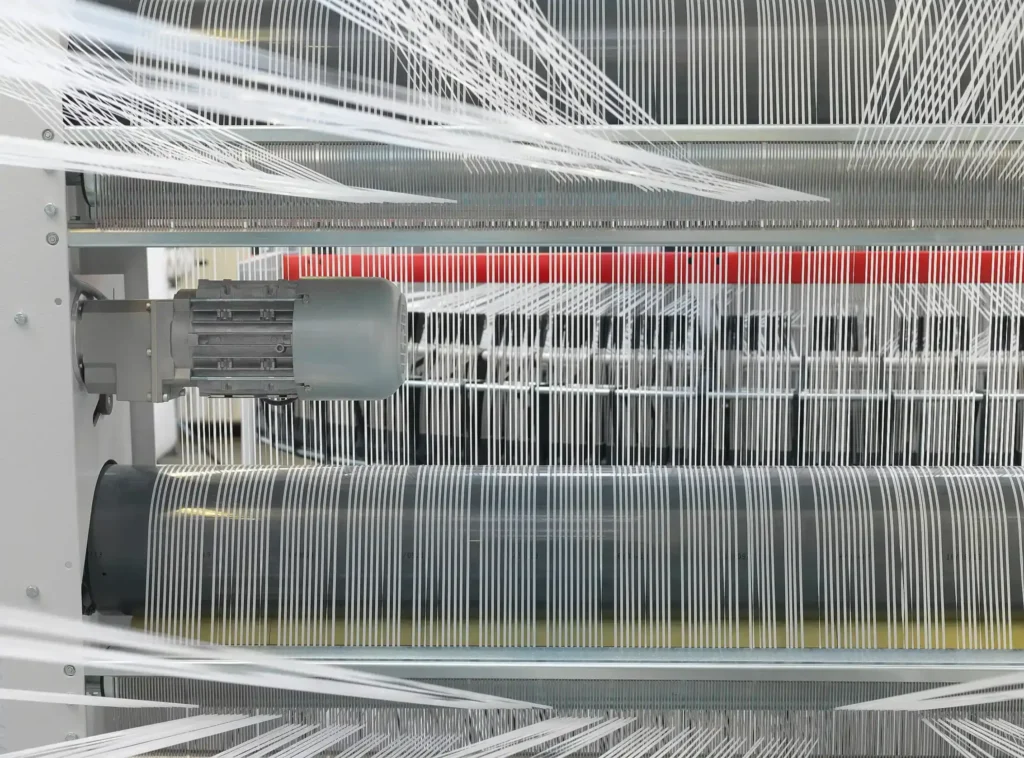
Resin and tapes. Isotactic polypropylene (PP) homopolymer is extruded into a sheet, slit, and drawn ~6–8× into tapes. Drawing orients polymer chains, raising tenacity and creep resistance. Tapes are woven—on circular or flat looms—into fabrics typically 160–240 g/m² for single‑trip designs and higher GSM for multi‑trip service. Balanced machine‑direction (MD) and cross‑direction (CD) strength mitigates “barreling” under load and preserves panel geometry for sewing and printing.
Coatings and porosity. Where dust containment and moisture moderation are needed, an extrusion‑coated PP layer (≈20–35 μm per side) reduces inter‑yarn porosity and yarn fuzz. Ventilated produce bags omit coatings and instead use leno/slit panels to promote airflow for onions, potatoes, and firewood. The coating also stabilizes on‑bag print and improves scuff resistance.
Cost driver. Fabric GSM is the dominant mass and cost lever. Down‑gauging by even 5–10 g/m² across the ~7 m² of fabric in a typical bag compounds across large runs. However, any reduction must preserve seam efficiency and top‑lift performance mandated by specification (e.g., 5:1 safety factor for single‑trip, 6:1 for multi‑trip).
2) Lifting elements and reinforcements
Loops. High‑tenacity PP (or polyester where specified) woven webbing is stitched as corner loops, cross‑corner loops, sleeve lifts, or tunnel lifts. Loop width (≈70–100 mm), pick density, and stitch patterns determine elongation and load distribution during top‑lift tests. Reinforcement tapes at high‑stress regions can raise safety margins without a wholesale GSM increase.
Base and seams. Bottom options include flat, conical, and star‑petal discharge designs. Seam architectures—safety seam, double‑chain, over‑lock—are selected to reach required seam efficiency under top‑lift and cyclic tests. Thread choice matters: PP multifilament for most cases; polyester where heat resistance is needed; aramid in edge scenarios. Needle size and stitch density influence both tensile performance and dust control.
3) Liners and barrier stacks
Purpose. Liners address moisture ingress, oxygen ingress, aroma egress, and contamination risk. They also improve product release during discharge. For hygroscopic salts or sensitive food ingredients, the liner is mission‑critical.
Materials. LDPE/LLDPE tubular liners (50–120 μm) are common for moisture control and toughness. PP copolymer liners support mono‑PP logic with suitably low seal‑initiation temperatures. High‑barrier PA/EVOH/PE coextrusions or foil laminates are selected for oxygen‑sensitive foods or aroma‑rich commodities (with end‑of‑life trade‑offs documented). Conductive liners with static‑dissipative additives are specified where powders have low minimum ignition energy (MIE) and the static class is C or D.
Seal windows. Great liners fail if seals fail. Seal initiation temperature (SIT), hot‑tack, and peel mode (cohesive preferred) control line speed and leak prevention. Increasingly, buyers request welded coupon samples using the exact sealer and parameters deployed at the filler rather than lab‑only curves.
4) Static‑control fabrics (Type A, B, C, D)
Type A. Non‑conductive fabrics for non‑flammable products in non‑flammable atmospheres.
Type B. Non‑conductive but low breakdown voltage (<6 kV) to prevent propagating brush discharges; suitable for powders with MIE ≥ 3 mJ when flammable atmospheres are controlled.
Type C. Conductive grid fabrics that must be grounded during fill/empty; verified resistance‑to‑earth ensures safe charge dissipation.
Type D. Static‑dissipative fabrics that neutralize charge without external ground when used per guidance; useful where grounding logistics are variable.
Static class selection is a core risk control. As powders become finer and conveying speeds rise, charge accumulation increases. Matching static class to powder MIE, facility earthing, and likelihood of flammable atmosphere reduces the probability of incendive discharges.
5) UV stabilization and weathering
Outdoor staging demands hindered amine light stabilizers (HALS) and pigment packages aligned to local UV index and dwell. Under‑dosing manifests later as brittle fabric, loop tear, and seam failures. Over‑dosing wastes money and may complicate recyclability. Sizing the UV package to the expected exposure profile is a non‑negotiable element of durable FIBC Jumbo Bags.
6) Printing and identification
Reverse printing below a thin PP film or coated face preserves GHS/CLP pictograms, handling instructions, and barcodes against scuff and condensation. Where labels are mandatory, heat‑welded PP labels preserve mono‑material logic; paper labels are avoided unless required by regulation.
Additives
HALS for UV life, antioxidants for thermal stability, antistatic packages for liners and Type B/D fabrics, pigments for visibility and brand coding (food‑contact evaluated where relevant).
Cost Focus
Fabric GSM and sewing time dominate cost; coat‑weight mapping and right‑sized loops prevent overbuild while protecting safety margins.
Recyclability
Monomaterial PP (fabric, coating, webbing, labels) aligns with #5 PP recovery where infrastructure exists. Keep inks beneath film and avoid paper labels to improve sortation.
What are the features of FIBC Jumbo Bags?
FIBC Jumbo Bags are selected when attributes convert into measurable outcomes: fewer handling steps, safer powder management, lower product loss, and traceability with audit‑ready documentation. The features below are paired with mechanisms and practical indicators.
High payload at low tare. A one‑ton design can weigh 1.5–3.0 kg, enabling payload‑to‑tare ratios exceeding 300:1. Fewer truck runs per ton of delivered product, lower warehouse footprints per batch, and reduced labor per kilogram follow.
Defined safety factors and standardized tests. Single‑trip programs use a 5:1 safety factor; multi‑trip often 6:1. Credible specs include cyclic loading, top‑lift, topple, base‑lift (if applicable), and seam efficiency inspection. These emulate real hazards like off‑center picks and dwell compression.
Static‑safety options matched to powder risk. Types A–D align with powder MIE and operational environment. Grounding protocols for Type C and verified behavior for Type D reduce the probability of incendive discharges. Routine resistance‑to‑earth checks embed safety into operations.
Configurability for flow and form. Baffled panels hold a cuboid shape for pallet density; conical discharges help sticky products; star‑petal bottoms speed flow; sleeve/tunnel lifts transform backroom ergonomics where top hooks are impractical.
Hygienic and food‑contact variants. Food‑grade programs pair compliant contact layers (with migration files) and controlled manufacturing with pest‑exclusion, needle accountability, and metal detection where warranted. Reverse‑printed identification under film resists abrasion and moisture.
Documentation and traceability. Serialized bag IDs link to fabric lots, loop webbing, liner extrusion runs, seal coupons, and QC results. For retail and food storage, this granularity supports recalls and shelf‑life governance.
End‑of‑life pathways. Monomaterial PP designs align with #5 streams; multi‑trip programs amortize manufacturing impacts across uses when inspections (loop elongation, seam wear, UV checks) are disciplined.
What is the production process of FIBC Jumbo Bags?
- Resin selection & compounding. PP homopolymer for tapes; masterbatches for HALS, pigments, antistatic, slip/antiblock; melt filtration and moisture control to prevent gels and die‑lines that act as crack initiators.
- Tape extrusion & drawing. Extrude sheet, slit to tapes, draw ~6–8×; control draw ratio, temperature, and haul‑off speed for tenacity and elongation; inline gauges maintain width/thickness distributions.
- Weaving. Circular/flat looms produce fabric at target GSM and pick density; balanced MD/CD reduces barreling; ventilated fabrics use leno/slit construction.
- Coating (optional). Extrusion coating (≈20–35 μm/side) reduces porosity and stabilizes print; coat‑weight mapping correlates with dust egress and moisture uniformity.
- Cutting & panel prep. Panels for U‑panel, four‑panel, circular, or baffled designs are cut with seam allowances; spouts and collars prepared.
- Sewing & reinforcement. Loop webs stitched with prescribed patterns; seam type and stitch density documented; thread compatible with environment; needle control limits foreign‑object contamination.
- Liner extrusion, insertion, fixation. PE/PP liners or barrier coextrusions extruded, then inserted and tied, glued, or captured; weld coupons tested to confirm heat‑seal windows and peel mode.
- Printing & labeling. GHS/CLP pictograms, handling instructions, and serial codes printed; where possible, reverse print under a thin film or coated face for abrasion life.
- Quality control & testing. Top‑lift to safety factor, cyclic load, topple test; static checks for Type C/D; UV accelerated weathering; barrier tests at bag level where relevant; dimensional checks and loop equality; documentation for food‑contact claims.
- Serialization & packing. Unique IDs tie to bill of materials and QC results; packing preserves loop geometry and hygiene.
What is the application of FIBC Jumbo Bags?
- Grains & pulses. Baffled FIBC Jumbo Bags maintain pallet geometry; food‑grade liners protect against moisture and pests; discharge spouts integrate with mixers or silos.
- Sugar & starch derivatives. Reverse‑printed labels survive condensation; dust shrouds reduce exposure; conical discharges mitigate bridging.
- Salt, minerals, fertilizers. Welded liners and moisture‑tuned structures reduce caking; ventilated FIBCs support onions, potatoes, and firewood.
- Pet food & feed ingredients. Kibble bases and premixes arrive in FIBC Jumbo Bags for decanting to consumer packs; metal screening and needle control support food safety.
- Construction & landscape aggregates. Sleeve lifts or tunnels improve forklift ergonomics; form‑stable designs present neatly on retail pallets.
- Polymers & chemicals. Pellets, masterbatches, additives—classic use cases; Type C/D static classes protect against ignition risk.
- Emergency & resilience logistics. Staple reserves staged in FIBC Jumbo Bags nest in ISO containers and deploy rapidly to varied infrastructure.
Systems thinking for “FIBC Jumbo Bags: The Growing Role in Retail and Food Storage”
To make the title actionable, decompose the challenge into interacting subsystems—labor × pallet efficiency, food safety × information integrity, moisture control × dust containment, static safety × powder sensitivity, sustainability × policy, digital traceability × audits—then recompose into an integrated playbook.
Subsystem A — Labor productivity × Pallet efficiency
Why it matters. Retail backrooms and food warehouses face labor scarcity and space constraints. FIBC Jumbo Bags cut touches: one lift replaces fifty 20‑kg sacks. Baffled designs hold a cuboid footprint, enabling tighter racking and fewer replenishment cycles.
Risk and remedy. High unit mass raises incident severity if a failure occurs. Counter: conservative safety factors (≥6:1 for multi‑trip), inspection before reuse, and anti‑slip corridors (COF tuning) to resist pallet shifts.
Subsystem B — Food safety × Information integrity
Why it matters. Back‑of‑store decanting and food storage require labels that endure abrasion and condensation, and serial IDs that link to digital documents. Reverse‑printed panels under film outlast paper; QR codes connect to DoCs, migration data, and allergen SOPs.
Risk and remedy. Glare and condensation can foil scanners. Counter: matte windows, larger x‑height fonts, and routine readability checks under warehouse lighting.
Subsystem C — Moisture control × Dust containment
The real driver. Bag‑level WVTR stems more from coat‑weight uniformity, seam design, and liner cuffing than from flat‑film numbers. Edge wicking at stitches is the dominant ingress path in sewn constructions.
Action. Cuff‑seal liners below the stitch; map WVTR at seams (not just panels); right‑size liner thickness only after sealing and fixation are proven.
Subsystem D — Static safety × Powder ignition sensitivity
Why now. Finer powders and faster conveying increase charge accumulation. Type selection (A/B/C/D) must match minimum ignition energy and facility earthing. Type C relies on verified grounding; Type D provides dissipation without clamps when used per guidance.
Action. Resistance‑to‑earth checks, visible earthing points, operator training, and documented procedures transform static control from assumption to practice.
Subsystem E — Sustainability metrics × EPR and waste fees
Why it matters. Extended producer responsibility (EPR) and landfill taxes shift cost toward mixed or hard‑to‑recycle materials. Monomaterial PP FIBC Jumbo Bags avoid multi‑material penalties.
Action. Publish mass per bag and polymer breakdown; segregate clean production scrap from contaminated returns; adopt multi‑trip programs with defined inspection criteria (loop elongation, seam wear, UV embrittlement).
Subsystem F — Digital traceability × Audit readiness
Retail and food clients increasingly require energy per thousand bags, mass per bag, scrap ratios by process step, and digital certificates accessible via bag‑level codes. Integrating serialization, DoCs, and test results reduces audit friction and accelerates onboarding for new SKUs.
Standards, certifications, and test methods (2024–2025)
- Safety & performance. Programs specify safety factors (5:1, 6:1), top‑lift and cyclic loading protocols, topple/base‑lift where applicable, seam efficiency checks, and static‑class verification for Types A–D.
- Food‑contact & hygiene. Where polymer contact layers are present, material compliance follows recognized migration limits and good manufacturing practices; packaging plants serving food clients operate under robust hygiene schemes with label/ink controls and food defense.
- Management systems & sustainability. Quality, environmental, and OH&S frameworks structure change control, corrective action, energy/scrap KPIs, and continuous improvement. Procurement increasingly weights declared mass per bag and energy intensity.
- Common test methods. Tensile (films and fabrics), friction (COF), impact (dart), barrier (WVTR/OTR) where liners are used, seal strength (F88/F88M), and whole‑bag drop/stack/top‑lift tests connect lab metrics to field reality. Static resistance and continuity checks protect against incendive discharges.
Engineering tables — parameters & details
Design playbook — practical choices & trade‑offs
- Form stability vs. mass. Baffles increase pallet density but add cut parts and sewing time. Choose for export or racking; for short internal moves, U‑panel can suffice.
- Coating vs. breathability. Coatings reduce dust/moisture ingress yet can trap heat and vapor if filled warm. Specify cool‑down periods for grains; ventilated panels for produce.
- Liner thickness vs. seam pathways. Thicker liners cannot compensate for leaky cuffs. Validate whole‑bag WVTR, then adjust thickness.
- Static class vs. operational discipline. Type C is robust with reliable grounding; Type D reduces reliance on clamps but requires adherence to usage guidance. Select based on facility maturity and powder MIE.
- Single‑trip vs. multi‑trip. Multi‑trip (6:1) reduces bag count but demands inspection criteria (loop elongation, seam wear, UV embrittlement) and cleaning that preserves labels and coatings.
- Monomaterial PP vs. barrier laminates. Mono‑PP simplifies recycling; barrier laminates are justified for oxygen/aroma‑sensitive SKUs. Be candid on end‑of‑life and segregate clean scrap from contaminated returns.
Field failures — diagnostics & correctives
- Top‑lift failure at first cycle. Diagnostic: underspecified seam or loop anchorage; tape variability. Corrective: audit draw ratios; increase stitch density; add reinforcement tapes.
- Caking despite strong film data. Diagnostic: seam ingress or warm‑fill condensation. Corrective: cuff‑seal liners; enforce cool‑down; map WVTR across seams.
- Static brush discharges on emptying. Diagnostic: wrong static class or poor grounding. Corrective: migrate to Type C with verified earthing or Type D per powder MIE; adjust flow rate; add humidification where safe.
- Bulging and topple in racking. Diagnostic: low GSM and no baffles. Corrective: specify baffled design; marginal GSM increase; limit stack height; introduce rack support.
- Unreadable labels after yard storage. Diagnostic: surface‑print with UV fade. Corrective: reverse print under film; UV‑stable inks; matte scanner windows.
Worked specifications — editable templates
Spec A — Food‑grade sugar, export (1,000 kg, baffled)
Structure: woven PP 200 g/m² coated 25 μm; baffled; LDPE liner 90 μm; 4× corner loops 90 mm; fill spout + dust shroud; discharge spout with rope lock.
Targets: SWL 1,000 kg; safety factor 5:1; bag‑level WVTR aligned to climate; scan pass ≥99%; top‑lift pass at 5× SWL; topple pass at specified stack.
Notes: enforce cool‑down before bagging; reverse‑printed identification panel under film.
Spec B — Rice for warehouse clubs (1,000 kg, display pallet)
Structure: baffled FIBC with sleeve lifts; coated fabric 180 g/m²; PP liner 70 μm tied at spout; large matte barcode window; pallet base to club display spec.
Targets: cuboid form stability; high scanability; simple decanting; UV‑stable print for brief outdoor staging.
Spec C — Calcium chloride pellets (1,200 kg, moisture‑critical)
Structure: woven PP 210 g/m² coated 30 μm; PP copolymer liner 80 μm cuff‑sealed; conical discharge; cross‑corner loops.
Targets: minimized WVTR; cohesive seal failure on peel; drop/top‑lift to spec; wet COF corridors for rainy season handling.
Spec D — Combustible starch powder (800 kg, Type C)
Structure: conductive grid fabric with visible earth tabs; grounded fill/discharge; LDPE/LLDPE liner 80 μm with antistatic additive; dust shroud; loop reinforcement.
Targets: resistance‑to‑earth within threshold; operator grounding SOP; documented static checks; top‑lift at SWL × 5.
A reasoned outline of the title’s promise
- Define the platform: FIBC Jumbo Bags are collapsible bulk containers that reduce labor and improve pallet efficiency while preserving hygiene and traceability.
- Derive features from structure: woven PP tapes for strength; coatings for dust control; liners for moisture/barrier; loops/seams for safe lift; static classes for ignition control; baffles for cubic stability.
- Map to retail & food storage: backroom labor savings, clean handling, durable labels, predictable stacking, and fast decanting explain adoption.
- Anchor with standards: safety factors, lift/stack/static tests, migration limits for contact layers, and management system certifications translate claims into auditable facts.
- Integrate with systems thinking: labor × pallet footprint; food safety × information integrity; moisture × dust; static × powder MIE; sustainability × EPR; digital traceability × audits.
- Operationalize: specification templates, QC matrices, seam/loop inspections, whole‑bag barrier tests, and published KPIs (mass/energy/scrap).
- What are FIBC Jumbo Bags?
- The materials of FIBC Jumbo Bags
- What are the features of FIBC Jumbo Bags?
- What is the production process of FIBC Jumbo Bags?
- What is the application of FIBC Jumbo Bags?
- Systems thinking for “FIBC Jumbo Bags: The Growing Role in Retail and Food Storage”
- Subsystem A — Labor productivity × Pallet efficiency
- Subsystem B — Food safety × Information integrity
- Subsystem C — Moisture control × Dust containment
- Subsystem D — Static safety × Powder ignition sensitivity
- Subsystem E — Sustainability metrics × EPR and waste fees
- Subsystem F — Digital traceability × Audit readiness
- Standards, certifications, and test methods (2024–2025)
- Engineering tables — parameters & details
- Design playbook — practical choices & trade‑offs
- Field failures — diagnostics & correctives
- Worked specifications — editable templates
- A reasoned outline of the title’s promise
Opening Dialogue
Product Manager (PM): “Ray, retailers are demanding FIBC bags that combine durability with aesthetics for food-grade storage. How can VidePak leverage its expertise to meet this need?”
Ray (CEO, VidePak): “By integrating Starlinger’s fine-filament weaving technology and ISO-certified PP resins, we’ve engineered FIBC jumbo bags with 30% higher tensile strength and FDA-compliant liners. Our focus on thread density optimization and multi-layer lamination ensures they withstand 1,500kg loads while maintaining visual appeal for retail branding.”
H2: Fine-Filament Weaving Technology: Revolutionizing FIBC Bag Performance
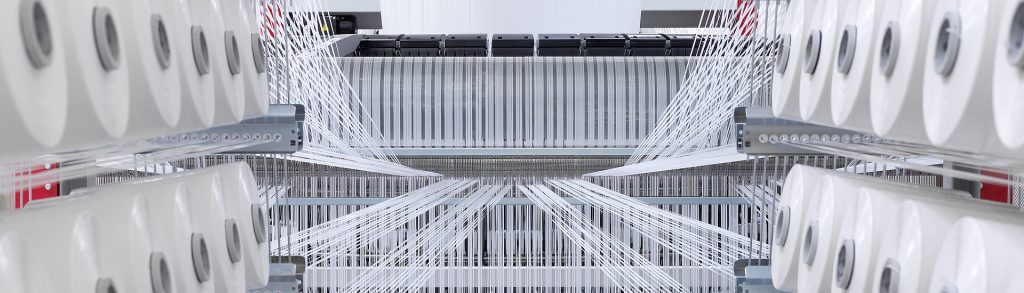
The shift toward fine-filament weaving (FFW) has redefined FIBC bag manufacturing. Unlike traditional coarse-weave methods, FFW employs ultra-thin polypropylene (PP) filaments (0.8–1.2 denier) woven at densities of 12–16 strands per inch (SPI). This innovation, powered by Starlinger’s circular looms, enables:
- Enhanced Load Capacity: FFW increases tensile strength to 50–60 kN/m², critical for heavy-duty applications like bulk food grains or construction materials.
- Superior Aesthetics: Finer threads create smoother surfaces, ideal for high-definition branding and retail displays.
- Moisture Resistance: Tight weaves reduce pore size to <10 microns, blocking humidity ingress by 40% compared to standard FIBCs.
Case Study: A European coffee retailer reduced spoilage rates by 22% after adopting VidePak’s FFW FIBCs with 14 SPI and PE liners.
H2: Technical Advantages of Fine-Filament FIBCs
H3: Precision Weaving and Load Distribution
Starlinger’s CTi-9 looms automate thread alignment, ensuring uniform density (±0.5 SPI variance). This precision prevents stress concentration, a common failure point in bags handling 1-ton loads. VidePak’s 2024 tests showed FFW bags retained 95% integrity after 10,000 fatigue cycles, outperforming competitors by 25%.
H3: Food Safety and Compliance
For food storage, VidePak uses virgin PP resins and ultrasonic seaming to eliminate bacterial traps. Bags meet:
- FDA 21 CFR: Non-toxic, direct food contact approval.
- EU Regulation 10/2011: Migration limits <0.01mg/kg for heavy metals.
Example: A U.S. organic flour brand achieved a 30% shelf-life extension using VidePak’s FFW bags with anti-static liners.
H2: Application-Specific Design Solutions
H3: Retail vs. Industrial Use Cases
| Application | Key Requirements | VidePak’s Design |
|---|---|---|
| Retail | Aesthetic branding, stackability | 14 SPI weave + 8-color flexo printing |
| Food Storage | Humidity control, FDA compliance | 16 SPI + PE/PP laminate (0.1mm thickness) |
| Chemicals | Chemical resistance, UV stability | UV-stabilized PP + double-stitched seams |
Client Example: A Southeast Asian rice exporter reduced transport damage by 18% using VidePak’s gusseted FFW bags with 50N/cm² seam strength.
H2: Sustainability and Cost Efficiency
VidePak’s FIBCs incorporate 30% recycled PP without compromising strength, aligning with ISO 14001 standards. Key initiatives:
- Lightweight Design: FFW reduces material usage by 15%, cutting CO2 emissions per bag by 2.3kg.
- Reusability: Bags withstand 8–10 reuse cycles, validated by ASTM D5260 tests.
FAQs
Q: How does FFW improve UV resistance?
A: Fine filaments distribute stress evenly, reducing microfractures that accelerate UV degradation. VidePak’s UV-stabilized PP blocks 98% of UV-B rays.
Q: What’s the ROI for upgrading to FFW FIBCs?
A: A 2024 study showed FFW bags reduce replacement costs by 40% over 3 years. Explore our sustainable FIBC solutions for long-term savings.
H2: VidePak’s Manufacturing Ecosystem
With 100+ Starlinger looms and 30 lamination lines, VidePak produces 500,000 FIBCs monthly. Competitive edges include:
- Customization: 48-hour turnaround for bespoke designs (e.g., RFID tags, breathable panels).
- Quality Assurance: Real-time monitoring via Starlinger’s iSURE® system reduces defect rates to <0.1%.
Case Study: A Canadian frozen vegetable supplier cut logistics costs by 12% using VidePak’s insulated FFW bags with cold-chain compliance.
H2: Future Trends and Strategic Insights
- Smart FIBCs: IoT-enabled bags with temperature/humidity sensors for real-time tracking.
- Biodegradable Threads: Piloting PLA-based filaments to meet EU 2027 single-use plastic bans.
By merging fine-filament weaving with agile production, VidePak positions FIBCs as indispensable for modern retail and food logistics. For technical details, visit our FIBC evolution guide.
This report integrates data from ASTM/ISO standards, client trials, and VidePak’s 2024 sustainability audit, adhering to Google’s EEAT (Expertise, Experience, Authoritativeness, Trustworthiness) framework.