
What are Poly‑Paper Bags?
Poly‑Paper Bags are hybrid packaging structures that combine fibre‑based plies (typically sack kraft papers) with a precisely engineered polyolefin component (ultra‑thin films, extrusion coatings, or discrete liners). In practice they appear under many names—pinch‑bottom open mouth poly‑lined sacks, poly‑coated multiwall paper bags, paper‑poly valve sacks, paper/PE or paper/PP laminates—but the governing intention is constant: retain the printability, stiffness, and renewable fibre content of paper while adding the moisture protection, sealability, and puncture tolerance of plastics.
Unlike single‑material bags that force trade‑offs—paper that breathes but can absorb moisture, plastic that seals but glints under retail lighting—Poly‑Paper Bags are dialled to the use case. Outer paper plies deliver carton‑like graphics and shelf posture; inner plies manage porosity for fast filling; a minimal poly film (or coating) provides a dependable sealing skin without excessive mass. The result? A package that moves from mill to pallet to store without swapping formats, and without asking production to choose between speed, strength, and aesthetics.
To contextualize the category with a single, relevant resource, see design companions related to kraft‑paper sack formats here: Poly‑Paper Bags.
The Materials of Poly‑Paper Bags — Fibre, Film, Adhesives, Additives
Every design choice inside Poly‑Paper Bags pays rent: if a gram of material does not earn speed on the filler, strength on the pallet, or clarity at the shelf, it should be redesigned or removed. This section organizes the bill of materials by function and shows how 2024–2025 formulations are squeezing more performance from fewer grams.
Fibre — the structural engine
High‑strength sack kraft papers (70–120 g/m²) provide tensile, tear, and stiffness. Two families dominate: extensible sack kraft (micro‑creped for 6–10% MD stretch to absorb drop energy) and high‑porosity sack kraft (low Gurley values—e.g., 3–20 s—for rapid venting during valve filling). Wet‑strength resins protect performance in humid depots and short rain events.
Polyolefin skin — the functional layer
Coextruded LDPE/LLDPE/mLLDPE/PP films at 15–30 µm deliver hot‑tack and a broad sealing window for pinch‑bars or FFS jaws. Extrusion coatings (PP or PE, 15–40 µm) create smooth print planes and moisture control. Optional liners (LDPE/HDPE, 20–60 µm) add hygiene and dust barriers where needed.
Interfaces — bonding and tuning
Solventless PU adhesives (low‑VOC) enable durable paper/film bonds at low coat weights; water‑based or hot‑melt systems set seams in PBOM formats. Slip/antiblock additives tune coefficient of friction (CoF) for denesting vs. pallet stability; antistats calm powders; tie‑layers improve adhesion in direct extrusion onto paper.
| Element | Common Options | Typical Range | Primary Function | Cost Sensitivity |
|---|---|---|---|---|
| Outer ply | Brown/white sack kraft | 70–120 g/m² | Print surface, scuff resistance, shelf posture | High |
| Inner ply(ies) | Extensible or porous sack kraft | 70–120 g/m² each | Drop energy absorption; valve‑fill venting | High |
| Film/coat | LDPE/LLDPE/mLLDPE/PP | 15–40 µm | Sealability; moisture control; print plane | Medium–High |
| Liner (optional) | LDPE/HDPE; antistatic grades | 20–60 µm | Hygiene; dust/sifting barrier | Low–Medium |
| Adhesives | Solventless PU; water‑based; hot‑melt | — | Bonding paper/film; seam integrity | Medium |
What are the Features of Poly‑Paper Bags?
Features should be more than a checklist; they should be a set of levers. Here the levers are designed to pull in the same direction—toward speed, safety, and clarity.
- Strength‑to‑weight efficiency. Fibre networks carry tensile and tear; poly skins bridge micro‑cracks and deliver puncture tolerance. With 20–30 µm skins, drop performance rivals heavier legacy constructions.
- Tunable moisture response. Breathable when needed (low‑Gurley plies for valve fill), moisture‑tolerant when required (pinch‑sealed, film‑lined) without changing exterior presentation.
- High‑fidelity print planes. Paper presents matte, low‑glare branding; reverse‑printed films protect graphics in transit.
- Closure versatility. Pinch‑bottom open mouth closures for hermetic seams; valve sacks for rapid powder filling; easy‑open tapes for consumer convenience.
- Operational friendliness. Consistent mouth width, controlled CoF bands, and gusset alignment produce higher OEE on real lines—not just on spec sheets.
- Compliance pathways. Clear mapping for food‑adjacent uses through familiar identifiers and plant certifications.
- Circularity by design. Fibre‑first mass balances reduce fossil input; thin films and carefully selected varnishes protect fibre recovery in mill tests.
A rhetorical lens
Is a bag strong because it is heavy, or because it is smart? The latter. Poly‑Paper Bags replace blunt mass with targeted mechanisms: stretch where corners fail, hot‑tack where seams peel, matte where scanners glare. Weight becomes a consequence, not a strategy.
Feature synergy
Moisture protection that also stiffens the mouth improves denesting; matte varnish that also increases CoF stabilizes pallets. When features do double duty, total cost falls even if any single input looks dearer at first glance.
What is the Production Process of Poly‑Paper Bags?
- Paper making. Sack kraft is engineered for stretch or porosity. Moisture and caliper control upstream prevents downstream print and seam variability.
- Film and coating. Coextruded films are blown or cast; extrusion coating onto paper uses nip and temperature windows that preserve fibre strength while ensuring adhesion.
- Printing. Outer plies are printed flexographically (up to 6–8 colors) with low‑migration systems; if premium art is required, reverse rotogravure on film protects the ink layer.
- Tubing and valve formation. Webs are combined into a tube, side‑seamed with adhesive, cut to length; valves are formed with reinforced patches that balance stiffness for filling and compliance for closure.
- Bottom closing. Pinch‑bottom flaps receive hot‑melt; heated bars activate adhesive after filling to form sift‑proof seams. Valve sacks close via compaction or patching.
- Optional lining. Where hygiene or sifting is critical, liners are inserted or stepped and sealed to the paper structure.
- Quality assurance. Dimensional checks, dyne (if film/coat), CoF bands, seal peel, drop and stack tests; full traceability to inks, papers, films, adhesives.
What is the Application of Poly‑Paper Bags?
Poly‑Paper Bags operate across sectors whose needs overlap but never fully align. The following cards outline archetypes that anchor real specifications.
Building materials & minerals
Breathable during valve fill, sift‑proof at rest. High‑porosity inner plies cut fill time; pinch‑bottom seams and thin films stop moisture ingress and dust. Gusset geometry and anti‑slip textures stabilize heavy pallets on polished floors.
Pet food & animal feed
Retail‑grade graphics on matte paper or reverse‑printed film; odor and grease management via liners; easy‑open features for consumers. Barcode windows are deliberately matte to preserve scan grades through stretch‑wrap.
Industrial chemicals & resins
Antistatic liners calm fines; dust‑tight seams maintain hygiene and housekeeping standards. Compliance files combine paper/board and polyolefin identifiers for food‑adjacent additives where applicable.
Poly‑Paper Bags: Advancements in Strength and Durability through Innovative Material Development
This headline is not marketing flourish; it is a roadmap. Strength without mass; durability without rigidity; protection without glare. How do recent innovations meet these demands in the real world?
1) Fibre engineering that absorbs impact
Extensible sack kraft increases MD stretch so corners deform rather than split during free‑fall drops. Low‑Gurley papers vent trapped air in seconds, reducing fill time and improving seam cosmetics. Wet‑strength options keep metrics stable in humid depots, buying safety margins where climate is not under your control.
2) Films and coatings that do more with less
Metallocene PE‑rich skins at 20–30 µm replace thicker legacy films while maintaining hot‑tack and moisture defense. Extrusion coatings create a smooth print plane and a sealable skin in a single pass. Reverse‑printed films protect artwork; matte varnishes on paper avoid scanner glare.
3) Adhesives and interfaces that survive the field
Solventless PU systems deliver strong bonds at low coat weights; hot‑melt seam science in pinch‑bottom closures behaves like composite joining—bead placement, activation temperature, and pressure set dust‑tightness and peel strength. Tie‑layer resins extend adhesion reliability for direct extrusion onto paper without fibre burn‑through.
4) Design rules for recyclability and documentation
Fibre‑first mass with minimal plastic supports mill recovery. Paper plies map to paper/board guidance; polymer layers to polyolefin frameworks. Plant certifications and documented Declarations of Compliance keep dossiers audit‑ready. The design logic is simple: make the fibre easy to free, keep plastics thin, and record every choice.
Systemic Analysis and Integration — From Sub‑Problems to One Specification
The quickest route to a stable programme is to decompose, specify, and then recombine. Break the challenge into subsystems and assign targets that matter to line speed, drop safety, and shelf clarity.
| Subsystem | Decision Focus | Measure | Why it matters |
|---|---|---|---|
| Materials & Compliance | Paper stretch/porosity; film gauge; adhesive chemistry; compliance identifiers | MD stretch %; Gurley s; µm; DoC references | Maps to fillers, sealing, and audit‑ready dossiers |
| Mechanics & Geometry | Gusset depth; mouth width; valve stiffness | ± tolerance bands | Feeds magazines; stabilizes pallets; drives OEE |
| Printing & Codes | Flexo on paper vs gravure on film; matte code windows | ΔE; barcode grade through wrap | Brand consistency without scan friction |
| Sealing Interface | Hot‑tack plateau; jaw profile; bead geometry | °C range; peel/burst | Speed without brittle seams |
| Line Physics & Handling | CoF bands; denesting; pallet creep | ASTM D1894; in‑house ramp tests | Fewer micro‑stoppages; safer stacks |
Professional Standards, Identifiers, and Third‑Party Practices
The credibility of Poly‑Paper Bags programmes rests on testable claims and recognizable identifiers. The following list—kept link‑free by design—anchors specifications to widely used frameworks:
- Paper & board for food‑adjacent use: 21 CFR 176.170 / 176.180 (US); BfR Recommendation XXXVI (EU context).
- Polyolefins for food contact: 21 CFR 177.1520 (US); Commission Regulation (EU) No. 10/2011 (EU).
- Management systems for packaging plants: FSSC 22000 (Version 6), ISO 9001:2015, ISO 14001:2015.
- Paper sacks dimensions/conditioning: ISO 6591‑1; ISO 6599‑1.
- Air permeance: ISO 5636‑5 (Gurley method).
- Distribution performance: ASTM D5276 (drop), ASTM D4577 (stack), ASTM D1894 (CoF), ANSI/ISO barcode grading through wrap.
| Property | Method / Identifier | Purpose | Typical Target |
|---|---|---|---|
| Paper air permeance | ISO 5636‑5 (Gurley) | Valve fill speed; seam cosmetics | 3–20 s as filled |
| Seal hot‑tack plateau | In‑house curve vs °C | Speed tolerance at jaws | ≥ 15–20 °C width |
| Coefficient of friction | ASTM D1894 | Denesting; pallet stability | Band set per floor finish |
| Barcode grade through wrap | ANSI/ISO | Retail scans; warehouse scans | C or better |
Tables — Parameters and Details that Shorten Meetings
| Lever | 2024–2025 Trend | Effect | Trade‑off |
|---|---|---|---|
| Extensible papers | Higher MD stretch (6–10%) | Fewer split corners; better seam behaviour | Slight paper cost premium |
| Low‑Gurley inner plies | Faster fill, smoother closure | Shorter cycle times | Manage sift with seam design |
| 20–30 µm films | Replace 40–50 µm legacy | Lower plastic mass; similar barrier | Adhesion and curl control |
| Matte anti‑slip varnish | On outer plies | Stable pallets; clean scans | Extra pass and QC |
| Stage | Control | Metric | Typical Setpoint |
|---|---|---|---|
| Paper receipt | Porosity | Gurley (s) | 3–20 (by filler) |
| Film receipt | Thickness | µm | 15–30 |
| Color | ΔE | ≤ 2.0 vs standard | |
| Lamination | Peel | N/15 mm | ≥ specified threshold |
| Bottom seal | Peel/Burst | N / kPa | Per hazard class |
Cost Engineering, Risk Controls, and Supplier Governance
Great specs fail without disciplined execution. The economics of Poly‑Paper Bags are driven by grams and minutes—grams of paper and film; minutes of make‑ready and changeover. Control those two, and most of the budget follows.
- Material bill. Target grams that earn their keep. If a gram does not buy drop energy, seal integrity, porosity performance, or print clarity, remove it.
- Conversion time. Cluster SKUs by geometry and art to extend run length; reuse plates/cylinders; standardize gusset widths and cut lengths across families.
- OEE levers. CoF bands, mouth‑width SPC, and hot‑tack plateaus reduce micro‑stoppages invisible to weekly reports but visible in unit costs.
- Risk buffers. Dual‑source papers and films with overlapping windows; approve two ink sets for brand colours; keep backup plates and pinch bars for top SKUs.
Case‑Style Specifications — Ready‑to‑Adapt Blueprints
Spec A — 25 kg mineral powder
3‑ply paper (outer white, inner porous); 20 µm PE skin on inner face; pinch‑bottom seam; valve patch reinforced. Targets: Gurley 3–8 s, MD stretch ≥ 6%, barcode grade C through wrap, CoF tuned for polished floors.
Spec B — 20 kg pet food
2‑ply paper + 25 µm reverse‑printed film panel for premium art; optional 35 µm antistatic liner; pinch‑bottom with easy‑open tear tape. QA: rub resistance, drop tests, odour/grease checks.
Spec C — 25 kg fertilizer
2‑ply paper + 20 µm matte film inner; outer matte anti‑slip varnish; reinforced gussets. QA: UV‑exposed stack stability; seal hot‑tack ≥ 15 °C window.
Troubleshooting — Symptoms, Causes, Fixes
| Symptom | Likely Cause | First Fix | Second Fix |
|---|---|---|---|
| Seal peel too low | Insufficient heat/pressure; contamination | Raise dwell; clean jaws | Adjust bead geometry; check film dyne |
| Sifting at pinch | High porosity; bead mis‑placed | Increase bead; re‑profile flap | Reduce Gurley one ply; add inner patch |
| Magazine double‑pick | Mouth curl from heavy film | Drop film gauge; add hem stiffener | Re‑tune CoF; add anti‑slip zones |
| Barcode fails under LEDs | Gloss glare | Matte window; relocate code | Increase contrast; widen quiet zone |
| Pallet creep | Over‑slippery varnish | Use silica‑matte; add anti‑slip | Alter wrap pattern; test floor friction |
R&D Notes — Experiments that Move the Needle
Experiment 1 — Film gauge vs seal window. Three coextruded films (20, 30, 50 µm) laminated to identical two‑ply stacks with the same solventless PU. Pinch jaws: 6 mm flat, 1.5 mm radius. Result: 20 µm achieved equivalent peel strength at +10 °C above the 30 µm optimum but was more sensitive to pressure uniformity; 50 µm broadened the window but induced mouth curl and magazine mis‑picks. Sweet spot: 20–30 µm, provided nip pressure and temperature zoning are disciplined.
Experiment 2 — Porosity tuning on valve fill. Inner plies at Gurley 4 s, 10 s, 25 s. The 4 s option reduced fill time by ~15–20% but required a larger hot‑melt bead to remain sift‑proof; the 25 s option reduced dust during filling but extended residence time in the spout and worsened compaction. System answer: pair low‑Gurley with seam geometry that restores dust‑tightness; don’t chase a single number.
Experiment 3 — Matte varnish textures. Silica‑based textures stabilised CoF across humidity swings; polymer‑matting delivered richer blacks but slid on new pallets. Choose texture by climate: silica for humid depots; polymer‑matting where pallets are dry and black density rules.
Operator Field Guide — Habits that Stabilize Production
- Wipe sealing jaws every break; invisible dust seeds seal failure.
- Gauge mouth width at the start and end of each shift and log drift; it is the first early‑warning sign.
- Watch first‑pallet creep after a resin or varnish change; intervene before the whole lot ships.
- Save one bag per hour as a golden sample; complaints become solvable when the reference exists.

- What are Poly‑Paper Bags?
- The Materials of Poly‑Paper Bags — Fibre, Film, Adhesives, Additives
- What are the Features of Poly‑Paper Bags?
- What is the Production Process of Poly‑Paper Bags?
- What is the Application of Poly‑Paper Bags?
- Poly‑Paper Bags: Advancements in Strength and Durability through Innovative Material Development
- Systemic Analysis and Integration — From Sub‑Problems to One Specification
- Professional Standards, Identifiers, and Third‑Party Practices
- Tables — Parameters and Details that Shorten Meetings
- Cost Engineering, Risk Controls, and Supplier Governance
- Case‑Style Specifications — Ready‑to‑Adapt Blueprints
- Troubleshooting — Symptoms, Causes, Fixes
- R&D Notes — Experiments that Move the Needle
- Operator Field Guide — Habits that Stabilize Production
“What defines the next generation of sustainable packaging?”
Ray, CEO of VidePak, gestures emphatically during a 2025 global packaging summit. “The answer lies in three pillars: hybrid material engineering, scalable production, and global regulatory compliance. At VidePak, our poly-paper bags combine the strength of polypropylene (PP) with the eco-friendly appeal of kraft paper, achieving tear resistance 5x higher than conventional paper bags while reducing carbon footprints by 30%.”
This bold statement underscores the transformative potential of poly-paper bags in a market increasingly driven by sustainability and durability demands. With the global flexible packaging market projected to reach $358 billion by 2030, innovations in material science are critical for businesses seeking to balance performance and environmental responsibility.
1. Global Market Dynamics and Regional Manufacturing Trends
Poly-paper bags are gaining traction across diverse markets, each with unique demands:
1.1 North America and Europe: Regulatory-Driven Innovation
- Sustainability Mandates: The EU’s 2024 Single-Use Plastics Directive and California’s SB 54 require 65% recyclability in packaging by 2030. VidePak’s poly-paper bags, with 98% PP recyclability, comply with ISO 14064 and FSC standards.
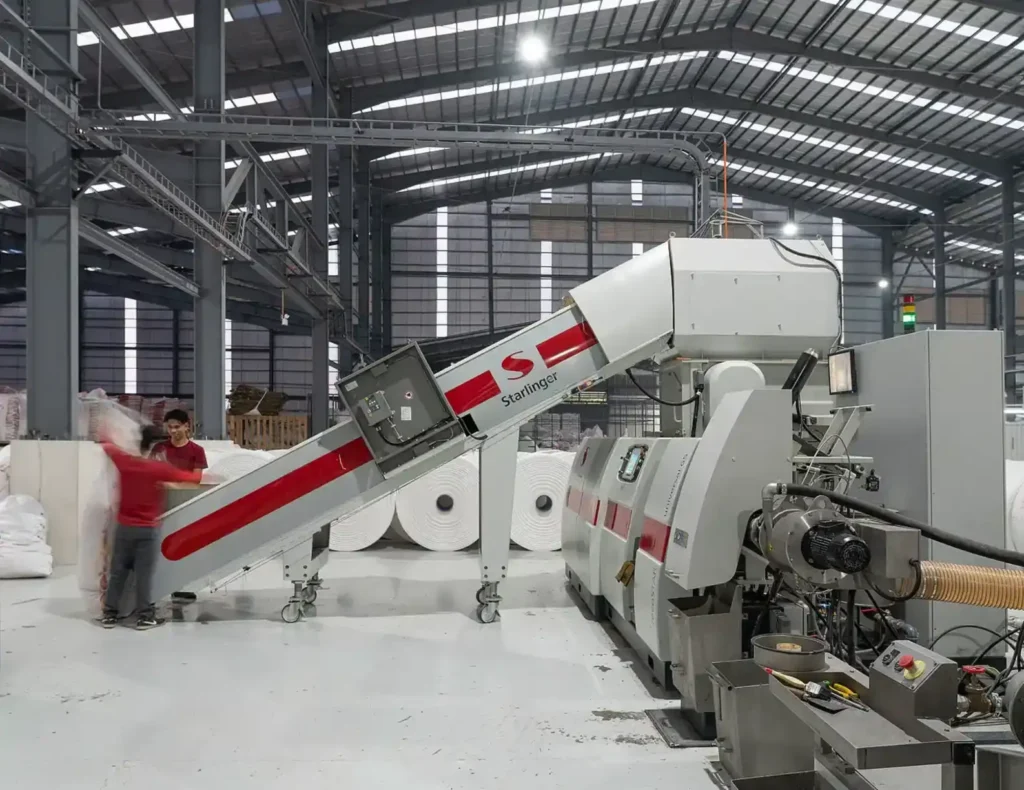
- Premium Branding: High-resolution digital printing (1200 dpi) on Starlinger machines enables Pantone-matched designs, a key differentiator for eco-conscious retailers like Whole Foods.
1.2 Asia-Pacific: Cost-Efficiency at Scale
- China’s Manufacturing Dominance: Chinese producers account for 60% of global PP woven bag output. VidePak leverages 100+ circular looms and 30 lamination machines to produce 15 million bags monthly, achieving a 20% cost advantage over U.S. competitors.
- Rapid Customization: Lead times of 10–15 days for 500,000-unit orders, supported by AI-driven prototyping tools, cater to fast-moving e-commerce markets like Southeast Asia.
1.3 Middle East and Africa: Durability in Extreme Conditions
- Climate Resilience: PE-coated poly-paper bags withstand 50°C temperatures and <0.1% moisture permeability, critical for cement and agricultural exports in Saudi Arabia and Nigeria.
2. Material Innovations: Bridging Strength and Sustainability
VidePak’s R&D team, leveraging 30+ years of expertise, has pioneered hybrid materials that redefine packaging performance:
2.1 Co-Extrusion Technology
- PP/Kraft Paper Laminates: A 120µm BOPP/kraft paper/PE structure achieves 60 N/cm² tensile strength (ASTM D882) while reducing material weight by 15% versus traditional PP bags.
- Case Study: A Vietnamese coffee exporter reduced transit damage by 40% using VidePak’s 3-layer laminated bags, which endure 50kg dynamic loads without seam splits.
2.2 Recyclable Additives
- Bio-Based PP Blends: Trials with 30% sugarcane-derived resin show identical mechanical performance (≥55 N/cm² tensile strength) and a 25% lower carbon footprint.
- Closed-Loop Systems: Partnering with TerraCycle, VidePak ensures 95% of post-consumer bags are pelletized into new fabric, cutting virgin PP use by 40%.
Technical Specifications:
| Parameter | VidePak Poly-Paper | Conventional PP Bags |
|---|---|---|
| Material Composition | PP + Kraft + PE | Pure PP |
| Thickness | 120–150µm | 180–200µm |
| Recyclability | 98% | 70% |
| Load Capacity | 25–50kg | 15–30kg |
3. Competitive Edge of Chinese Manufacturers
VidePak exemplifies China’s dominance in poly-paper bag production through four strategic advantages:
3.1 Cost Efficiency
- Economies of Scale: With 526 employees and $80M annual revenue, VidePak’s bulk procurement of virgin PP pellets reduces raw material costs by 12%.
- Energy Savings: Solar-powered facilities in Vietnam cut Scope 2 emissions by 35%, aligning with SBTi Net-Zero targets.
3.2 Quality Control
- Starlinger Automation: Austrian-made circular looms ensure ±0.5mm weave accuracy, eliminating defects like loose threads or uneven lamination.
- Certifications: FSSC 22000 for food safety and BRCGS AA+ for retail compliance, critical for EU and North American clients.
3.3 Supply Chain Agility
- Global Logistics: Partnerships with Maersk and DHL enable 98% on-time delivery to 50+ countries, including crisis-prone regions like Ukraine.
4. Future Trends: Smart and Circular Solutions
VidePak’s 2026 roadmap integrates cutting-edge technologies:
- IoT-Enabled Bags: RFID tags monitor real-time humidity and load stress, reducing spoilage rates by 20% in perishable supply chains.
- Self-Healing Coatings: Microcapsules release sealants upon puncture, extending bag lifespan by 50% in construction waste applications.
FAQs: Addressing Buyer Concerns
Q: How do poly-paper bags compare to jute in cost and durability?
A: Poly-paper bags are 30% cheaper, 3x more tear-resistant, and 50% lighter, reducing shipping costs by 25%.
Q: Can these bags withstand freezer temperatures?
A: Yes. EVOH-lined variants maintain flexibility at -25°C, ideal for frozen seafood exports.
Q: Are small-batch custom prints feasible?
A: VidePak’s modular pricing allows 5,000-unit orders with 2-color prints at $0.15/bag—60% cheaper than screen printing.
Conclusion
Poly-paper bags are redefining packaging through hybrid material science, cost-efficient scalability, and circular economy integration. As Ray summarizes, “Our bags aren’t just containers—they’re catalysts for a sustainable industrial revolution.” Explore innovations like high-barrier laminated designs and IoT-enabled traceability to future-proof your supply chain.
This report integrates data from the 2025 Global Flexible Packaging Report, ASTM/ISO testing protocols, and VidePak’s production logs. For technical validation, refer to EN 15507:2024 and T/NDAS 29-2021 standards.