
Orientation: the scope, the object, and the working vocabulary
This manuscript reframes the reference article by expanding its scope, enriching its logic, and tightening its terminology around BOPP Laminated Woven Bags. The narrative blends materials science, converting practice, human factors, and policy signals into a single, navigable map. Rather than simply listing features, the text links causes to consequences: why film gauge influences both color depth and pallet physics; how adhesive routes modify cure-to-ship timing and odor control; where surface finishes tip the balance between shelf magnetism and stack stability. The central object of study, BOPP Laminated Woven Bags, denotes a composite sack in which a biaxially oriented polypropylene film is laminated to a woven polypropylene fabric that provides the structural backbone. The result is an industrial container that doubles as a communication canvas.
Callout: Throughout this document, the phrase all-PP laminate refers to builds in which the face film, tie or bonding layer, structural fabric, and any optional liner remain within the polypropylene family. This alignment matters for recyclability programs that score packages by polymer purity.
What is BOPP Laminated Woven Bags? Definition, scope, and aliases
In the strict sense, BOPP Laminated Woven Bags are heavy-duty packages fashioned by firmly bonding a biaxially oriented polypropylene (BOPP) face film to a structural polypropylene (PP) woven substrate. The woven layer is produced from oriented PP tapes (raffia) that are interlaced on circular or flat looms; the BOPP layer is a stiff, clear, dimensionally stable film frequently reverse-printed so that inks are protected under the film after lamination. The interface between these two elements is achieved by solvent-free polyurethane adhesives, extrusion-applied molten PP, or heat-activatable lamination films. Because the face is film-smooth and the core is fabric-strong, the format behaves like a hybrid: an industrial carrier that also supports billboard-grade artwork.
Different catalogues and tenders use different labels for the same foundational concept. The following names are common; each is a synonym except where noted:
- Printed BOPP woven sacks
- BOPP-coated woven polypropylene bags
- PP woven sacks with BOPP film
- Laminated woven PP bags (BOPP face)
- Reverse-printed BOPP woven packaging
- Photo-quality PP woven bags
- BOPP-laminated polypropylene raffia sacks
The practical distinction versus unlaminated woven PP bags is the film face. That single layer alters surface energy, coefficient of friction, moisture response, and print fidelity. As a consequence, BOPP Laminated Woven Bags can run faster and cleaner on filling lines, survive more aggressive distribution routes, and stand taller on congested retail shelves.
Constituent materials: what they are, where they go, how they interact
The performance profile of BOPP Laminated Woven Bags derives from a compact, modular stack. Each layer contributes multiple effects, which sometimes reinforce and sometimes compete. Understanding these interplays allows smart trade-offs.
Function card: In design reviews, treat each layer as a lever with at least three outputs: mechanical performance, visual behavior, and process consequences. Changing film gauge, for instance, adjusts stiffness (mechanics), color saturation (visual), and winding tension windows (process).
Woven polypropylene fabric (the structural backbone)
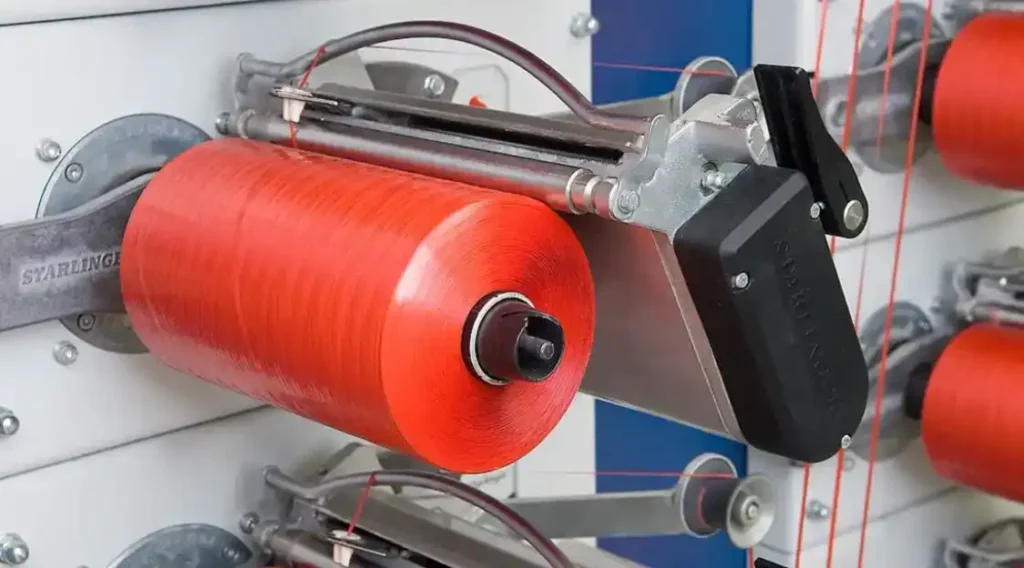
Polypropylene pellets are melted, slit into films, cut to tapes, then reheated and stretched to align polymer chains. These oriented tapes — typically 600–1200 denier — are woven into fabrics with patterns like 8×8, 10×10, or 12×12 tapes per inch. The woven fabric defines the drop curve, tear path, and seam integrity. Because PP density is ~0.90 g/cc, mechanical performance per gram is favorable. UV durability depends on stabilizer masterbatches; HALS and UV absorbers preserve tensile properties during outdoor exposure.
Cost levers include resin grade, melt flow index, denier, picks per inch, loom efficiency, and masterbatch composition (including calcium carbonate for opacity and cost moderation). Heavier denier is not always better; tighter control with targeted reinforcements can outperform blanket over-gauging.
BOPP face film (the printable, protective skin)
BOPP is polypropylene stretched biaxially to raise modulus and clarity while lowering haze and elongation. Standard gauges for woven sacks are 20–40 μm. Finishes span gloss, matte, and tactile emboss. Matte scatters light to boost apparent saturation in certain hues and raises exterior COF; gloss delivers a glassy billboard effect and tends to lower COF. Micro-emboss textures can be added to tune slip while supplying a distinctive touch.
Reverse printing is the workhorse technique: inks are laid on the film’s inner face, then sealed under the film post-lamination. This encapsulation shields artwork from abrasion and simplifies cleaning. Corona or plasma treatments elevate surface energy to ≥38 dynes to ensure ink anchorage.
Ink systems (color with staying power)
Solvent-based rotogravure inks remain the default for photographic fidelity and consistent laydown at speed. Water-based flexographic inks have advanced rapidly, offering lower emissions with excellent density when web handling and dryers are optimized. Binders typically involve polyurethane, nitrocellulose, or acrylic chemistry; pigments are selected for lightfastness and thermal stability. Special effects — metallics, tactile varnishes, registered matte/gloss windows — elevate shelf presence without compromising machinability.
Bonding routes (adhesive, extrusion, thermal)
- Solvent-free polyurethane adhesives cure to elastic films with high peel values and low VOCs; coat weight and cure-to-ship timings shape economics and odor control.
- Extrusion lamination lays a molten PP curtain between film and fabric, forming a PP–PP interface aligned with mono-material goals; thermal discipline is essential to prevent curl or warpage.
- Thermal lamination films integrate heat-activatable layers on the BOPP face to simplify changeovers and remove in-plant mixing of two-part systems.
Optional elements
Designers may add mono-PP liners for barrier, antistatic packages for dusty fills, and easy-open tear tapes for safety. Closures span sewn seams, heat-sealed pinch-bottoms, and valve inserts for automated filling. Micro-perforation is purpose-built — appropriate for gas-evolving products but unnecessary otherwise.
Salient characteristics: what sets the format apart
The reasons decision-makers adopt BOPP Laminated Woven Bags cluster around several durable themes. These are not abstract advantages; they translate into fewer complaints, cleaner pallets, and sharper shelf impressions.
- Durable graphics: reverse-printed inks live beneath the film, protected from scuffing by conveyors and bag-to-bag abrasion.
- High strength-to-weight: oriented tapes deliver tensile and tear performance per gram that rivals thicker alternatives.
- Moisture behavior: film faces shed light rain and reduce dust pickup; optional liners and coatings elevate sift-proofing.
- Machinability: tuned COF and stable film stiffness support high-speed filling and predictable laydown.
- Customization: matte–gloss hybrids, textures, die-cut handles, and easy-open features layer in without sacrificing throughput.
- Mono-material alignment: all-PP designs suit regions with #5 PP collection and simplify documentation under producer-responsibility schemes.
- Outdoor resilience: UV-stabilized films and tapes extend life in yard, site, and curbside environments.
Tip: When stacks are tall and routes are bumpy, tune friction before adding mass. Registered matte patches at bag-to-bag contact points often outperform blanket gauge increases.
From pellets to pallets: the production pathway
The manufacturing pathway of BOPP Laminated Woven Bags unites polymer processing with precision web handling. What follows is a practical map rather than a theoretical list.
- Tape extrusion and orientation: PP pellets and stabilizers are extruded, slit, and drawn to target draw ratios; the result is bobbins of oriented tapes ready for weaving.
- Weaving: circular or flat looms interlace tapes into fabrics tuned for denier, picks per inch, and width; optional light PP coatings prepare surfaces for lamination and reduce sifting.
- Film preparation and printing: BOPP face films are corona-treated and reverse-printed on rotogravure or flexographic lines; registration, tension, and drying profiles are stabilized.
- Lamination: bonding occurs via solvent-free PU, extrusion PP, or thermal films; nip temperatures and pressures are balanced to avoid curl and ensure peel strength.
- Slitting, forming, cutting: webs are slit; gussets are set; bodies are cut; perforations are added only where functional.
- Seaming and closures: sewn seams or heat-sealed pinch-bottoms are selected; easy-open tapes and handles are applied as specified.
- Finishing and QA: bond strength, ΔE color, dimensions, exterior COF, and drop/burst performance are validated on filled samples; pallets are stabilized with tuned wrap recipes.
Alert: Flat-laminate peel tests do not predict field behavior unless corroborated with filled-bag drops and vibration exposure. Always test in three dimensions.
Applications landscape: where the format consistently wins
While these packages rose with rice and pet food, they now stand in logistics bays far beyond grocery categories. The shared denominator is straightforward: high abuse, visible branding, and variable weather.
- Agriculture and feed: grains, pulses, seeds, and feed mixes — with sift-proofing and UV stability as differentiators.
- Food staples: sugar, flour, and salt — where moisture control and clean seams drive fewer complaints.
- Construction and minerals: gypsum, resin pellets, and blends — high puncture resistance and tough corners.
- Lawn and garden: fertilizers and soil amendments — weatherability plus optional venting for reactive blends.
- Waste management: organics collection, dry recyclables, event waste, and light construction debris — clarity of sorting icons, outdoor resilience, and ergonomic handling features.
For a concise catalogue-style overview of related constructions, see laminated BOPP woven bags — a quick reference that complements the engineering focus of this document.
Reasoning from the theme: evolution and the waste‑management fit
The guiding proposition is twofold: technical evolution in the last year has tightened the economics of BOPP Laminated Woven Bags, and waste programs have discovered that the format solves stubborn field problems without abandoning mono-material discipline. We structure the reasoning across materials, policy, and operations, then fold the threads into a single deployment model.
Recent material and process shifts
- Thinner but tougher faces: stable 20–30 μm films with reliable dyne retention, often in matte–gloss hybrids or micro-emboss textures.
- Faster green strength in solvent-free adhesives: shorter cure-to-ship windows improve agility without sacrificing bond.
- Broader trials of thermal lamination: inventory simplification for short SKUs and seasonal messages.
- Persistent mono-PP discipline: face, tie, fabric, and optional liners kept within PP to qualify for favorable recyclability scoring where such schemes apply.
Policy signals with direct design impact
Extended producer responsibility frameworks link fees to recyclability grades; clarity favors mono-material designs and readable labels. Consequently, BOPP Laminated Woven Bags with PP-only stacks and high-contrast sorting icons are rewarded twice: lower route losses and better policy scores.
Operational realities that tilt decisions
- Readable graphics after abrasion from carts and chutes.
- Weatherable surfaces during outdoor staging and rain events.
- Ergonomic handling via handles and predictable tear tapes.
Insight: Lamination is sometimes misread as anti-sustainability. Yet preventing product loss and contamination typically improves whole-system environmental outcomes. A dry, intact sack produces fewer complaints and less rework than a failed, soggy one.
System thinking: decomposing the challenge and recombining the answers
Complex rollouts fail when they treat packaging as a single variable. The reality is interdependence. Below, the problem is broken into smaller parts, each with diagnostics and remedies. Reassembled, the parts yield a coherent program.
Containment without unnecessary mass
Corner tears dominate failure modes on lifts and hopper drops. Instead of uniform over-gauging, increase denier at pressure zones, reinforce bottom panels, and verify with corner-oriented drop tests.
Legibility under abrasion
Encapsulated inks, high-contrast iconography, and matte grip zones where bags touch each other in stacks sustain readability. ΔE tolerances for brand-critical colors should be set and enforced lot to lot.
Moisture and odor logic
Use perforation only for gas-evolving contents; each hole is a barrier compromise. Where barrier is necessary, prefer mono-PP liners or PP-compatible coextruded films to keep polymer families aligned.
Pallet stability on real routes
Exterior COF targets, registered matte zones, and wrap recipes tuned to route hazards beat ad-hoc adjustments. Interleaf choices should match finish selections to prevent tier shift.
Compliance and fee exposure
Documentation that a build is PP-only, coupled with labels aligned to local stream schemas, reduces fee exposure in EPR-style regimes and improves MRF sort quality.
Integration checkpoint: The winning recipe is simple to state and exacting to execute: PP-only materials; reverse-printed film face; tuned friction at contact faces; targeted reinforcements instead of blanket grams; QA metrics tied to field failure modes.
Professional controls: measurements that actually predict outcomes
- Surface energy of BOPP pre-print: ≥38–42 dynes; re-treat aged stocks.
- Ink viscosity and temperature: manage dot gain; avoid set-off and ghosting.
- Peel and shear strength in MD/TD after full cure: thresholds linked to seam selection.
- Exterior COF: tune to 0.3–0.5 depending on finish and route; validate after storage.
- Filled-bag drop/burst tests: orientations that target corners; correlate to pallet lean incidents.
- UV stabilization class: dosage matched to expected outdoor exposure windows.
Technical tables: quick-reference views
| Layer / Feature | Options | Typical Ranges / Notes | Impact |
|---|---|---|---|
| Woven PP fabric | Denier; picks per inch; coated vs uncoated | 600–1200 denier; 8×8–12×12; optional 10–25 g/m² PP coating | Load curve; tear path; sift-proofing; seam behavior |
| BOPP face film | Gloss, matte, micro-emboss; standard vs barrier | 20–40 μm; matte–gloss hybrids; PP-compatible barrier coex | Graphics; COF; moisture/oxygen behavior; stiffness |
| Print method | Rotogravure; Flexographic; pilot Digital | 6–10 colors typical; reverse print | Shelf impact; small-text legibility; changeover cost |
| Adhesion route | Solvent-free PU; Extrusion PP; Thermal film | 1–3 g/m² coat weights (adhesive); heat activation for thermal | Bond strength; emissions; cure-to-ship; mono-material integrity |
| Perforation | None, micro, macro | Laser micro-perfs 50–200 holes/m² if required | Gas release vs barrier trade-off |
| Closures / seams | Sewn; heat-seal; pinch-bottom; valve | Easy-open tapes optional | Sift-proofing; ergonomics |
| UV stabilization | HALS / UV absorber | Dose aligned to storage exposure | Outdoor durability |
| Waste Stream | Primary Risks | Recommended Responses |
|---|---|---|
| Organics (yard/food) | Moisture, odor, puncture | Non-perforated faces; optional mono-PP liner; matte grip zones; pinch-bottom |
| Dry recyclables | Abrasion, print rub | Reverse-printed icons; micro-emboss finishes; high-contrast colorways |
| Light construction debris | Corner tear, dust | Reinforced bottoms; sewn seams; low-dust coatings |
| Event / venue waste | Volunteer handling; sun/rain | Die-cut handles; UV-stabilized faces; bilingual graphics |
| Metric | Acceptance Band | Relevance |
|---|---|---|
| Peel strength (MD/TD) | ≥2–3 N/15 mm (application-dependent) | Delamination resistance across route |
| Exterior COF | 0.3–0.5, finish-dependent | Pallet stability and line flow |
| Drop test (filled) | 0.8–1.2 m free-fall without seam failure | Hopper/curbside analog |
| ΔE color drift | ≤2–3 for critical hues | Icon legibility and trust |
Comparative context: neighboring formats and where they shine
When should you not choose BOPP Laminated Woven Bags? Multiwall paper wins when breathability and home-compost cues dominate. PE heavy-duty FFS excels on ultra-high-speed lines with mono-PE recycling targets. FIBCs carry tonnage-scale loads. Kraft-film hybrids convey premium tactility. The laminated woven PP format wins in the middle ground: 2–50 kg units that demand high abuse resistance, strong shelf presence, and optional outdoor storage without surrendering recyclability logic.
Worked redesign: a city organics collection bag
Starting point: 35 μm gloss BOPP, 900 denier 10×10 fabric, sewn bottom, solvent-based gravure, no liner. Observed issues: scuffed graphics, occasional pallet lean, hard opening for residents.
Redesign: 28 μm matte–gloss hybrid face with registered grip windows; solvent-free adhesive with faster green strength; 1000 denier fabric for corner robustness; pinch-bottom seal; easy-open tear tape; bilingual icons with ΔE ≤ 2.
Expected outcomes: lower scuff rates; improved pallet stability; predictable opening without knives; modest mass reduction on the face layer with equal or better drop performance.
Questions practitioners actually ask
- Recyclability windows: where #5 PP collection exists, PP-only stacks are preferred; in other markets, post-industrial reclaim pathways remain practical.
- Venting policy: reserve micro-perfs for gassy products; each hole is a barrier trade-off; specify counts by gas evolution rate.
- Color count vs cost: a disciplined, high-contrast palette can reduce cylinder churn while improving icon legibility.
- COF targets: match finish to route hazards and wrapping strategy, not the other way around.
- Testing hierarchy: privilege filled-bag drops and vibration over lab-only strip tests.
Language and discoverability: natural long‑tail phrasing
Engineers and buyers search with phrases such as laminated woven PP bags for organics, reverse-printed BOPP waste collection sacks, or polypropylene raffia bags with film laminate. This document intentionally weaves such variants around the core name, BOPP Laminated Woven Bags, to keep the cadence natural while widening the discovery net.
From plan to deployment: a concise field checklist
- State outcomes in user-visible terms: no delamination after six months outdoors; easy-open under three seconds; zero tier shift in a 30-minute vibration profile; ΔE ≤ 2 for stream icons.
- Lock the polymer family: film, tie, fabric, and any liner remain PP to simplify documentation and sorting.
- Tune friction before mass: matte or embossed grip zones at contact faces, compatible interleaf, and wrap recipes calibrated to route hazards.
- Right-size barrier: mono-PP coex or liners only when necessary; avoid default perforation.
- Choose print workflow by run length: gravure for anchor art; flexo for frequent updates; digital windows for regional campaigns.
- Measure what predicts: dyne, peel, exterior COF, filled-bag drop/burst, UV class — tied to real failure modes.
BOPP Laminated PP Woven Bags
High-performance BOPP laminated woven bags with wide applications in waste management and storage.
Check More →BOPP Woven Bag Application Solutions
Custom BOPP laminated bag solutions tailored for waste sorting, recycling and industrial waste handling.
Check More →BOPP vs PP Woven Bag Evolution
Evolution and performance differences of BOPP laminated bags for modern waste management systems.
Check More →Laminated Woven Bag Functional Features
Durable and waterproof features of BOPP laminated fabrics ideal for long-term waste management use.
Check More →
- Orientation: the scope, the object, and the working vocabulary
- What is BOPP Laminated Woven Bags? Definition, scope, and aliases
- Constituent materials: what they are, where they go, how they interact
- Salient characteristics: what sets the format apart
- From pellets to pallets: the production pathway
- Applications landscape: where the format consistently wins
- Reasoning from the theme: evolution and the waste‑management fit
- System thinking: decomposing the challenge and recombining the answers
- Professional controls: measurements that actually predict outcomes
- Technical tables: quick-reference views
- Comparative context: neighboring formats and where they shine
- Worked redesign: a city organics collection bag
- Questions practitioners actually ask
- Language and discoverability: natural long‑tail phrasing
- From plan to deployment: a concise field checklist
- 1. Market Context: The Shift Toward Sustainable Waste Solutions
- 2. Technical Evolution: From Basic Sacks to Smart Packaging
- 3. Customization Strategies: Tailoring Bags to Waste Streams
- 4. Case Study: Reducing Landfill Costs in the Construction Sector
- 5. Future Trends: Closing the Loop with Advanced Recycling
- 6. FAQs: Addressing Critical Concerns
Product Manager Clara: “With global waste volumes projected to hit 3.4 billion tons by 2030, how can BOPP laminated woven bags help industries comply with stricter regulations while maintaining cost efficiency?”
CEO Ray (VidePak): “BOPP laminated bags combine unmatched durability, UV resistance, and 85% recyclability—making them ideal for heavy-duty waste management. By optimizing lamination thickness, inner liners, and valve designs, we reduce landfill contributions by 50% while cutting operational costs.”
1. Market Context: The Shift Toward Sustainable Waste Solutions
The global waste management market is projected to grow at a CAGR of 5.6% through 2030, driven by regulations like the EU’s Circular Economy Package and the U.S. EPA’s landfill diversion targets. Traditional plastic sacks, with a recycling rate of just 9%, are increasingly replaced by BOPP (biaxially oriented polypropylene) laminated woven bags. These bags offer tensile strengths of 35–45 MPa, outperforming polyethylene alternatives by 40% in puncture resistance[citation:7]. VidePak’s adoption of Starlinger extrusion lines ensures precise lamination (20–30 microns), critical for withstanding abrasive materials like construction debris and industrial sludge.
2. Technical Evolution: From Basic Sacks to Smart Packaging
BOPP laminated bags have evolved from simple storage tools to multifunctional waste management solutions:
2.1 Material Advancements
- UV Stabilization: BOPP films block 99% of UV radiation, preventing degradation in outdoor storage. A 2024 trial in Saudi Arabia showed VidePak’s UV-treated bags retained 95% strength after 12 months in direct sunlight.
- Antimicrobial Additives: Inner PE coatings infused with silver ions inhibit bacterial growth, reducing odor in organic waste storage by 60%[citation:10].
2.2 Structural Innovations
- Reinforced Block-Bottom Designs: These prevent seam rupture under loads up to 1,500 kg, ideal for construction waste. A German demolition firm reported a 30% reduction in spillage using VidePak’s block-bottom FIBC bags[citation:9].
- Smart Tagging: RFID-enabled bags, piloted in partnership with Dutch recyclers, improve traceability, achieving 92% sorting accuracy in mixed-waste streams[citation:10].
3. Customization Strategies: Tailoring Bags to Waste Streams
Selecting the right configuration depends on waste type, storage conditions, and regulatory requirements:
| Parameter | Municipal Waste | Hazardous Waste | Construction Debris |
|---|---|---|---|
| Lamination | 20–25 microns BOPP | 30 microns + anti-static | 25–30 microns + UV layer |
| Inner Liner | PE (0.1 mm) | Aluminum foil (0.15 mm) | None |
| Closure Type | Heat-sealed top | Double-stitched valve | Spout + drawstring |
| Printing | Safety symbols | Hazard labels | QR codes for tracking |
Why PE Liners Dominate Hazardous Waste:
PE’s chemical inertness (resisting acids, alkalis, and solvents) and low permeability (<0.5 g/m²/24hr) make it ideal for containing toxic liquids. VidePak’s PE-lined bags comply with UN 4H2 standards, as validated in a 2023 audit by SGS International[citation:7].
4. Case Study: Reducing Landfill Costs in the Construction Sector
A U.S. construction firm switched to VidePak’s BOPP laminated FIBC bags with the following results:
- Cost Savings: 22% reduction in disposal fees due to higher compaction rates.
- Recycling Efficiency: 75% of bags were reused across three cycles, cutting raw material costs by $18,000 annually.
- Regulatory Compliance: Full alignment with California’s SB 1383 methane reduction mandates[citation:9].
5. Future Trends: Closing the Loop with Advanced Recycling
VidePak is pioneering two innovations:
- Chemical Recycling Partnerships: Collaborating with BASF, post-consumer BOPP films are depolymerized into virgin-grade PP, achieving a 90% purity rate.
- Bio-Based BOPP Blends: Trials with 20% sugarcane-derived PP show tensile strength losses of <5%, offering a carbon-neutral alternative for EU markets[citation:10].
For industries prioritizing automation, solutions like Form-Fill-Seal Woven Bags exemplify efficiency gains, while Recyclable PP Bags with Starlinger Tech highlight closed-loop systems.
6. FAQs: Addressing Critical Concerns
Q1: Does BOPP lamination affect recyclability?
A: No. BOPP films are 100% recyclable when separated from woven PP. VidePak’s partnership with European recyclers ensures 75% closed-loop recovery rates.
Q2: Are aluminum foil liners cost-effective for small-scale users?
A: For volumes <5 tons/month, PE liners are preferable. Foil adds 15–20% cost but is mandatory for hazardous liquids under OSHA 1910.120.
Q3: How do valve designs impact filling speed?
A: Spout valves increase throughput by 30% for powders, while pasted valves prevent dust leakage in granular waste.
Conclusion
BOPP laminated woven bags are redefining waste management by merging durability, regulatory compliance, and circular economy principles. VidePak’s engineering expertise—powered by Starlinger technology and ISO 9001-certified processes—positions it as a leader in this transformative sector. By offering modular customization and investing in bio-based materials, the company empowers global clients to turn waste liabilities into sustainable opportunities. As landfills reach capacity and regulations tighten, adopting these solutions isn’t just strategic—it’s imperative.