
What Are Square Bottom PP Valve Bags?
Square Bottom PP Valve Bags are industrial sacks built from woven polypropylene fabric and finished with a self‑closing valve sleeve, enabling rapid, low‑dust filling and a compact, brick‑like package shape. The square or block bottom forms a stable, stand‑up base that improves pallet efficiency and transport stability. Unlike open‑mouth sacks that rely on sewing or separate heat sealing, the valve sleeve collapses under product pressure to close automatically and can be ultrasonically or thermally sealed for near‑hermetic performance when required.
Callout — Why this format exists
Powders behave like liquids until they bridge. They dust. They settle. They cake. Square Bottom PP Valve Bags counter these behaviors with a geometry that stacks like a block and a closure that limits aerosol escape at the packer. The result: faster filling, cleaner lines, and tighter pallets.
Also known as (aliases):
- Block Bottom PP Valve Sacks
- PP Woven Valve Bags
- Square‑Base Valve Bags
- Valve‑Type Woven Poly Sacks
- Pinch‑Bottom PP Valve Bags
- Self‑Sealing Woven Valve Sacks
Materials and Architecture of Square Bottom PP Valve Bags
The construction of Square Bottom PP Valve Bags combines an oriented‑tape woven substrate for strength, a sealing skin or laminate for controlled closure and barrier, a purpose‑built valve sleeve for fast filling, and a folded block bottom for pallet stability. Each layer has discrete materials and costs; together they form a system that trades a slightly higher bag unit price for lower total packaging cost per ton—less spillage, fewer stoppages, better cube efficiency.
Woven substrate
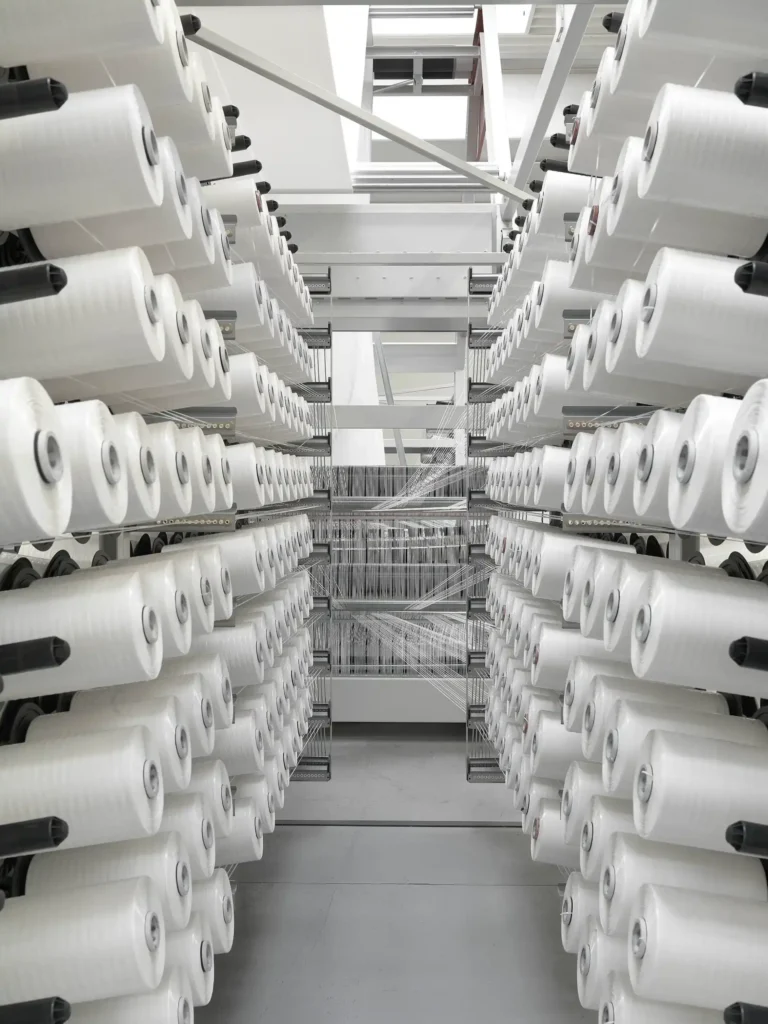
Extruded PP sheet is slit into tapes and drawn 5–7× to increase orientation, then woven (warp/weft) to a target GSM and pick count. The fabric delivers tensile strength, puncture resistance, and dimensional stability in the gussets and base folds.
Coatings and skins
Thin extrusion coats—often PE‑rich—enable heat or ultrasonic sealing at the valve, improve moisture resistance, and tune the coefficient of friction. Where mono‑material recovery is prioritized, PP‑rich skins paired with refined sealing recipes are specified.
Valve sleeve
A pre‑formed sleeve at the mouth accepts packer spouts (air, impeller, or screw). Product inflow inflates the bag and air exits through designed vent paths; the sleeve collapses after withdrawal to effect a self‑close. Film inserts, internal flaps, or short ultrasonic welds can elevate leak tightness.
Block bottom
A folded and sealed base creates a rectangular footprint. Correct crease memory and stress distribution at the corners are essential to prevent peel under compression and vibration.
Typical material palette includes polypropylene for tapes, polyethylene in sealing skins, optional antistatic or UV stabilizers, and print treatments such as corona to ≥ 38 dyn/cm. Additives for slip and antiblock control the outer COF and prevent jaw contamination at heat‑seal stations.
Callout — Anatomy in one line
Strong woven fabric, engineered sealing skin, treated print face, and a smart valve: the working anatomy of Square Bottom PP Valve Bags.
Features and Performance of Square Bottom PP Valve Bags
- High mechanical strength at low mass: oriented tapes resist puncture and suppress tear propagation when confronted with angular solids.
- Clean, efficient filling: valve sleeves interface with packers to reduce dust at the throat; optional ultrasonic/thermal steps elevate closure integrity.
- Square‑bottom stackability: brick‑like geometry improves pallet layer counts and reduces load shift during transport.
- Tunable friction surfaces: inner and outer COF settings reconcile conveyor flow with stable stacking; targeted anti‑slip bands add grip without marring graphics.
- Traceability ready: treated faces carry high‑contrast barcodes and serialized 2D codes that survive abrasion and handling.
- Circularity paths: mono‑PP options align with PP‑only recycling; PP/PE blends feed polyolefin streams; in‑plant regrind can be reincorporated with controls.
- Outdoor durability: UV packages protect fabric integrity in seasonal yard storage typical of minerals and building materials.
Why strength matters
Granular materials can cut like knives at edges and still flow like water through a spout. The woven lattice spreads stress and guards against catastrophic tears.
Why sealing matters
Needle holes leak. By replacing sewing with sealing—at the valve mouth or via internal flaps—operators cut dust, protect sensors and bearings, and simplify housekeeping.
Why data matters
From recycled‑content declarations to FEFO tracking, reliable codes printed on treated faces keep inventory honest and audits fast.
Production Process for Square Bottom PP Valve Bags
- Polymer preparation and compounding — Blend PP (and optional PE) with UV stabilizers, pigments, slip, and antiblock; dry to stabilize draw ratios and adhesion.
- Tape extrusion and orientation — Extrude thin sheet, slit into tapes, and draw 5–7× to achieve target denier/modulus; recycle edge trim to close the loop.
- Weaving — Interlace warp and weft on flat or circular looms to the specified GSM and PPI; control tension and humidity for uniformity.
- Surface activation — Elevate surface energy via corona or flame treatment to ≥ 38 dyn/cm for coating and print anchorage.
- Extrusion coating/lamination — Apply PE‑rich or PP‑rich skins (10–35 µm) and tune additives to target COF, WVTR, and sealing behavior.
- Printing — Flexographic printing (2–8 colors) with abrasion‑resistant inks; include hazard icons, barcodes, and serialized fields.
- Valve sleeve fabrication — Form the sleeve (coated fabric or film insert), integrate venting, and pre‑assemble to the mouth at tight tolerances.
- Bottom forming (square/block) — Fold and seal bottom panels to create a rectangular base; reinforce corner stress points.
- Conversion and QA — Cut, fold, and finish to nominal width/length/gusset; inspect sleeve dimensions, bottom symmetry, print registration, and coating coverage.
- Palletization and shipment — Bundle, wrap, and palletize with interleaves as needed; document lots and QC results for traceability.
Process Tip
Seal windows for woven builds are typically hotter and longer than for monolayer films. Guard against jaw fouling from slip bloom, record temperature/dwell/pressure via SPC, and clean routinely to keep peel strength consistent.
Application Landscape for Square Bottom PP Valve Bags
Public works, building materials, chemicals, agriculture, and recyclate logistics all rely on Square Bottom PP Valve Bags for their mix of speed, cleanliness, and stackability. Below, representative sectors demonstrate why the format is preferred and how it is tuned.
Building materials & minerals
Cement, mortar, grout, lime, and gypsum benefit from fast valve filling and square‑bottom stacking. Quick post‑seals limit dust from ultra‑fine fractions.
Chemicals & industrial powders
Pigments, hydrated lime, soda ash, and catalytic powders prefer woven strength with controlled venting and optional antistatic pathways.
Agriculture & feed
Mineral premixes, salts, and seed treatments pack cleanly; the brick‑like shape helps FEFO rotations and warehouse density.
Recyclate shipping
Polyolefin pellets and PET flakes ship with moisture protection and scannable IDs, simplifying receiving and silo feeding.
Square Bottom PP Valve Bags: Optimizing Packaging Applications and Requirements
Optimization begins with questions: What must the package endure? What must it prevent? How must it fit the packer? Where must it end its life? When these questions are answered in sequence, Square Bottom PP Valve Bags shift from a commodity to an engineered solution.
Problem → Response Cards
Throughput limits
Valve interface reduces manual handling; ultrasonic tack‑seals shorten close time; BPM rises without dust spikes.
Dust exposure
Sleeve geometry and vent zoning limit aerosolization; better housekeeping and sensor uptime follow.
Moisture ingress
Coating thickness and hooding recipes are tuned to WVTR targets based on climate and storage duration.
Traceability gaps
Large, treated panels hold resilient codes; EPR and FEFO reporting become routine, not heroic.
Trade‑offs remain. A PE‑rich skin broadens the sealing window but adds a second polyolefin; a mono‑PP sealing layer preserves purity but requires higher jaw temperatures and tighter process control. Low outer COF speeds belts yet risks pallet telescoping; high COF stabilizes stacks but may drag on conveyors. UV packages protect outdoors but, overdosed, can shift friction and seal behavior. The solution is disciplined trials and a shared vocabulary between engineering and finance.
Technical Parameters and Benchmarks
Build Options vs. Recyclability and Sealing
Quality Control Plan for Square Bottom PP Valve Bags
Writing the Specification: A Practical Template
- Format — 25 kg Square Bottom PP Valve Bags, corner‑top valve sleeve 130 mm, finished length 650 mm.
- Fabric — 90 g/m² PP woven; 1000D tapes; 11 PPI; corona treatment ≥ 38 dyn/cm on print side.
- Coatings — Outer 25 µm PE‑rich with 80 mm anti‑slip band at mid‑panel; inner 15 µm.
- Valve — Sleeve with PE film insert; designed for impeller packer spout Ø 50 mm; optional ultrasonic close at 0.3 s dwell.
- Printing — 4‑color flexo; hazard icons; serialized 2D code; recyclability mark “PP Woven”.
- Performance — Drop ≥ 6 @ 1.0 m; seal peel ≥ 20 N/15 mm; outer COF 0.38 ± 0.05; WVTR ≤ 3 g/m²·day.
- Palletization — 5 × 8 layer pattern; stretch hood; corner boards; total height ≤ 1.6 m.
- Compliance — Food‑contact inks where relevant; antistatic per risk assessment; artwork change control tied to lot serialization.
FAQ for Engineering and Procurement
Is a valve bag always cleaner than an open‑mouth bag? Often, yes—particularly with fine powders—because the spout enters a sleeve, product inflates the bag, and the sleeve collapses to close. Filling parameters (air assist, de‑aeration, venting) must still be tuned.
Can Square Bottom PP Valve Bags run on any packer? They interface with air, impeller, and screw packers, but sleeve width, spout diameter, and bag dimensions must match. Short machine trials are recommended.
What limits recycled content? Color, odor, and tensile consistency. Post‑industrial regrind usually integrates more easily than post‑consumer PCR. Start with 10–20% and validate.
How do we avoid pallet telescoping? Balance outer COF, place anti‑slip bands only where layers contact, verify pallet patterns, and prefer hooding over simple stretch wrap on tall loads.
When do we choose mono‑PP over PP/PE? If local reclaimers value PP‑only streams and higher sealing temperatures are manageable, mono‑PP is attractive. If robustness and wider sealing windows matter most, a PP/PE structure may be better.
Roadmap: Pilot to SOP in 12 Weeks
- Weeks 1–2 — Define PSD, bulk density, moisture sensitivity, combustible dust risks; pick preliminary GSM, denier, PPI, coatings.
- Weeks 3–4 — Lab builds: compare PE‑rich vs. PP‑rich skins; test two valve geometries; confirm dyne retention and print anchorage.
- Weeks 5–6 — Line trials: establish seal windows; measure BPM and spillage; tune sleeve fit and vent zoning.
- Weeks 7–8 — Performance: drops, pallet compression, WVTR; iterate fabric GSM and anti‑slip placement.
- Weeks 9–10 — Artwork/data: finalize barcodes, 2D codes, recyclability marks; lock pallet patterns and hooding.
- Weeks 11–12 — SOP: train operators; fix process parameters; implement SPC on temperature/dwell/pressure.
Case Snapshots (Illustrative)
Mineral powders (25 kg): Switching from sewn open‑mouth to Square Bottom PP Valve Bags reduced visible dust at fill, enabled one extra pallet layer, and cut weekly cleanup hours.
Pet‑care absorbents (20 kg): Square bottom improved shelf presentation and stacking in retail distribution. Valve filling kept staging areas clean and allowed higher BPM without clogging.
Specialty cement (40 kg): PP fabric with a PE‑rich sleeve insert plus ultrasonic post‑seal delivered near‑hermetic closure while maintaining rugged handling for export.
Internal Link for Context
For background on the broader family that includes Square Bottom PP Valve Bags, see this reference on valve bags. For material fundamentals, compare with polypropylene woven bags to understand substrate behavior.
- What Are Square Bottom PP Valve Bags?
- Materials and Architecture of Square Bottom PP Valve Bags
- Features and Performance of Square Bottom PP Valve Bags
- Production Process for Square Bottom PP Valve Bags
- Application Landscape for Square Bottom PP Valve Bags
- Square Bottom PP Valve Bags: Optimizing Packaging Applications and Requirements
- Technical Parameters and Benchmarks
- Build Options vs. Recyclability and Sealing
- Quality Control Plan for Square Bottom PP Valve Bags
- Writing the Specification: A Practical Template
- FAQ for Engineering and Procurement
- Roadmap: Pilot to SOP in 12 Weeks
- Case Snapshots (Illustrative)
- Internal Link for Context
- 1. Technical Specifications: Balancing Strength and Cost
- 2. Construction Waste Management: High-Strength, Low-Cost Solutions
- 3. Anti-Static and Safety Features
- 4. Sustainability: Aligning with Global ESG Goals
- FAQs: Addressing Industry Concerns
- 5. The Future: Smart Packaging and Automation
- Conclusion: Engineering Resilience in Waste Logistics
“Why are square bottom PP valve bags becoming the go-to solution for heavy-duty industrial applications like construction waste management?”
Ray, CEO of VidePak, answers with authority: “It’s the fusion of structural integrity, cost efficiency, and sustainability. At VidePak, we engineer bags that don’t just carry waste—they redefine durability.”
This philosophy has driven VidePak—a global leader with $80M annual revenue and 526 employees—to pioneer square bottom PP valve bags that excel in demanding sectors like construction waste logistics. Founded in 2008, the company combines 30+ years of expertise, Austrian Starlinger machinery, and a commitment to ESG principles to deliver solutions that meet the dual demands of strength and affordability. This report explores the technical specifications, applications in construction waste management, and how VidePak’s innovations align with global industrial needs.
1. Technical Specifications: Balancing Strength and Cost
Square bottom PP valve bags are engineered to withstand abrasive materials and dynamic loads. Key parameters include:
A. Material Composition
- Virgin PP Resin: Tensile strength of 30–40 MPa (warp) and 25–35 MPa (weft), exceeding ASTM D5035 standards.
- PE Coating: Optional 20–30 micron polyethylene lamination for moisture resistance (<1.5 g/m²/24hr permeability).
B. Dimensional Ranges
- Thickness: 0.10–0.15 mm (±0.02 mm tolerance), ideal for 25–50 kg loads.
- Size: Customizable from 50 cm × 80 cm to 100 cm × 120 cm, accommodating bulky debris like concrete fragments.
| Parameter | VidePak Standard | Industry Average |
|---|---|---|
| Load Capacity | 5:1 safety factor | 4:1 |
| Valve Seal Strength | 80–100 N/cm | 60–80 N/cm |
| Moisture Resistance | <1.5 g/m²/24hr | <3.0 g/m²/24hr |
Case Study: A 2024 project with a UAE construction firm reported zero bag failures during the transport of 50 kg concrete debris, attributed to VidePak’s 0.12 mm PE-coated bags with ultrasonic seams.
2. Construction Waste Management: High-Strength, Low-Cost Solutions
Construction waste—ranging from rubble to metal scraps—demands packaging that balances durability and affordability. Square bottom valve bags address this through:
A. Structural Advantages
- Reinforced Corners: PP fabric with 12×12 strands/inch weave density resists punctures from sharp debris.
- Stackability: Square design enables stable stacking up to 8 layers (4 meters), optimizing container space by 30%.
B. Cost Efficiency
- Bulk Production: VidePak’s 100+ Starlinger looms produce 200+ bags/hour, reducing unit costs by 15%.
- Recyclability: 100% PP composition (resin ID #5) allows post-use recycling, cutting waste disposal expenses.
Case Study: A Canadian demolition firm saved 25% on packaging costs by switching to VidePak’s uncoated square bottom bags for non-hazardous dry waste, validated by a 0.5% defect rate in 2024 audits.
3. Anti-Static and Safety Features
While not always highlighted for construction waste, anti-static properties are critical for handling fine粉尘 (e.g., cement residues):
- Carbon-Black Additives: Reduce surface resistivity to <10¹² Ω/sq (ASTM D257), preventing static sparks.
- Conductive Threads: Integrated stainless steel fibers redirect charges safely.
4. Sustainability: Aligning with Global ESG Goals
VidePak’s 2025 initiatives include:
- 30% Recycled PP Blends: Maintain >90% tensile strength while reducing virgin resin use.
- Energy Recovery Systems: Starlinger’s heat exchangers cut energy consumption by 25% during extrusion.
FAQs: Addressing Industry Concerns
Q1: How do square bottom bags prevent bursting during pneumatic filling?
A: VidePak’s 5:1 safety factor and ultrasonic seams withstand 0.5 bar pressure, validated by ISO 22434.
Q2: Are these bags suitable for wet construction waste?
A: Yes. PE-coated variants achieve <1.5 g/m²/24hr moisture permeability.
Q3: What certifications ensure quality?
A: ISO 9001, ISO 14001, and BRCGS, with third-party testing by SGS.
5. The Future: Smart Packaging and Automation
VidePak’s roadmap includes:
- NFC Tracking: Embedded chips for real-time waste logistics monitoring (2025 pilot).
- Regional Production Hubs: Southeast Asian facilities to reduce logistics costs by 20%.
Conclusion: Engineering Resilience in Waste Logistics
Square bottom PP valve bags exemplify the intersection of industrial pragmatism and innovation. VidePak’s commitment to Starlinger-driven precision, cost-effective production, and ESG-aligned practices positions it as a leader in sustainable packaging. As Ray asserts: “In an era demanding circular economies, our bags don’t just contain waste—they enable its rebirth.”
For industries seeking certified, high-performance solutions, VidePak remains the benchmark.
Note: All data reflects 2025 industry benchmarks and VidePak’s internal testing protocols.