
What Are BOPP Woven Bags?
BOPP Woven Bags are engineered polypropylene packages that pair a rugged woven substrate with a biaxially oriented polypropylene (BOPP) laminate to achieve an unusual combination: industrial durability and retail‑grade surfaces in the same sack. Practically, converters weave highly oriented PP tapes into a fabric and then bond a thin BOPP print film onto one or both faces. The woven lattice carries loads, resists tearing, and tolerates rough handling; the laminate side adds a smoother, printable skin with tunable friction, moisture response, and heat‑seal behavior. The outcome is a package that can move fertilizer through a bulk warehouse, survive forklift nicks, and still present crisp artwork in a county ag store.
The platform is flexible in form: pillow sacks, square‑bottom or block‑bottom formats, open‑mouth or valve designs, and continuous tubular rollstock for FFS equipment. In every case, the defining idea is the same—use orientation in the fabric for strength, use BOPP on the face for graphics and process control, and integrate sealable skins where dust‑tight closures are essential.
Also known as (aliases):
- BOPP‑laminated PP Woven Bags
- Printed Woven Polypropylene Sacks (BOPP Face)
- Laminated Raffia Bags with BOPP
- Glossy BOPP Woven Packaging
- Reverse‑Printed BOPP Woven Sacks
- BOPP‑Coated Poly Woven Bags
Callout — Why this hybrid works
A woven fabric dissipates impact through yarn crossovers, stopping tears from unzipping; a BOPP laminate protects yarns, hosts high‑definition graphics, and allows friction to be tuned for fast conveyors yet stable pallets. Together the layers do what neither can do alone.
The Materials of BOPP Woven Bags: Resins, Layers, and Roles
Specifying BOPP Woven Bags is an exercise in system design. Each layer carries a job—load bearing, bond cohesion, print presentation, seal integrity, or friction management—and the art is to meet that job with the simplest, most recyclable set of materials that will still hold up in the real world.
1) Woven polypropylene fabric
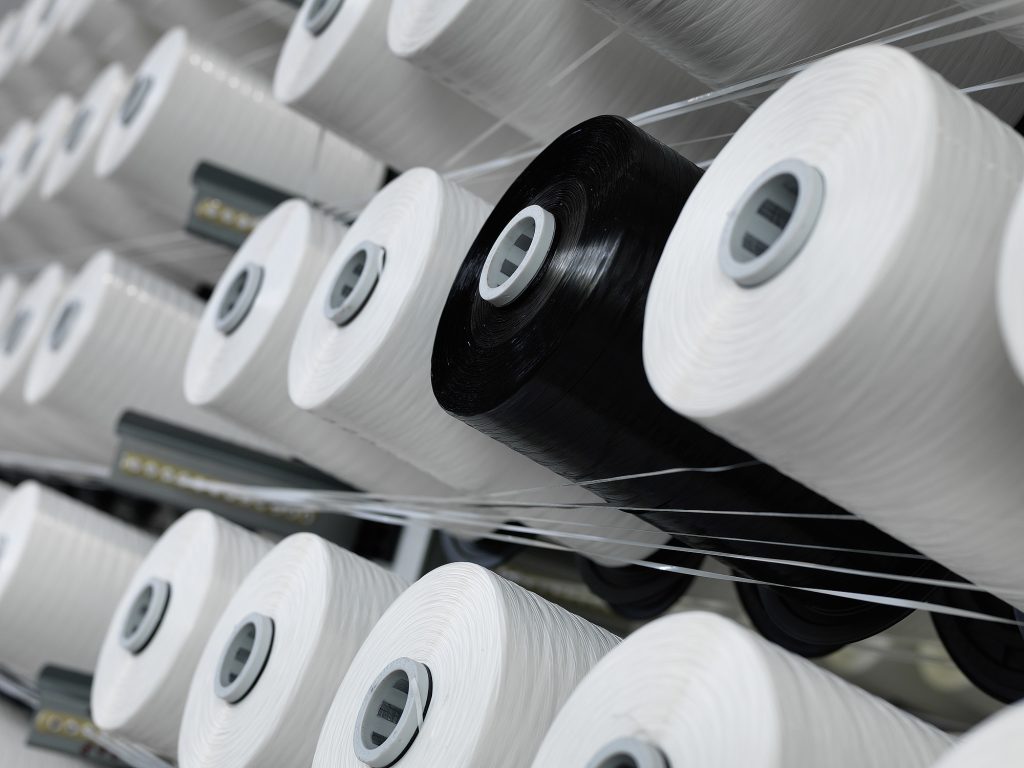
Isotactic PP is extruded as a sheet, slit into tapes, and drawn 5–7× to align chains. Tapes interlace as warp and weft on circular or flat looms. Basis weight (GSM), tape denier, and picks per inch (PPI) set tensile/tear curves and air permeability. Higher PPI reduces dust emission; higher denier resists puncture from angular solids.
2) BOPP face film
Biaxially oriented PP (typically 15–25 μm) offers gloss, stiffness, and flatness. Graphics are usually reverse‑printed on the inner face so inks are protected beneath the film. Variants include matte BOPP for paper‑like tactility, anti‑scuff coatings for rough routes, and white‑pigmented BOPP to hide weave show‑through.
3) Tie and adhesive system
Extrusion coating lays down molten polyolefin between film and fabric; adhesive lamination (often polyurethane) creates strong bonds at low gauge. PP‑based tie resins keep mono‑material pathways open. Bond strength and cure dictate downstream seal temperatures and curl control.
4) Inner sealing skins
Co‑extruded skins (10–40 μm) deliver hot‑tack and peel strength. PP‑rich skins preserve mono‑PP integrity; PE‑rich skins widen the sealing window for colder jaws. Micro‑texture bands tune coefficient of friction (COF), balancing belt speed and pallet stability.
Cost perspective. Unit price scales with fabric GSM, denier/PPI, BOPP thickness, adhesive chemistry, and print complexity. Total cost per ton handled often falls, however, because BOPP Woven Bags cut dust, stabilize pallets, and lower returns. In short: slightly higher bag price, lower system cost.
One‑sentence anatomy
Oriented PP fabric for strength, BOPP film for graphics and surface control, a tie for cohesion, and a sealing skin for clean closures—that is a modern BOPP Woven Bag.
Signature Features of BOPP Woven Bags
- High mechanical resilience at low mass: woven architecture arrests tear propagation and resists puncture from angular solids such as fertilizer prills, salt, or PET flakes.
- Retail‑grade print that survives distribution: reverse‑printed BOPP keeps artwork under film, protecting brand colors and safety icons from scuff.
- Moisture governance and cleanliness: encapsulated yarns shed less dust; sealable skins support dust‑tight closures.
- Pallet efficiency: block‑bottom and disciplined length control create brick‑like geometry for stable, dense stacks.
- Automation‑friendly: smoother faces and consistent calipers improve form, fill, seal, and pick‑and‑place at speed.
- Mono‑material pathways: PP fabric + BOPP + PP ties/skins align with polypropylene recovery streams where available.
Strength → Fewer ruptures
By placing stiff but brittle elements near the neutral axis and surrounding them with ductile layers, laminates disperse stress and resist crack growth through bends and drops.
Graphics → Durable communication
Reverse printing protects inks; hazard pictograms and QR codes remain legible, supporting traceability and stewardship.
Friction → Stability with speed
COF zoning—low on running faces, higher at contact bands—allows fast conveyors without sacrificing stack stability.
Production Techniques for BOPP Woven Bags: From Tapes to Finished Sacks
- Polymer preparation. Choose PP grades, optionally with qualified post‑industrial or post‑consumer content; dose UV, slip, antiblock, antistatic, and color masters.
- Tape extrusion & orientation. Extrude sheet, slit tapes, and draw 5–7×; target denier and modulus; reclaim edge trim to support circularity.
- Weaving. Interlace warp and weft on circular or flat looms to specified GSM/PPI; control warp tension/humidity for a flat lay.
- Surface activation. Flame or corona treat film/fabric to ≥ 38 dyn/cm; verify with dyne pens or contact‑angle readings.
- Lamination. Extrusion coat polyolefin tie or use polyurethane adhesives to bond reverse‑printed BOPP to the fabric; cure and test bond per F904.
- Functional skins. Co‑extrude inner seal layers; add anti‑slip stripes at layer‑contact zones; confirm COF targets.
- Conversion. Cut, gusset, and form pillow or block‑bottom formats; build valve or open‑mouth sacks; produce tubular rollstock for VFFS.
- Closure engineering. Heat‑seal, sew plus tape‑over, or pinch‑fold; set temperature × dwell × pressure windows; clean sealing jaws on schedule.
- Quality plan. Routine tensile/tear, lamination bond, seal peel, WVTR, COF, drop, and pallet compression; embed SPC on critical parameters.
- Palletization. Select patterns for truck cube; use boards/hoods where outdoor dwell is likely; serialize pallets for traceability.
Process tip
Heat‑seal windows for woven laminates are hotter and narrower than for monolayer film. Maintain jaw cleanliness and log temperature, dwell, and pressure with SPC so peel remains predictable across shifts.
Where BOPP Woven Bags Excel: Cross‑Industry Applications
From fertilizers to resin pellets, from rice to salt, BOPP Woven Bags deliver cleanliness and strength without sacrificing brand presence. Below are representative use cases and the reasons the platform fits.
Fertilizers & soil amendments
Prills and blends demand puncture resistance and UV durability. Anti‑slip bands and strict length control boost pallet stability; reverse‑printed panels carry agronomic guidance intact.
Food & pet nutrition (dry)
Rice, pulses, flour, and pet kibble use BOPP faces for shelf clarity; optional inner skins control grease spotting and reduce powder transfer.
Salts & de‑icers
Moisture‑managed laminates keep bags from going soggy; white‑pigmented BOPP hides show‑through for clean branding after wet handling.
Resin pellets & recyclate
Abrasion‑resistant faces keep labels legible at silos; serialized codes travel through the value chain to support inventory accuracy.
Construction minerals
Cement, mortar, gypsum, and decorative aggregates benefit from rugged walls and predictable stack geometry; dust‑tight closures help job‑site cleanliness.
For closely related structures and design choices, see this concise overview of laminated BOPP woven bags.
System Thinking: From Sub‑Problems to a Unified Spec for BOPP Woven Bags
A reliable specification emerges when you decompose the packaging objective into solvable parts, then recombine the answers. Below are common sub‑problems with practical levers and measurable outcomes.
Containment & cleanliness
Address needle‑path leaks with heat‑sealable skins or tape‑over sewing; optimize dwell and pressure; add liners for very hygroscopic powders. Track visible dust index and grams lost per thousand bags.
Moisture governance
Tune skin thickness and choose BOPP/BOPE faces to meet WVTR targets. Validate at 38 °C/90% RH. Use pallet hooding and yard SOPs where outdoor dwell is likely.
Pallet stability vs conveyor speed
Zone anti‑slip bands only where layers touch to keep inner surfaces slick for fast belts. Confirm with tilt‑table and acceleration tests.
Graphics durability & data
Reverse print under BOPP; pick abrasion‑resistant ink systems; place codes in protected zones. KPI is post‑rub scan rate above 99%.
Synthesis: Define standard families of BOPP Woven Bags per product cluster (fertilizer, seed, feed, salts, resins). For each, lock GSM/denier/PPI, BOPP thickness, seal window, COF targets, and artwork template. Validate on the intended lines and shipping routes; then freeze documents under change control.
Technical Tables for BOPP Woven Bags
Practical Roadmap for BOPP Woven Bags: From RFQ to SOP
- Clarify goals: puncture risk, dust limits, moisture targets, branding, and end‑of‑life claims.
- Select structure: mono‑PP BOPP laminate where feasible; document exceptions and rationale.
- Fix geometry: width/length/gusset for pallet efficiency and ergonomic lifts; decide pillow vs block‑bottom.
- Engineer seals: set temperature × dwell × pressure; guard jaw cleanliness; confirm peel with calibrated fixtures.
- Tune friction: inner/outer COF targets; limit anti‑slip bands to layer contact zones.
- Lock graphics & data: reverse printing, serialized 2D codes, accurate resin identification marks.
- Run trials: measure BPM, dust index, WVTR, drop matrix; adjust GSM, PPI, skin gauge.
- Plan end‑of‑life: bale specs, reclaimer partners, and pathways for trim and returned sacks; track bale purity.
- Publish SOP & train: hold SPC on seals and lamination bonds; clean jaws on schedule; audit scan rates.
- Iterate: dashboard KPIs and feed learnings back into the next revision.
Tip
Use consistent terminology across specifications, RFQs, and product pages so technical language matches how buyers and auditors search and read. Be precise: when claiming mono‑material, list the layers and their polymers.
- What Are BOPP Woven Bags?
- The Materials of BOPP Woven Bags: Resins, Layers, and Roles
- Signature Features of BOPP Woven Bags
- Production Techniques for BOPP Woven Bags: From Tapes to Finished Sacks
- Where BOPP Woven Bags Excel: Cross‑Industry Applications
- System Thinking: From Sub‑Problems to a Unified Spec for BOPP Woven Bags
- Technical Tables for BOPP Woven Bags
- Practical Roadmap for BOPP Woven Bags: From RFQ to SOP
- 1. BOPP Woven Bags in Fertilizer Packaging: Key Applications and Challenges
- 2. Technical Solutions and Material Innovations
- 3. Selecting the Right BOPP Bag: A Buyer’s Guide
- 4. VidePak’s Competitive Edge in Agricultural Packaging
- 5. Frequently Asked Questions (FAQs)
- 6. Future Trends: Smart and Sustainable Packaging
A Dialogue with Industry Experts
Ray, CEO of VidePak: “BOPP woven bags are transforming agricultural packaging in China by addressing critical challenges like moisture control, corrosion resistance, and regulatory compliance. At VidePak, our Starlinger-powered production lines ensure these bags meet the highest global standards, offering farmers and distributors unmatched reliability.”
Dr. Li Wei, Agricultural Packaging Specialist: “The integration of BOPP lamination with PP weaving creates a barrier that combats humidity and chemical degradation—essential for fertilizers. This innovation aligns with China’s push for sustainable, high-performance agricultural solutions.”
This exchange underscores the report’s central thesis: BOPP woven bags are revolutionizing fertilizer packaging through advanced material science and compliance-driven design, positioning companies like VidePak as leaders in a $5.2 billion global market.
BOPP Laminated PP Woven Bags Analysis
Deep dive into the evolution, technology and market growth of BOPP woven bags in China’s packaging industry.
Check More →Printed BOPP Woven Bags
Advanced printed BOPP woven bags representing the future trend of China’s innovative packaging solutions.
Check More →Laminated BOPP Woven Bags
High-performance laminated BOPP woven bags driving the modernization of China’s industrial packaging sector.
Check More →Custom Printed BOPP Bags
Customized BOPP woven bags leading the future development and branding trends in China’s packaging industry.
Check More →1. BOPP Woven Bags in Fertilizer Packaging: Key Applications and Challenges
BOPP (Biaxially Oriented Polypropylene) woven bags combine PP fabric’s tensile strength with BOPP film’s barrier properties, making them ideal for fertilizers and agrochemicals.
1.1 Critical Performance Requirements
- Moisture Resistance: Fertilizers like urea and ammonium nitrate are hygroscopic. BOPP lamination reduces water vapor transmission to ≤5 g/m²/day, preventing caking and nutrient loss.
- Corrosion Resistance: Composite fertilizers (e.g., NPK blends) release corrosive gases. VidePak’s BOPP/PE laminated bags resist pH levels as low as 2.5, ensuring 18+ months of shelf life.
- Heat Dissipation: Exothermic reactions in bulk storage are mitigated via breathable valve designs, reducing internal temperatures by 8–12°C.
Case Study: A Jiangsu-based fertilizer producer reduced spoilage rates by 22% after switching to VidePak’s BOPP laminated bags with PE liners.
2. Technical Solutions and Material Innovations
VidePak’s engineering addresses industry-specific demands through tailored designs.
2.1 Multi-Layer Structural Design
- Outer Layer: 90–120 GSM PP fabric for puncture resistance (≥8 N/mm² tensile strength).
- Middle Layer: 18–25 micron BOPP film for UV and moisture barriers.
- Inner Layer: 50–80 micron PE coating or detachable liner for leak-proof containment.
Table 1: BOPP Bag Configurations for Fertilizer Types
| Fertilizer Type | Structure | Key Features |
|---|---|---|
| Urea | PP/BOPP/PE | Anti-caking, ≤3% moisture absorption |
| NPK Blends | PP/BOPP/Aluminum Foil | Gas barrier, pH resistance |
| Organic Compost | PP/BOPP (Breathable) | Micro-perforations for aeration |
2.2 Compliance with Global Standards
- EU (EN 277:2015): Requires ≥4.5 N/mm² seam strength and ≤0.1% leakage under 2-hour compression tests.
- US (ASTM D5260): Mandates UV stability for 500-hour exposure without >10% tensile loss.
- China (GB/T 8946-2022): Specifies 10×10 weave density and 55–230 GSM fabric weight for agro-use.
VidePak’s ISO 9001-certified quality systems ensure adherence to these benchmarks, supported by Starlinger’s automated looms and lamination lines.
3. Selecting the Right BOPP Bag: A Buyer’s Guide
Farmers and distributors must evaluate parameters based on fertilizer properties and logistics.
3.1 Parameter Optimization
- Thickness: 0.15–0.25 mm for heavy-duty fertilizers (e.g., DAP); 0.10–0.15 mm for lightweight organics.
- Load Capacity: 25–50 kg bags require 12×12 weave density and 120 GSM fabric.
- Closure Systems:
- Valve Bags: Ideal for automated filling; reduces dust by 30%.
- Sewn Mouth Bags: Cost-effective for manual handling.
3.2 Regional Certification Priorities
| Region | Key Certifications | Focus Areas |
|---|---|---|
| EU | REACH, EN 277 | Chemical safety, recyclability |
| USA | ASTM D5260, USDA BioPreferred | UV resistance, biodegradability |
| Japan | JIS Z 1539 | Precision seam strength |
4. VidePak’s Competitive Edge in Agricultural Packaging
With 16 extrusion lines and 30 lamination machines, VidePak produces 15 million BOPP bags monthly, serving 50+ countries.
4.1 Case Study: Export Success in Southeast Asia
A Thai importer of NPK fertilizers reported a 40% reduction in transit damage after adopting VidePak’s aluminum-foil laminated bags, which exceed JIS Z 1539’s seam strength requirements by 15%.
4.2 Sustainability Initiatives
- Recyclability: VidePak’s mono-material PP bags achieve 95% recyclability, aligning with EU Circular Economy Action Plan targets.
- Waste Reduction: Production scraps are repurposed into non-woven agrotextiles, diverting 500+ tons/year from landfills.
5. Frequently Asked Questions (FAQs)
Q1: How does BOPP lamination enhance moisture resistance compared to standard PP bags?
Answer: BOPP’s crystalline structure reduces moisture permeability by 80%, critical for hygroscopic fertilizers like ammonium sulfate.
Q2: What certifications should I prioritize for exporting to Europe?
Answer: Focus on EN 277 for mechanical strength and REACH for chemical compliance. VidePak’s bags are pre-certified for both.
Q3: Can BOPP bags withstand prolonged UV exposure in tropical climates?
Answer: Yes. UV-stabilized BOPP films retain >90% tensile strength after 1,000 hours of exposure, per ASTM G154.
6. Future Trends: Smart and Sustainable Packaging
- Smart Tags: RFID-enabled bags for real-time moisture and temperature monitoring (piloted in VidePak’s 2025 lineup).
- Bio-Based BOPP: Partnerships with biopolymer startups aim to replace 30% of fossil-based PP with PLA by 2027.
Final Insight
As Ray of VidePak notes, “The future of agricultural packaging lies in marrying durability with sustainability.” By leveraging advanced materials and global certifications, BOPP woven bags are poised to dominate China’s agro-packaging sector.
External Resources:
- Explore how moisture-proof BOPP bags enhance fertilizer storage.
- Learn about high-efficiency production with Starlinger in woven bag manufacturing.
This report synthesizes technical data, regulatory insights, and VidePak’s operational excellence to outline the transformative role of BOPP woven bags in modern agriculture.