

What are FIBC Bags for Animal Feed Packaging?
In essence, FIBC Bags for Animal Feed Packaging are flexible intermediate bulk containers built to carry substantial volumes of feed ingredients—grains, meals, pellets, additives, premixes—through intake, blending, pelleting, storage, and distribution with minimal product loss and consistent hygiene. Their architecture is deceptively simple: woven polypropylene fabric that resists tearing; engineered seams that keep fines in; lift loops that make forklifts and hoists your allies; filling and discharge features that keep dust where it belongs; and, when needed, a food-contact liner that protects quality against moisture, oxygen, or aroma transfer. The real secret is the combination: a light body that is strong, a large capacity that is maneuverable, a tough bag that still treats delicate feed gently.
Ask a mill supervisor what these containers do, and you may hear: they reduce housekeeping. Ask a quality manager: they preserve nutrients and prevent cross-contamination. Ask a logistics planner: they increase cube efficiency and lower freight cost. Three perspectives, one conclusion—when selected and specified carefully, FIBC Bags for Animal Feed Packaging are not merely carriers; they are process tools.
- Bulk Bags
- Big Bags
- Jumbo Bags
- Super Sacks
- Tonne Bags
- Flexible Intermediate Bulk Containers (FIBC)
- Form-stable Baffle Bags (Q-Bags)
- Food-grade Bulk Bags
Materials and Construction: What are FIBC Bags for Animal Feed Packaging Made Of?
FIBC Bags for Animal Feed Packaging are composites where each part contributes a function that the others cannot. The following breakdown covers the body fabric, lifting system, inlets and outlets, liners, seams, and optional baffles—plus the invisible scaffolding of labels and traceability. The aim is not trivia; it is specification fluency.
Core Characteristics: What are the Features of FIBC Bags for Animal Feed Packaging?
Feature lists are only useful when they direct decisions. The items below highlight trade-offs and triggers—what to specify, when, and why.
Manufacturing Flow: What is the Production Process of FIBC Bags for Animal Feed Packaging?
Production looks like a compact textile operation fused with specialized conversion and food-program hygiene. The highlights below show where most performance is won or lost.
- Tape extrusion & drawing — PP resin becomes sheets, then tapes. Draw ratio determines tenacity and shock tolerance; melt filtration keeps gels from becoming tear starts; UV stabilizers are blended as needed.
- Weaving — Circular or flat looms knit tapes into panels or tubes. Pick density, tape width, and tension profiles control GSM and stiffness.
- Cutting & printing — Panels are cut; graphics and trace panels are applied using inks compatible with destination rules. Sharp registration helps ID and branding survive the road.
- Sewing & seam engineering — Loops, baffles, reinforcement patches, and spouts are sewn. Stitch type and density serve the SWL/SF target; filler cords are added where fines pose risk.
- Liner manufacture & integration — Mono or multilayer films emerge as lay-flat or form-fit liners. Attachment can be tabbed, glued, or spout-to-spout; compatibility with static class is essential.
- Inspection & type testing — Dimensions, loop symmetry, seam integrity, and print legibility are screened. Load, top-lift, stacking, and drop tests validate the class; static protection is verified for Type C/D designs.
- Hygiene controls — Segregated areas, pest control, foreign matter barriers, garment rules, and micro-particulate management keep the bags clean for feed programs.
Use Cases: What is the Application of FIBC Bags for Animal Feed Packaging?
Because FIBC Bags for Animal Feed Packaging scale well and customize easily, they appear across the value chain—from raw intake to finished goods dispatch, from micro-ingredients to pellets. The diversity is not noise; it is proof of fitness.
- Mills and integrators receiving soy meal, distillers’ grains, or corn gluten; staging micros; moving pellets to regional hubs where totes beat tankers on flexibility.
- Premix and additives that demand oxygen control, dust tightness, and immaculate lot traceability.
- Seed and specialty grains where kernel integrity and low-damage handling are worth the geometry discipline of baffles.
- Aquafeed and pet food sensitive to fats and oxidation; barrier liners maintain flavor and nutrition while static protection manages ignition risk.
- Export logistics where low tare weight and 6:1 safety factors survive multi-leg moves and inconsistent handling regimes.
A Structured Buyer’s Analysis: Choosing the Right Bulk Bags for Your Needs
Selection is not about browsing a catalogue; it is about aligning risk with control. Translate product behavior, regulatory jurisdiction, equipment realities, environmental exposure, and economics into concrete specification choices. The following grid moves from questions to levers to measurable outcomes.
| Question | Specification Lever | Evidence of Success |
|---|---|---|
| Does the product form combustible dust? | Type C (grounded) or Type D static class; operator training | Documented grounding checks; incident-free near-miss logs |
| Is moisture/oxygen a driver of defects? | EVOH or aluminum-laminate liners; seal QA | MVTR trend improvements; lower clumping and rancidity complaints |
| Are aisles tight or stacks unstable? | Baffle bodies; fill-height governance; pallet COF targets | More stacks per bay; fewer topple reports |
| Do fines leak and contaminate stations? | Sift-proof seams; spout-to-spout liner integration; extraction hoods | Lower housekeeping hours; improved swab results |
| Is reuse part of your cost model? | 6:1 or 8:1 safety factor; inspection and retirement criteria | Extended tote life without safety incidents |
System Thinking: Break the Big Problem into Solvable Modules
When you split a complex packaging decision into modules, patterns emerge. Below are six persistent problems and the interventions that reliably move the numbers. Each item pairs observation, action, and verification—because improvement without measurement is just optimism.
Technical Parameters and Configuration Tables
Numbers turn preferences into engineering. The following color-coded tables condense recurring decisions for FIBC Bags for Animal Feed Packaging into scannable references you can paste into vendor RFQs or internal standards.
| Variable | Typical Range / Options | Practical Implication |
|---|---|---|
| Safe Working Load (SWL) | 500–2,000 kg | Match density × volume with handling margins |
| Safety Factor (SF) | 5:1 single-trip; 6:1 reusable; 8:1 heavy-duty reusable | Defines reuse allowance and test thresholds |
| Fabric weight | 130–230 g/m² | Heavier for sharp/abrasive ingredients |
| Construction type | 4-panel, U-panel, circular | Impacts seam count, strength, cost |
| Loop style | Four-loop, cross-corner, full-body | Affects pick speed and load distribution |
| Baffles | None / Corner / Full wall | Controls bulge; improves cube and stack |
| Seams | Overlock, chain, lockstitch + filler cords | Drives sift-proof performance |
| UV stabilization | 6–12 months outdoor (as needed) | Protects fabric in yard staging |
| Area | Options | When to Use |
|---|---|---|
| Inlet | Duffle top, spout top (custom diameter/length), open top, conical | Duffle for versatility; spout for dust control; conical for low-density powders |
| Outlet | Plain, discharge spout, star/pyjama closure, iris | Plain for one-way; spouts for controlled emptying; iris for dosing |
| Liner attachment | Sewn-in, glued tabs, spout-to-spout | Spout-to-spout to keep a closed system |
| Liner Type | Typical Thickness | Barrier Profile | Use Cases |
|---|---|---|---|
| LDPE / LLDPE (mono) | 75–150 µm | Moisture barrier, basic aroma control | General grains, pellets |
| Multilayer PE + EVOH | 90–150 µm | Enhanced oxygen barrier + low MVTR | Fat-rich premixes; oxidation-sensitive actives |
| Aluminum laminate | 100–150 µm | Highest barrier; light/oxygen sensitive | Specialty additives; long-hold exports |
| Class | Meaning | Grounding? | Typical Fit |
|---|---|---|---|
| Type A | No static protection | No | Non-flammable environments and products |
| Type B | Insulating; limited breakdown voltage | No | Powders with low MIE but no flammable vapors |
| Type C | Conductive/groundable | Yes | Combustible dust zones with reliable grounding |
| Type D | Static-protective fabric | No (follow fabric guidance) | Mixed operations; grounding impractical |
Crafting a Complete Specification (RFQ Language You Can Reuse)
Scope: Supply FIBC Bags for Animal Feed Packaging rated SWL 1,000 kg, SF 5:1 unless otherwise noted; construction 4-panel with cross-corner loops. Food contact: PP fabric and liner constituents compliant with destination regulations. Liner 120 µm LDPE, spout-to-spout attachment. Sift-proofing: double-needle lockstitch with filler cord at side and base seams. Static class: Type C for premixes with grounding tabs; instructions for grounding at fill/empty. Baffles: corner baffles for export SKUs. Marking: label each bag with SWL, SF, class, lot, date, test reference. Testing: provide current type-test records and stacking recommendations. Hygiene: manufactured under audited food-safety management with pest control, foreign matter exclusion, and traceability.
Real‑World Trade‑offs and Practical Tips
- Clumping in humid seasons? Upgrade liners before blaming the filler—moisture is subtle and ruthless.
- Leaning pallets? Check fill height relative to base and consider baffles; fabric mass is not the only lever.
- Dust blooms on discharge? An iris valve or star-closure plus extraction will often beat a costly bag redesign.
- Audit fatigue? Pre-negotiate a document packet: resin declarations, liner batch data, type-test certificates, hygiene attestations.
A Short Decision Tree (From Risk to Bag)
- Dusty and combustible? Choose Type C (with strict grounding) or Type D (where grounding is unreliable).
- Moisture or oxygen sensitive? Specify EVOH or aluminum-laminate liners.
- Space constrained or unstable stacks? Select baffles and enforce fill-height rules.
- Valuable fines? Demand sift-proof seams and spout-to-spout lined interfaces.
- Reusing totes? Move to 6:1 safety factor and implement inspection criteria.
Frequently Asked Questions (Focused on Animal Feed)
Q1. Are food‑grade claims the same as “FDA‑approved bags”?
No. There is no such thing as an FDA‑approved FIBC. What matters is that direct-contact components meet the relevant food‑contact regulations and that bags are made under an audited food‑safety system.
Q2. Do liners always need to be virgin resin?
For direct food contact, buyers typically require virgin resin. Recycled content may be used in non‑contact components where allowed by local rules and risk assessment.
Q3. How to choose between Type C and Type D?
If you can guarantee reliable grounding at every fill and empty point, Type C is robust. If not, Type D offers static protection without grounding—provided liner compatibility rules are followed.
Q4. What makes a bag reusable?
The safety factor and your inspection policy. A 6:1 class with clear retirement criteria can safely cycle multiple times in the right applications.
Q5. Why do some totes bulge so much?
Standard bodies belly under load; baffles restrain side walls and return cubic discipline to the pallet.
Implementation Roadmap for a Feed Mill or Premix Plant
- Weeks 0–2 — Requirements capture: confirm bulk densities, flow indices, combustibility, humidity/temperature profiles; map fill and empty equipment.
- Weeks 3–6 — Trials: A/B liners and baffle vs non‑baffle bodies; weigh dust loss; measure fill times; solicit operator feedback.
- Weeks 7–10 — Validation: load/stack tests; verify static class in the intended environment; document hygiene and traceability controls.
- Weeks 11–14 — SOPs: update filling and emptying instructions; implement grounding checks for Type C; set receiving acceptance criteria.
- Weeks 15–18 — Rollout: lock the SKU specification library; train; review KPIs monthly (dust loss, complaints, near‑misses, OEE at fillers).
Keywords and Long‑Tail Variants
Primary keyword appearing throughout: FIBC Bags for Animal Feed Packaging. Long‑tail and near‑synonym phrases included organically: animal feed bulk bags; food‑grade FIBC for premixes; antistatic jumbo bags for feed mills; baffled bulk bags for pellets; sift‑proof big bags for additives; grounded Type C super sacks; static‑protective Type D big bags; EVOH‑lined FIBC for aquafeed; reusable 6:1 safety factor FIBC for integrators.
- What are FIBC Bags for Animal Feed Packaging?
- Materials and Construction: What are FIBC Bags for Animal Feed Packaging Made Of?
- Core Characteristics: What are the Features of FIBC Bags for Animal Feed Packaging?
- Manufacturing Flow: What is the Production Process of FIBC Bags for Animal Feed Packaging?
- Use Cases: What is the Application of FIBC Bags for Animal Feed Packaging?
- A Structured Buyer’s Analysis: Choosing the Right Bulk Bags for Your Needs
- System Thinking: Break the Big Problem into Solvable Modules
- Technical Parameters and Configuration Tables
- Crafting a Complete Specification (RFQ Language You Can Reuse)
- Real‑World Trade‑offs and Practical Tips
- A Short Decision Tree (From Risk to Bag)
- Frequently Asked Questions (Focused on Animal Feed)
- Implementation Roadmap for a Feed Mill or Premix Plant
- Keywords and Long‑Tail Variants
“Why are FIBC bags increasingly replacing traditional packaging in the global animal feed industry?” asked a logistics manager at a recent agricultural trade show. The answer lies in their unmatched load capacity, adaptability to harsh environments, and compliance with modern quality control standards. Flexible Intermediate Bulk Containers (FIBCs) are engineered to safeguard feed integrity, optimize storage, and reduce transportation costs. This report analyzes critical design parameters, manufacturing innovations, and how VidePak leverages Starlinger’s technology to deliver bulk bags that meet the rigorous demands of feed producers worldwide.
1. The Role of FIBC Bags in Animal Feed Logistics
FIBC bags, capable of holding 500–2,000 kg of feed, address three core challenges in the industry:
- Moisture and pest resistance: Multi-layer laminates (e.g., PP/PE or aluminum foil) reduce humidity absorption by 30% and prevent insect infiltration.
- Durability: High-tensile polypropylene (PP) fabric with 12×12 threads/cm² weave density withstands stacking heights of 8 meters, critical for warehouse efficiency.
- Sustainability: 100% recyclable PP aligns with EU Circular Economy targets, reducing landfill waste by 50% compared to single-use alternatives.
Anti-Bulge FIBC Bulk Bags
Sturdy FIBC bags ideal for animal feed bulk packaging, offering high weight capacity and long-lasting durability.
Check More →FIBC Jumbo Bag Solutions
Customizable FIBC jumbo bags designed for safe, efficient animal feed storage and transportation needs.
Check More →FIBC Jumbo Bag Production
Professional manufacturing process ensures food-safe, reliable FIBC bags for animal feed packaging applications.
Check More →Heavy-Duty Woven Bags Guide
Complete guide to heavy-duty FIBC and woven bags optimized for bulk animal feed industrial packaging.
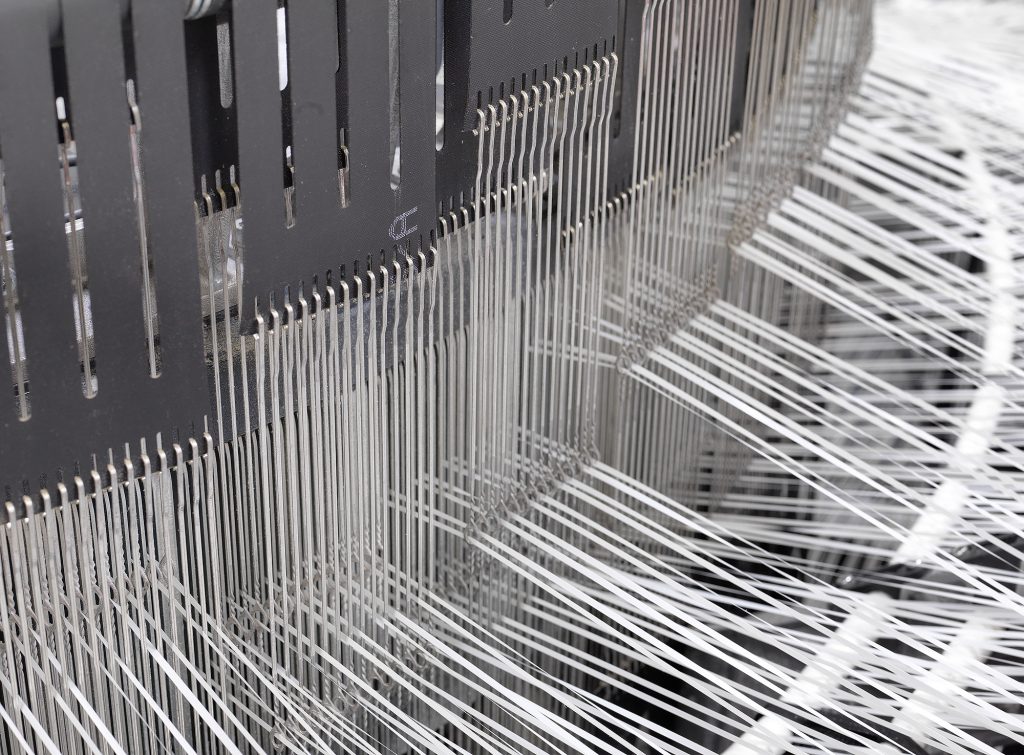
Check More →VidePak’s FIBCs, produced using Austrian Starlinger looms and virgin PP resin, achieve tensile strengths exceeding 1,800 N/5 cm. Their annual output of 10 million bags supports clients like Cargill and Tyson Foods in maintaining feed quality across transcontinental supply chains.
2. Quality Control and Standardization: Preventing “Bursting” Risks
Feed packaging demands precision to avoid catastrophic failures. VidePak’s manufacturing process ensures:
- Material consistency: Virgin PP pellets with a melt flow index (MFI) of 3–5 g/10 min guarantee uniform thickness (120–150 g/m²) and zero weak spots.
- Positive tolerance design: Bags are engineered to hold 10–15% above stated capacity, preventing rupture under dynamic loads.
- Hourly testing: Starlinger’s automated systems conduct real-time checks for seam strength (>250 N/cm) and UV resistance (1,500+ hours under ISO 4892-3).
Case Study: A 2024 project for a Brazilian poultry feed producer utilized VidePak’s anti-bulge FIBC bags with cross-stitched baffles, reducing transportation damage by 40% and saving $250,000 annually.
3. Customization Options for Diverse Feed Requirements
Key FIBC Configurations
| Type | Features | Best For |
|---|---|---|
| Ventilated | Breathable fabric strips (5–10 mm gaps) | Pelleted feed requiring airflow to prevent mold |
| Anti-static | Carbon-coated PP (surface resistivity <10^9 Ω) | Feed mills with combustible dust risks |
| Reinforced baffle | Internal baffles for shape retention | High-moisture feeds like soybean meal |
| UV-stabilized | BOPP lamination with UV inhibitors | Outdoor storage in tropical climates |
FAQs
Q1: How to choose between PE liners and aluminum foil?
A: PE liners suit moisture-sensitive feeds (e.g., fishmeal), while aluminum foil is mandatory for volatile additives like vitamin premixes.
Q2: Does printing affect recyclability?
A: VidePak’s solvent-free flexographic inks are ISO 14001-certified, ensuring full recyclability without compromising colorfastness.
Q3: What’s the lifespan of a typical FIBC bag?
A: Under proper conditions, VidePak’s UV-stabilized bags retain 90% strength after 5 years, supporting 8–10 reuse cycles.
4. VidePak’s Manufacturing Edge: Technology Meets Scale
Founded in 2008, VidePak combines legacy expertise with cutting-edge infrastructure:
- Production capacity: 100+ Starlinger circular looms and 30 lamination machines enable 24/7 production of 50,000+ bags monthly.
- Custom printing: 10-color rotogravure presses embed QR codes for traceability, critical for EU Feed Hygiene Regulation compliance.
- Global certifications: ISO 9001, BRCGS, and FDA 21 CFR 175.300 ensure market access across 60+ countries.
A 2023 collaboration with a Dutch feed mill showcased RFID-enabled FIBCs, reducing inventory errors by 25% through real-time tracking.
5. Future Trends: Smart Packaging and ESG Alignment
Emerging innovations include:
- IoT integration: Temperature/humidity sensors alert distributors to spoilage risks, piloted in VidePak’s 2024 smart bag trials.
- Bio-based PP: Partnerships with BASF aim to launch 30% plant-derived PP by 2026, cutting carbon footprints by 20%.
- Self-healing films: Microcapsule technology repairs minor punctures, extending bag lifespan by 50%.
Conclusion
Selecting the right FIBC bag requires balancing load requirements, environmental conditions, and regulatory compliance. VidePak’s fusion of Starlinger’s engineering, rigorous quality control, and smart customization positions it as a leader in feed packaging innovation. As sustainability and digitization redefine logistics, choosing a partner with both technical prowess and ESG commitment is no longer optional—it’s imperative.
For deeper insights, explore anti-bulge FIBC solutions and sustainable bulk bag practices.