
What Are FIBC Bags and Why the Term Still Matters?
FIBC Bags (Flexible Intermediate Bulk Containers) are large-capacity industrial containers constructed from woven polymer fabrics, purpose-built for transporting and storing dry, flowable products such as powders, pellets, flakes, granules, and seeds in typical loads ranging from 500 kg to 2,000 kg. By combining a high-tenacity woven shell with engineered lifting systems, tailored filling and discharge features, and optional barrier liners, FIBC Bags deliver a distinctive triad of strength, flexibility, and operational efficiency. In supply chains where uptime is money and cleanliness is safety, these containers bridge the gap between small sacks and rigid bins—lighter than drums, more stackable than bales, more adaptable than crates.
Also known as (aliases):
- Bulk bags
- Big bags
- Jumbo bags
- Super sacks
- Q‑bags or baffle bags (form‑stable variants)
- Square FIBCs (form‑stable family)
- Conductive Type C bulk bags
- Static‑dissipative Type D FIBCs
Why now? Over the past 12 months, engineering guidance on stacking and filling height has sharpened and circular‑economy policies have accelerated. In parallel, liner technology has matured: seven‑layer coextruded films deliver improved moisture and oxygen control, while antistatic and even conductive options address powder safety. In short, the state of the art caught up with the everyday problems FIBC Bags were invented to solve.
The Materials of FIBC Bags — What They Are, Why They’re Used, How the Stack Works
An FIBC is less a “bag” than a material system. Each constituent—shell, faces, liner, lifting webbing, closures—performs a specific role, and mis‑specifying any one can ripple through uptime, safety, and cost. Think of the construction as a layered stack: load‑bearing shell → faces/coatings → liner (optional) → lifting system → closures and accessories → print and marking. When these layers harmonize, FIBC Bags feel inevitable; when they fight, everything feels difficult.
1) Woven Polypropylene (PP) Body Fabric
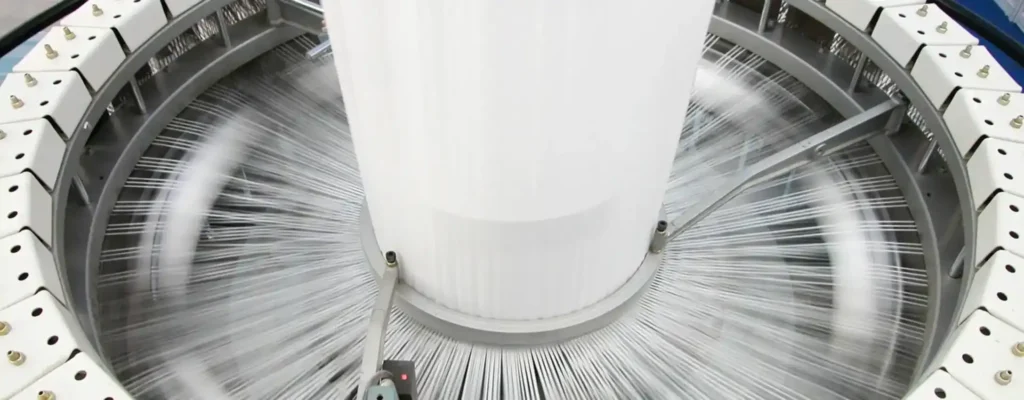
Polypropylene pellets are melted, cast as thin film, slit into narrow tapes, then drawn to orient polymer chains. These oriented tapes are woven on circular or flat looms into fabric. For 1,000–1,500 kg SWL (safe working load) FIBC Bags, body weights commonly fall in the 160–230 g/m² range for single‑trip models; multi‑trip builds step up to heavier GSM and localized reinforcements.
- Chosen for high tensile‑to‑weight, low water uptake, and abrasion tolerance.
- Reinforcement zones at corners and bases counter end‑drops and fork‑tip shocks.
- Cost levers: resin index (virgin vs. rPP blends), tape denier (yield), loom efficiency, and additive packages (UV, slip, antistatic).
2) Exterior Faces & Coatings
Faces set coefficient of friction (bag‑to‑bag), govern scuff behavior, and influence print durability. Options include thin PP/PE extrusion coatings, BOPP laminates for high‑fidelity graphics, and paper‑laminated faces where tactile friction or paper aesthetics are desired.
- Matte BOPP or anti‑slip varnish often reduces wrap consumption by increasing COF.
- Paper faces enhance handling friction but complicate plastic‑only recycling.
- Cost levers: film gauge & color count; paper basis weight & varnish; one‑ vs. two‑sided treatment.
3) Liners & Seven‑Layer Coextruded Films
Loose or attached liners—LDPE/LLDPE, HDPE, PP, or multilayer—control vapor and oxygen ingress and keep fines contained. The advanced tier: five‑ to seven‑layer coextrusions using EVOH for oxygen barrier, polyolefins for moisture control, optional polyamide for toughness, and antistatic or conductive layers for powder safety.
- Form‑fit liners match the FIBC geometry, avoiding pleat zones where product collects.
- Attached liners improve hygiene and line speed; loose liners reduce unit cost and simplify reuse loops.
- Cost levers: layer mix, barrier resin content, film gauge (typically 60–120 µm for dry goods), and antistatic packages.
4) Lifting Systems & Accessories
High‑tenacity PP or polyester webbing is stitched into side seams (corner loops), across corners (cross‑corner loops), or configured as tunnel sleeves for forklifts. Stitch density and patterns (box‑and‑cross, bar‑tack) spread loads and resist tear initiation.
- Longer, stiffer loops speed crane hooks; tunnel sleeves speed forklifts.
- Wear pads prevent scuff at frequent contact points.
- Cost levers: webbing denier, loop length, sewing time, abrasion overlays.
5) Static‑Protective Options
Static class is independent of geometry. Type A for non‑flammable products; Type B where propagating brush discharges must be avoided; Type C with conductive grids that require grounding; Type D with dissipative fabrics that bleed charge to air without a direct ground. Liners can mirror these behaviors via antistatic or conductive layers.
6) Closures & Discharge
Fill options include open top, spout top, and full duffle; discharge options span flat bottom, discharge spout, and full‑open bottoms with petal closures. Skirts and ties contain fines. The right pairing cuts changeovers, reduces dust, and accelerates throughput—turning FIBC Bags into a speed asset rather than a constraint.
Key Features That Change Daily Outcomes
Features only matter when they move the needle on uptime, hygiene, and cost. What follows links attributes to measurable effects in mills, recyclers, and chemical plants—so that FIBC Bags are justified not by adjectives but by metrics.
- Form stability and cube utilization: Baffle panels or form‑stable weaves hold a square footprint after fill, increasing storage density and container payloads without altering footprint. Less creep, straighter stacks, calmer warehouses.
- High strength at modest tare: Oriented PP tapes deliver tensile and tear performance without drum‑like mass. Targeted bottom GSM and corner reinforcements resist puncture from angular media.
- Moisture and oxygen moderation: With laminates and seven‑layer liners, FIBC Bags achieve WVTR/OTR levels suitable for sensitive powders—dampening caking, preserving flavor/aroma precursors, and reducing rework.
- Static safety choices: Type C (grounded) or Type D (dissipative) unlocks speed where combustible dusts once forced caution. Fewer nuisance trips, fewer shutdowns, more stable BPM at the filler.
- Line cleanliness and speed: Correct spouts, de‑aeration paths, and mouth stability cut reseats and dust. Skirted liner mouths capture fines; operators spend more time running and less time sweeping.
- Clear markings and traceability: Visible SWL, safety factor, static class, and QR/datamatrix zones make audits dull—in the best way.
- Reuse in controlled loops: 6:1 or 8:1 builds, paired with inspection and cleaning SOPs, replace “single‑trip” with “right‑trip.” When reuse is impractical, mono‑polymer designs aid mechanical recycling.
How FIBC Bags Are Produced — From Pellet to Pallet
Manufacturing is a chain of tolerances. Each station either tightens control or magnifies risk. The smoothest operations write their success in the details: denier accuracy, baffle window geometry, seal windows, print rub resistance. Get these right and FIBC Bags behave like loyal equipment rather than consumables.
- Tape extrusion and drawing. PP pellets plus UV/antistatic masterbatches are melted, cast, slit into tapes, then drawn to raise tensile strength. Denier variance here reappears later as seam failures or uneven tear behavior. In Type C fabrics, conductive yarns or tapes are introduced to establish a continuous grid.
- Weaving. Circular or flat looms set GSM and picks per inch. For form‑stable bodies, weave patterns create load paths that mimic baffle restraint. Otherwise, standard body panels and separate baffle panels are produced (with laser‑cut or die‑cut windows sized to particle behavior).
- Coating and lamination. Extrusion coatings reduce sifting and establish weldable interfaces. Adhesive or extrusion lamination bonds BOPP or paper faces for print, scuff control, and friction.
- Printing and marking. Art and regulatory panels are printed on film or paper webs pre‑lamination for fidelity. Quiet zones for machine‑readable codes are placed outside conveyor scuff paths.
- Cutting, baffle prep, and sewing. Body panels are cut to tolerance; baffles are cut with window geometry tuned to aeration and flow. Multi‑row seams join panels; dense box‑and‑cross patterns secure lifting points.
- Liner fabrication and fitment. Tubular, gusseted, or form‑fit liners—sometimes seven‑layer—are extruded and cut. Attached liners are heat‑tacked at alignment points; conductive/antistatic liners are oriented and verified.
- Finishing and inspection. Spouts, skirts, and closures are installed; dimensions, seam strength, top‑lift cycles, drop tests, compression dwell, COF, static performance (when relevant), and liner seal checks are completed. Traceability marks (SWL, safety factor, static class, date codes) are printed.
Applications That Reward the Format
FIBC Bags thrive wherever bulk solids dominate and the cost of a spill, a lean, or a delay is real. The categories differ, but the dials repeat: geometry for stack, friction for stability, liners for barrier, static class for safety.
- Food ingredients & nutraceuticals: sugar, starch, proteins, vitamins, spices. Hygiene and oxygen control drive seven‑layer liners with EVOH cores; antistatic management protects against dust ignition.
- Feed & agriculture: grains, pellets, premixes, seeds. Moisture moderation, UV‑ready storage in yards, and robust discharge spouts to mate with augers are typical asks.
- Chemicals & minerals: pigments, TiO₂, calcium carbonate, potash, salts. Abrasion resistance and static management matter; tight coatings/liners limit sifting.
- Construction powders: cement, gypsum, dry mortar. Form‑stable bodies keep pallets square; reinforced bases endure angular aggregates.
- Recycling & waste: PET flakes, HDPE regrind, glass cullet, RDF/SRF pellets. Square geometry maximizes container payloads; liners manage odor and fines; static class selection addresses dust risk.
- Specialty & regulated: where UN codes apply, construction and testing are prescribed; anti‑bulge geometry and barrier liners are layered in as needed.
Versatile Designs Meet Seven‑Layer Coextruded Films
The phrase may sound grand, but the problem it solves is ordinary: different products need different behaviors, yet one site must run them all. Geometry (U‑panel, circular, four‑panel, baffle), static class (A/B/C/D), loop style, and spout configuration give the outside of FIBC Bags their personality. Coextrusion gives the inside its voice—one liner, many functions: oxygen barrier, moisture control, mechanical toughness, sealability, electrostatic behavior. These two levers—outer design and inner film—create a practical palette for real factories.
Consider a starch processor exporting both food‑grade and industrial grades. The outer format stays constant—a baffle FIBC Bags body for square stacks and repeatable container planning. The liner changes: a seven‑layer EVOH core for oxygen‑sensitive food starch; a simpler antistatic PE liner for industrial stock. Same pallet pattern, same forklift ballet, different barrier economics.
Specification Tables — Engineering Starting Points
| Material profile | Recommended format | Body GSM | Exterior face | Liner strategy | Static class | Notable options |
|---|---|---|---|---|---|---|
| PET flakes (0.7–0.9 t/m³) | Baffle/form‑stable Q‑bag | 180–200 g/m² | Matte, anti‑slip face | 70–90 µm EVOH seven‑layer (form‑fit) | Type A/B (Type C if dust classified) | Duffle top; discharge spout; tunnel sleeves |
| HDPE regrind (dusty) | Q‑bag, coated fabric | 170–190 g/m² | Matte BOPP or coated PP | 60–80 µm antistatic liner; skirted mouth | Type B (C/D if explosive dust) | Dust skirt; monitored ground clamps (Type C) |
| Glass cullet (1.2–1.5 t/m³) | Q‑bag with wear patches | 200–230 g/m² | Scuff‑resistant matte face | Optional simple PE liner | Type A | Reinforced base; corner wear pads |
| Oxygen‑sensitive powders | Any stable geometry; liner is key | 170–200 g/m² | Cleanable matte face | 70–120 µm seven‑layer EVOH (form‑fit) | Type B/C/D per hazard | Hygienic seams; rub‑resistant label varnish |
| RDF/SRF pellets (odor) | Q‑bag; odor‑managed liner | 170–190 g/m² | Matte face | 80–100 µm coex liner + skirt | Type B (C/D if dust risk) | Petal closure; skirted mouth |
| Food sugar/starch (export) | Square FIBC; form‑fit liner | 180–210 g/m² | Smooth, high‑contrast print face | 80–100 µm seven‑layer EVOH | Type B/C per zoning | Hygienic seams; validated barcode zones |
| Parameter | Typical target/window | Why it matters |
|---|---|---|
| Seam strength (sewn) | ≥ 300 N per 10 cm (program‑specific) | Avoids split seams under conveyor drops |
| Stack compression dwell | No failure at specified top‑load/time | Sets safe stack height and container cube |
| Valve/liner leak rate | Within target (e.g., < 0.5% sift/24 h) | Pallet hygiene and product loss control |
| Bag‑to‑bag COF | 0.35–0.55 | Stack stability and wrap reduction |
| Print rub resistance | Pass after simulated conveyor cycles | Label durability and compliance |
| OTR/WVTR (liner coupons) | Per product oxygen/moisture needs | Shelf life and anti‑caking performance |
| Static performance | Meets class spec (C grounded, D dissipative) | Ignition risk control in powder operations |
Systems Thinking — Break the Decision, Then Recombine
To specify FIBC Bags with confidence, decompose the problem into six subsystems—integrity, mechanics, operations, compliance, sustainability, cost—and then assemble a design that balances all six. The method is simple, the outcomes are not.
1) Integrity
Humidity and oxygen degrade powders; fines migrate and contaminate neighbors. Choose coatings and liners to hit WVTR/OTR targets for climate and dwell. Use skirted or duffle liner mouths where odor matters; tighten seam designs where sifting shows up in sweep logs.
2) Mechanics
Pallets lean; bases fail; corners abrade. Increase GSM at base; add wear pads; adopt baffle geometry to keep edges inside pallet boundaries; tune COF with matte or anti‑slip faces.
3) Operations
Reseats, dust alarms, mouth collapse: match spout diameters, pre‑crease mouth panels, and size vent paths for peak BPM. Add tunnel sleeves where forklifts dominate; longer loops where cranes rule.
4) Compliance
Align your language and tests with the current standard. Post fill‑height guidance (e.g., no more than twice the shortest base dimension) right at the filler. Reserve high‑contrast zones for labels; test rub resistance after conveyor exposure.
5) Sustainability
Implement closed‑loop reuse with 6:1 or 8:1 builds and documented inspection where routes are predictable. Elsewhere, prefer mono‑polyolefin architectures and mark end‑of‑life pathways clearly.
6) Cost‑to‑Serve
Model avoided loss—fewer burst failures, less caking, higher container payloads, reduced wrap, lower housekeeping—and compare against unit price. The cheapest bag often costs the most to run.
Practical Risk Register — Symptom → Likely Cause → Fix
- Leaning pallets in storage → COF too low; bulge exceeds pallet edge; wrap recipe off → specify matte faces or anti‑slip varnish; adopt form‑stable bodies; adjust wrap and add corner boards.
- Excess dust at filler → undersized vent area; unskirted liner mouth; spout mismatch → increase baffle windows or micro‑perfs; add skirted mouth; match and clamp spouts.
- Under‑payload in containers → conservative stack height; bulging reduces grid → tighten form‑stability spec; validate higher layer count with compression tests; re‑grid pallet layout.
- Liner slump/snags on discharge → loose liner without tacks; poor form fit → heat‑tack at alignment points; shift to form‑fit liners; raise liner gauge in lower third.
- Static alarms or near‑miss events → poor ground contact (Type C) or wrong class → use monitored ground clamps; clean contact points; consider Type D where grounding is unreliable.
- Baffle blow‑outs → stitch density too low; baffle GSM under‑spec → increase stitch density; upgrade baffle fabric; consider form‑stable weaves to reduce seam count.
Worked Cost‑of‑Quality Lens
A recycler moves 1,000 kg PET flakes per unit. Switching from standard four‑panel to baffle FIBC Bags with matte faces and form‑fit seven‑layer liners raised container payload about a fifth in a typical lane and trimmed stretch‑wrap use by roughly a fifth. Skirted liner mouths cut sweep time at the filler. Even with a modest unit premium, freight normalization, rework avoidance, and housekeeping savings drove a lower total cost‑to‑serve. The geometry paid; the film whispered; the spreadsheet agreed.
RFQ Checklist — Copy, Paste, Fill the Blanks
- Format: FIBC Bags — U‑panel / circular / four‑panel / baffle (circle one).
- Dimensions (L × W × H): ____ × ____ × ____ mm; target fill height ≤ 2 × shortest base dimension.
- SWL and safety factor: ____ kg at ____:1 (5:1 single‑trip; 6:1 or 8:1 for closed‑loop multi‑trip or heavy duty).
- Body fabric: ____ g/m²; bottom panel: ____ g/m²; UV package: ____ hours.
- Exterior face: coated PP / matte BOPP / gloss BOPP / paper‑laminated; target COF: ____.
- Liner: none / loose / attached / form‑fit; gauge ____ µm; seven‑layer barrier (yes/no); EVOH core (yes/no); antistatic or conductive layer (specify).
- Static class: Type A / B / C / D; grounding hardware required (for Type C): yes/no.
- Loops: corner / cross‑corner / tunnel sleeves; loop length ____; webbing spec ____.
- Fill: plain / spout / duffle (size ____); Discharge: flat / spout / full‑open bottom; dust skirt (yes/no).
- Print: ____ colors; high‑contrast regulatory panel (yes/no); rub‑resistant varnish (yes/no); QR/datamatrix zone (yes/no).
- Tests: top‑lift cycles; drop test; compression dwell; COF; static verification; liner seal and leak test; print rub test.
- End‑of‑life plan: closed‑loop reuse (SOP attached) / mechanical recycling (marks added); recycled content target ____% where allowed.
Frequently Asked Technical Questions
Do seven‑layer liners always outperform simpler liners? Not universally. They earn their keep with oxygen‑sensitive foods, odor‑critical fuels, or long‑dwell export routes. For inert minerals or cullet, a simple antistatic PE liner can be plenty.
Are baffle bodies heavier? Slightly, but modern GSM optimization and localized reinforcement keep tare close while stack integrity and payload density rise.
Type C or Type D? Type C is superb where grounding discipline is strong; Type D is pragmatic for mobile or mixed zones. Either path reduces ignition risk and unlocks steadier line speed.
Can FIBC Bags be reused? 6:1 or 8:1 builds can in closed loops with inspection and cleaning SOPs; 5:1 single‑trip constructions should not be reused.
Do paper‑laminated faces undermine recyclability? In polymer‑stream markets, mono‑polyolefin faces are cleaner; paper‑laminated variants make sense where fiber‑plastic separation exists or where extra friction is invaluable. Label end‑of‑life clearly.
Scenario Planning With Seven‑Layer Films — Templates
Oxygen‑Sensitive Foods
Form‑fit seven‑layer liner with EVOH core; matte face for COF; Type B or C per zoning; baffle body for square stacks. This pairing protects flavor chemistry and extends shelf life without re‑engineering pallets.
Combustible Dust, Mobile Filling
Type D fabric body; antistatic seven‑layer liner; humidity control in the fill zone; tunnel sleeves for forklifts. Safety becomes habit, not heroics.
Odor‑Critical RDF/SRF
Q‑bag with attached seven‑layer liner, skirted mouth, petal closure, matte face; compression dwell tests set stack height. Odors contained, payload maximized.
Heavy, Angular Media
Form‑stable body with reinforced base and corner pads; optional simple PE liner; Type A class; wear resistance first, everything else after.
A Compact Buyer’s Map (In One Breath)
Product behavior → climate and dwell → geometry and static class → fabric GSM and reinforcements → face friction and print durability → liner barrier and electrostatics → spout choices and de‑aeration → stack and wrap recipe → end‑of‑life. Pause. Measure. Iterate. Then standardize. That is how FIBC Bags stop being a commodity and become a lever for throughput, safety, and cost.
- What Are FIBC Bags and Why the Term Still Matters?
- The Materials of FIBC Bags — What They Are, Why They’re Used, How the Stack Works
- Key Features That Change Daily Outcomes
- How FIBC Bags Are Produced — From Pellet to Pallet
- Applications That Reward the Format
- Versatile Designs Meet Seven‑Layer Coextruded Films
- Specification Tables — Engineering Starting Points
- Systems Thinking — Break the Decision, Then Recombine
- Practical Risk Register — Symptom → Likely Cause → Fix
- Worked Cost‑of‑Quality Lens
- RFQ Checklist — Copy, Paste, Fill the Blanks
- Frequently Asked Technical Questions
- Scenario Planning With Seven‑Layer Films — Templates
- A Compact Buyer’s Map (In One Breath)
- 1. The Evolution of FIBC Bags: From Utility to High-Performance Solutions
- 2. Fine-Filament Weaving Technology: Precision Meets Durability
- 3. Seven-Layer Coextruded Films: Barrier Performance Redefined
- 4. Global Manufacturing Landscape: China’s Strategic Edge
- 5. Applications and Case Studies
- 6. Product Specifications and FAQs
- 7. Future Trends: Smart FIBCs and Circular Economy
“How can FIBC bags balance heavy-duty performance with sustainability while meeting diverse industry demands?” This question, raised by a logistics director at a global packaging summit, underscores the evolving challenges in bulk packaging. The answer lies in innovative design engineering, precision manufacturing technologies like fine-filament weaving, and the integration of advanced seven-layer coextruded films—principles that define VidePak’s leadership in FIBC (Flexible Intermediate Bulk Container) solutions.
1. The Evolution of FIBC Bags: From Utility to High-Performance Solutions
FIBC bags, capable of handling 500–2,000 kg loads, are indispensable in industries ranging from agriculture to chemicals. Their versatility stems from customizable designs—such as baffles, duffle tops, and spout bottoms—and advanced material science. VidePak, leveraging 30+ years of expertise, produces over 5 million FIBC bags annually using Austrian Starlinger circular looms and ISO 9001-certified processes.
2. Fine-Filament Weaving Technology: Precision Meets Durability
A cornerstone of VidePak’s FIBC innovation is fine-filament weaving, a process that uses ultra-thin polypropylene (PP) threads (80–120 denier) to create high-density fabric.
2.1 Technical Principles
- High-Density Weaving: Starlinger looms interlace filaments at 12–16 threads/cm², achieving fabric densities of 140–160 g/m². This surpasses traditional 8–10 threads/cm² weaves, reducing pore size to <50 microns.
- Enhanced Tensile Strength: Fine filaments distribute stress evenly, yielding warp/weft tensile strengths of 1,800–2,200 N/5 cm (ISO 9854), a 25% improvement over standard FIBCs.
2.2 Advantages
- Load Capacity: VidePak’s 1-ton FIBC bags withstand 6:1 safety factor loads (6,000 kg) without seam failure, critical for construction materials like cement.
- Aesthetic Appeal: Smooth, uniform surfaces enable high-definition flexographic printing, retaining 95% color vibrancy after 10,000 handling cycles.
3. Seven-Layer Coextruded Films: Barrier Performance Redefined
For FIBC liners, VidePak employs seven-layer coextruded films combining PP, polyethylene (PE), and ethylene-vinyl alcohol (EVOH) to achieve unmatched barrier properties.
3.1 Layer Composition and Function
| Layer | Material | Function |
|---|---|---|
| 1 (Outer) | LLDPE | Abrasion resistance |
| 2 & 6 | Adhesive resin | Bonding layers |
| 3 & 5 | PP | Structural integrity |
| 4 (Core) | EVOH | Oxygen barrier (<0.1 cc/m²/day) |
| 7 (Inner) | LDPE | Sealing and flexibility |
3.2 Performance Metrics
- Moisture Barrier: <5 g/m²/day (ASTM E96), ideal for hygroscopic chemicals.
- Chemical Resistance: EVOH layers resist oils and solvents, validated by 30-day immersion tests in diesel (weight loss <0.5%).
4. Global Manufacturing Landscape: China’s Strategic Edge
China dominates FIBC production, accounting for 65% of global output. VidePak exemplifies this through:
| Factor | Advantage | VidePak’s Implementation |
|---|---|---|
| Cost Efficiency | PP granules at $1,200/ton (vs. $1,600 in EU) | 25% lower production costs. |
| Speed-to-Market | Integrated supply chains (72-hour custom prints) | 100+ looms, 30+ printing machines. |
| Sustainability | 30% recycled PP content, ISO 14001-certified. | 15% lower carbon footprint. |
5. Applications and Case Studies
- Agriculture: UV-stabilized FIBCs store 50,000 tons of rice annually for a Thai exporter, reducing spoilage by 12%.
- Chemicals: PE-coated liners prevent sulfuric acid leakage, complying with UN 13H1 regulations.
6. Product Specifications and FAQs
Technical Parameters
| Feature | VidePak FIBC | Industry Standard |
|---|---|---|
| Load Capacity | 2,000 kg | 1,500 kg |
| Seam Strength | 2,500 N/5 cm | 1,800 N/5 cm |
| Oxygen Transmission | 0.08 cc/m²/day | 0.5 cc/m²/day |
| Recyclability | 100% | 70–80% |
FAQs
Q1: Can FIBC liners withstand sub-zero temperatures?
A: Yes. VidePak’s EVOH-PP films retain flexibility at -40°C (ASTM D746).
Q2: Are custom designs feasible for niche industries?
A: Absolutely. Recent projects include antistatic FIBCs for electronics (surface resistivity <10¹¹ Ω).
Q3: How does fine-filament weaving impact cost?
A: Initial costs rise by 10%, but lifespan increases by 40%, yielding 20% ROI over 5 years.
7. Future Trends: Smart FIBCs and Circular Economy
VidePak’s R&D pipeline includes:
- IoT-Enabled Bags: RFID tags for real-time tracking (piloted with a German automotive supplier).
- Bio-Based PP: Partnering with Braskem to develop 50% sugarcane-derived PP by 2026.
External Resources:
- Discover how anti-bulge FIBC designs enhance protection in volatile cargo transport.
- Learn about sustainable FIBC production practices aligning with ESG goals.
Conclusion
FIBC bags are no longer mere containers but engineered systems combining material science, precision manufacturing, and sustainability. VidePak’s fusion of fine-filament weaving and seven-layer coextrusion positions it as a global innovator, delivering solutions that transcend traditional performance benchmarks. As industries prioritize efficiency and eco-compliance, VidePak’s technological agility ensures it remains at the forefront of bulk packaging evolution.