
In the dynamic landscape of packaging, Industrial Woven Packaging Bags are emerging as a pivotal solution for various industries. As the demand for sustainable and efficient packaging increases, businesses are seeking innovative ways to address environmental concerns while fulfilling customer needs. This article delves into the future trends and developments in industrial woven bags, focusing on recyclability, biodegradability, and customization to meet diverse market requirements.
What are Industrial Woven Packaging Bags?
Industrial Woven Packaging Bags are engineered sacks built from oriented polymer tapes—most commonly polypropylene—that are woven into a fabric, then optionally laminated, printed, and converted into open‑mouth, valve, pinch‑bottom, or block‑bottom formats. In logistics, they carry powders, pellets, grains, fertilizers, chemicals, minerals, feeds, and aggregates; in operations, they behave like equipment: shaping loose materials into stack‑stable, scannable, moisture‑tolerant units that survive forklifts, conveyors, rain, and long transport legs. Put plainly, they do three jobs at once—containment, communication, and compliance—while keeping mass and cost remarkably low for the payload they move.
The expression itself is a banner term: it covers simple woven polypropylene sacks, photo‑grade film‑laminated versions for premium graphics, and paper‑plastic composites that add compressive stiffness or friction. Despite these many variants, the structural core never changes: a woven substrate carries the load; a surface system manages barrier and print; closures turn a panel into a container. When those layers are specified well, Industrial Woven Packaging Bags become an elegant, low‑failure interface between product and process.
- PP woven sacks
- BOPP laminated woven bags
- Raffia polypropylene bags
- Block‑bottom woven valve sacks
- Pinch‑bottom woven packaging
- Industrial woven poly sacks
- Mono‑PP laminated woven bags
- Paper‑plastic composite woven sacks
Why they matter in 2024–2025 Expectations rose simultaneously in traceability (2D codes), recyclability (mono‑material design), and automation (stack stability, scan reliability). Industrial Woven Packaging Bags sit at the intersection: a single container that can be rugged, legible, and ready for future rules.
The material of Industrial Woven Packaging Bags
Materials are the grammar of performance: each layer speaks a function. The woven substrate supplies tensile backbone; coatings and films moderate moisture and carry art; adhesives or molten ties fuse layers into a single wall; closures and liners finish the story. Below is the canonical bill of materials and how each element contributes to the whole.
| Layer / Component | What it is | Key traits | Where it sits | Cost posture |
|---|---|---|---|---|
| Woven PP fabric (raffia tapes) | PP film slit to tapes, drawn 4–7×, woven on circular or flat looms | High tensile & tear resistance, low elongation, puncture tolerance | Structural core; defines SWL and seam behavior | Primary cost driver (gsm, denier, weaving time) |
| BOPP film (gloss/matte) | Biaxially oriented polypropylene, reverse‑printed when used | Moisture moderation, abrasion protection, photo‑grade print canvas | Outer face (single‑ or double‑side) | Adds unit cost; often lowers system cost via fewer re‑bags |
| Paper plies (sack kraft) | MF/MG kraft 70–100 g/m² per ply | Compressive stiffness, high surface friction, familiar aesthetic | Outer or inner plies in composites | Moderate; enables brick‑like stacks |
| Sealant/liners (PE/PP) | LDPE/LLDPE form‑fit or loose liners; PP seal webs | Hermeticity, hygiene, lower dust escape | Innermost interface; optional | Incremental but justified on hygroscopic/dusty goods |
| Tie/adhesive | Extruded PP/PE tie or solventless PU adhesive | Bond integrity, flex‑crack damping | Between layers | Small cost; large reliability impact |
Polypropylene as the backbone Why PP and not something else? Density (~0.90 g/cm³) yields exceptional payload‑to‑package ratios; chemical resistance and fatigue tolerance suit abrasive, angular loads; and regional resin supply keeps economics attractive. With UV stabilizers, tapes resist chalking outdoors; with the right denier and pick density, fabric shoulders sharp edges without zippering.
Films as skins When humidity, dust control, pictograms, or serialization matter, film skins—especially BOPP—become invaluable. Reverse‑printing tucks inks under the film, protecting them from rain, scuffs, and solvents. Matte variants reduce glare for scanners and handwriting; gloss variants amplify shelf impact. Because BOPP shares the same base polymer as raffia fabric, all‑PP stacks support design‑for‑recycling aspirations.
Paper as a helper Paper plies restore a familiar tactile feel and add compressive stiffness and friction. In composite stacks, paper helps courses lock on pallets and resists slide in high‑bay storage. When moisture exposure is likely, paper hides behind a film skin or yields to all‑PP designs.
What are the features of Industrial Woven Packaging Bags?
Features are simply problems solved in advance. For Industrial Woven Packaging Bags, those problems are mechanical, environmental, informational, and operational. The result is a toolkit of capabilities that can be dialed up or down per SKU.
| Feature theme | What it delivers | Design levers | When it matters most |
|---|---|---|---|
| Mechanical resilience | High tear & puncture resistance; safe drops; robust seams | Fabric gsm/denier; pick density; seam type; DS‑BOPP; anti‑scuff varnish | Aggregates, minerals, nail‑embedded debris, abrasive pellets |
| Stackability & cube | Brick‑like pallets; fewer topple events | Block‑bottom/pinch‑bottom; fill‑line control; anti‑slip textures | Automated DCs, high‑bay storage, long overland hauls |
| Moisture & dust control | Reduced caking; cleaner docks; better housekeeping | DS‑BOPP; liners; welded/pinch seams; micro‑perfs for venting | Hygroscopic fertilizers, cementitious fines, powder premixes |
| Information durability | Graphics that survive rain and abrasion; fast scans | Reverse‑print; matte windows; high‑contrast iconography | Regulated chemicals, audit‑heavy supply chains, e‑commerce |
| Mono‑material pathway | Cleaner end‑of‑life in PP streams | PP‑to‑PP lamination; welded seams; compatible inks/adhesives | Markets prioritizing design‑for‑recycling |
Rhetorical tests worth asking If a sack tears, where did the crack start—seam, corner, or face? If barcodes mis‑read, is glare or contrast the villain? If pallets topple, did geometry or friction fail? These questions translate directly into levers: heavier seam spec, matte data windows, block‑bottom + anti‑slip.
What is the production process of Industrial Woven Packaging Bags?
Production knits material science, print craft, and seam engineering into a reliable object. The steps below outline how a concept becomes a pallet‑ready container that crews trust.
- Tape extrusion & drawing. Polypropylene is melted, cast, slit to tapes, then drawn in heated stages to align chains. Draw ratio governs tensile envelope and elongation; quench and stretch uniformity govern loom behavior.
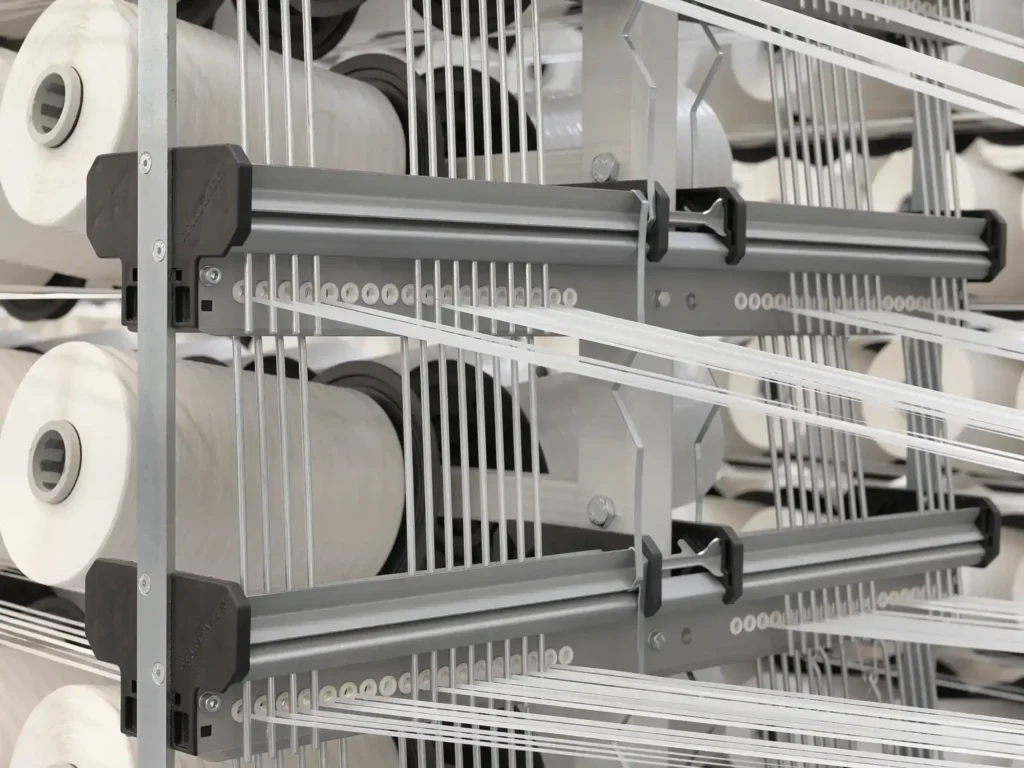
- Weaving. Circular or flat looms interlace tapes; pick density and denier tune burst/tear. Calendaring or light coatings can smooth surfaces for print or welded seams.
- Film printing. BOPP (or specialty films) is corona‑treated and reverse‑printed via rotogravure or high‑definition flexo. Matte/gloss mosaics are chosen so data panels remain glare‑free while brand panels pop.
- Lamination. Printed film is bonded to fabric by extrusion (molten PP/PE tie) or solvent‑less adhesive. Process windows—nip pressure, dyne, chill temperature—must be kept in a sweet spot to avoid curl and ensure bond strength.
- Conversion. Laminates are gusseted, cut, and formed into open‑mouth, valve, or block‑bottom sacks. Closures are sewn, pinch‑sealed, or hot‑air welded; optional laser micro‑perfs provide venting; anti‑slip coats and transparent windows are added.
- Quality assurance. Test fabric tensile/tear, seam efficiency, drop/stack, MVTR, print rub, and scan rate on finished pallets. Where UV dwell is expected, pull exposure samples and verify retained strength and legibility.
What is the application of Industrial Woven Packaging Bags?
Applications are simply patterns of risk. Map the risks and the use‑cases fall into place.
- Agriculture & feed: grains, rice, seed, premixes, animal feed. Needs: humidity moderation, abrasion tolerance, legible labeling in dusty mills.
- Building materials & minerals: cement, gypsum, mortar blends, decorative stone, salts. Needs: dust containment (DS‑BOPP), block‑bottom pallets, anti‑slip faces.
- Chemicals & resins: masterbatch, additives, pelletized polymers, pigments. Needs: scan‑reliable codes, rugged seams, anti‑scuff prints.
- Consumer staples & pet food (bulk formats): photo‑grade branding with matte data windows; reclose options; puncture‑resistant faces for e‑commerce handling.
- Construction & demolition: segregated debris, rubble, and fines; mini‑FIBCs bridge hand‑carry sacks and roll‑offs in tight urban sites.
Industrial Woven Packaging Bags: Exploring the Future
The phrase that anchors this entire article—Industrial Woven Packaging Bags: Exploring the Future—invites a hard look at where capability and constraint are marching next. The future is not abstract; it is a list of purchase orders and audit questions arriving sooner than expected. What changes? Three vectors dominate: policy that favors recyclable‑by‑design, automation that demands stack‑stable and scan‑reliable containers, and digital traceability that turns every sack into a data surface.
Vector 1 — Design‑for‑recycling The safest default is mono‑PP where performance allows: PP fabric + BOPP film, bonded by extrusion, finished with welded seams, printed with compatible systems. This keeps the structure in a single polymer family and positions Industrial Woven Packaging Bags for PP‑stream collection where it exists. Where paper plies are indispensable (aesthetic or friction), use them deliberately and design for separation.
Vector 2 — Automation readiness As more pallets meet depalletizers and vision systems, free features become non‑negotiable: block‑bottom geometry, anti‑slip faces, high‑contrast icons, and matte data windows. The prize is fewer topple events and faster scan speeds.
Vector 3 — Data on pack QR and 2D identifiers migrate from novelty to default. Sacks must carry serialization, batch, and handling instructions that remain scannable after scuffs, rain, and long dwell. Reverse‑printed films with matte windows make this possible.
Where does this leave a buyer or packaging engineer in 2025? With a portfolio strategy: keep a foil‑free, high‑barrier track for goods that can tolerate it; keep a film‑laminated all‑PP track for industrial workhorses; keep a paper‑composite track for channels that value paper feel and stack friction. Across all three, hold to the same geometry, icon library, and scan rules. That way, crews learn once, and performance repeats.
Systematized analysis and synthesis
System thinking treats a packaging choice as a network of dependencies. Break the problem into sub‑problems; solve each with concrete levers; then recombine them into a program.
| Sub‑problem | Failure modes | Levers | Program rule |
|---|---|---|---|
| Caking & dust escape | Moisture gain; fines leakage; housekeeping burden | DS‑BOPP; form‑fit liners; pinch/welded bottoms; micro‑perfs; RH controls | Hygroscopic blends always get DS‑BOPP + liner |
| Ruptures & seam failures | Edge impacts; zippering tears; base bursts | Heavier gsm; higher seam spec; block‑bottom; anti‑scuff varnish | Minerals & rubble always use ≥80 gsm fabric + block‑bottom |
| Barcode/QR mis‑reads | Glare; low contrast; contaminated quiet zones | Matte windows; reverse‑print; art templates with quiet‑zone guards | All SKUs reserve matte code panels by design |
| Policy uncertainty | Shifting recyclability claims; audit friction | Mono‑PP baseline; welded seams; documented inks/adhesives | Keep a dossier per SKU; avoid exotic layers by default |
| Supplier substitutions | Bond drift; ink set changes; foil/film gauge swaps | Change‑control clauses; dyne logs; quick‑peel QC | No change ships without re‑qualification data |
Professional details: from lab numbers to dock behaviors
Composite mechanics Think of the wall as a composite beam. BOPP spreads point impact; the weave arrests crack growth along warp and weft; robust bonds make the layers act as one. When bonds are weak, creases become micro‑crack incubators; when bonds are strong, the laminate shrugs off corner knocks that would shred paper alone.
Corona & dyne discipline Surface energy decays with time; log dyne levels pre‑print and pre‑lamination. Under‑treatment risks ink pick; over‑treatment risks embrittlement. Good lines record, don’t guess.
Seam engineering Sewing is rugged and simple but creates needle holes; pinch‑sealing and hot‑air welding close those holes and help mono‑material claims. For powders, leak‑tightness favors pinch/welded; for coarse fills, sewn seams often suffice.
| Spec anchor | Reference range | Why it matters |
|---|---|---|
| Fabric weight (pre‑lamination) | 60–140 g/m² | Higher gsm → better puncture & tear; match to payload |
| BOPP caliper | 15–35 µm | 25–30 µm balances print durability with abrasion |
| Paper ply weight | 70–100 g/m² | Stiffness & stack friction for composite builds |
| Closure | Sewn / pinch‑sealed / welded | Leak‑tightness, recyclability, and line fit |
| UV window | 3–12 months | Outdoor dwell before notable strength/print decay |
Worked scenarios
Scenario 1 — Fertilizer to humid ports Product is hygroscopic and cakes within weeks. Spec DS‑BOPP, form‑fit liner, pinch‑sealed bottom, anti‑slip face, and matte code window. Warehouse moves drop dust complaints; discharge flow improves; pallet stability rises.
Scenario 2 — Mineral powders with scan issues Dust plumes and glossy barcodes cause chargebacks. Add DS‑BOPP, upgrade to block‑bottom, and impose matte windows with large quiet zones. Mis‑reads collapse; dock crews move faster.
Scenario 3 — C&D corridor Thin PE liners rupture on rubble. Shift to SS‑/DS‑BOPP woven PP sacks, block‑bottoms for stacks, and a mini‑FIBC bridge for crane lifts. Reuse rates deliver lower cost per ton handled.
Procurement checklist
- Geometry: open‑mouth/valve/block‑bottom; gusset width; printed fill line.
- Fabric: gsm, denier; target SWL; UV stabilization window.
- Films: BOPP caliper; gloss/matte mix; anti‑slip or micro‑texture.
- Lamination: extrusion (PP/PE tie) vs solvent‑less adhesive; welded vs sewn closures.
- Printing: gravure/flexo/digital; color management; icon library; QR/linear codes with quiet zones.
- QA: tensile/tear/seam; drop/stack; MVTR; print rub; pallet scan‑rate on finished loads.
- Documentation: declarations for polymers/inks/adhesives; migration data for food/feed adjacency; UV dwell guidance; end‑of‑life notes.
Frequently asked technical questions
Q1. Are Industrial Woven Packaging Bags recyclable? All‑PP stacks (woven PP + BOPP + welded seams) support PP‑stream recovery where available. Paper‑plastic composites complicate sorting; design for separation or accept mixed‑material handling where justified by performance.
Q2. Can glossy film hurt scan rates? Yes. Gloss increases glare under warehouse lights. Reserve matte windows or specify matte BOPP across ID zones.
Q3. Valve vs open‑mouth? Valve wins for powders and granules on high‑speed lines; open‑mouth remains practical for manual fills and coarse aggregates.
Q4. Why not pure paper multiwall? Paper excels with dry, gentle routes; humid yards and abrasive loads push it to failure. Laminated woven options add toughness and moisture tolerance without major mass penalty.
Q5. How to manage UV? Stabilized tapes, UV‑fast inks/varnishes, and defined dwell windows (e.g., 6–12 months) keep strength and legibility within spec.
Keywords and long‑tail phrases
Place these naturally across your specifications, sales sheets, and knowledge base: Industrial Woven Packaging Bags PP woven sacks BOPP laminated woven bags mono‑PP laminated woven packaging block‑bottom valve woven bags pinch‑bottom woven packaging matte barcode window sacks extrusion‑laminated PP composite bags solvent‑free adhesive laminated woven bags GS1 2D barcode woven packaging moisture‑resistant woven sacks mini‑FIBC woven packaging.
Extended engineering notes
MVTR & OTR in context BOPP moderates moisture ingress; for ultra‑sensitive powders, add liners and spec MVTR targets. Oxygen is less of a threat for most industrial fills than for foods, but pigments and additives can oxidize; choose barrier only where value justifies it. Anti‑slip as a safety control Micro‑texture or varnish increases layer‑to‑layer friction, reducing stretch‑wrap and topple events. Human‑factors typography Big icons, few words, redundant color cues: operators move faster when cognitive load is low. Place orientation arrows at the shoulder; standardize data blocks across SKUs.
| Test | Method (typical) | Target | Purpose |
|---|---|---|---|
| Fabric tensile (warp/weft) | ISO 13934‑1 / ASTM D5035 | Aligned to SWL, e.g., >800/600 N per 5 cm for rubble sacks | Prevent tear‑through under point loads |
| Elmendorf tear | ISO 6383 | Meet/beat vendor baselines | Arrest crack propagation |
| Seam efficiency | ASTM D5034 + SOP | ≥80–90% of fabric tensile | Bottoms are the usual failure point |
| Drop test | 0.8–1.2 m by product | No burst or seam failure | Simulate mishandling |
| MVTR | ASTM F1249 | Product‑specific | Predict caking/clumping risk |
| Print rub | TAPPI T‑830 (mod.) | Pass/no ink pick | Protect barcodes/QR |
| Scan success | ISO/IEC 15416 | ≥99% pallet‑level | Verify traceability readiness |
A quick decision tree
- Is dust containment paramount? Choose DS‑BOPP + pinch or welded bottom.
- Is outdoor dwell > 3 months? Add UV stabilizers and matte data windows.
- Will you palletize for automation? Prefer block‑bottom + anti‑slip face.
- Do you need frequent handwriting & scanning? Specify matte data blocks.
- Is recyclability a top KPI? Favor mono‑PP with welded seams; avoid foreign liners unless essential.
Treat Industrial Woven Packaging Bags as infrastructure, not consumables, and your line speeds, audit results, and claims data will quietly improve.
Overview of Industrial Woven Packaging Bags
Industrial Woven Bags are designed primarily for bulk packaging. Made from durable polypropylene (PP) and woven together to form a robust structure, these bags are suitable for a wide range of applications, including agricultural products, construction materials, and chemical substances. The inherent strength and flexibility of these bags make them a preferred choice for industries requiring reliable packaging solutions.
Key Features of Industrial Woven Packaging Bags:
- Durability: These bags withstand rigorous handling and transport.
- Customizability: They can be tailored to specific sizes, weights, and designs.
- Cost-Effectiveness: Woven bags offer a low-cost solution for bulk packaging needs.
- Eco-Friendly Options: Advances in materials allow for recyclable and biodegradable choices.
Table of Key Points and Structure
| Section | Key Points |
|---|---|
| Introduction | Importance of industrial woven bags and their applications |
| Current Trends | Focus on sustainability, customization, and market demands |
| Recyclability and Biodegradability | Environmental benefits and material innovations |
| Customization for Diverse Applications | Tailoring solutions for various industries |
| Challenges and Solutions | Addressing market and environmental challenges |
| Future Outlook | Predictions for the growth and evolution of industrial woven bags |
| Conclusion | Summary of key insights and the importance of innovation |
Current Trends in Industrial Woven Packaging
The packaging industry is undergoing significant transformation, driven by consumer awareness and regulatory pressures regarding sustainability. As a result, Industrial Packaging Sacks are increasingly being designed with recyclable and biodegradable materials.
Recyclability and Biodegradability
One of the most pressing challenges for manufacturers is to produce packaging that minimizes environmental impact. Traditional woven bags made from virgin polypropylene contribute to plastic waste, prompting the industry to explore alternatives:
- Recyclable Materials: Many companies are now using recycled polypropylene in their bags. This approach not only reduces waste but also lowers production costs and energy consumption.
- Biodegradable Options: Innovations in material science have led to the development of biodegradable woven bags that decompose naturally over time. These bags can be made from starch-based polymers or other organic materials that do not leave harmful residues.
By adopting these materials, companies can cater to eco-conscious consumers and meet regulatory requirements, fostering a positive brand image.
Customization for Diverse Applications
As businesses recognize the importance of tailored solutions, the demand for customized Industrial PP Bags is on the rise. Different industries have unique requirements based on the nature of the products being packaged:
- Agricultural Sector: Woven bags designed for agricultural products like grains and fertilizers often feature UV resistance to withstand outdoor conditions. Customization can include specific sizes to optimize storage and transport.
- Construction Industry: In this sector, bags must be robust enough to carry heavy materials such as cement or sand. Custom designs may include added reinforcement at seams and specialized closures to prevent spillage.
- Chemical Industry: Packaging chemicals necessitates additional precautions, including barrier properties to prevent leakage and contamination. The use of special coatings or inner liners enhances safety.
This level of customization ensures that businesses can optimize their supply chains and maintain product integrity throughout transport and storage.
Challenges and Solutions
Despite advancements, the industry faces challenges that require innovative solutions:
- Material Sourcing: Finding sustainable materials at scale can be difficult, especially for manufacturers accustomed to traditional practices. Building partnerships with suppliers who focus on sustainable materials can alleviate this issue.
- Consumer Awareness: Educating customers on the benefits of sustainable packaging is essential. Companies need to communicate the environmental advantages of using recyclable and biodegradable options effectively.
- Cost Implications: Transitioning to eco-friendly materials might raise costs in the short term. However, the long-term benefits, including reduced waste disposal costs and improved brand loyalty, often outweigh initial investments.
Future Outlook
The future of Industrial Woven Bags is promising, with trends leaning towards greater sustainability and customization. Key predictions include:
- Increased Adoption of Sustainable Materials: As technology advances, more manufacturers will likely shift towards using recycled and biodegradable materials.
- Automation in Production: The rise of smart manufacturing will streamline production processes, reducing costs and enhancing efficiency.
- Expanded Applications: With ongoing innovations, woven bags will find applications in new sectors, such as pharmaceuticals and food packaging.
- Focus on Brand Differentiation: As the market becomes increasingly competitive, companies that prioritize brand identity and environmental responsibility will stand out.
Summary
The evolution of Industrial Woven Packaging Bags reflects broader trends in sustainability and customization, driven by the need to meet diverse market demands. By embracing recyclable and biodegradable materials, and offering tailored solutions for various industries, manufacturers can ensure their relevance in a changing marketplace. As innovations continue to emerge, the future of woven packaging looks not only promising but essential for the sustainability goals of businesses worldwide.
Incorporating these insights, companies like VidePak are well-positioned to lead the way in providing high-quality, eco-friendly packaging solutions that meet the needs of a diverse clientele, ultimately contributing to a greener future.