

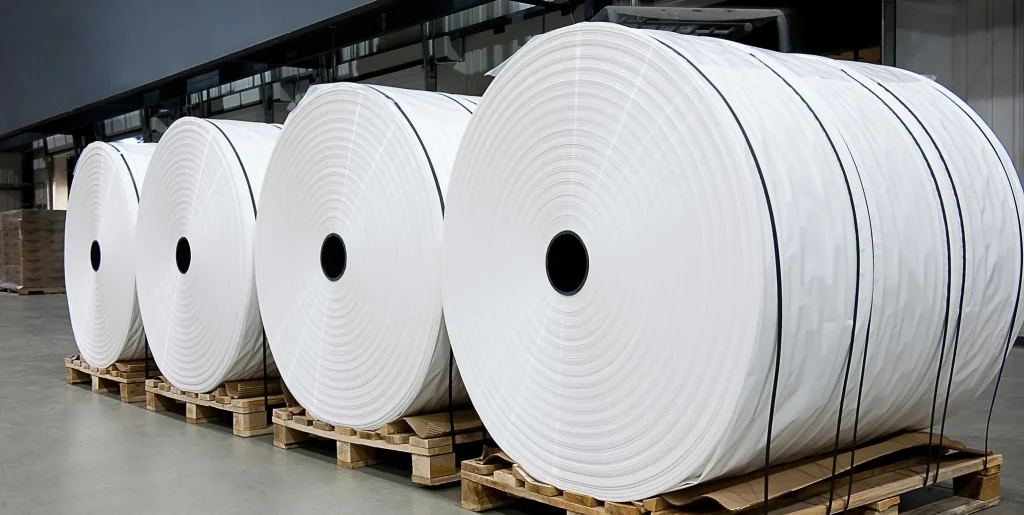
What are FFS Roll Bags?
FFS Roll Bags are continuous tubular or flat films delivered on rolls and transformed in a single pass on form‑fill‑seal equipment: the film is formed into a tube, the product is filled, and the package is sealed. In food operations that prize hygienic handling, predictable sealing, and high throughput, FFS Roll Bags offer an elegant balance of barrier protection, machinability, and cost efficiency. The appeal is simple yet profound: fewer touch points, fewer variables, more consistent outcomes.
- FFS roll stock
- Form‑fill‑seal roll bags
- VFFS roll bags (vertical form‑fill‑seal)
- HFFS roll bags (horizontal form‑fill‑seal)
- Tubular PE FFS rolls
- Heavy‑duty FFS tubular film
- Food‑grade rollstock bags
Call them by any of these names; the operating principle is unchanged: a roll‑fed film engineered to run cleanly and seal hermetically at speed.
The materials of FFS Roll Bags
What determines whether a line hums or hitches? Materials. The polymer family, the layer design, the orientation method, and the additive package all steer machine speed, seal integrity, barrier performance, and recyclability. The architecture below reflects how modern FFS Roll Bags are built for food safety and industrial reliability.
LDPE and LLDPE supply sealability and toughness; HDPE adds stiffness and puncture resistance. Co‑extrusion lets designers put a soft, low‑SIT inner layer for hot‑tack and an outer layer with controlled COF for smooth web travel. Resin pricing, gauge, and layer count dominate cost.
Ethylene‑vinyl alcohol cores suppress oxygen ingress for aroma‑sensitive foods (nuts, coffee, snacks). Because EVOH loses barrier at high humidity, it is encapsulated between PE tie layers to stabilize performance and maintain mono‑family recyclability.
Machine‑direction‑oriented PE (MDO‑PE) and bi‑axially oriented PE (BOPE) stiffen the web and sharpen print registration. Orientation allows downgauging—thinner films with equal or better mechanicals—while remaining in a PE‑centric system.
Metallocene LLDPE lowers seal‑initiation temperature and strengthens hot‑tack. Anti‑block (silica) and slip (erucamide) tune COF so film feeds and seals without stick‑slip or jaw pick‑off. The goal: hermetic seals at the lowest feasible temperature/dwell.
Anti‑fog keeps produce visible; UV absorbers protect film and contents; color concentrates support branding while respecting food‑contact migration limits. Additives are chosen for performance without compromising compliance.
The features of FFS Roll Bags
Features are more than labels; they are behaviors under pressure. Below, the capabilities that make FFS Roll Bags the quiet workhorses of food lines.
Low SIT and robust hot‑tack keep seals intact even at high cycles per minute. Controlled COF prevents hesitation and mis‑registration at forming shoulders.
Sealing windows (temperature/pressure/dwell) are wide, verifiable, and repeatable—validated with burst, vacuum, and dye ingress tests for confidence beyond line smoothness.
EVOH thickness and humidity shielding are modeled to the food’s critical limits—high for nuts and coffee, moderate for frozen goods where oxygen is less decisive.
Thicker gauges and higher dart impact ratings absorb drops and pallet scuffs for staples like rice, flour, and sugar.
Oriented PE and tuned surface energy deliver crisp registration and code legibility; reverse printing protects graphics from abrasion.
Declarations of compliance, migration data, and resin/additive traceability support food safety audits without scramble.
The production process of FFS Roll Bags
From pellets to predictable uptime, the chain is only as strong as its weakest link. Each stage below contributes to the line’s final stability.
- Resin selection & testing: grade choices (mLLDPE, C6 LLDPE, HDPE) set sealability and strength; incoming QC checks MFI, density, and gels.
- Co‑extrusion & orientation: multi‑layer blown film balances seal, barrier, and abuse; MDO or BOPE raises stiffness and clarity for downgauging.
- Surface activation: corona or plasma lifts dyne levels to anchor inks and adhesives.
- Printing & registration: flexo or digital systems apply graphics; low‑migration inks and solvent recovery protect workers and food safety.
- Slitting, winding, roll build: edge quality and roll hardness prevent telescoping and mis‑feeds; cores, OD, and splice policy match the FFS machine.
- Bag‑making on VFFS/HFFS: forming shoulders, pull belts, and jaw profiles are tuned to the film’s SIT and COF; gussets and valves added as the product requires.
- Quality assurance: F88 seal tests, F2054/F2095 leak checks, D3985 OTR, F1249 WVTR, and D1709 dart impact establish performance with records tied to resin lots.
The applications of FFS Roll Bags
From pantry staples to frozen produce, FFS Roll Bags adapt by pairing right‑sized barrier with right‑sized mechanicals.
- Staple grains & powders: rice, flour, sugar, starches. Tubular PE with higher dart impact and robust gussets supports pallet stability at heavy fills.
- Snacks & dry mixes: chips, cereals, baking mixes. Oriented PE plus thin EVOH protects aroma and enables high‑speed vertical runs.
- Frozen & chilled: vegetables, seafood, ready meals. Low‑SIT sealants cope with condensation and light oil contamination.
- Confectionery: smooth surfaces and controlled COF prevent scratching and jams in HFFS infeed.
- Pet food & specialty nutrition: heavier fills and fat migration require stronger seals and grease‑resistant layers within a PE family.
- Institutional formats: large pillow packs and liners for bulk ingredients prioritize efficiency and drop resistance.
For a product page aligned with tubular PE formats, see the heavy‑duty FFS tubular polyethylene rolls.
FFS Roll Bags: Ensuring Quality and Efficiency in Food Packaging
Quality and efficiency are not rivals; they are twins measured in different units. Tight seals mean fewer leakers and fewer complaints; stable web travel means more saleable units per hour. How do FFS Roll Bags deliver both? By solving five subsystems together.
- Product & barrier model: define oxygen and moisture limits; select EVOH and gauge only as much as the shelf‑life model demands.
- Seal‑integrity regime: choose low‑SIT sealants; validate hot‑tack at line speed; specify jaw coatings that resist pick‑off.
- Machine/film interaction: set COF targets and track drift; match stiffness to forming hardware so tubes build without wrinkles.
- Compliance & auditability: release rolls with resin/additive traceability and migration summaries; keep documentation current.
- Circularity & policy alignment: favor mono‑PE designs, removable labels, compatible inks; keep non‑PE tie layers minimal.
Systematic breakdown and synthesis
Break the problem down, solve each piece, and recombine into a line‑ready spec.
Pick PE grades, EVOH %, tie layers, and orientation to hit barrier and stiffness without choking sealability. Avoid over‑engineering that forces higher jaw temperatures.
Find the lowest, widest window that still yields weld‑type seals through light contamination. Lock it as a recipe and verify with F88 and leak testing.
Tune forming shoulders, pull‑belt pressure, nip temperatures, and web guides to the film’s COF and stiffness. Plan for COF drift over storage.
Bundle declarations of compliance, migration data, and traceable test results (OTR, WVTR, dart, burst) with every roll release.
Technical tables and operator tools
Table 1. Core performance targets
| Attribute | Typical target | Why it matters |
|---|---|---|
| Seal strength (ASTM F88) | 6–12 N/15 mm (format‑dependent) | Survives distribution; avoids leakers |
| Hot‑tack window | Holds at line speed (120–160 °C range) | Prevents pop‑opens before crystallization |
| OTR (ASTM D3985) | < 1–10 cc/m²·day for aroma‑sensitive foods | Protects flavor and shelf life |
| WVTR (ASTM F1249) | < 1–5 g/m²·day for moisture‑sensitive powders | Avoids caking and texture loss |
| Dart impact (ASTM D1709) | 300–1000 g for heavy sacks | Resists drops and rough floors |
| COF (film/film; film/metal) | 0.25–0.45 (controlled) | Stable feed and tube forming |
Table 2. Seven‑layer PE‑centric architecture
| Layer (outside → inside) | Function | Notes |
|---|---|---|
| Slip‑controlled exterior | Printability, machine feed | Optimized COF, corona‑treated |
| HDPE abuse layer | Stiffness, puncture | Supports downgauging |
| Tie resin | Adhesion | Matches EVOH; keeps mono‑family |
| EVOH barrier | Oxygen control | Thickness set by shelf‑life model |
| Tie resin | Adhesion | Symmetry improves stability |
| LLDPE sealant | Seal & hot‑tack | Low SIT for speed |
| Anti‑block interface | Seal support | Prevents blocking on rolls |
Table 3. Sealing window mapping on VFFS
| Parameter | Low | Nominal | High | Failure modes when too low/high |
|---|---|---|---|---|
| Jaw temperature (°C) | 110 | 135 | 160 | Low: cold seals, leakers. High: shrink, pick‑off |
| Dwell time (ms) | 150 | 250 | 400 | Low: under‑fusion. High: distortion, cycle loss |
| Jaw pressure (bar) | 2.0 | 3.0 | 4.5 | Low: incomplete knit. High: cut‑through |
| Cooling/hold (ms) | 100 | 180 | 280 | Low: opens under tension. High: idle penalty |
Table 4. Compliance & audit checklist
| Item | Evidence |
|---|---|
| Food‑contact declaration | Resin/additive list; migration summary |
| Traceability | Resin lot IDs; roll IDs; slitting/winding records |
| Mechanical/barrier QA | F88, F2054/F2095, D3985, F1249, D1709 results |
| Hygiene & allergens | Ink/adhesive statements; GMP records |
| Certification | Packaging scope under recognized schemes |
| Recyclability statement | Structure disclosure; sorting codes; labeling guidance |
Frequently asked questions
Is EVOH compatible with recycling claims? At modest loadings and when encapsulated in PE, EVOH often remains compatible with PE recycling streams; always align the claim with local infrastructure.
How do I push speed without adding leakers? Use low‑SIT sealants, verify hot‑tack at target cycles per minute, and keep the jaw profile focused on the knit zone.
Can I run PCR in food‑contact layers? Where regulators have approved the recycling process, yes; otherwise place PCR in non‑contact layers with documented segregation.
Why does COF drift over storage? Slip agents bloom over time; specify COF at release and at end‑of‑life, and plan nip/tension adjustments rather than chasing temperature alone.
A purchase‑order preset you can adapt
- Product: FFS Roll Bags (PE‑centric, seven‑layer co‑ex)
- Format: VFFS rollstock, 600 mm web, 76 mm core, roll OD 600 mm
- Barrier: EVOH core encapsulated by PE tie layers; target OTR < 5 cc/m²·day at 23 °C, 0% RH
- Seal: mLLDPE sealant with SIT 95–105 °C; hot‑tack validated at nominal line speed
- Orientation: MDO on print side for stiffness and registration
- COF: 0.32 ± 0.05 film/metal; 0.28 ± 0.05 film/film
- Printing: reverse, up to 8 colors, low‑migration inks, corona ≥ 38 dynes
- Compliance: food‑contact declaration, migration data, allergen/NIAS statements
- QA: F88 ≥ 8 N/15 mm; dart ≥ 400 g; WVTR ≤ 3 g/m²·day; OTR ≤ 5 cc/m²·day
- Recycling: mono‑PE claim where applicable; label and ink compatibility disclosed
- Roll build: hardness profile documented; ≤ 1 splice/roll; splices flagged and color‑coded
- What are FFS Roll Bags?
- The materials of FFS Roll Bags
- The features of FFS Roll Bags
- The production process of FFS Roll Bags
- The applications of FFS Roll Bags
- FFS Roll Bags: Ensuring Quality and Efficiency in Food Packaging
- Systematic breakdown and synthesis
- Technical tables and operator tools
- Frequently asked questions
- A purchase‑order preset you can adapt
“Why are FFS (Form-Fill-Seal) roll bags revolutionizing food packaging? The answer lies in their versatility, automation compatibility, and ability to integrate advanced functional designs—attributes perfected by VidePak through 30+ years of expertise, ISO-certified processes, and cutting-edge Starlinger machinery.”**
1. The Functional Evolution of FFS Roll Bags
FFS roll bags are pre-formed tubular packaging materials used in automated systems to fill and seal products at speeds exceeding 200 bags/minute. Their design flexibility allows customization for diverse food applications, from dry grains to perishable snacks. The global FFS packaging market is projected to grow at 6.5% CAGR (2025–2030), driven by demand for efficiency and sustainability.
VidePak’s BOPP laminated FFS roll bags exemplify this trend. Using virgin polypropylene (PP) and co-extrusion technologies, they achieve tensile strengths of 40–60 N/cm² while reducing material waste by 20% compared to traditional methods. For instance, a 2024 project for a Southeast Asian rice exporter demonstrated a 30% reduction in packaging downtime through VidePak’s automated Starlinger lines.
2. Tailored Designs for Diverse Applications
2.1 Breathable Designs for Agricultural Products
Grains and fresh produce require controlled gas exchange to prevent spoilage. VidePak’s micro-perforated FFS bags enable oxygen transmission rates (OTR) of 1,500–2,000 cm³/m²/day, reducing condensation by 50% in humid climates. A case study with a Vietnamese rice mill showed a 25% extension in shelf life using breathable bags with 120 gsm PP and 0.5 mm pore density.
2.2 Barrier Designs for Sensitive Foods
For oils, spices, and dairy, barrier properties are critical. VidePak’s aluminum foil-laminated rolls achieve water vapor transmission rates (WVTR) <1 g/m²/day and oxygen barriers <5 cm³/m²/day, complying with EU EN 13592 standards. These bags are 30% lighter than multi-layer alternatives, reducing shipping costs for a European olive oil brand by 15%.
2.3 Anti-Static Solutions for Hazardous Environments
Flour mills and electronic component suppliers face explosion risks from static. VidePak’s carbon-infused PP bags reduce surface resistivity to 10⁶–10⁸ Ω/sq, meeting OSHA 1910.178 guidelines. A U.S. flour distributor reported zero static-related incidents after switching to these bags.
2.4 Antimicrobial Coatings for Food Safety
VidePak’s silver-ion-coated FFS rolls inhibit 99.9% of E. coli and Salmonella within 24 hours, ideal for meat and pharmaceutical packaging. A Thai seafood processor reduced bacterial contamination by 40% using antimicrobial bags with FDA-compliant additives.
3. VidePak’s Technological Edge: Starlinger Automation and Compliance
With 100+ Starlinger circular looms and 30+ lamination machines, VidePak achieves:
- High-speed production: 500–700 bags/hour per line, with a total annual output of 150 million bags.
- Multi-layer co-extrusion: Combines PP, PE, and EVOH layers for tailored barrier properties.
- ISO 9001 compliance: Virgin PP resin purity (melt index 2–4 g/10min) ensures consistency across 16 extrusion lines.
A 2023 collaboration with a European pet food brand showcased VidePak’s 8-color flexographic printing, boosting shelf appeal and increasing retail sales by 18%.
4. Technical Specifications and Market Alignment
Table 1: VidePak’s FFS Roll Bag Portfolio
| Parameter | Specification | Key Application |
|---|---|---|
| Material | PP/BOPP, PP/PE, PP/EVOH | Snacks, Grains, Pharmaceuticals |
| Thickness | 80–200 µm | Dairy, Oils, Spices |
| Barrier Properties | OTR <5 cm³/m²/day, WVTR <1 g/m²/day | Perishable Foods |
| Certifications | FDA, EU EN 13592, ISO 9001 | Global Export Compliance |
| Customization | Anti-static, Antimicrobial, UV-resistant | Hazardous & Medical Goods |
FAQs
Q: How do breathable bags prevent mold in tropical climates?
A: Micro-perforations allow controlled airflow, reducing humidity buildup by 50% and inhibiting fungal growth.
Q: Are laminated bags recyclable?
A: VidePak’s mono-material PP/PE blends achieve 85% recyclability, aligning with the EU’s Circular Economy Action Plan.
5. Case Study: Optimizing Pet Food Packaging
A U.S. pet food brand required high-barrier FFS rolls to prevent fat oxidation in kibble. VidePak delivered aluminum-coated bags with OTR <3 cm³/m²/day, extending shelf life by 6 months and reducing returns by 22%. The project utilized FFS Roll Bags: Optimal Solutions for Building Materials and High-Speed Packaging Efficiency technologies.
6. Sustainability and Future Innovations
VidePak is pioneering bio-based PP blends (30% starch derivatives) and QR-code-enabled smart bags for real-time freshness monitoring. Partnerships with Sustainable FIBC Bulk Bags aim for 100% recyclability by 2030, reducing landfill waste by 40%.
Conclusion
FFS roll bags are redefining food packaging through adaptability, automation, and advanced material science. VidePak’s integration of Starlinger technology, ISO rigor, and R&D-driven customization positions it as a leader in the $50B global packaging market. By balancing functionality with sustainability, the company exemplifies how innovation can drive both operational efficiency and environmental stewardship.
Data synthesized from industry reports (2025), ASTM/ISO standards, and VidePak’s production analytics.