

Context and Purpose: why FIBC bags matter to fertilizer logistics
When dry nutrients must move safely, cheaply, and predictably from mines and reactors to blending towers and farm gates, packaging is no longer an afterthought—it is infrastructure. FIBC bags (also called flexible intermediate bulk containers, bulk bags, jumbo bags, super sacks, and big bags) sit at the very center of this infrastructure. They concentrate a remarkable engineering proposition: high safe working loads at low packaging mass; configurable electrostatic behavior; moisture and oxygen control by liners; and shapes that stack, ship, and empty with a surprising grace for one-ton workhorses. This article reframes the familiar narrative with deeper mechanics, quantified trade‑offs, and fieldable checklists tuned to urea, AN, DAP/MAP, NPK blends, potash, and micronutrient premixes.
What exactly are FIBC bags and how do they differ?
At their simplest, FIBC bags are woven polypropylene containers rated for 500–2,000 kg payloads. Yet simplicity is deceptive. The body architecture (circular, U‑panel, 4‑panel, baffle/Q), fabric electrostatic type (A/B/C/D), coating presence, seam design, and liner geometry interact to produce dramatically different outcomes under humidity, stacking, and discharge stress. The same outward silhouette can be a low‑risk export workhorse—or a source of invisible losses via dusting, bulging, or slow‑burn caking that only appears at the customer’s auger. To choose well is to ask the right questions about product physics, route climate, and plant interfaces.
Material science of FIBC bags: from tapes to barriers
The keystone of FIBC bags is isotactic polypropylene drawn into high‑tenacity tapes. Draw ratio, tape width, and thickness determine tenacity and elongation at break; loom speed and pick density set mesh uniformity and tear propagation behavior. Additives matter: UV packages preserve mechanicals during outdoor dwell; masterbatch pigments tune opacity and print fidelity; and antistatic agents in liners or coatings influence charge decay profiles during fill and discharge.
Coating is a thin PP film that stabilizes yarns, lowers porosity, and creates a cleaner print surface. The price is reduced breathability; the payoff is lower dusting and a measurable drop in water vapor transmission rate when combined with seam sealing. Liners are the decisive barrier element: LDPE/LLDPE for economical moisture control, HDPE for puncture resistance and lower WVTR, EVOH co‑ex for oxygen‑sensitive chemistries, and aluminum laminates for long‑dwell or odor‑critical assignments. Form‑fit liners preserve cube in baffle bodies and discharge more cleanly; loose tubular liners are cost‑lean but can pleat at the spout.
| Layer | Function | Key knobs | Trade‑offs |
|---|---|---|---|
| Woven PP fabric | Load bearing and tear resistance | GSM, weave density, tape tenacity | Higher GSM raises cost and stiffness but improves stacking |
| PP coating | Dust and moisture mitigation; print holdout | Coating weight, surface energy | Lower breathability; added unit cost |
| Liner | Moisture/oxygen barrier; cleanliness | Polymer choice, thickness, form‑fit vs. loose | Handling effort in form‑fit; pleating risk in loose |
Feature set that distinguishes modern FIBC bags
Nine properties set the pace for contemporary fertilizer packaging: high SWL at minimal mass; configurable safety factors; electrostatic typing attuned to minimum ignition energy; moisture governance by coating, seams, and liners; form stability via baffles; operator ergonomics through loop geometry and spout design; regulatory readiness for dangerous goods; traceable identity; and circularity potential through mono‑material thinking. Together they answer the daily questions of plant managers: Will the stack lean? Will the spout dust? Will the label survive? Will the audit pass?
Manufacturing journey of FIBC bags: from resin to outbound pallets
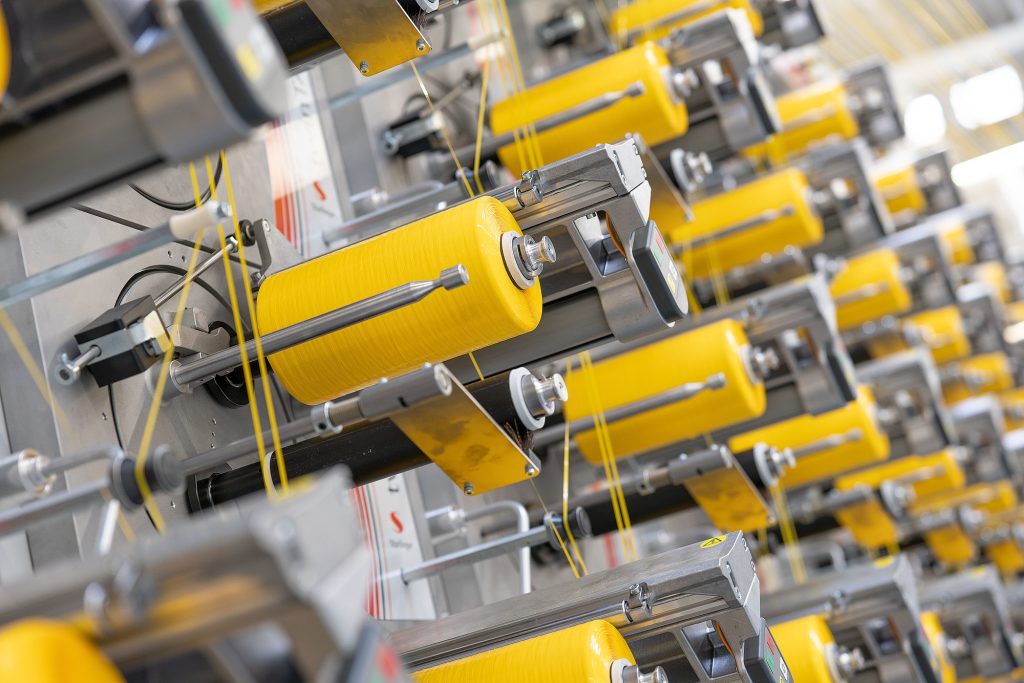
Precision is not a luxury in one‑ton packaging; it is a safety control. The journey begins with resin selection (virgin PP with specified melt flow), followed by tape extrusion where draw ratios architect strength. Circular looms translate tenacity into coherent fabrics, coatings seal the pores, and printing adds identity that survives abrasions and ultraviolet exposure. Cutting tables and automated webbing stations set dimensional truth; sewing cells convert components into load‑bearing bodies; liner insertion teams prevent pleats and ensure earthing for antistatic structures; and finishing stations check, bundle, and palletize for long journeys by road, rail, or sea.
- Front‑end verification: resin identity, masterbatch dispersion, UV stabilizer loading, liner WVTR/OTR checks.
- Extrusion: tape width and thickness, tenacity/elongation, winding quality for loom uptime.
- Weaving: GSM and mesh density controls, visual defect capture, width tolerance.
- Coating: g/m² control, surface energy for print anchorage, optional seam sealing.
- Printing: abrasion‑resistant inks, regulatory pictograms, high‑contrast batch IDs.
- Cutting & prep: panel and base accuracy, loop webbing heat‑seals, baffle pieces.
- Sewing & assembly: needle spec, stitches‑per‑inch, thread tex, seam class.
- Liner insertion: form‑fit tie‑outs positioned, antistatic continuity verified.
- Finishing: 100% visual, metal detection where required, correct document pockets.
- Testing: proof and cyclic loads, drop/topple/stack, seam and loop strength, electrostatics, liner leak.
Use cases for FIBC bags across fertilizer chains
Whether charging prilled urea at river terminals, moving mined potash between railheads and granulation, or exporting DAP through humid ports, FIBC bags shape the efficiency frontier. They serve as primary packaging for one‑ton drops at cooperatives, as intermediate containers inside blending hubs, and as cost‑effective alternatives to drums in oxidizer‑class products under UN oversight. Baffle bodies improve container loads; form‑fit liners safeguard cube and discharge; and tailored spouts translate to cleaner, faster hopper connections.
- Primary packaging for urea, AN‑based blends, DAP/MAP, NPKs, SOP/MOP, micronutrients, crystalline water‑soluble fertilizers.
- Intermediate logistics across mine → plant → blending hub → port → distribution center topologies.
- Export lanes using Q‑bags to raise payload per TEU and curb topple events.
- On‑farm depots embracing one‑ton drops to cut small‑sack labor and film waste.
- UN‑certified assignments for certain nitrate formulations with electrostatic controls.
Quality governance: how to assure FIBC bags perform when it counts
Quality is a choreography of standards, material integrity, process capability, and inspection cadence. A four‑pillar scheme works well: build to internationally recognized norms with documented tests; purchase prime materials from audited producers; invest in high‑repeatability equipment; and sustain a layered inspection strategy that touches incoming lots, in‑process checkpoints, and finished goods tests. Do that, and the safety factors quoted on paper become real‑world protection against fatigue and misuse.
Decision map: selecting the right FIBC bags for each fertilizer SKU
Six interacting variables define a robust spec: hygroscopicity and caking risk; electrostatic profile and atmosphere; route climate and dwell; handling intensity; cube constraints; and regulatory class. Engineer to the worst‑case component when blends vary. If there is any chance of flammable vapors or low‑MIE dusts, select Type C with auditable grounding—or Type D when grounding cannot be guaranteed. Where stacking or container fill is the bottleneck, baffle bodies pay back quickly.
| Fertilizer | Moisture sensitivity | Electrostatic concern | Recommended configuration |
|---|---|---|---|
| Urea (prilled or granular) | High | Low–moderate (dust) | Baffle body; coated fabric; form‑fit PE liner 90 μm; dust‑proof seams; Type B/C per site |
| Ammonium Nitrate (AN) / AN‑based | High + oxidizer | Moderate–high | UN‑certified; 6:1; Type C grounded or Type D; antistatic liner; strict labeling |
| DAP/MAP | Medium | Low–moderate | Coated body; form‑fit liner for export; baffle for cube |
| NPK blends | Variable | Variable | Engineer to worst‑case component; dust‑proof seams; electrostatic type per MIE |
| Potash (MOP/SOP) | Medium (abrasive) | Low | Higher GSM; optional coating; unlined or thin liner by climate |
Failure modes and the controls that keep FIBC bags honest
Caking and lumps? Lower WVTR, manage RH, and pick a liner gauge that respects dwell. Dusting at the spout? Tight weaves, dust‑proof seams, and iris closures. Static shocks? Choose the right fabric type and verify continuity or decay times. Stack collapse or bulging? Baffle bodies, pallets with edge stiffness, and stack height limits. Faded or lost labels? UV‑stable inks and over‑laminated data plates. The pattern is simple but non‑negotiable: define the risk, map it to a control, and verify the control with tests that mirror the route.
From sub‑problems to a cohesive playbook for FIBC bags
A workable blueprint starts with SKU physics (hygroscopicity, MIE, bulk density), then tracks the route climate and dwell, then locks the electrostatic fabric type and body architecture, then sizes seams and loops to handling cycles, and finally sets the liner architecture to WVTR/OTR targets. Document safety factors, labels, and traceability; pilot and test; train and audit; improve with field data. It sounds obvious because it is. But it is also rare.
- Define physics and hazards.
- Map routes and climates.
- Select fabric type and body style.
- Engineer seams, loops, and GSM to cycles.
- Choose liner architecture for barrier targets.
- Set safety factor and any UN certification plan.
- Lock markings and traceability.
- Pilot, test, iterate.
- Train operators and audit behaviors.
- Close the loop with SPC and field claims.
Frequently asked questions about FIBC bags in fertilizer duty
Do all urea shipments require liners? Not universally. But for humid routes or storage beyond sixty days, a PE liner at 70–100 μm is low‑cost insurance against caking; dust‑proof seams multiply the effect.
When to choose Type C vs. Type D? If you can reliably ground and audit, Type C is economical. If grounding is impractical or forbidden by procedure, Type D used within its instructions offers operational convenience.
Reusable vs. single‑trip? Only reuse designs validated for it (6:1 or above with inspection and cleaning programs), and be cautious with oxidizer residues.
Are baffle bags worth the premium? Where warehouse density or container fill constrains your economics, Q‑bags typically repay themselves in payload per TEU and calmer stacks.
Specification snapshot for export‑urea via FIBC bags
- SWL: 1,000 kg; Safety factor: 5:1
- Body: baffle (Q‑bag), 200 GSM coated PP fabric
- Liner: 90 μm form‑fit LDPE with four tie‑outs
- Seams: double‑chain with dust‑proof tape
- Top/Bottom: duffle top; 14‑inch discharge spout with iris
- Loops: four cross‑corner, 30 cm
- Labels: product ID, handling pictograms, batch/QR, protected document pocket
- Palletizing: heat‑treated pallets, corner boards, stable wrap
- Tests: proof and cyclic load; liner leak; stack/topple/drop per route risk
Cost levers, value levers, and how FIBC bags earn their keep
The price of a bag is not the cost of a shipment. Fabric GSM, liner architecture, baffle bodies, and certification scope do move unit price. But payload per TEU, claim rates, cleaning labor, and throughput at hoppers dominate total cost. A 20–30% cube gain from Q‑bags frequently outweighs the bag premium; a modest step from 70 to 90 μm form‑fit liners can wipe out caking complaints on humid lanes; moving from Type B to Type C in a site with sporadic solvent presence calms static alarms and downtime. Pay where the physics pays you back.
Sustainability pathway for FIBC bags without sacrificing safety
Mono‑material thinking helps: favor PP where possible, isolate liners for simpler separation, avoid dark masterbatches that depress recyclate value, and publish clear after‑use guidelines through QR codes on labels. In operation, the high SWL‑to‑mass ratio and baffle‑driven cube efficiency reduce transport emissions per ton. Where rules allow, controlled recycled content enters non‑food, non‑dangerous applications, but only with stout QA and mechanical evidence that safety margins remain intact. Sustainability is engineering with a longer time constant.
Troubleshooting playbook for fielded FIBC bags
| Symptom | Likely root cause | Actionable fix |
|---|---|---|
| Caking after 30–60 days | Liner pinholes; high RH; thermal cycling; liner too thin | Increase liner gauge; switch to form‑fit; add seam sealing; control RH and airflow |
| Static shocks at discharge | Wrong fabric type; poor earthing; contaminated clamps | Upgrade to Type C/D; verify continuity or decay; clean clamps; ensure antistatic liner spec |
| Stack lean/bulge | Overfill; standard body bulge; soft pallets | Enforce fill height; adopt baffle bodies; improve pallet stiffness; limit stack height |
| Label unreadable at destination | UV fade; abrasion; ink mismatch | Use UV‑stable inks; over‑laminated labels; better pocket placement |
Procurement checklist for FIBC bags in fertilizer service
- Target SWL and safety factor by route and handling cycles.
- Body style decision: baffle for density or standard for cost.
- Fabric type decision: A/B/C/D by dust MIE and atmosphere.
- Barrier plan: coating weight, seam sealing, liner type and thickness.
- Top and bottom spout geometries matched to fill/discharge hardware.
- Loop geometry and height for forklifts and hooks.
- Labeling set: UN markings if applicable, permanent IDs, document pocket.
- Tests: proof/cyclic load, ESD, WVTR checks, stack/topple/drop as required.
- Pallet plan: HT pallets, corner boards, wrap specification, stack limits.
- Training and audit cadence for operators.
October 20, 2025
- Context and Purpose: why FIBC bags matter to fertilizer logistics
- What exactly are FIBC bags and how do they differ?
- Material science of FIBC bags: from tapes to barriers
- Feature set that distinguishes modern FIBC bags
- Manufacturing journey of FIBC bags: from resin to outbound pallets
- Use cases for FIBC bags across fertilizer chains
- Quality governance: how to assure FIBC bags perform when it counts
- Decision map: selecting the right FIBC bags for each fertilizer SKU
- Failure modes and the controls that keep FIBC bags honest
- From sub‑problems to a cohesive playbook for FIBC bags
- Frequently asked questions about FIBC bags in fertilizer duty
- Specification snapshot for export‑urea via FIBC bags
- Cost levers, value levers, and how FIBC bags earn their keep
- Sustainability pathway for FIBC bags without sacrificing safety
- Troubleshooting playbook for fielded FIBC bags
- Procurement checklist for FIBC bags in fertilizer service
- 1. Introduction to FIBC Bags and Their Role in the Fertilizer Sector
- 2. VidePak’s Competitive Edge: Quality Control from Raw Materials to Finished Products
- 3. Technological Infrastructure and Production Capacity
- 4. FIBC Customization for Fertilizer Applications
- 5. FAQs: Addressing Industry Concerns
- 6. Sustainability and Future Trends
- 7. Conclusion
“Why should chemical fertilizer manufacturers prioritize FIBC bags for bulk packaging?” This question often arises among industry stakeholders. The answer lies in FIBC bags’ unparalleled durability, cost-efficiency, and adaptability to stringent safety standards—qualities that VidePak, a leader in woven packaging solutions, has mastered through decades of expertise. By integrating rigorous quality control measures, advanced manufacturing technologies, and a deep understanding of chemical compatibility, VidePak ensures its FIBC solutions meet the demanding needs of global fertilizer producers.
1. Introduction to FIBC Bags and Their Role in the Fertilizer Sector
Flexible Intermediate Bulk Containers (FIBCs), commonly known as jumbo bags, are large woven polypropylene containers designed to transport and store dry, flowable materials like chemical fertilizers. With a global FIBC market projected to reach $7.8 billion by 2028 (Grand View Research, 2023), their adoption in the fertilizer industry is driven by:
- High load capacity (up to 2,000 kg per bag).
- Moisture resistance critical for hygroscopic fertilizers.
- Customizable designs for automated filling/discharge systems.
VidePak’s FIBC bags, manufactured using Austrian Starlinger machinery and premium PP resins, exemplify these traits while aligning with ISO 21898 standards for hazardous material packaging.
2. VidePak’s Competitive Edge: Quality Control from Raw Materials to Finished Products
2.1 Supplier Qualification and Raw Material Sourcing
VidePak’s commitment to quality begins at the source. The company enforces a three-tier supplier evaluation process:
- Certification audits: Suppliers must hold ISO 9001/14001 certifications and demonstrate compliance with ASTM D5725 (PP resin standards) and EN 1898 (FIBC safety requirements).
- Technical capability assessments: VidePak partners with global resin producers like BASF and Sinopec, securing long-term supply agreements to stabilize costs and quality. For instance, BASF’s PP homopolymers exhibit a melt flow index (MFI) of 2.5–4.0 g/10 min, ideal for high-tensile weaving.
- Market reputation reviews: Suppliers are vetted through platforms like Alibaba Supplier Assessments and third-party audits.
2.2 Incoming Material Inspection Protocols
Every resin batch undergoes:
- Visual inspection for discoloration/contamination.
- MFI testing (ASTM D1238) to verify processability.
- Tensile strength tests (ISO 527-3), with acceptance thresholds >35 MPa.
AQL sampling per ISO 2859-1 (Level II, 1.5% defect rate) ensures statistical reliability. Data is logged into VidePak’s SAP-based QMS for traceability—a critical feature for fertilizer clients requiring SDS documentation.
3. Technological Infrastructure and Production Capacity
VidePak’s 526-strong workforce operates:
- 100+ circular looms producing 120–200 g/m² woven fabric.
- 16 extrusion lines coating fabrics with BOPP films (15–30 µm thickness) for moisture barriers.
- 30+ lamination/printing machines enabling 10-color HD printing for brand-specific designs.
Case Study: A Brazilian fertilizer company reduced packaging waste by 22% after switching to VidePak’s UV-resistant, 6-ply laminated FIBCs with anti-static properties (tested per IEC 61340-4-4).
4. FIBC Customization for Fertilizer Applications
4.1 Design Variants
| Type | Key Features | Fertilizer Use Case |
|---|---|---|
| Type C (Conductive) | Dissipates static electricity | Ammonium nitrate storage |
| Laminated | PE/BOPP moisture barrier | Urea granules in humid climates |
| Baffled | Internal partitions prevent shifting | Bulk SSP (Single Superphosphate) |
4.2 Safety and Compliance
Fertilizers like DAP (Diammonium Phosphate) require UN-certified FIBCs for transport. VidePak’s bags meet:
- UN 13H1/Y for hazardous solids.
- BC Code for maritime safety.
5. FAQs: Addressing Industry Concerns
Q1: How do FIBC bags compare to rigid containers in cost?
A: FIBCs reduce packaging costs by 40–60% due to lightweight design and recyclability. VidePak’s bulk pricing for 1,000-unit orders starts at $12/bag.
Q2: Can FIBCs withstand prolonged outdoor storage?
A: Yes. VidePak’s UV-stabilized bags, tested per ASTM D4355, retain 95% tensile strength after 12 months of sun exposure.
Q3: Are customized discharge spouts available?
A: Options include duffle tops, spout bottoms, and pasted valve designs for pneumatic filling systems.
6. Sustainability and Future Trends
VidePak’s R&D team is pioneering recyclable FIBCs using mono-material PP structures, achieving 98% recyclability in trials. Partnering with sustainable packaging initiatives, the company aims to reduce carbon footprint by 30% by 2026.
7. Conclusion
For fertilizer producers navigating volatile markets and tightening regulations, VidePak’s FIBC solutions offer a blend of reliability, customization, and compliance. By controlling raw material quality at every stage and investing in cutting-edge production technologies, the company has positioned itself as a global leader—evidenced by its $80 million annual revenue and 37% repeat client rate.
In the words of CEO Ray Chiang: “Our mission isn’t just to make bags; it’s to engineer packaging systems that solve real industrial challenges.” For chemical fertilizer businesses, that mission translates into safer, smarter, and more sustainable bulk handling.