
Orientation: why PE Coated Valve Woven Bags quietly decide downstream performance
Packaging for fine powders is often described as a commodity until a pallet leans, a bag sifts, or a customer’s hopper chokes. Then the commodity turns into a system. PE Coated Valve Woven Bags are that system distilled: a woven polypropylene skeleton for strength, a polyethylene skin for barrier and print, and a valve interface that mates with impeller, screw, or air‑packer fill lines. The format is compact, fast, repeatable. It can be economical and elegant at the same time. But what exactly is it? How is it built? Why does one specification run like a metronome while another coughs dust? The pages below answer with mechanics first and marketing last.
What are PE Coated Valve Woven Bags and what are they also called?
At core, PE Coated Valve Woven Bags are industrial sacks for 10–80 kg fills (most commonly 20–50 kg). They use a woven PP substrate for mechanical strength, PE extrusion coating for moisture control and clean print, and a valve sleeve for high‑speed dosing that self‑closes under head pressure and can be sealed by heat or ultrasonics. The result is a square‑shouldered, dust‑lean, stack‑friendly package for fertilizers, cement, mineral additives, chemical powders, and polymer resins.
Common aliases that point to the same format:
- PP Woven Valve Bags
- PE‑Coated Valve Sacks
- Woven Polypropylene Valve Bags
- Block‑Bottom Valve Bags
- Valve‑Top Woven Sacks
- Moisture‑Proof Valve Bags
Different names, one principle: tensile efficiency plus barrier discipline plus a clever inlet that shortens fill cycles. The silhouette looks simple; the physics is not. A bag is judged by the seconds it shaves, the grams it keeps out, and the meters it holds together.
Materials and architecture of PE Coated Valve Woven Bags
Materials decide behavior. Change the polymer, shift the draw ratio, tweak the coating gram weight, and a pallet behaves differently. Below is the anatomy and the logic behind each layer.
Woven polypropylene base fabric
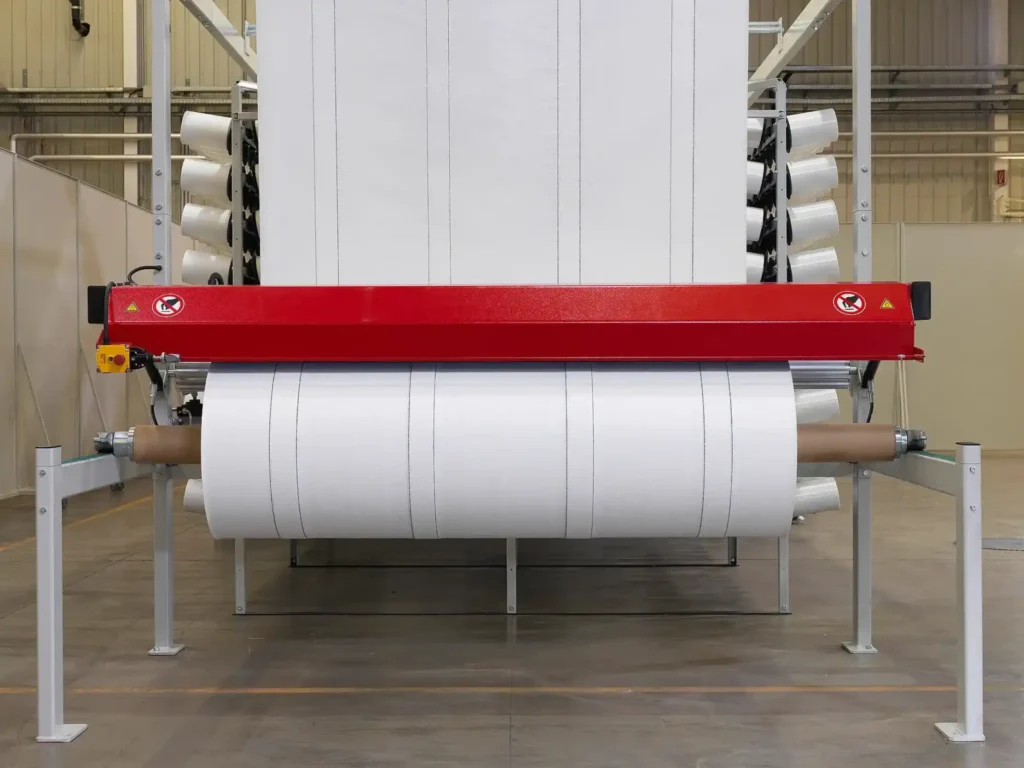
Isotactic PP is extruded into a flat sheet, slit into tapes, and drawn to align chains and raise tenacity. Those tapes are woven into fabric—circular for tubular bodies, flat for block‑bottom patterns. Basis weights of 55–85 g/m² cover most 25–50 kg duties. Higher meshes suit abrasives like potash or tall stacks. PP brings low water uptake and chemical resistance to salts and common minerals. It is the skeleton: load‑bearing, tear‑resistant, and surprisingly light.
PE extrusion coating
A melt curtain of LDPE/LLDPE—or a blend with MDPE for puncture—lands on the fabric and freezes into a tight skin. Typical coating weights sit between 18 and 35 g/m². Push higher for tropical humidity and long dwell; trim for dry, short routes. The coating lowers porosity and becomes the printable face. With sealed seams, it drags WVTR into low single‑digits g/m²/day under lab conditions, which has real consequences for urea caking and NPK flowability.
Valve sleeve and closure
The sleeve may be coated fabric, plain PE film, or a coextruded laminate. Friction must be tuned to the packer so the spout does not eject or jam. After dosing, the sleeve self‑closes under head; a single pass of a hot bar or an ultrasonic nib can lock it. With fine powders, an antistatic additive in the valve film reduces nuisance shocks and keeps dust from clinging.
Inks, additives, and functional coats
Abrasion‑resistant flexographic inks carry identity, instructions, and hazard icons. Anti‑slip lacquer or sand‑finish stripes on the outside raise pallet friction; internal slip agents smooth product flow during fill. Pigment and UV systems guard labels against sun and scuff. Where scanning is essential, specify high‑contrast data plates and protect them with over‑laminate.
Optional laminates
Some projects swap simple coating for bonded films like PE/EVOH/PE to chase oxygen barrier, or hybridize with paper for retail presence. Barrier rises; so does complexity. For fertilizer duty where ruggedness rules, PE‑only coating is the pragmatic sweet spot.
| Layer | What it does | Primary knobs | Trade‑offs |
|---|---|---|---|
| Woven PP fabric | Carries load, resists tear and puncture | GSM, mesh density, tape tenacity | Higher GSM adds cost/stiffness but calms stacks |
| PE coating | Controls moisture, provides print face | g/m², polymer blend, corona energy | Lower breathability; incremental cost per m² |
| Valve sleeve | Interfaces to packer; seals post‑fill | Friction window, seal curve, antistatic | Too slick jams; too grippy stalls; seal abuse scorches film |
Feature set that makes PE Coated Valve Woven Bags outperform look‑alikes
Speed with control; moisture governance; stack stability; mechanical resilience; identity and compliance; recyclability within the polyolefin family—these are not buzzwords, they are levers. Pull them in sequence and the line runs faster and cleaner. Ignore them and the same line ships complaints along with product.
Production process for PE Coated Valve Woven Bags and why equipment pedigree matters
A bag’s reliability is the sum of thousands of controlled steps. Inputs are verified, tapes are drawn, fabrics are woven, coatings are fixed, graphics are anchored, patterns are cut, valves are formed, seams are sealed or sewn, and pallets are built. Each link can hold or fail; the difference is process capability and machine discipline.
- Front‑end checks: PP melt flow, PE seal curve, masterbatch dispersion, UV stabilization, antistatic resistivity for valve films, and ink adhesion after corona.
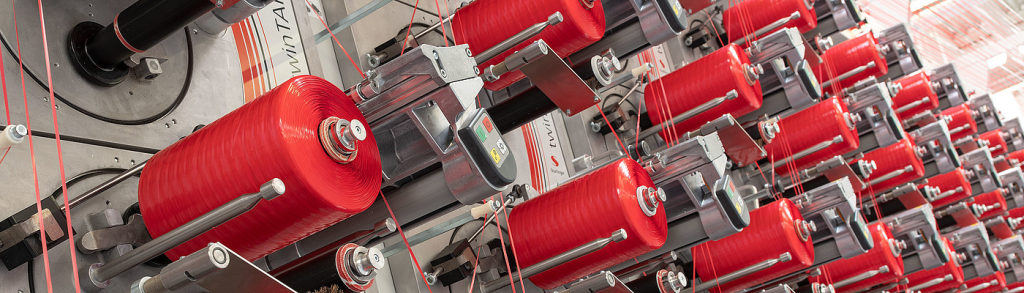
- Tape extrusion: sheet slit into tapes; draw ratios set tenacity; winders build packages that feed looms without breaks.
- Weaving: circular or flat looms hold density and width; defects are trapped early.
- Coating: melt curtain bonded; grams‑per‑square‑meter trended; seam sealing spec’d where dust control demands it.
- Printing: rub‑resistant inks and precise registration maintain legibility on wrapped panels.
- Conversion to valve sacks: block‑bottom welds or sewn pillows; valve sleeve geometry held within millimeters; micro‑perfs applied judiciously.
- Finishing: counting, bundling, palletizing with corner boards; wraps stabilize; documentation pockets applied.
- Final tests: tear/tensile, burst, valve leak, spot WVTR, print rub; spot checks escalate when climate risk rises.
Applications for PE Coated Valve Woven Bags across industries
The same geometry that made valve sacks famous in cement now lifts performance in other categories. In fertilizers, the emphasis is moisture control and clean, quick fills. In chemicals and minerals, it is dust and discharge predictability. In polymer resins, it is tear resistance and valve integrity. Across all, it is pallet truth: neat stacks that travel well and unload without drama.
- Fertilizers: urea, NPK blends, ammonium sulfate; antistatic tweaks for fines or nitrate content
- Cement and binders: cement, gypsum, fly ash, lime; micro‑perfs tuned for rapid air release
- Minerals and chemicals: TiO₂, kaolin, carbonates; valve friction calibrated to packer
- Polymer resins and additives: masterbatch, fillers, flame retardants; rugged seams
- Animal nutrition: mineral premixes; block‑bottoms for calm stacks in farm depots
How VidePak guarantees PE Coated Valve Woven Bags quality from spec to shipment
Quality is choreography. It is also a habit. VidePak runs a four‑pillar model that turns paper specifications into field behavior.
“PE Coated Valve Woven Bags: Key Specifications and Applications” — a structured walk‑through
When engineers hear the phrase above, they reach for a checklist. Specifications only matter if they map cleanly to application pressures: humidity, fines, stack height, route duration, regulatory markings, and fill‑line interface. Below is the translation chart many teams end up sketching on whiteboards; here it is, made explicit.
Specification core
- Capacity: 20–50 kg common; match dimensions to density and pallet plan
- Fabric: 55–85 g/m²; climb when stacks are tall or minerals are abrasive
- Coating: 18–35 g/m²; raise on humid routes and long dwell
- Valve: self‑closing or heat‑sealable; friction window matched to packer
- Body: block‑bottom for cube and stability; pillow for cost simplicity
- Perforation: micro‑perfs for air release; avoid over‑perforation on hygroscopic SKUs
- Print: abrasion‑resistant inks; high‑contrast data plates
Application‑driven tweaks
- Urea on tropical export: push coating toward the upper band and consider a thin liner after WVTR trials
- NPK with fines: antistatic valve film; conservative micro‑perfs; sealed seams
- Cement/gypsum: robust block‑bottom welds; micro‑perfs tuned to fast air release
- Mineral abrasives: higher GSM; MDPE blend in coating; scuff‑resistant print windows
Decision narrative
If humidity dominates, bias coating and sealing. If dust and trapped air dominate, bias valve friction and micro‑perfs. If space dominates, bias block‑bottoms and anti‑slip. If discharge cleanliness dominates, keep internals smooth and avoid liner pleats—unless a form‑fit liner is the better compromise. The common mistake is to solve last year’s failure and ignore next quarter’s route.
Systems thinking: from sub‑problems to a cohesive spec for PE Coated Valve Woven Bags
Break it down. Physics (humidity ingress, dust generation), structure (fabric GSM, coating weight, body geometry), process (extrusion → weaving → coating → printing → conversion), regulation (marking, safety communication), economics (bag price versus delivered cost). For each, assign a measurable: WVTR, tear/tensile, seal window, fill‑cycle time, stack height, deformation under load. Pilot under the climate your route actually sees. Then integrate with buffer: enough barrier for storm delays, enough stiffness for bumpy floors, enough print durability for rough rail legs. That is how specifications stop being guesses and start being safeguards.
Technical tables for PE Coated Valve Woven Bags
| Parameter | Typical options / ranges | Engineering notes |
|---|---|---|
| Sack capacity | 20–50 kg common; 10–80 kg edge cases | Match volume to density and pallet pattern |
| Fabric GSM | 55–85 g/m² | Increase for abrasives or tall stacks |
| PE coating | 18–35 g/m² | Heavier on humid routes; confirm WVTR |
| Valve type | Self‑closing; heat‑sealable; ultrasonic spot‑seal | Match friction and seal window to packer |
| Body style | Block‑bottom; pillow‑type | Block‑bottom improves cube/stability |
| Micro‑perforation | None, light, medium | Vent air; avoid over‑perforation on hygroscopic goods |
| Printing | 2–6 colors flexo | Use rub‑resistant inks; ensure barcode legibility |
| Anti‑slip | Stripe or full‑surface | Improves pallet safety and density |
| UV stabilization | 200–500 h class | Match to likely outdoor dwell |
| Component | Spec (illustrative) | Function |
|---|---|---|
| Woven PP fabric | 65 g/m²; 100 cm layflat | Mechanical strength |
| PE coating | 25 g/m²; corona‑treated | Moisture barrier; print holdout |
| Valve sleeve | PE/PP laminate; antistatic | Low‑dust filling; seal window |
| Inks & lacquers | Rub‑resistant set | Legibility and branding |
| Anti‑slip | Partial stripe | Stack friction |
Failure modes and controls for fielded PE Coated Valve Woven Bags
Caking and lumps? Lower WVTR via higher coating and sealed seams; add a thin liner on long, humid routes. Dusting at the spout? Tune valve friction, pick conservative micro‑perfs, and keep seam paths tight. Stack bulge? Prefer block‑bottom bodies and stiffer pallets, enforce fill heights. Lost labels? Use UV‑stable inks and protect data plates. The pattern is simple: name the risk, select the control, verify with tests that mimic the route.
| Risk | Primary control | Secondary control |
|---|---|---|
| Caking | Raise coating g/m²; seal seams | Add thin liner for long dwell |
| Dusting | Tune valve friction | Micro‑perfs balanced for air release |
| Stack bulge | Block‑bottom body | Anti‑slip + pallet stiffness |
| Label loss | Abrasion‑resistant inks | Over‑laminated data plate |
Cost levers, value levers, and the ROI of PE Coated Valve Woven Bags
A unit price is a small number that masks large consequences. Fabric GSM, coating grams, body style, and valve spec do move the line item. But pallet stability reduces wrap and rework, block‑bottoms lift container payload, faster fills cut labor, and lower claims protect margins. Often, a few grams of coating or a switch to block‑bottoms repay themselves by the end of the first voyage. Spend where the physics pays back.
Sustainability pathway for PE Coated Valve Woven Bags
Keep it in the polyolefin family. Favor PP base with PE skin for recoverability, separate liners when used, avoid heavily tinted masterbatches that suppress recyclate value, and print recycling guidance onto data plates via QR. In operation, high strength‑to‑mass ratios and block‑bottom cube efficiency reduce transport emissions per ton. Where rules allow, controlled recycled content can serve non‑food, non‑hazardous SKUs—guarded by stout QA so safety margins remain intact.
Procurement checklist tailored to PE Coated Valve Woven Bags
- Target fill weight and pallet/stack pattern
- Body style: block‑bottom for cube; pillow for cost
- Fabric GSM matched to stack height and abrasion
- Coating g/m² set by route humidity and dwell
- Valve sleeve: self‑closing vs. sealable; friction and antistatic window
- Micro‑perfs and anti‑slip plan
- Print, labels, and regulatory icons locked
- Tests: tear/tensile, burst, valve leak, WVTR, print adhesion
- Pilot lots on actual filling and stacking workflow
- Field data captured and specifications iterated
October 20, 2025
- Orientation: why PE Coated Valve Woven Bags quietly decide downstream performance
- What are PE Coated Valve Woven Bags and what are they also called?
- Materials and architecture of PE Coated Valve Woven Bags
- Feature set that makes PE Coated Valve Woven Bags outperform look‑alikes
- Production process for PE Coated Valve Woven Bags and why equipment pedigree matters
- Applications for PE Coated Valve Woven Bags across industries
- How VidePak guarantees PE Coated Valve Woven Bags quality from spec to shipment
- “PE Coated Valve Woven Bags: Key Specifications and Applications” — a structured walk‑through
- Systems thinking: from sub‑problems to a cohesive spec for PE Coated Valve Woven Bags
- Technical tables for PE Coated Valve Woven Bags
- Failure modes and controls for fielded PE Coated Valve Woven Bags
- Cost levers, value levers, and the ROI of PE Coated Valve Woven Bags
- Sustainability pathway for PE Coated Valve Woven Bags
- Procurement checklist tailored to PE Coated Valve Woven Bags
- 1. Defining PE Coated Valve Woven Bags: Core Components and Functionality
- 2. Technical Specifications: Engineering for Performance
- 3. Selecting the Right Packaging Configuration: A Decision Matrix
- 4. Why PE Liners Dominate Industrial Applications
- 5. Industry-Specific Applications and VidePak’s Custom Solutions
- 6. FAQs: Addressing Critical Client Questions
- 7. Sustainability and Innovation
- 8. Conclusion
“Why are PE coated valve woven bags becoming the gold standard for industries handling hygroscopic or volatile materials?” This question reflects a growing need for packaging that balances functionality with cost-efficiency. The answer lies in their unique combination of moisture resistance, structural integrity, and compatibility with automated systems—a trifecta that VidePak has perfected through 30+ years of engineering excellence. With 526 employees, $80 million in annual revenue, and a global client base, VidePak leverages Austrian Starlinger technology to deliver valve bags that redefine reliability in demanding environments.
1. Defining PE Coated Valve Woven Bags: Core Components and Functionality
PE (polyethylene) coated valve woven bags are multi-layered polypropylene (PP) sacks featuring:
- Valve design: A tubular sleeve for dust-free pneumatic filling.
- PE coating: 15–50 µm extruded layer for moisture/chemical resistance.
- High-density weaving: 12–16 threads/cm² fabric for load capacities up to 50 kg.
The global market for such bags is projected to grow at 5.6% CAGR through 2030, driven by demand in fertilizers (35%), construction materials (28%), and food additives (18%) (Transparency Market Research, 2023).
2. Technical Specifications: Engineering for Performance
2.1 Material Architecture
VidePak’s bags utilize a 3-layer structure:
- PP woven layer: 120–200 g/m² fabric (ISO 527-3 tensile strength: 35–45 MPa).
- PE coating: Low-density polyethylene (LDPE) with 0.03–0.08 g/m²/24h WVTR (ASTM E96).
- Optional inner liner: Choices include:
- PE liner: 20–40 µm thickness for basic moisture protection.
- Aluminum foil: 7–12 µm metallized layer for UV/oxygen barrier (≤0.001 g/m²/day O₂ transmission).
2.2 Valve Mechanisms
| Valve Type | Filling Speed | Seal Integrity | Ideal Application |
|---|---|---|---|
| Pasted Valve | 1,200 bags/hour | Heat-sealed edges | Fertilizers, Cement |
| Sewn Valve | 800 bags/hour | Stitched + adhesive | Food-grade powders |
| Block Bottom | 900 bags/hour | Flat-base stability | Stacked warehouse storage |
Case Study: A Vietnamese coffee exporter reduced product clumping by 40% using VidePak’s 25 kg valve bags with 30 µm PE liners.
3. Selecting the Right Packaging Configuration: A Decision Matrix
3.1 When to Choose PE Coating vs. Lamination
- PE coating: Cost-effective for moderate moisture (RH ≤65%).
- BOPP lamination: Superior for RH >80% (WVTR 0.02 g/m²/24h vs. PE’s 0.08).
3.2 Inner Liner Selection Guide
| Liner Type | Pros | Cons | Best For |
|---|---|---|---|
| PE Film | $0.05–$0.10/bag cost | Limited UV resistance | Fertilizers, Feed |
| Aluminum Foil | Blocks light/oxygen | 30% higher cost | Pharmaceuticals, Spices |
| Kraft-PE Composite | Recyclable, tear-resistant | Reduced moisture barrier | Eco-conscious brands |
3.3 Closure Systems
- Heat sealing: For powders <100 µm particle size.
- Stitched closure: With PP thread for coarse materials like aggregates.
4. Why PE Liners Dominate Industrial Applications
4.1 Cost-Benefit Analysis
PE liners reduce total packaging costs by 18–25% compared to aluminum alternatives while providing:
- Puncture resistance: 4.5 N/mm² (ASTM D1709) vs. 2.8 N/mm² for foil.
- Recyclability: Mono-material PP/PE structures meet EU PPWR 2025 standards.
4.2 Chemical Compatibility
VidePak’s PE formulations resist:
- Acids: pH 2–12 (ASTM D543).
- Oils: ≤5% weight gain after 48h immersion (ASTM D471).
5. Industry-Specific Applications and VidePak’s Custom Solutions
5.1 Agricultural Chemicals
- Requirement: Moisture protection for ammonium nitrate (hygroscopicity: 0.5% @ RH 60%).
- Solution: 40 µm PE-coated bags with anti-static treatments (<10⁸ Ω surface resistivity, IEC 61340-4-1).
5.2 Construction Materials
- Requirement: Dust containment for cement (particle size: 1–50 µm).
- Solution: Paste-valve bags with double-stitched closures and 200 g/m² fabric.
6. FAQs: Addressing Critical Client Questions
Q1: How does PE coating compare to lamination for humid climates?
A: PE offers 0.08 g/m²/24h WVTR vs. BOPP’s 0.02 g/m²/24h. Choose BOPP for monsoonal regions (RH >85%).
Q2: Can valve bags handle liquid products?
A: Yes, when paired with PE-lined block-bottom designs and viscosities <5,000 cP.
Q3: What’s the MOQ for custom-printed designs?
A: 10,000 units with 8-color HD printing (Pantone ±0.5 ΔE).
7. Sustainability and Innovation
VidePak’s R&D initiatives include:
- 30% Post-consumer recycled (PCR) PE: Reduces carbon footprint by 22% (ISO 14040 LCA).
- Biodegradable additives: Oxo-degradable PE liners breaking down in 18–24 months (ASTM D6954).
8. Conclusion
In an era where packaging directly impacts supply chain resilience, VidePak’s PE coated valve woven bags offer a science-driven solution. By marrying material innovation (e.g., 0.03 mm precision coatings) with operational expertise (16 extrusion lines producing 8M bags/month), CEO Ray Chiang’s team has cemented the company as a global leader—evidenced by their 40% market share in Southeast Asia’s agrochemical sector.
For businesses navigating the complexities of modern logistics, the choice is clear: Packaging isn’t just a container—it’s a competitive advantage engineered by VidePak.