# Choosing the Right Open Top PP Woven Bags for Chemical Products — A 2025 Engineer’s Field Guide
> Primary keyword family: **Open Top PP Woven Bags** (also: open‑mouth PP woven sacks, sewn‑open‑mouth polypropylene bags, open‑top woven polypropylene chemical sacks)
—
## What Are Open Top PP Woven Bags?
Open Top PP Woven Bags are industrial sacks made by weaving polypropylene (PP) tapes into a strong fabric tube, leaving the top **open** for gravity or auger filling and then closing by sewing, heat‑sealing (when a heat‑sealable layer/liner is present), or taping on the packing line. In the chemical supply chain, this format is prized for line speed, low capital requirements, and robust performance in 5–50 kg packs.
**Common aliases (bolded) you will see in specs and catalogs:**
1. **Sewn Open Mouth (SOM) PP Woven Bags**
2. **Open‑Mouth Polypropylene Woven Sacks**
3. **Open‑Top Woven Polypropylene Bags**
4. **PP Raffia Open‑Mouth Sacks**
5. **BOPP‑laminated SOM PP Bags** (when a printed BOPP film is laminated)
6. **PE‑lined Woven PP Open‑Mouth Sacks** (when an internal liner is included)
These names all describe the same core architecture: a woven PP fabric body with an open filling mouth.
—
## From Monomer to Sack: What Materials Build Open Top PP Woven Bags?
**1) Polypropylene (PP) tapes (the structural “fabric”):**
Open Top PP Woven Bags rely on slit‑film or flat PP tapes, oriented for high tensile strength and tear resistance. PP’s low density (≈0.90 g/cm³) enables excellent strength‑to‑weight ratios, and its semi‑crystalline, non‑polar chemistry confers broad resistance to many salts, bases, and non‑oxidizing chemicals. In practice, that means tough sacks that resist moisture uptake and maintain stiffness under load. For cold‑chain or winter logistics, PP copolymer tapes can be selected for improved low‑temperature impact.
**2) Coatings and laminates (the weather/ingress shield):**
To enhance dust control, water resistance, and printability, the woven fabric is often coated with a thin PP or PE layer (typically ~18–40 μm). Where high‑fidelity graphics or extra moisture barrier is needed, a reverse‑printed BOPP film can be laminated to the fabric (“BOPP woven bag”), delivering retail‑grade shelf appeal with scuff resistance. The coating/laminate also improves “sift‑proofness” for fine powders, though seam engineering (see below) is equally critical.
**3) Inner liners (the product‑interface layer):**
Moisture‑sensitive or odor‑critical chemicals often require an inner liner: LDPE/LLDPE for moisture control and heat sealing; HDPE for stiffness and lower permeation; co‑extrusions with **EVOH** for oxygen barrier; or **aluminum‑foil composite liners** (PET/AL/PE) for highest barrier and light protection. Liners can be **loose**, **tabbed**, **form‑fit**, or **inserted and anchored**; selection depends on filling method (gravity vs. auger), de‑aeration needs, and post‑fill sealing method.
**4) Additive packages (performance tuners):**
• **UV stabilizers** to maintain tensile properties during outdoor exposure (e.g., 200–300 kLy targets)
• **Antistatic or conductive solutions** (e.g., antistatic masterbatch in tapes/liners, Type C solutions with grounding tabs in high‑risk dust atmospheres)
• **Slip/antiblock** for downstream bag handling
• **Pigments** for brand identity and lot differentiation
**5) Sewing/closure components:**
High‑tenacity polyester or PP sewing threads; **filler cord** or felt for **sift‑proof seams**; optional easy‑open tapes. For heat‑sealable tops, a narrow sealant tape or liner lip may be designed into the mouth.
**How the bag is built (bill of materials overview):**
* Woven PP fabric tube or panels (circular or U‑panel/4‑panel)
* Coating/laminate (optional)
* Inner liner (optional: LDPE/LLDPE/HDPE/EVOH/foil composite)
* Bottom construction (fold‑and‑sew; sometimes double‑fold with crepe tape)
* Open top mouth (hemmed or raw‑cut; may include heat‑seal tape or drawstring)
* Print decoration (flexo on coating, or gravure on BOPP film)
* Documentation pouch, labels, barcodes/QR for traceability
—
## Functional DNA: Key Features of Open Top PP Woven Bags
**Mechanical strength per gram.** The oriented PP weave gives high tensile and tear at low basis weight, enabling safe 5–50 kg chemical packs with good stackability and reduced pallet weight.
**Moisture and dust control.** Coating/lamination plus seam design (filler cord/felt) cut dusting and “sifting.” Liners reduce water vapor transmission and protect hygroscopic powders (e.g., salts, peroxides, catalysts) during long ocean voyages.
**Chemical compatibility.** PP is broadly resistant to many inorganic salts, bases, and numerous organics; where permeation or odor pickup is a concern, choose liners (HDPE/EVOH or foil) to add barrier. For oxidizers or solvents, consult compatibility charts and UN packaging rules.
**Process‑friendly open mouth.** The open top allows fast, low‑maintenance filling (manual or semi‑automatic). After filling, the top is closed by sewing (most common), heat sealing (liner/laminate), or tying—whatever best fits throughput and dust goals.
**Brandable surfaces.** Coated or BOPP‑laminated bags accept high‑resolution graphics; color PP tapes are also possible when a fabric finish is desired.
**Regulatory pathways.** For hazardous solids in transport, woven plastic **bag codes** (e.g., 5H1/5H2/5H3) and testing (drop, vibration; stacking rules vary) define the path to UN/DOT compliance. Open Top PP Woven Bags can be engineered to these codes with suitable fabrics, seams, and closures.
**Circularity options.** Using mono‑PP structures (fabric + PP coating) improves recyclability in PP streams; where liners are needed, design for separability.
—
## From Resin to Ready Bag: The Production Process for Open Top PP Woven Bags
**A. Upstream: Raw material selection and verification**
1. **Resin selection**: PP homopolymer for stiffness and tensile; PP copolymer for cold‑impact toughness. Resin melt flow index (MFI) is chosen to suit tape extrusion draw ratio and loom speed.
2. **Additives**: UV masterbatch level set to target exposure; antistatic for fine powders; pigments for brand color; slip for machinability.
3. **Liner film resins**: LDPE/LLDPE/HDPE blends for moisture control and sealability; EVOH for oxygen barrier; aluminum foil composites for ultra‑low OTR/MVTR.
4. **Incoming QC**: Certificate of Analysis (MFI, density, ash), pellet moisture check, lab extruder trials for tape tenacity, and film dart/drop tests for liners.
**B. Core converting steps (typical state‑of‑the‑art line)**
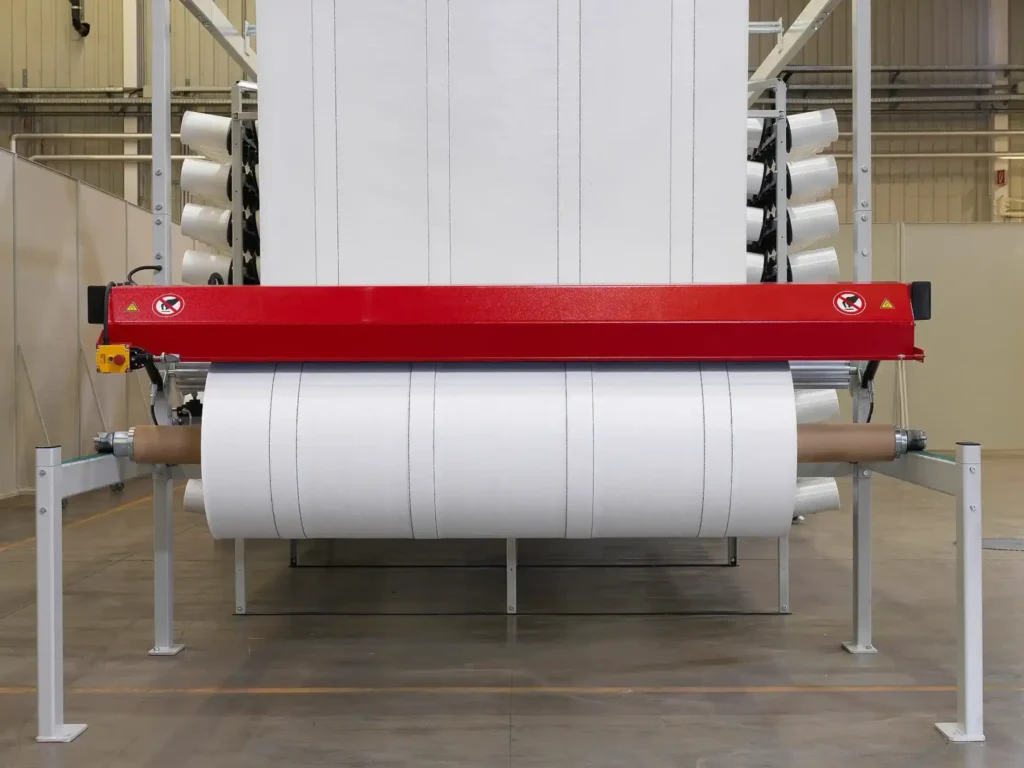
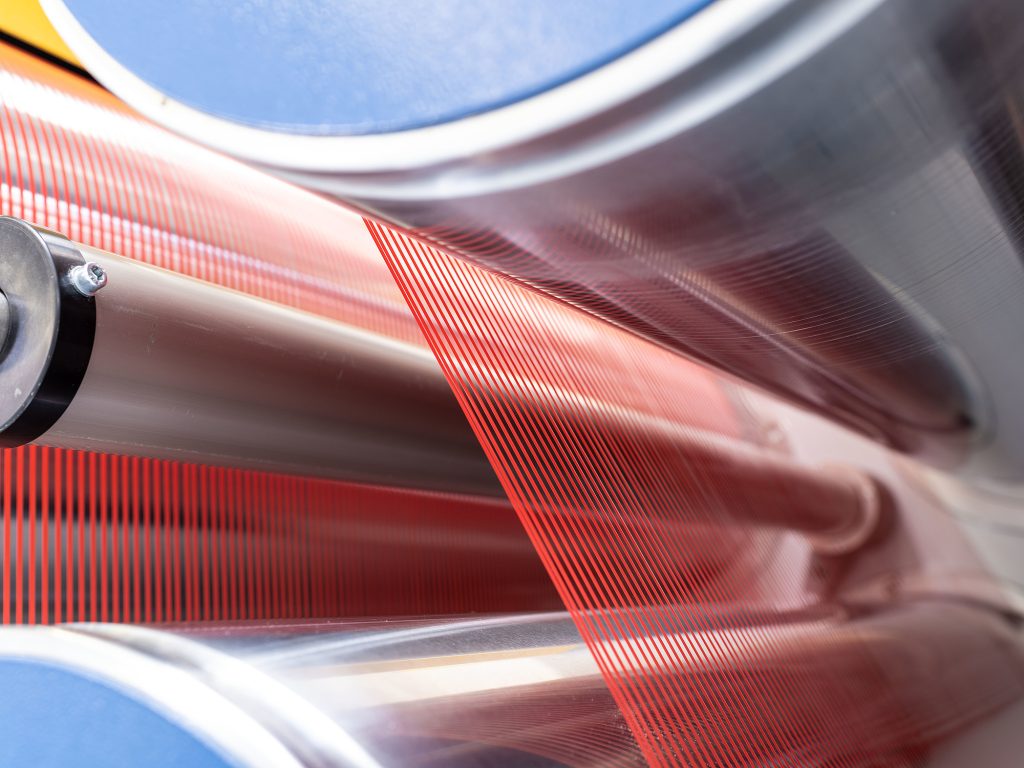
1. **Tape extrusion & orientation**: PP pellets are extruded into a slit film sheet, slit into tapes, and biaxially oriented by hot drawing for high tenacity. AI‑assisted tape lines optimize draw ratios and thermal profiles to maximize strength at minimum GSM.
2. **Weaving (circular or flat looms)**: Tapes are woven into fabric with controlled pick density (warp/weft tapes per 10 cm) to balance tensile, tear, and sifting resistance.
3. **Coating/lamination**: Extrusion coating of PP/PE or lamination with reverse‑printed BOPP adds barrier and print surfaces.
4. **Printing**: Flexographic or gravure printing (up to 8–10 colors) adds graphics, regulatory marks, barcodes, and handling symbols.
5. **Cutting & sewing**: Fabric is cut to length; bottoms are folded and stitched (single/double fold with crepe tape as required). Mouths may be hemmed; **filler cord** or felt is inserted into seams for **sift‑proof** performance. Liner insertion (loose or form‑fit) and anchoring tabs occur here when specified.
6. **Finishing**: Easy‑open features, lot coding, palletizing with corner boards, and stretch‑wrapping.
**C. Downstream: Quality assurance and release**
* **In‑process controls**: Tape tenacity/elongation, loom fabric GSM and pick density, coating thickness, print adhesion, seam strength, mouth width tolerance.
* **Product tests**: Bag dimensioning, burst/tear checks, **drop testing** with filled product or dummies, sifting trials for fine powders, moisture ingress trials (for linered variants), pallet compression and stability checks, and accelerated aging for UV‑stabilized SKUs.
* **Compliance marking**: If UN‑rated, apply proper **5H** code, PG level, and manufacturer cert numbers; maintain test reports and QA traceability.
**Why VidePak emphasizes equipment provenance**
VidePak specifies European center‑of‑excellence machinery: **Starlinger (Austria)** for PP tape extrusion, circular looms, lamination/coating, and bag innovations; and **Windmöller & Hölscher, W&H (Germany)** for high‑end printing/processing in flexible packaging. This combination yields consistent tensile properties, precise coating thickness, sharp registration in printing, and repeatable seam quality—all essential for chemical‑grade sacks.
—
## Where Open Top PP Woven Bags Fit: Applications in the Chemical Supply Chain
* **Inorganic salts and minerals**: Soda ash, caustic soda flakes (with liner), sodium chloride, gypsum, bentonite.
* **Fertilizers and agrochemicals**: Urea, NPK blends, ammonium phosphate; coated sacks or linered variants protect against caking and moisture uptake.
* **Polymer resins and additives**: PP/PE pellets, masterbatches, flame retardants (consider antistatic measures for dust control).
* **Pigments and fillers**: Titanium dioxide, carbon black (special care for dust/ESD), calcium carbonate, silica.
* **Detergent and cleaning chemicals**: Powdered detergents, builders (with anti‑sift seams and liners).
* **Construction chemicals**: Cement additives, tile adhesives, grouts (may prefer BOPP lamination for durability and print quality).
* **Hazardous solids**: Where applicable, engineer to UN bag codes (5H1/5H2/5H3) and perform qualification testing.
—
## How VidePak Controls and Guarantees Quality (Step‑by‑Step)
**1) Standards‑aligned design, production, and testing**
VidePak engineers Open Top PP Woven Bags to mainstream standards and regulatory regimes. Designs follow recognized frameworks for non‑bulk hazardous packagings (drop testing, vibration, and, where applicable, stacking simulations), and quality management is aligned to ISO‑style process controls. For food‑contact SKUs (e.g., food‑grade salts), VidePak follows relevant GMP and migration‑safe material selection.
**2) 100% virgin raw materials from major producers**
Consistent tape tenacity and coating adhesion begin with stable resin lots. VidePak sources virgin PP/PE and masterbatches from tier‑one suppliers and validates every incoming lot against the internal spec (MFI, density, ash, color).
**3) Best‑in‑class equipment: Austria’s Starlinger + Germany’s W&H**
Tape lines, circular looms, coating/lamination, and printing are run on flagship European machinery to lock in process capability (Cpk) on critical‑to‑quality metrics: tape strength, GSM, coating thickness, graphic registration, and seam consistency.
**4) A complete test funnel: incoming → in‑process → finished goods**
• **Incoming**: resin/MB COAs, melt flow checks, moisture, pigment concentration.
• **In‑process**: tensile/elongation of tapes, loom fabric audits, coating thickness mic checks, print adhesion cross‑hatch, seam stitch density, filler‑cord placement.
• **Finished goods**: dimensional checks, **drop tests**, sifting trials with product simulants, pallet compression, humidity chamber exposure (liner validation), UV exposure for outdoor SKUs, and routine **sampling inspection** per AQL.
Together, these layers create a closed‑loop system that prevents drift and captures issues before release.
—
## Choosing the Right Open Top PP Woven Bags for Chemical Products (A Practical, Human‑Style Framework)
Below is a decision framework used by experienced packaging engineers. Move through the questions in order; each answer narrows the right construction, closure, and test plan.
**A) What’s the hazard and regulatory class?**
* Non‑hazardous solid → standard open‑mouth woven PP, coated or uncoated, with optional liner for moisture.
* Hazardous solid (UN) → design to **5H1/5H2/5H3** as applicable; perform design‑qualification tests (drop; vibration; evaluate stacking needs for pallets even if the bag standard doesn’t require a formal stacking test). Select seam/liner combinations to meet sift‑proof or water‑resistant claims.
**B) What’s the powder’s particle size and flow behavior?**
* **Granular (≥500 μm)**: uncoated or light‑coated fabric can suffice; standard seams.
* **Fine powder (<150 μm)**: coated/laminated fabric is recommended; add **filler cord/felt** for **sift‑proof seams**; consider a liner to curb dust and moisture.
* **Cohesive/air‑entraining powders**: include de‑aeration strategies (liner venting, vacuum assist at fill) and stiffer fabric to resist bulging.
**C) Moisture and gas sensitivity?**
* Slight sensitivity → coated fabric and LDPE liner.
* High sensitivity → HDPE or **EVOH** co‑ex liner; consider **foil** liners for oxygen/light‑sensitive chemistries.
* Salt caking risk → aim for low MVTR; include anti‑caking agents as per product spec.
**D) ESD/dust ignition risk?**
* Non‑flammable powders → standard antistatic measures are usually adequate.
* Flammable/ignitable dust atmospheres → add antistatic masterbatch and/or conductive strategies with proper grounding protocols; review plant area classification.
**E) Filling and closure method?**
* Manual/semi‑auto gravity filling → classic sewn closure; ensure **easy‑open** tape for end users.
* Auger/compaction filling → reinforced mouth; seam spec for higher top stresses.
* Need hermetic seal → heat‑seal liner lip or add hot‑melt tape.
**F) Logistics profile?**
* Short haul, indoor storage → standard coating; moderate GSM.
* Export, humid/tropical, outdoor exposure → higher GSM, UV‑stabilized tapes, robust coating/laminate, and stronger pallet wrap scheme.
**G) Sustainability constraints?**
* Mono‑material PP preference → PP fabric + PP coating; design liner as separable component.
* Recycled content goals → discuss post‑industrial PP for outer fabric where regulations and performance allow; maintain virgin liners for chemical purity.
**H) Branding and compliance labeling?**
* Choose coated or BOPP‑laminated surfaces for high‑resolution graphics; reserve panel space for UN marks, handling symbols, batch/Lot, and QR/GS1 codes.
**A complete bill of specification (example)
for a moisture‑sensitive, non‑hazardous chemical powder (25 kg):**
* Body: circular‑woven PP fabric, 70–80 GSM, white, UV‑stabilized for 200 kLy
* Coating: PP 25–30 μm
* Seam: double‑fold bottom with crepe tape; side seams eliminated by circular fabric; **filler cord** at top seam
* Liner: LDPE 50–70 μm form‑fit, lip for heat‑seal
* Mouth: open top, hemmed; heat‑seal through liner lip then 1‑needle safety stitch (belt‑and‑braces)
* Printing: 6‑color flexo with QR for traceability
* Palletization: 5‑layer stack, interleaf sheets for friction, stretch‑wrap with corner boards
* QA: in‑line seam audits, MVTR check on liner film, filled‑bag **drop tests** at target PG equivalent for safety margin
---
## Systems Thinking: Decompose, Optimize, Integrate
**Subsystem 1 — Fabric mechanics**: GSM, weave density, and tape tenacity set the bag’s load envelope and creep behavior under stacking. **Trade‑off**: higher GSM improves tensile/tear but increases cost and carbon intensity. **Optimization**: move to high‑draw tape line settings (more orientation) and circular weaving to remove a side seam—a common failure locus.
**Subsystem 2 — Barrier & cleanliness**: Coatings/laminates and liners control MVTR/OTR and dusting. **Trade‑off**: barrier layers complicate recyclability. **Optimization**: use mono‑PP coating and a separable liner; specify low‑odour inks/adhesives and clean‑room converting if the chemical is purity‑critical.
**Subsystem 3 — Seams & closures**: Stitch density, thread selection, and filler cord placement determine **sift‑proof** performance. **Trade‑off**: tighter seams cost more time/consumables. **Optimization**: standardize seam recipes by powder granulometry bands and validate with sifting rigs.
**Subsystem 4 — Print & compliance**: Graphics must coexist with UN marks, hazard pictograms, and traceability. **Trade‑off**: dark inks may affect recyclate quality. **Optimization**: adopt low‑migration inks where needed and encode batch/QR for recalls.
**Subsystem 5 — Test regimen**: Testing isn’t a checkbox; it’s a feedback loop. **Optimization**: link test data (drop, seam strength, MVTR) to SPC dashboards; apply AQL sampling tuned by shipment risk.
**Integration plan**: Start with the hazard class and moisture/ESD profile; choose fabric GSM and coating/liner accordingly; define seam recipe for sifting class; lock filling/closure method; then finalize graphics and palletization. Validate with lab tests (drop, sifting, MVTR) before line‑wide release.
---
## Technical Summary Tables
### Table 1 — Typical Construction Options for Open Top PP Woven Bags
| Element | Main options | When to use | Notes |
| ---------------- | ----------------------------------------------------------------- | -------------------------------------------------- | ----------------------------------------------------------- |
| Fabric type | Circular‑woven; U‑panel; 4‑panel | Circular to avoid side‑seam, panels for boxy shape | Circular improves strength uniformity; panels allow gussets |
| Fabric GSM | 60–120 g/m² (typical chemicals) | Heavier for export/stacking; lighter for low‑risk | Confirm with drop trial and pallet plan |
| Coating/laminate | PP/PE coating 18–40 μm; BOPP lamination 20–40 μm | Dust control; weather/print quality | BOPP gives retail graphics; coating boosts sift‑proofness |
| Liner | LDPE/LLDPE 30–100 μm; HDPE 30–80 μm; EVOH co‑ex; foil composite | Moisture/oxygen/light‑sensitive chemicals | Form‑fit liners minimize folds and pinholes |
| Mouth | Open top, hemmed; heat‑seal lip; drawstring | Depends on closure method and user convenience | Easy‑open tape improves user experience |
| Seam | Double‑fold + crepe tape; **filler cord**/felt for **sift‑proof** | Fine powders; long transport legs | Validate with sifting rig before release |
| Printing | Flexo (up to 8–10 colors); gravure on BOPP | Branding + compliance marks | Low‑migration inks where purity matters |
| UV package | 200–300 kLy equivalent | Outdoor storage in tropics | Re‑test after accelerated aging |
### Table 2 — Example Test & Inspection Plan (non‑exhaustive)
| Stage | Test/Check | Purpose |
| -------------- | ----------------------------------------------------------------------------------------------------------------------- | ------------------------------------------------ |
| Incoming | Resin MFI/density/ash; masterbatch pigment; liner optical/dart | Confirms raw material conformance |
| In‑process | Tape tenacity/elongation; GSM and pick density; coating thickness; print adhesion | Keeps CTQs on spec in real time |
| Finished goods | Dimensions; seam strength & stitch density; **drop test** (filled); sifting trial; moisture ingress; pallet compression | Validates field performance and transport safety |
### Table 3 — Scenario‑to‑Spec Quick Picks
| Scenario | Recommended spec |
| ---------------------------------------------------------- | ---------------------------------------------------------------------------------------------------------------------------------- |
| Hydroscopic fertilizer (25–50 kg), export to humid climate | 80–100 GSM circular fabric, PP coating 25–30 μm, LDPE liner 60–80 μm form‑fit, filler‑cord seams, UV package, 6‑color flexo |
| Fine pigment (<45 μm), dust‑ignition concern | 90–110 GSM, coated fabric, antistatic masterbatch in tapes and liner, sift‑proof seams, HDPE/EVOH liner, grounded filling protocol |
| Salt (non‑hazardous), domestic | 70–80 GSM, coated fabric, LDPE liner 50–60 μm, standard seam, easy‑open tape |
| Aggressive outdoor storage, long dwell | Heavier GSM (100–120), robust coating, high UV package, interleaf sheets on pallet, corner boards + stretch‑wrap |
---
## Writing With the Title In Mind: “Choosing the Right Open Top PP Woven Bags for Chemical Products”
**Mental map before writing (how the choices cascade):**
1. Hazard class → 2) Powder fineness & moisture sensitivity → 3) ESD risk → 4) Filling/closure → 5) Logistics climate → 6) Branding/compliance → 7) Sustainability.
This chain determines fabric GSM, coating/laminate, seam recipe, liner architecture, and the validation tests you must run.
**Putting it all together (a single, workable solution for most chemical powders):**
Start with circular‑woven PP at 75–90 GSM, extrusion‑coat 25–30 μm PP, specify **filler‑cord seams** and a **form‑fit LDPE liner** with a heat‑seal lip. At the packer, heat‑seal the liner, then add a one‑needle safety stitch to lock the mouth. Print 4–6 colors with low‑migration inks; add a QR/GS1 code for traceability. Finally, certify performance with a filled‑bag **drop test**, confirm no sifting beyond acceptance thresholds, and run pallet compression checks to your warehouse stack plan. If the product is UN‑regulated, ensure the design maps to 5H1/5H2/5H3 as required and keep records at the lot level.
**A note on cost and TCO:**
Material dominates cost (fabric GSM + liner thickness). Line speed, rejects, and pallet density drive TCO. European machinery and rigorous QA minimize rejects and print/registration waste, often paying back via fewer customer complaints, fewer reworks, and better pallet cube utilization.
---
## Frequently Asked Engineer‑Level Questions (Concise)
**Q: Are Open Top PP Woven Bags recyclable?**
A: Mono‑PP builds (fabric + PP coating) are compatible with PP recycling streams. Design liners to be separable; foil/EVOH liners complicate recycling but can be removed.
**Q: How do I know if I need sift‑proof seams?**
A: If D50 <150 μm or the product “dusts,” specify filler‑cord seams and coated fabric, then validate on your sifting test rig with your actual powder.
**Q: Heat‑seal or sew the mouth?**
A: If you have a liner lip and want hermeticity, heat‑seal first. Many packers then add a safety stitch for mechanical strength and tamper evidence.
**Q: What changes for tropical shipments?**
A: Increase GSM, add UV stabilization, and consider higher‑barrier liners. Re‑evaluate pallet wrap schemes and dunnage for humidity.
**Q: Can I push graphics to retail quality?**
A: Yes—choose BOPP lamination with gravure; it improves scuff resistance and print resolution, though it adds cost and recycling complexity.
---
## Closing Perspective
Open Top PP Woven Bags distill decades of polymer science and industrial converting into a deceptively simple package that protects value‑dense chemical powders under real‑world abuse. When specified with the right fabric, seam, and liner—and validated with the right tests—they deliver the best balance of strength, barrier, machinability, and cost for 5–50 kg chemical packs. Equip your spec with the decision logic above, and you’ll get a sack that runs fast on your line, arrives clean, and complies in every port—all while supporting modern brand, safety, and sustainability targets.
“How can chemical manufacturers ensure safe and cost-effective waste management?”asks a plant manager at an industry conference. **“By selecting open-top PP woven bags with *UV-resistant coatings*, *anti-static properties*, and **customizable load capacities up to 1,000 kg—features that VidePak’s solutions deliver while reducing packaging costs by 30%,” *explains a VidePak technical advisor.* This exchange underscores the critical balance between safety, durability, and affordability in industrial packaging for hazardous materials.
Open-top PP woven bags are indispensable for chemical and construction industries, offering versatility in handling corrosive substances, abrasive waste, and bulk materials. VidePak, with 16 years of expertise and ISO-certified production lines, has emerged as a global leader in designing bags that meet stringent safety standards while optimizing logistics efficiency. This report analyzes technical specifications, application-specific requirements, and VidePak’s innovations in sustainable, high-performance packaging.
1. Technical Requirements for Chemical and Construction Applications
Chemical Compatibility and Safety
Chemical products demand packaging that resists corrosion, leakage, and static discharge. VidePak’s BOPP-laminated PP bags incorporate:
Multi-layer barriers: A 3-ply structure (PP weave + BOPP film + PE liner) reduces chemical permeation by 90%, ideal for acids, alkalis, and solvents[citation:19].
Anti-static additives: Carbon-black-infused fibers (5–8% blend) lower surface resistivity to ≤10^8 Ω/sq, mitigating explosion risks during flammable powder transport[citation:26].
Case Study: A German chemical manufacturer reduced spillage incidents by 45% after switching to VidePak’s laminated bags for hydrochloric acid storage.
Construction Waste Management
For debris like concrete rubble and metal scraps, bags require:
High tensile strength: 150–200 g/m² grammage with double-stitched seams (burst strength ≥35 kPa)[citation:44].
Cost efficiency: VidePak’s recycled PP blends (30% post-industrial waste) lower material costs by 20% while maintaining durability[citation:55].
Table 1: Key Parameters for Industrial PP Woven Bags
Application
Grammage (g/m²)
Thickness (microns)
Special Features
Hazardous Chemicals
120–160
100–150
BOPP lamination, anti-static
Construction Debris
150–200
150–200
UV-resistant, reinforced seams
Agricultural Powders
80–120
80–120
Breathable micro-perforations
2. VidePak’s Customization Capabilities
Material Innovations
UV Stabilization: Hindered Amine Light Stabilizers (HALS) extend outdoor usability by 18 months, critical for construction sites[citation:44].
Eco-Friendly Options: Bio-based PP derived from sugarcane reduces carbon footprint by 40%, aligning with EU Green Deal mandates[citation:55].
Design Adaptations
Color-Coded Branding: Blue stripes for toxic materials, red for flammables, and green for recyclables enhance warehouse safety and sorting efficiency[citation:19].
Ergonomic Features:
Wide mouth openings: Facilitate rapid loading of bulky debris.
VidePak’s 100+ Starlinger circular looms produce 500,000 bags daily with ≤2% material waste, leveraging AI-driven cutting algorithms[citation:55].
Economic Advantages
Bulk Pricing: Orders ≥10,000 units reduce costs to $0.25–$0.40/bag for construction-grade bags.
Reusability: 85% of VidePak’s FIBCs withstand 10+ cycles, lowering TCO (Total Cost of Ownership) by 50%[citation:44].
4. Case Study: Optimizing Waste Management in Dubai
A UAE construction firm faced frequent bag ruptures during sand transport. VidePak redesigned their packaging with:
200 g/m² PP fabric + UV-resistant coatings.
Cross-stitched bottom panels (burst strength: 45 kPa). Result: Rupture rates dropped from 15% to 2%, saving $120,000 annually in cleanup costs.
5. FAQs: Addressing Critical Concerns
Q: Can these bags handle sharp-edged metal scraps? A: Yes. Our triple-layered laminates (PP + adhesive + PE) resist punctures from debris ≤5 mm in size.
Q: Are VidePak’s bags compliant with EU chemical regulations? A: Absolutely. We hold REACH, UN 13H2, and FDA certifications for global shipments.
Q: What’s the lead time for custom-printed orders? A: 12–15 days, including 3D mockup approvals and ISO-compliant quality checks.
6. Industry Trends and VidePak’s Vision
The global PP woven bag market will reach $14.2 billion by 2027, driven by construction and chemical sectors[citation:44]. VidePak’s R&D in IoT-enabled smart bags (humidity sensors, QR traceability) positions it to capture 20% of this growth, particularly in emerging markets.
Selecting the right open-top PP woven bags is a strategic decision impacting safety, efficiency, and profitability. VidePak’s fusion of Austrian engineering precision, global certifications, and cost-optimized production ensures that every bag exceeds industrial benchmarks. As industries prioritize sustainability and automation, partnering with a certified innovator isn’t optional—it’s essential.