
Canvas: 111
What Are Poly – paper Bags?
Poly – paper Bags are hybrid industrial sacks that merge the tactile stiffness, print warmth, and stack-friendly geometry of kraft paper with the moisture resistance, sealability, and hygiene of polyethylene. In practice, they are built either as paper walls extrusion‑coated with poly or as paper tubes combined with a loose, tabbed, or form‑fit PE liner. The outcome is a rugged package that carries 10–50 kg—sometimes more—of powders, granulates, or dry goods while resisting humidity, rain splash, and warehouse abrasion. Paper faces invite crisp water‑based flexographic graphics and compliance panels; poly layers create controllable moisture‑vapor transmission rates and predictable heat‑seal behavior. The point is simple: present like paper, perform like poly, ship as a reliable workhorse.
Also known as
- Poly-lined paper bags
- Polyethylene-coated paper sacks
- Paper–poly barrier sacks
- Multiwall paper sacks with PE liner
- Pasted valve poly–paper sacks
- Pinch-bottom poly–paper bags
- Kraft–poly hybrid bags
- Moisture-resistant paper sacks with liner
Different labels, same architecture. Whether your drawing calls them pasted‑valve, SOM (sewn open mouth), or PBOM (pinch‑bottom open mouth), the mission of Poly – paper Bags does not change: keep contents dry and clean, run fast on real filling lines, stack neatly through transport, and communicate clearly to both operators and end users.
The Materials of Poly – paper Bags (Architecture, Properties, and Roles)
Think of a bag not as a sheet, but as a system. The paper walls distribute load and present the visual language of safety and compliance; the poly layer governs moisture, odor, and heat‑seal; the adhesive network unites plies without killing porosity; and the small parts—threads, tapes, valves, tear features—decide whether day‑to‑day handling feels effortless or fragile. Below, each material earns its keep.
1) Paper walls — structural and communicative backbone
Unbleached sack kraft is the mainstay for Poly – paper Bags, chosen for high tear, tensile energy absorption (TEA), and a forgiving stiffness that yields brick‑like pallet faces. Typical per‑ply basis weights range 60–100 g/m²; two to four plies allow designers to balance drop energy, compression, and print appearance. Outer plies are often calendered for crisp graphics; inner plies are tuned for porosity to support de‑aeration during fill.
Porosity & breathability. Sack kraft is engineered with controlled air permeability so aerated powders can settle without ballooning. Add a poly layer and you must plan de‑aeration deliberately—via micro‑perfs, valve vent paths, or timed sealing—so you achieve line speed without dust.
Scuff & flatness. Paper faces resist scuff better than many bare films, especially with matte overcoats. Stiffness keeps panels flat for scannable barcodes and clear warning icons; that flatness also protects pinch‑seals from post‑closure bending stress.
2) Poly layer — coating, film, or liner
Poly is the quiet muscle in Poly – paper Bags. It closes pores, blocks splash, and delivers heat‑seal pathways that paper alone cannot. You can place poly three ways:
- Extrusion coating (15–40 μm) laid directly on paper. Inside coatings present a seal surface and help MVTR; outside coatings offer wipe‑clean faces and rain resilience.
- Film lamination (20–60 μm) using PE or co‑ex films (e.g., PE/EVOH/PE). Films bring tighter barrier, higher puncture resistance, and—if outside—excellent rub durability.
- Loose or form‑fit liners (LDPE/LLDPE/HDPE; EVOH co‑ex when oxygen matters). A skirted liner captured in the top seam minimizes folds and pin‑holes, and its lip can be heat‑sealed before sewing or pinching.
Cost signal. Poly is a minority of mass but a majority of barrier value. Coatings add grams and energy per square meter yet prevent outsized losses from caking/spoilage. Liners increase unit cost and sometimes cycle time; they are justified where moisture or odor risk is real.
3) Adhesives and tie layers — invisible but decisive
Pasting systems (water‑based starch/synthetics) build tubes and bottoms; hot‑melt stripes reinforce corners and pinch‑seals. When laminating, polyolefin tie layers (maleic‑anhydride grafts) secure films to paper without crushing caliper. Set adhesion just strong enough to survive logistics—and no stronger—so fiber recovery remains possible where mills accept coated grades.
4) Inks, varnishes, and finishes
Water‑based flexographic inks dominate, paired with matte or semi‑gloss overprints that resist rub while keeping QR and barcodes glare‑free. Pigments are selected for lightfastness and compliance; black inks intended for codes are verified under abrasion.
5) Small parts with big consequences
Threads and crepe tapes convert sheets into sift‑tight sacks. Filler cords seated in stitch penetrations can reduce fines leakage by orders of magnitude versus stitching alone. Tear tapes, pull notches, and peel‑strips guarantee clean, tool‑free opening at mixers—an often‑overlooked safety win.
Tip
If you need barrier beyond what coatings can manage, place it in a removable liner. Keep the outer bag simple and the end‑of‑life story honest.
Rule of thumb
Every unnecessary gram in paper or poly is cost and carbon. Engineer to the lightest safe window that still passes drop and stack plans.
Key Features of Poly – paper Bags (What Specifiers Value)
Why do engineers keep returning to Poly – paper Bags when alternatives abound? Because these hybrids resolve tensions that pure substrates struggle with. Paper asks, “Can you print me clearly and stack me neatly?” Poly replies, “Can you keep me dry and seal me tight?” Together, they say yes more often than no. Consider the following set of intertwined strengths:
- Moisture governance with a paper face. Poly layers reduce MVTR and block splash while paper keeps panels flat and readable.
- Predictable closures. PBOM achieves hermeticity with hot‑melt plus heat‑seal; SOM offers speed with seal‑then‑sew; pasted valves feed rotary packers at pace.
- Stack stability and ergonomics. Paper’s modulus creates brick‑like faces; anti‑skid lacquers or micro‑embossed outer films curb pallet lean.
- High‑impact communication. Water‑based flexo yields crisp warnings, handling icons, and scannable codes. Matte overcoats keep QR readable in bright light.
- System flexibility. The same platform adapts to fertilizer, flour, pigments, pet food, or cement additives by swapping liners, valves, and closure geometry—no reinvention of your filling hall.
- Safety and compliance pathways. Food contact? Choose compliant inks/adhesives/resins. Hazard classes for solids? Map the construction to the relevant code suite and keep test records current.
- Circular‑design options. Separable liners, delaminable bonds, and honest labels provide real end‑of‑life routes without derailing line speed.
How Poly – paper Bags Are Produced (From Roll Stands to Ready Pallets)
Production is not magic; it is a sequence. Select. Convert. Assemble. Verify. Release. Skip a gate and the bag reminds you later—on a wet dock or under a pallet stack. The following map mirrors best‑in‑class lines.
A) Upstream — raw materials and incoming tests
- Papers: verify basis weight, porosity, tensile/TEA, moisture. Acclimate rolls to plant humidity before lamination or pasting.
- Resins & films: check MFI, gels, dart/drop, slip, haze. For co‑ex films (PE/EVOH/PE), confirm layer distribution and bond readiness.
- Adhesives & hot melts: validate viscosity, open/set windows at plant temperature; peel tests on coupons define your working range.
- Inks & varnishes: confirm pH/viscosity and rub resistance; proof barcode contrast and quiet zones.
- Ancillaries: threads, crepe tapes, filler cords, valves, tear tapes—dimensional checks and strength audits prevent in‑line surprises.
B) Core converting — tube making and face preparation
- Unwind & register. Multi‑roll unwinds with tension control; splice strategy keeps critical graphics out of seams.
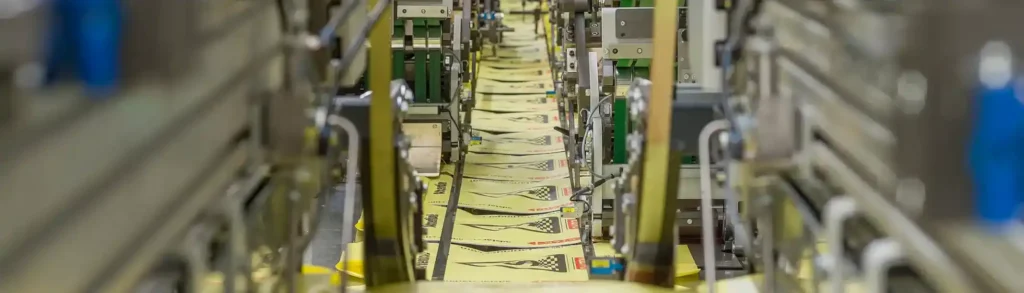
- Tubing & pasting (pasted‑valve path). Plies meet at the former; longitudinal seams are pasted; bottom squares are formed with programmed glue patterns; valve patches are applied and tunneled.
- PBOM formation (pinch‑bottom path). Cold‑glue pre‑line plus hot‑melt strip await activation at closing; an inner coated ply or film presents the heat‑seal surface.
- Extrusion coating or lamination. Coaters lay poly; laminators marry film and paper using tie layers or extrusion nip. Gauge and bond uniformity are monitored continuously.
- Printing. Water‑based flexo lays graphics and variable data; compliance panels get matte overcoats.
- Liner insertion. Loose, tabbed, or form‑fit liners are placed. Skirted liners protrude for pre‑seal prior to final closure. Vents (if needed) are punched in patterns clear of code zones.
C) Closing at fill — where hermeticity is won or lost
On the filling line, PBOM bags are heat‑sealed along the pinch; SOM bags are typically “seal liner, then sew” with tape‑over‑sew where dust is harsh; pasted‑valve sacks rely on valve memory and optional post‑tacks. Seal windows (temperature, dwell, pressure) are tuned to the chosen resin, and peels plus hot‑creep are verified at realistic temperatures.
D) Downstream QA — the three‑gate funnel
- In‑process controls: ply alignment, paste application weight maps, bond peels, valve tunnel dimensions, coating gauge maps, print register.
- Finished‑goods tests: dimensions, drop at target height/temperature, sifting trials with representative powders, seal peel/creep, MVTR where linered, pallet compression, barcode abrasion.
- Documentation: a runbook per SKU retains lots, settings, and readings—your passport for repeats and audits.
Equipment pedigree matters
VidePak runs European machine centers end‑to‑end: Starlinger (Austria) for film/lamination and sack conversion modules; Windmöller & Hölscher, W&H (Germany) for high‑end extrusion, printing, and automation. Wider process windows and high capability on tape strength, gauge control, bond uniformity, and registration translate to steadier seams, cleaner pallets, and graphics that survive the route.
Applications of Poly – paper Bags (Where They Excel)
From bakeries to bulk terminals, Poly – paper Bags cover more ground than most packaging platforms. They shine when content value is high, moisture risk is real, or communication must remain legible after abuse.
- Food & nutrition ingredients: flour, sugar, starches, dairy powders, proteins. Paper signals cleanliness; poly delivers seals and moisture restraint; easy‑open features protect mixers from fiber contamination.
- Animal nutrition & seed: abrasion‑prone lanes favor tougher faces and anti‑skid; pinch‑bottom closures block pest ingress; branding benefits from crisp print.
- Fertilizers & soil amendments: hygroscopic content and yard storage push liners and laminated inners; anti‑caking becomes a QA metric.
- Minerals & industrial powders: CaCO₃, bentonite, talc, pigments. Dust governance via seal‑then‑sew and filler cords; barcodes must survive conveyor rub.
- Construction chemicals: tile adhesive, grout, self‑leveling compounds. Brick‑like geometry + scuff‑resistant faces preserve pallet stability and legibility.
- Retail & civic programs: paper faces carry clear instructions, warnings, and QR help; poly keeps packs tidy in rain and during returns.
How VidePak Controls and Guarantees Quality
Quality is built in, not inspected in. VidePak runs a four‑part method that meets auditor expectations and operator needs alike.
- Standards‑aligned design, production, and testing. Engineering references mainstream norms (ISO/ASTM/EN/JIS families where applicable). Qualification plans cover drop, sifting, seal integrity, MVTR for linered SKUs, pallet compression, and abrasion cycles for compliance panels.
- Virgin raw materials from major producers. Papers, resins, films, adhesives, and inks come from approved suppliers with certificates of analysis. Incoming verification keeps variability out of the line.
- Best‑in‑class equipment. End‑to‑end conversion, coating/lamination, and printing on Starlinger and W&H assets with in‑line monitoring stabilize CTQs—tape strength, gauge, bond, register—and convert into fewer customer complaints.
- Complete test funnel. Incoming → in‑process → finished goods. Acceptance checks for paper/resin/film; SPC on pasting and lamination; seam audits; adhesion and seal tests; filled‑bag drop and sifting trials; MVTR where required; pallet compression to stack plans; routine AQL sampling for statistical confidence.
Poly – paper Bags: A Sustainable and Versatile Packaging Solution — From Headline to Plan
A headline makes a promise; a specification keeps it. To move from slogan to shelf, structure your thinking like a builder: define the environmental claim, align operations, and protect economics. Then write a test plan that proves each claim under your actual conditions.
Environmental outcomes
- Prefer the fewest layers that deliver the target: paper for faces and stiffness; poly only where barrier and sealability pay back.
- If a liner is needed, make it separable and say so on pack. Clarity converts intent into action.
- Design labels that survive abrasion so disposal guidance remains readable at end‑of‑life.
Operational performance
- Choose porosity, venting, and valve geometry for line speed.
- Engineer seals for peels and hot‑creep at realistic temperatures.
- Reserve quiet zones for barcodes and QR; use matte coats to keep contrast.
Economic sanity
- Standardize seam/valve/closure recipes across SKUs to shrink changeovers.
- Cluster SKUs by artwork to reduce plate changes and make‑ready waste.
- Index price clauses to paper and poly benchmarks; track OEE, not anecdotes.
If “sustainable” must be more than a word, align material simplicity, end‑of‑life labeling, and weight discipline. If “versatile” must be more than a boast, pick closure options that fit your lines and venting that fits your powders. If “solution” must be more than a promise, test it—drop, sift, seal, compress—and publish the numbers.
Keyword cluster and near‑synonyms used for clarity
poly‑lined paper bags, multiwall paper sacks with PE liner, polyethylene‑coated paper bags, kraft–poly hybrid bags, pasted‑valve poly–paper sacks, pinch‑bottom poly–paper, paper–poly barrier packaging.
Technical Tables (Fast Reference)
For a broader family of woven solutions that pair well with liner strategies, see this reference on kraft‑sack formats and applications.
Risk‑Driven Decision Tree for Poly – paper Bags
- Regulatory & hazard class. If food contact applies, lock compliant inks/adhesives/resins; if hazardous solids analogues apply, map markings and tests early.
- Powder fineness & aeration. Porosity, venting, and seam recipes (filler cord/felt) flow from how your product behaves.
- Moisture/oxygen sensitivity. Decide coating vs film vs liner; set MVTR/OTR targets and test conditions.
- ESD profile. Specify antistatic strategy and handling SOPs where needed.
- Filling & closure. Match valve diameter or mouth hem stiffness; validate seal windows against your bars and resins.
- Logistics. Outdoor dwell, ocean legs, and stack height drive paper basis, anti‑skid, and UV‑tolerant overprints.
- End‑of‑life story. Pick one route—separable liner with fiber recovery; delam‑friendly bonds for mills; or poly‑first in regions that accept flexible poly—and label it clearly.
A Practical Baseline Specification You Can Issue Tomorrow
- Body: two‑ply sack kraft, 70–90 g/m² per ply; outer calendered for print, inner tuned for fill porosity.
- Poly: inner extrusion coat 20–30 μm LDPE/LLDPE; upgrade to 30–40 μm outer film lamination for harsh logistics or retail.
- Closure: PBOM hot‑melt + heat‑seal for hermeticity, or SOM with “seal liner, then sew” and tape‑over‑sew where dust is severe.
- Liner: form‑fit LDPE 50–70 μm skirted for pre‑seal; switch to HDPE/EVOH co‑ex if oxygen control is required.
- Venting: perforation pattern matched to aeration; keep clear of barcode quiet zones.
- Printing: water‑based flexo; abrasion‑resistant black for codes; matte overcoats on compliance panels.
- Marking: lot/GS1 codes, QR to handling and end‑of‑life guidance, clear liner‑removal instructions when present.
- Validation: filled‑bag drop tests; sifting with your product; seal peel and hot‑creep; MVTR as needed; pallet compression; barcode abrasion cycles.
When specified as a system—paper backbone sized to the physics of your product and route, poly sized to barrier risk, closures tuned to your line, graphics treated as data, and end‑of‑life labeled without ambiguity—Poly – paper Bags stop being a compromise and start looking like a solution you can defend in the boardroom and on the dock.
October 22, 2025
- What Are Poly – paper Bags?
- The Materials of Poly – paper Bags (Architecture, Properties, and Roles)
- Key Features of Poly – paper Bags (What Specifiers Value)
- How Poly – paper Bags Are Produced (From Roll Stands to Ready Pallets)
- Applications of Poly – paper Bags (Where They Excel)
- How VidePak Controls and Guarantees Quality
- Poly – paper Bags: A Sustainable and Versatile Packaging Solution — From Headline to Plan
- Technical Tables (Fast Reference)
- Risk‑Driven Decision Tree for Poly – paper Bags
- A Practical Baseline Specification You Can Issue Tomorrow
- 1. Structural Integrity and Cost Efficiency in Construction Waste Management
- 2. Sustainability: Closing the Loop in Construction Logistics
- 3. Technical Specifications and Customization
- 4. VidePak’s Manufacturing Ecosystem
- 5. Future Trends: Smart Packaging for Waste Tracking
- Conclusion: Redefining Construction Waste Logistics
“Why are construction firms globally shifting from traditional waste disposal methods to poly-paper bags?”
This question, raised by a project manager at a leading European construction conglomerate, highlights the urgent need for efficient and eco-conscious waste management. The answer lies in poly-paper bags’ unique combination of durability, cost efficiency, and environmental compliance—three pillars that position VidePak’s solutions as indispensable in modern construction logistics.
1. Structural Integrity and Cost Efficiency in Construction Waste Management
1.1 High-Strength Material Engineering
Poly-paper bags, crafted from polypropylene (PP) woven fabric laminated with kraft paper, offer tensile strengths of up to 50 N/cm², capable of withstanding loads exceeding 40 kg. This is critical for transporting abrasive construction debris like concrete fragments, metal shards, and broken bricks. VidePak’s Austrian Starlinger circular looms extrude PP tapes with precision tolerances (±0.02 mm), ensuring uniform weave density and tear resistance exceeding 600 mN (tested via Elmendorf method).
Laminated Kraft Paper Sacks
Eco-friendly poly-paper composite sacks with sustainable features and versatile packaging for multiple industries.
Check More →Kraft Paper Valve Bags Solutions
Durable poly paper blended valve bags, offering eco-sustainable packaging and flexible application scenarios.
Check More →Multiwall Paper Valve Bags
Multi-layer poly-paper hybrid bags designed for sustainability, high durability and universal packaging use.
Check More →Compliant Pasted Open Mouth Paper Bags
Sustainable poly paper combined open mouth bags, reliable and eco-conscious for modern packaging needs.
Check More →A 2025 study by the Journal of Construction Materials found that PP-kraft laminated bags reduce on-site spillage by 25% compared to traditional HDPE sacks, translating to annual savings of $18,000 for a mid-sized demolition contractor handling 10,000 tons of waste.
1.2 Cost Optimization Through Scalable Production
VidePak’s 16 extrusion lines and 30 lamination machines enable mass production of poly-paper bags at $0.12–$0.18 per unit—30% cheaper than composite plastic alternatives. For bulk projects, FIBC (Flexible Intermediate Bulk Container) bags with 1–2 ton capacities reduce per-unit costs by 40% while maintaining ISO 21898 compliance[citation:10].
Case Study: A Chinese road construction firm cut waste management expenses by 35% after adopting VidePak’s FIBC bags for transporting crushed concrete, citing their 10,000+ Martindale abrasion cycles and UV-resistant coatings for outdoor storage.
2. Sustainability: Closing the Loop in Construction Logistics
2.1 Recyclability and Circular Economy Integration
Poly-paper bags achieve 85% recyclability, with post-consumer PP reprocessed into non-woven geotextiles for soil stabilization—a practice adopted in German highway projects. VidePak’s closed-loop system recovers 90% of material waste during production, aligning with the EU’s Circular Economy Action Plan targets for 55% plastic recycling by 2030.
2.2 Reducing Carbon Footprint
PP’s low melting point (160°C vs. PET’s 260°C) cuts energy consumption by 25% during manufacturing. A lifecycle analysis by Sustainable Packaging Review (2025) showed VidePak’s bags generate 45% less CO₂ than virgin plastic alternatives, equivalent to saving 12 tons of CO₂ per 10,000 bags produced.
3. Technical Specifications and Customization
| Parameter | VidePak Poly-Paper Bags | Industry Average |
|---|---|---|
| Load Capacity | 40–50 kg | 25–35 kg |
| Thickness | 120–150 gsm | 80–100 gsm |
| Recyclability Rate | 85% | 60% |
| UV Resistance | 500-hour QUV testing | 300-hour |
| Custom Print Colors | Up to 8-color HD flexo printing | 4–6 colors |
FAQs
Q: Can poly-paper bags withstand sharp-edged debris?
A: Yes, laminated PP layers with 150 gsm kraft paper provide puncture resistance up to 15 N/mm², ideal for glass and metal fragments.
Q: How do these bags compare to biodegradable options?
A: PP’s 85% recyclability outperforms PLA’s 30% compostability in industrial facilities, offering superior cost and durability for heavy-duty use.
Q: Are custom sizes available for specialized waste?
A: VidePak offers FIBC bags up to 2-ton capacities and custom dimensions with reinforced seams for irregular debris like insulation materials[citation:10].
4. VidePak’s Manufacturing Ecosystem
Founded in 2008 under CEO Ray Chiang’s leadership, VidePak combines 30+ years of expertise with cutting-edge infrastructure:
- 100+ Starlinger Circular Looms: Producing 20 million bags monthly.
- ISO 9001-Certified QC: Defect rates ≤0.3%.
- Global Reach: Serving 40+ countries with $80M annual revenue.
A U.S. demolition contractor noted: “VidePak’s FIBC bags reduced our landfill costs by 50%, while their UV coatings prevented degradation in desert sites.”
5. Future Trends: Smart Packaging for Waste Tracking
VidePak is piloting RFID-tagged bags for real-time waste tracking, integrating with IoT platforms to monitor fill levels and route optimization. Early trials with a Japanese firm reduced transportation costs by 18% through dynamic load balancing.
Conclusion: Redefining Construction Waste Logistics
Poly-paper bags are not merely containers but strategic tools for sustainable development. VidePak’s fusion of recyclable materials, precision engineering, and cost-effective production positions it as a leader in the $46B global construction packaging market. As industries prioritize ESG compliance, these innovations will drive efficiency while mitigating environmental impact.
For insights into high-capacity FIBC solutions, explore our guide on FIBC Bulk Bags. To learn about eco-friendly innovations, visit Sustainable Woven Bags.
VidePak: Engineering Sustainability into Every Fiber.