
What Are Kraft Paper Woven Bags? A Plant-Floor Portrait With Everyday Names
Kraft Paper Woven Bags are hybrid sacks that merge a printable kraft paper exterior with a tough woven polyolefin substrate to create a composite body engineered for powders, granules, and crystalline goods. The paper face brings premium shelf presence, tactile grip, and crisp ink lay; the woven fabric contributes tensile strength, puncture resistance, and dimensional stability; the optional internal liner governs moisture and oxygen. Together they deliver a package that looks like paper and performs like an industrial textile—suited for commodities such as cement, fertilizer, rice, flour, sugar, pet feed, seed stock, resin pellets, and a long tail of mineral salts.
Because packaging teams speak in many dialects, the same concept circulates under several labels. The differences often reflect forming method, closure strategy, or application niche:
1. Paper Poly Woven Bags
2. Paper Laminated Woven Sacks
3. Block‑Bottom Paper Woven Valve Bags
4. Pinch‑Bottom Kraft Poly Sacks
5. Open‑Mouth Kraft Woven Bags
6. Paper‑Poly FIBC Liners / Over‑bags (for bulk systems that demand a paper identity layer)
Why do plants keep coming back to Kraft Paper Woven Bags? Because they square a familiar circle: paper aesthetics, poly strength, and production‑line speed. A sack that prints like cartonboard, runs like a valve bag, and stacks like a brick changes the ledger in ways a unit price never reveals.
The Materials of Kraft Paper Woven Bags: Paper Grades, Poly Fabrics, Tie Layers, and How They Work Together
At the material level, the hybrid construction turns complementary chemistries into single‑purpose performance. The outer ply is kraft paper—bleached or unbleached, virgin or controlled‑recycled—selected for stiffness, tear, and ink receptivity. Beneath that face, a woven polyolefin cloth (commonly PP raffia; HDPE variants are also used) supplies the load‑bearing grid. Between them, a tie layer (often extrusion‑coated LDPE/LLDPE or a purpose‑formulated hot‑melt) couples paper fiber networks to polymer tapes. Optionally, a mono‑PE or barrier liner protects hygroscopic or aroma‑sensitive products. Each piece has a job, and the composite behaves only as well as the worst‑tuned layer.
Paper face: identity, print, and handling
• Kraft basis weight: Typical ranges for sack kraft face plies sit around 70–120 g/m². Higher basis weight stiffens the panel, enabling squarer stacks and crisper corners; lower weights can suffice where the woven cloth carries most mechanics.
• Fiber chemistry: Long‑fiber virgin kraft resists tear and handles multiple folds; controlled recycled content can be deployed with careful monitoring of burst and ring crush.
• Porosity and Cobb: Porosity influences ink set and venting; Cobb values indicate liquid water resistance. For dusty powders, a modestly lower porosity can keep print clean while vent paths are managed elsewhere (micro‑vents or valve design).
• Surface treatment: Sizing, clay coatings, or primers enhance dot gain control and rub resistance, reducing scuffing in distribution.
### Woven substrate: strength and longevity
• Base fabric: Woven polypropylene tapes at 60–100 g/m² for 25–50 kg sacks are common; higher GSM and denier appear in heavy‑abuse use cases. The grid spreads load, throttles creep, and tolerates point impacts from pallets and conveyors.
• Tape denier & pick count: Denier between ~600–1200 (sack scale) and pick counts tuned to sifting resistance determine tensile and tear while shaping loom productivity.
• UV package: If pallets live in sun‑exposed yards, UV stabilizers in the tapes and in any outer extrusion layers protect against chalking and embrittlement.
Tie layers and adhesives: the quiet heroes
• Extrusion lamination: LDPE or LLDPE tie layers (≈12–30 g/m²) thermally bond paper to fabric. Control of melt temperature, die‑lip, and nip pressure ensures bonding without over‑stiffening the fold.
• Hot‑melt systems: EVA or metallocene‑based hot‑melts can be used in narrow bond lines for pinch closures or localized laminations; their viscosity curve must match line speeds to avoid holidays and voids.
• Water‑borne primers: Where reverse printing or specialty coatings are used, primers can raise dyne and improve cross‑material adhesion.
Optional liner: barrier that pays for itself
• Mono‑PE liners: 40–80 μm liners limit water vapor transmission and protect free‑flowing solids such as sugar or salt.
• Barrier liners: Where oxygen matters (fortified flours, certain additives), thin PE/EVOH/PE constructions control O₂ ingress while staying compatible with most food‑contact expectations.
• Electrostatic options: Antistatic additives in liners reduce resistivity for dust‑prone fills.
Cost—where engineers really move the number
• Paper basis weight vs. fabric GSM: Substituting strength from fabric to paper (or the reverse) alters both runnability and print feel. The optimal mix balances squareness with foldability and press uptime.
• Coat weight / tie layer: Too light and bond holidays create delamination at folds; too heavy and the sack behaves like a sheet of plastic, wrinkling at closers.
• Graphics recipe: Large solid areas, matte/soft‑touch varnish, and multiple spot colors raise ink consumption and press passes. Reverse print under a protective laminate is an alternative when rub resistance is critical.
• Valve geometry & change parts: A sleeve that fits the lance and vent strategy saves far more in uptime and dust housekeeping than it costs in fabric and labor.
| Layer / Component | Typical Material | Primary Function | Design Notes |
|---|---|---|---|
| Outer ply | Sack kraft 70–120 g/m² | Premium print, stiffness, handling | Tune porosity and Cobb for inks and environment |
| Tie layer | LDPE/LLDPE extrusion 12–30 g/m² or EVA hot‑melt | Bond paper to fabric | Avoid over‑stiffening; protect fold zones |
| Woven substrate | PP or HDPE raffia 60–100 g/m² | Tensile, puncture, creep control | Denier/pick count set sifting resistance |
| Liner (optional) | Mono‑PE 40–80 μm or PE/EVOH/PE | Moisture/O₂ management | Antistatic options for dust‑prone fills |
| Closure system | Block‑bottom valve / pinch‑bottom / open‑mouth | Fill speed, dust control, seal integrity | Match to product flow and plant equipment |
Key Features of Kraft Paper Woven Bags: What Makes the Hybrid Format Win
• Strength at low mass — the woven grid carries tensile load and resists puncture, delivering drop performance that plain paper struggles to match.
• Premium print and touch — the kraft face takes ink cleanly, manages dot gain, and offers a natural hand feel that many brands prefer for food, seed, and specialty minerals.
• Stack stability — block‑bottom and pinch‑bottom constructions produce square bags that build straight pallets; paper stiffness helps corners survive compression.
• Moisture strategy options — choose unlined for breathable goods, lined for hygroscopic products, and tune wrap timing to route humidity.
• Valve‑ready speed — with a shaped sleeve and sensible vent design, valve versions fill rapidly with minimal dust.
• Traceable identity — paper faces accept high‑resolution lot codes, variable QR, and regulatory marks with rub resistance.
• Recovery pathways — paper can be separated from poly in some dismantling workflows; mono‑poly substrates under the paper face keep material options open.
• Ergonomics — paper surfaces grip better in manual handling, reducing slip in wet or dusty environments.
How Kraft Paper Woven Bags Are Produced: Materials → Lamination → Printing → Conversion → QA
Successful output is less about heroics and more about consistent choreography. Plants that run quietly share three habits: explicit inputs, disciplined transformations, and checks that mirror real hazards.
Upstream selection and incoming checks
• Paper specs: basis weight, burst, ring crush, porosity, Cobb, moisture, and surface strength (picking). Records include mill, lot, and treatment.
• Fabric specs: GSM, denier, pick count, tensile MD/CD, and UV package when required.
• Tie‑layer resins/adhesives: melt index windows, viscosity curves, and supplier COAs.
• Liner films: gauge, SIT, WVTR/OTR, and antistatic properties.
• Hygiene: dust, gels, and moisture are screened; retains tie each inbound roll to eventual bag lots.
Core process stages
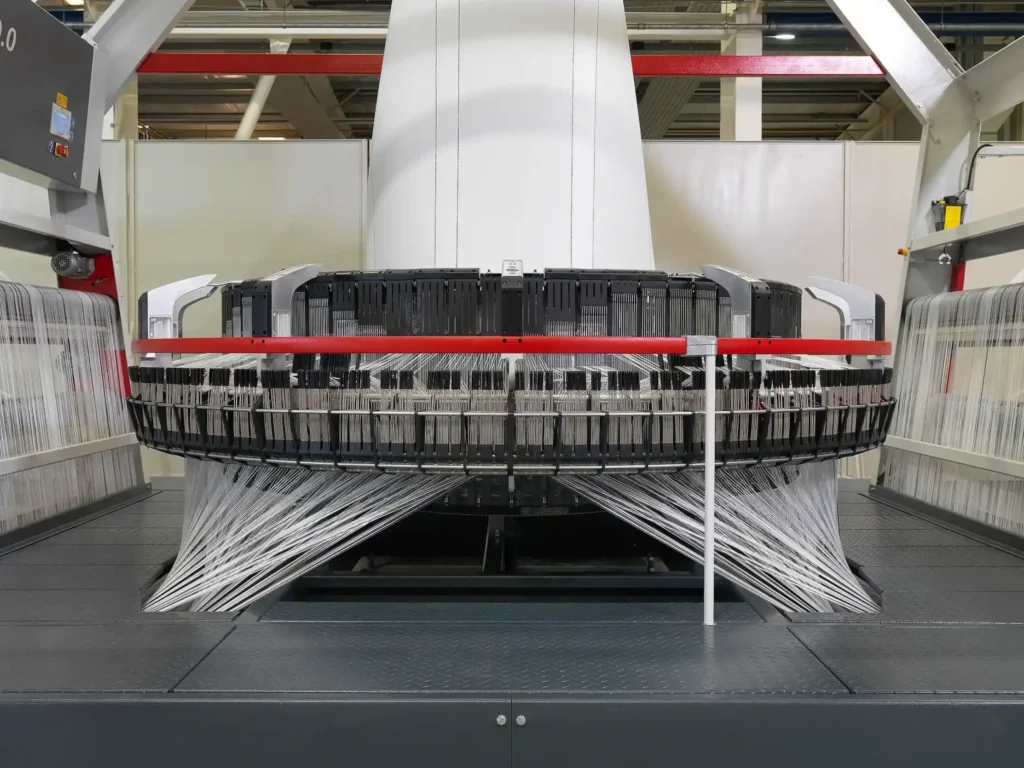
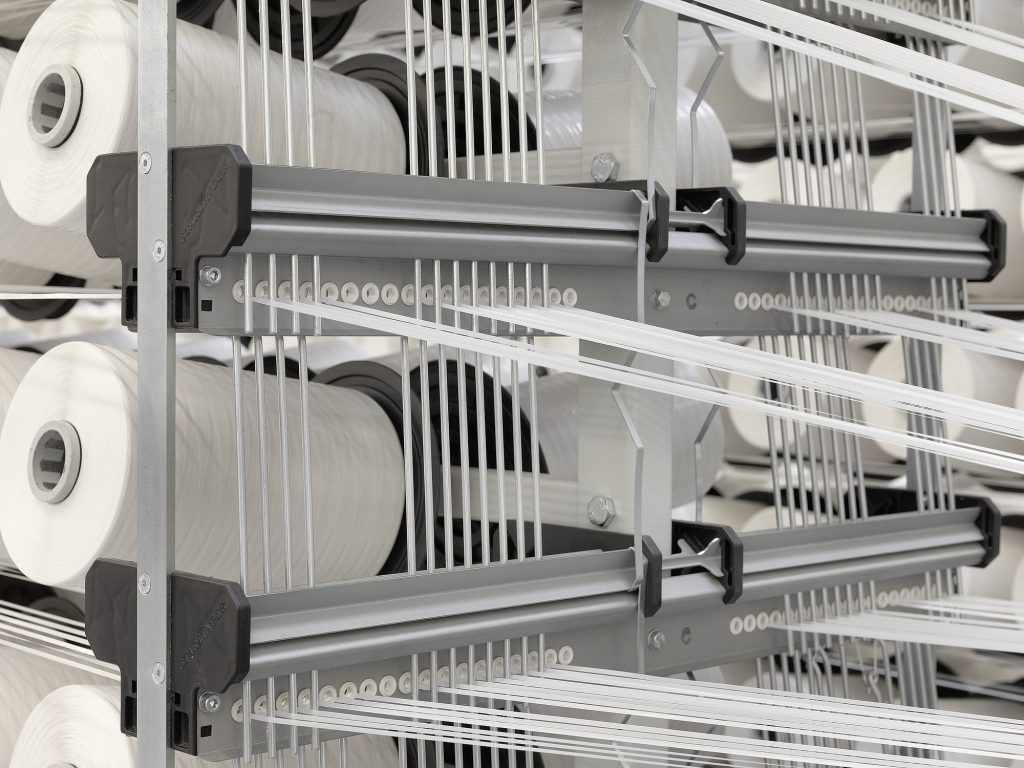
1. Tape extrusion & weaving — polymer is extruded as a film, slit into tapes, and drawn to align chains; tapes are woven on circular or flat looms. Selvage quality predicts conversion calm.
2. Extrusion lamination — LDPE/LLDPE tie layer is applied between kraft and fabric. Control die‑lip, nip pressure, and chill calendar to deliver bond without curl or over‑stiffness.
3. Printing — flexographic presses lay down branding, regulatory icons, and variable data. Paper is corona/plasma treated or primed to stabilize dyne and dot gain.
4. Slitting & sheeting — laminated webs are dimensioned for conversion; edge quality matters for valve insertion and bottom folds.
5. Conversion — open‑mouth and pinch‑bottom lines fold and close the bottom via heat or adhesive; block‑bottom valve lines form square bases and fit sleeves that mate the plant’s lance geometry.
6. Finishing & pack‑off — bundles are counted, stacked, and strapped. Interlayers and pallet patterns are matched to paper surface friction to prevent lean while ensuring easy release.
Downstream quality gates
• Bond strength: peel tests across the web and, crucially, in fold zones.
• Dimensional capability: cut length, web squareness, bottom geometry variance under SPC.
• Print durability: rub/scuff tests, adhesion, and color targets against standards.
• Drop matrix: corner/edge/flat orientations at specified heights with pass/fail tied to tears, delamination, and sifting.
• Moisture screens: WVTR at climate setpoints when unlined; liner integrity and seal checks when lined.
• COF and handling: conveyor and panel friction windows validated at the packer.
Where Kraft Paper Woven Bags Excel: Application‑by‑Application Guidance
• Cement and mineral powders: block‑bottom valve versions for dust control and square stacks; venting strategy aligned with particle fineness.
• Fertilizers: UV‑stabilized fabrics, coated or lined depending on hygroscopicity; paper face for clear handling marks.
• Flour, rice, and sugar: pinch‑bottom with food‑contact liners; rub‑resistant graphics for warehouse readability.
• Animal feed and seeds: open‑mouth or pinch‑bottom for manual reclosure on farm; breathable options for certain seeds.
• Resin pellets and additives: valve designs with antistatic measures where dust fines are present.
• Charcoal and specialty minerals: paper aesthetics align with retail while woven fabric tolerates abrasion.
| Cargo | Preferred Format | Controls | Why It Works |
|---|---|---|---|
| Cement blends | Block‑bottom valve | Valve/lance fit; micro‑vents; panel anti‑slip | Clean fills; square pallets; controlled dust |
| Fortified flour | Pinch‑bottom + liner | WVTR/OTR spec; food‑contact documentation | Moisture/aroma protection with paper identity |
| Fertilizer prills | Valve or pinch‑bottom | UV package; panel friction; liner for hygroscopic blends | Seasonal throughput; yard survival |
How VidePak Guarantees Quality for Kraft Paper Woven Bags: Fourfold Discipline
1. Named standards and methods — tensile and tear on fabric strips, bond/peel for laminates, friction for conveyor/panel dynamics, drop orientation matrices for sacks; methods are written with equipment and pass/fail criteria so a number means the same thing everywhere.
2. Virgin‑grade inputs from major mills and resin producers — audited sources with batch COAs and traceability; recycled content only within defined use cases and guardrails.
3. Best‑in‑class machinery — Austrian woven‑packaging competence and German converting/printing precision ensure gauge control, registration accuracy, and logged energy/pressure.
4. Complete inspection flow — incoming (basis weight, burst/RCT, MI/density, dyne/COF), in‑process (bond maps, registration, geometry), and finished goods (rub, drop, WVTR/OTR where relevant, dimensional capability, valve fit tests). Retains and traceability are non‑negotiable.
Kraft Paper Woven Bags: Versatility and Benefits—From Concept to Control Plan
Turning promise into plant‑floor reality requires a compact chain of cause and effect: structure → property → performance → risk.
• Structure — pick paper basis weight and porosity, tie‑layer type/coat weight, fabric GSM/denier/pick count, liner type, and closure geometry.
• Property — measure bond strength, tensile/tear, COF, rub resistance, WVTR/OTR, and dimensional capability.
• Performance — validate packing speed, dust counts, valve closure, pallet lean, and drop survivability at target line rates.
• Risk — rank sifting, delamination, scuffing, seam split, moisture pickup; reduce via prevention (spec changes) and detection (in‑process checks) until residual risk meets policy.
System Thinking for Kraft Paper Woven Bags: Sub‑Problems → Root Causes → Remedies
A) Scuffing and graphic loss
Drivers: high panel friction, abrasive transport, insufficient varnish.
Remedies: apply protective varnish, consider reverse print under a thin laminate, add slip‑balanced interlayers.
B) Pallet lean
Drivers: friction mismatch between paper face and interlayer, length variance, aggressive pattern.
Remedies: one‑panel anti‑slip or selective varnish; tighten cut length; adopt brick/pinwheel and confirm after vibration conditioning.
C) Delamination at bottom folds
Drivers: bond holidays, low nip pressure, over‑stiff tie layer.
Remedies: raise local coat weight, increase nip, and soften tie‑layer rheology; enlarge fold radius.
D) Sifting at corners
Drivers: low fabric pick count, tie‑layer thin spots, valve dusting that re‑routes fines.
Remedies: lift pick count modestly, reinforce corner bonds, and fix dust at the source—the valve.
E) Moisture pickup
Drivers: late wrapping, high ambient RH, unlined designs on hygroscopic goods.
Remedies: shorten fill‑to‑wrap dwell, add mono‑PE liner, and confirm WVTR at route climates.
Technical Parameters for Kraft Paper Woven Bags: Baselines to Tailor
| Attribute | Typical Target (25–50 kg) | Why It Matters |
| ———————— | ———————————– | —————————————————– |
| Paper basis weight | 70–120 g/m² | Governs stiffness, print quality, and corner strength |
| Fabric GSM (uncoated) | 60–100 g/m² | Carries tensile/tear, limits creep |
| Tie layer (extrusion) | 12–30 g/m² | Bond integrity without over‑stiffening |
| Bond peel (paper↔fabric) | ≥ 2.5–4.0 N/15 mm (spec‑dependent) | Prevents delam at folds and under drops |
| Panel COF (paper/paper) | 0.35–0.55 | Stack vs. conveyor balance |
| Rub resistance | Pass per internal cycles | Keeps marks legible |
| Drop test | Pass corner/edge/flat at set height | Simulates mishandling |
| WVTR (unlined) | ≤ 5–20 g/m²·day @ 38 °C/90% RH | Moisture screen for routes |
| Valve sleeve tolerance | ±1.0–1.5 mm placement | Dust control and fill repeatability |
| Bottom geometry variance | ≤ ±2 mm over 1,000 bags | Pallet squareness and speed |
> Note: Methods and limits should reflect your hazards and climate. Numbers without context mislead.
Validation Plan for Kraft Paper Woven Bags: Lab → Pilot → Packer → Route
1. Lab — bond/peel maps including fold zones; fabric tensile/tear; COF; rub; WVTR/OTR where relevant.
2. Pilot lamination & conversion — 2–3 lots; log coat weight profiles, bottom geometry, sleeve placement.
3. Packer trial — run at target packs/min; capture dust counts, reject codes, net‑fill accuracy.
4. Distribution simulation — vibration + compression + drop; measure pallet lean after 48 hours; age samples at hot/humid setpoints.
5. Freeze spec — lock ranges where multiple good settings exist, not a single precarious peak.
• Confirm powder flow, bulk density, and angle of repose
• Select format by fill behavior (valve vs. pinch vs. open‑mouth)
• Set paper basis weight, fabric GSM, and tie layer by drop and bond goals
• Define venting/sleeve geometry and validate at speed
• Prove pallet pattern; choose interlayer friction that matches paper finish
• Build traceability; calibrate test rigs; run capability studies
Sustainability and End‑of‑Life for Kraft Paper Woven Bags
Sustainability becomes real when it survives the plant. Three pragmatic steps matter most:
• Design for separation — specify bond chemistries that enable mechanical delamination or selective disassembly in take‑back schemes.
• Keep materials simple — prefer mono‑poly substrates under paper to preserve recovery options.
• Prevent product loss — the surest footprint reduction is avoiding waste; durable sacks keep commodities intact.
For a related product family focused purely on the paper‑first route (without the woven substrate), see this short overview of kraft paper sack options.
Procurement and Supplier Governance for Kraft Paper Woven Bags
• Qualify mills and resin producers; request variability data (basis weight, Cobb, MI/density) and proof of traceability.
• Audit lamination and conversion capability; expect logged coat weights, nip/temperature profiles, bottom geometry control, and sleeve placement tolerance.
• Demand retains and CAPA discipline; suppliers who share capability studies recover faster from excursions.
• Secure parts and service; when a closer stops, minutes are expensive.
Template Specs for Kraft Paper Woven Bags (Illustrative)
• 25 kg flour: pinch‑bottom; paper 90 g/m²; fabric 70 g/m²; tie layer 18 g/m²; liner 60 μm mono‑PE; rub‑resistant varnish; WVTR target ≤ 8 g/m²·day @ 38 °C/90% RH.
• 50 kg fertilizer: block‑bottom valve; paper 80 g/m²; fabric 85 g/m²; UV package; tie layer 22 g/m²; optional liner per hygroscopicity; panel anti‑slip; valve micro‑vents.
• 25 kg resin pellets: valve; paper 80 g/m²; fabric 80 g/m²; tie layer 20 g/m²; antistatic liner optional; sleeve‑to‑lance fit verified.
Frequently Asked Questions About Kraft Paper Woven Bags
Do these sacks still breathe? Unlined versions permit modest vapor exchange via paper; lined versions prioritize barrier. Choose by product sensitivity and climate. Are they recyclable? Paper/poly hybrids can be separated in some dismantling schemes; designing for separation and minimizing material variety help. Which closure is better—valve or pinch? Valve excels for fast powders; pinch avoids stitch holes and can be better for moisture‑sensitive goods. Pick by fill behavior and barrier needs. Why do some pallets lean even when the bag looks great? Friction balance and pattern choice govern lean as much as geometry. Treat palletization as part of the package. How do we minimize scuffing? Varnish selection, reverse print where warranted, and interlayer friction control reduce rub damage.
October 23, 2025
By VidePak Market Research Team
Introduction: Why Kraft Paper Woven Bags Are Redefining Packaging
“What makes kraft paper woven bags a superior choice for industries ranging from agriculture to construction?” This question, posed by a logistics manager during a recent industry conference, underscores the growing demand for sustainable and durable packaging solutions. The answer lies in their unmatched versatility, eco-friendliness, and advanced manufacturing standards, which VidePak has perfected over decades of innovation.
At VidePak, founded in 2008 and led by CEO Ray Chiang—a visionary with extensive global market expertise—our mission is to deliver packaging solutions that balance functionality and sustainability. With a workforce of 526 professionals and a production capacity bolstered by 100+ circular looms, 16 extrusion lines, and 30+ lamination and printing machines, we produce over 50 million kraft paper woven bags annually, generating $80 million in global sales. This report explores how our products meet modern industrial demands while adhering to rigorous quality benchmarks.
1. The Multifunctional Applications of Kraft Paper Woven Bags
Kraft paper woven bags are engineered for adaptability. Their layered structure—combining kraft paper’s rigidity with polypropylene (PP) woven fabric’s tensile strength—makes them ideal for:
- Agricultural Storage: Resistant to moisture and pests, they safely store grains, fertilizers, and animal feed.
- Construction Materials: Capable of holding up to 50 kg of cement or sand without tearing.
- Chemical Packaging: Laminated variants prevent leakage of hazardous powders, complying with ISO 9001 and ISO 14001 standards.
Case Study: A Southeast Asian rice exporter reduced post-harvest losses by 15% after switching to VidePak’s kraft paper bags with woven PP liners, citing enhanced durability during maritime transport.
2. Quality Control and Standardization: The Backbone of Reliability
VidePak’s manufacturing philosophy prioritizes precision. Key measures include:
a) Material Excellence
- Virgin PP/PE Granules: Unlike recycled materials, virgin polymers ensure consistent tensile strength (≥90 N/cm²) and elongation resistance.
- Strict Thickness Standards: Bags are produced with a positive tolerance of +0.02 mm to prevent “bursting” under stress.
b) Advanced Production Technology
- Starlinger Machinery: Our Austrian-made looms and laminators guarantee seam uniformity, reducing defect rates to <0.5%.
- Anti-Fading Printing: High-definition flexographic inks, tested for 500+ hours under UV exposure, retain vibrancy even in harsh climates.
Table 1: Key Product Specifications
| Parameter | Standard Value | Tolerance Range |
|---|---|---|
| Fabric Weight | 80-120 g/m² | ±2 g/m² |
| Bag Thickness | 0.18-0.25 mm | +0.02 mm |
| Load Capacity | 25-50 kg | Customizable |
| Printing Durability | Grade 4-5 (ISO 105) | No fading after 1 year |
3. Sustainability Meets Performance
Kraft paper woven bags align with global eco-conscious trends:
- Biodegradability: 70-80% of materials decompose within 2 years, outperforming traditional plastics.
- Reusability: A European construction firm reported reusing VidePak bags 3-5 times for aggregate storage, cutting costs by 20%.
4. VidePak’s Technological Edge
Our R&D team leverages cutting-edge solutions:
- Customization: From 1-color logos to 8-color HD prints, we support bespoke designs for brands like Nestlé and Cargill.
- Smart Automation: AI-driven quality inspection systems scan 1,000 bags/hour, flagging micro-tears or misprints.
5. FAQs: Addressing Client Concerns
Q1: How does VidePak prevent “bursting” during transit?
*A1: By using *virgin PP granules* and enforcing positive thickness tolerance, we eliminate weak seams. Our bags withstand 3x the rated load during stress tests.*
Q2: What printing techniques ensure longevity?
*A2: We employ *UV-cured flexography, which bonds ink molecules to the fabric, resisting abrasion and humidity.
Q3: Can bags be tailored for food-grade applications?
*A3: Yes. Our *PE-coated variants* meet FDA standards, ideal for flour and sugar packaging.*
6. Market Trends and VidePak’s Vision
The global kraft packaging market is projected to grow at 4.8% CAGR through 2030, driven by e-commerce and agro-industrial demand. VidePak aims to lead this shift by:
- Expanding into recyclable PE liners by 2026.
- Partnering with NGOs to promote circular economy practices.
Conclusion
Kraft paper woven bags are not just packaging—they are a testament to engineering ingenuity and environmental stewardship. At VidePak, we combine Austrian precision machinery, virgin materials, and client-centric innovation to deliver solutions that transcend industry boundaries. As Ray Chiang often states, “Quality isn’t a step in our process; it’s the foundation of every bag we produce.”
References
- Industry Report on PP Woven Bags, JINGQIN Plastics Co., Ltd.
- Kraft Paper Bag Applications, Shanghai ZhiZheng Packing Material Co., Ltd.
- Sustainable Packaging Trends, A&P Packaging.
- Production Standards for Industrial Bags, Anhui TIANDA Environmental New Material Co., Ltd.
- Printing Technology in Packaging, Qingdao Chenghaoda Science and Technology Co., Ltd.
- Global Market Analysis, Weifang Brother Packing Co., Ltd.
- Quality Control in Woven Bags, VidePak Internal Documentation.
External Links
- Learn more about advanced lamination techniques.
- Explore customization options.
Report generated by VidePak Market Research Team on March 6, 2025.