
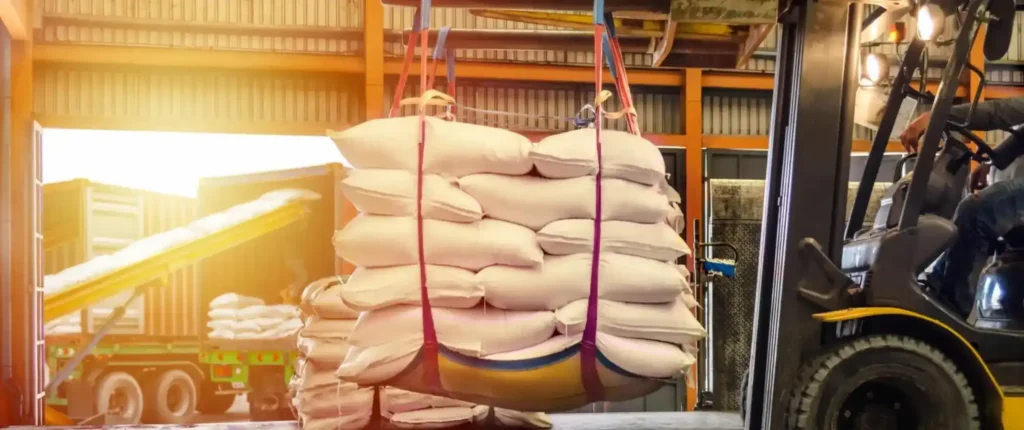
What Are Anti‑Bulge FIBC Bags?
In the realm of heavy‑duty packaging, a familiar problem hides in plain sight: filled bulk sacks swell into soft cylinders, stealing pallet space, leaning in stacks, and wasting container volume. Anti‑Bulge FIBC Bags exist to solve exactly that. By integrating internal stabilization elements—most commonly engineered baffles—they redirect the lateral forces generated during filling and transport so the container maintains a near‑rectangular footprint. The result is geometry you can trust: squarer layers, straighter stacks, tighter truck cubes, and calmer warehouses.
Common aliases for Anti‑Bulge FIBC Bags (different labels, same intent). Each term below emphasizes the form‑stable objective; unless specified otherwise on a drawing or purchase order, they point to the same structural logic.
- Baffle FIBC
- Q‑bag
- Form‑stable FIBC
- Cube bulk bag
- Square FIBC
- Anti‑swell FIBC
- Baffled big bag
- Container‑optimized FIBC
- Space‑saving FIBC
- Form‑fit bulk container
Ask a few practical questions and the concept clarifies itself. What shape do pallets and containers prefer? Rectangles. What shape do conventional filled sacks naturally become? Bulging pillows. What, then, must a better bulk bag do? It must hold its shape. Anti‑Bulge FIBC Bags do precisely that by using internal panels with calibrated apertures and high‑efficiency seams to moderate product flow and counter outward pressure. Brand managers see neater stacks; operators feel safer motion; logistics teams bank better cube utilization; finance records lower landed cost per delivered ton.
The Materials of Anti‑Bulge FIBC Bags
Materials are more than a shopping list; they are levers. Choose differently and the bag behaves differently. In Anti‑Bulge FIBC Bags, every constituent—resin, fabric, baffle, webbing, liner, coating, thread—plays a measured part. Below we map each component to its role, the most sensitive settings, and the tradeoffs that actually matter on the floor.
| Component | What it is | Primary functions | Design levers | Cost levers |
|---|---|---|---|---|
| Woven PP fabric (shell) | Drawn polypropylene tapes woven to target GSM and ends/picks | Tensile strength, tear arrest, abrasion resistance, seam retention | GSM, denier, EPI/PPI, UV package, coating | GSM and UV dominate; loom yield matters |
| Baffle panels (stabilizers) | Internal PP woven/non‑woven/mesh panels with aperture maps | Shape control, head‑pressure equalization, flow mediation | Span, aperture size/spacing, seam pattern, corner attachment | GSM and aperture density trade fill speed vs. stability |
| Coating (optional) | PP/PE extrusion coat 20–35 µm | Dust control, moisture moderation, surface friction tuning | Coat weight, chill roll temp, OPV/matte zoning | Coat weight and line speed |
| Inner liner (optional) | LDPE/LLDPE/mLLDPE tube; loose or form‑fit; antistatic when required | Hygiene, moisture/odor barrier, clean discharge | Gauge, slip/additives, neck‑to‑spout fit, seal profile | Gauge dominates; additives add stability and cost |
| Webbing & lift loops | PP multifilament or flat webbing, 45–70 mm widths | Safe handling, load transfer, color coding | Loop length/pitch, bartack pattern, reinforcement patches | Webbing denier and stitch time |
| Thread & seam reinforcements | PP/PET threads; tapes at stress trajectories | Seam efficiency and dust control | Needle size, SPI, lock vs. chain stitch, hot‑air assist | Thread dtex and machine throughput |
| Electrostatic class | Type A/B/C/D FIBC fabrics and grounding schemes | Ignition risk control for powders and zoned areas | Grounding tabs, conductive grids, handling SOPs | Conductive yarn cost; training cost |
Callout: most bulge is geometry, not mass. Before you add GSM to the shell, tune the baffle span, aperture pattern, and seam architecture. Let the structure, not just the weight, carry the shape of Anti‑Bulge FIBC Bags.
Features of Anti‑Bulge FIBC Bags
The value of Anti‑Bulge FIBC Bags compounds across the chain. They reclaim space, reinforce safety, sharpen presentation, and reduce wrap and rework. Each feature below pairs a practical lever with the metric that proves it worked—because poetry is pleasant, but numbers move budgets.
Container and pallet efficiency. Rectangles fill rectangles. Form‑stable cubes reduce void space in 20‑ft and 40‑ft boxes and sit neatly on 48×40 in or 1200×1000 mm pallets. Metric: bags per container, over/underhang, lean angle.
Warehouse footprint and stack safety. Less lateral creep under compression enables higher stacks at equivalent risk. Metric: compression creep over dwell time; COF against deck material.
Cleaner, faster filling. Baffle aperture maps tame turbulence and equalize head pressure; liners synchronize with spout geometry for clean cut‑offs. Metric: net‑weight sigma; airborne dust index; cycle time.
Reduced wrap usage. Straight sides need fewer film layers to achieve restraint; corners keep their lines. Metric: film meters per pallet; corner board usage; rewrap events.
Better presentation. Pallets that look deliberate convey quality. Customers perceive order; auditors perceive control. Metric: barcode grade at destination; audit pass rate; complaint trend.
Automation‑friendly geometry. Palletizers, AGVs, and strappers prefer predictability. Metric: misstrap rate; AGV interventions; palletizer stops per 1000.
Perspective: the single greatest sustainability win in bulk packaging is damage prevention. If Anti‑Bulge FIBC Bags cut your product losses by even a fraction, they have already out‑greened heavier alternatives that waste goods and time.
The Production Process of Anti‑Bulge FIBC Bags
Repeatability is not an accident; it is an architecture. VidePak’s line integrates Austria’s Starlinger platforms for tape extrusion, weaving, and conversion, and Germany’s W&H presses for printing and film handling. Together they set a narrow process envelope where the 100,000th bag behaves like the signed‑off sample. What follows is the choreography—from resin and yarn to a pallet of certified Anti‑Bulge FIBC Bags.
Upfront selection and testing. PP tape‑grade resin verified for melt flow, ash, moisture; webbing yarn checked for tenacity and elongation; baffle fabric validated for GSM and tear; liner resins screened for seal window and odor. Non‑conforming lots are quarantined and linked to a digital genealogy from day one.
Tape extrusion and orientation — Starlinger. PP is melted, slit, drawn, and stabilized. SPC tracks denier and break rate; surface finish is monitored to prevent fuzz and fly on looms. The goal: tapes that weave without drama.
Weaving — Starlinger circular/flat looms. Ends/picks and shed height are dialed to hit GSM and width. Vision assists map holes and weft breaks; loom IDs and roll numbers ensure every meter can be traced.
Coating (if specified). A thin PP/PE coat tunes dust and moisture moderation and lets us engineer COF bands. Coat weight and curl are measured on‑line to protect foldability and stack behavior.
Printing — W&H. When graphics are specified, flexo stations with low‑odor inks deliver crisp codes and color control. Registration cameras and spectrophotometry hold ΔE so the brand looks the same in week one and week ten.
Cutting and panel prep. Shell panels are cut to length; gussets pre‑creased; baffle panels are cut and perforated to the aperture map; alignment points ensure consistency when the system is stitched together.
Sewing and assembly — the form‑stable core. Baffles are stitched to side panels with reinforced box‑X patterns; loop bases receive bartacks over reinforcement patches; top spouts or duffles and discharge spouts are attached with heat‑assisted seams to reduce dust through needle holes.
Liner integration (as specified). Loose or form‑fit liners are inserted, tabbed, or cuffed. Seal windows are validated to deliver burst pressure and clean cut‑offs. Antistatic grades are paired with the FIBC type to match facility zoning and product MIE.
Final inspection and pack‑out. Dimensions, baffle alignment, spout sizes, loop length/pitch, seam efficiency, SWL/top‑lift/cyclic lift, COF, compression, and metal detection (when specified) are checked under an AQL plan. Pallets ship with full genealogy—resin lots, loom IDs, coating lanes, press jobs, conversion cells.
Equipment note: choosing Starlinger and W&H is not branding theater; it is process insurance. Stable gauge, dependable registration, and repeatable bonds compress variation at the source—where it is cheapest to control.
Applications of Anti‑Bulge FIBC Bags
Whenever cubic fidelity creates value, Anti‑Bulge FIBC Bags pay for themselves. Below, representative segments show how specs shift with risks, and which levers move outcomes the most. Think in terms of intent: efficiency of container fill, safety of stacks, hygiene of product, clarity of codes.
| Segment | Typical configuration | Spec priorities | Primary risks | Countermeasures |
|---|---|---|---|---|
| Industrial minerals and cementitious powders | SWL 1000–1500 kg; shell 160–200 GSM; baffles 90–110 GSM with dense apertures; coated shell; discharge spout | Shape fidelity, dust control, abrasion tolerance | Corner blowouts, sifting, pallet lean | Reinforced seams, coating, antiskid bases, compression tests |
| Fertilizers (prilled/granular) | SWL 1000–1500 kg; UV‑stabilized fabric; medium baffle density; duffle top; quick‑tie discharge | Outdoor life, stack stability, moisture moderation | UV embrittlement, hydration, leaning stacks | UV packages, antiskid fields, validated compression/COF |
| Food ingredients (sugar, salt, starches) | SWL 1000–1250 kg; food‑contact liner; precise aperture maps; Type C/D for zoned facilities | Hygiene, dust discipline, barcode integrity | Contamination, dust ignition, scuffed codes | Antistatic liners, OPV, metal detection, grounding SOPs |
| Plastic resins and masterbatch | SWL 1000–1250 kg; uncoated shell; fewer, larger apertures; wide fill spout; cone discharge | Flowability, cycle time, impact protection | Bridging, long cycles, container voids | Spout‑to‑granule matching, aperture tuning, corner reinforcements |
| Seeds and agricultural commodities | SWL 500–1000 kg; gentler aperture maps; antiskid base; breathable shells when moisture permits | Kernel integrity, pallet stability, label protection | Crushed edges, leaning pallets, rub damage | Lower aperture aggressiveness, base reinforcement, OPV zoning |
Related reading: see the reference on electrostatic safety classes for bulk containers: Understanding Types A, B, C, and D for FIBC. Pairing the right class with your product’s ignition profile is as important as getting shape control right in Anti‑Bulge FIBC Bags.
How VidePak Controls and Guarantees the Quality
Quality is a chain of evidence. VidePak’s chain has four audited links: standards‑aligned methods, virgin inputs from tier‑one producers, best‑in‑class equipment (Starlinger and W&H), and layered inspections (incoming, in‑process, outgoing). The aim is not to memorize acronyms but to make numbers comparable across geographies and quarters.
Standards in practice. Methods align with ISO/EN frameworks for FIBC performance and ASTM/JIS analogs for fabric tensile/tear and friction; electrostatic practices follow class guidance for Types A/B/C/D. Results travel with your shipments.
Virgin raw materials. Structural layers—PP tapes/fabric, webbing, baffles, coating and liners—are specified as 100% new. Predictable melt and bond behavior drive seam efficiency and long‑cycle durability.
Machines that hold tolerance. Starlinger and W&H platforms keep gauge, registration, and bond consistency tight—so a second run in another plant behaves like the approved pilot.
Layered inspection. Incoming COAs, in‑process SPC, and outgoing AQL sampling close the loop. Traceability ties a pallet of Anti‑Bulge FIBC Bags back to resin lots, loom IDs, coating lanes, press jobs, and assembly cells.
| Stage | Primary checks | Why it matters | Evidence |
|---|---|---|---|
| Incoming | Resin MFI/ash/moisture; baffle GSM/tear; webbing strength; liner gauge/additives | Predictable processing, seam integrity, hygiene | Sampling logs; retain library; hold/release tags |
| In‑process | Tape denier SPC; fabric GSM/width; aperture verification; loop bartack stitch counts; coat weight/COF | Prevents drift and cascading defects | Control charts; settings capture; CAPA |
| Outgoing | Dimensions; SWL/top‑lift/cyclic; seam efficiency; COF; compression; metal detection | Ships what you specified, not what you hoped | AQL sheets; release signatures; pallet genealogy |
Evidence over opinion: a top‑lift test without rate and cycles is a story; a compression test without dwell and COF is a rumor. Write the numbers; let them protect your route and your brand.
Expanding the Source Themes for a Competitive Global Market
The central thesis is simple: in a market where container space and operational safety are scarce, shape is strategy. Anti‑Bulge FIBC Bags convert that strategy into daily practice. We extend the argument with five lenses—space, speed, sustainability, consistency, and human factors—and show how each lens refracts into decisions at the spec table.
- Space: A few additional bags per container across quarters tallies into serious budget and CO₂ savings. Space saved is cash saved is carbon saved.
- Speed: Straight pallets move faster because operators trust them. Trust removes hesitation; hesitation costs throughput.
- Sustainability: Damage prevention beats recycled rhetoric. Avoiding product loss is the single biggest environmental action a bag can take.
- Consistency: Platform choices like Starlinger and W&H purchase a portable process envelope—so specs do not lose their meaning as they travel.
- Human factors: Square bags feel safer. Drivers fight fewer shifts; auditors read cleaner codes; customers see order, not chaos.
Systems Thinking: From Subproblems to a Single, Coherent Specification
We decompose the engineering challenge into five recurring subproblems and answer each with a lever, a test, and a decision rule. Then we synthesize them into a living one‑page spec for Anti‑Bulge FIBC Bags.
A) Lateral expansion under head pressure. Lever: baffle span and aperture map; seam pattern. Test: wall deflection at 25/50/75/100% fill. Decision: deflection stays inside pallet envelope with 10% margin.
B) Vertical compression in storage. Lever: fabric GSM/base reinforcement; COF tuning. Test: compression at planned stack height/dwell. Decision: creep and tilt remain within thresholds.
C) Fill speed vs. dust. Lever: aperture open area; venting; spout geometry. Test: cycle‑time and airborne dust index. Decision: meet weight sigma within dust limits.
D) Handling and lifting safety. Lever: loop length/pitch; bartack; needle/thread pairing. Test: SWL and cyclic top‑lift; loop elongation. Decision: meet safety factor with controlled elongation.
E) Genealogy and audit readiness. Lever: QR/DM traceability across stations. Test: mock recall time to isolate lots. Decision: contain within hours, not days.
Synthesis in one view: baffled square FIBC; SWL 1000–1500 kg; shell 160–200 GSM; baffles 90–110 GSM with 10–18% open area; coat 25–30 µm as needed; liner 80 µm where risk justifies; loops cross‑corner 45–55 mm; COF 0.35–0.45 on deck; QC = SWL/top‑lift/cyclic, compression, COF, dimensional, metal detect.
Engineering Heuristics and Useful Numbers
- For 0.9–1.2 t/m³ powders at 1000–1250 kg, shell 160–180 GSM and baffles 90–100 GSM are a dependable starting point.
- For 1.4–1.8 t/m³ minerals at 1500–2000 kg, consider shell 190–220 GSM, denser apertures, and reinforced bases.
- Aperture open area per baffle face commonly lands at 10–18%; round holes favor tear resistance, slots favor equalization.
- Loop elongation at SWL must remain narrow; geometry shifts mid‑route if loops stretch too far.
- Always pair COF data with compression outcomes; friction without load is a half truth.
Troubleshooting Atlas: Symptom → Cause → Corrective Action
| Symptom | Probable cause | Corrective action |
|---|---|---|
| Pallet leans after dwell | COF too low; gusset asymmetry; baffles off‑center | Raise COF with matte zones/antiskid; recalibrate gusset knives; tighten baffle alignment SOP |
| Excess dust during filling | Apertures too large; no venting; stitch holes open | Reduce aperture area; add venting; use needle heat/hot‑air assist |
| Mid‑height bulge | Baffle span wide; weak seam architecture | Reduce span; upgrade to reinforced box‑X seams |
| Corner tears near loop base | Stitch density/needle mismatch; missing reinforcement | Increase stitch density; adjust needle size; add reinforcement tapes |
| Slow discharge/bridging | Apertures too small; discharge spout mismatch | Increase open area; resize spout; add vibration/air‑assist as permitted |
Remember: the fastest fix is not always a new material; often it is the clarity of the spec and the discipline of the settings that bring your bag and your line back into harmony.
Cost Engineering Without False Economies
Cut cost where it does not cut corners. These levers consistently lower total cost of ownership while preserving the advantages of Anti‑Bulge FIBC Bags:
- Optimize baffle geometry before increasing shell GSM—geometry beats mass for shape retention.
- Engineer COF with data; tune wrap recipes to the friction you actually have, not what you hope you have.
- Standardize footprints, spout diameters, and loop lengths across SKUs to slash changeovers and spare complexity.
- Buy repeatability; the cheapest bag on paper can become the costliest on the dock.
Sustainability That Survives the Route
The greenest move in bulk packaging is to keep product intact and moving. Still, Anti‑Bulge FIBC Bags enable additional, credible reductions when configured intelligently.
| Vector | Tactic | Contribution |
|---|---|---|
| Transport efficiency | More payload per container from shape fidelity | Lower CO₂ per delivered ton |
| Damage prevention | Straighter stacks; controlled friction; fewer lean events | Less rework and waste across the route |
| Material right‑sizing | Strength from design before mass | Lower grams without safety compromise |
Specification Template: Turn Needs into Numbers
| Attribute | Specification | Rationale |
|---|---|---|
| Format | Baffled square FIBC, SWL 1000–1500 kg at defined safety factor | High utilization and stack stability |
| Dimensions | L×W×H tuned to pallet/container footprint | Container cube and deck fidelity |
| Shell fabric | 160–200 GSM (UV option for yard storage) | Strength/abrasion margin |
| Baffle design | 90–110 GSM; round/slot apertures 30–60 mm on 80–140 mm grid | Fill speed vs. shape control |
| Coating | 25–30 µm PP/PE (as needed) | Dust/moisture moderation; COF tuning |
| Liner | 80 µm LLDPE; antistatic where zoned | Hygiene and seal consistency |
| Loops | Cross‑corner 45–55 mm; bartack per SOP | Safe lifting and controlled elongation |
| COF | 0.35–0.45 on typical deck materials | Stack safety without over‑wrapping |
| QC | SWL/top‑lift/cyclic; compression; COF; dimensional; metal detect | Evidence‑based release |
Integration Examples: Three Routes, Three Specs
Case A — 1000 kg sugar, audited food route. Shell 170 GSM; baffles 95 GSM with round holes; coated shell; food‑contact antistatic liner 80 µm; Type C fabric with grounding tabs. Outcome: cleaner fills, zero static events, consistent barcode grades after export.
Case B — 1500 kg mineral, rough yard storage. Shell 200 GSM with UV package; baffles 110 GSM with slot apertures; antiskid base; coated shell; discharge spout with petal closure. Outcome: taller, straighter stacks; corner damage reduced; wrap usage down by 20%.
Case C — 1200 kg resin pellets, high‑speed filler. Shell 160 GSM uncoated; baffles 90 GSM with fewer, larger apertures; large fill spout; cone discharge. Outcome: faster cycles with preserved shape; container loading gains two extra bags per box on average.
Frequently Asked Questions
Are “baffle FIBC,” “Q‑bag,” and “Anti‑Bulge FIBC Bags” different? They describe the same intent: internal stabilization to preserve cubic shape. Differences live in baffle materials, perforation patterns, and seam architectures.
Do I always need a liner? No. Use liners for hygiene, moisture, or odor control; otherwise a coated shell may suffice. Decide with WVTR/Cobb, complaint trends, and route climate.
How tall can I stack? As high as compression tests approve at your COF and dwell. Form stability raises the ceiling but does not replace validation.
Why VidePak? Because we combine standards discipline, virgin inputs, and Starlinger/W&H machinery with layered QC—so your Anti‑Bulge FIBC Bags arrive ready to run, not ready to troubleshoot.
2025-10-25
- What Are Anti‑Bulge FIBC Bags?
- The Materials of Anti‑Bulge FIBC Bags
- Features of Anti‑Bulge FIBC Bags
- The Production Process of Anti‑Bulge FIBC Bags
- Applications of Anti‑Bulge FIBC Bags
- How VidePak Controls and Guarantees the Quality
- Expanding the Source Themes for a Competitive Global Market
- Systems Thinking: From Subproblems to a Single, Coherent Specification
- Engineering Heuristics and Useful Numbers
- Troubleshooting Atlas: Symptom → Cause → Corrective Action
- Cost Engineering Without False Economies
- Sustainability That Survives the Route
- Specification Template: Turn Needs into Numbers
- Integration Examples: Three Routes, Three Specs
- Frequently Asked Questions
- References
In the world of bulk packaging, Anti-Bulge FIBC bags have carved a niche for themselves due to their unique design and functionality. These bags, also known as FIBC Bags, Bulk bags, Ton bags, and Jumbo Bags, are widely used in various industries, from agriculture to construction. In this article, we will explore the characteristics and advantages of Anti-Bulge FIBC bags, while also delving into the competitive landscape of the global woven bag market, particularly highlighting the strengths of Chinese manufacturers.
Understanding Anti-Bulge FIBC Bags
Anti-Bulge FIBC bags are specifically designed to prevent bulging during the storage and transportation of bulk materials. Traditional FIBC bags can experience bulging due to the weight of the contents, leading to inefficiencies in storage and handling. The innovative design of the Anti-Bulge FIBC bag addresses this issue by incorporating various features:
- Customized Openings: These bags can have different designs for filling and discharge, including wide openings for easy filling and valve designs for precise dispensing. This versatility allows for adaptability to various materials and applications.
- Stability and Safety: The Anti-Bulge design not only enhances the stability of the bag during transport but also reduces the risk of spillage or material loss. This is particularly crucial in industries handling fine powders or granular materials.
- Material Composition: Constructed from high-quality polypropylene (PP), these bags are resistant to tearing and provide excellent tensile strength, ensuring the safety and integrity of the contents.
- Sustainability: Many manufacturers are focusing on eco-friendly materials and processes, which adds another layer of appeal to these products in an increasingly environmentally-conscious market.
Key Features of Anti-Bulge FIBC Bags
The table below summarizes the key parameters and advantages of Anti-Bulge FIBC bags:
| Feature | Description |
|---|---|
| Design Options | Customizable openings (wide, valve) |
| Material | Made from durable polypropylene |
| Load Capacity | Can typically hold up to 2000 kg (4,400 lbs) |
| Stability | Anti-bulge design prevents deformation |
| Applications | Suitable for granules, powders, and more |
| Sustainability | Options for eco-friendly materials |
| Certifications | Compliant with ISO and other industry standards |
Global Market Characteristics
The global market for woven bags, particularly FIBC bags, is diverse, with different countries showcasing unique characteristics and consumer demands. Below is an overview of several key markets:
- United States: The U.S. market is characterized by a high demand for quality and compliance. Manufacturers here often focus on advanced technology and certifications to meet stringent safety regulations.
- Europe: European countries prioritize sustainability, leading to a rise in demand for eco-friendly packaging solutions. Companies are investing in recyclable and biodegradable materials to meet consumer expectations.
- India: India is a growing hub for FIBC bag production due to its large agricultural sector. The emphasis is on cost-effective manufacturing processes, making these bags highly competitive in pricing.
- Southeast Asia: Countries like Vietnam and Thailand are increasingly becoming manufacturing hotspots due to their lower labor costs and growing export capabilities. They focus on bulk production with quick turnaround times.
- China: Chinese manufacturers dominate the FIBC market with significant advantages in quality, price, lead time, and global supply chains. The country’s manufacturing prowess allows for:
- Quality Control: Many Chinese manufacturers adhere to international quality standards, ensuring that their products are reliable and safe for global distribution.
- Competitive Pricing: The cost of labor and materials in China is relatively lower, allowing for competitive pricing while maintaining quality.
- Efficient Lead Times: With advanced manufacturing techniques and a well-developed infrastructure, Chinese manufacturers can produce and deliver products quickly, meeting the demands of fast-paced markets.
- Robust Supply Chains: China’s established logistics networks facilitate efficient distribution to various global markets, making it easier for companies to manage inventory and transportation.
The Importance of Customization
Customization is a significant trend in the production of Anti-Bulge FIBC bags. Manufacturers are increasingly recognizing the importance of tailoring their products to meet the specific needs of their clients. This includes options for size, thickness, printing, and even incorporating logos. Customization enhances brand visibility and allows companies to differentiate themselves in a crowded market.
Technological Advancements in Production
Modern production technologies, particularly those employed by leading manufacturers like Starlinger, play a critical role in enhancing the quality and efficiency of FIBC bag production. These technologies include:
- Automated Manufacturing: High levels of automation reduce labor costs and increase production speed, resulting in lower prices for consumers.
- 3D Weaving Techniques: These advanced techniques create stronger, more durable fabrics that enhance the functionality of Anti-Bulge bags.
- Quality Control Measures: Integrated quality checks throughout the manufacturing process ensure that each bag meets the required specifications.
Conclusion
The Anti-Bulge FIBC bag represents a significant advancement in bulk packaging solutions, offering stability, safety, and customization options for a variety of applications. As the global market continues to evolve, understanding the unique characteristics of different regions and the strengths of manufacturers, particularly in China, is essential for businesses looking to remain competitive. The emphasis on quality, sustainability, and efficient production processes will shape the future of FIBC bags, ensuring their relevance in a rapidly changing packaging landscape.
References
- Starlinger & Co. GmbH. (2023). “Technological Advancements in Woven Bag Production.”
- International Journal of Packaging Technology. (2022). “Comparative Study of FIBC Bags in Global Markets.”
- Packaging World. (2022). “Sustainable Packaging Trends in the Bulk Bag Industry.”
- Market Research Future. (2023). “FIBC Bags Market Research Report.”
This article provides a comprehensive look into Anti-Bulge FIBC bags, their applications, and the competitive landscape of the woven bag market. By focusing on innovation and customization, manufacturers can position themselves effectively within the global market.