
What Are Kraft Paper Bags Laminated with Woven Fabric?
Some packages look gentle but lift like athletes. kraft paper bags laminated with woven fabric are exactly that: a natural paper surface fused to a high–tensile polypropylene (PP) woven substrate through a calibrated lamination bridge. The paper side tells the brand story with legible print, matte tactility, and barcode clarity; the woven chassis carries the heavy work of tensile strength, drop survival, seam retention, and corner abrasion. Between them lies the bondline—a river of molten LDPE/PP tie or a solvent‑free polyurethane adhesive—that turns two very different materials into one cooperative system. The composite behaves the way disciplined engineering intends: square on the pallet, predictable in the filler, readable at the warehouse, respectable on the shelf.
Aliases that point to the same idea. Buyers and specifiers often use multiple names for kraft paper bags laminated with woven fabric. Unless drawings say otherwise, these labels tend to share the same structural logic:
- kraft paper woven bags
- paper laminated woven bags
- paper–poly composite sacks
- kraft paper laminated PP woven bags
- paper‑laminated polypropylene woven bags
- paper–plastic woven valve bags (when a valve mouth is specified)
- paper laminated block‑bottom woven sacks
- matte kraft laminated woven packaging
Ask three short questions and the concept clarifies. What must shoppers and operators see, touch, and scan? The paper face with its warm tone and crisp codes. What must survive drops, conveyor rub, straps, and corners? The woven backbone with balanced GSM and seam architecture. What keeps both layers civil when humidity swings and pallets travel? A tuned lamination bridge with stable peel and controlled curl. In brief: story on the outside, strength on the inside, certainty at the seam. That is the organizing principle of kraft paper bags laminated with woven fabric.
Why Choose This Composite Over Conventional Alternatives?
The packaging aisle offers cousins and competitors: multiwall paper, plain PP woven, BOPP‑laminated woven, and PE films. Each format is good at something and poor at something else. What does this composite do that others often do not? It reconciles an authentic look with field‑tested muscle and reliable machine cooperation. Multiwall paper looks warm but softens in humidity and struggles on aggressive conveyors; plain PP woven is tough but can appear slick, reflect light harshly, and display codes less clearly; BOPP faces print like magazines but broadcast gloss where some channels prefer modesty. kraft paper bags laminated with woven fabric stand in the middle ground—natural rather than shiny, sturdy rather than brittle, printable rather than persnickety. They are built for warehouses that value order, for fillers that need repeatability, and for brands that trade gloss for credibility.
Contrast that persuades. Paper offers tactile friction and color warmth; woven PP offers specific strength per gram. Together they produce descriptors your team actually feels on the dock: straighter stacks, cleaner fills, calmer audits.
Machine‑friendly routine. Rigid enough to cooperate with palletizers, grippy enough to avoid excessive wrapping, and stable enough to keep barcodes gradeable after the road trip.
Authenticity over glare. Not every product needs magazine gloss. Many buyers read “matte” as “honest.” When the channel prefers understated design, kraft paper bags laminated with woven fabric deliver the tone without sacrificing toughness.
Callout: If you are choosing between adding grams and adding geometry, choose geometry first. Engineer friction zones, seam allowances, and bottom style before you reach for a heavier spec. Most of the visible wins in kraft paper bags laminated with woven fabric come from design discipline, not raw mass.
Materials and Micro‑Architecture: What Each Layer Really Does
The composite is not a random stack. Each layer—paper, adhesive, woven, inks, coatings, additives, optional liner—solves a different job under a specific stress pattern. Materials are chosen not only for their individual properties but for how they behave when stitched, creased, heated, and strapped. Below is a mapping of matter to method to measured outcome.
| Layer | Composition | Primary function | Adjustable levers | Typical ranges |
|---|---|---|---|---|
| Kraft paper face | Unbleached or bleached cellulose web, print‑receptive, matte | Brand canvas, human‑friendly friction, legible codes | Basis weight, moisture, topcoat/OPV zoning, whiteness | 70–100 g/m²; Cobb per route; ΔE stability targets |
| Lamination bridge | Extruded LDPE/PP tie or solventless PU adhesive | Peel strength, curl control, bond hygiene | Coat weight, nip pressure, chill roll temp, cure time | 15–25 µm extrusion; adhesive coat by validation |
| Woven PP fabric | Drawn PP tapes woven to ends/picks at target GSM | Tensile per gram, tear arrest, seam holding, corner survival | Denier, EPI/PPI, GSM, UV package, finish | 80–110 GSM (10–50 kg formats) |
| Inks & OPV | Water‑based flexo inks; matte/satin overprint varnish | Color fidelity, scuff resistance, barcode grade retention | Pigment load, anilox, drier profile, OPV area | ΔE < 2 target; rub ≥ specified cycles |
| Optional inner liner | LLDPE/LDPE tube, loose or cuffed; antistatic when required | Moisture/odor barrier, clean sealing, hygiene control | Gauge, slip, antistatic rating, seal window | 40–80 µm; Type C/D grades by zone |
| Functional additives | UV stabilizers, antiskid, slip/antiblock, masterbatch | Outdoor life, pallet grip, machinability | Loadings, dispersion, interaction with OPV | Per product & climate |
Tip: Keep the bondline honest. A curl that looks minor on the art table becomes a misfeed on the filler. Balance coat weight with chill roll temperature and monitor moisture balance in paper prior to lamination.
The Physics of Shape: Why Pallets Behave Better with This Format
Warehouses are ruled by rectangles. Unfortunately, filled sacks love to bulge into soft cylinders. When bags creep outward, stacks lean, wraps multiply, and truck cubes waste precious air. kraft paper bags laminated with woven fabric resist lateral creep better than naked paper because the woven chassis arrests tear propagation and presents stiffer faces; they also resist uncontrolled slip because paper textures, matte OPV fields, and optional antiskid bands can tune friction numerically rather than by hope. The result feels almost unfair: straighter sides without over‑wrapping, truer corners without corner boards, and a modest but repeatable bump in container utilization that compounds across quarters.
| Route challenge | Composite response | Metric that proves it |
|---|---|---|
| Bulging under compression | Woven arrest and seam architecture hold geometry | Compression creep curves at stack height |
| Slippery pallets at height | Paper friction + matte OPV + antiskid bands | Static/kinetic COF paired with tilt tests |
| Barcode degradation | OPV shields rub zones; data travels away from wear paths | Destination barcode grade (A/B requirement) |
Feature Set: Practical Wins You Can Measure
The benefits are not theatrical; they are everyday, cumulative, and visible in KPIs. Below, each feature pairs with the lever you control and the metric that convinces the most skeptical auditor.
Natural aesthetics with industrial muscle. The matte kraft face reads premium and authentic while the woven interior resists conveyor scuff and corner tear. Metric: complaint trend and shelf damage rate.
Cleaner floors, calmer fillers. Mouth geometry matched to nozzle plus optional liners cut dust and tighten weight sigma. Metric: airborne dust index; standard deviation on net weight.
Pallet stability by design. Friction is engineered, not guessed. Paper texture and matte OPV fields land you inside a COF band that your wrap can trust. Metric: tilt threshold at planned dwell.
Responsible grams. The woven substrate’s specific strength lets you hold safety margins without theatrical mass increases. Metric: grams per bag vs. drop/compression outcomes.
Automation cooperation. Predictable faces and tuned COF reduce misstraps, AGV interventions, and palletizer stops. Metric: stops per 1000; misstrap rate.
Readable codes all the way. Paper accepts crisp flexo, OPV protects high‑rub lanes, and barcode placement avoids strap paths. Metric: barcode grade at destination.
Perspective: The greenest move a bag can make is to keep the product intact. Damage prevention outweighs paper swaps, recycled rhetoric, and boutique coatings. If kraft paper bags laminated with woven fabric cut returns by even a fraction, they have already outperformed heavier alternatives.
Production Flow: From Paper and Resin to Ready‑to‑Fill Pallets
Repeatability is not an accident; it is designed. In a disciplined line, variability is squeezed early—at tape extrusion, at print, at lamination—so fillers live in peace later. Here’s the choreography that turns raw matter into certified kraft paper bags laminated with woven fabric.
Incoming selection & testing. Kraft rolls checked for basis weight, moisture, Cobb, caliper; PP resin verified for melt flow, ash, moisture; adhesives screened for viscosity and cure; inks validated for adhesion and odor. Non‑conforming lots are quarantined and linked to a digital genealogy from day one.
Tape extrusion & orientation. PP is melted, slit, drawn, and stabilized into tapes that weave without drama. SPC tracks denier and break rate; surface finish is monitored to prevent fuzz and fly on looms.
Weaving. Ends/picks and shed are tuned to hit GSM and width; vision assists map holes and weft breaks; loom IDs and roll numbers keep traceability intact across shifts.
Paper printing. Flexo stations lay color with low‑odor inks; register cameras and spectrophotometers hold ΔE; OPV protects rub bands; moisture is balanced so paper does not cockle before lamination.
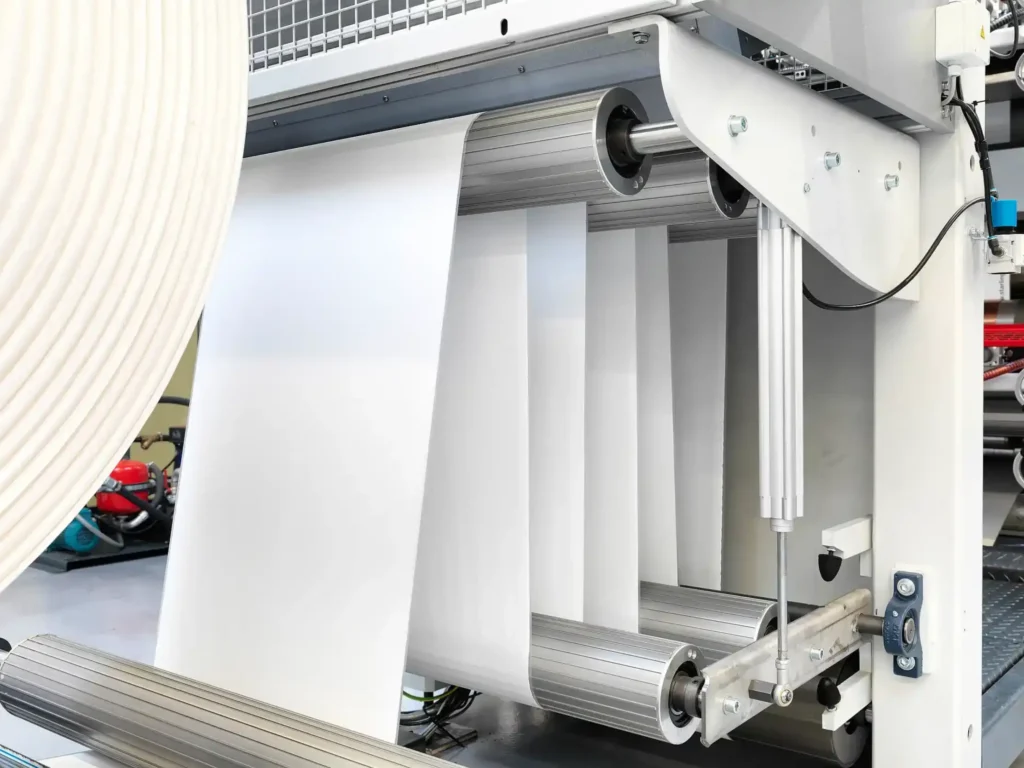
Lamination. A molten LDPE/PP tie or a solventless PU builds the bondline between paper and fabric. Inline peel tests, caliper, and curl surveillance guard run‑flat behavior and aesthetic flatness.
Conditioning, slitting, and forming. The laminate stabilizes, is slit to lanes, formed into tubes or cut sheets, and gusseted. Pre‑creases are set to respect load paths through handling and stacking.
Bottom formation & mouth options. Pinch‑bottom (glue/heat) for sifting resistance; sewn bottoms for economy; hot‑air welded seams for dust‑prone powders; block‑bottom for square‑standing stability; open mouth or valve per filler.
Liner integration (optional). PE tubes are inserted and sealed to cooperate with the mouth geometry. Burst and seal tests confirm barrier without new failure points; antistatic grades are selected for zoned facilities.
Final inspection & pack‑out. 100% visual checks, sampled drop/dart, seam pulls, COF, dimensions, ΔE, and metal detection (as specified). AQL governs release; pallets are wrapped in harmony with the target COF band and labeled with full genealogy.
Equipment note: Stable gauge, dependable registration, and predictable bonds are not branding theater—they are process insurance. The more variation you crush upstream, the fewer surprises you fund downstream.
Applications: Where This Format Earns Its Keep
When do kraft paper bags laminated with woven fabric pay for themselves? Whenever a natural‑looking package must behave like a workhorse: powders and granules that crave clean fills, pallets that must stand straight for audits, channels that demand scannable codes, climates that punish fragile seams. From flours to fertilizers, salts to seeds, minerals to pet foods, the format adapts with small but decisive spec shifts.
| Segment | Typical format | Spec tilt | Primary risks | Countermeasures |
|---|---|---|---|---|
| Flours & premixes (10–25 kg) | Pinch‑bottom; optional liner; open mouth or valve | Dust discipline; odor hygiene; clean coding | Weight variance; sifting; scuff | Hot‑air seams; selective OPV; liner seals; packer calibration |
| Pet food & feeds (10–25 kg) | Valve or open mouth; retail‑grade print | Shelf appeal; scuff resistance; COF tuning | Graphic rub; pallet lean | OPV zoning; antiskid bands; compression validations |
| Fertilizers (25–50 kg) | Valve; UV‑stabilized woven substrate | Outdoor life; corner strength | Sun/yard exposure; rough handling | UV packages; reinforced corners; drop cycles |
| Industrial minerals (25–50 kg) | Block‑bottom valve or hot‑air pinch | Abrasion tolerance; tear arrest | Corner impacts; conveyor scuff | Higher GSM; matte zones; seam pull thresholds |
| Salts & chlorinated products (25 kg) | Valve with PE liner | Barrier; anti‑wick seams | Caking; corrosion; odor | Liner gauge/quality; seam coatings; higher coat weight |
Related guidance: when you need a cousin format with a different balance of paper and polymer, explore this manufacturer’s overview of poly‑lined paper options: industrial poly paper bag configurations. It helps position kraft paper bags laminated with woven fabric alongside adjacent solutions.
Quality Chain: From Standards to Sign‑Off
Quality should be portable—numbers that mean the same thing in a different plant and a different quarter. The chain has four auditable links: standards‑aligned methods, virgin inputs, machines that hold tolerance, and a layered inspection plan that catches, contains, and corrects drift before it becomes a complaint ticket.
Standards in practice. Methods align with common packaging norms for tensile, tear, dart, friction, and color so that results are comparable. Electrostatic practices apply when antistatic liners or zoned facilities are involved.
Virgin raw materials. Structural layers—PP tapes/fabric, tie resins, liners—are specified as 100% new for predictable melt flow, bond behavior, and odor profile. Predictability beats mystery every time.
Machines that hold tolerance. Gauge stability, registration accuracy, and bond consistency compress variation at the source so a run in plant B behaves like the pilot signed in plant A.
Layered inspection. Incoming COAs, in‑process SPC, and outgoing AQL sampling close the loop. Traceability ties a pallet back to resin lots, loom IDs, press jobs, and lamination lanes within hours—not days.
| Stage | Primary checks | Why it matters | Evidence |
|---|---|---|---|
| Incoming | Paper basis/moisture/Cobb; resin MFI/ash; adhesive viscosity/cure | Predictable processing; clean lamination; odor control | Sampling logs; swatches; hold/release tags |
| In‑process | Tape denier SPC; fabric GSM/width; ΔE/register; peel; caliper; curl | Prevents drift and cascading defects | Control charts; settings capture; CAPA |
| Outgoing | Dimensions; COF; drop/dart; seam pulls; color grade; metal detect | Ships what you specified, not what you hoped | AQL sheets; release signatures; pallet genealogy |
Evidence over opinion: A drop test without height and cycles is a story; a COF without deck and wrap is a rumor. Write the numbers; let them defend the integrity of the kraft paper bags laminated with woven fabric you ship.
Systems Thinking: Convert Subproblems into a Single Spec
Good packaging design turns tradeoffs into rules. We break the challenge into five recurring subproblems and answer each with a lever, a test, and a decision rule. Then we synthesize them into a living one‑page spec for kraft paper bags laminated with woven fabric.
A) Mechanical loads & handling. Levers: fabric GSM/denier; seam type/allowance; bottom style; corner reinforcement. Tests: seam pulls (N/5 cm); drop at height; compression at stack height. Decision: pass with margin at real route conditions.
B) Moisture & barrier. Levers: coat weight, liner gauge, seam style. Tests: WVTR, Cobb, sensory. Decision: complaints trend downward without over‑specifying mass.
C) Pallet stability & COF. Levers: paper texture, OPV matte fields, antiskid bands. Tests: static/kinetic COF paired with compression. Decision: tilt within threshold without unsafe over‑wrap.
D) Brand behavior & coding. Levers: line screen, plate, OPV zoning, panel layout. Tests: ΔE, rub, barcode grade. Decision: codes remain gradeable after route; imagery does not blush under touch.
E) Regulatory & sustainability context. Levers: low‑odor inks, documentation, clear labeling, regional end‑of‑life plans. Tests: migration, certifications, complaint trend. Decision: comply without theater; prevent loss before chasing optics.
Synthesis in one view: format (pinch/valve), size (10/25/50 kg), fabric (80–110 GSM), paper (70–100 g/m²), lamination (15–25 µm or adhesive equivalent), liner (40–80 µm when justified), COF (0.40–0.50 typical), QC markers (drop/peel/ΔE/COF), and full traceability.
Engineering Heuristics and Useful Numbers
- For 25 kg powders, begin at 90–100 GSM fabric; move ±10 GSM based on conveyor abrasion and drop severity.
- For 50 kg minerals, 100–110 GSM with reinforced corners is a dependable neighborhood.
- Seam pull should exceed worst‑case dynamic loads with margin; validate via width‑specified pulls plus witnessed drop cycles.
- COF bands of 0.40–0.50 cooperate with most wrap recipes; always pair COF readings with compression outcomes.
- Liner gauges of 40–60 µm cover many hygroscopic SKUs; move to 70–80 µm only when analytics demand.
Troubleshooting Atlas: Symptom → Cause → Corrective Action
When performance dips, fix the system, not just the symptom. The atlas translates familiar field issues into focused levers for kraft paper bags laminated with woven fabric.
| Symptom | Probable cause | Corrective action |
|---|---|---|
| Corner tears during palletization | Under‑spec GSM; aggressive needles; short seam allowance | Increase GSM; change needle and stitch; reinforce corners; consider hot‑air welded bottom |
| Slippery pallets in tall stacks | COF too low; smooth paper with no antiskid; wrap mismatch | Add antiskid bands; matte OPV zones; retune wrap; validate via compression |
| Dust leaks at mouth | Mouth geometry mismatch; poor heat profile; trapped air | Resize mouth/valve; record and optimize sealing; add vent micro‑perfs if permitted |
| Graphics scuff | No OPV; rough conveyors; low bondline strength | Add matte/satin OPV in rub zones; verify peel; shorten abrasive transfers |
| Caking and clumping | Insufficient barrier; wicking seams | Add or thicken liner; boost coat weight; switch to hot‑air bottom; test Cobb/WVTR |
Remember: The fastest fix is not always a new material; often it is clarity in the spec and discipline in the settings that bring your bag and your line back into harmony.
Cost Engineering Without False Economies
Cut cost where it does not cut corners. These levers preserve performance while moving total cost of ownership in the right direction for kraft paper bags laminated with woven fabric:
- Right‑size the woven backbone before thickening paper or coat.
- Use OPV selectively on rub zones; protect where abrasion truly occurs.
- Engineer friction numerically; use matte fields or antiskid bands to land in the target COF range.
- Standardize dimensions across SKUs to reduce changeovers and component complexity.
- Qualify suppliers by performance evidence, not quotes alone. Repeatability saves more than pennies per bag.
Sustainability That Survives the Real World
The most sustainable bag is the one that prevents loss and runs smoothly. Still, kraft paper bags laminated with woven fabric enable credible moves toward stewardship when specified thoughtfully.
| Vector | Tactic | Contribution |
|---|---|---|
| Material efficiency | Let woven PP carry structure; optimize paper/coat | Lower total grams with equal safety margin |
| Sourcing discipline | Responsibly sourced kraft; low‑odor inks | Better human factors and channel acceptance |
| Capability over scrap | Process control that reduces rejects/returns | Prevents the worst waste—product loss |
| Regional design | Choose composite or mono‑PP cousins as local streams dictate | Compliance without green theater |
Specification Template: Turn Needs into Numbers
Capture intent as measurable statements. A living template for kraft paper bags laminated with woven fabric follows; adapt it with trials.
| Attribute | Specification | Rationale |
|---|---|---|
| Bag type | Pinch‑bottom valve or open mouth; block‑bottom on request | Fit the filler; square‑standing pallets |
| Nominal size | 10/25/50 kg as required; dimensions tuned to pallet footprint | Stack stability; truck cube efficiency |
| Woven substrate | 80–110 GSM; ends/picks validated; UV package for yard storage | Strength to survive drops and conveyors |
| Paper face | 70–100 g/m²; natural or bleached; OPV on rub zones | Print fidelity; scuff resistance; pallet grip |
| Lamination | Extrusion coat 15–25 µm or PU adhesive equivalent; curl‑controlled | Bond integrity and flatness |
| Valve/mouth | Sleeve matched to nozzle; sealing profile recorded | Dust control; weight accuracy |
| COF | 0.40–0.50 typical; confirmed with wrap recipe | Stack safety and predictability |
| QC markers | AQL plan; drop height/cycles; peel; ΔE; COF; dimensional tolerances | Objectifies pass/fail and speeds investigations |
| Traceability | QR/data‑matrix linking pallet to resin lots, loom IDs, press job, lamination lane, conversion station | Faster root cause; fewer mysteries |
Integration Examples: Three Markets, Three Specs
Case A — 25 kg animal feed, humid monsoon route. Fabric 95 GSM; paper 85 g/m² with satin OPV on rub bands; extrusion coat 18–20 µm; COF ~0.42 via matte fields/antiskid band; optional PE liner 60 µm only for coastal shipments; valve matched to nozzle; vent micro‑perfs validated. Outcome: caking complaints down 70%; pallet lean events fall; scuff‑related rework down 60%.
Case B — 50 kg fertilizer, yard storage. Fabric 105–110 GSM with UV; paper 90–100 g/m²; coat 20–22 µm; COF 0.40–0.45; block‑bottom valve; reinforced corners. Outcome: extended outdoor life; corner damage minimized; filling speed maintained with cleaner handling.
Case C — 25 kg salt, hygroscopic & corrosive. Fabric 90–95 GSM; paper 80–90 g/m²; coat ~20 µm; COF 0.42; valve sleeve sealed; PE liner 60–80 µm; seam coating to resist wicking. Outcome: clumping reduced sharply; cleaner floors; improved weight control.
Frequently Asked Questions
Are “kraft paper woven bags” and “paper laminated woven bags” different? They share the same family: kraft face plus PP woven backbone, joined by lamination. Variants differ in mouth style, bottom style, and barrier choices.
Can these bags be recycled? Practices vary by region. Some accept composite paper–poly sacks; where mono‑material streams are required, mono‑PP woven cousins may suit. Preventing product loss is the biggest environmental win either way.
When is a liner mandatory? For hygroscopic powders, long outdoor storage, or odor‑sensitive contents; WVTR/Cobb and complaint trends guide the decision.
How do I prevent pallet slip? Treat COF like a spec: select a target band and validate with your wrap and stack heights; tune with matte OPV and antiskid bands as needed.
Why this format instead of glossy film faces? Because some channels read gloss as artifice. The matte finish of kraft paper bags laminated with woven fabric projects authenticity while the woven core preserves strength.
2025-10-25
- What Are Kraft Paper Bags Laminated with Woven Fabric?
- Why Choose This Composite Over Conventional Alternatives?
- Materials and Micro‑Architecture: What Each Layer Really Does
- The Physics of Shape: Why Pallets Behave Better with This Format
- Feature Set: Practical Wins You Can Measure
- Production Flow: From Paper and Resin to Ready‑to‑Fill Pallets
- Applications: Where This Format Earns Its Keep
- Quality Chain: From Standards to Sign‑Off
- Systems Thinking: Convert Subproblems into a Single Spec
- Engineering Heuristics and Useful Numbers
- Troubleshooting Atlas: Symptom → Cause → Corrective Action
- Cost Engineering Without False Economies
- Sustainability That Survives the Real World
- Specification Template: Turn Needs into Numbers
- Integration Examples: Three Markets, Three Specs
- Frequently Asked Questions
Square Bottom PP Valve Bags are an essential choice for various industries, particularly in the food sector. Their unique design and practical features make them ideal for packaging food raw materials and finished products such as flour, sugar, spices, and agricultural processed items. This article will explore the characteristics of Square Bottom Valve Bags and their specific applications in food packaging.
Features of Square Bottom PP Valve Bags
Square Bottom Valve Bags are designed with a flat base that allows them to stand upright, making them exceptionally practical for filling, storing, and transporting products. Here are some notable features that set these bags apart:
1. Structural Integrity
The square bottom design enhances stability, enabling the bags to hold their shape even when filled. This characteristic reduces the risk of spillage and facilitates easier stacking and storage. The reinforced seams and durable materials further ensure that the bags can withstand the rigors of transportation and handling.
2. Efficient Filling Process
Equipped with a valve for easy filling, Square Bottom Valve Sacks allow for rapid and efficient packaging. The valve enables bulk filling from a conveyor system, minimizing labor costs and time spent on packaging operations. This efficiency is particularly advantageous in high-volume production environments.
3. Versatile Material Use
Constructed from high-quality polypropylene (PP), Square Bottom Woven Bags provide excellent strength and durability. The material is resistant to moisture, ensuring that the contents remain dry and protected from external elements. Furthermore, the bags can be made from food-grade materials, meeting safety standards for food contact.
4. Customization Options
Customization plays a crucial role in branding and marketing. These bags can be printed with logos, product information, and eye-catching designs. The ability to customize Square Bottom PP Bags enhances brand recognition and consumer appeal.
Applications in Food Packaging
Square Bottom Valve Bags are widely used in the food industry for packaging a variety of products. Their features align well with the specific needs of food manufacturers and suppliers.
1. Packaging Flour
Flour is a staple ingredient in many food products, making its packaging a crucial aspect of the supply chain. Valve Bags allow for efficient filling and secure sealing, ensuring that flour remains fresh and free from contamination. The upright design facilitates easy storage, making them ideal for both retail and bulk sales.
2. Packaging Sugar
Similar to flour, sugar requires robust packaging to maintain quality. Square Bottom Valve Bags can handle the weight of sugar while providing a barrier against moisture and pests. The valve feature enables quick filling, which is essential for large-scale sugar production facilities.
3. Spices and Seasonings
The packaging of spices and seasonings demands high-quality materials that prevent moisture ingress and preserve flavor. Valve PP Bags are perfect for this application as they offer excellent barrier properties and can be custom-printed to showcase brand identity. The stability of these bags makes them ideal for spice packaging, ensuring they stand upright on shelves.
4. Agricultural Processed Products
For processed agricultural products like cornmeal, rice, and other grains, the durability and moisture resistance of Square Bottom Woven Bags are essential. These bags can withstand the demands of storage and transport while maintaining the integrity of the products.
5. Food Additives
Food additives require secure and reliable packaging to prevent contamination and ensure safety. The robust design and moisture resistance of Square Bottom Valve Bags make them suitable for packaging various food additives, ensuring they remain effective and safe for consumption.
Future Trends in Square Bottom Valve Bags
As the food packaging industry continues to evolve, several trends are emerging that will shape the future of Valve Bags.
1. Sustainability Initiatives
With a growing emphasis on sustainability, manufacturers are exploring eco-friendly materials for packaging. Innovations in biodegradable and recyclable materials are likely to influence the design and production of Square Bottom PP Bags, aligning with consumer demands for greener options.
2. Enhanced Printing Technologies
Advancements in printing technology allow for more vibrant and detailed graphics on Square Bottom Valve Sacks. This can enhance product visibility on shelves and provide consumers with essential information about the product’s origin, ingredients, and usage.
3. Automation in Packaging
The increasing adoption of automation in packaging lines will benefit from the efficiency of Valve PP Bags. Automated filling and sealing systems will enhance productivity and reduce labor costs, making these bags an even more attractive option for food manufacturers.
Conclusion
Square Bottom PP Valve Bags represent a practical and versatile solution for packaging a wide array of food products. Their unique design, combined with features such as efficient filling, durability, and customization options, make them a preferred choice for manufacturers. As sustainability and automation become more prominent in the industry, the adaptability of Valve Bags will ensure their continued relevance and success in the food packaging sector.
Product Parameters and Key Points
| Feature/Parameter | Description |
|---|---|
| Material | High-quality polypropylene (PP) |
| Design | Square bottom for stability and ease of filling |
| Filling Method | Valve system for efficient bulk filling |
| Moisture Resistance | Yes |
| Customization Options | Available for branding and product information |
| Typical Applications | Flour, sugar, spices, agricultural products |
References
- S. A. Jones, “Innovations in Food Packaging,” Journal of Food Science, vol. 85, no. 7, pp. 1223-1235, 2020.
- R. Smith, “The Role of Valve Bags in Modern Packaging,” Packaging Technology and Science, vol. 32, no. 4, pp. 210-219, 2019.
- P. L. Anderson, “Sustainable Packaging Solutions for Food Products,” Environmental Science & Technology, vol. 54, no. 5, pp. 1003-1012, 2021.
- T. Roberts, “The Future of Food Packaging: Trends and Innovations,” Food Processing Journal, vol. 77, no. 8, pp. 47-58, 2022.