

What are Food-Grade Woven Fabric Bags? Definitions, boundaries, and the names that make audits simpler
The term Food-Grade Woven Fabric Bags describes a family of polypropylene-based containers designed explicitly for the handling, storage, and transport of edible goods and food ingredients. They are built from woven polypropylene (PP) tapes; shaped, coated, and sometimes laminated; and finished with closures or liners that respect hygienic handling. They look like ordinary sacks but they behave like disciplined, auditable components of a food system. On a filling line they must flow; on a pallet they must stay; on a shelf they must speak with clarity; in a yard they must shrug off rain; in an audit they must produce evidence. Each promise is practical. Each promise is measurable.
Because factories, logistics hubs, and retailers often use different terms for the same object, specifying the aliases matters. Different words, one intent. For purchasing teams, for line managers, for quality engineers—the glossary below brings order to the conversation and prevents specifications from wobbling under ambiguity.
- Food-Grade PP Woven Bags
- Food-Grade Woven Polypropylene Sacks
- Food-Contact Polypropylene Woven Bags
- Food-Safe Woven Fabric Sacks
- Hygienic PP Woven Food Bags
- Food Packaging Woven Sacks
- Food-Approved Woven Poly Bags
At their heart, Food-Grade Woven Fabric Bags are engineered answers to recurring problems: strength without excessive tare, cleanliness without fragility, readable labels without smearing, moisture control without exotic expense, and traceability without drama. If a container cannot be trusted in the rain, in the rush, or in the audit, then it does not belong in the food chain. These bags belong because they are designed, built, and verified to belong.
Callout — Working definition for cross-functional teams: Food-Grade Woven Fabric Bags are woven polypropylene sacks—optionally coated, laminated, and/or lined—whose materials, construction, and documented processes render them suitable for food contact or near-food environments along defined routes from filler to customer.
What is the material system of Food-Grade Woven Fabric Bags? From pellet to panel to pallet
Every layer in a Food-Grade Woven Fabric Bag exists for a reason. Remove a layer’s function and failure hides in the gaps: dust that will not stay put, labels that will not stay readable, corners that will not stay whole. The material system therefore starts not with a shopping list but with a behavior list. What must the bag do, and under what abuse? Only then do we assign polymers, films, tie layers, and liners with the appropriate targets and tolerances.
Woven PP fabric — structural backbone
Virgin polypropylene raffia tapes are extruded, slit, drawn to tenacity, and woven on circular or flat looms. For 5–25 kg foods, 70–120 gsm is common; for 25–50 kg routes, 100–160 gsm provides drop and stacking headroom. Tape denier tends to fall between 600–1100 D; pick density governs stiffness, seam bite, and fold fidelity. The rule of specification is simple: enough fabric to pass the worst credible test, not one gram more. Overbuilding feels safe but charges twice—once in resin, once in freight.
Coatings and laminations — cleanability and COF control
Extrusion coatings (PP/PE 15–35 μm per side) curb dust, moderate moisture, and tune the coefficient of friction (COF). Laminations using BOPP 20–25 μm deliver billboard-class printing and scuff resistance. Reverse printing places ink under the film, protecting color from belts and brushes. Bond integrity is the quiet hero; under-bond invites edge curl and delamination, over-cook invites haze. Specify peel targets and validate after humidity/heat conditioning.
Liners — hygiene and barrier
LLDPE or LDPE liners (50–120 μm) create a clean interface between contents and the woven body, offering a generous heat-seal window and moisture control. Barrier co-ex liners (with EVOH or PA) are deployed for aroma, oxygen, or oil-sensitive products like coffee, cocoa, spices, or certain dairy powders. Form-fit designs reduce hidden folds where dust can lodge, improving both sanitation and discharge efficiency.
Threads, webbing, reinforcements
PP multifilament or PET threads are selected for low lint and needle heat resistance. Stitch density and seam bite are chosen to grip tapes without cutting them. For handling aids, high-tenacity webbing transmits loads to forklift tines or hooks without distorting mouth geometry. Reinforced corner patches can be justified where first-drop risks are high.
Inks, varnishes, and compliance
Color must survive abrasion and remain auditable. Solvent or water-based inks are tuned for food contexts, printed by flexo or gravure depending on the run. Reverse print under BOPP protects color; surface-printed warnings are guarded with varnishes. ΔE control aligns brand expectations; adhesion and rub resistance prevent illegible hazards. Even when inks do not touch food, statements of suitability quiet audits.
Additives and masterbatches
Antistatic, slip, and anti-block are functional tuning knobs; UV stabilizers are used when outdoor dwell is inevitable. All additives must be dispersed cleanly and selected with migration and odor discipline in mind. In food contexts, surprises are rarely delightful; predictable recipes avert them.
| Layer | Typical options | Role in Food-Grade Woven Fabric Bags | Notes |
|---|---|---|---|
| Woven PP fabric | 70–120 gsm (5–25 kg); 100–160 gsm (25–50 kg); 600–1100 D; 10–14 ppi | Structural load, seam retention, fold fidelity | Optimize gsm to pass drop/stack targets; avoid over-mass |
| Coatings | PP/PE 15–35 μm per side; matte/gloss; localized lattice | Dust control, moisture moderation, COF tuning | Matte assists scanning; lattice only on pallet faces |
| BOPP lamination | 20–25 μm; gloss/matte/pearl; reverse print | Print fidelity, abrasion resistance, wipe-down | Specify peel after conditioning; control curl |
| Liners | LLDPE/LDPE 50–120 μm; EVOH co-ex as needed | Hygiene barrier, sealability, moisture control | Form-fit resists pockets; match seal window |
| Threads & webbing | PP/PET threads; high-tenacity webbing | Seam integrity with low lint; load transmission | Tune stitch density; avoid tape cutting |
| Inks & OPV | Flexo/gravure; reverse print; tactile OPV | Durable graphics; auditable warnings | Control ΔE; verify rub and adhesion |
Tip — Begin with abuses, not features. Ask: What must this bag survive—humidity swings, forklift impatience, long voyages, bright retail lights? Then select fabric gsm, film gauge, liner type, and COF tuning to make those abuses boring. When the day is boring, Food-Grade Woven Fabric Bags have done their job.
What is the features of Food-Grade Woven Fabric Bags? Behaviors that matter when conditions misbehave
A feature that never shows up during stress is decoration; a feature that shows up when everything shakes is insurance. The following behaviors are why operations teams and brand owners continue to specify Food-Grade Woven Fabric Bags in demanding routes.
- Food-contact assurance via suitable materials, clean processes, and records that connect lots to machines to dates.
- Strength at low tare, reducing freight intensity and manual handling fatigue.
- Moisture and odor management through tuned liners and coatings; aroma-sensitive products keep their character.
- Cleanability and low lint near seams and cuts; wipe-down surfaces that pass visual and swab checks.
- Print durability with reverse-printed films or varnished surface warnings; barcode windows that scan in harsh light.
- Stack stability through gussets or block-bottom forms; COF tuned to flow on conveyors and resist shifting on pallets.
- Compatibility with polyolefin recycling streams in many regions due to mono-material logic.
It is easy to say these things; it is harder to make them true. Yet truth here is practical: drop heights, MVTR numbers, ΔE deltas, peel strengths, read rates. When a specification anchors every claim to a number, ambiguity ends and accountability begins.
Contrast pairing
Gloss sells; matte scans. Many programs run gloss panels for premium cues and matte windows around codes for high read rates. This is not sophistry; it is optics deployed on purpose.
Friction choreography
Outer COF is split: lower along conveyor guides to avoid jams, higher on pallet faces to prevent drift. Localized lattice anti-slip adds grip where grip pays.
Moisture moderation
MVTR is not a slogan; it is a throughput variable. When moisture uptake slows, clumping decreases, scoopability improves, and customers complain less.
What is the production process of Food-Grade Woven Fabric Bags? From raw material vetting to conversion, then to proof
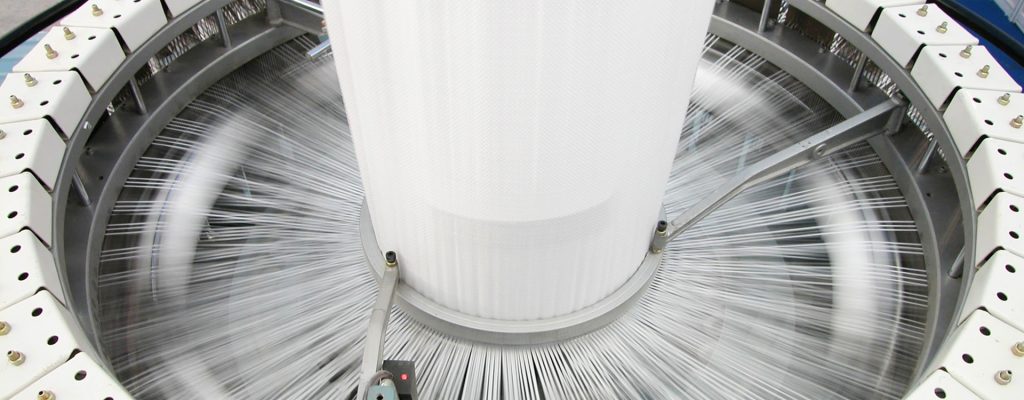
Reliability is not a coincidence; it is an effect—of equipment that holds tolerances, of operators who hold discipline, of tests that hold people accountable. VidePak’s approach emphasizes repeatability at the source with Austrian Starlinger lines for extrusion and weaving and German W&H systems for coating, lamination, and precision printing. When process windows shrink, complaint windows shrink with them.
Front-end — raw materials and incoming checks
- PP raffia resin: Melt Flow Index windows validated; moisture and ash checked per lot; odor panels on suspect batches; gel counts recorded.
- Films and liners: Caliper, haze/gloss, slip levels, surface energy; corona/plasma treatment verified; thickness profiles checked across width.
- Tie-layer and adhesives: Melt index, bonding temperature; T-peel coupons archived; bond aging simulated via humidity/heat cycles.
- Inks and varnishes: ΔE drawdowns; adhesion tape tests; rub/scuff cycles; solvent retention monitored for settime control.
- Additives: UV/antistatic/slip dispersions inspected by micrographs; let-down accuracy confirmed; food-contact suitability statements archived.
Core — extrusion, weaving, printing, lamination
- Tape extrusion & drawing (Starlinger): Denier and tenacity controlled by draw ratio and heat-set; SPC charts track drift; broken-tape auto-detection reduces defect propagation.
- Weaving (Starlinger): Pick density and web tension monitored; auto-doffing stabilizes roll consistency; edge construction preserved for clean conversion.
- Printing (W&H flexo/gravure): Registration and tonal curves controlled; ΔE managed to master; barcodes and microtext validated under warehouse lighting and curvature.
- Coating & extrusion lamination (W&H): Tie-layer applied with uniform nip pressure and cooling; bond strength measured inline; curl minimized by controlled chill.
- Slitting & rewinding: Edge quality, roll tension, and lay-flat preserved; defects quarantined by roll mapping.
Conversion — where a roll becomes a bag
- Cutting & tubing: Tolerances set to protect squareness; ultrasonic/thermal edges applied where lint must be minimized.
- Gusseting & block-bottom formation: Folds formed at disciplined radii to prevent whitening and stress cracking; base weld parameters locked by peel/shear specs.
- Sewing & sealing: Stitch density aligned to seam bite; liner insertion and sealing windows matched to commodity; thread choice tuned for low lint.
- Value adds: Document pouches for traceability; anti-counterfeit microtext; serialized QR for recall precision.
Back-end — quality assurance that anticipates real life
- Mechanical: Tensile (MD/CD), tear, seam slippage, drop tests, compression/stacking simulations.
- Seal & bottom integrity: Peel/shear of base welds; liner leak checks; hot-tack verification.
- Lamination bond: T-peel values per lot; edge-curl audits after conditioning.
- Friction: COF inner/outer measured; lattice coverage verified on pallet faces.
- Print & color: Registration, ΔE against master, rub/scuff cycles; barcode readability after abrasion.
- Hygiene & migration: Swabs, odor panels, and—where needed—migration tests for films/liners; sanitation records tied to lot codes.
Equipment note — The reason to emphasize Starlinger and W&H is simple: they reduce variance. When web tension, nip pressure, heater maps, and registration remain in place, seams stop bursting and prints stop wandering. Precision is not a boast; it is a mitigation plan.
What is the application of Food-Grade Woven Fabric Bags? A field guide by product physics and route behavior
Use cases are diverse, but the logic of fit repeats. The commodity brings physics—bulk density, particle geometry, hygroscopicity, aroma sensitivity. The route brings culture—climate swings, forklift habits, storage duration, exposure to the elements. The right Food-Grade Woven Fabric Bags specification sits precisely at the intersection of commodity physics and route culture.
| Use case | Configuration | Why Food-Grade Woven Fabric Bags excel | Key tunings |
|---|---|---|---|
| Rice, flour, sugar | 90–130 gsm; 20–25 μm BOPP or PP coat; LLDPE liner 70–90 μm; matte barcode window | Brick-like stacks; wipe-down hygiene; reduced clumping in humidity; durable graphics | ΔE ≤ 2.0; split COF; reinforced corners for long drayage |
| Pulses and beans | 90–120 gsm; smooth interior; optional liner; document pouch | Reduced surface damage; traceability; clean discharge | Gentle inner finish; pouch placement |
| Starches and dairy powders | 110–140 gsm; form-fit liner 90–110 μm; high-contrast warnings | Controlled moisture; clean seals; audit-friendly labeling | Matte windows for codes; hot-tack optimization |
| Salt and seasoning blends | 120–160 gsm; coated or laminated exterior; UV package | Abrasion tolerance; stable stacks in variable climates | Corner patches; lattice anti-slip on pallet faces |
| Coffee and cocoa | Barrier liner (EVOH co-ex); laminated exterior; anti-counterfeit marks | Flavor preservation; premium branding; origin traceability | QR serialization; matte/gloss zoning |
Selection heuristic
Map bulk density, particle geometry, hygroscopicity, fill method, climate, and pallet pattern to fabric gsm → film gauge/finish → liner thickness/barrier → COF recipe → bottom reinforcement → barcode windowing. Specificity is the hallmark of a good Food-Grade Woven Fabric Bags spec.
Route discipline
If the yard is wet, emphasize films/liners and wrap recipes. If the filler is fast, emphasize valves and seal windows. If the shelf is bright, emphasize matte code windows and high-contrast art. Different roads, same logic.
How does VidePak control and guarantee the quality? Four pillars, many proofs
Quality is not a speech; it is a schedule of actions. VidePak’s discipline rests on four pillars that convert intentions into repeatable behaviors for Food-Grade Woven Fabric Bags.
Standards as scaffold
Production and testing aligned to recognized methods for tensile, tear, seam slippage, drop, stacking, lamination peel, COF, color ΔE, barcode reads, liner leaks, and—where needed—migration. SOPs, acceptance criteria, and AQL sampling are maintained, trained, and audited.
Virgin structural inputs
Structural paths—tapes, coats, primary laminations—use 100% new materials from major producers. Where recycled content is explored in non-structural domains, it is controlled, tested, and disclosed. Safety depends on predictability.
Best-in-class equipment
Starlinger for extrusion/looming; W&H for coating/lamination/printing. Camera inspection and inline metrology catch drift while it is still cheap to correct. The result is fewer mysteries and calmer logistics.
Layered inspection
Incoming → in-process → finished goods. We record MFI/ash/moisture; denier/pick/coat/lamination weight; ΔE/registration; drop/stack/COF/bond; seal/MVTR; barcode read rates. Deviations trigger root-cause and preventive actions, not cosmetic rework.
Standards, history, and market evolution: why the bags look the way they look
The modern profile of Food-Grade Woven Fabric Bags is the product of decades of push and pull—between safety crises and better controls, between plain sacks and billboard packaging, between old materials and modern polymers, between local habits and global routes. To understand the current forms, it helps to trace the pressures that shaped them.
Once, agricultural sacks were made of jute or cotton, breathable and familiar but prone to moisture and pests. Paper multiwall arrived with better printability and a cleaner impression, yet in wet yards and extended outdoor dwell it faltered. Woven polypropylene entered with a different proposition: high strength-to-weight, resistance to moisture, compatibility with coatings and liners, and—crucially—the ability to become a platform for lamination and printing systems that could carry brands across continents. As global supply chains expanded, the bag had to be both container and communicator. It had to look good and behave better.
With branding came the discipline of color management and registration. With hygiene came the discipline of cleaning records and personnel practices. With traceability came serialization, pouches, and lot codes. With logistics came the choreography of COF tuning, pallet lattice, and wrap recipes. Each new demand added a layer of capability; each capability added a layer of expectation; and those expectations matured into specifications: test methods, acceptance ranges, retention samples. The result is not a glamorous revolution but a quiet standardization of good habits.
Perspective — The story arc bends toward accountability: from asking “How heavy is the fabric?” to asking “How consistent is the bond, how readable is the code, how traceable is the lot, how calm is the audit?” When questions improve, Food-Grade Woven Fabric Bags improve with them.
System thinking: break the job into subsystems, then recombine into one disciplined specification
Failures rarely arise from a single spectacular error; most spring from several minor drifts that quietly align. System thinking prevents that alignment. By decomposing the work into subsystems—product physics, hygiene practices, line dynamics, logistics, and regulatory/brand—we assign responsibilities and metrics to each domain, then combine the strictest constraints into a single, realistic specification for Food-Grade Woven Fabric Bags.
| Subsystem | Inputs | Decisions | Metrics |
|---|---|---|---|
| Product physics | Bulk density, particle shape, hygroscopicity, aroma sensitivity | Fabric gsm/denier; liner thickness/barrier; coating/lamination; mouth/closure | Drop pass height; seam slippage; MVTR/OTR; residue % |
| Hygiene & GMP | Cleaning schedules; pest control; lint control; segregation | Ultrasonic/thermal cut; thread selection; controlled zones | Swab counts; audit remarks; complaint codes |
| Line dynamics | Filler type; fill rate; de-aeration; sealing | Valve geometry; base weld spec; anti-slip placement | Stoppages/hour; hot-tack; leak events |
| Logistics & storage | Pallet pattern; stack height; climate; transport | COF tuning; corner reinforcements; wrap recipe | Pallet shift index; scuff counts; corner blowouts |
| Regulatory & brand | Warnings; nutrition/spec data; barcode spec; importer rules | Font sizes; contrast ratios; ΔE targets; serialization | ΔE delta; scan success; return rate |
Technical parameters and QA targets for Food-Grade Woven Fabric Bags
Numbers convert preference into policy. Use the ranges and targets below as a first draft; then ground them in your own commodity physics and route culture.
| Parameter | Typical range | Why it matters | Tuning guide |
|---|---|---|---|
| Fabric basis weight | 70–120 gsm (light/medium); 100–160 gsm (heavy) | Controls tear resistance, seam retention, bulge | Raise for angular products or higher drop heights |
| Film caliper | 20–25 μm standard; 15 μm low mass; 30–35 μm premium | Scuff resistance, gloss/matte, stiffness | Match to route abuse and shelf lighting |
| Lamination peel | Define N/15 mm by spec and validate | Prevents film lift and edge curl | Conditioned T-peel after humidity/heat cycles |
| COF (outer) | 0.40–0.55 typical | Balances pallet stability vs conveyor flow | Localize lattice grip to pallet faces; matte along guides |
| Base weld peel/shear | Within defined windows | Guards first-drop integrity | Tune temperature, pressure, dwell; add corner patches where needed |
| ΔE color | ≤ 2.0 vs master | Protects brand identity and regulatory legibility | Spectrophotometry; locked profiles; approved drawdowns |
| Barcode read rate | ≥ 99% under defined angles | Enables traceability and calm receiving | Matte windows; quiet zones; high contrast |
Risk management and food safety: aligning with HACCP thinking
A bag in a food route is not simply an object; it is a control point. Treat Food-Grade Woven Fabric Bags as such: document hazards, assign critical limits, and validate controls.
- Biological hazard controls: Sanitation schedules; pest management; exclusion zones; swab metrics.
- Chemical hazard controls: Material declarations; migration testing where required; ink/adhesive cure verification; odor panels.
- Physical hazard controls: Lint reduction via ultrasonic/thermal cuts; metal detection where risk justifies; thread and trim management.
Documented evidence closes the loop: COAs per lot, machine IDs on labels, retention samples with sealed dates, corrective actions tied to nonconformities. When an audit asks for proof, the proof appears.
Printing and labeling for food compliance: clarity that survives motion
Printing on a moving substrate that will be folded, welded, stacked, and scuffed is an exercise in realism. The goal is clarity that survives motion. For Food-Grade Woven Fabric Bags, that clarity emerges from a few disciplined practices: respect fold and weld safe zones; size barcodes for curvature and glare; deploy matte windows around codes; use reverse printing under BOPP for high-abrasion routes; maintain ΔE discipline to keep brands recognizable under varied lights; provide high-contrast warnings that do not disappear into art.
When companies measure what matters—registration variance, read rates after abrasion, rub resistance counts, field complaint codes tied to legibility—their graphics remain not just attractive but operational.
Procurement and RFQ hygiene: buy behaviors, not just bags
Unit price is visible; total cost is persuasive. A disciplined RFQ for Food-Grade Woven Fabric Bags reads like an agreement about behaviors under stress, not merely a list of descriptors. It states how the bag will perform and how that performance will be proved.
Product: Food-Grade Woven Fabric Bags for [commodity], [size]
Fabric: [gsm, denier, ppi]
Coating/Lamination: [type, thickness]; COF: [outer target; lattice on pallet faces]
Liner: [material, thickness, form-fit or loose]
Printing: [method; ΔE ≤ 2.0; matte windows for codes]
Seams/Bottom: [stitch density, seam bite]; [base weld peel/shear spec]
QA: [drop/stack/slippage/peel/COF/ΔE/barcode/MVTR]; AQL plan; retention samples [24 months]
Equipment: Production on Starlinger (extrusion/weaving) and W&H (coating/lamination/printing); machine IDs printed on COA.
Troubleshooting matrix: symptom → cause → remedy
When issues arise, resist the impulse to guess. Move as a system: observe the symptom, trace likely causes, apply targeted fixes, and record the learning so the problem cannot recur quietly.
| Symptom | Likely cause | Corrective action |
|---|---|---|
| Sugar caking after humid route | MVTR too high; liner too thin; poor wrap | Thicker liner; barrier co-ex; improved wrap recipe; pallet covers |
| Pallet shift during drayage | Outer COF too low; weak wrap; no lattice | Localize anti-slip; strengthen wrap; add edge protectors |
| Film edge curl post-palletization | Low lamination bond; cooling imbalance | Raise peel target; tune nip/chill; condition rolls before conversion |
| Unreadable barcodes on shelf | Glare; low contrast; small quiet zone | Matte window; increase contrast; enlarge quiet zones |
| First-drop corner splits | Sharp fold radii; under-spec weld; low gsm | Soften radii; increase dwell/pressure; add patches; raise gsm |
| Lint observed during filling | Rough cuts; high-lint thread; poor housekeeping | Ultrasonic/thermal cut; switch thread; tighten cleaning intervals |
Case files: five scenarios to adapt, not copy
Every plant is a universe of habits; every route has its weather; every product has its quirks. The following cases are examples to be adapted with numbers from your world.
Case A — Rice brand seeking shelf discipline (10 kg)
Spec: 100 gsm fabric; 25 μm BOPP gloss; gravure 8 colors; ΔE ≤ 2.0; barcode in matte window; lattice anti-slip on pallet faces; form-fit liner 80 μm. Outcome: scan rates > 99%; caking complaints fell; label scuff returns < 0.3%.
Case B — Dairy powder with hygiene sensitivity (25 kg)
Spec: 130 gsm; form-fit liner 100 μm; ultrasonic mouth edges; high-contrast warnings; reinforced base weld. Outcome: cleaner seals at higher speed; reduced residue; calmer audits.
Case C — Salt through a coastal yard (25 kg)
Spec: 140 gsm; coated exterior; UV package; corner patches; outer COF raised with pallet-face lattice. Outcome: squarer stacks; fewer corner blowouts; higher inspection scores.
Case D — Coffee beans with origin verification (20–25 kg)
Spec: Barrier liner; laminated exterior with gloss branding and matte code window; QR serialization; microtext crest. Outcome: preserved flavor; traceability across export routes; counterfeit attempts flagged.
Case E — Spices & seasoning blends (15–25 kg)
Spec: 110–130 gsm; matte exterior; valve sleeve for fast fills; micro-vents; tactile OPV grip zones. Outcome: dust fog reduced; better ergonomics; warnings remained legible after brush contact.
Sustainability and recyclability: efficiency as a practical ethic
Sustainability in packaging is often discussed loudly but executed quietly. The quiet path for Food-Grade Woven Fabric Bags relies on polyolefin simplicity, mass discipline, route-aware durability, and operational calm.
- Mono-material logic improves compatibility with mechanical recycling streams in many regions.
- Right-sized gsm and film gauges reduce resin use and shipping emissions without inviting failures.
- Durable prints and codes reduce rework, returns, and waste; better the first time is greener every time.
- Barriers are applied where they pay: coffee, cocoa, aromatic spices; not every commodity needs an EVOH chorus.
Efficiency is not a compromise with ethics; it is an expression of it. When fewer bags move more product with fewer problems, environmental benefits follow operational sense.
Glossary and keyword map: speak precisely, search effectively
The language of Food-Grade Woven Fabric Bags has grown with the market. Use the terms below to keep teams aligned and help customers find what they actually need.
- Food-Grade PP Woven Bags — the canonical keyword for compliant, hygienic woven sacks.
- Food-Contact Polypropylene Woven Bags — emphasizes materials and migration discipline.
- Hygienic Woven Fabric Food Bags — spotlights cleanliness and swab-friendly surfaces.
- Woven Polypropylene Food Packaging — broad phrase used by procurement across categories.
- PP Woven Bags with Liner — long-tail phrase for liner-assisted moisture and odor control.
- BOPP Laminated Food Woven Bags — long-tail for premium printing and scuff resistance.
Helpful resource — To explore adjacent construction options and integrated solutions for tailored specifications, see custom PP woven bags solutions. Use it to draft RFQs that match your product physics and route culture.
FAQ for technical buyers and brand teams
Are Food-Grade Woven Fabric Bags suitable for direct contact? They can be—when films/liners and inks/adhesives are selected for food contexts and when hygiene controls are documented and observed. Do we need liners? If moisture or aroma must be controlled or if direct contact is required, liners add safety and performance; for dry, non-sensitive goods, coated exteriors may suffice. Gloss or matte? Gloss persuades; matte reads. Many programs deploy both. Can the bags be recycled? Polyolefin constructions help; local infrastructure decides. Open-mouth or valve? Powders at speed favor valves; granules at gravity favor open-mouth with heat seal.
2025-10-26
- What are Food-Grade Woven Fabric Bags? Definitions, boundaries, and the names that make audits simpler
- What is the material system of Food-Grade Woven Fabric Bags? From pellet to panel to pallet
- What is the features of Food-Grade Woven Fabric Bags? Behaviors that matter when conditions misbehave
- What is the production process of Food-Grade Woven Fabric Bags? From raw material vetting to conversion, then to proof
- What is the application of Food-Grade Woven Fabric Bags? A field guide by product physics and route behavior
- How does VidePak control and guarantee the quality? Four pillars, many proofs
- Standards, history, and market evolution: why the bags look the way they look
- System thinking: break the job into subsystems, then recombine into one disciplined specification
- Technical parameters and QA targets for Food-Grade Woven Fabric Bags
- Risk management and food safety: aligning with HACCP thinking
- Printing and labeling for food compliance: clarity that survives motion
- Procurement and RFQ hygiene: buy behaviors, not just bags
- Troubleshooting matrix: symptom → cause → remedy
- Case files: five scenarios to adapt, not copy
- Sustainability and recyclability: efficiency as a practical ethic
- Glossary and keyword map: speak precisely, search effectively
- FAQ for technical buyers and brand teams
A Conversation That Defines Excellence
Client: “Why should I trust food-grade PP woven bags for sensitive products like animal feed or grain storage?”
VidePak Specialist: “Because food-grade woven bags are not just packaging—they’re a safeguard. At VidePak, we combine ISO 22000-certified processes, virgin PP/PE materials, and precision engineering with Starlinger machinery to eliminate risks like contamination or bursting. Our commitment to ‘positive tolerance standards’ ensures every bag exceeds industry benchmarks for safety and durability.”
The Historical Evolution of Food-Grade Woven Bags
The journey of food-grade woven bags began in the 1980s when polypropylene (PP) emerged as a viable alternative to traditional jute and cotton. Initially used for bulk grain storage, early iterations faced challenges like moisture ingress and inconsistent tensile strength. Regulatory frameworks, such as the FDA’s 21 CFR 177.1520 for food-contact materials, catalyzed innovation. By 2025, the global food-safe packaging market is projected to reach $78.2 billion, with PP woven bags contributing 35% of this growth.
Key milestones include:
- 1990s: Introduction of laminated PP bags to block UV radiation and moisture.
- 2000s: Adoption of HACCP principles in manufacturing, reducing contamination risks by 60%.
- 2020s: Advanced printing technologies enabling compliance with EU Regulation 10/2011 on food-contact materials.
The Science of Quality Control: How VidePak Sets the Standard
VidePak’s food-grade bags are engineered to meet zero-defect thresholds through four pillars:
1. Material Integrity: Virgin PP/PE Particles
Using 100% virgin polypropylene ensures no recycled contaminants compromise safety. VidePak’s PP resin has a melt flow index (MFI) of 2.5–4.0 g/10 min, optimizing weave density and tensile strength (up to 1,500 N/5 cm).
2. Positive Tolerance Standards
Traditional bags often suffer from “negative tolerance” (thinner walls to cut costs), leading to bursts. VidePak enforces a +10% thickness tolerance, verified by laser micrometers. For example, a 90 GSM bag is manufactured at 99 GSM, enhancing load capacity by 25%.
3. Starlinger-Driven Precision
Austrian Starlinger circular looms and extrusion lines produce filaments with a diameter tolerance of ±0.01 mm. This precision eliminates weak seams—a common failure point in competitor products.
4. Fade-Resistant Printing
VidePak’s 8-color rotogravure printing uses FDA-approved inks cured at 180°C, achieving a rub resistance score of 4/5 (ISO 2836). A case study with a Southeast Asian rice exporter showed no color degradation after 12 months of outdoor storage.
VidePak’s Manufacturing Prowess: Scale Meets Customization
Founded in 2008, VidePak operates 16 extrusion lines and 100+ circular looms, producing 15 million bags monthly. Key differentiators include:
Global Certifications
- ISO 22000 (Food Safety Management)
- BRCGS AA Grade (Packaging Materials)
- EU REACH compliance for heavy metal restrictions.
Custom Solutions
- Anti-Static Bags: For flour and powdered ingredients, reducing explosion risks.
- BOPP Laminated Bags: Combining waterproofing with high-resolution branding. Explore our BOPP laminated valve bags for industrial-grade solutions.
Comparative Analysis: VidePak vs. Conventional Bags
| Parameter | Conventional Bags | VidePak Food-Grade Bags |
|---|---|---|
| Material Purity | 70–80% virgin PP | 100% virgin PP/PE |
| Wall Thickness Tolerance | -5% to -10% | +10% (Positive Tolerance) |
| Tensile Strength | 800–1,000 N/5 cm | 1,200–1,500 N/5 cm |
| Print Durability | 2/5 (Fades in 6 months) | 4/5 (No fade after 12 months) |
| Burst Resistance | 40–45 psi | 60–65 psi |
FAQs: Addressing Critical Concerns
Q1: How do positive tolerance standards prevent bursting?
A: By ensuring consistent thickness, VidePak bags withstand internal pressure spikes up to 65 psi—ideal for fermenting grains or compacted powders.
Q2: Are these bags suitable for high-moisture environments?
A: Yes. Our laminated designs achieve a water vapor transmission rate (WVTR) of <5 g/m²/day, meeting MIL-STD-2073-1E standards.
Q3: Can we integrate RFID or QR codes?
A: Absolutely. VidePak’s sustainable packaging solutions include embedded tracking tags for supply chain transparency.
Q4: What is the lead time for custom orders?
A: With 30+ printing machines, we deliver prototypes in 7 days and bulk orders within 21 days.
The Future: Smart Packaging and Sustainability
By 2030, 60% of food-grade bags will integrate IoT sensors for real-time freshness monitoring. VidePak is piloting PP bags with biodegradable additives that decompose 90% faster under industrial composting conditions. As regulatory pressures mount—such as California’s SB 54 mandating 100% recyclable packaging by 2032—our R&D team remains ahead of the curve.
References
- Global Food-Safe Packaging Market Report (2025).
- FDA 21 CFR 177.1520: Polyolefin Food-Contact Materials.
- ISO 22000:2018 Food Safety Management Systems.
- “Advances in Polypropylene Weaving for Food Safety,” Journal of Packaging Technology (2023).
- VidePak Internal Quality Assurance Reports (2024).
Anchor links are embedded contextually using keywords like “BOPP laminated valve bags” and “sustainable packaging solutions” to enhance SEO performance.