
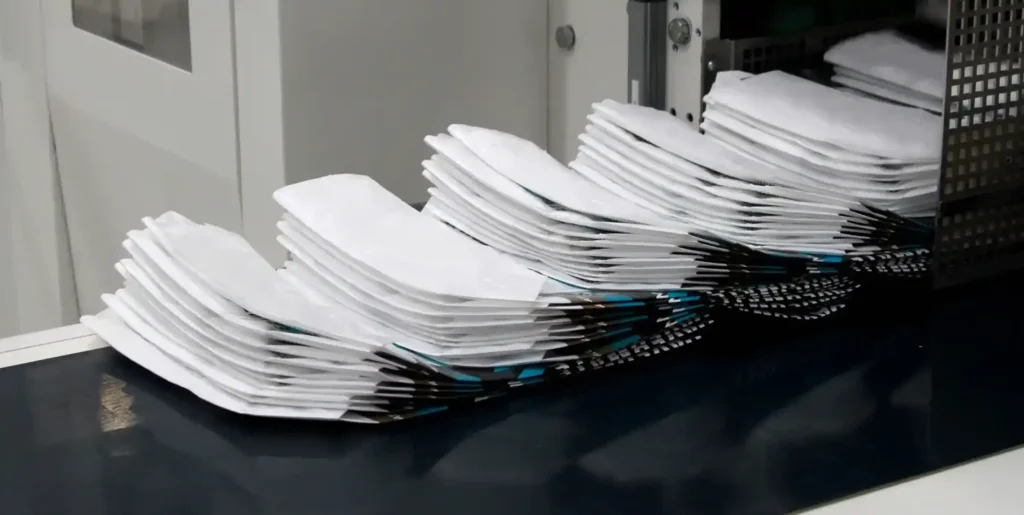
What Are Form‑Fill‑Seal Woven Bags?
Form‑Fill‑Seal woven bags are industrial packages designed to be formed, filled, and sealed on automated or semi‑automated lines. In a construction setting, a roll of coated woven polypropylene (or a stack of pre‑cut woven sleeves) is guided over a forming shoulder, transformed into a tube with fin or lap seams, precisely dosed with cement, dry mortar, tile adhesive, gypsum plaster, silica sand, or grout, and then closed by heat, ultrasonics, or sewing. What once required multiple manual touchpoints becomes a continuous rhythm: web in, bags out. The system’s promise, however, is not speed alone. It is repeatable speed—speed that does not leak dust, that does not scuff print into ambiguity, that does not collapse on the third pallet layer.
Across markets the same platform wears different names. Vocabulary shifts; physics persists. To avoid confusion, here is the common alias set for Form‑Fill‑Seal woven bags in construction packaging:
- FFS woven bags
- Form fill seal woven sacks
- Automated FFS PP woven bags
- Woven polypropylene FFS bags
- Coated woven FFS sacks
- FFS construction bags
- Valve‑style FFS woven bags
- PE‑laminated PP woven FFS bags
- BOPP‑laminated woven FFS bags
Every alias points to the same architectural idea: a high‑tenacity woven chassis with polyolefin films that enable fast sealing, clean dosing, readable coding, and safe stacking.
The Material Architecture of Form‑Fill‑Seal Woven Bags
Materials define both the ceiling of performance and the floor of cost. In Form‑Fill‑Seal woven bags, the structural load is carried by drawn‑tape polypropylene; dust control and sealability come from polyethylene coatings and liners; abrasion resistance and premium graphics leverage BOPP or hard‑coated facings; and long‑route resilience is assured by the right cocktail of additives. There is no single ideal recipe, only a best fit for a given powder, route, and plant behavior.
Woven Polypropylene (PP) Fabric
Extruded PP tapes, drawn to align chains, are woven on circular or flat looms into the fabric that becomes the bag body. This chassis supplies tensile strength and tear resistance at low mass. Its fatigue behavior under pallet compression is superior to paper multi‑wall stacks, and its hydrophobic nature resists splash and ambient humidity.
Polyethylene Coatings and Liners
LDPE and LLDPE deliver low seal initiation temperature (SIT) and generous hot‑tack, enabling faster cycles with fewer peel‑backs. They also provide moisture resistance and a smooth surface to contain cement and gypsum dust. Internal liners are deployed when routes are humid or the powder is especially fine.
BOPP and Functional Films
BOPP facers carry high‑coverage artwork and shrug off abrasive conveyors; PA or HDPE reinforcement layers add puncture and scuff resistance where products like silica sand would otherwise bruise the package. Polyolefin‑compatible tie layers keep laminates flat and peel‑resistant.
| Layer / Part | Typical Material | Primary Function | Cost Impact | Notes |
|---|---|---|---|---|
| Structural wall | PP woven (140–220 g/m²) | Tensile & tear strength | Base | Denier & weave density drive strength |
| Outer coating/laminate | LDPE/LLDPE or BOPP | Dust control, print surface | Low–Moderate | BOPP for premium graphics |
| Inner liner (optional) | LDPE/LLDPE | Moisture barrier, fine dust | Low–Moderate | Recommended for gypsum routes |
| Reinforcement | PA/HDPE patch or layer | Abrasion & puncture | Moderate | Useful for silica sand flows |
| Tie/adhesive | Polyolefin adhesive | Bond integrity | Low | Peel without curl |
| Additives | UV, antistatic, slip | Durability & handling | Low | Tuned to climate/product |
Put bluntly: not every problem demands another layer. The most sustainable bag is the one that is just strong enough, just sealed enough, just printed enough for the true route. Down‑gauging enabled by tight process control often saves more resin than any single exotic film could. The craft is in earning each gram.
Key Features of Form‑Fill‑Seal Woven Bags
A feature matters only when it translates to fewer stoppages, fewer claims, and safer yards. In construction packaging, Form‑Fill‑Seal woven bags succeed because they combine speed with integrity, cube with clarity, strength with restraint. Consider the following attributes not as slogans but as operating realities.
Generous hot‑tack in the inner layer lets sealing jaws cycle faster without the slow‑motion disaster of post‑discharge peel‑backs. When the seal holds hot, lines run cool.
Coated fabrics and liners tame cement fines; antistatic packages reduce cling on forming sets; valve options manage air escape in powdery fills without ejecting clouds.
Woven bodies resist creep, gussets maintain geometry, and consistent lengths deliver neat layers—a quiet recipe for fewer pallet incidents and faster truck turns.
| Attribute | Indicative Window | What Tunes It |
|---|---|---|
| Nominal fill | 20–50 kg | Footprint, height, density |
| Line speed | 18–40+ bags/min | Seal window, dosing repeatability |
| Drop resistance | 1.2–1.5 m pass | Fabric GSM, laminate adhesion |
| MVTR | 0.5–2.5 g/m²·day | Film thickness, liner, seals |
| Pallet creep | Low over 24–48 h | Weave density, gusset design |
Production Process: From Resin to Release
Reliable Form‑Fill‑Seal woven bags do not emerge from inspection; they emerge from discipline. VidePak’s practice is to prevent defects upstream, control variation midstream, and confirm conformance downstream—on equipment that holds settings without drama. That is why the core lines are from Starlinger (Austria) and Windmöller & Hölscher (Germany): stable extrusion, consistent lamination, controlled print register, and flat, trouble‑free rolls.
Front‑End: Raw Materials and Incoming QA
- Virgin PP grades for tape extrusion, tuned for melt flow and low ash; LDPE/LLDPE for coatings and liners with target SIT and hot‑tack; BOPP and PA only where justified.
- Approved vendor lists, certificates of analysis, and documented lot traceability.
- Incoming tests: MFI, density, gel count, haze/opacity, COF, dyne levels, moisture checks on any paper/liner components.
Each Process Segment and Its Controls
| Segment | Primary Goal | Control Points | Why It Matters |
|---|---|---|---|
| PP tape extrusion | Uniform denier & strength | Melt temperature, draw ratio | Backbone of tensile/tear |
| Weaving | Stable fabric GSM | Picks per inch, loom tension | Uniformity and seam behavior |
| Coating/lamination | Adhesion without curl | Nip temp/pressure, coat weight | Seal quality and lay‑flat |
| Printing | Readable graphics & codes | Registration, ΔE, ink adhesion | Traceability and brand fidelity |
| Slitting & winding | Flat, stable rolls | Tension profiles, edge quality | Uptime on FFS lines |
| Conversion (at filler) | Clean forming & seals | Seam profile, jaw dwell/pressure | Speed without peel‑backs |
Back‑End: Quality Inspection and Release
- In‑process checks: denier mapping, peel adhesion, COF, dyne retention, on‑line seal pulls, register audits.
- Final tests: tensile (warp/weft), burst, drop, dimensional AQL, pallet compression stacks, MVTR when claimed.
- Traceability: batch IDs connecting resin lots, machine settings, and operators; CAPA routines for non‑conformances.
- Retention: archived samples for aging reviews and field‑claim forensics.
Applications in the Construction Industry
The construction supply chain is unforgiving: abrasive materials, dusty packers, outdoor staging, and hurried handling. Form‑Fill‑Seal woven bags earn their keep by meeting these stresses without collapsing into over‑engineering. Because the platform is configurable, one chassis can serve cements, mortars, gypsums, sands, and grouts with only material stack and seam adjustments.
| Product | Preferred Build | Key Gains |
|---|---|---|
| Cement & blends | Coated woven + valve | Dust control, packer speed |
| Dry mortar & tile adhesive | BOPP/PE laminated woven | Graphics, abrasion resistance |
| Gypsum plaster | Woven + PE liner | Moisture protection, clean seals |
| Silica sand | Woven + reinforcement patch | Puncture endurance |
| Grout & repair compounds | Woven with spout/valve | Controlled discharge, labeling space |
For an adjacent perspective focused on film geometry in automated bagging, see: why choose tubular FFS films for industrial packaging. It complements the woven‑bag discussion with insights on tubular lay‑flat stability and seam choices.
How VidePak Controls and Guarantees the Quality
Quality is a system, not a bottleneck. VidePak structures that system around four steps that each attack a different failure mode—design risk, material risk, process risk, and release risk. The outcome is not a certificate on the wall; it is a line that runs without alarms during a hot shift on a dusty day.
Step 1 — Standards‑anchored workflows
Design, production, and testing align with recognized methods under ISO/ASTM/EN/JIS and relevant national standards. Procedures are documented; equipment is calibrated; changes are controlled.
Step 2 — 100% virgin raw materials
PP, PE, films, adhesives, and additives are sourced from vetted major producers with traceable lots. Incoming sampling verifies every certificate of analysis.
Step 3 — Best‑in‑class equipment
Starlinger (Austria) and W&H (Germany) platforms anchor extrusion, lamination, and roll handling, shrinking gauge scatter and stabilizing nip conditions. Designs can therefore use less material yet meet the same tests.
Step 4 — Layered inspections
Incoming (MFI, dyne, COF, moisture), in‑process (denier, peel, register), final (tensile, drop, dimensions, MVTR when claimed), and retention sampling for aging checks.
System Thinking: Decomposing Trade‑Offs and Reassembling a Solution
A specification that pretends trade‑offs do not exist will fail at speed. A specification that names them can resolve them. With Form‑Fill‑Seal woven bags, five tensions dominate: throughput vs integrity; abrasion vs print; moisture vs breathability; safety vs speed; sustainability vs performance. Resolve each, then reintegrate.
Throughput vs integrity
Use inner layers with low SIT and robust hot‑tack, jaw profiles that spread pressure, and dosing discipline to prevent seam‑stretching overfills.
Abrasion vs print
Apply BOPP facers or hard coats where brand equity demands; reinforce only high‑impact zones; simulate conveyor abrasion before freezing art.
Moisture vs breathability
Pair liners and tight seals for humid routes; allow controlled venting only where temperature cycling and off‑gassing require it; validate with moisture‑gain trials.
Safety vs speed
Antistatic packages and dust extraction stabilize fast filling; clear safety icons and forklift training reduce incidents without slowing flow.
Sustainability vs performance
Down‑gauge by measured margin rather than hope; introduce PCR where allowed with odor and gel screening; keep mono‑polyolefin where realistic end‑of‑life options exist.
Seal Science: From SIT and Hot‑Tack to Jaw Geometry
Seals are where everything succeeds or fails. The choreography among seal initiation temperature, hot‑tack, dwell, and pressure decides whether a bag clears the closer—or gets rejected thirty meters later. Form‑Fill‑Seal woven bags thrive when inner layers start sealing early, hold while still hot, and tolerate small temperature swings without brittle peel.
- Inner blends: LDPE for early SIT, metallocene LLDPE for hot‑tack; ratios tuned to the closer’s metallurgy.
- Jaw design: Chevron or flat profiles distribute pressure; corner stress relieved by radius transitions.
- Contamination tolerance: Dust‑rich environments need profiles that push fines away; vacuum assists at the jaw line mitigate inclusions.
Printing, Coding, and Traceability That Endure the Route
Identity is not ornament; it is recall insurance. Barcodes and batch strings must scan under warehouse light, not just a studio lamp. Form‑Fill‑Seal woven bags that preserve high‑contrast marks and steady register reduce returns and accelerate audits.
- Maintain dyne so inks wet uniformly and resist smear; verify post‑treatment retention.
- Reserve contrast bands behind codes; test with the scanners your sites actually use.
- Use camera‑aided register control on press; verify that bag length syncs with mark location on the filler.
Risk Register and Countermeasures
| Risk | Symptom | Likely Cause | Countermeasure |
|---|---|---|---|
| Top‑seal peel‑back | Opens after discharge | Low hot‑tack, dust inclusion | Adjust dwell/pressure; change inner blend; dust capture |
| Scuffed graphics | Abrasion on conveyors | Low hardness, thin facer | BOPP or hard coat; zone reinforcement |
| Telescoping rolls | Edge drift during unwind | Poor tension profile | Re‑profile winding; stronger cores |
| Mis‑registration | Codes outside windows | Register drift | Tighten press control; camera register |
| Pallet creep | Leaning stacks after 48 h | Under‑spec fabric or gusset | Increase GSM; optimize gusset angles |
| Moisture gain | Caking, set failures | Weak seals or no liner | Add liner; raise seal integrity; improve wrap |
From RFQ to Ongoing Improvement: A Playbook
Procurement is engineering in disguise. The fastest path to reliable Form‑Fill‑Seal woven bags is a disciplined playbook that starts with real constraints and ends with monitored performance.
- Gather: particle size, angularity, bulk density, binder content, fill temperature, climate exposure, route map, regulatory icons.
- Select: fabric GSM and weave density; coating/lamination choices; liner and reinforcement where justified.
- Pilot: thousands of bags through actual fillers; collect OEE, rejects by cause, drop and pallet data.
- Freeze: lock dimensions, art, blends, SPC charts, and AQL levels.
- Review: quarterly business reviews with field data; change only with evidence and cost tracking.
Key Performance Indicators for Continuous Improvement
Segment by cause—seal, print, gauge, wind—and chase the loudest lever first.
Track alongside jaw temperature and dwell to understand speed margin versus risk.
Measure by height and orientation; match to genuine route severity, not wishful thinking.
Case Vignettes from the Floor
Gypsum exporter, monsoon exposure. Switching to a linered build with metallocene‑rich inner layers cut caking complaints and enabled higher sealing speed at the same jaw temperature, despite ambient humidity spikes.
Silica sand supplier to rugged sites. Woven‑laminated Form‑Fill‑Seal woven bags with reinforcement patches reduced puncture claims dramatically. Added cost was dwarfed by fewer pallet rebuilds and cleaner receiving bays.
Brand‑forward mortar line. BOPP facers and reserved contrast bands preserved shelf appearance and boosted first‑scan pass rates in distribution centers.
Keyword and Phrase Map
For clarity and discoverability, this article deliberately interleaves related phrases with the anchor term. The anchor is Form‑Fill‑Seal woven bags, supported naturally by FFS woven bags form fill seal woven sacks automated FFS PP woven bags coated woven FFS sacks PE‑laminated PP woven FFS bags BOPP‑laminated woven FFS bags cement packaging woven bags dry mortar woven sacks gypsum plaster FFS bags silica sand woven packaging construction industry packaging automation.
2025-10-26
- What Are Form‑Fill‑Seal Woven Bags?
- The Material Architecture of Form‑Fill‑Seal Woven Bags
- Key Features of Form‑Fill‑Seal Woven Bags
- Production Process: From Resin to Release
- Applications in the Construction Industry
- How VidePak Controls and Guarantees the Quality
- System Thinking: Decomposing Trade‑Offs and Reassembling a Solution
- Seal Science: From SIT and Hot‑Tack to Jaw Geometry
- Printing, Coding, and Traceability That Endure the Route
- Risk Register and Countermeasures
- From RFQ to Ongoing Improvement: A Playbook
- Key Performance Indicators for Continuous Improvement
- Case Vignettes from the Floor
- Keyword and Phrase Map
- 1. How Form-Fill-Seal Woven Bags Automate Packaging
- Co-Extruded FFS HDPE Bags
- FFS Roll PE Film With Gussets
- 25kg Tubular FFS Films
- 50kg PE FFS Packaging Films
- 2. Applications in the Construction Industry
- 3. How to Choose the Right FFS Woven Bag for Construction Materials
- 4. Important Considerations for Customizing FFS Woven Bags in Construction Packaging
- 5. Conclusion
- References
Form-fill-seal (FFS) Woven Bags and Woven Sacks have revolutionized the packaging industry by enabling fast, efficient, and automated packaging of various products. These bags, made from woven polypropylene (PP), are commonly used in industries requiring durable, customizable, and reliable packaging solutions. This article will focus on two main aspects: how Form-fill-seal Woven Bags achieve automatic packaging and their applications in the construction industry, such as cement, putty powder, gypsum, and joint compound packaging. Additionally, we will explore how to choose and customize the right product parameters for these applications.
1. How Form-Fill-Seal Woven Bags Automate Packaging
Form-fill-seal Woven Bags are used in automated packaging systems designed to handle high-speed filling and sealing operations. These systems integrate bag forming, filling, and sealing into one continuous process, which not only improves efficiency but also minimizes manual handling, reducing labor costs and human error.
The process works as follows:
- Bag Formation: The system uses a roll of flat tubular woven polypropylene material or a pre-formed FFS PP Bag. The machine cuts the material to the desired length, creating an open bag.
- Filling: Once the bag is formed, the product is automatically dispensed into the bag. For construction materials like cement or gypsum, which are often powder-based, specialized dosing systems are used to ensure precise filling, avoiding overfilling or underfilling.
- Sealing: After the bag is filled, the machine seals the top of the bag to ensure the product is fully enclosed. Heat sealing or sewing techniques can be used, depending on the bag material and application.
- Discharge and Palletizing: The sealed bags are then automatically discharged onto a conveyor system, where they can be further processed for palletizing or storage.
FFS Woven Bags and Tubular Woven Bags are widely used in industries requiring high-strength packaging, as they are resistant to tearing, can hold heavy loads, and are suitable for both powder and granular products. The automated process reduces packaging time significantly compared to manual processes, making these systems ideal for high-volume industries.
2. Applications in the Construction Industry
In the construction industry, Form-fill-seal Woven Bags and FFS PP Bags are essential for packaging a wide range of materials. Some of the most common construction products packaged using FFS Woven Sacks include:
- Cement
- Putty powder
- Gypsum powder
- Joint compound
Each of these materials requires special considerations for packaging due to their specific characteristics, such as density, moisture sensitivity, and fine particle size. Let’s explore each application in detail.
a. Cement Packaging
Cement is one of the most commonly used materials in the construction industry, and its packaging must meet stringent requirements to maintain product integrity. Since cement is heavy, abrasive, and sensitive to moisture, FFS Woven Bags used for cement packaging must be strong, durable, and moisture-resistant.
Key considerations for cement packaging:
- Bag Strength: Cement is typically packaged in 50kg bags, which need to withstand the weight and abrasiveness of the product. Bags should be made from durable woven polypropylene, with a thickness of 90 to 120 microns.
- Moisture Resistance: Cement can lose its binding properties if exposed to moisture. Laminated Tubular Woven Bags are often used to provide an additional moisture barrier, ensuring the cement remains dry during transportation and storage.
b. Putty Powder Packaging
Putty powder, used for smoothing walls before painting, is a fine, lightweight material. However, it is also highly sensitive to moisture, which can cause clumping and reduce the product’s performance.
Key considerations for putty powder packaging:
- Bag Size: Putty powder is usually packaged in smaller bags, ranging from 5kg to 25kg. This is to facilitate ease of handling at construction sites.
- Lamination: As with cement, moisture resistance is critical. Laminated FFS Woven Bags are ideal for packaging putty powder to prevent clumping and product spoilage.
- Sealing: Heat-sealed bags are preferred for putty powder packaging to ensure airtight closure.
c. Gypsum Powder Packaging
Gypsum powder is another construction material commonly used for drywall and plaster applications. It has similar packaging needs to putty powder, as it is a fine material prone to moisture absorption.
Key considerations for gypsum powder packaging:
- Inner Lining: For extra protection against moisture, FFS PP Bags with an internal polyethylene lining are often used. This inner lining provides an additional barrier to protect the gypsum powder from humidity.
- Bag Strength: Gypsum is slightly heavier than putty powder but not as abrasive as cement. Therefore, bag strength should be moderate, with a thickness of 80 to 100 microns.
d. Joint Compound Packaging
Joint compound, or drywall mud, is a paste-like substance used to fill joints between sheets of drywall. It is usually packaged in buckets or plastic bags, but FFS Woven Sacks are also used for bulk packaging.
Key considerations for joint compound packaging:
- Bag Material: Since joint compound is a wet product, FFS Woven Bags used for this application must be waterproof. Laminated woven bags or bags with inner linings are often used.
- Weight Capacity: Joint compound is typically heavy, so bags must have a higher weight capacity, usually 50kg or more.
3. How to Choose the Right FFS Woven Bag for Construction Materials
Choosing the right FFS Woven Bag or FFS PP Bag for packaging construction materials involves several key considerations. The following table summarizes the main parameters and recommendations for customizing FFS Woven Bags for different applications in the construction industry.
| Parameter | Description | Optimal Specification |
|---|---|---|
| Bag Thickness | Influences durability and strength. Thicker bags are better for heavier loads. | 80 to 120 microns, depending on the material being packaged. |
| Bag Weight (g/m²) | Affects overall strength and cost. | 70 to 110 g/m², depending on material density and handling. |
| Bag Size | Varies according to the type of construction material. | Common sizes: 5kg, 25kg, 50kg. |
| Lamination | Provides a moisture barrier, especially for powders. | Yes, particularly for cement, putty powder, and gypsum. |
| Inner Lining | Adds extra protection for moisture-sensitive materials. | Optional, recommended for gypsum and joint compound. |
| Bag Type | Various types for different products. | Tubular Woven Bags, FFS Woven Bags, FFS PP Bags. |
4. Important Considerations for Customizing FFS Woven Bags in Construction Packaging
When choosing and customizing Form-fill-seal Woven Bags for construction materials, it is essential to take into account the following factors:
a. Product Characteristics
Each construction material has unique characteristics that affect packaging choices. For example, cement is dense and abrasive, requiring thicker, more durable bags. On the other hand, putty powder and gypsum are lightweight but moisture-sensitive, making laminated bags a priority.
The product’s particle size, weight, and moisture sensitivity all play a role in determining the most appropriate packaging solution.
b. Moisture Protection
Many construction materials are sensitive to moisture, especially powders like cement, gypsum, and putty powder. Exposure to moisture can cause clumping, reduce the quality of the product, and make it difficult to use on construction sites. Therefore, choosing laminated FFS Woven Bags or adding an inner polyethylene lining can significantly extend the shelf life of these products.
c. Bag Strength and Weight Capacity
For heavier materials like cement and joint compound, bag strength is a critical factor. FFS Woven Bags made from high-strength polypropylene are ideal for these applications. Thicker materials with higher weight capacity should be selected for products that require stronger packaging solutions.
d. Environmental Considerations
In some regions, environmental sustainability is becoming a key consideration in packaging. Recyclable or reusable packaging materials can be a selling point for environmentally conscious customers. Woven polypropylene bags are already relatively eco-friendly compared to single-use plastic bags, as they can be recycled and reused multiple times.
5. Conclusion
Form-fill-seal Woven Bags, FFS Woven Sacks, and FFS PP Bags are versatile and efficient packaging solutions for a wide range of construction materials, including cement, putty powder, gypsum, and joint compound. Automating the packaging process with these bags enhances productivity and ensures consistent product protection.
When selecting the right packaging for construction materials, customers must consider factors such as bag thickness, weight capacity, moisture protection, and bag size. By carefully analyzing these factors, businesses can choose the most suitable Tubular Woven Bags or FFS Woven Bags to meet their specific needs, ensuring safe transportation and storage of their products.
References
- Parameswaran, S., & Joshi, A. (2020). Packaging and its Role in the Construction Industry. Journal of Industrial Packaging, 12(3), 45-52.
- Goyal, R., & Singh, M. (2019). *Sustainable