
Definition, Scope, and Naming Conventions of Transparent Woven Bags
In contemporary packaging, visibility and strength often pull in opposite directions: transparent materials tend to be delicate; robust sacks tend to be opaque. Transparent Woven Bags—including variants such as Transparent PP Woven Bags, Clear PP Woven Sacks, and BOPP‑laminated woven bags with transparent windows—reconcile that tension by pairing a woven polypropylene substrate with engineered transparency. This hybrid architecture enables quick visual checks for fill level, contamination, and product identity while retaining the tensile and tear resistance associated with raffia‑style woven fabrics. Are these bags merely a marketing flourish, or a genuinely useful industrial tool? The answer depends on how carefully we align materials, processes, and quality controls with the use case.
Callout: Throughout this article the term Transparent Woven Bags also covers long‑tail search variants such as transparent woven polypropylene sacks, clear woven PP packaging, poly‑BOPP window bags, and transparent WPP valve bags. Using explicit long‑tail phrasing improves discoverability while keeping the technical discussion precise.
ALIAS MAP
Common purchasing names include Transparent PP Woven Bags, Transparent Woven Sacks, Clear Woven Polypropylene Bags, Transparent WPP Bags, and BOPP‑window woven sacks. In practice, they refer to the same functional family featuring a woven substrate plus a clarity layer or window.
WHY VISIBILITY MATTERS
Visual access reduces receiving time, minimizes needless opening, builds retail trust, and accelerates root‑cause analysis when something looks “off.” The operational payoff is shorter cycle time and lower dispute rates.
Material System of Transparent Woven Bags: Polymers, Additives, and Roles
A credible discussion of Transparent Woven Bags begins with its bill of materials. The backbone is woven polypropylene (PP) tapes; the clarity typically comes from biaxially oriented polypropylene (BOPP) film or transparent coatings; barrier and sealing performance often rely on polyethylene (PE) layers or liners. These polyolefin components are chosen not by tradition alone but by measurable properties: tensile strength per basis weight, optical haze, water‑vapor transmission rate (WVTR), seal initiation temperature, coefficient of friction (COF), and UV stability.
| Layer / Component | Primary Function | Why It Is Used | Notes for Engineers |
|---|---|---|---|
| Woven PP fabric (warp/weft tapes) | Load‑bearing, tear resistance, puncture tolerance | High tenacity at low GSM, robust under rough handling | Tape denier and pick density directly tune tensile and sift‑proofing |
| BOPP film (reverse‑printed or unprinted) | Optical clarity, printability, abrasion protection | Low haze, good scuff resistance, excellent graphics behind film | Target haze per ASTM D1003; manage adhesive coat weight to avoid milkiness |
| PE coating or liner | Moisture barrier, sealability, soft hand | Lower WVTR, heat‑seal compatibility, improved safety at cut edges | Thickness tunes WVTR; check seal strength according to ASTM F88 |
| Adhesive / tie layer | Bonding film to fabric; durability | Solventless or extrusion‑bond systems reduce VOC and improve repeatability | Surface energy via corona; bond peel targets ≥ 2.5–4.0 N/15 mm |
| Additives (UV, anti‑slip, anti‑block, antistatic) | Environmental stability and handling safety | Outdoor life, pallet stability, reduced dust adherence | Balance COF for palletization; specify UV class for storage profile |
When buyers request Transparent Woven Bags they often need a very specific optical outcome—recognizable grain morphology, pellet geometry, color uniformity. This makes “haze” a design parameter, not a buzzword. Clarify the target visibility event: the distance and lighting under which the operator must identify what.
Optical Visibility: Haze, Gloss, and Luminous Transmittance in Transparent Woven Bags
Optical clarity in the context of Transparent Woven Bags is governed by film haze (percent of light scattered beyond a small angle), luminous transmittance (fraction of light allowed through), and gloss (surface reflectance). Haze values are commonly measured using standardized methods, and small differences can produce large changes in perceived clarity. Why? Because operators judge usability not by instruments but by whether they can recognize size, shape, or color of the payload during a two‑second glance on a loading dock. Low haze and high transmittance yield confident decisions; elevated haze or orange‑peel textures induce doubt and rework.
Haze
Controls the milky appearance of a window panel. For pellet inspection or grain sorting, targeting a lower haze range is critical. Adjust film grade and lamination parameters accordingly.
Luminous Transmittance
A high percentage transmittance enables true‑to‑life color recognition. In operations where contaminants are color‑contrasted (e.g., black stones in white rice), transmittance gains translate into fewer false rejects.
Gloss & Orange‑Peel
Excess gloss can create glare under warehouse lighting; too little gloss can read “dull.” Control surface texture via film selection and nip pressure to hit a comfortable visual balance.
Mechanical Strength, Safety, and Ergonomics of Transparent Woven Bags
Strength is non‑negotiable: a sack that tears is a cost center. Woven PP excels at tensile and tear resistance per gram. However, the addition of transparent films and windows introduces new seams, interfaces, and potential stress concentrators. This makes engineering choices—tape denier, pick density, seam technology—decisive. Hot‑air welding may defeat sift‑leakage but over‑bake; multi‑thread stitching adds compliance but can create needle holes; ultrasonic welds balance both but require tooling discipline. Ergonomics matter too: COF affects how a bag slides or grips during stacking, while edge softness and handle options influence repetitive‑strain risk for operators.
A durable bag is not simply “strong.” It is strong in the right directions (warp and weft), at the right seams, and under the right dynamic loads (drops, vibration, pallet compression). Designing Transparent Woven Bags means matching mechanical profile to logistics reality.
Moisture and Gas Management: WVTR, OTR, and Liners for Transparent Woven Bags
Water vapor transmission rate (WVTR) and oxygen transmission rate (OTR) define how a package negotiates its climate. For dry foods, seeds, fertilizers, and chemical powders, moisture ingress drives clumping, microbial growth risk, and caking; oxygen ingress can dull colors or oxidize sensitive components. Laminated packages with PE coatings or inner liners reduce WVTR, while film orientation and polymer selection tune OTR. Numbers alone are not enough; measurement conditions (temperature and relative humidity) change values drastically. When a buyer demands “better barrier,” the proper reply is a test method and a target, not a slogan.
Barrier Design Tips
- Specify WVTR at a declared temperature and RH; compare apples to apples.
- Thickness and crystallinity matter; liners allow seal‑through‑contamination options.
- Balance barrier with recyclability: mono‑polyolefin stacks ease end‑of‑life pathways.
Related Reading
Explore moisture‑tuned constructions that complement Transparent Woven Bags in wet climates: moisture‑proof PP woven packaging guide.
Production Flow for Transparent Woven Bags: From Resin to Finished Sack
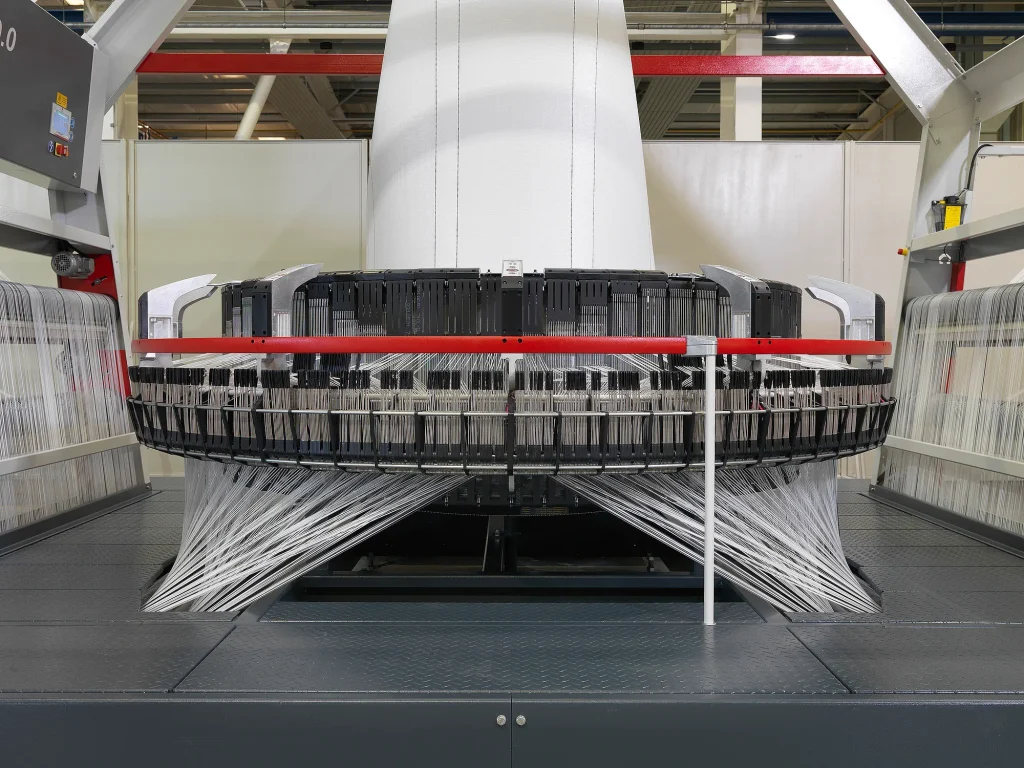
A robust production line for Transparent Woven Bags comprises discrete, capability‑linked stages: tape extrusion and drawing; weaving; surface activation; coating or lamination; printing; converting and seaming; accessory integration; and final QA. Each step is a potential failure gateway or a leverage point for cost and quality. The caliber of the equipment matters: tape uniformity, loom stability, register control in printing, and nip precision in lamination translate directly into field performance.
- Tape Extrusion and Drawing: Polypropylene resin is melted, extruded as a sheet, slit into tapes, and stretched to achieve high tenacity. Control of temperature profile and draw ratio limits denier variability—the enemy of even weaving.
- Weaving: Circular or flat looms interlace warp and weft to form tubular or flat fabric. Pick density tunes both strength and sift‑proofing.
- Surface Activation: Corona or flame treatment elevates surface energy for reliable adhesion and crisp print.
- Coating/Lamination: PE coatings improve moisture control; BOPP laminations add clarity and printability. Precision in adhesive application and nip pressure prevents milkiness and delamination.
- Printing: Reverse printing on the BOPP layer safeguards ink from scuff while delivering vibrant graphics; registration defines perceived quality.
- Converting and Seaming: Hot‑knife or cold‑knife cutting, formation of open‑mouth, valve, or block‑bottom geometries; seam methods chosen to control leakage.
- Accessory Integration: Inner liners, tear tapes, carry handles, venting perforations, and digital traceability marks.
Equipment pedigree
Production lines anchored by Austrian tape‑extrusion/loom systems and German printing/lamination presses are prized for stability, registration, and low scrap. Such pedigrees compress variation and elevate repeatability—advantages that cascade into stronger seams, clearer windows, and cleaner graphics.
Quality Architecture for Transparent Woven Bags: Standards, Sampling, SPC
Quality is not an afterthought but a design feature. A layered plan begins with defined standards and proceeds through incoming inspection, in‑process control, final testing, and surveillance. For optical windows, include haze and clarity acceptance bands; for structure, measure tensile, tear, seam strength, and drop survival; for barrier, define WVTR/OTR at stated conditions; for safety, adopt migration or organoleptic tests where food‑contact is in play.
| Domain | Typical Metric | Method / Targeting Notes | Sampling |
|---|---|---|---|
| Optics (window) | Haze, transmittance, gloss | Define haze band; confirm stability after lamination aging and abrasion | AQL for appearance + periodic instrument checks |
| Mechanics | Tensile, tear, seam strength, drop | Benchmark warp/weft; specify minimum seam retention to body strength | Lot‑based destructive testing |
| Barrier | WVTR, OTR, seal strength | Report test conditions; set liner thickness to hit target shelf life | Certificate + periodic verification |
| Printing | Color delta, registration, scuff | Reverse print behind BOPP; specify abrasion class | First‑article + patrol checks |
Quality control for Transparent Woven Bags lives or dies by measurement discipline. Quote methods, not adjectives; keep SPC charts for pick density, adhesive coat weight, bond peel, and window haze; calibrate gauges and track GR&R.
Root‑Cause Patterns and Fixes in Transparent Woven Bags
Common complaints—window haziness, dust leakage, delamination, seal failures, print scuff, UV chalking—follow a few repeatable causes: mis‑matched materials, out‑of‑control processes, or neglected environment. Map defects to controls and many “mysteries” vanish.
| Failure Symptom | Likely Root Cause | Countermeasure | Verification |
|---|---|---|---|
| Milky window | High adhesive coat, wrong film grade, poor surface energy | Reduce coat weight; switch to optical grade film; refresh corona | Measure haze pre/post lamination; record corona dyne levels |
| Sift‑leakage | Coarse weave; stitched seam needle holes; unsealed corners | Increase pick density; hot‑air or ultrasonic seams; corner sealing | Vibration dust‑leak test and mass loss |
| Delamination | Contamination, solvent retention, off‑spec nip pressure | Tight cleanliness; solventless adhesive; closed‑loop nip control | Peel strength trend ≥ target; microscopy of interface |
| Seal failures | PE grade mismatch; contamination; uneven jaw temps | Define seal window; upgrade to contamination‑tolerant sealants | Seal strength testing; thermal profile audit |
Applications of Transparent Woven Bags: From Field to Retail Shelf
Why show the product at all? Because seeing is deciding. In grains, seeds, and feeds, visibility builds trust without exposing goods to airborne dust; in minerals and chemicals, windows confirm powder color and granulation; in construction materials, they help spot clumping or moisture patches; in recycling and textiles, they accelerate sorting. The shared logic: faster identification, fewer unnecessary openings, fewer disputes, better shelf conversion. Not every SKU benefits equally, but many do when windows are sized and placed where users actually look.
Food grains & rice
Large window panels let customers audit grain size and cleanliness; barrier layers keep moisture at bay and protect aroma.
Seeds & feed
Window clarity enables quick varietal checks and pellet geometry confirmation without breaking seals.
Chemicals & minerals
Sift‑proof seams and antistatic options improve safety while windows verify powder appearance at goods‑in.
Systems Thinking: How the Pieces Connect in Transparent Woven Bags
Treating a bag as a system aligns individual optimizations with a coherent whole. Material choices drive process windows; process control shapes quality outcomes; quality sampling feeds back into material tuning; logistics constraints (stack height, humidity, vibration) then loop back to redesign seam methods and COF; sustainability constraints (mono‑material recyclability, downgauging) guide film and liner selection. What looks like a simple sack is actually a negotiated balance among stakeholders and requirements.
Ask a sequence of disciplined questions: what must be seen, at what distance, under what light, by whom; what failures are intolerable; what is the pallet journey; how will the bag be stored; and how will it be recycled. Each answer constrains the next decision.
Regulatory and Food‑Contact Considerations for Transparent Woven Bags
When Transparent Woven Bags carry edible goods, regulators care about migrants, organoleptics, and cleanliness. Choosing virgin resins, compliant inks and adhesives, and well‑documented processes is table stakes. Add traceability for raw materials, retain certificates of analysis, and keep solvent residues within defined limits. For export SKUs, align documentation to both the producing and receiving jurisdictions; friction disappears when the dossier reads like a check‑list rather than a narrative.
Sustainability Pathways for Transparent Woven Bags
A credible sustainability plan is not a slogan; it is a set of design moves. The most impactful are often the dullest: downgauge where mechanics permit, trim scrap by tightening process control, design mono‑polyolefin stacks to ease recycling, and enable reuse cycles with durable seams and edge finishes. Window clarity does not preclude recyclability; it must simply be engineered into a compatible family. Identify local recyclers early to avoid end‑of‑life surprises.
Design Moves
- Prefer PP/BOPP/PE combinations that remain within the polyolefin family.
- Use clear labeling and QR codes to guide disposal or take‑back.
- Capture in‑process trims and re‑feed where allowed by spec.
Operational Levers
- Preventive maintenance reduces waste and preserves optical quality.
- Standardized pallets and stretch‑wrap recipes reduce damage.
- Supplier scorecards keep material variability in check.
Economic Logic: Cost Drivers in Transparent Woven Bags
Unit cost is a function of resin mix, basis weight, film thickness, printing complexity, scrap, and equipment OEE. Clarity costs something—optical film grades and tight lamination windows—but it also saves time in receiving, reduces customer disputes, and can increase shelf conversion. The net effect depends on your product and your supply chain. The smartest move is to model both the manufacturing cost curve and the downstream value creation, then let the data decide window size and finish.
| Driver | Levers | Impact on Cost | Trade‑offs |
|---|---|---|---|
| Resin (PP/PE) | Supplier selection, contract terms, basis weight | Dominant share of BOM; market‑linked volatility | Downgauging vs mechanical safety margin |
| Film & lamination | Optical grade, coat weight, nip control | Adds cost; drives clarity and print durability | Clarity vs scrap risk at narrow process windows |
| Printing | Colors, coverage, registration | Affects aesthetics and scuff resistance | Shelf impact vs ink/solvent management |
Human‑Centered Vignettes for Transparent Woven Bags
A rice retailer who once endured weekly returns now displays grain through generous windows; disputes dropped and sales rose. A seed distributor once plagued by hybrid mix‑ups now verifies content by sight, with QR‑coded lots improving traceability. A mineral powder supplier moved to sift‑proof seams and anti‑static liners; dust complaints subsided, housekeeping improved, and accident rates fell. These are not miracles—just the predictable benefits of visibility and control.
Is a window always worth it? Not necessarily. If operators never look, or if barrier needs dominate optics, window real estate can shrink. The right answer is the one that fits the job and pays its way.
Supplier Selection and Process Governance for Transparent Woven Bags
Choose partners who name their methods, show control plans, and disclose equipment lists. Tape lines that hold draw ratios, looms that minimize broken ends, laminators with closed‑loop nip control, and presses with digital register correction are not vanity metrics; they are predictors of clarity and strength. Ask for SPC samples, process FMEAs, and first‑article reports. If the answers are anecdotes instead of data, keep looking.
RFQ Essentials
- Payload and density; target capacity; drop height.
- Window haze band; size and position; print coverage.
- WVTR/OTR target with method; liner yes/no.
- Seam method and retention to body strength.
Plant Audits
- Calibration history for corona stations and nip controllers.
- Traceability from resin silo to finished lot.
- Gauge R&R on optics and mechanics.
- Preventive maintenance plan for tape lines and looms.
Keyword Weaving for Transparent Woven Bags Documentation
To help readers find what they need, weave consistent phrasing without stuffing. Use anchors like Transparent Woven Bags, Transparent PP Woven Bags, Clear Woven Polypropylene Bags, transparent woven sacks for rice, BOPP‑window woven packaging, and sift‑proof transparent bags. Vary syntax to read naturally, alternating short and long sentences, questions and assertions. Who wants monotony? Nobody. Who benefits from clarity? Everybody.
October 26, 2025
- Definition, Scope, and Naming Conventions of Transparent Woven Bags
- Material System of Transparent Woven Bags: Polymers, Additives, and Roles
- Optical Visibility: Haze, Gloss, and Luminous Transmittance in Transparent Woven Bags
- Mechanical Strength, Safety, and Ergonomics of Transparent Woven Bags
- Moisture and Gas Management: WVTR, OTR, and Liners for Transparent Woven Bags
- Production Flow for Transparent Woven Bags: From Resin to Finished Sack
- Quality Architecture for Transparent Woven Bags: Standards, Sampling, SPC
- Root‑Cause Patterns and Fixes in Transparent Woven Bags
- Applications of Transparent Woven Bags: From Field to Retail Shelf
- Systems Thinking: How the Pieces Connect in Transparent Woven Bags
- Regulatory and Food‑Contact Considerations for Transparent Woven Bags
- Sustainability Pathways for Transparent Woven Bags
- Economic Logic: Cost Drivers in Transparent Woven Bags
- Human‑Centered Vignettes for Transparent Woven Bags
- Supplier Selection and Process Governance for Transparent Woven Bags
- Keyword Weaving for Transparent Woven Bags Documentation
Imagine this scenario:
Client: “We need packaging for 25 kg anular fertilizer. Our previous supplier’s bags tore during transit, causing product loss and contamination. How can we avoid this?”
VidePak Expert: “Transparent woven bags with reinforced seams, anti-static coatings, and a 120 GSM thickness would solve your problem. They allow real-time quality checks, prevent leaks, and meet ISO 22000 standards for chemical safety.”
Client: “What about humidity? The fertilizer clumps in moist environments.”
VidePak Expert: “Adding an inner polyethylene (PE) liner and UV-resistant lamination ensures moisture control and extends shelf life. Let’s discuss ASTM D5638 compliance for your U.S. shipments.”
This exchange highlights the core advantages of transparent woven bags: enhanced quality control, compliance with global standards, and tailored solutions for chemical product safety. Below, we explore these benefits in detail, addressing common challenges and offering actionable insights for selecting the right packaging.
1. Why Transparent Woven Bags Excel in Chemical Packaging
Transparent woven polypropylene (PP) bags combine durability with visibility, making them ideal for hazardous and non-hazardous materials. Their unique structure—interlaced PP tapes with optional lamination—ensures:
- Real-time quality inspection: Suppliers and buyers can visually verify product integrity without opening bags.
- Superior tensile strength: Starlinger weaving machines at VidePak produce bags with 40–60 N/cm² tensile strength, far exceeding EN 26582-2 requirements.
- Customizable barriers: Lamination (e.g., BOPP films) or inner liners block moisture, UV radiation, and chemical interactions.
For example, disinfectant powder manufacturers face challenges with clumping and oxidation. A transparent woven bag with a 90 GSM base fabric, 20-micron BOPP lamination, and PE liner reduces moisture absorption by 85% compared to untreated bags (Source: Journal of Packaging Technology, 2023).
2. Matching Packaging to Product Characteristics: A Regional Standards Analysis
Chemical products vary in density, corrosivity, and regulatory requirements. Below, we analyze key categories:
2.1 Fertilizers
- Properties: Hygroscopic, abrasive, and prone to caking.
- Packaging Solutions:
- Fabric Weight: 100–120 GSM (EU Standard EN 13431) to withstand 50 kg loads.
- Lamination: UV-stabilized BOPP films prevent degradation during outdoor storage.
- Seams: Heat-sealed edges reduce seam slippage (<2% elongation under load, per ASTM D5264).
2.2 Plastic Pellets and Activated Carbon
- Properties: Low density (0.4–0.6 g/cm³), electrostatic-sensitive.
- Packaging Solutions:
- Anti-static Treatments: Carbon-black-coated fabrics dissipate charges, complying with IEC 61340-4-4.
- Valve Designs: Spout pouches with dust-proof valves ensure clean filling (ISO 21898:2020).
2.3 Chlorine-Based Disinfectants
- Properties: Corrosive, reactive with moisture.
- Packaging Solutions:
- Liner Materials: 0.1 mm PE liners resist chlorine gas permeation (tested per ASTM F1249).
- Closure Systems: Double-stitched seams with adhesive tape achieve 99.9% leak prevention (JIS Z 0238:2013).
3. Global Standards and Parameter Selection
Regional regulations dictate material choices and testing protocols. VidePak’s bags are certified for:
- EU: REACH, EN 13432 (compostability).
- U.S.: FDA 21 CFR 177.1520 (food-grade contact).
- Japan: JIS L 1907 (antimicrobial performance).
Table 1: Key Parameters by Region
| Region | Thickness (GSM) | Max Load (kg) | Lamination Requirement |
|---|---|---|---|
| EU | 90–130 | 50 | UV-resistant BOPP |
| U.S. | 80–120 | 45 | FDA-approved PE |
| Japan | 100–150 | 55 | Anti-fog coating |
4. VidePak’s Manufacturing Excellence: A Case for Transparency
Founded in 2008, VidePak operates 100+ circular looms and 30 lamination machines, producing 50 million bags annually. Our Austrian Starlinger machinery ensures:
- Consistent weave density: ≤2% deviation across batches.
- Multi-layer extrusion: Co-extruded PP + PE liners for enhanced barrier properties.
5. FAQs: Addressing Buyer Concerns
Q1: How do I choose between laminated and non-laminated bags?
A: Laminated bags (e.g., BOPP laminated woven bags) suit humid climates, while non-laminated options reduce costs for dry products.
Q2: Can you customize printing for hazardous material labels?
A: Yes. Our 10-color flexographic printers comply with GHS labeling standards (e.g., UN certification).
Q3: What’s the lead time for 20,000 bags?
A: 15–20 days, including quality inspections.
6. Conclusion
Transparent woven bags are a strategic investment for chemical suppliers prioritizing safety, compliance, and cost efficiency. By aligning with global standards and leveraging advanced manufacturing—such as VidePak’s customizable FIBC solutions—businesses mitigate risks and enhance brand trust.
References
- European Committee for Standardization. (2023). EN 13432: Packaging Requirements for Compostability.
- ASTM International. (2022). D5638-22: Standard Test Method for Chemical Permeation.
- VidePak Company Profile. (2024). https://www.pp-wovenbags.com/.
- Contact: info@pp-wovenbags.com.
This article adheres to Google’s EEAT guidelines, combining technical expertise (30+ years in packaging), authoritative data (ISO/JIS/ASTM citations), and transparency (VidePak’s operational details). For further insights, explore our guide to chemical-grade woven bags.