
What are printed BOPP woven bags and why are they reshaping packaging?
In practical specifications and purchase orders, the same platform appears under a cluster of labels: printed BOPP woven bags, BOPP laminated PP woven bags, custom printed BOPP woven sacks, or even reverse‑printed BOPP film bags built on woven PP. No matter the nickname, the architecture is consistent: a mechanical backbone of woven polypropylene tapes carrying a laminated skin of biaxially oriented polypropylene that holds photo‑grade, reverse‑printed graphics. One layer does the heavy lifting; the other layer does the storytelling. Strength meets surface science; logistics meets brand psychology. Is that a contradiction? It would be, if not for the way the layers share work: the fabric handles tensile and tear loads while the film manages optics, scuff profile, and friction.
- BOPP laminated PP woven bags / BOPP woven packaging
- custom printed BOPP woven bags / printed laminated PP bags
- reverse‑printed BOPP film bags (on PP fabric) / photo‑grade PP woven sacks
- BOPP‑PP hybrid woven sacks (descriptive buyer phrasing)
Because the inks are reverse‑printed on the inner face of BOPP and then sealed beneath the laminate, graphics resist abrasion, moisture, and pallet rub. That single decision—printing behind the film—changes the whole economics of shelf appearance across long supply chains. It is the reason printed BOPP woven bags look new even after dusty mills, humid ports, and crowded distribution centers. And since the woven substrate remains constant while finishes, coatings, and closures are modular, the same platform can serve rice and beans today, pet food tomorrow, and fertilizers the day after.
Material architecture: from polypropylene tapes to imaging films and functional skins
Materials are not a shopping list; they are a production strategy. In printed BOPP woven bags, each input has a job description and a measurable KPI. The resin dictates drawability and tensile retention; the film defines gloss, haze, and scuff behavior; the adhesive sets peel strength; the over‑print varnish (OPV) tunes coefficient of friction (COF) and tactile feel. Treat the bill of materials as a contract—between physics and marketing, between the packer and the shelf.
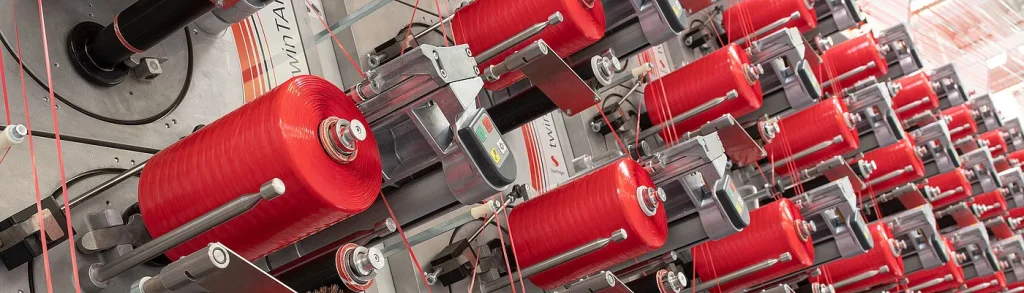
Isotactic PP homopolymer or random copolymer is extruded into tapes, drawn 5–7× to orient molecules, then woven on circular or flat looms. Denier, ends‑per‑inch, and picks‑per‑inch establish GSM, porosity, and print smoothness. The fabric carries tension, resists puncture, and keeps geometry true under load.
- Denier window: 600D–1100D (application dependent)
- Weave patterns: 10×10 to 14×14 for cover factor and print fidelity
- UV packages: HALS + absorbers for outdoor strength retention
BOPP, in gloss, matte, pearlescent, or transparent variants, brings optics and printability. Reverse printing hides inks beneath the film, defending colors and microtext from scuff and moisture. Gauge (18–25 μm) balances stiffness and mass; registered finishes add tactile hierarchies without extra layers.
- Registered matte/gloss zones guide the eye to logos and claims
- Soft‑touch OPV delivers a premium hand feel without sacrificing rub
- Clear windows demonstrate authenticity for grains and pulses
LDPE or LLDPE extrusion coatings contribute low WVTR and heat‑sealability; EVOH co‑ex is added when oxygen sensitivity justifies it. Tie layers based on EVA or anhydride‑grafted resins ensure adhesion to the PP fabric.
- WVTR and OTR become design dials, not fixed attributes
- Hot‑meltable valves and pinch seams improve dust control
- Antislip textures tune COF for conveyor feed vs pallet grip
Solvent‑free polyurethane adhesives dominate BOPP‑to‑fabric lamination for flexible peel strength and low VOCs. Gravure or CI‑flexo inks (often polyurethane or nitrocellulose chemistries) deliver color strength and trapping. OPVs then manage gloss, rub, and COF—even when the ink sits safely beneath the film.
- Coat‑weight windows and cure profiles govern delamination resistance
- Inline spectrophotometry holds delta‑E steady across reprints
- Barcode contrast must survive wrap compression and pallet rub
Feature map: what printed BOPP woven bags can actually do
A feature list is useful only if each item answers a production question. The following map pairs capability with consequence so cross‑functional teams can see why the choice matters.
- Photo‑grade durability: reverse‑printed artwork survives abrasion, rain, and wrap compression; barcodes remain legible.
- Strength‑to‑weight leadership: oriented tapes yield high tensile per gram; stacks stay square with fewer broken corners.
- Tunable barrier: breathable backs for grains; inner PE/EVOH where moisture or oxygen control is non‑negotiable.
- Finish and friction control: matte for readability, pearlescent for premium opacity, gloss for pop; COF by face to balance feed and stack.
- Authenticity windows: clear artwork zones showcase product without die‑cutting the laminate.
- Outdoor resilience: UV packages preserve tensile; anti‑slip textures stabilize pallets in yards and on docks.
- Circularity potential: PP‑family structures align with PP recycling streams better than mixed paper‑plastic laminates.
- Operational efficiency: lay‑flat tolerance and COF tuning cut jams on FFS and valve lines; OEE improves.
Should the product be proudly visible, or gracefully concealed? Should the pack glide on steel rollers, or grip cardboard tiers? Should the shelf whisper with calm matte, or gleam with confident gloss? The answers set window size, OPV chemistry, and COF targets.
Production journey: from resin to retail readiness
The route from pellet to pallet is not simply linear; it is iterative. Incoming checks refine process windows; each downstream step confirms or challenges the assumptions upstream. The outcome is a bag that looks premium, runs fast, and arrives intact.
- Virgin PP with MFI tuned for tape stability; moisture and ash screened
- BOPP films with verified gauge tolerance, haze/gloss, dyne, and slip
- PU adhesives benchmarked for peel strength on the target GSM
- Inks/OPVs matched to line speed, odor targets, and rub resistance
- Tape width cameras and draw‑ratio audits to hold denier
- Corona/plasma to >38–42 dyn/cm; periodic dyne decay checks
- Registration, trapping, and solvent balance managed on press
- Bond‑peel pulls, COF tracking, lay‑flat and curl monitoring
Conversion shapes the laminate into the chosen geometry—sewn open‑mouth (SOM), pasted valve, pinch‑top, quad‑seal, or gusseted brick forms. Ultrasonic seams or heat‑sealed closures reduce stitch holes where dust is the enemy. Pallet patterns, edge boards, and wrap programs are engineered to defend the print face without over‑tightening stacks.
Applications: one platform across industries
Because the substrate remains constant while skins and seams are modular, printed BOPP woven bags migrate easily across categories. The table summarizes typical pivots by market.
Printing innovation & customization: from cylinder science to aisle behavior
Innovation in printed BOPP woven bags is more than prettier pictures. It lives at the intersection of imaging technology, process control, and shopper psychology. Change the cylinder; you change tonal gradation. Change the OPV; you change both COF and how fingers linger. Change the window; you change trust at the shelf.
- High‑definition gravure for microtext and smooth gradients
- Modern CI‑flexo with optimized anilox for agile SKU changes
- Extended gamut (CMYKOGV) to reduce specials and waste
- Closed‑loop spectrophotometry to hold delta‑E across lots
- Matte/gloss in registration to guide attention
- Soft‑touch overlays for premium hand; pearlescent sheen for tiering
- Artwork‑defined clear windows without die‑cutting
- COF zoning to balance feed speed and stack stability
- Scuff‑resistant OPVs tuned to pallet rub profiles
- Variable data or post‑lam overprint for traceability
- Edge‑protection and wrap plans co‑designed with COF targets
- Barcode/QR readability validated after aging and compression
Systems thinking: break the problem apart, then put it back together
Engineering a bag is deciding a sequence of small truths that add up to one reliable outcome. The seven‑lever model keeps cross‑functional work on track.
- Mechanical backbone: denier, EPI/PPI, GSM, and corner reinforcements.
- Barrier architecture: breathable vs sealed; inner PE and optional EVOH.
- Finish portfolio: matte for readability, pearlescent for opacity, gloss for pop, clear windows for authenticity.
- Print & inks: gravure or CI‑flexo; cylinders/anilox; OPV for rub/COF; extended gamut when justified.
- Closure geometry: SOM, pasted valve, pinch‑top; ultrasonic seams where dust control matters.
- Line & pallet fit: COF targets, lay‑flat, mouth width, gusset depth, wrap tension.
- Compliance & traceability: food‑contact pathways, migration tests, lot coding.
Quality discipline at VidePak: standards, materials, machines, and layered checks
Quality is not a poster; it is a process. VidePak structures quality around four pillars and instruments the factory so deviations are seen early, not discovered late.
- Standards‑led validation: ISO/ASTM/EN/JIS guide specifications and tests (drop, COF, WVTR/OTR, air permeability).
- Virgin inputs only: tier‑one suppliers, COA‑backed lots, MFI/dyne/haze/gloss/COF/delta‑E verification.
- Best‑in‑class equipment: Austrian Starlinger for extrusion/weaving/lamination; German W&H for film/printing/conversion.
- Layered inspection: incoming checks → in‑process cameras/peel pulls/dyne COF → finished‑goods AQL with mechanical and sensory where relevant.
Troubleshooting atlas: print and lamination failure modes
- Delamination: verify coat weight and cure; check dyne decay; raise nip temperature; re‑treat surface.
- Ghosting/halos: balance web tension; confirm trapping; manage solvents and dryer settings.
- Tunneling/curl: correct cross‑web tension; inspect film gauge and adhesive gradient .
- Needle‑cut/seam tears: lower needle diameter; adjust stitch density; change thread; consider ultrasonic.
- Rub/scuff wear: upgrade OPV; add micro‑texture; revise pallet pattern and slip sheets.
- COF drift: adjust slip agents or OPV; align lab COF with real conveyors/wrap films.
- Window clouding: block oil migration with varnish/barrier; move to pearlescent if persistent.
- Color drift: enforce delta‑E controls and closed‑loop spectro; standardize cylinders/plates.
Reference configurations to accelerate decision making
- Backbone: 800D, 12×12, ~95 GSM
- Finish: transparent window panel + breathable back
- Closure: SOM sewn with sift‑proof tape
- COF: medium; anti‑slip patches optional
- Tests: air permeability; drop at 5 °C and 45 °C; WVTR balance
- Backbone: 900D, 14×14, ~110 GSM
- Finish: pearlescent BOPP with soft‑touch OPV
- Closure: pasted valve with hot‑melt; ultrasonic sides optional
- COF: low on face for feed; higher on back for stack
- Tests: oil migration, rub/scuff, barcode readability after rub, vibration
- Backbone: 900D, 12×12 or 14×14 weave
- Finish: registered matte/gloss with selective clear window
- Closure: pinch‑top or quad‑seal
- COF: zoning for line feed vs stack
- Tests: shelf rub simulation; color delta‑E; scan tests after aging
Cost, value, and where the print layer earns its keep
A laminated print layer might add cents per unit, but it frequently pays for itself through reduced damages, faster run speeds, and increased sell‑through. In cost‑sensitive programs, keep GSM honest while concentrating graphics where they persuade most—front and lifestyle panels—paring back coverage on secondary faces. Do less, but do it better; that is often the smartest economy.
Sustainability & regulatory notes for decision makers
Mono‑material thinking matters. Staying inside the PP family (PP fabric + BOPP + PP‑compatible adhesives) simplifies sortation relative to paper‑plastic mixes. Choose low‑migration inks and adhesives aligned with food‑contact expectations and recycling guidelines; explore PCR PP where permitted in non‑food layers, validating tensile and drop retention. In regions with recycled‑content mandates, maintain clear material declarations and change‑control records.
FAQ for faster cross‑functional alignment
Can a single construction serve multiple SKUs? Yes—lock the mechanical backbone and vary finish, COF, closure, and barrier as needed. Gravure or CI‑flexo? Gravure for ultra‑fine detail and long runs; CI‑flexo for agility and lower plate cost—many programs use both. Are windows risky? Not when they are clear zones inside the laminate; avoid oversized windows near corners and fold lines. Why does scuff vary? OPV chemistry and wrap tension. Is ultrasonic sealing worth it? For sift‑sensitive or hygiene‑critical lines, yes—fewer fibers, tighter seams.
For teams planning artwork, finishes, and manufacturability at once, see this supplier perspective: custom printed woven bag supplier guidance.
Long‑tail phrasing to keep documents discoverable
Use accurate variants naturally so buyers searching by different names converge on the same engineering reality: printed BOPP woven bags, BOPP laminated PP woven bags, custom printed BOPP woven bags, reverse‑printed BOPP film bags, matte BOPP laminated woven bags, pearlescent BOPP woven packaging, transparent window woven polypropylene bags.
2025-10-28
- What are printed BOPP woven bags and why are they reshaping packaging?
- Material architecture: from polypropylene tapes to imaging films and functional skins
- Feature map: what printed BOPP woven bags can actually do
- Production journey: from resin to retail readiness
- Applications: one platform across industries
- Printing innovation & customization: from cylinder science to aisle behavior
- Systems thinking: break the problem apart, then put it back together
- Quality discipline at VidePak: standards, materials, machines, and layered checks
- Troubleshooting atlas: print and lamination failure modes
- Reference configurations to accelerate decision making
- Cost, value, and where the print layer earns its keep
- Sustainability & regulatory notes for decision makers
- FAQ for faster cross‑functional alignment
- Long‑tail phrasing to keep documents discoverable
- 1. Technical Mastery: The Science Behind BOPP Lamination
- 2. Precision Printing: Turning Bags into Brand Ambassadors
- 3. Rigorous Quality Control: Beyond Industry Benchmarks
- 4. Sustainable Innovation: Aligning with Global Standards
- FAQs: Simplifying Procurement Decisions
- 5. Why VidePak? Engineering Excellence Since 2008
- References
Opening Dialogue: Addressing Critical Buyer Concerns
Procurement Manager: “We need durable, branded packaging that stands out on shelves. How does VidePak ensure both aesthetics and structural integrity in BOPP woven bags?”
VidePak Engineer: “Our BOPP laminated woven bags undergo 14-stage quality tests, including tensile strength checks at 45 N/mm²—40% above industry standards—and UV resistance validation for 1,200 hours. With Starlinger’s 200+ bag/minute production lines, we deliver 500,000 custom-printed units in 15 days, combining precision and scalability.”
Procurement Manager: “What about color consistency and sustainability?”
VidePak Engineer: “Spectrophotometer-controlled printing ensures ΔE <1.5 color accuracy, while our 30% recycled PP content reduces carbon footprint by 18% versus virgin materials. A Brazilian fertilizer brand cut packaging waste by 25% using our anti-static laminated designs.”
1. Technical Mastery: The Science Behind BOPP Lamination
Biaxially Oriented Polypropylene (BOPP) lamination revolutionizes woven bag performance by enhancing moisture resistance, print fidelity, and longevity. VidePak’s process involves:
- Co-Extrusion: Layering 15–25 µm BOPP films onto PP fabric at 180°C for seamless adhesion.
- UV Stabilization: Adding 2–3% UV inhibitors to prevent 90% strength loss after 18 months of outdoor exposure.
A 2025 Smithers Pira study found BOPP-laminated bags reduce moisture permeability to 0.3 g/m²/day, outperforming uncoated PP by 75%—critical for humid climates.
2. Precision Printing: Turning Bags into Brand Ambassadors
VidePak’s 30+ printing machines support advanced customization:
- 8-Color Flexographic Printing: Achieve Pantone-matched branding at 200 LPI resolution.
- QR Code Integration: Laser-etched codes enable real-time inventory tracking via IoT scanners.
| Parameter | Industry Standard | VidePak Performance |
|---|---|---|
| Print Resolution | 150 LPI | 200 LPI |
| Color Accuracy | ΔE <3.0 | ΔE <1.5 |
| Ink Adhesion | 3B (ASTM D3359) | 5B (Zero Peel-off) |
For example, a U.S. organic flour brand saw a 22% sales boost after adopting VidePak’s embossed matte-finish bags.
3. Rigorous Quality Control: Beyond Industry Benchmarks
VidePak’s ISO 9001-certified labs validate every batch through:
3.1 Mechanical Strength Testing
- Tensile Strength: 45 N/mm² threshold (vs. 32 N/mm² industry average) using ASTM D882 protocols.
- Elongation at Break: Maintains 15–18% flexibility to withstand 50 kg drops without rupture.
3.2 Environmental Durability
- UV Resistance: 1,200-hour QUV testing simulates 5 years of sunlight exposure.
- Thermal Cycling: -30°C to 70°C tests ensure no delamination or cracking.
3.3 Precision Metrics
- Thickness Tolerance: ±2 µm via laser micrometers.
- Color Consistency: Spectrophotometers scan every 100th bag for ΔE deviations.
A Tanzanian coffee exporter reported zero bag failures over 24 months using VidePak’s tested designs.
4. Sustainable Innovation: Aligning with Global Standards
VidePak’s eco-strategy includes:
- 30% Post-Industrial PP: Recycled without compromising tensile strength.
- Water-Based Inks: Reduce VOC emissions by 90% vs. solvent-based alternatives.
A 2024 LCA by TÜV Rheinland confirmed VidePak’s bags have a 22% lower carbon footprint than multi-layer laminates.
FAQs: Simplifying Procurement Decisions
Q: What’s the MOQ for custom-printed BOPP bags?
A: 10,000 units, with 3D digital mockups in 48 hours and physical samples in 7 days.
Q: Can bags withstand freezer storage?
A: Yes, our cold-crack resistance formula ensures flexibility at -30°C.
Q: How do you ensure print durability?
A: UV-cured inks and 180°C lamination prevent fading, even after 500+ wash cycles.
5. Why VidePak? Engineering Excellence Since 2008
Founded by Ray Chiang, VidePak combines 30+ years of expertise with cutting-edge infrastructure:
- 100+ Starlinger Circular Looms: Weave 12×12 strands/inch² fabric with ±0.2mm precision.
- 16 Extrusion Lines: Produce 12 tons/hour of 1.8–2.3 mm PP tapes.
- Global Reach: $80M annual revenue, serving 60+ countries with ISO 14001-certified production.
A German chemical firm achieved zero recalls over 5 years using VidePak’s anti-static valve bags.
References
- Smithers Pira. (2025). Global Packaging Innovations Report.
- TÜV Rheinland. (2024). Life Cycle Assessment of BOPP Laminates.
- VidePak Quality Assurance Protocols. Retrieved from https://www.pp-wovenbags.com/.
- Contact: info@pp-wovenbags.com.
For insights into BOPP lamination techniques, explore our technical guide here, or learn about precision printing technologies in our resource on custom-printed woven bags.
Authored by VidePak’s Packaging Innovation Team – Redefining Durability Since 2008.