
Identity and scope: what are Tubular Woven Bags with Form‑Fill‑Seal (FFS) Systems and why do they matter?
In industrial packaging, few solutions combine mechanical ruggedness, automation readiness, and cost discipline as convincingly as Tubular Woven Bags with Form‑Fill‑Seal (FFS) Systems. At a glance, the format looks simple: a continuous tube of woven polypropylene (PP) rollstock that becomes a finished sack only at the moment of filling and sealing. Yet simplicity masks sophistication. The woven backbone carries loads and resists abrasion; the surface skin enables heat sealing and graphics; the tubular geometry removes a seam, improving strength and stack performance. The outcome is a hybrid that behaves like a film in a Form‑Fill‑Seal system and like a textile inside logistics.
Terminology varies across plants and markets, but the convergence is clear. Buyers may hear or search for tubular FFS bags, FFS woven sacks, woven polypropylene FFS rollstock, or poly‑woven FFS packaging. All describe the same class of automation‑ready, heat‑sealable roll webs engineered from PP tapes and protective skins. The driver is operational: by feeding a continuous tubular web to an FFS machine, manufacturers minimize manual handling, cut sewing consumables, and standardize seals that are sift‑proof on powders and tidy in pallets. The result is not merely a different bag; it is a different rhythm of work.
Material architecture: how the woven backbone and sealing skin co‑create performance
A Tubular Woven Bag for FFS is not a single layer; it is an engineered laminate in function, even when it remains a mono‑family polyolefin for recyclability. The base fabric is woven from oriented PP slit‑film tapes. Stretching these tapes aligns polymer chains, raising tenacity and stiffness so the fabric resists creep under stack compression. On its own, however, this fabric is porous and not heat‑sealable. A surface layer solves both: an extrusion‑coated PP/PE blend or a laminated BOPP film closes porosity for dust control and provides a sealable interface.
The skin’s chemistry governs seal initiation temperature, hot‑tack, and peel mode. Corona or plasma treatment elevates surface energy for print adhesion. Additives modulate behavior: slip agents tune coefficient of friction (COF) for web handling; anti‑block prevents telescoping on the unwind; UV stabilizers preserve strength for outdoor yards; anti‑static reduces clinging fines during filling. What appears to be a single “bag” is, practically speaking, a set of negotiated compromises between stiffness and sealability, friction and release, barrier and breathability.
Geometry and tunability: why the tubular format outperforms flat web plus seam
Removing the longitudinal seam is more than a cosmetic choice. A tubular woven FFS bag distributes stress uniformly around the circumference, boosting burst strength and improving dimensional stability during palletizing. Layflat width maps directly to finished girth, and gussets can increase volume without enlarging external footprint—valuable where pallet patterns are tight or conveyors narrow. Micro‑perforations hidden in gusset valleys vent air during filling while sheltering the printed face from scuff. The tubular web also tracks more predictably through collars because edges are factory‑folded rather than trimmed and sewn.
To the sceptic who asks, “Isn’t a seam good enough?” the reply is pragmatic: seams concentrate stress and attract sifting. Needles, threads, and fold memory introduce variables that automation seeks to erase. In FFS cells where uptime is king, fewer variables beat clever fixes.
| Design lever | Impact on performance | Typical tuning window |
|---|---|---|
| Layflat width | Controls finished girth; impacts collar stability and tracking. | 360–700 mm common for 20–50 kg formats |
| Gusset depth | Improves cube efficiency and pallet stability. | 30–80 mm per side depending on fill density |
| Pick density | Raises tensile & reduces weave “print‑through” at seals. | 8–12 picks/10 mm |
| Coating/lamination | Opens seal window; adds barrier & printability. | PP/PE coat 20–40 µm or BOPP 18–25 µm |
From pellet to roll: the integrated production flow that underwrites consistency
The reliability of FFS woven bags begins upstream. Resin choice sets the ceiling; tape extrusion locks in tenacity; weaving enforces uniformity; coating or lamination equips the surface for sealing; winding preserves flatness and splice discipline. Each handoff leaves a fingerprint on how the web will run on a Form‑Fill‑Seal machine. The following flow makes the dependencies visible.
- Polymer & tape line. Isotactic PP with melt flow suited to draw; filters keep gels from printing through; draw ratios align chains to raise tensile and limit creep.
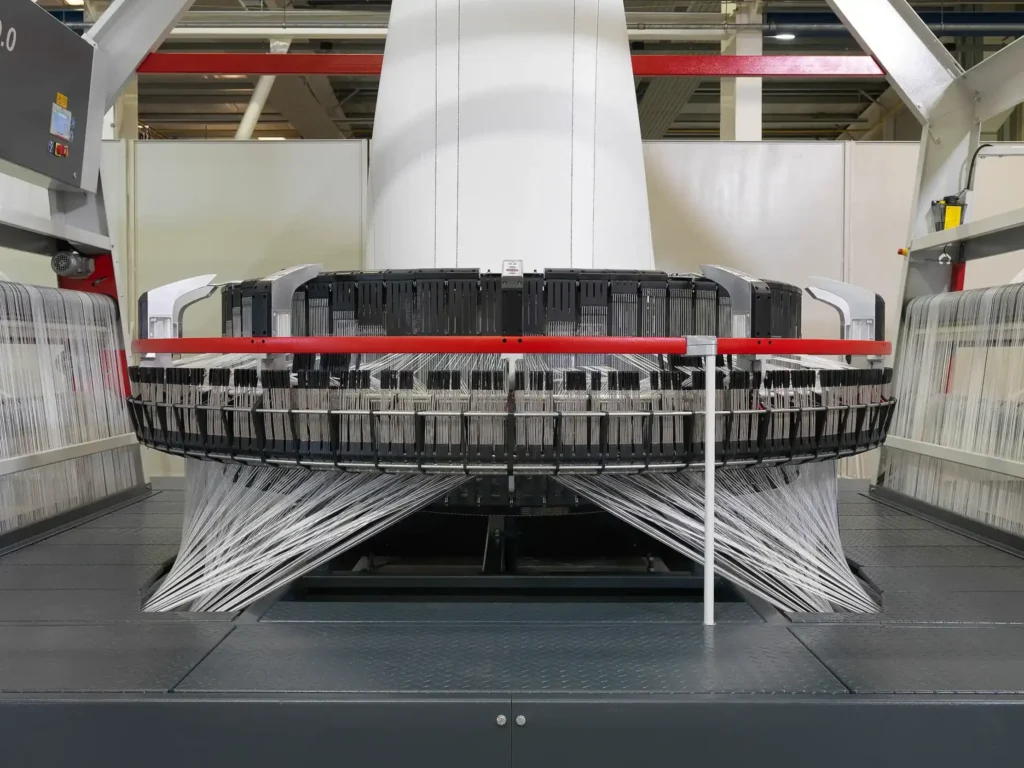
- Weaving on circular looms. Pick regularity and tension control prevent stripes and weak zones; tubular fabric eliminates a back seam.
- Surface engineering. Corona adds surface energy; compatible tie‑layers or coats ensure adhesion to woven peaks without embrittlement.
- Coating/lamination. PP/PE coating for a forgiving seal window and dust control; BOPP for scuff resistance and crisp graphics; micro‑perfs placed behind gussets for deaeration.
- Slitting & winding. Edge stability, layflat bandwidth, core ID, OD, and splice policy tailored to the FFS unwind and collar geometry.
- Conversion on FFS. Form, fill, seal, cool; add date/batch codes, handle hole or vent paths as required; eject to palletizer.
Interface with automation: collars, jaws, pressure profiles, and speed
When the web meets the machine, two preferences must agree: the material’s seal window and the line’s cadence. Constant‑heat and impulse jaws each have a place; serration geometry governs how the seal crushes over woven knuckles; cooling bars immediately after hot jaws stabilize hot‑tack at speed. Brushes and air‑knives clean the seal area before closing; dust mitigation matters because powders can defeat the best recipes. FFS woven sacks that run well are those whose seal layer is tuned to the jaw’s pressure profile, not merely to temperature setpoints.
| Machine factor | Why it matters | What to validate |
|---|---|---|
| Collar geometry | Controls tracking and tube inflation; impacts cut length accuracy. | Layflat vs. collar width tolerance; friction strip wear; web wander limits. |
| Jaw profile | Crush pattern over knuckles defines peel mode and seal strength. | SIT, hot‑tack, peel curve; pressure uniformity; cooling dwell. |
| Web COF | Affects tension control and slip at feed belts; too low and alignment drifts, too high and scuff rises. | COF inner/outer; additive migration over time; conveyor material compatibility. |
| Vent strategy | Controls trapped air and sifting; influences bag geometry at palletizer. | Micro‑perfs location; gusset shields; dust collection near cut/seal. |
Feature set and value proposition: what FFS tubular woven bags deliver in real plants
The appeal of tubular PP FFS packaging spans operations, quality, and brand. Mechanically, the woven base absorbs abuse that would puncture monolithic films. Seals close without needles or threads, reducing sifting on powders and housekeeping burden. Automation reduces labor exposure and ergonomic risk. Graphics printed on BOPP or coated PP survive long conveyor journeys and arrive with edges sharp enough for retail‑adjacent channels. In sum: fewer steps, fewer variables, cleaner pallets.
Applications across sectors: from petrochem to food to building materials
Where do FFS woven bags shine? Anywhere product flows freely, the environment is demanding, and line speed matters. Petrochemical pellets prefer webs that resist scuff and puncture; fertilizers challenge seals with dust; powdered minerals push for stiff walls that keep pallets box‑shape; refined sugars need graphics that remain legible after miles of conveyors. Tubular woven FFS systems embrace these contradictions with tunable skins and robust backbones.
| Sector | Typical fill | Critical risks | Web tuning focus |
|---|---|---|---|
| Petrochemicals | PE/PP pellets, resins | Scuff, puncture, slip on conveyors | BOPP outer for abrasion, tuned COF; heavier weave in corners |
| Fertilizers | Urea, DAP, NPK blends | Dust, sifting, UV yard storage | Seal‑forgiving coat; micro‑perfs; UV stabilization |
| Building materials | Cement, limestone, fly ash | Drop impact, humidity, box‑shape | Double seals; stiffer laminate; anti‑slip outer |
| Food & feed | Sugar, salt, grains, premixes | Cleanliness, print legibility | Reverse‑printed BOPP; low‑dust skin; HACCP‑friendly documentation |
Quality metrics and why they map directly to risk
Validation for tubular woven bags with FFS is persuasive only when measurement links to risk. Seal strength supports drop height; COF supports pallet pattern; dart impact correlates with conveyor scuff; compression relates to warehouse stacking. Instead of testing out of habit, test with intent: each metric should drive a process window or a supplier acceptance criterion.
- Thickness tolerance. Too thin raises rupture risk; too thick inflates resin cost and narrows seal windows.
- Cut edge quality. Burrs and fuzz contaminate seals; clean edges support reliable heat‑sealing.
- GSM uniformity. Fabric weight consistency reduces weak spots and stabilizes web handling.
- Tensile & elongation. Ensures the web survives acceleration and drop stress without creep.
- Impact resistance. Protects against puncture and corner crush in mixed‑mode shipping.
- UV resistance. Prevents yard storage degradation; critical for fertilizers and minerals.
- Environmental fitness. Document additives and pathways for recycling within polyolefin streams.
Comparative lens: woven FFS vs. mono‑PE FFS film vs. valve‑type sacks vs. multiwall paper
Choosing a format is rarely about absolutes. It is a portfolio decision shaped by product flow, drop height, climate, print needs, and labor philosophy. Form‑Fill‑Seal woven bags keep wall stiffness better than many mono‑PE films, resisting stretch and scuff across conveyors. Against valve‑type woven sacks, tubular FFS webs remove needles and thread, cutting labor and sifting while retaining the woven skeleton. Compared with multiwall paper, woven/BOPP skins endure humidity without resorting to heavy overwraps. None of these are theoretical debates; they are line‑side tradeoffs measured in stoppages, claims, and pallets per truck.
| Format | Strengths | Constraints | Best‑fit scenarios |
|---|---|---|---|
| Tubular woven FFS | High abuse resistance; sift‑proof seals; automation‑ready; graphics‑friendly. | Slightly higher GSM than film; seal window must be mapped to jaw profile. | Chemicals, minerals, fertilizers, refined sugars; yards with humidity & UV. |
| Mono‑PE FFS film | Lightweight; very wide sealing latitude; excellent clarity for branding. | Lower puncture resistance; limp walls on conveyors; scuff marks accumulate. | Free‑flowing pellets, indoor logistics, high‑speed palletizers. |
| Valve‑type woven sacks | Good for existing valve fillers; self‑sealing valves; familiar in cement. | Sewing or valve hardware; more sifting on fines; higher labor. | Legacy lines, coarse powders, where change control is strict. |
| Multiwall paper | Renewable base; breathability options; print warmth. | Moisture sensitivity; lower outdoor durability; potential extra overwrap. | Dry climates; lower drop heights; food‑adjacent brands seeking paper look. |
System thinking: turning sub‑problems into an integrated operating model
Packaging performance emerges from interactions—material with machine, product with environment, operators with targets. Treat each component as a sub‑problem and recombine with intention. Define the seal window; confirm web COF on both faces; model pallet compression versus storage time; validate drop height at cold and hot temperatures; align print durability with conveyor length. Then integrate: the right FFS tubular woven bag is not the strongest in one metric, but the most balanced across many.
Procurement and QA: a checklist that prevents surprises
An effective sourcing plan turns technical choices into clear supplier deliverables. Specify polymer family, weave density, coat/laminate type and thickness, vent strategy, COF targets, and seal window. Request roll maps showing splice frequency and positions. Define acceptance testing at incoming with simple gauges and test coupons. For tubular FFS woven bags, clarity speeds up launch and reduces back‑and‑forth during trials.
| Spec item | Target or range | How to verify |
|---|---|---|
| Layflat width | ±3 mm vs. nominal | Tape measure every roll start/end |
| GSM (fabric) | ±5% | Cut‑and‑weigh (100×100 mm) |
| Coating/lamination | 20–40 µm PP/PE coat or 18–25 µm BOPP | Micrometer; peel to confirm adhesion |
| COF (outer/inner) | 0.25–0.40 outer; 0.35–0.50 inner | COF sled on reference substrate |
| Seal strength | ≥ value that correlates with site’s drop height | Peel test after cooling dwell |
Sustainability without euphemism: mono‑material logic and real‑world recovery
Sustainability claims ring hollow unless they match sorting bins and recovery streams. By maintaining a polyolefin family—PP tapes with PP/PE coats and PP‑compatible ties—tubular woven FFS rollstock keeps options open for mechanical recycling and down‑gauging strategies. Document colorants and additive packages; prefer reverse‑printed BOPP where graphics need longevity so inks remain behind film; and publish end‑of‑life guidance that customers can act on.
Risk scenarios and mitigation: dust, humidity, cold starts, and mixed freight
Not every day is 23°C and dry. Powder fines creep into seals; humidity softens some papers; cold starts embrittle films; mixed freight rubs graphics raw. FFS woven bags mitigate by design: firmer walls minimize scuff; micro‑perfs vent fill air without exposing printed faces; UV stabilization preserves yard stacks; and laminated BOPP keeps images legible in real‑world wear. If the brief is simple—“fewer claims and cleaner aisles”—this is the path.
When to choose alternatives: decision trees that earn their keep
Honesty is a virtue in packaging. Some scenarios truly favor other paths. If walls must be very limp to nest into odd geometries, mono‑PE film can help. If legacy valve fillers define the plant, valve‑type woven sacks avoid capex. If a paper look and handfeel are strategic, multiwall sacks can win—as long as climate and drop heights cooperate. The decision is a tree, not a slogan. A cross‑functional review that weighs labor, throughput, claims, and brand yield is always cheaper than a rushed retrofit.
Case‑styled scenarios: how changes upstream ripple downstream
Scenario A: A fertilizer plant adopts tubular PP FFS packaging with micro‑perfs behind gussets. Immediate effects: faster deaeration, shorter cut length variation, neater pallets. Scenario B: A resin producer downgrades the coat from a PP/PE blend to a thin PP‑only film without revisiting the jaw profile; seal peel mode shifts, top seam opens in low‑temperature drops. Scenario C: A sugar brand switches to reverse‑printed BOPP; graphics survive conveyors, consumer complaints fall. Each scenario illustrates the same point: upstream choices decide downstream outcomes.
Future signals: where material science and automation are heading
Expect further convergence between woven backbones and sophisticated skins. Coatings with better hot‑tack at lower temperatures; lamination paths that maintain mono‑material recoverability; digital print layers that carry batch data without damaging seal windows; and jaw designs that sense pressure distribution in real time. The horizon belongs to hybrids that behave like textiles in logistics yet seal like films on the line.
A practical buyer’s path: from requirement to validated rollout
Translate needs into specs. Run a structured line trial with defined success criteria. Lock in suppliers who document resin lineage, additive packages, and splice maps. Raise deviations early; fix pressure before temperature. Then scale with confidence. For a broader view of PP fabric packaging options and tradeoffs beyond FFS woven sacks, see this complementary guide: comprehensive buyer’s analysis of PP fabric bags.
October 28, 2025
- Identity and scope: what are Tubular Woven Bags with Form‑Fill‑Seal (FFS) Systems and why do they matter?
- Material architecture: how the woven backbone and sealing skin co‑create performance
- Geometry and tunability: why the tubular format outperforms flat web plus seam
- From pellet to roll: the integrated production flow that underwrites consistency
- Interface with automation: collars, jaws, pressure profiles, and speed
- Feature set and value proposition: what FFS tubular woven bags deliver in real plants
- Applications across sectors: from petrochem to food to building materials
- Quality metrics and why they map directly to risk
- Comparative lens: woven FFS vs. mono‑PE FFS film vs. valve‑type sacks vs. multiwall paper
- System thinking: turning sub‑problems into an integrated operating model
- Procurement and QA: a checklist that prevents surprises
- Sustainability without euphemism: mono‑material logic and real‑world recovery
- Risk scenarios and mitigation: dust, humidity, cold starts, and mixed freight
- When to choose alternatives: decision trees that earn their keep
- Case‑styled scenarios: how changes upstream ripple downstream
- Future signals: where material science and automation are heading
- A practical buyer’s path: from requirement to validated rollout
In the dynamic world of packaging, Tubular Woven Bags have emerged as a vital solution, particularly when integrated with advanced Form-Fill-Seal (FFS) systems. These bags are designed for efficient packaging processes, offering a combination of strength, versatility, and cost-effectiveness. This article will delve into the components of Tubular Woven Bags with FFS systems, identify suitable customers for this type of packaging solution, and highlight the advantages of utilizing 200-ton packing machines to enhance packaging efficiency and safety.
What are Tubular Woven Bags?
Tubular Woven Bags, also known as PP Tubular Woven Bags, are constructed from woven polypropylene (PP) material. They are characterized by their tubular shape, which allows for seamless construction and superior strength. These bags are used for a variety of applications, particularly in industries such as agriculture, food, chemicals, and construction.
Key Features of Tubular Woven Bags
- Durability: The woven structure provides excellent tear resistance and load-bearing capacity, making them ideal for heavy materials.
- Moisture Resistance: Tubular Woven Bags are designed to withstand moisture, ensuring the safety of the contents during storage and transportation.
- Customization: These bags can be tailored in size, thickness, and printing to meet specific customer requirements.
- Eco-Friendly Options: Many manufacturers are now offering recyclable versions of these bags, catering to environmental concerns.
Form-Fill-Seal (FFS) System Components
The FFS system is a modern packaging technology that automates the process of forming, filling, and sealing bags. The integration of FFS Woven Bags with this system significantly enhances efficiency and productivity. The main components of an FFS system include:
- Film Feed: This is the initial stage where a flat roll of film (typically made of polyethylene or polypropylene) is fed into the machine. In the case of FFS PP Bags, the film can also be pre-printed for branding.
- Bag Formation: The film is shaped into a tubular bag. The process involves folding and sealing the film’s edges to create the bag structure.
- Filling Mechanism: Once the bag is formed, it is filled with the product. The filling can be done through various methods, including volumetric, gravimetric, or auger filling, depending on the type of product being packaged.
- Sealing Mechanism: After filling, the bag is sealed, typically using heat or ultrasonic technology. This ensures that the bag remains airtight and secure, preventing spillage.
- Cutting and Discharge: The finished bags are then cut from the film roll and discharged for further processing or packing.
Who Should Consider FFS Systems?
The adoption of FFS PP Bags and the corresponding systems are particularly suitable for customers in various sectors:
- Food Industry: Companies packaging grains, snacks, or other food products benefit from the hygiene and efficiency of FFS systems. The ability to produce sealed bags in a controlled environment minimizes contamination risks.
- Agriculture: Suppliers of fertilizers, seeds, and other agricultural products can utilize these systems for efficient packaging, ensuring their products remain protected during transit.
- Chemical Industry: The robustness and moisture resistance of Tubular Woven Sacks make them ideal for packaging chemicals and other hazardous materials.
- Construction: Companies dealing with construction materials, such as sand, gravel, or cement, can leverage the durability of these bags to ensure safe and efficient transport.
- Logistics and Distribution: Businesses that require bulk packaging and efficient storage solutions can benefit from the space-saving designs of FFS Woven Bags.
Advantages of Using 200-Ton Packing Machines
In the packaging process, utilizing a 200-ton packing machine provides significant advantages compared to traditional packing methods. Here are some key benefits:
- Increased Capacity: A 200-ton packing machine can compress bags more efficiently, allowing for a greater number of bags to be packed into a shipping container. This reduces shipping costs and increases overall efficiency.
- Improved Efficiency: Automated packing reduces labor costs and minimizes the risk of human error. The speed and consistency of a 200-ton machine enhance the overall production rate.
- Enhanced Protection: Using pallets and stretch film wrapping around the packed bags provides additional protection during transportation. This ensures that the bags remain secure and intact, preventing damage from external factors.
- Optimized Space Utilization: The ability to pack more products into a single container maximizes space utilization, leading to cost savings in transportation and storage.
- Quality Assurance: Advanced packing machines are equipped with precise control systems that ensure consistent bag weight and sealing quality, which is essential for maintaining product integrity.
Comparative Table of Tubular Woven Bags and FFS Systems
To better understand the specifications and advantages of Tubular Woven Bags and the FFS system, the following table summarizes key parameters:
| Parameter | Tubular Woven Bags | FFS System |
|---|---|---|
| Material | Woven Polypropylene (PP) | Polyethylene or Polypropylene film |
| Bag Formation | Tubular, seamless construction | Automated forming from a flat film roll |
| Filling Method | Manual or semi-automated filling | Automated, volumetric, or gravimetric filling |
| Sealing Method | Heat or ultrasonic sealing | Heat or ultrasonic sealing for airtight closure |
| Applications | Agriculture, chemicals, food, construction | Food, agriculture, chemicals, and bulk products |
| Advantages | Durable, moisture-resistant, customizable | High efficiency, increased capacity, automated process |
| Space Optimization | Varies based on packing method | Maximizes space in containers due to compact design |
| Quality Control | Manual quality checks | Automated quality checks and consistent outputs |
Conclusion
Tubular Woven Bags with Form-Fill-Seal (FFS) systems represent a significant advancement in the packaging industry, offering businesses an efficient and reliable solution for their packaging needs. By automating the processes of forming, filling, and sealing, companies can significantly enhance productivity, reduce labor costs, and ensure the safe transport of their products.
The integration of modern packing machines, such as 200-ton machines, further optimizes the packaging process, allowing for higher capacity, improved protection, and better space utilization. As businesses seek ways to enhance their operational efficiency and product integrity, the adoption of Tubular Woven Bags and FFS systems will undoubtedly play a crucial role in shaping the future of packaging. Whether in the food, agriculture, chemical, or construction sectors, these innovative solutions offer unmatched advantages that cater to the evolving demands of the market.