
Scope, intent, and key terms for heat‑sealable woven packaging
This document rewrites and expands a technical discussion of modern polyolefin woven packaging with a precise focus on heat‑sealed woven bags and adjacent families such as BOPP woven bags, laminated PP woven bags, and FFS‑compatible woven sacks. The goal is to make the argument more detailed and more actionable: to ground every claim in process‑level detail, to contrast design options through engineering trade‑offs, and to connect operational decisions (from resin choices to pallet wrap settings) with measurable performance outcomes (from drop testing to color drift, from COF windows to seal burst pressure). Where appropriate, ideas are regrouped into systems layers—structure, surface, barrier, machinability, sustainability—so that cross‑effects are explicit rather than accidental.
A secondary objective is to place these packaging forms within real process windows: seal initiation versus hot‑tack plateaus; dynamic versus static surface friction; moisture and oxygen transmission where liners are used; and the role of vent design for dusty powders filled at high speed. Design choices are compared against common alternatives—paper valve sacks, plain PE FFS films, block‑bottom valve PP sacks—so that trade‑offs are diagnosed, not hand‑waved.
What are heat‑sealed woven bags? Terms, long‑tail aliases, and the family tree
In the broadest engineering sense, heat‑sealed woven bags are polyolefin textile packages—usually woven polypropylene—that have been made heat‑sealable by adding one or more thermoplastic interface layers. Those layers are commonly extrusion‑coated PP or PE, or an oriented film such as BOPP laminated onto the fabric with a functional tie resin. The purpose is twofold: (1) enable automatic forming, filling, and sealing on high‑speed equipment; (2) retain the superior puncture and tear resistance of a woven core compared to monolayer films of the same mass.
Overlap with adjacent product families is expected. In procurement and retail copywriting, the same constructions are frequently referenced with different names. The following long‑tail aliases refer to substantially similar ideas and will appear throughout as synonyms or near‑synonyms:
- heat‑sealable woven poly bags
- FFS woven sacks
- BOPP woven bags (when the outer face is a printed BOPP film bonded to the woven fabric)
- laminated PP woven bags
- coated PP woven sacks
- film‑faced woven packaging
- automated form‑fill‑seal woven bags
- heat‑seal PP fabric bags
These terms emphasize different subsystems—surface print, inner seal layer, or machine compatibility—but they describe one architecture: a load‑bearing woven shell plus heat‑sealable surfaces that let the package be produced and closed at speed.
Material stack: resins, films, coatings, and why each layer exists
The composite nature of heat‑sealed woven bags allows each layer to serve a precise function. The woven fabric carries load; a coating or laminate makes seals; a printed face communicates and protects; vent patterns relieve fill air; additives tune friction, static, and weathering. The result is a film‑like machinability without surrendering the toughness of woven polypropylene.
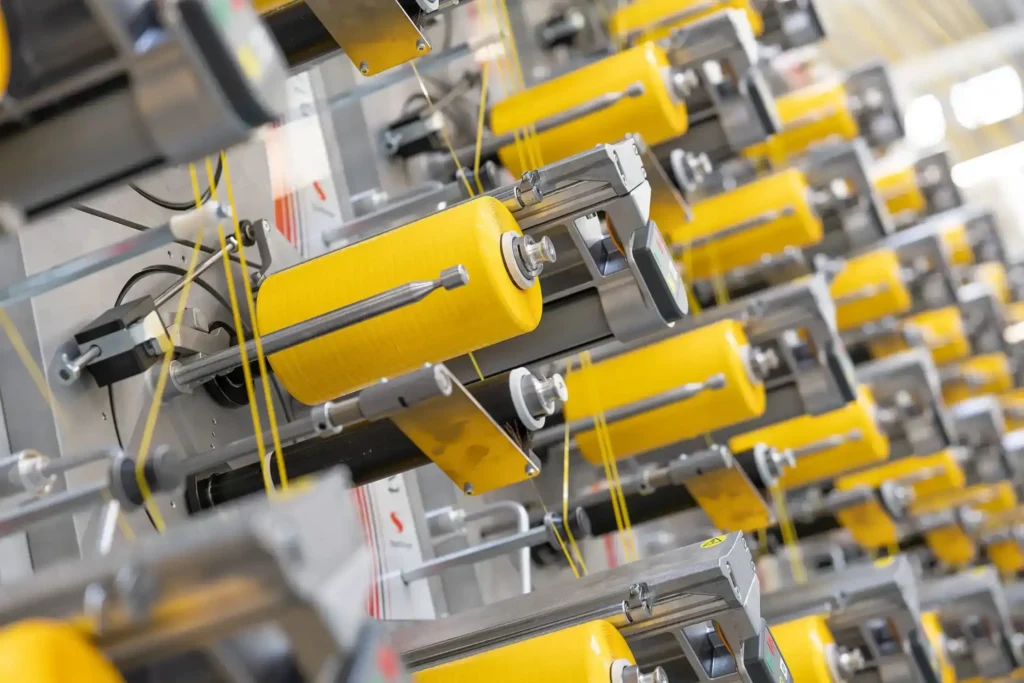
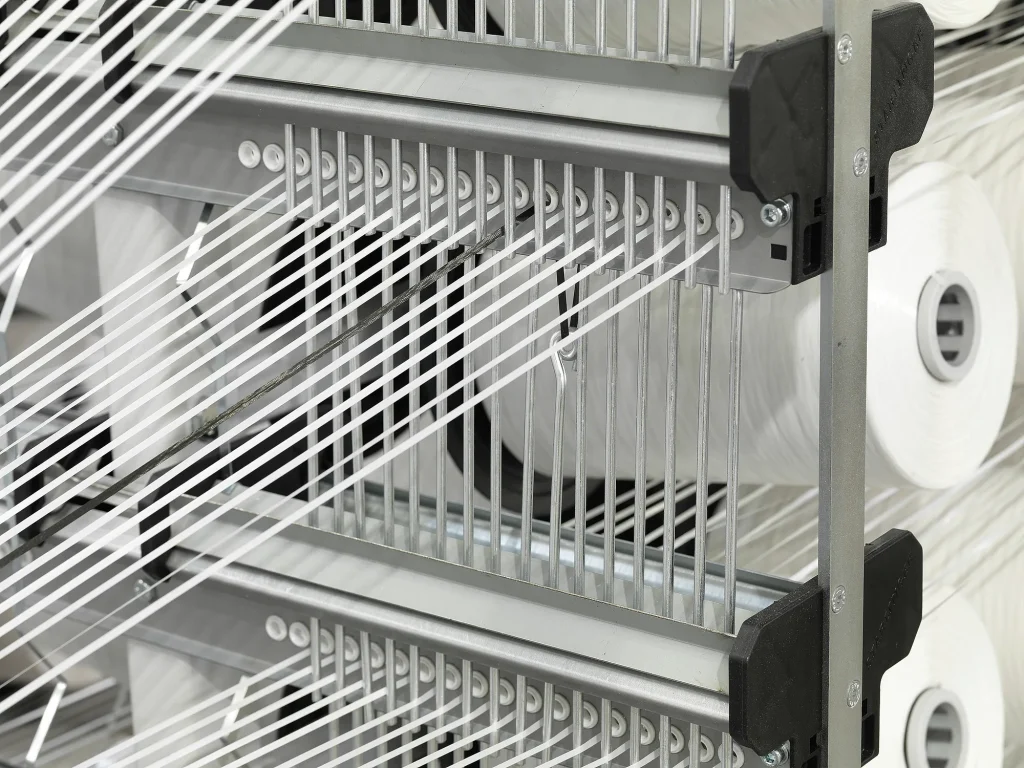
Oriented raffia tapes—extruded, slit, and drawn—are woven on circular or flat looms into tubular or flat fabric. Typical basis weights span 85–150 gsm for construction‑class sacks, increasing for sharp or heavy aggregates. High tensile‑to‑weight ratios, tongue‑tear resistance, and abrasion endurance make the fabric the core safety margin.
- Design knobs: GSM, ends‑per‑inch (EPI), picks‑per‑inch (PPI), UV packages (HALS/UVA)
- Failure onset: seam transitions and folds rather than in‑panel rupture—hence seam architecture is critical
Polyolefin coatings on the inner face—PP, PE, or blends—create a controllable seal window and increase dust‑tightness. Functional tie resins ensure that dissimilar layers stay bonded, especially through creased, heat‑affected zones.
- Parameters: coat weight (20–40 g/m²), seal initiation temperature, hot‑tack plateau
- Quality risks: curl from unbalanced nip/chill; peel loss at creases if tie resin under‑spec
When branding matters, a BOPP film laminated to the fabric’s exterior offers high‑fidelity graphics, scuff resistance, and controlled surface friction. Reverse printing protects inks beneath the film skin.
- Design knobs: film gauge (15–35 μm), matte–gloss contrast, over‑lacquer zones
- COF tuning: keep outer dynamic COF in a pallet‑safe band (often 0.25–0.40)
High‑speed filling traps air; vent corridors and micro‑perfs release it without losing fines. Perf diameter, density, and placement are aligned with powder rheology.
- Typical diameters: 80–200 μm; density 10–60 per cm² in localized corridors
- QA: airflow benches and fluorescent‑powder vibration tests to verify dust retention
Feature set: what heat‑sealed woven bags actually deliver
Web flatness, controlled COF, and predictable seal windows let heat‑sealed woven bags run on FFS assets with film‑like cadence while keeping the robustness of woven cores.
Compared with monolayer films at the same mass, woven PP resists puncture, edge rub, and drop impacts, cutting splits and in‑transit leaks.
Coatings and seals reduce sifting; venting evacuates fill air without aerosolizing fines. Plants stay cleaner; pallets stay presentable.
Tuned outer COF and tight dimensional control create square stacks that travel well, allowing wrap reduction targets without compromising safety.
With BOPP faces, artwork remains legible after warehouse handling; matte–gloss contrasts help SKU differentiation under LED glare.
Polyolefin‑only stacks simplify sorting; fewer rejects and reduced wrap lower embodied polymer per tonne delivered.
Process discipline: from resin to pallet, how performance is earned
Resin MFI, moisture, and color indices; film gauge and dyne levels; coating MI and seal curves; ink viscosity and ΔE; additive loadings for slip and antistatic—all are validated lot‑wise before bulk conversion. Early certainty is cheaper than late heroics.
Conversion steps are stabilized by high‑repeatability equipment pedigrees for woven PP: tape extrusion and orientation, circular/flat weaving, extrusion coating/lamination, precision printing, controlled micro‑perforation, and careful slitting/gusseting. This equipment reduces noise in the data and makes corrective actions simpler to identify and enforce.
For the inner seal layer, the key is to map seal initiation and hot‑tack plateaus against the FFS jaw settings. A robust program saves operators from running at razor‑thin setpoints that drift with ambient humidity.
Perf corridors are placed behind gussets or within double‑skinned regions so that air finds an exit while fines face a tortuous path. Air leaves quickly; powder stays home.
Applications: where heat‑sealed woven bags shine
Construction materials define the native habitat for heat‑sealed woven bags: cement, dry mortar, gypsum, tile adhesives, sands and fine aggregates, lime, and mineral fillers. Outside of construction, fertilizers and de‑icing salts benefit from the same hybrid of speed plus ruggedness.
| Product | Priority risks | Design preferences |
|---|---|---|
| OPC & blended cements | Ballooning during fill; pallet stability; UV exposure | Localized perf corridors; robust fin seals; UV‑stabilized outer; outer COF ~0.30–0.38 |
| Dry mortar & tile adhesive | Fine dust, leak paths at gusset roots; rub scuff in retail | Concealed venting; matte faces; selective over‑lacquers; double seals |
| Gypsum & plaster | Dusting; easy peel under low RH if seals are marginal | Smooth seals; broader hot‑tack plateaus; consistent crease memory |
| Sand & fine aggregates | Edge rub; puncture at corners; pallet slip | Heavier fabric; textured outer; higher COF; corner protectors |
Quality assurance: translating risks into measurable tests
- Standards‑aligned testing: tensile, tear, puncture, COF, seal peel/burst, drop/vibration/stack compression; color ΔE and rub resistance for printed faces.
- 100% virgin raw materials in primary load paths; recycled content, if used, restricted to non‑critical layers with transparent declarations.
- Best‑in‑class equipment pedigrees for woven PP conversion and film/printing to compress process variability.
- Closed‑loop QA: incoming verification → in‑process SPC → end‑of‑line audits with CAPA linked to lot codes and retention samples.
Comparative reasoning: when to choose BOPP woven bags, when to prefer plain film, when to stay with paper
Packaging selection is context‑dependent. For abrasion and yard exposure, laminated PP woven bags usually outperform paper valve sacks. For extremely high sealing throughput with low puncture risk, plain PE FFS may win on simplicity. When shelf branding matters, BOPP woven bags provide print gloss and rub durability that plain fabric lacks. The right answer is the design that meets risks with the leanest architecture, not the design that merely looks modern.
- Pros: breathability; mature recovery streams in many regions
- Cons: wet weakness; scuff; strength loss when abraded
- Pros: fast seals; simple mono‑material; good moisture control
- Cons: lower puncture and tear margin at equal mass
- Pros: toughness; brand‑grade print; yard durability
- Cons: more complex composite; requires tight lamination control
For an extended engineering look at oriented‑film‑faced woven constructions, consult this internal resource on performance principles: performance playbook for heat‑sealed woven bags.
Risk‑to‑spec translation: an RFQ template grounded in measurable outcomes
- “No scuff at retail” becomes rub cycles at fixed load and a maximum ΔE drift.
- “No pallet leaning” becomes outer dynamic COF windows, corner protection spec, and a wrap tension SOP.
- “No dust trails” becomes perf geometry plus a pass/fail threshold for fluorescing powder after vibration.
- “Stronger seals” becomes peel/burst targets for both flat and creased zones across an ambient humidity range.
Failure modes and practical fixes (field guide)
| Symptom | Likely cause | Corrective |
|---|---|---|
| Ballooning during fill | Perf density too low or misplaced; de‑aeration pad misaligned | Add corridors behind gussets; align pad; verify airflow bench results |
| Seal peel weak at fin seam | Inner coat under‑spec; dwell too short; geometry uneven | Re‑tune seal curve; increase dwell/pressure; standardize fin geometry |
| Delamination at folds | Tie resin mismatch; overheated laminate | Rebalance nip/chill; audit crease‑zone peel and haze |
| Pallet slippage | Outer COF drift; wrap variance | Raise COF; standardize wrap SOP; add corner protection |
| Dust trails at gusset roots | Leak paths from poor crease memory or perf proximity | Refine crease tooling; move perfs; consider narrow inner seam tape |
| Winter brittleness | Hot‑tack margin inadequate at low RH | Adjust formulation; run slightly hotter/longer dwell; pre‑condition rolls |
Engineering deepening: mechanics, sealing physics, and surface science
Three technical levers largely determine outcomes for heat‑sealed woven bags: (1) bulging mechanics of filled sacks; (2) thermodynamics of seal formation; and (3) tribology of surfaces in motion.
Hoop stresses drive lateral bulging; seams see concentrated loads. Gusset geometry and, where used, baffle concepts can reclaim cubic alignment. The goal is a rectangular footprint at rest without over‑mass.
Seal initiation must occur at a temperature where the inner layer flows to wet the interface; hot‑tack must persist long enough for the freshly closed seam to bear tension while cooling. Mapping the safe plateau prevents both cold seals and burn‑through thinned seams.
The coefficient of friction governs both machinability and pallet stability. Too slick and pallets skate; too sticky and chutes jam. COF tuning is the unglamorous but decisive control knob that determines wrap usage and reject rates.
Sustainability: fewer grams, fewer rejects, fewer wraps
A practical sustainability path favors data over slogans: polyolefin‑only stacks for sortability, downgauging with guardrails (hold drop/stack tests while trimming GSM), and scrap minimization through steadier machinability. Publish grams of polymer per tonne delivered by SKU and trend it downward as control charts tighten.
| Lever | Metric | Typical outcome |
|---|---|---|
| COF tuning for pallet stability | kg of wrap per pallet | 20–40% reduction with equal or better stability |
| Downgauging with guardrails | g/bag vs. baseline at constant drop/stack | 5–12% mass saving without performance loss |
| Scrap minimization | rejects per 1,000 bags | Sub‑AQL escapes; cleaner aisles; faster changeovers |
Worked scenarios: complaint → root cause → corrective → outcome
Finding: outer COF drifted 0.33 → 0.22; gusset crease memory inconsistent. Fix: restore COF band; retrain crease bar settings; add corner protectors. Outcome: lean events −70%; wrap usage −25% with improved stability.
Finding: perf pattern close to fin seam; seals over‑hot and thinned. Fix: move perfs behind gussets; lower jaw temperature, lengthen dwell; selective over‑lacquer at rub zones. Outcome: leak complaints below AQL.
Finding: single‑line seal with marginal hot‑tack. Fix: double‑seal geometry with staggered jaws; modified inner seal layer. Outcome: field openings near zero; line speed intact.
Frequently asked questions for cross‑functional teams
Are heat‑sealed woven bags waterproof? They are splash‑resistant; continuous coatings and well‑tuned seals minimize ingress. For long‑term moisture control, liners remain the reliable solution.
Can we heat‑seal every format? Outer laminated faces do not seal to woven cores; inner coatings or liners carry the seal. Valve sacks and block‑bottom designs may still be sewn depending on the application.
Are they food‑safe? With appropriate films, inks, and cleanliness controls, yes; always match documentation to jurisdictional requirements.
Is static a hazard? Mostly a housekeeping and ergonomics issue for construction powders; in true combustible‑dust contexts, use antistatic pathways and document grounding at fillers.
- Scope, intent, and key terms for heat‑sealable woven packaging
- What are heat‑sealed woven bags? Terms, long‑tail aliases, and the family tree
- Material stack: resins, films, coatings, and why each layer exists
- Feature set: what heat‑sealed woven bags actually deliver
- Process discipline: from resin to pallet, how performance is earned
- Applications: where heat‑sealed woven bags shine
- Quality assurance: translating risks into measurable tests
- Comparative reasoning: when to choose BOPP woven bags, when to prefer plain film, when to stay with paper
- Risk‑to‑spec translation: an RFQ template grounded in measurable outcomes
- Failure modes and practical fixes (field guide)
- Engineering deepening: mechanics, sealing physics, and surface science
- Sustainability: fewer grams, fewer rejects, fewer wraps
- Worked scenarios: complaint → root cause → corrective → outcome
- Frequently asked questions for cross‑functional teams
- Opening Dialogue: Addressing Key Client Questions
- 1. BOPP Woven Bags: Core Features and Market Applications
- 2. Advanced Manufacturing: Precision Meets Sustainability
- 3. Warehousing and Logistics: Ensuring Quality from Factory to Site
- 4. Customization for Global Branding and Compliance
- 5. Sustainability and Cost Efficiency
- FAQs: Addressing Procurement Concerns
- References
Opening Dialogue: Addressing Key Client Questions
Client: “We need packaging that combines durability with high-quality branding for global distribution. How do Printed BOPP woven bags ensure both functionality and aesthetic appeal in demanding environments?”
VidePak Specialist: “BOPP woven bags deliver unmatched tensile strength (up to 2,500 N/cm²) and vibrant, fade-resistant prints, ideal for industries ranging from agriculture to chemicals. At VidePak, our 200MT hydraulic presses compress packaging by 30%, maximizing container space, while ISO-certified warehouses maintain 25°C/60% RH conditions to preserve material integrity. Combined with Starlinger’s precision weaving and 8-color digital printing, we ensure your brand stands out—globally. Let’s unpack how we tailor solutions to your logistics and branding needs.”
1. BOPP Woven Bags: Core Features and Market Applications
Biaxially Oriented Polypropylene (BOPP) woven bags are engineered for high tensile strength, moisture resistance, and customizable branding. Their laminated structure enhances durability while allowing vibrant, long-lasting prints—critical for industries requiring both protection and visual impact.
Key Applications
- Agriculture: UV-resistant bags for fertilizers, withstanding 50 kg loads and tropical climates.
- Chemicals: Anti-static coatings and HDPE liners prevent leakage, compliant with OSHA 1910.178(c).
- Retail: Custom-printed designs for branded grain or pet food packaging, enhancing shelf appeal.
Table 1: VidePak BOPP Woven Bag Specifications
| Parameter | Standard BOPP | Heavy-Duty BOPP | EcoGuard BOPP |
|---|---|---|---|
| Material Thickness | 80–120 GSM | 120–150 GSM | 100% Recycled PP |
| Load Capacity | 25–40 kg | 40–60 kg | 20–35 kg |
| Printing Colors | 4–6 Flexographic | 8 Digital | 6 Eco-Solvent |
| Compliance | ISO 9001, ASTM D5638 | UN Certification | EU REACH, FSC |
2. Advanced Manufacturing: Precision Meets Sustainability
VidePak’s production integrates cutting-edge technology and eco-conscious practices to meet global standards.
Starlinger Weaving Technology
- Circular Looms: 100+ Starlinger machines weave PP fabric at 12×12 threads/cm² (±3%), ensuring uniform strength and tear resistance exceeding ASTM D5265 benchmarks.
- Extrusion Lines: 16 lines extrude virgin PP at 230–250°C (±2°C), optimizing polymer alignment for 30% higher puncture resistance than industry averages.
Sustainable Practices
- Solar-Powered Production: A 2MW rooftop solar system covers 70% of energy needs, reducing CO₂ emissions by 1,200 tons annually.
- Recycled Materials: 30% post-industrial PP reused in EcoGuard bags, certified by SGS and EU REACH.
3. Warehousing and Logistics: Ensuring Quality from Factory to Site
Proper storage and packaging are critical to maintaining bag integrity and maximizing shipping efficiency.
Climate-Controlled Warehousing
- 25°C/60% RH Conditions: Prevent PP degradation and moisture absorption, critical for hygroscopic materials like fertilizers.
- Case Study: A Brazilian client reduced spoilage by 22% using VidePak’s humidity-controlled storage for rice packaging.
200MT Hydraulic Press Optimization
- Compression Efficiency: Reduces bag volume by 30%, enabling 40% more units per container.
- Load Stability: Pressed stacks withstand 10,000+ transport cycles (tested per ASTM D4169).
4. Customization for Global Branding and Compliance
VidePak’s modular design approach addresses niche requirements across industries:
Tailored Solutions
- Multi-Language Printing: QR codes and hazard symbols printed in compliance with EU CLP and US OSHA standards.
- Reinforced Stress Points: Double-stitched seams and corner guards for 50 kg cement bags, tested under ISO 2206.
- Anti-Counterfeit Features: Holographic prints and RFID tags for pharmaceuticals, aligning with WHO guidelines.
Global Regulatory Alignment
- EU EN 13432: Compostable liners for organic product packaging.
- Japan JIS Z 2801: Antimicrobial coatings for food-grade bags.
5. Sustainability and Cost Efficiency
VidePak’s green initiatives reduce both environmental impact and operational costs:
- Zero-Waste Production: 98% PP scrap recycled into new bags.
- Energy Rebates: Surplus solar energy sold to the grid, offsetting 15% of manufacturing costs.
FAQs: Addressing Procurement Concerns
Q1: How long does custom printing take?
A: 12–18 days for orders up to 500,000 units, using 30+ printing machines.
Q2: Can bags withstand maritime humidity?
A: Yes. Our MarineShield Series features PE lamination and desiccant pockets, tested under ISO 2233.
Q3: Are recycled BOPP bags as durable as virgin PP?
A: EcoGuard bags retain 90% tensile strength, certified by independent labs for 25 kg loads.
References
- VidePak Company Profile. https://www.pp-wovenbags.com/.
- International Standards: ASTM D5265, EU REACH, ISO 9001.
- Email: info@pp-wovenbags.com
External Links
- Discover our innovations in custom-printed BOPP solutions.
- Explore BOPP lamination techniques.
VidePak: Where Durability Meets Design, Delivered Sustainably.