# FIBC Bags: A Systems Playbook for Sustainable and Customized Bulk Packaging (2025–2030)
> This long-form guide synthesizes engineering practice, supply‑chain economics, and sustainability science to help you specify, source, and operate **FIBC Bags** at scale. It expands the themes of innovation and customization with concrete parameters, test methods, risk controls, and implementation templates.
—
## What Are FIBC Bags? (Definition, Aliases, Scope)
**FIBC Bags**—short for Flexible Intermediate Bulk Containers—are industrial packaging containers made of woven polypropylene that safely carry bulk materials (typically 500–2,000 kg per unit) through filling, handling, transport, and discharge. They fold flat when empty, form stable cubes when filled, and accept a wide range of closures, liners, static‑control pathways, and lifting configurations.
In procurement and operations, the same platform appears under several names. For clarity, we enumerate the most common aliases and keep them consistent across documentation:
1. **Bulk Bags**
2. **Jumbo Bags**
3. **Ton Bags**
4. **FIBC Jumbo Bags**
5. **Big Bags**
6. **PP Woven FIBC**
7. **Q‑Bags (Baffled FIBC)** for form‑stable variants
8. **Ventilated FIBC** for breathable agricultural use
9. **Food‑Grade FIBC Bags** for hygienic, migration‑controlled builds
10. **UN‑Approved FIBC** for hazardous goods
11. **Type A/B/C/D FIBC** for static electricity control categories
Throughout this article, **FIBC Bags** is the canonical term; we use the other names as context‑specific synonyms.
—
## The Materials of FIBC Bags (Constituents, Properties, Cost Logic)
A credible **FIBC Bags** program begins with a disciplined bill of materials. Each gram must justify its function under drop, lift, clamp, vibration, and humidity cycles. Here is the materials stack and where it lives:
### 1) PP Woven Fabric (Structural Web)
The substrate is woven from slit‑film polypropylene tapes extruded, slit, and oriented to align polymer chains. Typical fabric weights for **FIBC Bags** range from 140–230 g/m² for general duty, with higher GSM for UN or multi‑trip builds. Tape denier and weave density (picks per inch) are tuned to Safe Working Load (SWL) and Safety Factor (SF) targets.
Key properties and rationale:
* High specific strength: oriented PP delivers tensile and tear performance per gram.
* Hydrophobic and chemically inert: suitable for fertilizers, salts, pigments, and many food ingredients.
* Thermoformability: compatible with extrusion coating and heat‑cut edges to reduce fray.
* Cost stability: PP resin tracks olefin indexes and remains competitive against engineered polymers.
Where it lives: body panels (tubular or flat), baffles (for Q‑bags), reinforcement tapes, and dust‑proof strips.
### 2) Extrusion Coating or Lamination (Optional Barrier)
Many **FIBC Bags** use PP extrusion coating (e.g., 20–35 g/m²) to improve dust retention and moisture resistance. Full film lamination is less common than in small woven sacks but appears in specialty retail or moisture‑sensitive applications. Coat weights and nip pressure define bond strength; matte finishes help friction and stacking.
### 3) Inner Liners (LDPE/LLDPE/Co‑ex)
For powders or hygroscopic contents, a **liner**—loose, tab‑fixed, or glued—provides the main WVTR/OTR barrier and product cleanliness. Typical gauges: 60–120 μm for LDPE/LLDPE; co‑extruded liners introduce tie layers, antistatic agents, or EVOH (rare in mono‑material programs). Liner formats include tubular, form‑fit (for Q‑bags), and baffle‑compatible liners.
### 4) Lifting Systems (Loops and Webbing)
**FIBC Bags** are defined as much by the loop system as by the fabric. Options include 4‑loop (most common), 2‑loop, single‑loop, cross‑corner, and tunnel‑lift styles. Webbing is typically multifilament PP, stitched with high‑tenacity thread to specified pull strengths and stitch densities. Loop height and angle govern fork engagement and crane rigging clearances.
### 5) Closures, Spouts, and Accessories
* **Top options**: open‑top, skirt (duffle), filling spout (standard 35–50 cm), conical top for low‑bulk‑density products.
* **Bottom options**: plain, discharge spout with star‑closure, conical discharge for poor‑flow powders, safety tie‑ups, and dust‑proof flap.
* **Seam finishes**: safety stitched, over‑locked, chain stitch with filler cords for sift‑proofing.
* **Add‑ons**: document pockets, label windows, liners tabs, tamper seals, and color coding.
### 6) Static‑Control Packages (A/B/C/D)
When flammable powders or explosive atmospheres are present, **FIBC Bags** selection must follow IEC/ISO static control rules.
* **Type A**: no static features; only for non‑flammable products in non‑hazardous environments.
* **Type B**: low breakdown voltage fabric to prevent propagating brush discharges (PBD); still requires no flammable atmosphere.
* **Type C**: conductive grids requiring grounded connections; safest where reliable grounding is enforced.
* **Type D**: static dissipative fabrics (e.g., corona discharge yarns) that neutralize charges without grounding leads.
### 7) UV Packages, Pigments, and Functional Masterbatches
Outdoor storage demands UV stabilization of fabric and webbing (e.g., 200–300 kLy exposure targets). Pigments and whites control opacity and brand colors; antistatic and slip agents tune handling. In lightweight programs, virgin PP is favored to minimize variability, while recycled PP (rPP) can be mass‑balanced or mechanically blended with strict caps for critical components.
—
## What Are the Features of FIBC Bags? (Performance, Handling, Brandability)
To earn their keep, **FIBC Bags** must deliver in real operations, not just catalog data. The core features and why they matter:
* **High SWL with tested Safety Factor**: Common SWL bands are 500, 1,000, 1,250, and 2,000 kg. Single‑trip bags target SF 5:1; multi‑trip designs SF 6:1. UN builds may require specific test regimens.
* **Form stability**: Q‑bag baffles maintain cubic geometry, increase pallet density, reduce leaning, and protect warehouse aisles.
* **Operational friendliness**: 4‑loop designs enable effortless forklift or crane handling; tunnel‑lift supports single‑operator workflows.
* **Moisture and dust control**: extrusion coating and liners keep powders inside and humidity outside; sift‑proof seams protect filling rooms and customers.
* **Customization headroom**: geometry, spouts, printing, barcodes/QRs, RFID, and color coding adapt to SKUs and plants.
* **ESD safety**: selection by Type A/B/C/D locks in safe handling for flammable powders or atmospheres.
* **Hygienic builds**: food and pharma grades feature controlled particulates, migration limits, metal detection/optical inspection, and cleanroom finishing where specified.
* **Sustainability levers**: mono‑polyolefin systems, grams removed in fabric/webbing, recycled content in non‑critical layers, reuse cycles where regulated, and documented end‑of‑life pathways.
A useful heuristic: pallet‑level behavior trumps single‑bag metrics. If form‑stability and face stiffness allow just one extra pallet layer without deformation or returns, field performance—and total landed cost—improve materially.
—
## What Is the Production Process of FIBC Bags? (Front‑End Gatekeeping → Unit Operations → Quality Release)
**FIBC Bags** performance is produced, not improvised. VidePak secures capability and traceability at each station, operating critical assets from Austria’s Starlinger and Germany’s W&H to stabilize outcomes. The process divides into three arcs:
### A. Front‑End: Raw Material Selection and Incoming Testing
1. Supplier qualification: Approved lists for PP resin, films, masterbatch, and webbing yarns with audited specs and compliance files.
2. Identity and CoA checks: Melt flow rate, density, moisture, ash; coating gauge maps; UV package identification; liner gauge and gel specs.
3. Lab gate tests: DSC fingerprints on PP, tensile bars (ASTM proxies), oven moisture for hygroscopic inputs, color drawdowns for Delta‑E targets.
4. Cleanliness regime: For food/pharma builds—bioburden checks, ATP or particle counts, and allergen segregation documentation.
### B. Core Manufacturing Flow (Station‑by‑Station)
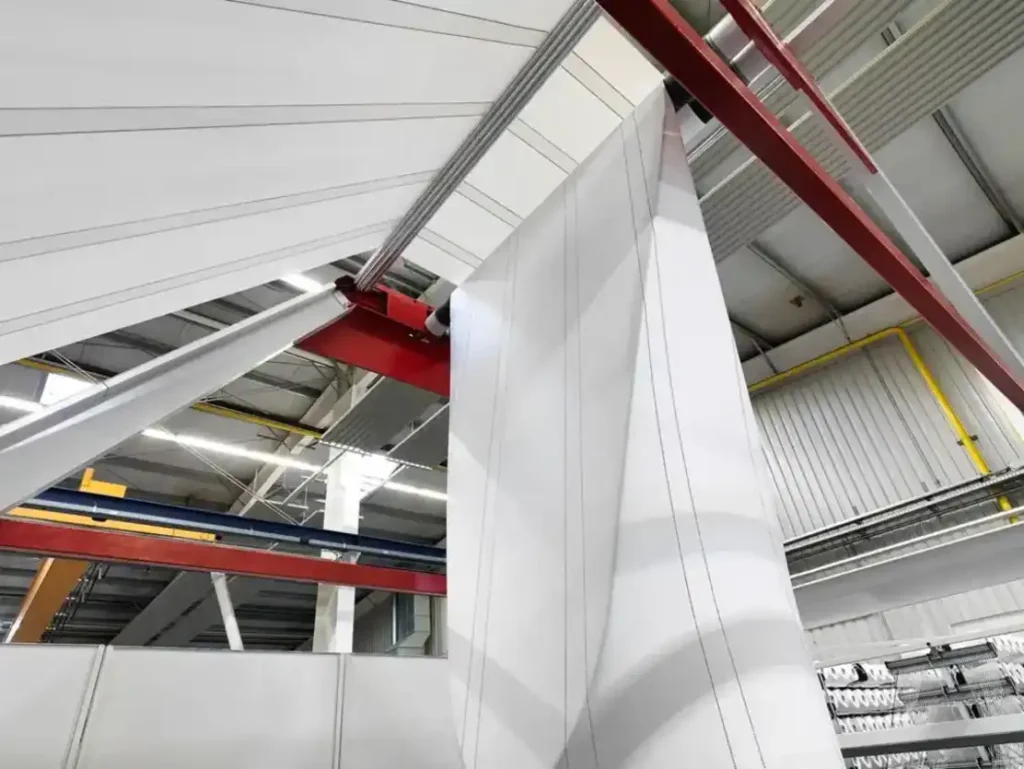
1. **Tape extrusion & orientation (Starlinger)**: pellets → sheet → slit tapes → reheated → drawn. Control denier, draw ratio, shrink, and crystallinity; verify tensile and elongation inline.
2. **Weaving (circular/flat looms)**: set PPI and loom tension to protect flatness and seamability; avoid over‑tension that thins tapes and weakens corners.
3. **Coating/lamination (Starlinger/W&H)**: extrusion coat PP to achieve dust and moisture goals; pick matte for friction or gloss for print pop.
4. **Printing (gravure/flexo)**: high registration, low VOC or solventless inks where possible; barcode/QR squares must scan after abrasion.
5. **Cutting & forming**: cut panels or tubular bodies; add baffles for Q‑bags; reinforce lift points; heat‑cut edges to reduce fray.
6. **Liner conversion & insertion**: tubular or form‑fit liners made on co‑ex lines; tab‑fix or glue; optional heat‑seal to dust‑proof seams.
7. **Sewing & closure systems**: loop attachment with stitch density and thread spec controls; bottom spouts with star‑closure; skirt/duffle top hems; safety ties and dust flaps.
8. **Converting & palletizing**: count, stack, and wrap with controlled compression; avoid set‑creases that disturb forming.
### C. Back‑End: Quality Control, Release, and Traceability
* **Dimensional and mass checks**: cut sizes, loop heights, baffle spacing, GSM, coat weights.
* **Mechanical tests**: top‑lift, cyclic fatigue (e.g., 30 cycles at SWL), topple, drop, and stack/edge‑crush proxies.
* **ESD tests**: surface resistivity for Type C/D; continuity of ground paths (Type C); charge decay times.
* **Hygiene & barrier**: WVTR, pinhole scans, particle counts for food/pharma, odor/VOC limits for pet food.
* **Traceability**: lot coding from resin silo to wrap; retains held to match shelf‑life; digital route cards capture machine/shift.
> Equipment note: best‑in‑class Starlinger (extrusion, weaving, coating) and W&H (coating/printing) platforms hold narrow process windows that are essential for lightweighting and static safety. Spares, service networks, and recipe repeatability translate directly into stable field performance.
—
## What Is the Application of FIBC Bags? (Use‑Cases by Industry and Product)
**FIBC Bags** operate wherever bulk density, moisture sensitivity, static risk, or hygiene targets define packaging choice. Representative verticals and configuration heuristics:
* **Agriculture & Food Ingredients**: grains, pulses, rice, sugar, flour, starch, additives. Favor food‑grade builds with liners; consider Q‑bags for warehouse density; ventilated FIBC for potatoes/onions.
* **Pet Food**: mid‑to‑large formats (15–1,000 kg) needing aroma control and shelf graphics; use matte finishes, food‑contact liners, and dust‑proof seams.
* **Chemicals & Polymers**: resins, masterbatch, salts; specify Type C or D for flammable powders or ATEX zones; use form‑fit liners for humidity and cleanliness.
* **Construction & Minerals**: cement, gypsum, sand, aggregates; heavy‑duty fabrics, discharge spouts, and abrasion‑resistant seams; Q‑bags for cube efficiency.
* **Mining & Metal Concentrates**: high density, sharp‑edged materials; edge reinforcements, abrasion‑resistant webbing, and UN builds as required.
* **Waste & Recycling**: rubble, scrap, hazardous waste; color coding, barcode tracking, and reinforced dump loops; UN or special permit builds.
Format shorthand:
* **4‑loop general duty** for most plants.
* **Q‑bag (baffled)** where pallet density or container cube rules economics.
* **Single‑loop/two‑loop** for high‑volume, low‑touch operations.
* **Ventilated** for respiration; **coated + liner** for moisture/dust control.
* **UN certified** for dangerous goods; **Type C/D** for ESD safety.
—
## How VidePak Controls and Guarantees the Quality (Four Pillars)
1. **Standards‑aligned production & testing**: SOPs reference international frameworks (e.g., ISO 21898 for FIBC, IEC 61340‑4‑4 for ESD, UN Recommendations for dangerous goods, ISO 22000/BRCGS for food‑grade). Acceptance criteria track tensile, top‑lift, cyclic, drop, topple, WVTR, particulate counts, and scan reliability.
2. **Virgin, tier‑one raw materials**: 100% virgin PP for critical load paths (fabric, webbing, threads) unless otherwise specified; vetted films and liners; masterbatches with stable thermal fingerprints. Upstream variance is the enemy of downstream control.
3. **Best‑in‑class equipment**: All critical steps run on Starlinger and W&H platforms—chosen for process capability, global service, and recipe repeatability—so grams removed do not reappear as returns.
4. **Layered inspection & traceability**: Incoming → in‑process → final; lot retains; digital route cards; machine/shift lineage. Deviations can be ring‑fenced to protect customers and brands.
—
## Extending the Theme: Sustainability and Customization (2025 Outlook)
Innovation in **FIBC Bags** is converging on two axes—environmental performance and precision fit. The following vectors are reshaping specs and contracts:
### A. Sustainability Vectors
* **Recycled polypropylene (rPP)**: mechanical blends in non‑critical layers (liners, baffles) and mass‑balance approaches for critical paths. Requires robust melt‑flow control, filtration, and odor management.
* **Design for disassembly**: mono‑material PP architectures, liner detachment tabs, and minimal incompatible pigments.
* **Energy & emissions**: PV‑powered plants, heat‑recovery on extruders, low‑VOC inks, solventless coatings; process KPIs stated as kWh/1,000 bags and kg CO₂e/bag.
* **Reuse programs**: defined cycle counts with inspection gates; wash and dry SOPs; visual and RFID status flags.
* **Material passports**: QR‑linked specs documenting resin, additives, and testing; unlock closed‑loop collection.
### B. Customization Vectors
* **Geometry**: from 45 × 60 cm small formats to 120 × 180 cm large cubes; baffle spacing to ±5 mm for form stability.
* **Spouts**: fast‑fill designs, dust socks, air‑evac ports; bottom star‑closures to limit sifting.
* **Static control**: recipe choices between Type C (grounded) and Type D (dissipative) by site capability.
* **Smart packaging**: barcodes/QR for WMS; RFID for closed‑loop pool management; optional weight sensors in loops for crane feedback.
* **Brand & retail**: matte faces, high‑definition print, transparent windows for premium SKUs.
The governance rule: every customization must be tied to a measurable operational outcome—fill rate, damage rate, pallet density, scan reliability, or audit speed.
—
## System Thinking: From Sub‑Problems to an Integrated Solution
Lightweight yet strong; customizable yet standardizable; recyclable yet safe—these are not contradictions but constraints. Break the challenge into sub‑problems and pair each with a solution pattern; then synthesize.
### Sub‑Problem A: Reduce Fabric Mass Without Sacrificing Safety
* **Risk**: seam pulls, top‑lift failures, or lean.
* **Pattern**: increase tape orientation, select baffles for form stability, tighten stitch specs, and adopt coatings only where the bag’s duty cycle demands. Validate by cyclic tests at SWL and edge‑crush proxies at the pallet level.
### Sub‑Problem B: Control Moisture for Hygroscopic Powders
* **Risk**: caking, hydration (cement), or microbial growth (food).
* **Pattern**: coated fabric + liner gauges tuned to WVTR targets; pinhole AQL; heat‑seals on liner spouts; humidity cycling in validation.
### Sub‑Problem C: Manage Static Energy
* **Risk**: brush or propagating discharges near flammable atmospheres.
* **Pattern**: choose Type C or D **FIBC Bags** by plant discipline; enforce grounding checks (Type C) or decay tests (Type D); log ESD audits.
### Sub‑Problem D: Preserve Speed and Cleanliness on Fillers
* **Risk**: flutter, dusting, spillage.
* **Pattern**: specify skirt/duffle tops, optimized spout diameters, and dust socks; add face stiffness through coating; run plant‑site rate trials.
### Sub‑Problem E: Enable Closed‑Loop Reuse and Recycling
* **Risk**: cross‑contamination, traceability gaps, or low return rates.
* **Pattern**: QR/RFID for custody; wash/dry SOPs; inspection gates; mono‑material design with easy liner removal; take‑back incentives.
**Synthesis**: the integrated solution is a constraint‑based optimum where grams, SWL, ESD class, WVTR, and pallet behavior meet cost and ESG targets. This is engineered—never accidental.
—
## Technical Tables (Illustrative Spec Windows)
> Values below are common practice ranges; always confirm against local regulations, product hazards, and filler/warehouse constraints.
### Table 1 — Core Bill of Materials
| Component | Typical Spec Window | Contribution | Notes |
| ———————————- | —————————– | ———————————— | ——————————– |
| PP woven fabric | 140–230 g/m²; 10×10–14×14 PPI | Tensile/tear; form stability | Virgin PP favored for load paths |
| PP extrusion coating | 20–35 g/m² | Dust/WVTR control; face stiffness | Matte vs. gloss for friction |
| Liner (LDPE/LLDPE) | 60–120 μm | Moisture/oxygen barrier; cleanliness | Form‑fit for Q‑bags |
| Webbing & loops | Rated to SF targets | Safe lifting and handling | Multifilament PP |
| Threads & filler cords | Per stitch spec | Sift‑proof seams | Food‑grade options |
| Additives (UV, antistat, pigments) | Per TDS | Outdoor, safety, color | Respect thermal windows |
### Table 2 — Geometry & Handling
| Parameter | Options | Operational Impact |
| ——— | —————————————— | —————————— |
| Bag body | Tubular, 4‑panel, Q‑bag (baffled) | Cube efficiency; lean control |
| Loops | 4‑loop, 2‑loop, single‑loop, tunnel‑lift | Rigging options; labor savings |
| Tops | Open, skirt/duffle, filling spout, conical | Fill cleanliness & speed |
| Bottoms | Plain, discharge spout, conical | Emptying control; dust |
| Liner | Loose, tab‑fixed, glued, form‑fit | WVTR targets; hygiene |
### Table 3 — Performance & Testing
| Test | Target Window (Illustrative) | Why It Matters |
| —————– | ——————————————————- | ———————— |
| SWL/SF | 500–2,000 kg @ SF 5:1 (single‑trip) or 6:1 (multi‑trip) | Safe lifting and reuse |
| Top‑lift (static) | Safety factor proof loads | Infrastructure safety |
| Cyclic fatigue | 30 cycles at SWL with no failure | Real handling simulation |
| Drop/topple | Height per spec; no rupture | Transport shocks |
| WVTR/OTR | By content (cement vs. sugar) | Caking & quality |
| ESD | IEC class tests for A/B/C/D | Ignition prevention |
| Hygiene | Particle counts; migration limits | Food/pharma compliance |
### Table 4 — Application Fit Matrix
| Product | Recommended Format | Barrier Setup | Notes |
| —————— | ———————— | ————————— | ————————— |
| Flour, sugar, rice | Q‑bag + food liner | 70–100 μm food‑grade liner | Barcode legibility critical |
| Fertilizer & seeds | Coated + liner (outdoor) | UV package; optional liner | Ventilated for produce |
| Cement & gypsum | Coated; discharge spout | Liner for hydration control | Abrasion‑resistant seams |
| Polymer resins | Type C/D; spout | Antistatic liner | Cleanroom options |
| Waste & recycling | Heavy‑duty; color coded | Optional UN builds | RFID tracking helpful |
—
## Engineering Economics (COGS, Freight, Damage, ESG)
* **Resin & fabric**: grams dominate cost; a 10 g reduction across 100,000 units removes a metric ton of PP—significant for COGS and Scope 3.
* **Freight & storage**: form‑stable Q‑bags pack denser and reduce returns; one extra pallet layer often repays coating costs many times.
* **Damage & returns**: the worst lightweight program saves pennies and pays dollars in claims. Discipline is to validate at the pallet level, not only in the lab.
* **ESG clarity**: declare kWh/1,000 bags, % rPP in non‑critical layers, and closed‑loop capture rates; publish material passports via QR.
A working rule: total landed cost = (materials + conversion + freight + expected damage + compliance). Each customization should lower this function or raise its robustness.
—
## Risk & Troubleshooting Playbook
| Symptom | Likely Cause | Corrective Action |
| ——————- | —————————————————— | —————————————————— |
| Loop tear at lift | Stitch density or thread spec too low | Raise stitch density; change thread; add reinforcement |
| Leaning pallets | Insufficient face stiffness; baffle mis‑spacing | Increase coating; check baffles; revise wrap |
| Dusting during fill | Spout diameter mismatch; poor venting | Resize spout; add dust sock; set back‑pressure path |
| Moisture caking | Liner pinholes; under‑spec gauge | Heat‑seal spouts; pinhole scans; increase μm |
| ESD alarms | Poor ground continuity (Type C) or weak decay (Type D) | Test continuity; switch to Type D; audit straps |
| QR not readable | Low contrast; scuff | Print under coating; increase module size |
—
## Implementation Roadmap (From First Spec to Stable Supply)
1. Define use‑case: bulk density, hazard class, hygiene target, climate, and distribution map.
2. Set KPIs: SWL/SF, WVTR, ESD class, pallet density, fill rate, scan reliability.
3. Engineer geometry: body style, baffles, loop config; choose top/bottom and spouts.
4. Choose barrier: coating gauge and liner format/gauge.
5. Select static class: A/B/C/D anchored to plant capability and product risk.
6. Pilot: run‑at‑rate on filler; clamp/drop and humidity cycles; ESD audits.
7. Lock specs: sampling plans, AQLs, retain policy, QR material passport.
8. Rollout: change control; supplier scorecards; continuous improvement loops.
—
## Frequently Asked Questions (Engineering & Procurement)
**Do FIBC Bags always need liners?**
No. Many granules are fine with coated fabric alone, but hygroscopic powders almost always benefit from liners. Define WVTR targets first, then choose gauge and format.
**Type C or Type D—how to choose?**
If your site can guarantee grounding discipline (hardware + procedure + checks), Type C is robust and cost‑effective. Otherwise, Type D helps where grounding is unreliable—validate decay times.
**What makes a bag “food‑grade”?**
Material compliance (e.g., EU/FDA), cleanliness controls (particle counts, metal detection), hygienic conversion zones, and traceability. Liner cleanliness is often the limiting factor—treat it accordingly.
**How many reuse cycles are realistic?**
It depends on abrasion, UV, and handling discipline. Multi‑trip bags (SF 6:1) with inspection gates often run 3–10 cycles; always retire on damage or after defined limits.
**Can we use recycled PP?**
Yes, in non‑critical components (liners, baffles) with strict QA and odor management. For load paths (fabric, loops), most programs specify virgin PP or mass‑balance content with equivalent mechanicals.
—
## Closing Perspective
Lighter yet tougher. Safer yet simpler. Customized yet standardizable. **FIBC Bags** sit at the intersection of materials science, production discipline, and logistics pragmatism. With standards‑anchored SOPs, virgin inputs in critical paths, and best‑in‑class equipment from Austria’s Starlinger and Germany’s W&H, VidePak delivers a platform that you can specify, audit, and scale—confidently.
Imagine a conversation between a supermarket procurement manager and a packaging supplier: Manager:“We need bulk bags for rice and pet food that cut costs but don’t compromise on shelf appeal or safety. What’s the solution?” Supplier:“FIBC bags made from polypropylene (PP) woven fabric—they offer 30% lower lifetime costs than PE/PET alternatives, FDA-compliant material safety, and customizable breathability to prevent condensation. With VidePak’s anti-static coatings and UV-resistant laminates, your products stay intact from warehouse to checkout.” Manager:“How do we ensure consistency for global supply chains?” Supplier:“VidePak’s ISO-certified factories use 100+ Starlinger looms to produce 22 million FIBC bags monthly, with tolerances under ±0.5mm. Let’s optimize your design.”
This article explores how FIBC bags are redefining retail packaging through sustainable engineering and precision customization, backed by VidePak’s 30+ years of industry leadership.
Section 1: Cost Efficiency and Performance: FIBC vs. PE/PET Bags
1.1 Cost-Benefit Analysis Over Product Lifecycles
A 2024 study by the Global Packaging Alliance found that FIBC bags reduce total ownership costs by 25–30% compared to single-use PE/PET bags, primarily due to reusability (up to 5 cycles) and lower storage footprint. VidePak’s PP woven bags cost $0.12–$0.18 per kg versus PE’s $0.20–$0.30, with bulk discounts for orders exceeding 20,000 units.
1.2 Breathability and Moisture Control
PP woven fabrics achieve a moisture vapor transmission rate (MVTR) of 5–10g/m²/day, balancing humidity control without risking dehydration—critical for grains and pet food. In contrast, PE bags trap moisture, increasing mold risks by 40%. VidePak’s micro-perforated laminates allow adjustable airflow, maintaining 65–75% relative humidity ideal for starch and flour preservation.
Parameter
FIBC Bags (VidePak)
PE/PET Bags
Cost per 1,000 units
$120–$180
$200–$300
Reusability
3–5 cycles
Single-use
MVTR
5–10g/m²/day
<1g/m²/day
Tensile Strength
≥80 N/cm²
30–50 N/cm²
Section 2: Safety and Customization in Retail Applications
2.1 Material Safety and Regulatory Compliance
VidePak’s FIBC bags use 100% virgin PP resin, certified FDA-compliant for direct food contact (EU 10/2011). Unlike PET, which may leach antimony trioxide under UV exposure, PP remains inert even at -20°C to 50°C. For pet food packaging, VidePak’s anti-odor additives reduce volatile organic compounds (VOCs) by 90%, ensuring compliance with FDA’s FFDCA Section 409.
2.2 Size Flexibility and Branding Precision
Retailers like a North American supermarket chain reduced SKU complexity by 40% using VidePak’s custom-sized FIBC bags (20kg to 1,000kg capacity). The bags’ seamless design accommodates:
Variable dimensions: 45cm × 60cm to 120cm × 180cm.
High-definition printing: 12-color Pantone-matched graphics for brand visibility.
Reinforced lifting loops: Withstand 4:1 safety factor loads (e.g., 1,000kg bag tested to 4,000kg).
Section 3: Sustainability Innovations in FIBC Manufacturing
3.1 Recyclability and Circular Economy Integration
VidePak’s Recycle-Ready FIBC program ensures 95% material recovery post-use, aligning with the EU’s Circular Economy Action Plan. A 2025 pilot with a German retailer diverted 12 tons of PP waste from landfills monthly, reducing carbon footprints by 18%.
3.2 Energy-Efficient Production
VidePak’s Austrian Starlinger machines consume 8.2 kWh per 1,000 bags—20% below industry averages. Solar-powered facilities in Southeast Asia further cut Scope 2 emissions by 35%.
Section 4: VidePak’s Global Expertise and Scalability
4.1 Manufacturing Infrastructure
With 100+ circular looms and 30+ laminators, VidePak delivers:
Lead times: 15–20 days for 20,000+ units.
Custom coatings: Anti-static, UV-resistant, or fire-retardant options.
Quality control: <0.3% defect rate, validated by ISO 9001 audits.
4.2 Case Study: Pet Food Packaging Optimization
A European client reduced transport damage by 60% using VidePak’s FIBC bags with PE liners, which combine breathability and moisture barriers. The bags’ 90gsm fabric cut fuel costs by 12% due to lighter weight versus rigid containers.
FAQs: Addressing Key Client Concerns
Question
Answer
Minimum order quantity (MOQ)?
5,000 units for standard designs; 20,000 for custom coatings/printing.
Are bags suitable for humid climates?
Yes—tested at 85% humidity for 90 days without mold growth.
Certifications?
FDA, EU 10/2011, BRCGS, and ISO 9001.
Can bags handle sharp-edged products?
Reinforced seams and double-layered PP fabric prevent punctures.
Section 5: Future-Proofing with Custom Solutions
VidePak’s FIBC bags are engineered for diverse retail needs:
Anti-static variants: Surface resistivity <10¹⁰ ohms, critical for explosive powders.
UV-stabilized designs: 5-year outdoor durability for garden soil bags.
Transparent panels: For premium coffee beans, enhancing consumer trust.