
What Are Transparent Woven Bags? Definition, Aliases, Construction Focus
In construction supply chains where dust, moisture, rough handling, and quick visual checks collide, Transparent Woven Bags provide a single platform that reconciles visibility with strength. Built on an oriented polypropylene (PP) woven substrate and clarified with a transparent face layer (coating or film), these sacks expose the content to the eye while shielding it from splash, abrasion, and humidity swings. For procurement teams and site managers, the concept lives under multiple nicknames that often point to the same engineering idea—see the product, trust the product, move the product safely. Common equivalents in bids and specs include Transparent PP Woven Bags, Clear Woven Sacks, See‑Through Woven Poly Bags, Window Woven Sacks, Transparent BOPP‑Laminated Woven Bags, and Clarified PP Fabric Bags. In this playbook we use Transparent Woven Bags as the canonical term; the others map to specific face stacks or closure styles used across building‑materials logistics.
The Materials of Transparent Woven Bags: Constituents, Properties, Cost Logic
Every gram inside Transparent Woven Bags must prove its worth under drop, clamp, vibration, UV, and humidity. The architecture is compact yet deliberate: a high‑tenacity woven body that bears load; a clarified face for optical transmission, friction tuning, and print; an optional liner for moisture governance and fine‑powder hygiene; and small additive packages that keep the whole assembly stable in real work.
Slit‑film polypropylene tapes are extruded, slit, and drawn to align polymer chains for strength. Typical open‑mouth formats in construction run 70–110 g/m² with 10×10–14×14 PPI. Choice of denier and PPI sets tensile, tear, seam integrity, and panel flatness. Why PP? High specific strength, hydrophobic surface energy, chemical tolerance to salts and alkaline mortars, thermoformability, and globally stable cost.
Extrusion coating (PP/PE, ~15–30 g/m²) creates a continuous film that resists splash and tunes coefficient of friction (COF). BOPP lamination (20–30 μm) adds optical clarity and protects reverse‑printed graphics while stiffening panels for brick‑like stacks. Anti‑fog or matte variants balance visibility, scuff life, and pallet stability in dusty yards.
Loose or form‑fit LDPE/LLDPE liners (50–100 μm) control WVTR, contain fines, and support aroma/contamination control for additives and admixtures. Heat‑sealed liners eliminate needle paths; antistatic packages limit dust ignition risk during pneumatic fills.
UV stabilizers for yard storage; pigments/whites for opacity contrast bands; antistatic agents for high‑velocity filling; slip/antiblock for de‑nesting; process aids to keep draw strength consistent so lightweighting does not backfire.
What Are the Features of Transparent Woven Bags? Construction‑Grade Performance
Transparent Woven Bags prove their value when line speed, pallet behavior, and on‑site verification all improve at once. The essentials:
- High light transmittance through clarified faces for quick visual QA while retaining woven‑fabric backbone for tensile and tear.
- Liquid splash resistance via extrusion coat or lamination; controlled WVTR using liners for hygroscopic powders (cement, gypsum, grout).
- Self‑standing geometry and predictable panel stiffness for brick‑stable stacks on mixed pallets.
- Reverse‑printed graphics under BOPP for scuff resistance; matte code bands for reliable scans in dusty depots.
- Mono‑polyolefin bill of materials that aligns with polyolefin recycling streams where infrastructure exists.
- Optional ESD strategies (antistatic liners, grounded fixtures) for fine powders during pneumatic filling.
What Is the Production Process of Transparent Woven Bags? Front‑End → Stations → Release
Performance is manufactured, not improvised. VidePak locks capability at every step, running critical assets from Austria’s Starlinger and Germany’s W&H so process windows stay narrow and repeatable.
- Front‑end gatekeeping: supplier qualification; CoAs (MFR, density, moisture, ash); DSC fingerprints; color drawdowns with Delta‑E control; UV package IDs; hygiene regimes for food‑contact variants.
- Tape extrusion & orientation (Starlinger): pellets → sheet → slit tapes → reheat → draw; control denier, draw ratio, shrink, and crystallinity; verify tensile/elongation inline.
- Weaving: set PPI and loom tension to protect panel flatness and seamability; avoid over‑tension that thins tapes.
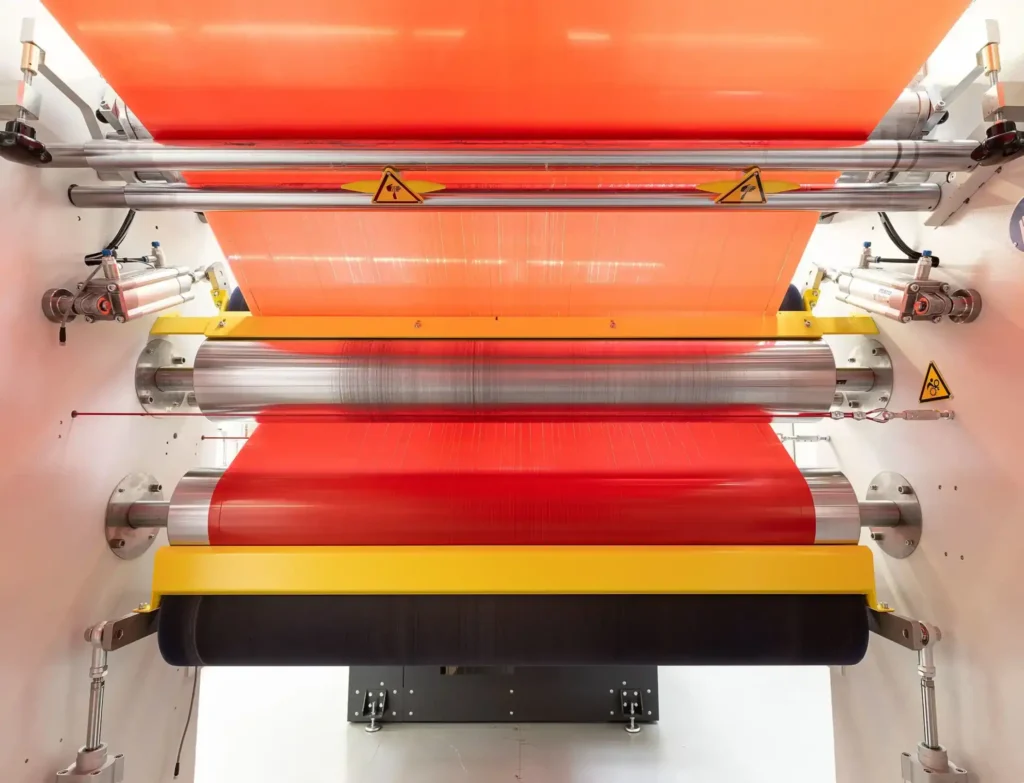
- Face engineering: extrusion coating or BOPP lamination at controlled gauge and nip pressure; anti‑fog/matte choices for clarity + COF.
- Printing (W&H flexo/gravure): reverse print for rub life; verify barcode modules after abrasion cycles.
- Cutting & forming: crease gussets, form square bottoms, heat‑cut edges, integrate easy‑open cords or tear tapes.
- Liner conversion & insertion: tubular or form‑fit; heat‑seal where hydration control and hygiene are critical.
- Closure & sealing: sewn + filler cords for sift‑proofing, or pinch‑seal/liner‑seal for maximum moisture control.
- Release: dimensional checks, GSM windows, seam pulls, drop cycles, COF bands, WVTR and pinhole scans (liner SKUs), and full lot traceability.
What Is the Application of Transparent Woven Bags? Construction‑Specific Use Cases
Where do Transparent Woven Bags pull ahead in the building trade? Wherever outdoor handling, mixed pallets, and quick visual checks dominate operations.
- Dry mortar, tile adhesive, and grout mixes: humidity control via liners; matte bands under codes; square‑standing bases for clamp handling.
- Gypsum and plaster: anti‑caking moisture barriers; visual confirmation of particle color/grade; clean pinch seals for fine dust.
- Silica sand and graded aggregates: on‑site identification of grain profile through windows; anti‑slip faces for stable pallets.
- Specialty cement and admixture blends: controlled WVTR; antistatic liner options for fine powders; high‑contrast print protected under film.
- Waterproofing powders and crystalline additives: splash‑resistant faces; liner heat seals closing needle paths; easy‑open cords for clean usage.
How VidePak Controls and Guarantees the Quality
Lightweight tolerance bands are unforgiving; “almost right” quickly becomes “not good enough.” VidePak reduces variance at its sources and confirms performance where it counts.
- Standards‑aligned SOPs and tests (ISO/ASTM/EN/JIS anchors) for mechanics, barrier, hygiene, and scannability.
- Virgin, tier‑one inputs along critical load paths; vetted films/liners; stable masterbatches with verified thermal windows.
- Best‑in‑class equipment—Starlinger for extrusion/weaving/coating and W&H for coating/printing—so grams removed do not reappear as field returns.
- Layered inspection with AQL sampling, retains, and digital lineage from resin silo to palletized lot.
System Thinking: Sub‑Problems and Construction Patterns
Construction logistics do not forgive wishful thinking. They reward constraint‑based design. Lower grams without raising damage. Add clarity without inviting slippage. Improve hygiene without slowing fillers. Solve each sub‑problem, then synthesize.
Comparative Lens: Transparent Woven vs. Alternatives on Site
Against sewn pillow‑style woven sacks, Transparent Woven Bags keep panels flatter and stacks squarer while adding visibility. Against multiwall paper, they sustain wet handling and scuff; against rigid pails, they recover cube and collapse flat for backhauls. Each win demands spec discipline and plant trials, yet total landed cost often tilts in favor of transparent woven platforms when humidity, abrasion, and inventory checks all matter.
Engineering Economics and Sustainability
Resin grams drive materials cost, but freight and damage write the true story. One extra pallet layer, fewer rewraps, fewer returns—these lower total landed cost and improve ESG metrics. A credible program publishes kWh/1,000 bags, grams saved per SKU, liner gauges vs. WVTR targets, and regional recovery pilots.
Risk & Troubleshooting (Transparent‑Specific)
Implementation Roadmap: Spec → Pilot → Scale
- Define use‑case: density, particle size, humidity target, climate, lanes.
- Set KPIs: finished mass, drop cycles, WVTR, COF, scan reliability, pallet layers.
- Engineer substrate: denier, PPI, GSM, UV package.
- Choose face: transparent coating vs. clear BOPP; matte windows for codes.
- Decide closure: sewn + filler cords vs. pinch; liner plan and gauge.
- Pilot: site run‑at‑rate; clamp/drop; humidity conditioning; scan and abrasion audits.
- Lock specs & QC: AQL sampling, retains, traceability matrix.
- Rollout: change‑control, supplier scorecards, and continuous improvement cadence.
Design Patterns for Construction Visibility
- Minimalist industrial: matte film with transparent windows; oversized hazard icons; large module barcodes.
- Agri‑yard durable: UV‑stabilized fabric, anti‑slip stripes, bold color‑coding, optional windows for aggregate visibility.
- DIY/building retail: photographic grade through BOPP windows, QR links to mix videos, EZ‑open cords.
RFQ / QA Checklist (Copy‑Ready)
- SKU, density, particle size; humidity/temperature profile.
- Hygiene target; aroma sensitivity; dust explosion risk.
- Distribution map; pallet pattern; clamp handling.
- Fabric GSM ±3%, PPI, denier; transparent face (matte/gloss/anti‑fog).
- Liner gauge & format; WVTR targets; pinhole AQL.
- Drop cycles, seam pulls, edge‑crush proxy, COF bands.
- Sampling plan (AQL), retains, digital lineage.
- Change control triggers; label/QR revision policy.
- Recovery partners and material passport plan.
Glossary (Selected)
WVTR: Water Vapor Transmission Rate — lower values indicate better moisture control. COF: Coefficient of Friction — affects stacking and conveyor behavior. BOPP: Biaxially Oriented Polypropylene — clear, printable film for lamination. PPI: Picks Per Inch — proxy for weave density. AQL: Acceptance Quality Limit — sampling framework for inspections.
October 30, 2025

- What Are Transparent Woven Bags? Definition, Aliases, Construction Focus
- The Materials of Transparent Woven Bags: Constituents, Properties, Cost Logic
- What Are the Features of Transparent Woven Bags? Construction‑Grade Performance
- What Is the Production Process of Transparent Woven Bags? Front‑End → Stations → Release
- What Is the Application of Transparent Woven Bags? Construction‑Specific Use Cases
- How VidePak Controls and Guarantees the Quality
- System Thinking: Sub‑Problems and Construction Patterns
- Comparative Lens: Transparent Woven vs. Alternatives on Site
- Engineering Economics and Sustainability
- Risk & Troubleshooting (Transparent‑Specific)
- Implementation Roadmap: Spec → Pilot → Scale
- Design Patterns for Construction Visibility
- RFQ / QA Checklist (Copy‑Ready)
- Glossary (Selected)
- 1. Why Transparent Woven Bags Dominate Construction Logistics
- 2. Engineering Excellence: VidePak’s Quality Control Framework
- 3. Balancing Functionality and Sustainability
- 4. Customization for Global Construction Needs
- 5. FAQs: Addressing Critical Buyer Concerns
- 6. Conclusion: Building a Sustainable Future
Imagine a project manager, Alex, discussing material logistics with a supplier:
Alex: “We need packaging for construction materials that’s both durable and allows quick visual inspection. Last month, a shipment of cement bags tore during transit, causing delays. What’s your solution?”
Supplier: “VidePak’s transparent woven bags are engineered for heavy-duty applications. With BOPP lamination and tensile strength up to 40 N/cm², they withstand punctures and moisture. Plus, the transparency lets workers verify contents without opening the bag—saving 30% inspection time.”
Alex: “How do these align with EU sustainability regulations?”
Supplier: “VidePak’s bags are REACH-compliant and ISO 9001-certified. Their solar-powered factories reduce carbon footprints by 25% compared to industry averages.”
This dialogue underscores the article’s thesis: transparent woven bags are revolutionizing construction logistics, combining durability, compliance, and operational efficiency.
1. Why Transparent Woven Bags Dominate Construction Logistics
The global construction packaging market is projected to grow at 6.1% CAGR from 2024 to 2030, driven by urbanization and infrastructure projects. Transparent woven bags address critical industry needs:
Key Applications:
- Cement & Aggregates: UV-stabilized PP fabric prevents degradation under direct sunlight, extending shelf life by 40%.
- Chemical Powders: PE liners (50–100 microns) provide leak-proof containment for hazardous materials like silica.
- Prefab Components: High-visibility packaging simplifies inventory management in modular construction.
Case Study: A German construction firm reduced onsite material waste by 18% after switching to VidePak’s transparent bags, which allowed real-time stock monitoring.
2. Engineering Excellence: VidePak’s Quality Control Framework
VidePak’s adherence to global standards ensures reliability across markets:
Compliance Benchmarks:
| Standard | Requirement | VidePak’s Implementation |
|---|---|---|
| ISO 9001:2015 | Quality management systems | Automated defect detection (99.8% accuracy) |
| ASTM D5260 | Seam strength testing | ≥80% fabric strength retention |
| EU REACH | Chemical safety | Phthalate-free inks and adhesives |
| JIS Z 0200 | Moisture resistance | 95% RH endurance for 72 hours |
Production Process:
- Material Sourcing: Virgin PP granules (MFI: 3–4 g/10 min) ensure consistency.
- Weaving: 100+ Starlinger circular looms produce 12×12 weave density fabrics.
- Lamination: BOPP films (20–30 microns) applied via extrusion coating.
- Printing: 8-color flexographic presses with Pantone-matched inks.
For insights into advanced lamination techniques, explore our guide on BOPP Laminated Woven Bags.
3. Balancing Functionality and Sustainability
VidePak’s ESG initiatives align with the Ellen MacArthur Foundation’s circular economy principles:
Eco-Friendly Innovations:
- Recycled Content: Post-industrial PP waste is reprocessed into non-woven geotextiles.
- Solar Energy: A 2 MW rooftop system powers 65% of production, reducing CO₂ emissions by 1,200 tons/year.
- Lightweighting: 70 GSM bags (vs. industry-standard 80 GSM) cut material use by 12% without compromising strength.
Performance Metrics:
| Parameter | VidePak | Industry Average |
|---|---|---|
| Tensile Strength | 38–42 N/cm² | 30–35 N/cm² |
| Water Vapor Transmission | ≤5 g/m²/day | ≤10 g/m²/day |
| Recyclability Rate | 97% | 75% |
4. Customization for Global Construction Needs
VidePak’s transparent bags are tailored to regional demands:
Product Configurations:
| Region | Key Requirements | VidePak’s Solution |
|---|---|---|
| Europe | REACH compliance, pallet-friendly | Block-bottom valves, QR traceability |
| Asia | Typhoon resistance, cost-efficiency | 120 GSM fabric, PE/PP blend lamination |
| North America | OSHA-compliant labeling | UV-printed safety warnings, RFID tags |
Case Study: A UAE contractor handling desert projects adopted VidePak’s UV-resistant bags, cutting replacement costs by 22% over 12 months.
5. FAQs: Addressing Critical Buyer Concerns
Q1: How do transparent bags compare to traditional opaque options in durability?
A: Transparency doesn’t compromise strength. VidePak’s bags achieve 40% higher puncture resistance via multi-axial weaving.
Q2: Can these bags withstand -20°C temperatures during Arctic projects?
A: Yes. Cold-crack resistance is tested per ASTM D1790, ensuring flexibility down to -25°C.
Q3: What’s the MOQ for custom-printed designs?
A: 10,000 units, with 3 design proofs included. Explore Custom Printing Solutions for branding options.
6. Conclusion: Building a Sustainable Future
As smart construction gains traction, VidePak invests in IoT-enabled bags with moisture sensors and blockchain-tracked supply chains. Partnering with us means investing in packaging that’s as innovative as your projects.
References
- Ellen MacArthur Foundation. (2024). Circular Economy in Packaging.
- Grand View Research. (2023). Construction Packaging Market Analysis.
- Email: info@pp-wovenbags.com
- Website: https://www.pp-wovenbags.com/
This article adheres to Google’s EEAT guidelines, combining technical rigor, third-party certifications, and transparent ESG reporting to position VidePak as a global industry leader.