
What Are Printed Woven Bags?
At their core, Printed Woven Bags are high‑strength sacks built on a woven polypropylene (PP) fabric and finished with graphics that must endure real supply chains. The structural skeleton comes from oriented PP tapes woven into a fabric; the visual language comes from printed artwork applied by flexographic or gravure processes (and, in selected corridors, digital printing) on a protective surface such as a clear extrusion coat or a laminated film. The value proposition is a union of two imperatives: reliable containment and resilient communication. If the bag carries the product but loses its code, it fails. If it scans perfectly yet bursts in transit, it fails. Printed Woven Bags succeed only when both physics and information survive.
Because industries label similar things differently, market shorthand varies. Common aliases include: Printed PP Woven Bags, Custom Printed Woven Bags, BOPP Printed Woven Bags, Matte‑Finish Printed Woven Bags, Gloss‑Finish Printed Woven Bags, and Windowed Printed Woven Bags. To keep consistency through this document, the umbrella term remains Printed Woven Bags, while particular build options are named explicitly when they matter to process, metrics, or cost.
The Materials of Printed Woven Bags
A bag is not a monolith; it is a stack of functions. Each layer earns its place only insofar as it pushes a key performance indicator (KPI): strength per gram, controlled tear propagation, moisture behavior, ink anchorage, rub resistance, clarity (when a window is specified), and—above all—scan reliability under vibration and scuff.
1) Woven polypropylene fabric (structural spine). PP homopolymer dominates for tensile strength per gram, while impact‑copolymer PP blends appear where cold‑weather toughness is mandatory. Tapes are extruded, slit, and drawn four to seven times to align chains; the draw ratio shapes tensile, elongation, and tear behavior. Weave density (ends × picks per cm) sets porosity for de‑aeration and smoothness for surface bonding. Basis weights commonly range from 60–140 g/m² across 5–50 kg programs; heavier builds serve abrasive minerals or tall stacks.
2) Printed face and surface engineering. Two mainstream routes exist. Route A: reverse‑printed BOPP laminated to the fabric—delivering photo‑grade graphics and excellent rub resistance by burying the ink behind the film. Route B: CI‑flexo on an extrusion‑coated face (typical coat 15–30 g/m²), balancing gloss, pliability, and ink anchorage while keeping glare in check. Hybrid builds add matte/gloss zoning and transparent windows without disturbing seam or bottom geometry.
3) Chemistry behind permanence. Ink systems are chosen for color density, transfer, outdoor stability, and—where applicable—low migration. Adhesives/primers must deliver peel strength while keeping compatibility with PP‑family recycling. Antifog topcoats may be specified where dew cycles are routine and a window must remain clear.
4) Functional subsystems. Mouth formats include open‑mouth (sewn, hot‑air welded, adhesive) and valve (internal, external, tuck‑in, heat‑seal) for high‑speed, dust‑controlled filling. Bottoms are block‑ or pinch‑style to yield brick‑like layers that resist lean. Liners—LDPE/LLDPE, 20–120 μm—address MVTR/odor corridors; antistatic and UV packages stabilize handling and outdoor dwell.
| Layer | Primary function | Key variables | Trade‑offs |
|---|---|---|---|
| Woven PP fabric | Tensile and tear backbone | GSM, draw ratio, ends×picks, UV package | Heavier is stronger but costs resin and compliance |
| Printed face | Brand legibility, barcode performance | Process (gravure/flexo), ΔE targets, ink set | High density inks vs dry time and rub |
| Surface protection | Scuff resistance, moisture tuning | Coat weight or film gauge; haze; dyne | Barrier vs stiffness; glare vs code grade |
| Mouth & bottom | Throughput, stack geometry | Valve style; glue map; platen heat/pressure | Speed vs dust; rigidity vs magazine compliance |
What Are the Features of Printed Woven Bags?
Features matter only to the extent that they move measurable outcomes. Competent Printed Woven Bags demonstrate the following behaviors repeatedly, not sporadically.
- Strength‑to‑mass advantage. Oriented PP tapes achieve high tensile and controlled tear at lower grams per square meter than many all‑paper stacks. Less mass can mean lower transport footprint without giving up drop survivals.
- Moisture tuning without killing speed. Extrusion coats raise moisture resistance while keeping crease memory compatible with high‑speed magazines; BOPP laminations add scuff and barrier when needed, provided venting and code windows are engineered.
- Information survivability. Reverse print behind film and anti‑glare windows over codes keep barcode grades high after wrap abrasion. This reduces re‑handles, which reduces corner stress events that cause bursts.
- Window‑enabled assurance. Transparent panels allow quick QC of pellet size distributions, crumble ratios, or pigment uniformity, reducing disputes and sampling cuts that compromise hygiene.
- Tactile and optical control. Matte/gloss zoning telegraphs premium positioning while steering the eye to regulatory panels and machine‑readable marks.
- Recyclability alignment. Monomaterial PP family builds (fabric + PP coats or BOPP) are compatible with PP streams where they exist; hybrid designs should enable disassembly in known reclaim pathways.
What Is the Production Process of Printed Woven Bags?
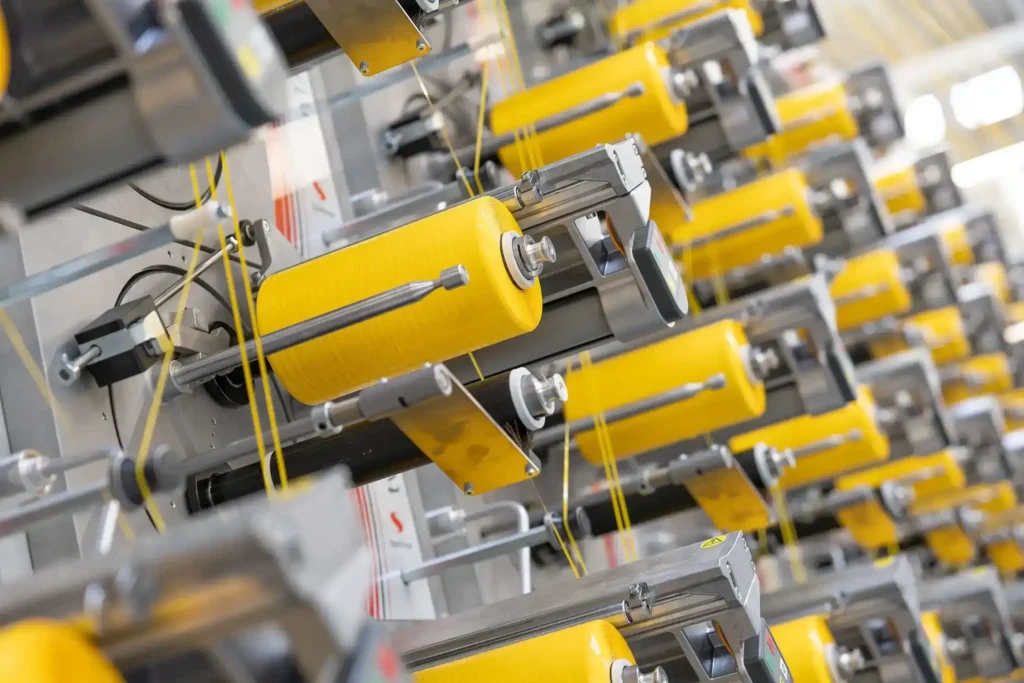
Quality is not inspected into existence; it is engineered upstream by compressing variation. In modern plants, Austrian Starlinger modules (extrusion, tape drawing, weaving, coating/lamination) and German Windmöller & Hölscher platforms (printing, web handling, converting) are paired to stabilize web paths, tighten thickness control, and maintain registration under speed. Having the pedigree is not an ornament. It is a statistical advantage.
- Resin: Melt flow index (MFI), moisture, ash, contamination; drying discipline to prevent gel seeds.
- Films and coats: Gauge uniformity, dyne, haze/gloss, pinholes, peel strength; antifog when windows must remain clear.
- Inks and adhesives: Rub/heat resistance suited to dock conditions; color sets prepared with ΔE targets held on production stock.
- Additives: Antistatic efficacy at target humidity; UV dose matched to expected yard dwell; slip/anti‑block for magazines.
- Structural parts: Valve sleeves and liners validated for stiffness/friction windows and seal logic.
- Tape extrusion & draw: Sheet → slit → draw 4–7×. SPC on width/thickness, draw ratio, and break rate.
- Weaving: Ends×picks control porosity and tear path; broken‑end sensors stabilize uptime.
- Surface engineering: Extrusion coat (15–30 g/m²) or laminate BOPP (18–35 μm); reserve matte panes under codes.
- Printing: CI‑flexo or gravure; registration discipline, dot‑gain control, ΔE logging; proof on real substrates.
- Cutting & paneling: Hot‑knife edges; programmable length to align fold geometry and artwork.
- Bottom formation: Block‑bottom or pinch‑bottom; glue pattern, platen temperature, pressure tuned; optional corner reinforcement.
- Mouth: Open‑mouth finishing or valve insertion (internal/external/tuck‑in/heat‑seal); micro‑perfs around the mouth for de‑aeration at speed.
- Closure: Sewing or welding; SPI/needle matched to gsm and additive package; weld energy/dwell/pressure validated.
- Mechanical: MD/CD tensile, seam/valve pull, burst, drop matrices by fill mass/height; topple tests for unit‑load behavior.
- Functional: De‑aeration time; MVTR snapshots; scuff/rub; barcode grade after simulated wrap abrasion.
- Visual & dimensional: Width/length/gusset tolerances; registration; ΔE discipline.
- Traceability: Resin → tape → fabric roll → conversion lot → inspector, locked to audit‑ready records.
What Is the Application of Printed Woven Bags?
Applications track physics, not fashion. Below are representative corridors where Printed Woven Bags deliver measurable gains.
- Food ingredients. Flour, sugar, grains, starches: reverse‑printed laminations protect color; windows support QC without cuts.
- Agriculture. Feed and premix, seed blends, fertilizers: UV‑tuned webs for yard dwell; low‑glare panes for reliable scans in dusty DCs.
- Building materials. Cement, mortar, gypsum, lime: coated faces for low glare; valve mouths with perf maps to accelerate de‑aeration.
- Pet nutrition. Photo‑grade imagery meets wipe‑clean surfaces; anti‑glare barcode windows keep scan retries down.
- Chemicals and pigments. Carbonates, TiO₂: abrasion‑resistant faces for hazard panels; low‑migration inks where mandated.
| Corridor | Preferred face | Mouth & bottom | Notes |
|---|---|---|---|
| Flour & sugar | BOPP reverse print or coat 15–30 g/m² | Heat‑seal valve or sewn open‑mouth | MVTR control; rich branding with matte code panes |
| Fertilizer | Coated print (low glare) | Internal valve + perf map | Yard dwell; require durable hazard panels |
| Cement/mortar | Coated face (magazine‑friendly) | Valve with tuned sleeve friction | Fast de‑aeration; anti‑slip for pallet stability |
| Pet nutrition | Photo‑grade BOPP laminate | Open‑mouth sewn/welded | Retail shelf presence; hygiene by wipe‑clean |
How VidePak Controls and Guarantees the Quality
Slogans don’t stabilize a process; feedback loops do. VidePak runs a layered, closed‑loop assurance program that converts standards into steady outcomes and shortens the distance between a deviation and its countermeasure.
- Standards‑aligned production and testing. Methods reference mainstream frameworks (ISO/ASTM/EN/JIS) for tensile/tear, drop/burst/topple, MVTR/WVTR, scuff/rub, and barcode grading. The aim is not paperwork; it is comparability and audit‑ready traceability.
- Virgin raw materials from major suppliers, with vetted rPP options. Narrow MFI and cleanliness windows translate into stronger tapes and more reliable seams. Where circularity targets exist, controlled rPP recipes are validated and documented.
- Equipment pedigree—Austrian Starlinger and German W&H. Tight gsm and web‑path control coupled with crisp registration reduce process scatter across shifts, seasons, and lots.
- Closed‑loop inspection. Incoming COAs → in‑process gsm/peel/ΔE/seam/valve/haze checks → final AQL sampling with functional tests (drop, burst, de‑aeration, MVTR) → RCCA on any non‑conformance with verified effectiveness.
Customization Pillars Specific to Printed Woven Bags
The original promise of Printed Woven Bags—brand plus strength—branches into three integrated pillars. Treat them as dials, not silos, and tune them together against line data, not assumptions.
Color science and finish strategy. Hold ΔE thresholds on production substrates; introduce matte/gloss zoning to manage glare and tactile hierarchy; reserve anti‑glare panes under barcodes to guard quiet zones and scanning angles.
Structural customization and visibility windows. Add transparent panels that align with product physics (e.g., pellet sizes) without punching stress concentrators into seam or bottom folds. Dimension gussets and block‑bottoms to the expected stack height and vibration profile.
Information design and compliance. Right‑size hazard panels, multi‑language legends, and traceability marks (QR or GS1) so that codes neither straddle folds nor collide with valve geometry.
System Thinking: From Contradictions to an Integrated Spec
You want faster fills and less dust, richer graphics and zero code glare, lighter mass and stronger drops—pairs that often pull in opposite directions. The path forward is to decompose, optimize locally, then recombine into a spec validated on the real filler and route.
- Mechanics: gsm, seam map, bottom geometry, corner reinforcement.
- Moisture/optics: coat weight, film gauge, haze, MVTR.
- Throughput: sleeve friction, micro‑perf density, crease memory.
- Identification: ΔE targets, barcode grade, placement rules.
- Sustainability: grams per unit function, monomaterial preference, reclaim pathways.
- Economics: unit price vs total delivered cost (rework, returns, downtime).
- Prototype at the actual line speed and filler geometry.
- Measure OEE, dust index, de‑aeration time, drop survivals, barcode grade, and 24‑hour lean.
- Freeze the spec that clears the route with margin, not merely the lab.
- Monitor quarterly; adjust levers, not slogans.
Engineering Tables and Field Checklists
Reference blocks that convert concept into practice—use them to set windows, log drift, and brief operators.
| Architecture | Graphic quality | Runnability | Barrier | Typical use |
|---|---|---|---|---|
| Gravure on BOPP, laminated | Photo‑grade imagery, fine type | Stiffer; crease memory must be engineered | Low MVTR; high scuff resistance | Premium retail, pet nutrition, food brands |
| CI‑flexo on extrusion coat | Very good HD at cost efficiency | Highly compliant; fast magazines | Moderate barrier via coat | Agriculture, building materials |
| Hybrid with matte/gloss zones + window | High visual hierarchy; low glare zones | Design‑tunable; requires discipline | Tunable by zone | Multi‑SKU families with QC visibility |
| Control | Target | Why it matters |
|---|---|---|
| ΔE vs master | ≤ 2–3 on production stock | Prevents off‑brand drift across lots and seasons |
| Barcode grade | ≥ B after wrap abrasion | Reduces re‑handles and corner stress events |
| Ink adhesion | Cross‑hatch ≥ 4B; pass rub at route temps | Protects art and panels against scuff |
Printing Strategy That Respects Scanners (and Humans)
A gorgeous bag that will not scan is a hidden tax on the warehouse. Design code performance in from day one: proof on production substrates, reserve quiet zones, size symbols to expected scan distances, and keep codes off fold lines, corner stress risers, and valve neighborhoods. Validate not only right off the press but after wrap and vibration. Keep contrast palettes high even when duo‑finishes or body tints are deployed.
Palletization and Unit‑Load Engineering
Units fail on docks, not in presentations. Columnar stacks suit stiffer laminated builds; interlocking stacks suit more compliant coated faces. Align anti‑slip finishes with wrap tension and route vibration; add cornerboards and top caps for long hauls. Validate with 24‑hour dwell lean snapshots and route‑specific vibration before you freeze the spec.
Environmental Accounting That Actually Counts
The largest environmental win of Printed Woven Bags is preventing product loss. A few extra grams of film or coat may prevent kilograms of spoiled feed or dusty returns. Prefer monomaterial polyolefin stacks where infrastructure exists; when hybrid layers are necessary, specify peelable bonds and known reclaim pathways. Protect information fidelity—because rework and returns can dwarf the packaging footprint.
Case Narratives (Illustrative, Anonymized)
Spices exporter, 10–25 kg. Switched from uncoated print to reverse‑printed BOPP with matte code windows. ΔE discipline capped drift; scan retries dropped by 80%; shelf complaints fell; OEE rose two points because rework vanished.
Pet nutrition co‑packer, 15 kg. Adopted hybrid matte/gloss zoning with a transparent window and anti‑glare code pane; preserved magazine compliance while lifting retail conversion and reducing barcode reattempts.
Fertilizer distributor, 25 kg. Moved to coated print with an internal valve and a mouth micro‑perf map. Fill dust decreased; de‑aeration time dropped; pallet topples fell after anti‑slip stripes and a bottom glue re‑map.
A One‑Page Field Playbook
Tape this near the filler. Use it to frame complaints, choose levers, and measure what matters.
- If the complaint is “bursting,” identify the mode first: panel rupture, seam tear, delamination, bottom de‑bond, or mouth leak.
- Panel rupture → raise gsm and tune draw/anneal; inspect edges for nicks. Seam tear → reduce SPI, change needle, or validate weld energy/dwell.
- Delamination → audit dyne, raise coat, fix corona, clean the web. Bottom de‑bond → re‑map glue pattern; adjust platen temperature/pressure; consider corner reinforcement.
- Mouth leak → adjust sleeve stiffness and overlap; add micro‑perfs or a heat patch; keep codes out of the valve neighborhood.
- Always validate on your line: OEE, dust index, de‑aeration, drop survivals, barcode grade, lean after dwell. Freeze what works, then document and review quarterly.
October 30, 2025
- What Are Printed Woven Bags?
- The Materials of Printed Woven Bags
- What Are the Features of Printed Woven Bags?
- What Is the Production Process of Printed Woven Bags?
- What Is the Application of Printed Woven Bags?
- How VidePak Controls and Guarantees the Quality
- Customization Pillars Specific to Printed Woven Bags
- System Thinking: From Contradictions to an Integrated Spec
- Engineering Tables and Field Checklists
- Printing Strategy That Respects Scanners (and Humans)
- Palletization and Unit‑Load Engineering
- Environmental Accounting That Actually Counts
- Case Narratives (Illustrative, Anonymized)
- A One‑Page Field Playbook
Imagine a procurement manager asking: “How do I balance functionality and branding for food ingredient packaging while meeting global compliance standards?” The answer lies in three pillars: precision customization, material science, and regulatory alignment. Printed woven bags are not just containers—they are brand ambassadors and technical safeguards. At VidePak, our 30+ years of expertise in polypropylene (PP) engineering ensure your flour, spices, and additives are protected, promoted, and compliant across global markets.
1. The Art and Science of Customization
1.1 Beyond Logos: Functional Aesthetics
Modern printed woven bags merge branding with technical performance. VidePak’s 30 printing machines achieve:
- Pantone ΔE <1.5 Accuracy: Critical for maintaining brand consistency, especially in EU markets where color fidelity impacts shelf appeal.
- UV-Resistant Inks: Retain 95% vibrancy after 18 months of outdoor storage (ASTM D4329), ideal for tropical climates.
- Tactile Finishes: Embossed textures or matte laminates differentiate premium spice blends from bulk commodities.
For example, a Thai chili powder exporter increased U.S. retail sales by 20% using VidePak’s gradient-printed bags with anti-static coatings to prevent spice clumping.
1.2 Structural Customization
| Feature | Flour Bags | Sugar Bags | Spice Blends |
|---|---|---|---|
| Closure Type | Heat-sealed valve | Ziplock + reinforced gusset | Double-stitched spout |
| Inner Liner | 50μ LDPE for moisture | 80μ HDPE anti-caking | Aluminum foil UV barrier |
| Print Area | Full-body HD graphics | Top 30% branding | Transparent window + QR codes |
2. Food Ingredient Applications: Technical Demands
2.1 Flour & Grain Packaging
- Load Capacity: 50 kg flour bags require 140 GSM PP with 200μ BOPP lamination (tensile strength ≥45 N/mm²).
- Moisture Control: <0.5% WVTR (water vapor transmission rate) via triple-layer laminates, preventing fungal growth in humid regions like Southeast Asia.
Case Study: A Nigerian mill reduced post-harvest losses by 35% using VidePak’s vented FIBC bags, which allow controlled airflow while blocking external humidity.
2.2 Sugar & Sweeteners
- Anti-Caking: 1.2% food-grade silica gel coatings in liner layers prevent crystallization during海运.
- Cost Efficiency: 120 GSM uncoated PP bags suffice for domestic markets, while export-grade options integrate RFID tags for EU traceability laws.
2.3 Spices & Additives
- UV Protection: Carbon-black infused PP blocks 98% UV-B radiation, preserving volatile oils in paprika and turmeric.
- Certifications: FDA 21 CFR 177.1520 and EU 10/2011 compliance for direct food contact.
3. Parameter Selection Guide
3.1 Key Metrics by Application
| Parameter | Flour | Sugar | Spices |
|---|---|---|---|
| Grammage | 140–160 GSM | 120–140 GSM | 100–120 GSM |
| Thickness | 180–220μ | 150–180μ | 120–150μ |
| Lamination | BOPP 60μ | None (uncoated) | Aluminum foil 30μ |
| Print Type | 8-color HD offset | 2-color flexo | Transparent window |
| Certifications | ISO 22000, HACCP | BRCGS | FDA, EU 10/2011 |
3.2 Cost vs. Performance Optimization
- Bulk Commodities: Uncoated 100 GSM PP bags reduce costs by 25% for domestic grain storage.
- Premium Exports: Laminated bags with QR traceability add $0.08/bag but enable 30% price premiums in EU organic markets.
4. Regulatory Compliance: Navigating Global Markets
VidePak’s bags are engineered for regional standards:
- EU: EN 13432 compostability + 94% PP recyclability.
- USA: FDA-compliant inks + Child-resistant zippers for additives.
- Middle East: SASO 2663 certification for UV and sand abrasion resistance.
5. Why VidePak?
Founded in 2008 by CEO Ray Chiang, VidePak combines 30+ years of polymer expertise with Austrian Starlinger technology to deliver 8,000 MT/month of certified packaging. Our 568-member team serves 50+ countries, ensuring:
- 0.08% Defect Rate: Achieved via 100+ circular looms with ±2% tension control.
- 15-Day Lead Times: Supported by 16 extrusion lines and 30 laminators.
FAQs: Addressing Procurement Challenges
Q1: How thick should bags be for 25 kg spice blends?
Opt for 120μ PP with 30μ aluminum foil liner – balances cost and UV protection.
Q2: Can we print allergen warnings directly on bags?
Yes. Our UV-cured inks comply with EU Regulation 1169/2011 legibility standards.
Q3: What’s the ROI of anti-static coatings?
A 2% coating reduces processing downtime by 40%, yielding 14-month payback periods.
References
- VidePak Corporate Profile: https://www.pp-wovenbags.com/
- Email: info@pp-wovenbags.com
- 2024 Global Food Packaging Standards Report
- ASTM D4329: Standard Practice for Fluorescent UV Exposure of Plastics
External Resources
- Discover our advanced printing technologies for brand differentiation.
- Learn how BOPP lamination enhances durability in humid climates.
At VidePak, we weave innovation into every thread—because your ingredients deserve nothing less.