
What Are Form‑Fill‑Seal Woven Bags?
Form‑Fill‑Seal Woven Bags (also referred to as FFS Woven Bags) are heavy‑duty, automation‑ready packaging units engineered to be formed from a continuous web, filled with bulk product, and sealed in a single, deterministic sequence on an FFS machine. Instead of presenting pre‑made sacks at a packing station, processors unwind an FFS‑ready laminate—typically a laminated woven polypropylene web with a sealable inner skin—through a former that shapes the web into a tube, creates a bottom seam, doses the product, de‑aerates the pack, and closes the top seam. The benefit is not merely mechanical convenience; it is process control: line speed that is programmable, seals that are reproducible, and geometry that is consistent from the first bag to the last.
In practical terms, Form‑Fill‑Seal Woven Bags combine three layers of value: a structural carcass that resists puncture and drop shock, a printable façade that carries brands and compliance marks at export‑grade fidelity, and a polyolefin sealing interface that closes reliably even when fine powders are in play. When the specification is properly tuned, the result is a logistics‑hardened sack optimized for forklifts, robotic palletizers, ocean containers, and multiple climate zones.
- FFS Woven Bags
- Form‑Fill‑Seal Woven Sacks
- FFS PP Woven Bags
- Tubular FFS Woven Bags
- BOPP‑Laminated FFS Woven Bags
- FFS Roll Bags / FFS Woven Rollstock
- Printed FFS Woven Sacks
- Industrial FFS Packaging Bags
- High‑Speed FFS Woven Packaging
These labels cluster around the same core architecture: a web‑fed woven polypropylene laminate that can be formed, filled, and sealed in one continuous pass on automated equipment.
If throughput, operator safety, and repeatable sealing are critical KPIs on your packing floor, start your baseline with Form‑Fill‑Seal Woven Bags. Everything else—graphic finishes, valve geometries, micro‑perforation patterns—is optimization around that baseline.
Material Architecture: From Tapes to Laminate and the Economics In‑Between
Material choices dictate 80% of the performance envelope. They shape how the web behaves on the former, how seals tolerate dust, how pallets stack in humidity, and how brands travel across borders. Below is a system‑level walk‑through of each layer, why it is present, what it costs, and how it trades off against alternatives.
- Extruded PP tapes, oriented for tenacity, woven into flat or tubular fabrics at ~70–130 g/m² for 10–50 kg fills.
- Advantages: high strength‑to‑weight, moisture resistance, good tear‑propagation behavior, competitive resin economics.
- Design notes: pick density, tape width, and GSM are tuned to drop‑test outcomes and pallet compression. Tubular fabrics reduce longitudinal seam complexity on some FFS models.
- Typical gauges 15–25 µm; supports saturated color, fine halftones, matte–gloss contrast, microtext, and QR serialization.
- Trade‑off: adds modest cost, but dramatically improves retail‑visible sacks and export documentation fidelity.
- Operational effect: scuff‑resistant varnishes stabilize ΔE across long routes and mixed depots.
- Polyolefin families—LDPE, LLDPE, MDPE, HDPE, or cast‑PP—selected for seal‑initiation temperature (SIT), hot‑tack, and dwell compatibility with the target FFS sealer.
- Typical gauges 40–100 µm; antistatic and slip packages reduce dust cling and tune COF for case handling.
- Valve lands benefit from draw‑down resins with predictable hot‑tack to avoid blow‑back and rework.
- Extrusion lamination with polyolefin tie resins or solventless PU adhesives is standard, targeting high peel without curl.
- Critical variables: coat weight, nip pressure, web temperature, and cure; poor control shows up later as tunneling or delamination during forming.
- End‑of‑life: select chemistries that do not contaminate polyolefin recycling streams when mono‑poly recovery is planned.
Finish layers complete the stack: gloss/matte OPVs to balance scuff and glare; anti‑slip textures to stabilize stacked layers; UV stabilizers for depots with long outdoor dwell; and low‑migration inks for food/feed contact programs. Properly balanced, this stack not only passes the lab but also survives fork tines, pallet corners, and container condensate without losing function or visual confidence.
Functional Features: What Performance You Actually Buy
Buyers rarely purchase “layers”; they purchase outcomes. For Form‑Fill‑Seal Woven Bags, those outcomes align around automation behavior, mechanical robustness, closure reliability, and brand transfer across global routes.
Cut squareness, web flatness, and tuned COF reduce misfeeds and jams. On stable webs, OEE climbs. On wandering webs, small variances multiply into stoppages.
The woven carcass resists puncture from crystalline powders and mitigates drop shock. Gussets hold cubic efficiency during palletization and container racking.
Seal windows are engineered around the actual sealer’s temperature–pressure–dwell profile. Antistatic liners reduce dust carry‑over that would otherwise compromise hot‑tack.
BOPP faces support saturated color, matte/gloss play, and abrasion‑resistant OPVs that keep ΔE within guard bands from plant to port.
UV‑stabilized fabrics endure depot storage; tuned COF and anti‑slip textures prevent layer slides at high humidity and tilt.
- Customization options: easy‑open tapes, tamper‑evident pinch‑tops, micro‑perforation for controlled de‑aeration, serializable QR panels, and mouth stiffness tuned to filler ergonomics.
- System integrability: inline coders, vision checks for mark presence, robotic palletizers with pattern libraries that assume known COF windows.
Production Flow: From Raw Resin to Pallet‑Ready Packs
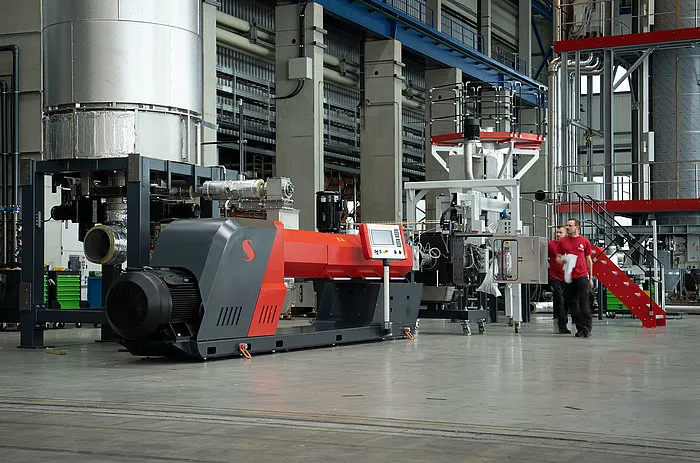
Industrial performance is manufactured. The route spans incoming qualification, disciplined converting, and a release protocol that makes each pallet traceable back to resin lots. VidePak builds Form‑Fill‑Seal Woven Bags on European platforms—Starlinger (Austria) for extrusion, weaving, and coating/lamination; Windmöller & Hölscher (Germany) for high‑register printing and converting—so tolerances remain narrow where they influence outcomes.
Upstream: incoming qualification
- Resins: virgin PP for tape drawing; PE/CPP sealants with documented SIT and hot‑tack windows; incoming COAs for MFI, density, ash, gels.
- Films: BOPP/PET with defined surface energy; OPVs and inks screened for low odor and migration where required.
- Additives: UV packages, slip/antistatic concentrates tailored to climate and product dustiness.
- Qualification: mini‑runs to set coat weights and nip pressure; curl checks; seal‑window scouting on the customer’s target sealer.
Core converting
- Extrusion & tape drawing (Starlinger)—tapes oriented 5–7×, with laser gauges and closed‑loop feedback to prevent thin‑spot initiation.
- Weaving—flat or tubular fabrics woven at 10–14 ends/cm under controlled tension for web flatness and square cutting.
- Lamination—BOPP or protective films bonded via extrusion lamination or solventless PU; targets: high peel, low curl, no tunneling.
- Printing (W&H presses)—flexo/gravure with viscosity and temperature control; spectrophotometry guards ΔE across lots.
- Slitting, winding, and prefolding—roll hardness profiles and edge quality tuned for smooth payoff and low forming resistance.
- Liner integration—tubular PE liners for dusty or regulated products; antistatic and food‑contact grades as specified.
Downstream: QC and release
- In‑process: GSM, pick density, tape tenacity, lamination peel, COF after varnish, print registration and ΔE.
- Finished goods: tensile/tear, seam pull and creep, drop/compression with filled samples, tilt/slide for pallet stability, and—if specified—WVTR/OTR spot checks on barrier liners.
- Release discipline: AQL per ANSI/ASQ Z1.4, certificates of conformance, retain libraries, and digital genealogy linking pallet IDs to raw‑material lots.
Tight orientation, flat webs, clean registration, and stable COF are platform outputs. On Starlinger and W&H lines, invisible variance is reduced at source—variance that would otherwise reappear as seam leaks, jam codes, and color drift on packed product.
Use‑Case Mapping: Where the FFS Premium Pays Back
The ROI for Form‑Fill‑Seal Woven Bags peaks at the intersection of throughput, hygiene, and logistics risk. Below are patterns by sector, with practical configuration notes.
Chemical and mineral powders
Titanium dioxide, calcium carbonate, silica, kaolin, cement admixtures: these products are abrasive, dusty, and often hygroscopic. Target web flatness for smooth forming, anti‑slip exteriors for pallet stability, and valve lands that tolerate dust without seal loss. For very dusty lines, antistatic liners and micro‑perfs improve pack density.
Fertilizers and agro inputs
Hygroscopic blends benefit from wider seal lands and UV‑stable exteriors. FFS automation reduces open‑time exposure on the filling floor, lowering caking risk before the first pallet is wrapped.
Polymer resins and masterbatch
Pelletized products demand puncture resistance and consistent geometry that feeds robotic palletizers cleanly. Tuned COF and hard roll profiles lower misfeeds and layer slides.
Food and feed ingredients
Salt, sugar, starches, and premixes move best when scuff‑resistant faces protect print and wide seals maintain closure despite dust. When barrier becomes critical, coex liners or foil‑laminated variants are specified.
Construction materials
Tile adhesives and grouts experience monsoon storage and rough handling. Anti‑slip and gusset stability reduce tilt events and preserve cubic efficiency under compression.
Quality Governance: How VidePak Controls and Guarantees Outcomes
Process control under ISO 9001 and environmental alignment with ISO 14001. For food/feed contact, alignment with EU 1935/2004, EU 10/2011, FDA 21 CFR, and GMP (EC) 2023/2006. Methods include ASTM D1894 (COF), ASTM D5276/D642 (drop/compression), ISO 12647 (color), and—when specified—ASTM F1249/ISO 15106‑2 (WVTR) and ASTM D3985 (OTR) for barrier liners.
Virgin PP, qualified BOPP and PE films, low‑migration ink/OPV systems, and approved adhesive chemistries. Each lot arrives with a COA and is verified before release to production.
Starlinger for extrusion/weaving/coating and W&H for printing/converting minimize drift at orientation, flatness, register, and COF—the exact variables that cause seam breaks and jam codes when they wander.
Incoming COA checks; in‑process GSM/pick/peel/COF/ΔE; finished‑goods tensile, seam creep, and pallet tilt/slide; AQL sampling; retains for stability; SPC with Cp/Cpk tracking; and 8D/FMEA where needed.
Automation Anatomy: Inside an FFS Woven‑Bag Line
Understanding the machine clarifies the bag. An FFS woven‑bag line follows a predictable sequence, and each module imposes constraints the specification must respect.
- Unwind and web guidance: edge guides and roll‑hardness profiles keep payoff smooth and centered.
- Forming: the web is shaped into a tube; tubular woven variants reduce forming resistance, while prefolded gussets reduce entry friction on flat webs.
- Bottom/fin seal: longitudinal and transverse closures are made under controlled energy input; seal land design must tolerate dust.
- Dosing and de‑aeration: weighers/augers feed product; vacuum shoes and micro‑perfs evacuate air to improve pack density and pallet stability.
- Top seal and cut: closure integrity is locked; geometry is trimmed to the downstream presentation device.
- Coding and vision checks: batch, QR, and regulatory icons are applied and verified for presence/contrast.
- Discharge and palletizing: bags are squared and layered under COF assumptions known to the palletizer’s pattern library.
When your specification interacts with tubular films and block‑bottom designs, it helps to benchmark against film‑centric FFS guidance. Explore this related perspective: optimizing barrel diameter and block‑bottom geometry for FFS. Thinking across both woven and film systems clarifies trade‑offs in former geometry and venting strategy.
Global Dynamics: Adoption, Regulation, and Capacity Behavior
The spread of Form‑Fill‑Seal Woven Bags tracks with macro forces: rising labor costs, stricter dust and hygiene regulation, export‑oriented brands that demand uniformity, and digitalized plants hungry for OEE clarity. Regions with port‑heavy chemical throughput—Southeast Asia, the Middle East, and parts of Europe—have adopted FFS woven platforms quickly, while brownfield sites in mature markets tend to upgrade line‑by‑line as legacy kit retires.
Regulatory vectors push in the same direction. Closed dosing, verifiable lot coding, and lower dust exposure align with modern safety regimes. At the same time, sustainability narratives favor mono‑polyolefin configurations that can claim improved recyclability relative to mixed‑material sacks, especially when bale specs and recovery routes are published.
Decision System: From Hazards to Bill of Materials
A structured pathway prevents over‑engineering and under‑protection. Use the following axes as decision gates to translate product and route realities into a concrete bill of materials for Form‑Fill‑Seal Woven Bags.
Moisture sensitivity, dustiness, oil/fat content, abrasiveness, light sensitivity—each hazard suggests materials and finishes. Example: antistatic liners and wider seal lands for dusty powders; abrasion‑resistant OPVs and higher GSM for pigment concentrates.
Monsoon depots demand wider seals, UV packages, and anti‑slip textures; desert routes emphasize scuff control and pallet wrap strategy. Pallet tilt/slide targets feed back into COF tuning.
Confirm former geometry, temperature–pressure–dwell profiles, and known jam codes. Design the bag to the machine, not the machine to the bag. Pilot 200–500 units at speed before freezing the BOM.
Food/feed contact? ADR/IMDG movement? Country‑specific labeling? Lock ink sets and adhesive families to avoid ingredient drift across markets.
Favor mono‑polyolefin stacks where feasible and publish bale specs for downstream partners. When mixed architectures are unavoidable, document separation guidance.
Technical Tables
Troubleshooting: Symptoms, Causes, Remedies
Increase seal land width; verify liner seals; consider pallet covers; audit depot RH profiles. Antistatic liners and micro‑perfs can improve de‑aeration and reduce micro‑leaks.
COF drift from varnish aging or humidity; re‑tune slip, add anti‑slip texture, and validate tilt angle with filled samples and actual pallet sheets.
Enforce ΔE guardbands, lock ink sets, and record press curves. Check corona and web temperature stability.
Low temperature, dust contamination, or jaw wear; perform seal‑window studies; improve de‑aeration near the seal land; service jaw faces.
RFQ Checklist for Buyers of FFS Woven Bags
- Product profile: powder/pellet, bulk density, abrasiveness, oil/fat content, moisture sensitivity.
- Fill weight: typical and maximum (e.g., 25 kg standard, 40 kg occasional).
- FFS line: model, former geometry, temperature–pressure–dwell, COF window, known jam codes.
- Route: climate zones, dwell times, tilt constraints, depot practices (UV/rain exposure).
- Branding: color set, matte/gloss targets, data carriers (QR, batch, regulatory icons).
- Compliance: food/feed contact, regional labeling, heavy‑metals limits.
- End‑of‑life: recycling streams available; mono‑poly preference.
- Pilot & acceptance: number of pilot bags on the real line; OEE and jam‑rate targets for release.
Keyword Deployment and Semantic Variants
To match buyer intent and search behavior, place the core term and its neighbors naturally in specifications, data tables, and application notes.
- Primary: Form‑Fill‑Seal Woven Bags.
- Variants: FFS Woven Bags, Form‑Fill‑Seal Woven Sacks, FFS PP Woven Bags, Tubular FFS Woven Bags, BOPP‑Laminated FFS Woven Bags, FFS Roll Bags, Printed FFS Woven Sacks.
- Long‑tails: high‑speed FFS woven packaging for fertilizers, FFS woven bags for chemical powders, BOPP‑printed FFS sacks for export, antistatic FFS woven bags for dusty products, tubular FFS woven sacks for pallet stability.
- What Are Form‑Fill‑Seal Woven Bags?
- Material Architecture: From Tapes to Laminate and the Economics In‑Between
- Functional Features: What Performance You Actually Buy
- Production Flow: From Raw Resin to Pallet‑Ready Packs
- Use‑Case Mapping: Where the FFS Premium Pays Back
- Quality Governance: How VidePak Controls and Guarantees Outcomes
- Automation Anatomy: Inside an FFS Woven‑Bag Line
- Global Dynamics: Adoption, Regulation, and Capacity Behavior
- Decision System: From Hazards to Bill of Materials
- Technical Tables
- Troubleshooting: Symptoms, Causes, Remedies
- RFQ Checklist for Buyers of FFS Woven Bags
- Keyword Deployment and Semantic Variants
A Client’s Perspective:
Client: “We need packaging that’s fast, durable, and globally compliant. How can your FFS woven bags meet these demands?”
VidePak Sales Representative: “Our Form-Fill-Seal (FFS) woven bags integrate cutting-edge automation, advanced fine-yarn technology, and 30+ years of industry expertise to deliver unmatched efficiency, strength, and customization. With a global network and ISO-certified processes, we ensure your products are protected and market-ready.”
1. The Rise of Automation in FFS Woven Bag Production
The packaging industry has undergone a seismic shift with the adoption of automated Form-Fill-Seal (FFS) systems. These systems streamline production by combining bag forming, filling, and sealing into a single continuous process. VidePak, leveraging Austrian Starlinger machinery and 100+ circular looms, produces over 50 million bags annually, reducing labor costs by 40% and minimizing human error.
For instance, automated lamination machines apply BOPP films with precision, enhancing moisture resistance while maintaining breathability—a critical feature for fertilizers and pet food.
Fine-Yarn Technology: Reinventing Woven Bag Performance
A cornerstone of VidePak’s innovation is fine-yarn weaving, a process that transforms polypropylene (PP) granules into ultra-thin, high-density filaments.
How It Works:
- Extrusion: PP granules are melted and extruded into fine filaments (40–120 microns).
- Weaving: Advanced looms interlace filaments at 12–16 threads per inch, creating a tightly woven fabric.
- Lamination: BOPP films or PE liners are heat-bonded for added barrier properties.
Advantages:
- Tensile Strength: Fine-yarn bags withstand loads up to 50 kg without elongation, outperforming standard woven bags by 25%.
- Aesthetic Appeal: Smoother surfaces enable high-definition printing, ideal for branding.
- Leak Prevention: Denser weaves reduce gaps, preventing fine powders like cement or flour from escaping.
2. Global Market Dynamics: Opportunities and Challenges
The FFS woven bag market is projected to grow at a CAGR of 5.8% through 2030, driven by rising demand in agriculture, construction, and chemicals. Key trends include:
| Market Trend | VidePak’s Response |
|---|---|
| Sustainability mandates | Recyclable PP materials, ISO 14001 compliance |
| Customization demands | 12-color rotary printing, 3D bag designs |
| Supply chain volatility | Factories in 6 countries, 30-day lead times |
For example, African agro-businesses now prioritize UV-resistant bags for prolonged outdoor storage—a need met by VidePak’s laminated BOPP solutions.
3. Why VidePak? Engineering Excellence Since 2008
Founded by CEO Ray Chiang, VidePak combines legacy expertise with modern agility:
- Infrastructure: 100+ circular looms, 30 lamination machines, and 16 extrusion lines.
- Certifications: ISO 9001, FDA-compliance for food-grade bags.
- Global Reach: 80+ countries served, $80M annual revenue.
Featured Product: BOPP Laminated Valve Bags
- Material: Virgin PP + 18-micron BOPP film.
- Capacity: 25–50 kg.
- Customization: Anti-static, UV-resistant, multi-language printing.
FAQs: Addressing Buyer Concerns
Q1: Can you handle small orders?
A: Yes! We accommodate orders from 5,000 to 5 million bags.
Q2: How do you ensure quality?
A: Every batch undergoes tensile, seam, and drop tests.
Q3: What’s the lead time?
A: 20–30 days, depending on design complexity.
References
- VidePak Company Profile. PP Woven Bags Manufacturer. Available at: www.pp-wovenbags.com.
- GlobalTextiles. (2024). PP/PE Woven Bags Market Analysis.
- Lansu Packaging. (2025). Fine-Yarn Weaving Techniques.
For inquiries, contact: info@pp-wovenbags.com.
Anchor Links:
- Learn how VidePak’s FFS tubular bags optimize filling efficiency.
- Explore customization options for valve bags in industrial applications.
This article synthesizes technical insights, market data, and VidePak’s operational strengths to position the company as a leader in automated, high-performance packaging solutions.